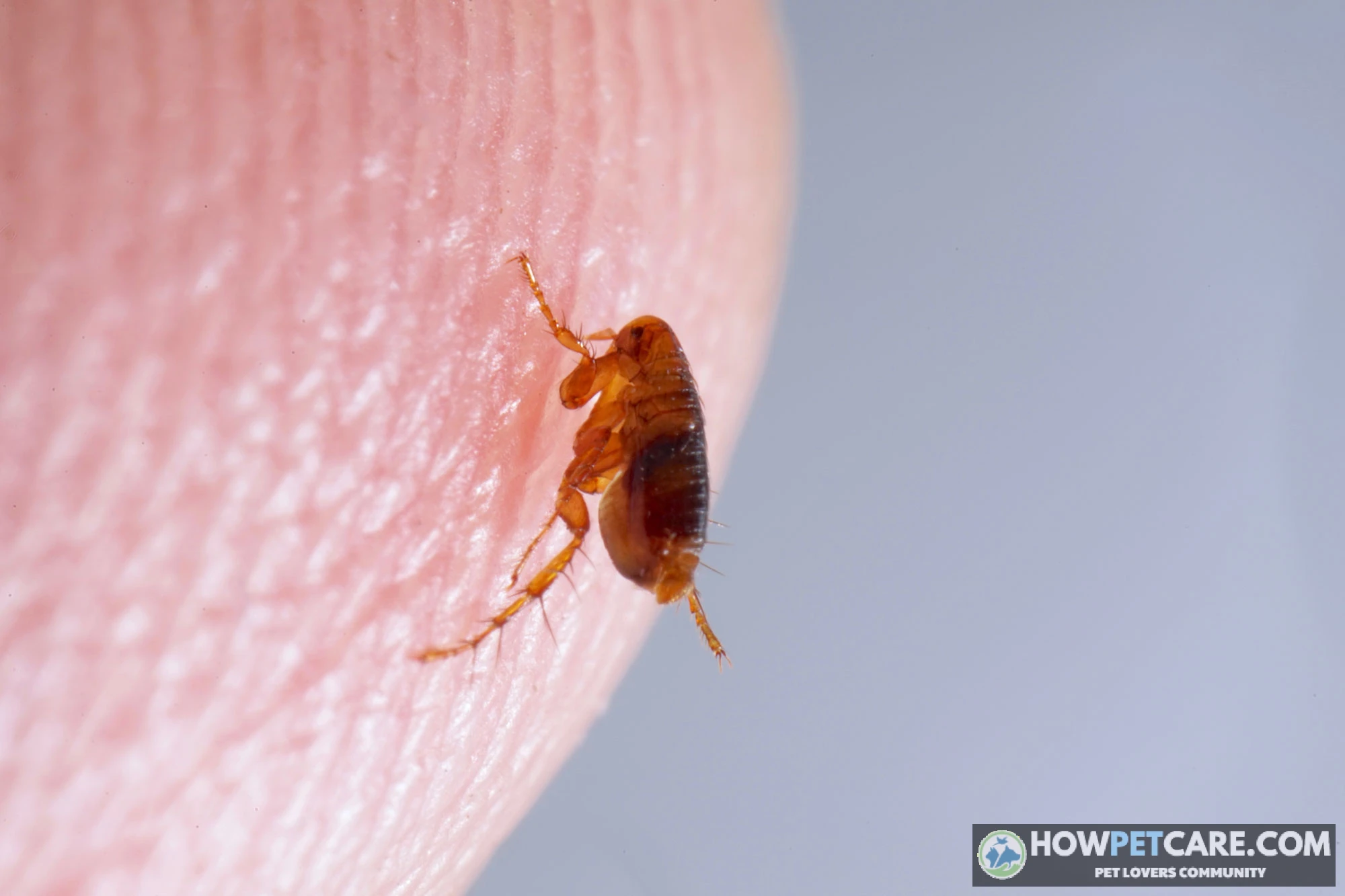

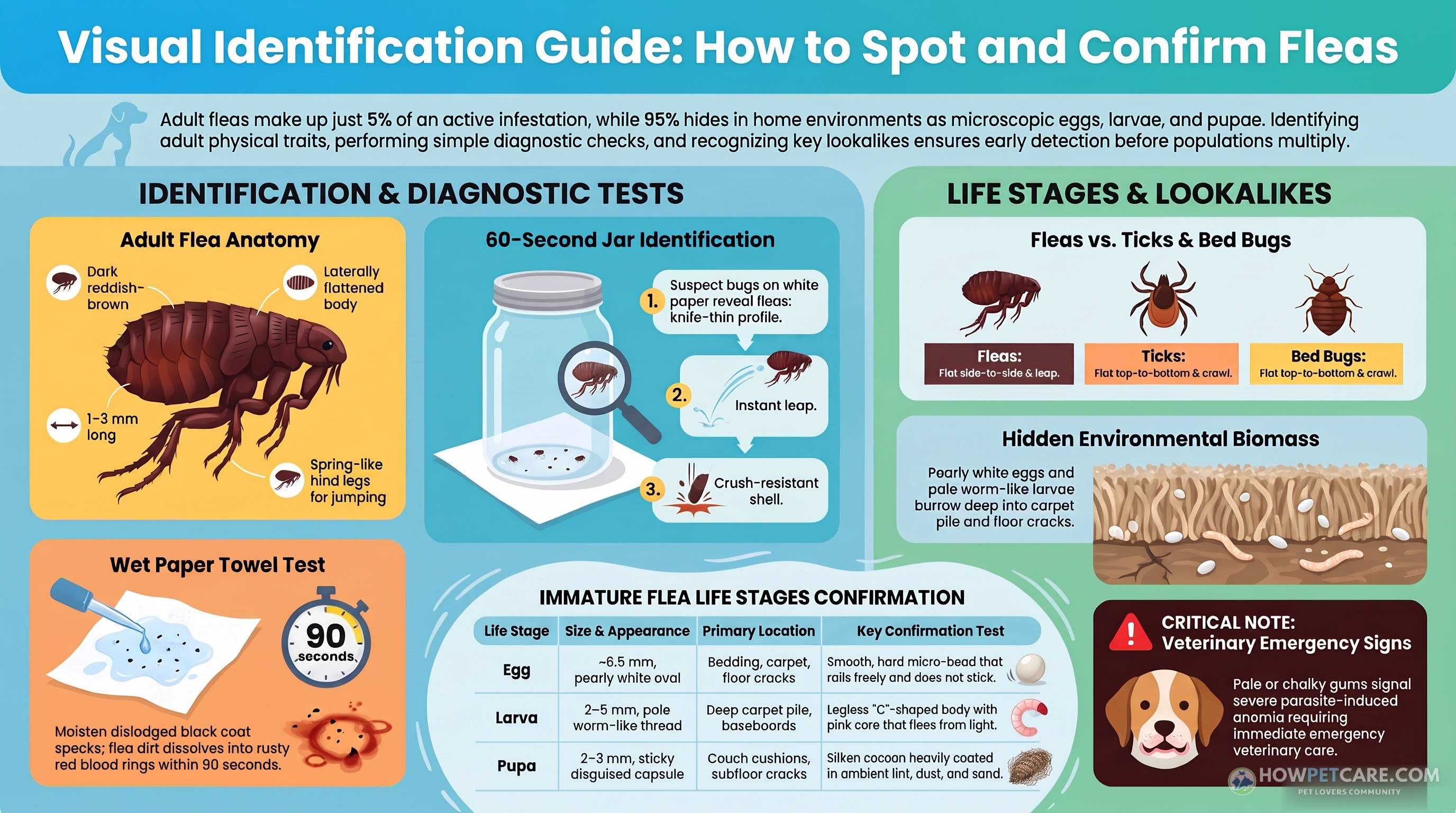
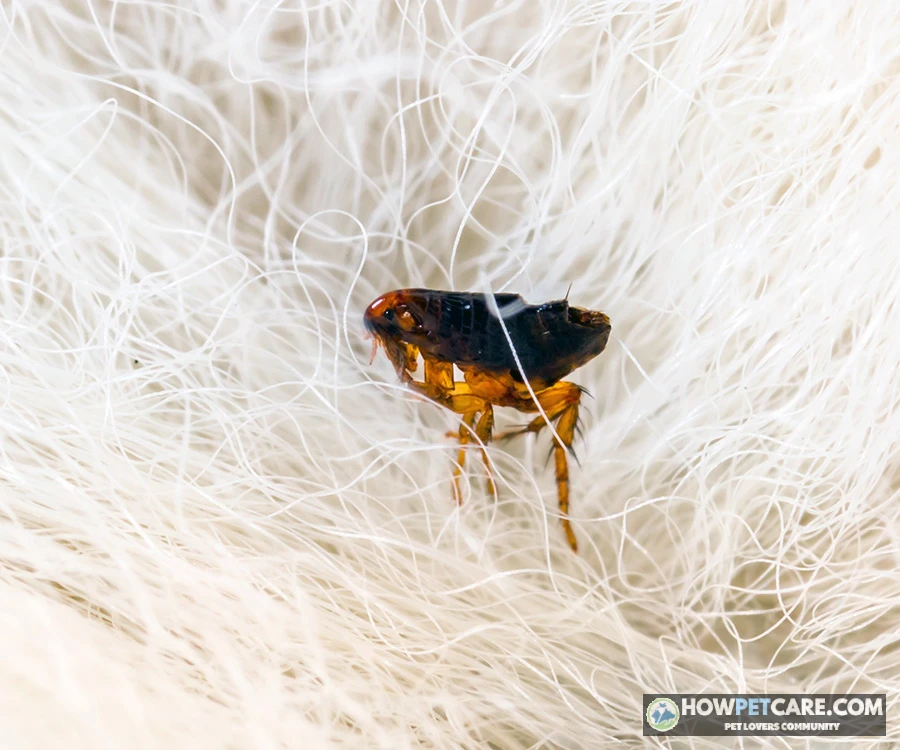
Adult fleas are tiny, wingless insects about 1–3 mm long — roughly sesame-seed sized — with dark reddish-brown bodies flattened side to side. They have six legs, oversized hind legs built for jumping, and a hard, glossy shell. They cannot fly; they jump several inches or scurry quickly through fur.
Adult fleas are tiny, wingless, dark reddish-brown insects roughly 1 to 3 millimeters long—about the size of a sesame seed—with narrow bodies flattened side to side that jump rather than crawl or fly.
Spotted a dark speck scurrying across your pet’s belly or jumping off the sofa? You need visual confirmation right away. Catching an infestation early spares your pet intense discomfort and keeps thousands of eggs from embedding in your carpets. To the naked eye, a flea looks like an impossibly fast, dark crumb. Up close, its specialized anatomy helps explain why it ranks among the most resilient parasites on earth.
What Fleas Look Like: Size, Color, Shape and Movement
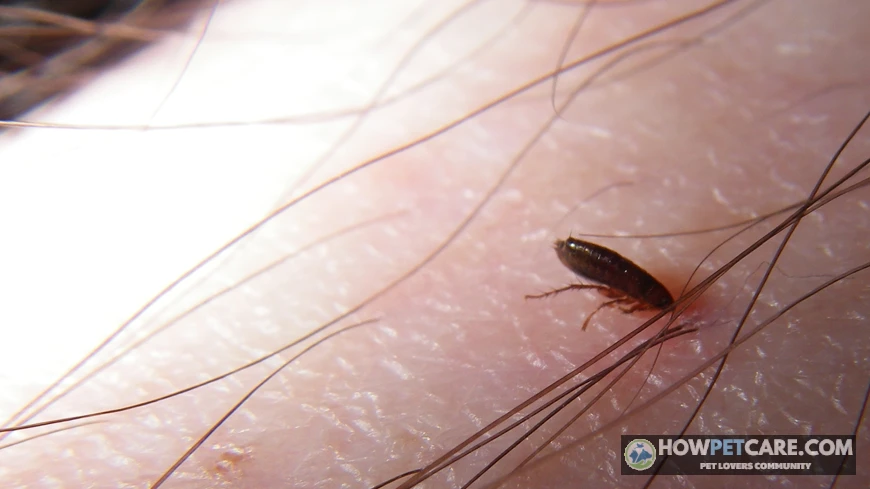
Depending on the species and whether the flea has recently fed, adult fleas measure between 1.5 and 4 millimeters, though most domestic specimens run around 2.5 millimeters. Picture a small sesame seed or the tip of a sharpened graphite pencil. Unfed fleas can look even smaller, close to the size of a coarse black pepper flake.
The cat flea (Ctenocephalides felis) is the species most often found on domestic animals. Despite the name, it infests both cats and dogs across North America and accounts for well over 90% of household flea infestations. The dog flea (Ctenocephalides canis) exists but is far less common indoors. Since both species look nearly identical without magnification, the identification markers are the same no matter which pet brought them inside.
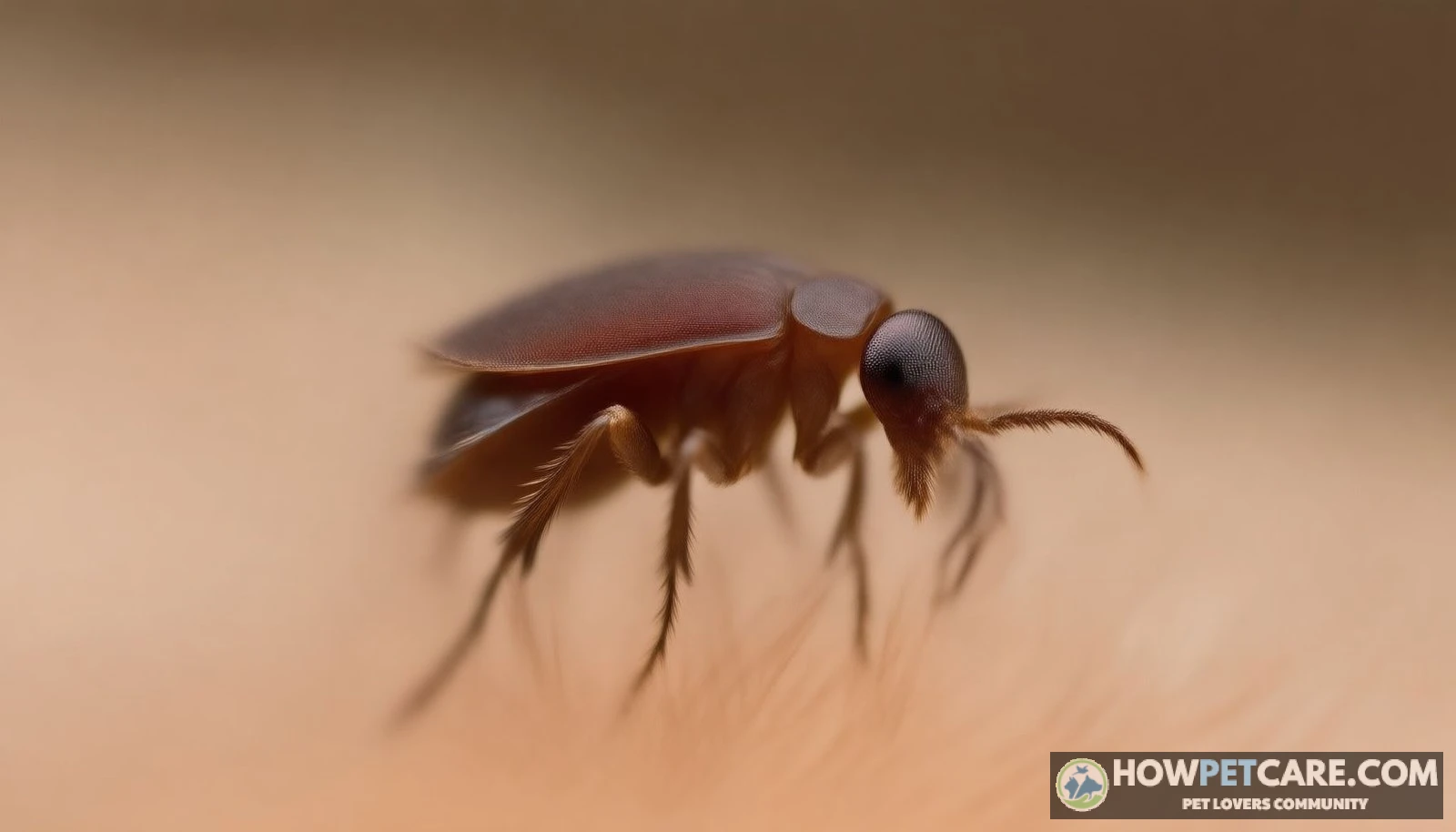
Seen from above, an adult flea is remarkably narrow. Its body is laterally compressed—flattened side to side like a knife blade—so it can part hairs and glide through a pet’s dense undercoat. From the side, it shows an arched, oval profile with a hard, shiny exoskeleton. Color runs from warm reddish-brown to near-black mahogany, and it turns darker, plumper, and glossier right after a blood meal.
The legs are one of the most reliable identification features. Six legs attach to the thorax, but the hind pair is much larger and longer, working like powerful mechanical springs. Fleas have no wings and cannot fly. Try to catch or squash one and its toughness is obvious: the hard chitinous shell resists crushing between your fingertips, and the insect slides away unless you trap it against a rigid surface.
Bug in a Jar: The 60-Second Flea ID
If you captured a suspicious bug from your pet or furniture, put it in a clear glass jar or under a drinking glass on a sheet of white paper. Work through this quick identification sequence:
- Does it jump? Tap the jar or blow gently on the insect. A flea springs several inches across the glass instantly. If it only crawls or tries to fly, it is not a flea.
- Is it sesame-seed sized or smaller? Fleas measure 1 to 3 millimeters. If the insect is as big as an apple seed (4 to 5 millimeters) or a grain of rice, you are likely looking at a bed bug, beetle, or swollen tick.
- Is it flattened side-to-side? Look at it head-on and from the side. A flea looks razor-thin from the front and teardrop- or oval-shaped from the flank.
- Are the rear legs noticeably oversized? Fleas have six legs, with the hind pair folded tight like coiled springs and extending past the abdomen.
- Is it hard to squash? Roll the insect gently between two fingernails. A flea’s slick, hard exoskeleton resists light crushing, while soft-bodied insects such as aphids or lice burst immediately.
- Where did you find it? Parasites taken straight from a cat or dog’s skin—especially near the tail base—are prime candidates for fleas.
Verdict: An insect that is laterally flat, reddish-brown, equipped with oversized hind legs, resists gentle crushing, and leaps abruptly is an adult flea.
Can you see fleas with the naked eye?
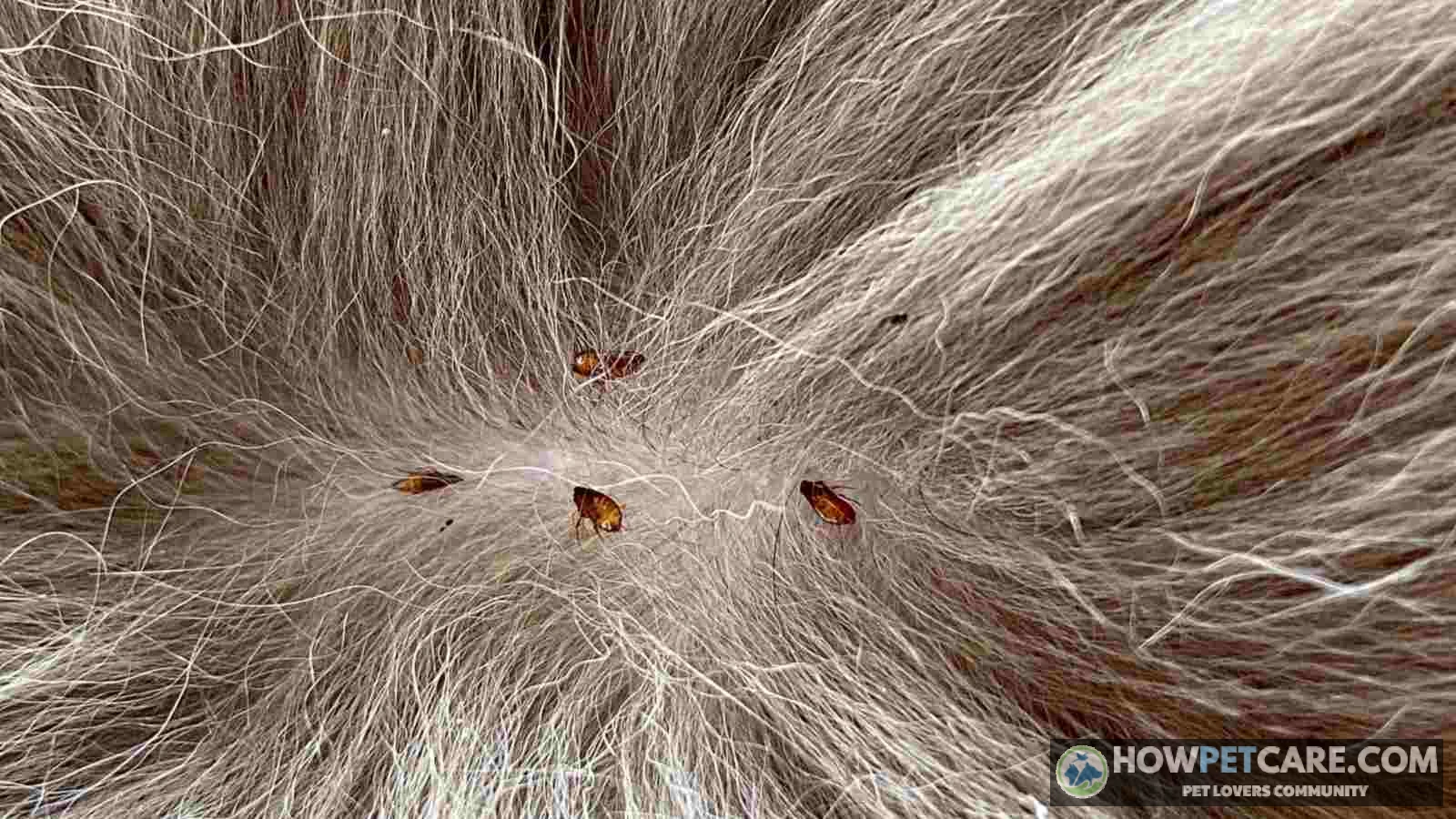
Yes. Adult fleas are visible without magnification if you have decent lighting and know where to look. A flea is small, but its dark silhouette contrasts sharply against pale skin, light fur, or white bedding. Still, checking a standing pet rarely turns up an easy sighting. Fleas avoid bright light and dive toward the skin surface the instant you ruffle the coat.
Without magnification, you usually cannot make out individual legs or segments. Instead, an active adult flea looks like a tiny, dark, reddish-brown oval darting quickly in a straight line through the base of the fur before vanishing. Part the fur quickly and you might catch a brief glimpse of it moving sideways along the hair shafts.
How fleas move: jumping, scurrying, and hiding
Movement is the fastest behavioral clue. Fleas do not crawl lazily, and they never fly. When disturbed, an adult flea uses resilin, a rubber-like protein stored in its hind legs, to catapult itself forward and upward. One leap can carry a flea 7 to 12 inches horizontally and up to 7 inches vertically—about 100 to 150 times its own body length.
Inside your pet’s fur, fleas scurry rapidly. Their backward-pointing body spines (ctenidia, or "combs") and flattened sides let them knife through a dense coat without snagging on hair shafts. Part your pet’s fur to expose a flea and it will not freeze or play dead. It scurries downward toward a skin fold or leaps off the animal to escape.
Male vs. female fleas: how to tell them apart under magnification
To the naked eye, male and female cat fleas look virtually identical. Under a 10x hand lens, pocket microscope, or clear smartphone macro photo, anatomical differences emerge.
Female cat fleas are noticeably larger than males, typically 2.5 to 3.5 millimeters versus 1.5 to 2.5 millimeters for males. The female abdomen is broad, rounded, and expanded for egg production. Internally, a female flea shows a distinct comma-shaped or bean-shaped structure near the rear of the abdomen called the spermatheca, which stores sperm after mating.
Male fleas have a distinctly upturned, blunt abdomen that tilts upward at the back end. Under magnification, the male’s reproductive apparatus—including coiled, spring-like structures called the aedeagus and genital claspers—gives the tail end a truncated, spiky, or squared-off profile. A male’s antennae are also relatively longer and more mobile than a female’s, helping it grasp the female during mating.
A standard smartphone camera held 3 to 4 inches away with 3x digital zoom and the flashlight enabled can capture enough macro detail to reveal the laterally flattened body and coiled hind legs of an adult flea.
What Flea Eggs, Larvae and Pupae Look Like, on Your Pet and in Your Home
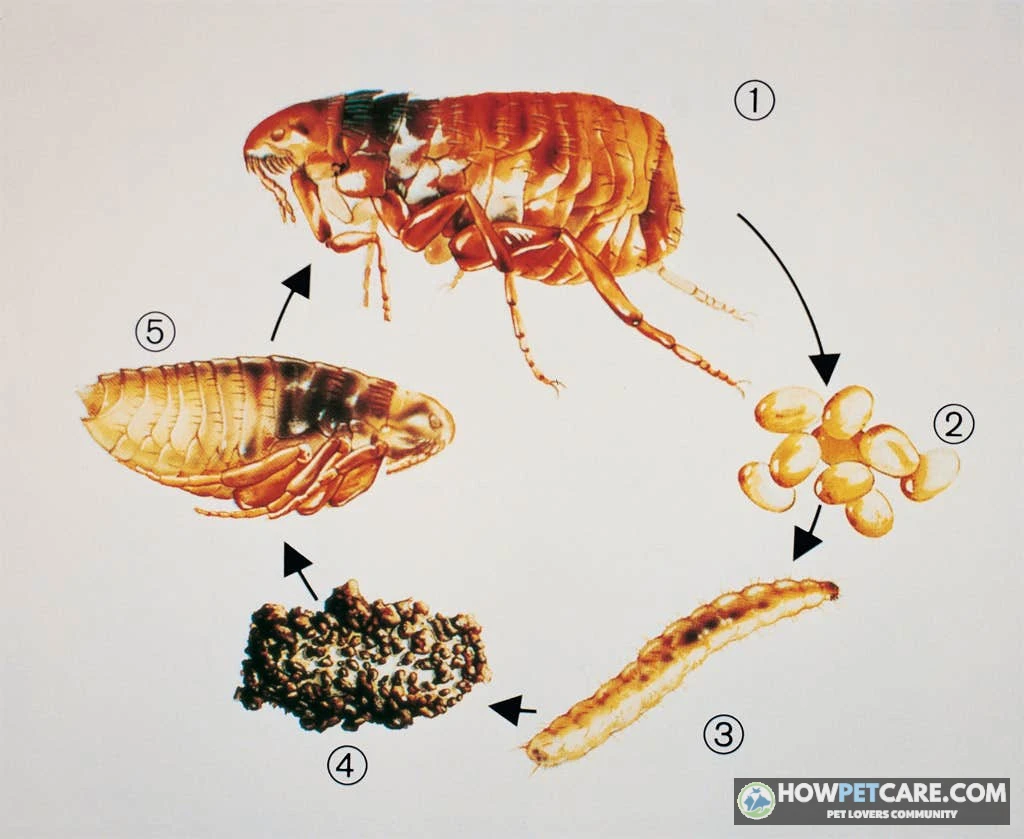
Focusing only on live, jumping adult fleas means missing 95% of an active infestation. Adult fleas on your pet make up just 5% of the total flea biomass in your home. The other 95% hides invisibly in carpets, upholstery, tile grout, and pet bedding as eggs, larvae, and pupae.
Knowing what these immature stages look like is key to confirming an environmental infestation before adult fleas start biting family members.
| Life stage | Approximate size (common-object comparison) | Color and shape | Where you find it | How to confirm it |
|---|---|---|---|---|
| Egg | ~0.5 mm — a grain of fine table salt | Pearly white or translucent, smooth oval | Falls off the pet into bedding, carpet, sofa seams, floor cracks | Unlike dandruff, it is a uniform, hard oval that rolls freely and does not stick to hair shafts |
| Larva | 2–5 mm — a short, thin thread | Off-white to dirty pink, worm-like, bristly, legless | Deep in carpet fibers, under furniture baseboards, inside pet bedding | Slender, writhing maggot-like body that curls into a ‘C’ shape and retreats actively from light |
| Pupa (cocoon) | ~2–3 mm — a speck of grit or coarse sand | Camouflaged capsule coated in household dust, fibers, and grit | Carpet bases, subfloor cracks, between couch cushions | A sticky, silken envelope heavily disguised by ambient lint; resistant to regular vacuum suction |
| Adult | 1–3 mm — a sesame seed | Dark reddish-brown, glossy, laterally flattened | Directly on the pet’s skin, tail base, belly, inner thighs | The jump test: springs several inches when disturbed; hard body resists light squeezing |
On the pet: what is and is not a flea egg
Flea eggs are microscopic ovals about 0.5 millimeters long. They are smooth, translucent to pearly off-white, and look like tiny grains of white sugar or fine table salt.
A female flea lays up to 40 or 50 eggs per day directly onto the host’s coat. Unlike head lice or mite eggs, flea eggs are completely non-sticky. As your cat or dog walks, scratches, or shifts position, the eggs slide off the hair shafts and scatter across floors, rugs, and furniture like invisible salt shakers.
Pet owners often mistake dry skin flakes for flea eggs. Here is how to tell them apart:
- Flea eggs are perfectly symmetrical, rounded ovals with a smooth, glass-like sheen. They have substance; rolled between your fingers, one feels like a hard, rolling micro-bead.
- Dandruff flakes are irregular, jagged, flat, and semi-opaque. They crumble when touched, stick statically to hair shafts, and vary widely in size and shape across the coat.
In the home: carpet, bedding and tile under a flashlight
Finding environmental flea stages takes a deliberate inspection. Flea larvae hatch from eggs within 1 to 10 days, emerging as slender, legless, off-white caterpillars 2 to 5 millimeters long. They have chewing mouthparts, microscopic bristles, and a semi-translucent look. As they feed on adult flea feces (flea dirt), their digestive tract fills with digested host blood, giving the central core a reddish-purple or dirty-pink tint.
Flea larvae flee from light. They burrow deep into carpet pile, work under baseboards, or crawl beneath couch cushions to find darkness and humidity.
To check your home for flea larvae and eggs, run a low-angle flashlight inspection:
- Turn off the overhead lights in a room where your pet spends a lot of time.
- Lay a bright LED flashlight flat on the floor so the beam skims horizontally across the surface at a 10- to 15-degree angle.
- Look for tiny, cast shadows. On dark tile or hardwood, flea eggs appear as gleaming, bright white specks against grout lines or floorboard crevices.
- In carpets, part the fibers down to the backing with a butter knife or stiff card under direct light. Flea larvae look like tiny, pale threads writhing in an undulating, ‘C’-shaped curl deep in the pile.
Pupae are the most elusive stage. Once a larva finishes developing, it spins a sticky, silken cocoon 2 to 3 millimeters across. The cocoon acts like an adhesive trap, instantly coating itself in dust bunnies, carpet fuzz, soil grains, and pet dander. To human eyes, a flea pupa looks indistinguishable from ordinary vacuum debris, lint, or coarse sand clinging to carpet fibers. Inside the shell, the developing flea is heavily shielded from household sprays and drying out.
Why you usually see adults and flea dirt but rarely eggs or larvae
Most pet owners notice adult fleas and flea dirt, then assume their home is clean because they see no worms or eggs. The gap happens because adults and flea dirt sit on the pet’s exterior, while immature stages disperse into the flooring right away.
Eggs tumble out of the fur within hours of being laid. Larvae quickly crawl away from light, burying themselves in upholstery seams and rug backings where surface cleaning never reaches. Pupae stay camouflaged under debris until environmental cues—carbon dioxide, vibrations from footsteps, or pet body heat—trigger the adult to emerge from the cocoon. Unless you actively inspect baseboards and rug piles with angled light, you will only meet the final, biting stage of the cycle.
Flea Dirt: What It Looks Like and How to Confirm It With the Wet Paper Towel Test
Many infestations never reveal a single live adult flea. Instead, the first concrete clue is "flea dirt." Flea dirt is adult flea feces, made almost entirely of partially digested, dehydrated host blood.
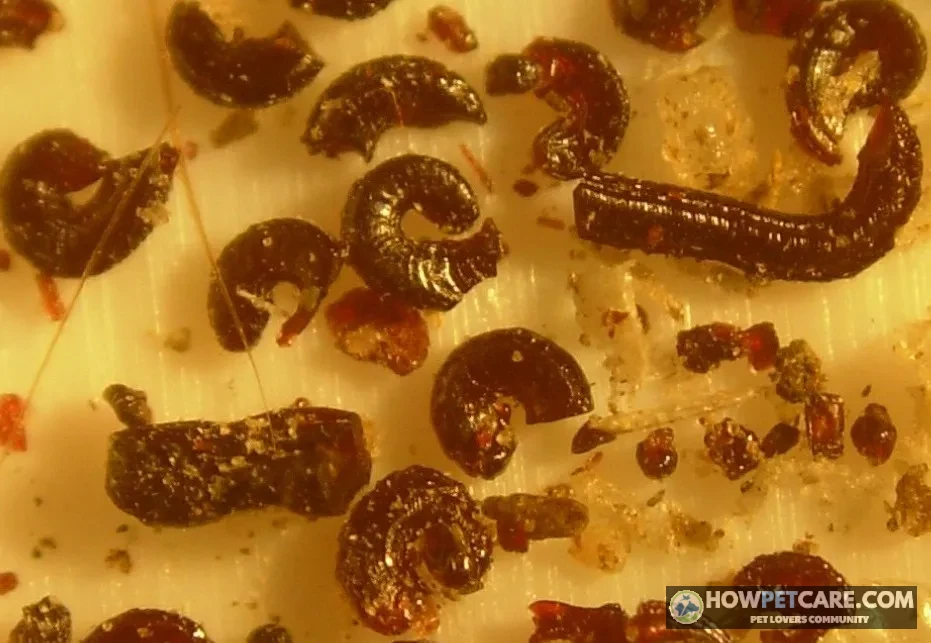
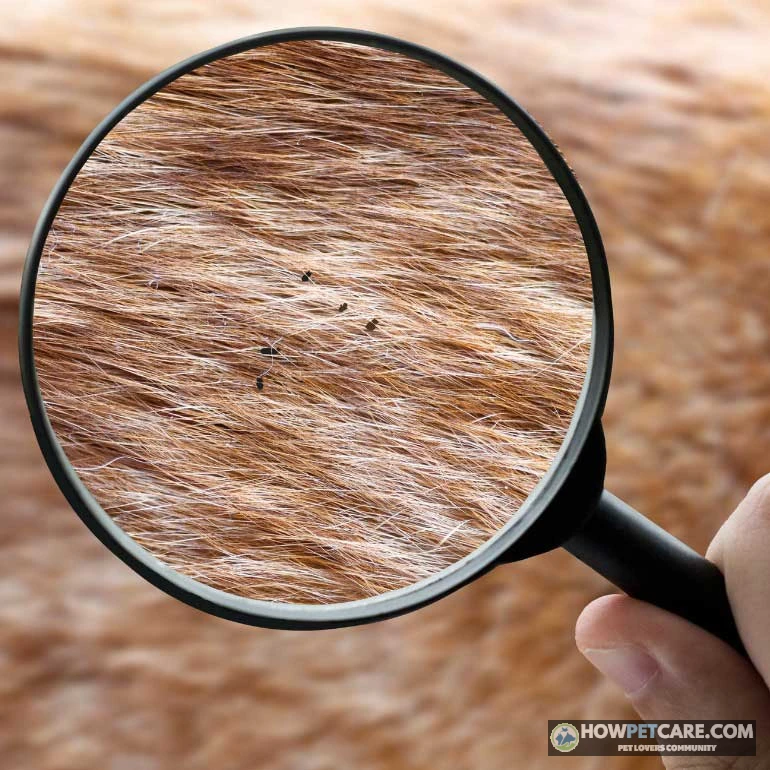
To the naked eye, flea dirt looks like tiny granules of cracked black pepper or fine, dark coffee grounds. It often collects in clusters along the skin at the tail base, deep in the groin folds, or across pet bedding. Examined closely or through a magnifying lens, individual specks often show an elongated, curled, or comma-shaped cylinder rather than a round ball.
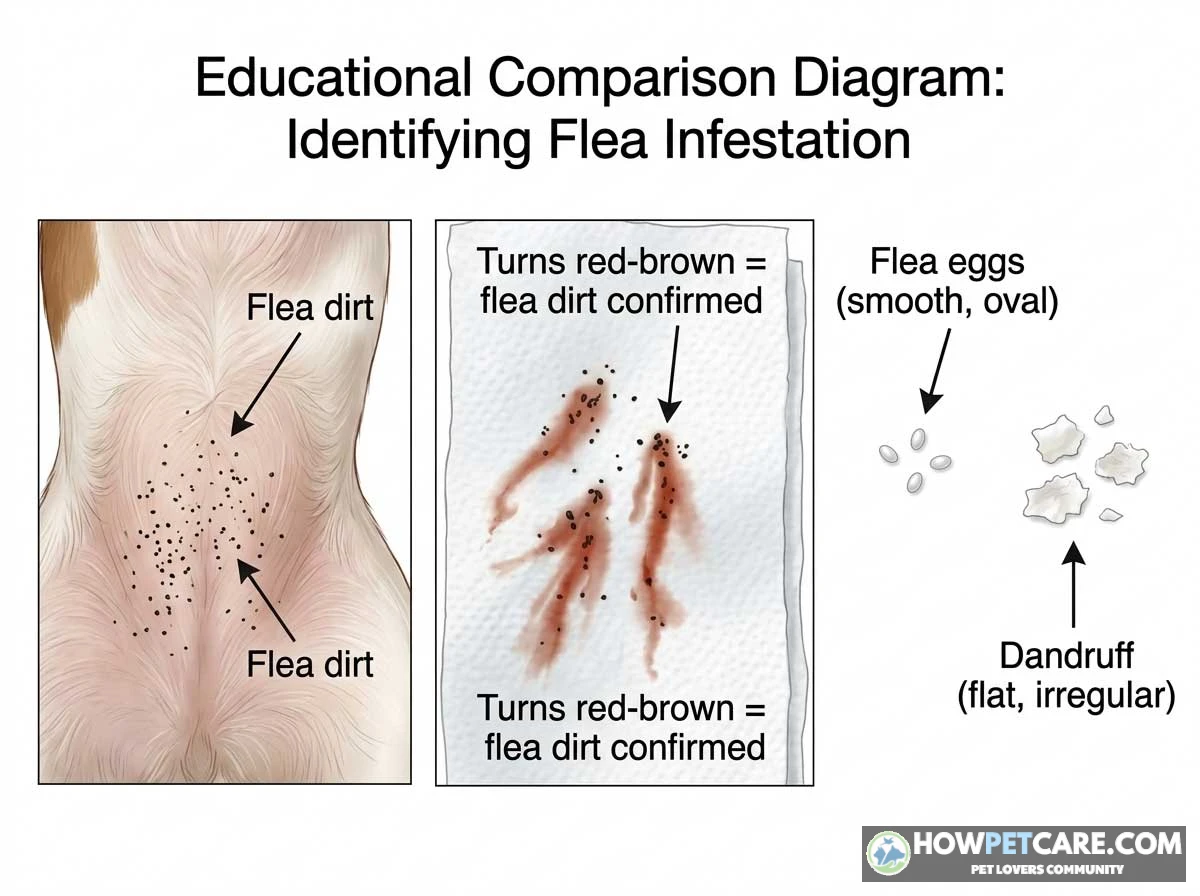
Because outdoor dirt, fireplace soot, and garden soil also look like dark specks in a dog or cat’s coat, never guess. Confirm flea dirt with the wet paper towel test.
-
Gather debris onto white paper
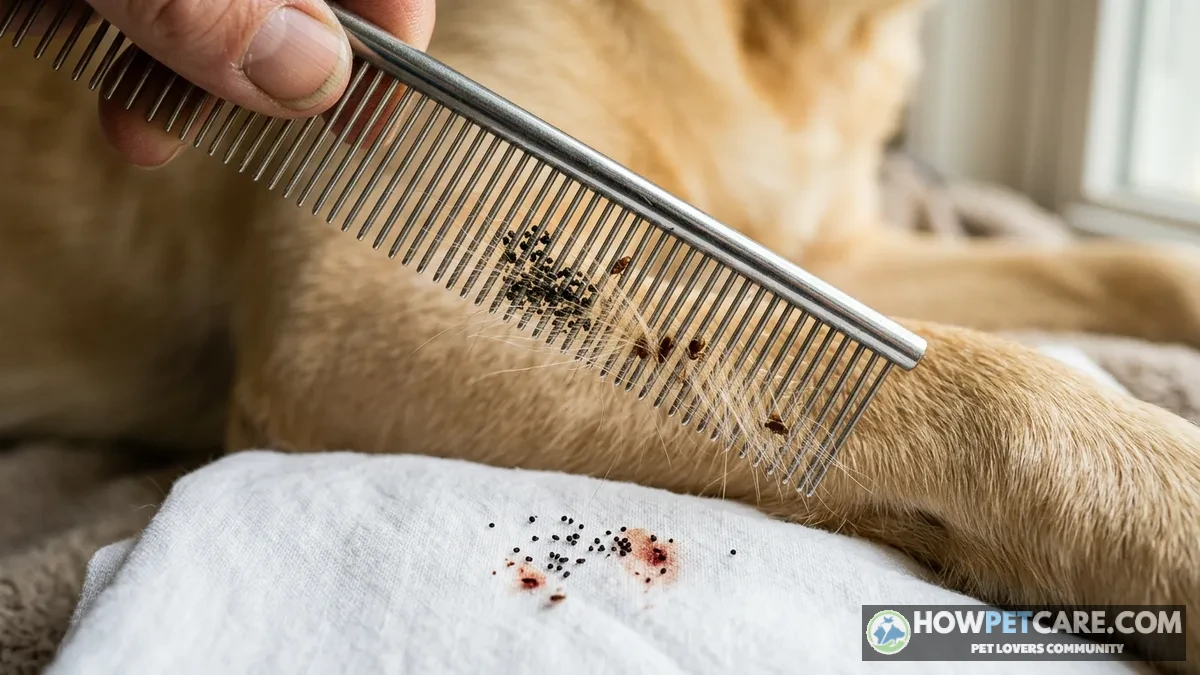
Run a fine-toothed flea comb through your pet’s fur, focusing on the lower back, groin, and neck. Tap the comb teeth firmly over a clean, flat white paper towel or plain tissue so the dislodged black specks settle on the surface.
-
Apply clean water
Using a clean fingertip, eyedropper, or spray bottle, place two or three drops of warm water directly onto the collected specks. Do not flood the paper towel; moisten the area gently.
-
Wait 60 to 90 seconds
Allow the moisture to penetrate the dried organic matter. The water will reconstitute any dehydrated blood cells held inside the granules.
-
Smear and observe color change
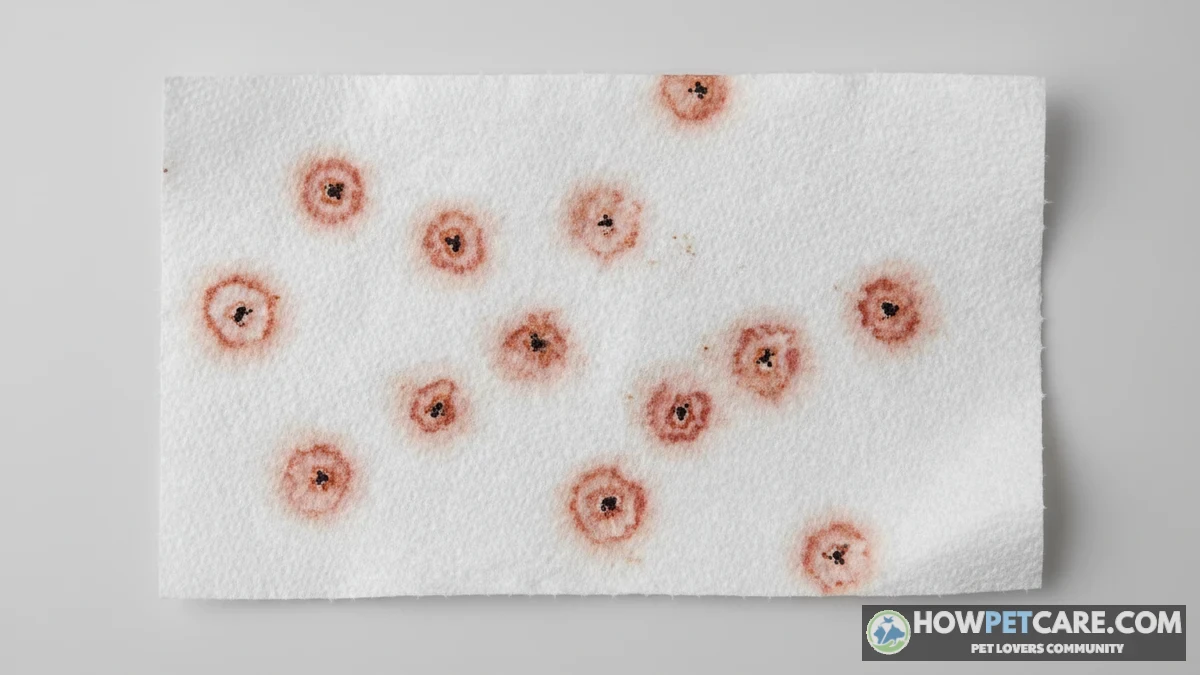
Gently press or drag a clean finger or cotton swab across the wet specks. If the granules are flea dirt, they will dissolve and bleed into distinct reddish-brown or rust-colored rings resembling fresh blood stains.
Flea dirt vs. dandruff vs. dirt: a quick comparison
- Flea Dirt: Pure black or deep reddish-black granules. They feel slightly gritty. Pressed into moisture, they actively liquefy into red or crimson halos.
- Ordinary Outdoor Dirt / Soil: Dark brown, grey, or black particles. They feel sandy or muddy. In the wet paper towel test, soil keeps its shape or dissolves into dull grey, yellowish, or muddy brown smears—never crimson or red.
- Dandruff / Sebum Plugs: Whitish, yellowish, or translucent flakes. They do not dissolve in water, contain no blood, and produce no color change on a paper towel.
What a positive and a negative test look like
A positive test result shows unmistakable evidence of feeding fleas. Even if you have not caught an adult insect, black specks that bleed red when wet confirm adult fleas are living on your pet or fed on it within the past few days.
A negative test result leaves the paper towel free of reddish pigment. The specks stay intact, like mineral sand, or melt into faint grey smudges. If your pet keeps scratching despite a negative test, the cause may be environmental allergies, food sensitivities, or microscopic skin mites rather than fleas.
How to Check Your Cat or Dog for Fleas, Step by Step
An accurate flea check takes patience, good lighting, and a systematic approach. A haphazard ruffle through your pet’s topcoat rarely uncovers an early infestation.
Gather your equipment: a fine-toothed metal flea comb (30 to 32 closely spaced teeth per inch), a bowl of warm water with a few drops of liquid dish soap, a white towel, and a bright flashlight. The soapy water matters. Plain water lets fleas float and jump off the surface, while dish soap breaks the surface tension so fleas sink and drown immediately.
-
Position your pet on a white surface
Place your cat or dog on a white bath towel, bed sheet, or inside a clean, dry white porcelain bathtub. Any live parasites or flea dirt dislodged during grooming falls onto the white surface and becomes visible instantly.
-
Comb the prime target zones
Start at the base of the neck and work slowly downward. Hold the flea comb at a 45-degree angle to the body, making sure the metal teeth pass completely through the fur to lightly touch the skin surface without scratching.
-
Submerge and inspect the comb
After each stroke, check the comb teeth. If you trap live insects or dark specks, plunge the comb head into the soapy water bath right away to immobilize them. Wipe the teeth clean with a damp white tissue to check for blood rings.
-
Check the underbelly and groin
Gently roll your pet onto its side or back. Hair is thinner across the abdomen and inner thighs, so this is often the easiest place to spot fleas walking on bare skin.
Where fleas hide on cats and dogs
Fleas seek warm, humid, protected spots where pets struggle to groom or scratch them away. Focus your inspection on these five hiding places:
- Base of the Tail and Lower Back: The number-one gathering point for fleas on dogs. The hair is dense and warm, with quick access to blood vessels.
- Groin, Inguinal Folds, and Lower Abdomen: Sparse hair on the inner thighs and lower belly lets you view pink skin directly. Fleas congregate here to feed and warm themselves.
- Armpits (Axillary Region): Protected skin folds under the front legs offer steady body heat and shelter from routine grooming.
- Nape of the Neck and Behind the Ears: A favorite zone on cats, which cannot easily reach the back of their own necks with claws or tongue.
- Under the Chin and Throat: Cats often carry clusters of flea dirt and small crusty scabs under the chin folds.
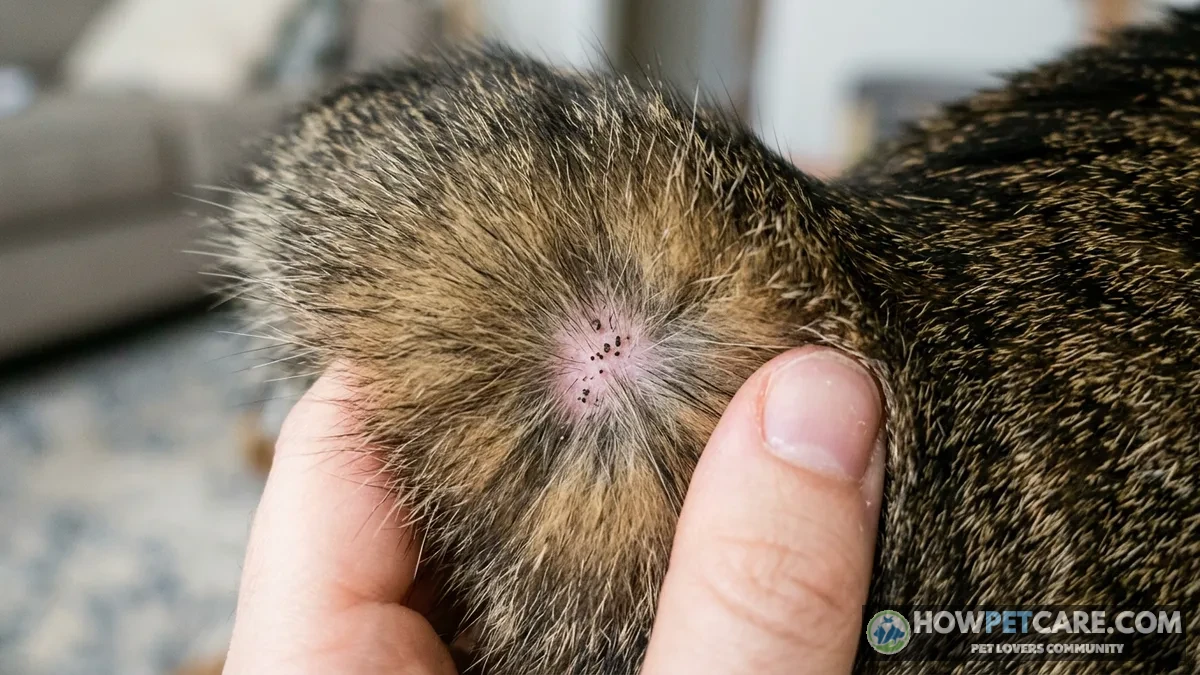
Cats and dogs show different behavioral clues during an infestation. Cats are fastidious groomers with barbed tongues that work like natural flea combs. A cat may swallow most of the live fleas on its body. Instead of crawling bugs, you are more likely to notice excessive swallowing, vomiting hairballs with dark debris, "twitchy back" syndrome, or tiny, sand-like scabs around the neck and tail base—a condition called miliary dermatitis.
Dogs lack that grooming precision. They chew, nibble, and bite frantically at their hind legs, lower spine, and flanks. A dog with fleas often develops rough, rust-colored saliva staining on white fur from constant licking, along with patchy hair thinning above the tail.
Using a flea comb correctly
A flea comb works by physical exclusion: the gap between its teeth is narrower than an adult flea’s body, trapping the insect while hair slides through. Use it correctly by never dragging the comb quickly across the coat like a regular slicker brush. Make short, slow, deliberate strokes against the hair’s natural direction so you lift the coat and expose the skin beneath.
Keep the soapy water bowl within reach. A flea can leap off a comb within one or two seconds of exposure to air. As soon as a stroke finishes, roll your thumb over the teeth to trap any wriggling insect against the comb spine, then submerge it straight into the suds.
When a pet scratches a lot but you find no fleas
Pet parents often report intense scratching, chewing, and skin inflammation, yet exhaustive combing turns up no live fleas and little flea dirt. This frequently points to Flea Allergy Dermatitis (FAD).
When a flea bites, it injects saliva containing enzymes, polypeptides, and histamine-like compounds to keep host blood from clotting. Normal animals feel only minor, localized itching. In a pet with FAD, the immune system launches a severe hypersensitivity reaction. For an allergic cat or dog, one flea bite can trigger weeks of widespread, debilitating pruritus.
Because the allergic pet grooms frantically after a bite, it often grooms away and swallows the single offending flea within minutes. No visible fleas does not rule out fleas as the trigger for raw, scabbed skin.
Another clue pointing to unseen fleas is tapeworms (Dipylidium caninum). Fleas serve as the intermediate host for tapeworm larvae. When your pet grooms and swallows an infected flea, the tapeworm matures inside the intestines. Tiny, white-to-cream segments resembling grains of white rice or cucumber seeds around your pet’s anus or dried on bedding mean your pet has almost certainly swallowed fleas.
How to Find Fleas on a Black or Dark-Coated Pet
Detecting dark reddish-brown fleas on a black Labrador, dark tortoiseshell cat, or dark brindle terrier is notoriously difficult. Standard advice to "look for dark specks moving in the coat" fails when the pet’s hair matches the parasite. You must adapt your technique to focus on skin contrast, light reflection, and surface transfer.
Never search for fleas by scanning the exterior hair fibers of a dark-coated pet. Focus entirely on contrast against bare skin and on light-colored collection surfaces placed beneath the animal.
Dark-Coat Detection Protocol: Finding Fleas on Black Fur
Brown fleas and black fur share nearly the same color profile, so do not inspect the coat from above. Follow these steps to isolate parasites on dark fur:
- ☐ Lay a white towel or sheet beneath the animal: Stand or lay your pet on a clean white bedsheet or bath towel before starting.
- ☐ Comb against the grain: Part the coat backward toward the head with a metal flea comb. Tap the teeth onto the white sheet after every stroke—dislodged specks and escaping jumpers stand out against crisp white fabric.
- ☐ Target pale-skinned anatomical zones: Flip your pet gently onto its back to inspect areas where fur thins completely, such as the inguinal folds, armpits, and lower abdomen. Fleas and dark flea dirt show clearly against pink, pale, or white skin.
- ☐ Part fur to the skin surface: Use your thumbs to press the fur apart in opposite directions until you expose bare skin along the spine and tail base. Hold the fur flat for five seconds; fleas scurry across the exposed skin path to escape.
- ☐ Use a high-lumen, low-angle flashlight: Hold a bright flashlight at a flat, glancing angle across the fur. A flea’s smooth, hard chitinous cuticle reflects light noticeably, standing out against matte pet hair.
- ☐ Perform the damp paper towel press: Run a damp white paper towel firmly across the lower back and belly. Flea dirt trapped in the dark undercoat sticks to the wet towel and dissolves into red rings.
- ☐ Inspect sleeping areas: Check the light-colored fabrics, crate pads, or white sheets where your black cat or dog sleeps. Dried flea dirt tumbles out of dark fur as the pet shifts at night, showing clearly on bedding.
- ☐ Repeat the check over three consecutive days: One clean comb pass is never a guarantee because dark fur can hide a very light flea burden. Repeat the inspection over several days if your pet remains persistently itchy.
Fleas vs. Ticks, Bed Bugs, Lice, Mites, Springtails and Carpet Beetles
Pet owners who find a tiny, unfamiliar bug often assume the worst. Many common household insects and external parasites—from bed bugs on cats to bathroom springtails—mimic parts of flea anatomy or behavior. Use the distinguishing markers in the matrix below to tell them apart.
| Insect | Size | Color and body shape | How it moves | Where you usually find it | Quick way to confirm |
|---|---|---|---|---|---|
| Flea | 1–3 mm (sesame seed) | Dark reddish-brown, flat side-to-side, 6 legs | Jumps several inches in a single leap; scurries through fur | Directly on pet skin, pet beds, living room carpets | The jump test: springs away instantly; cannot be squashed between soft fingers |
| Tick | 3–5 mm unfed; up to 10+ mm engorged | Brown, grey, black; oval, flattened top-to-bottom; 8 legs (adult) | Slow crawl; completely incapable of jumping | Firmly embedded into pet skin (head, ears, toes, neck) | Count the legs (8 on adults) and verify attachment; ticks anchor their mouthparts and do not run |
| Bed bug | 4–5 mm (apple seed) | Rusty brown; broad oval, flattened top-to-bottom; 6 legs | Crawls steadily; cannot jump or fly | Mattress piping, headboards, bed frames, furniture seams | Found in human sleeping furniture, not living on pets; flat like a coin, not flat side-to-side |
| Louse | 1–3 mm | Pale straw-yellow, grey, or translucent; elongated; 6 legs | Slow, clumsy crawl; cannot jump; clings tightly to hair | Anchored directly to hair shafts on neglected pets | Look for nits (eggs) permanently glued to the base of individual hairs; flea eggs fall off |
| Mite | <0.5–1 mm (microscopic) | Off-white, grey, or pinkish; microscopic round body; 8 legs | Microscopic crawl; invisible to the naked eye | Ear canals (ear mites) or burrowed in skin (mange) | Ear mites produce dry, black, crumbly "coffee ground" wax inside the ear canal |
| Springtail | 1–2 mm | Grey, black, purple, or white; elongated body; 6 legs | Jumps / pops using an abdominal spring mechanism | Damp bathrooms, sinks, potting soil, basement tiles | Jumps like a flea but dries out and dies on pets; thrives strictly in high moisture/soil |
| Carpet beetle | 2–4 mm | Mottled black, brown, yellow, and white; rounded oval shell; 6 legs | Slow crawl; adults can fly | Windowsills, closets, wool rugs, upholstered baseboards | Shell is hard, patterned, and rounded like a ladybug; larvae are fuzzy and shed brown skins |
Fleas vs. ticks on pets
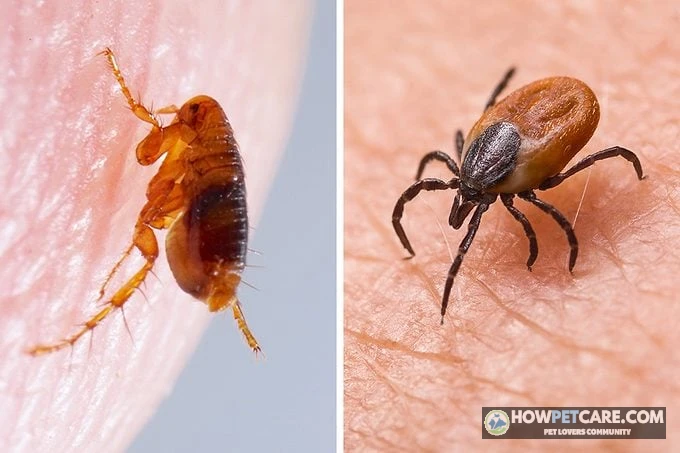
Fleas and ticks both feed on cat and dog blood, but their anatomy and habits differ entirely. Adult fleas are insects with six legs, measure 1 to 3 millimeters, and move continuously and rapidly across the host. They feed in short intervals, defecate constantly, and leap several inches the instant hair is parted.
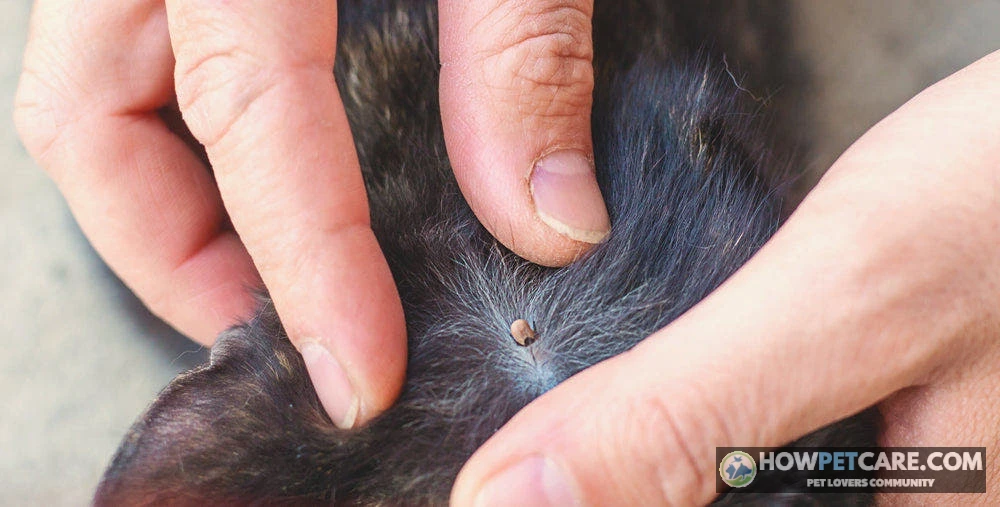
Ticks are arachnids. Adult ticks have eight legs and lack the flea’s side-to-side compression. Instead, they are dorsoventrally flattened—compressed top-to-bottom, like a sunflower seed.
Ticks do not jump, scurry, or hop. A tick crawls slowly up a blade of grass or onto an animal, inserts its barbed feeding apparatus into the host’s skin, and anchors itself for days. If you find a dark bug securely glued to your pet’s ear, neck, or toe web and it refuses to move when nudged, you are dealing with a tick, not a flea.
Household lookalikes that are not fleas
Mysterious jumping or crawling bugs on rugs or windowsills often trigger false alarms. Two non-parasitic insects cause most of them:
- Springtails (Collembola): Springtails are the top flea mimic indoors. Like fleas, they are tiny (1 to 2 millimeters) and can jump several inches when startled using a specialized abdominal appendage called a furcula. They are harmless to pets and humans, feeding on decaying organic matter, fungi, and mold. Jumping bugs around damp basement floors, bathroom sinks, windowsill condensation, or potted plant soil are springtails. They dehydrate and die quickly if they land on a dog or cat.
- Carpet Beetles (Anthrenus species): Pet owners often find carpet beetle larvae under beds or adult beetles along baseboards and mistake them for flea stages. Adult carpet beetles are round, dome-backed, and patterned with grey, white, and yellow splotches. They have wings and fly toward window light. Their larvae, about the same size as flea larvae, are covered in dense, bristly, dark brown hairs and feed only on natural fibers such as wool, feathers, leather, and pet hair—never on living animals.
What Flea Bites Look Like on People (and How They Differ From Other Bites)
Cat and dog fleas prefer non-human hosts, but hungry adults readily bite humans when an environmental infestation builds up indoors. They cannot breed or sustain a long-term population on human blood alone, but their exploratory bites cause pronounced discomfort.
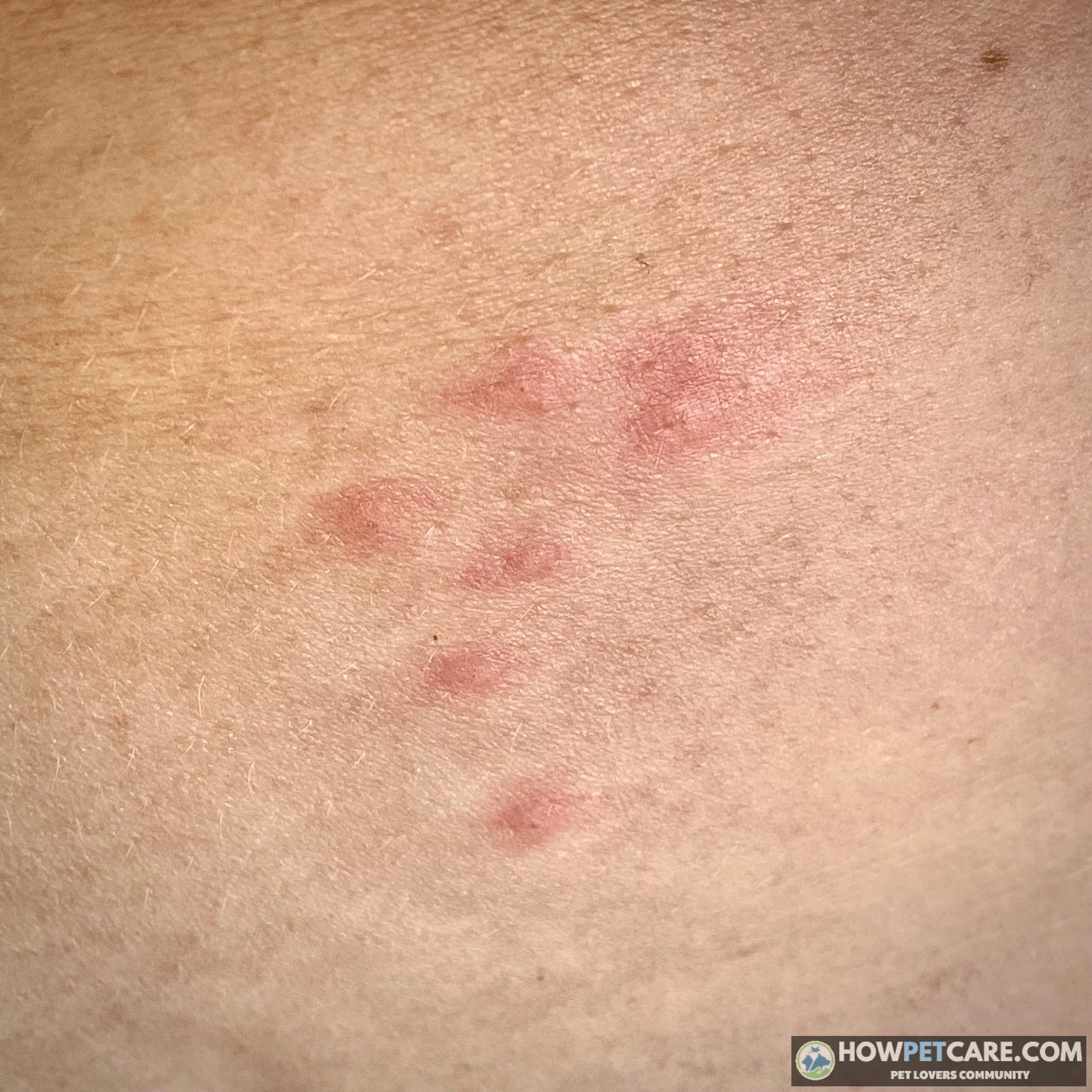
On human skin, flea bites look like small, firm, raised red papules typically 2 to 5 millimeters across. Unlike mosquito bites, which form diffuse, puffy, soft wheals that spread and fade within hours, flea bites stay hard, intensely itchy, and distinctly red for several days. A defining hallmark is a tiny, dark red puncture point in the center of the swollen bump, often surrounded by a reddish halo.
Because fleas emerge from carpets, baseboards, and low pet beds, bites on humans follow a distinct pattern on the body:
- Primary Distribution: Most flea bites appear on the lower extremities—ankles, tops of the feet, calves, and shins.
- Grouping Pattern: Fleas bite opportunistically, often in small clusters of two to four punctures or short linear tracks. Dermatologists sometimes call this "breakfast, lunch, and dinner."
- Secondary Distribution: If a pet sleeps in a human bed, bites can appear along the waistline, the bends of the elbows, or behind the knees where clothing sits tightly against the skin.
To tell flea bites apart from other insect encounters:
- Mosquito Bites: Larger, soft, puffy swelling with no central puncture point; random across exposed arms, neck, and face; itching peaks early and fades quickly.
- Bed Bug Bites: Broad, flat, red welts mainly on the upper body (face, neck, shoulders, arms) exposed during sleep; bed bugs rarely target only the ankles.
- Flea Bites: Hard, highly localized red dots clustered tightly on feet, ankles, and lower legs, with persistent, intense itching.
Vigorously scratching flea bites can break the skin, letting normal skin bacteria like Staphylococcus into the puncture and causing secondary infections. Use cool compresses, calamine lotion, or over-the-counter hydrocortisone cream to calm inflammation.
What Dead, Dying and Sluggish Fleas Look Like After Treatment
One of the most confusing experiences for a pet owner comes 12 to 48 hours after a veterinary flea treatment. You check your pet expecting a clean coat, but instead find fleas moving slowly across the fur. Many assume the medication failed. In reality, you are likely watching dying parasites.
Modern veterinary flea treatments—including topical formulas and oral isoxazoline medications—act directly on the flea’s nervous system. The isoxazoline drugs fluralaner, sarolaner, and afoxolaner, along with phenylpyrazoles such as fipronil, hyper-excite the parasite’s neurotransmitters. As the drug takes effect, the flea loses motor control, coordination, and the ability to orient toward the skin.
| Observation | Flea status | Typical behavior and appearance | What it means for your pet |
|---|---|---|---|
| Sluggish, uncoordinated, twitching | Dying | Cannot jump; stumbles clumsily; climbs to hair tips; legs shake or kick erratically | The treatment is working. Neurotoxins are paralyzing the parasite’s nervous system. |
| Motionless, curled, shriveled | Dead | Lying on its side; legs pulled tight beneath the thorax; dry or brittle; easily brushed away | Normal outcome. Dead fleas drop out of the coat over 24 to 72 hours as your pet moves. |
| Fast-moving, diving, jumping | Healthy / Live | Darts rapidly across the skin; springs away instantly when the coat is parted | Weeks after treatment, this suggests newly hatched fleas or an environmental reservoir. |
When fleas are dying, they lose their aversion to light. Instead of hiding deep against the skin in darkness, disoriented fleas crawl up toward the outer hair tips, where owners can see them. They twitch uncontrollably, stumble over hair shafts, and lose their jumping reflex entirely. If you comb out a flea that rolls onto its side, kicks its rear legs in place, or crawls slowly without jumping, the treatment is working as intended.
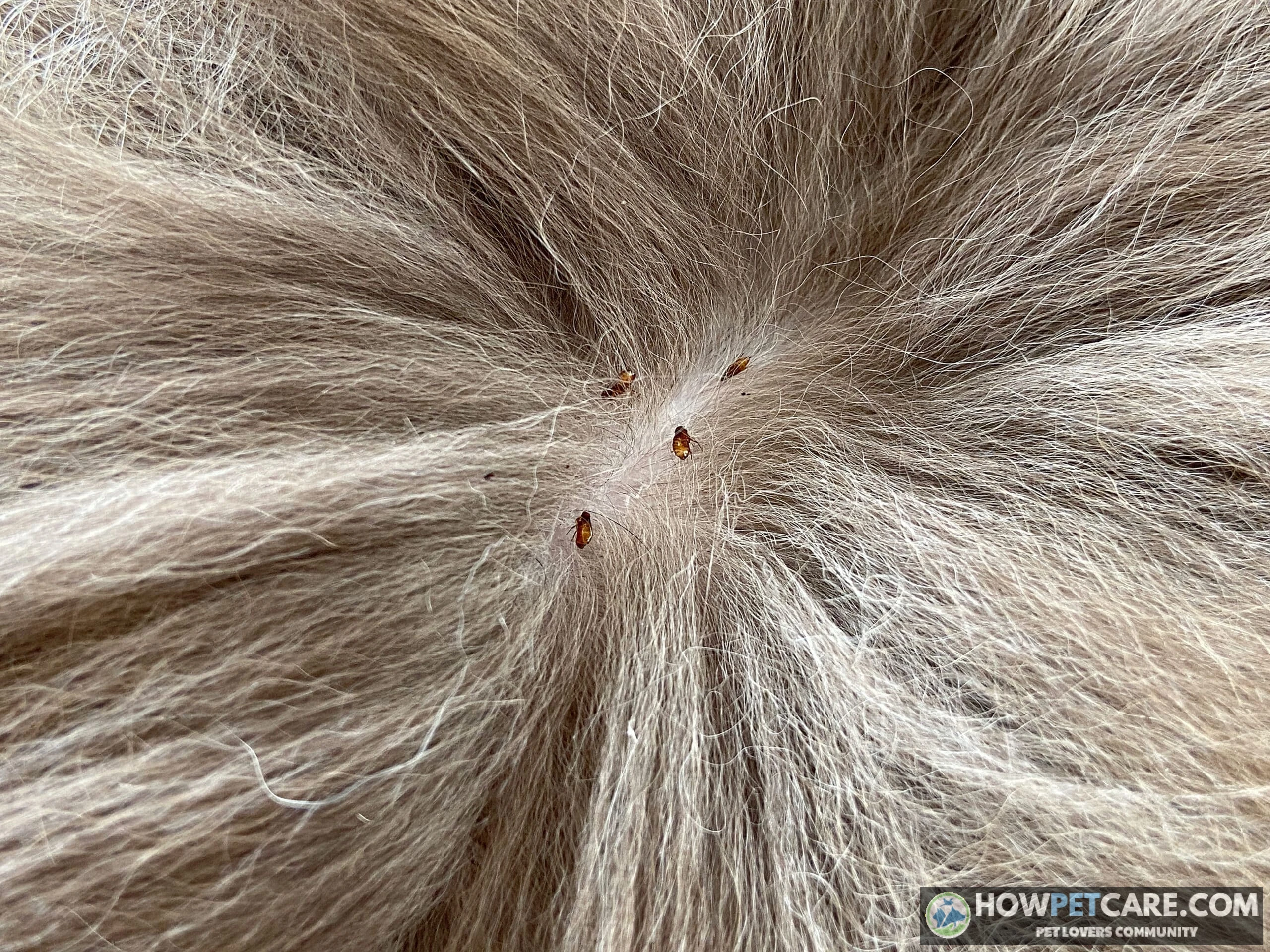
Dead fleas are completely immobile. Their bodies often curl inward slightly, with six legs tucked against the ventral abdomen. They lose their glossy sheen, look dry or shrunken, and fall out of the coat easily when you brush against the lay of the fur.
Seeing newly emerged adult fleas on a treated pet 10 to 14 days after treatment does not mean the medication stopped working. This is the expected "pupal window." No household topical or oral treatment kills flea pupae safely inside their silken cocoons. As environmental pupae finish developing, they hatch and hop onto the treated pet to feed, absorb the medication, and die within hours. Exhausting the environmental egg and pupa bank routinely takes two to three consecutive months of consistent treatment.
You’ve Identified Fleas: Home Treatment or a Vet Visit? A Decision Path
Once you verify adult fleas or confirm flea dirt, take prompt, structured action. Solving a flea problem means treating both the animal and the indoor environment at the same time.
| What you found | What it likely means | Home treatment or vet visit | Next step |
|---|---|---|---|
| A few live fleas, healthy adult pet | Early or mild infestation | Home treatment is reasonable | Start a vet-recommended flea preventative; wash all bedding in hot water; vacuum carpets weekly |
| Flea dirt only, no live fleas | Fleas have fed recently and remain nearby | Home treatment; continue monitoring | Treat pet with an approved preventative; conduct wet paper towel tests every 3 days |
| Heavy flea burden on pet and furniture | Established environmental infestation | Home treatment plus deep environmental protocol | Treat all pets in the home simultaneously; wash fabrics at 140°F; perform daily vacuuming |
| Pale gums, extreme lethargy, weakness | Severe blood loss resulting in anemia | Vet visit immediately | Emergency veterinary evaluation required; severe anemia can be fatal, especially in small animals |
| Fleas on a kitten, puppy, or senior pet | High vulnerability to toxicity and anemia | Consult vet before treating | Do not use over-the-counter adult flea medications; young animals require precise weight-based dosing |
| Raw, bleeding, or scabbed skin | Severe Flea Allergy Dermatitis (FAD) | Vet visit recommended | Your vet can prescribe short-term anti-inflammatories, antibiotics, and soothing therapeutics |
| Rice-like segments near the tail | Tapeworm infection (Dipylidium caninum) | Vet visit recommended | Pet requires a specific prescription dewormer (such as praziquantel) alongside ongoing flea control |
| Brisk, jumping fleas 4+ weeks post-treatment | Persistent re-infestation or product failure | Re-evaluate environment; vet consultation | Check for untreated indoor/outdoor pets; speak with your veterinarian about switching drug classes |
Signs that call for a vet visit
Most mild infestations on healthy adult dogs and cats can be resolved with standard veterinary-grade preventatives and diligent cleaning, but some visual findings demand immediate professional care:
- Pale, White, or Greyish Gums: Fleas are obligate blood-sucking parasites. A heavy infestation of several hundred fleas can consume significant amounts of blood daily. In kittens, puppies, small breeds, or elderly pets, this rapid blood loss triggers life-threatening parasitic anemia. Press your finger gently against your pet’s gums: chalky white, pale pink, or grey tissue instead of healthy bubblegum pink means a trip to the veterinary clinic right away.
- Very Young or Frail Animals: Most over-the-counter flea spot-ons and oral chews are strictly contraindicated for puppies and kittens under 8 to 12 weeks or below specific weight cutoffs (often 2 to 4 pounds). Adult treatments on young animals can cause severe neurotoxicity. A veterinarian can recommend safe, age-appropriate flea removal, usually relying on warm soapy baths and physical combing.
- Secondary Skin Infections and Intense Lesions: Open, oozing sores, hot spots, foul-smelling crusts, or widespread hair loss from scratching means over-the-counter flea collars or shampoos will cause severe pain and burning. A veterinarian must prescribe targeted therapeutics such as medicated washes, systemic antibiotics, or short courses of anti-pruritic medication.
Never apply a dog flea treatment to a cat. Many canine spot-on products contain high concentrations of permethrin or synthetic pyrethroids. Safe for dogs, permethrin is extremely toxic to cats, causing severe muscle tremors, seizures, and death within hours.
Short checklist: confirm, treat, and prevent
A thorough eradication protocol breaks the 8- to 12-week flea reproductive cycle permanently:
- Confirm the infestation visually: Use a flea comb and the wet paper towel test to verify that the specks you see are digested blood from fleas, not non-parasitic debris.
- Treat every pet in the household: Treating only the scratching pet fails. Untreated cats or dogs remain living parasite reservoirs that sustain the population. Use modern, veterinary-recommended oral or topical preventatives for every animal under your roof.
- Launder all bedding at high temperatures: Strip pet beds, crate liners, throw blankets, and human sheets where pets rest. Wash on the hottest cycle (at least 140°F / 60°C) and dry on high heat for at least 30 minutes to kill all eggs, larvae, and pupae.
- Vacuum methodically and discard the bag: Vacuum all carpets, area rugs, sofa cushions, baseboard edges, and subfloor gaps. Heat and vibration from the vacuum roller encourage dormant pupae to hatch into the open. Empty the canister or discard the bag into an exterior trash bin immediately after cleaning.
- Maintain continuous protection for at least 90 days: Dormant pupae take weeks to emerge from their cocoons, so never stop after the first month. Keep preventative coverage uninterrupted for at least three consecutive months so newly hatched fleas die before they can reproduce.
1What specific anatomical feature and chemical component enable an adult flea to catapult itself forward up to 150 times its body length?
Resilin is a rubber-like protein stored in the flea's large rear legs that functions like a mechanical spring during jumping.
2In a household with an active flea problem, adult fleas living directly on the pet account for approximately what proportion of the total flea biomass in the home?
Adult fleas on the animal represent only about 5% of the total flea population, while the remaining 95% exists as eggs, larvae, and pupae in the environment.
3A pet parent inspects their cat's fur and spots tiny white specks. Which of the following observations confirm that the specks are flea eggs rather than ordinary skin dandruff?
Flea eggs possess a consistent, glass-like oval structure with physical substance when rolled between fingers.
4When examining an adult cat flea (Ctenocephalides felis) under 10x magnification, which anatomical structure confirms that the specimen is female?
The spermatheca is an internal sperm-storing organ visible in the female flea's expanded posterior abdomen.
5A pet owner finds a small parasite attached to their dog's skin. Which set of features confirms that the bug is a tick rather than a flea?
Adult ticks are 8-legged arachnids flattened dorsoventrally (top-to-bottom) that insert mouthparts and remain firmly attached rather than jumping or scurrying.
6Tiny 1 to 2 mm insects are found popping and jumping near a damp bathroom sink and potted plant soil. Why are these identified as springtails rather than fleas?
Springtails are non-parasitic insects that pop via an abdominal spring (furcula) in damp environments and rapidly dehydrate if they land on dry pet fur.
7Which of the following bite patterns and visual characteristics help distinguish flea bites from mosquito or bed bug bites on humans?
Fleas leap onto humans from flooring, carpets, and low pet beds, making lower extremities the primary bite zone.
8During a physical check of a heavily infested pet, which clinical finding requires an immediate emergency veterinary visit rather than routine home care?
Pale or white gums indicate severe parasitic anemia from extensive blood loss caused by heavy flea burdens, which can be fatal.
9Which of the following techniques are recommended specifically for detecting dark reddish-brown fleas on a black-coated pet?
Combing over a white background ensures dislodged dark fleas and flea dirt stand out clearly against the fabric.
FAQ
Can an indoor-only cat get fleas?
Yes. Fleas can come in on people, on other pets, or from outside through doors and windows. They can then breed in carpet and bedding, so an indoor cat can still need checks.
Can fleas live on humans?
Fleas bite people, but they prefer fur and feathers and rarely stay on human skin. Most people just find itchy bites on their ankles and lower legs.
Do fleas cause tapeworms?
They can. A pet that swallows an infected flea while grooming may pick up a tapeworm, and small rice-like segments near the tail or in bedding are a sign. A vet can confirm and treat it.
How long can flea pupae stay in their cocoons?
Pupae can stay dormant in the cocoon for weeks or longer and emerge when they sense warmth, movement or vibration. This is why fleas can keep appearing after the first ones are gone.
Do fleas look different on a cat than on a dog?
The fleas themselves look the same, because the cat flea is the most common species on both. What differs is where you find them and how the pet reacts, since cats groom evidence away and dogs tend to show fleas near the tail base and belly.