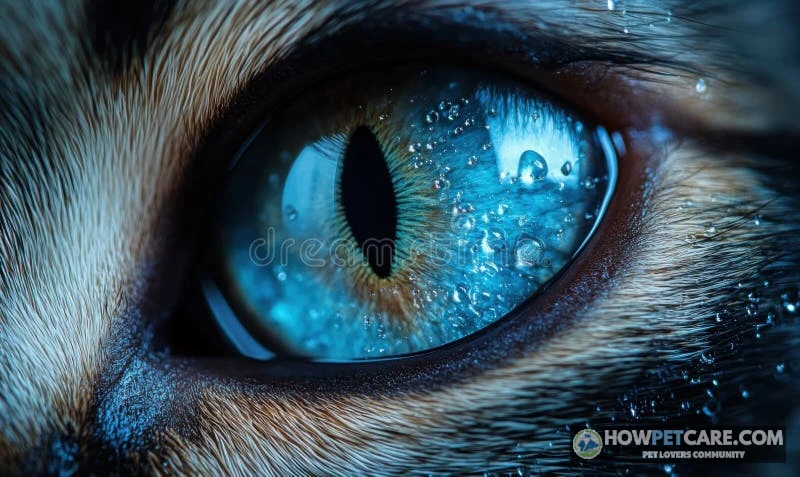

Cats are not completely color blind. They have dichromatic vision with two cone types instead of three, so they see blue and yellow hues best and struggle to tell red from green. Reds and greens look muted or dark. Missing a toy across the room is usually a distance-vision issue, not color blindness.
Cats are not completely color blind. They have dichromatic vision—two types of cone cells rather than the three humans have—so they perceive blue and yellow hues clearly but struggle with red-green distinctions. Poor distance vision, not color blindness, is what makes cats miss a toy across the room.
That distinction matters for everyday care. A cat that ignores a red ball on green grass may not be stubborn or nearsighted; it may simply see both as similar muted tones. Understanding feline color vision lets you pick toys, bowls, and household cues a cat can actually notice.
Are Cats Color Blind or Just Nearsighted? The Short Answer
Cats are not color blind in the sense of seeing only black and white. They have dichromatic vision, meaning their retina contains two cone types tuned to blue-violet and yellow-green wavelengths. Reds and greens appear muted, dark, or difficult to tell apart rather than vivid.
Nearsightedness is a separate issue. A cat’s sharpest vision is at roughly 20 feet (about 6 meters), and its field of view spans 200° to 270°. A toy tossed across a large room can be hard to resolve because of distance, not because of color. Many owners confuse the two problems and assume a cat that misses a thrown toy is color blind.
If your cat tracks a blue wand toy at close range but ignores a red one at the same distance, color—not focus—is likely the factor.

What Colors Can Cats See? A Side-by-Side View of Feline Color Vision
Human color vision is trichromatic: three cone types sensitive to short (blue), medium (green), and long (red) wavelengths. Cat vision is dichromatic, with cone peaks near 460 nm (blue-violet) and 560 nm (yellow-green).
Cats likely see blues, violets, and some yellow-green tones best. Reds and greens appear muted, dark, or difficult to distinguish. The world is not grayscale, but the palette is narrower and shifted toward blue-yellow contrast.
Human vs. Cat Color Perception
| Visual feature | Humans | Cats |
|---|---|---|
| Color channels (cone types) | 3 (trichromatic) | 2 (dichromatic) |
| Cone count | ~4–6 million | ~0.2–0.3 million (estimates vary) |
| Rod count | ~120 million | ~8x human rod count |
| Sharp-focus distance | ~20 feet typical | ~20 feet |
| Field of view | ~180° | 200°–270° |
| Low-light sensitivity | Baseline | ~6x human (commonly cited) |
| Tapetum lucidum | No | Yes |
| Color discrimination | Full trichromatic | Blue-yellow biased; weaker red-green |
Cats do not see the world in only black and white. Their cone count is roughly one-tenth of a human’s, while their rod count is about eight times higher. That trade-off favors motion detection and night vision over fine color discrimination.


Are Cats Color Blind Like Dogs? Cat, Dog, and Human Vision Compared
Cats and dogs both have dichromatic vision, but their strengths differ. Cats have stronger low-light and peripheral vision than humans, while dogs tend to have a wider field of view. Both species lean on blue-yellow cues rather than red-green separation.
| Metric | Humans | Dogs | Cats |
|---|---|---|---|
| Color channels (cone types) | 3 (trichromatic) | 2 (dichromatic) | 2 (dichromatic) |
| Approx. cone count | ~4–6 million | ~1–2 million | ~0.2–0.3 million (estimates vary) |
| Approx. rod count | ~120 million | Higher than humans | ~8x human rod count |
| Field of view | ~180° | ~240–250° | 200°–270° |
| Low-light sensitivity | Baseline | ~4–5x humans | ~6x humans (commonly cited) |
| Tapetum lucidum | No | Yes | Yes |
| Color discrimination | Full trichromatic | Blue-yellow biased | Blue-yellow biased, weaker red-green |
Cone and rod counts are approximate and source-dependent; treat them as relative benchmarks, not exact census figures. For shared household cues—like a blue bowl on a beige mat—both cats and dogs benefit from high-contrast blue or yellow items rather than red or green.
Can Cats See Red, Green, or Pink? Plain-Language Verdicts
Owners often ask whether cats can see red, green, or pink at all. The evidence supports hedged verdicts rather than absolutes.
Red
Red likely appears as a dark, greyish, or brownish tone rather than vivid red. A red toy on green grass or a beige carpet can blend into the background for a cat. Confidence is moderate, based on behavioral discrimination data and cone-opsin findings.
Green
Green likely appears yellowish, muted, or desaturated. A cat may struggle to separate a true green from a yellow-green tone. Everyday objects like plants or green toys can read as a flat, low-contrast shape rather than a distinct color.
Pink
Pink is unlikely to read as a distinct bright pink. It tends to blend toward pale grey or white. Confidence here is lower because fewer direct studies target pink specifically. A pink bowl on a white counter may be nearly invisible by color alone.
These verdicts vary with lighting, age, breed, and individual eye health. They are best-estimate guidance, not absolutes. Normal dichromacy is not a defect—preferring blue and yellow while ignoring red is expected feline vision.

Red: Likely perceived as a dark, greyish or brownish tone rather than vivid red. Confidence: moderate (behavioral discrimination + cone-opsin data). Green: Likely appears yellowish, muted, or desaturated; hard to separate from yellow-green. Confidence: moderate. Pink: Unlikely to read as a distinct bright pink; tends to blend toward pale grey/white. Confidence: lower (fewer direct studies). Caveats: results vary with lighting, age, breed, and individual eye health; these are best-estimate verdicts, not absolutes.
How Researchers Test Color Vision in Cats Without Human-Style Tests
Researchers do not use human color-blindness plates for cats. Instead they run behavioral discrimination tasks: show the cat two adjacent lights or panels differing only in wavelength, reward the cat for choosing the panel matching a target wavelength, then gradually shift the comparison wavelength until the cat can no longer tell them apart. That "can’t-tell-them-apart" wavelength is the neutral point—often reported near 505 nm in the blue-green range, though values vary by method.
A neutral point in the blue-green range is consistent with dichromatic vision: the cat’s two cone types overlap there, so the two lights look identical. Studies also examine cone cells, rod cells, and retina photoreceptors to link behavior to anatomy.

Because methods differ in training intensity, reward type, and lighting, treat any single neutral-point value as an estimate, not proof. Findings also vary on whether cats might have a third cone type; a 2016 PubMed study argued against trichromatic vision by finding a neutral point at 505 nm.
Researchers do not use human color-blindness plates for cats. Instead they run behavioral discrimination tasks: 1. Show the cat two adjacent lights (or panels) that differ only in wavelength. 2. Reward the cat for choosing the panel that matches a target wavelength. 3. Gradually shift the comparison wavelength until the cat can no longer tell them apart. 4. That ‘can’t-tell-them-apart’ wavelength is the neutral point — often reported near ~500 nm (blue-green), though values vary by method. A neutral point in the blue-green range is consistent with dichromatic vision: the cat’s two cone types overlap there, so the two lights look identical. Because methods differ (training intensity, reward type, lighting), treat any single neutral-point value as an estimate, not proof.
UV Vision and Cat Behavior: What Cats May See That Humans Don’t
Evidence suggests cats may detect some ultraviolet light. UV-sensitive cues may influence hunting, play, and surface inspection—urine trails and certain fabrics can reflect UV in ways humans cannot see. The tapetum lucidum supports low-light vision but is not the same as color vision; it reflects light back through the retina to boost brightness.
Indoor lighting changes which colors and cues remain visible. A toy that pops under warm incandescent light may fade under cool LED light. Cats need only about one-sixth the light humans need to see at night, but darkness still limits color discrimination for both species.
Breed, Age, and Eye Disease: When Feline Color Vision Changes
Inherited eye conditions can reduce cone function or overall vision. Aging may affect hue discrimination, contrast sensitivity, and night vision. Cataracts, retinal disease, and other disorders can alter color perception. Senior cats and cats with eye disease need higher-contrast environments.
Normal dichromacy is not an inherited cone disorder, and aging-related hue loss is not the same as cataracts or retinal disease—though they can overlap. A veterinary ophthalmology exam is the right step for sudden vision change, clouding, pupil asymmetry, or night-vision decline, not assumptions about color blindness.

Misconception: ‘My cat ignores red toys, so it must have an eye disease.’ Correction: Preferring blue/yellow and ignoring red is normal dichromatic vision, not a defect. Do not assume color indifference = pathology. Do not assume: Normal dichromacy = inherited cone disorder (different mechanism, different prognosis). Aging-related hue loss = cataracts or retinal disease (can overlap, but need vet exam to tell). A cat that bumps into red objects is color-blind; it may be nearsighted, have low contrast sensitivity, or have a medical issue. When to escalate: sudden vision change, clouding, pupil asymmetry, or night-vision decline → veterinary ophthalmology exam rather than color-vision assumptions.
Which Toy, Bowl, and Environment Colors Work Best for Cats
The evidence points to blue and yellow as the most visible hues for cats, with contrast, shape, and texture as backup cues.
Toys
Prefer bright blue or yellow toys over red or green ones. Add high-contrast markings such as black and white stripes so shape cues survive if color fades. Avoid red toys on green grass or beige carpet, where contrast collapses for a cat.
Bowls
Choose blue or yellow bowls and avoid red or green bowls on matching mats. Use matte finishes to reduce glare under indoor lighting. Keep bowl color consistent so location cues stay stable.
Household Cues
Mark hazards or edges with blue or yellow tape rather than red. Use texture and shape alongside color, since cats lean on contrast and form. Boost lighting for senior cats or cats with eye disease. Re-check visibility after changing rugs, lighting, or bowl placement.

Toys: Prefer bright blue or yellow toys over red/green ones. Add high-contrast markings (black/white stripes) so shape cues survive if color fades. Avoid red toys on green grass or beige carpet (low contrast for cats). Bowls & Feeding: Choose blue or yellow bowls; avoid red/green bowls on matching mats. Use matte finishes to reduce glare under indoor lighting. Keep bowl color consistent so location cues stay stable. Household Cues: Mark hazards/edges with blue or yellow tape rather than red. Use texture + shape alongside color (cats lean on contrast and form). Boost lighting for senior cats or cats with eye disease. Re-check visibility after changing rugs, lighting, or bowl placement.
| Species | Color Channels (Cone Types) | Approximate Cone Count | Approximate Rod Count | Field of View | Low-Light Sensitivity | Tapetum Lucidum | Color Discrimination |
|---|---|---|---|---|---|---|---|
| Humans | 3 (trichromatic) | ~4–6 million | ~120 million | ~180° | Baseline | No | Full trichromatic |
| Dogs | 2 (dichromatic) | ~1–2 million | Higher than humans | ~240°–250° | ~4–5x humans | Yes | Blue-yellow biased |
| Cats | 2 (dichromatic) | ~0.2–0.3 million (estimates vary) | ~8x human rod count | ~200°–270° | ~6x humans (commonly cited) | Yes | Blue-yellow biased, weaker red-green |
FAQ
Do cats see in black and white?
No. Cats have dichromatic vision, so they can perceive some colors, especially blue and yellow hues, rather than only grayscale.
Are cats color blind in the dark?
In very low light, color vision is reduced for both cats and humans. Cats see better than humans in dim light, but darkness still limits color discrimination.
Can cats see ultraviolet light?
Research suggests cats may have some ultraviolet sensitivity, although the exact role of UV vision in everyday cat behavior is still being studied.
How many colors can cats see?
There is no simple number. Cats likely perceive a narrower range than humans, with stronger sensitivity to blue and yellow wavelengths than to red and green.