

A cat seizure is a sudden episode of involuntary movement or behavior lasting seconds to a few minutes. Signs include collapse, stiffening, paddling legs, drooling, and unresponsiveness; focal seizures may cause only facial twitching or staring. Any seizure lasting five minutes, or repeated episodes, is an emergency.
What Does a Cat Seizure Look Like?
A seizure is a sudden episode of involuntary movement or behavior that can last seconds to a few minutes. Your cat may collapse, stiffen, paddle their legs, drool, or become unresponsive. A focal seizure can be harder to spot, with signs such as facial twitching or staring. Afterward, your cat may seem confused or unsteady.
Cat seizing right now? Follow the steps in the next section. If the seizure reaches 3 minutes, call an emergency veterinarian and prepare to leave. At 5 minutes, go to an emergency clinic immediately.
Signs of seizures in cats can include:
- Movement: Sudden collapse, stiffening, muscle twitching, jerking, or paddling limbs.
- Awareness and behavior: Loss of consciousness or reduced responsiveness, staring, or sudden, repetitive behavior that’s unusual for your cat.
- Other visible signs: Drooling, vocalizing, or loss of bladder or bowel control.
Many generalized seizures last approximately 1–3 minutes, though a brief episode can feel much longer. Even one short event deserves veterinary attention. A video and an examination can help distinguish a seizure from something that looks similar.
What to Do (and Not Do) While Your Cat Is Having a Seizure
The first 60 seconds: a numbered checklist
- Start a timer. Note when the abnormal movements began. If you missed the start, make your best estimate.
- Make the area safer. Move hard or sharp objects away, block access to stairs, dim bright lights, and keep children and other animals back.
- Avoid handling your cat unless necessary. If they’re in immediate danger, use a towel or blanket to move them away from the hazard, keeping your hands clear of their mouth. Pad the surrounding area instead of holding them down.
- Record a video if it’s safe. Capture your cat’s whole body and face, but don’t delay timing, preventing injury, or calling for help to get footage.
- Watch the clock and call. If the seizure continues toward 3 minutes, call an emergency clinic and prepare to leave. At 5 minutes, leave for emergency care. Call ahead or while someone else drives.

Once the movements stop, keep your cat in a quiet, secure space. Watch their breathing and responsiveness, and note if another episode occurs. Call your veterinarian or an emergency clinic and describe what you saw and how long it lasted. A prolonged convulsive seizure can cause dangerous overheating, so urgent treatment matters.
Common mistakes owners make
Don’t put your fingers or an object in your cat’s mouth. Cats don’t swallow their tongues during seizures, and an accidental bite can be serious. Don’t restrain your cat, shout, or try to force the movements to stop.
Wait until your cat is fully alert and steady before offering food or water. Don’t give medication during the episode or while your cat can’t swallow safely. If your veterinarian prescribed a rescue medication and showed you how to use it, follow that specific plan.

Is a Cat Seizure an Emergency? Duration and Frequency Triage
Time the episode from the first abnormal sign you observe. If you don’t know when it began, tell the clinic the duration is uncertain.
| Situation | What it means | Urgency level | What to do now |
|---|---|---|---|
| One event under 3 minutes; cat fully recovers; previous seizures have been evaluated | The episode has stopped, but the pattern still matters | Prompt veterinary advice | Call your vet today, report the event, and arrange the earliest recommended appointment. |
| Seizure continues for 3–5 minutes | The event is approaching a dangerous duration | Urgent | Call an emergency clinic now and prepare to leave; don’t wait for the clock to pass 5 minutes before making a plan. |
| Seizure reaches 5 minutes, or repeated seizures occur without recovery | Possible status epilepticus, a life-threatening prolonged seizure state | Emergency now | Go to an emergency veterinarian immediately; call ahead if possible. |
| Two or more suspected seizures within 24 hours | Cluster seizures can occur even if each episode is brief | Emergency now | Go to an emergency clinic, even if your cat seems better between events. |
| First-ever suspected seizure, any duration | The cause is unknown and needs urgent assessment | Immediate veterinary care | Contact an emergency clinic and arrange an immediate evaluation, even if the episode was short. |
| Any event with breathing trouble, suspected poison, recent head injury, worsening recovery, or a diabetic cat | An underlying problem or complication may be urgent | Emergency now | Call and go to an emergency clinic. |
The 5-minute threshold and the definition of cluster seizures as two or more events in 24 hours are established emergency markers. Status epilepticus can mean one prolonged seizure or repeated seizures without recovery, and it can be life-threatening. Don’t wait for the seizure to stop before arranging emergency help.
For a cat already evaluated for seizures, one brief episode isn’t always a minutes-count emergency if the cat fully recovers. Your vet still needs to know. Follow your veterinarian’s emergency plan if it sets an earlier threshold.
Persistent blindness, circling, or marked disorientation also calls for an urgent conversation with a veterinarian. If your cat isn’t clearly improving after about an hour, contact an emergency clinic rather than waiting overnight. Go sooner if signs are severe or worsening. A first seizure in an older cat is especially important to investigate promptly.
If cost is making you hesitate during an emergency, call the clinic while arranging transport. Tell the team you need an estimate and ask about options, but don’t delay the trip for a prolonged seizure or cluster.
Focal vs. Generalized Seizures in Cats, and the Three Phases of an Episode
Generalized tonic-clonic vs. focal seizures: how to tell them apart
A generalized tonic-clonic seizure affects the whole body. A cat typically loses consciousness, becomes stiff, then has rhythmic movements such as paddling. The movements are involuntary; holding your cat still won’t stop them.
A focal seizure starts in a more limited part of the brain and can look like a behavioral quirk. Possible signs include facial or eyelid twitching, repeated jaw movements, or staring. Your cat may remain partly aware during a focal episode, so responsiveness alone can’t rule one out. A focal seizure can also develop into a generalized seizure.
Veterinarians use terms such as focal, generalized, structural, and idiopathic to describe seizure patterns and possible causes. These labels help guide an evaluation; an owner can’t diagnose them from appearance alone.

Pre-ictal, ictal, and post-ictal: what each phase looks like and how long it lasts
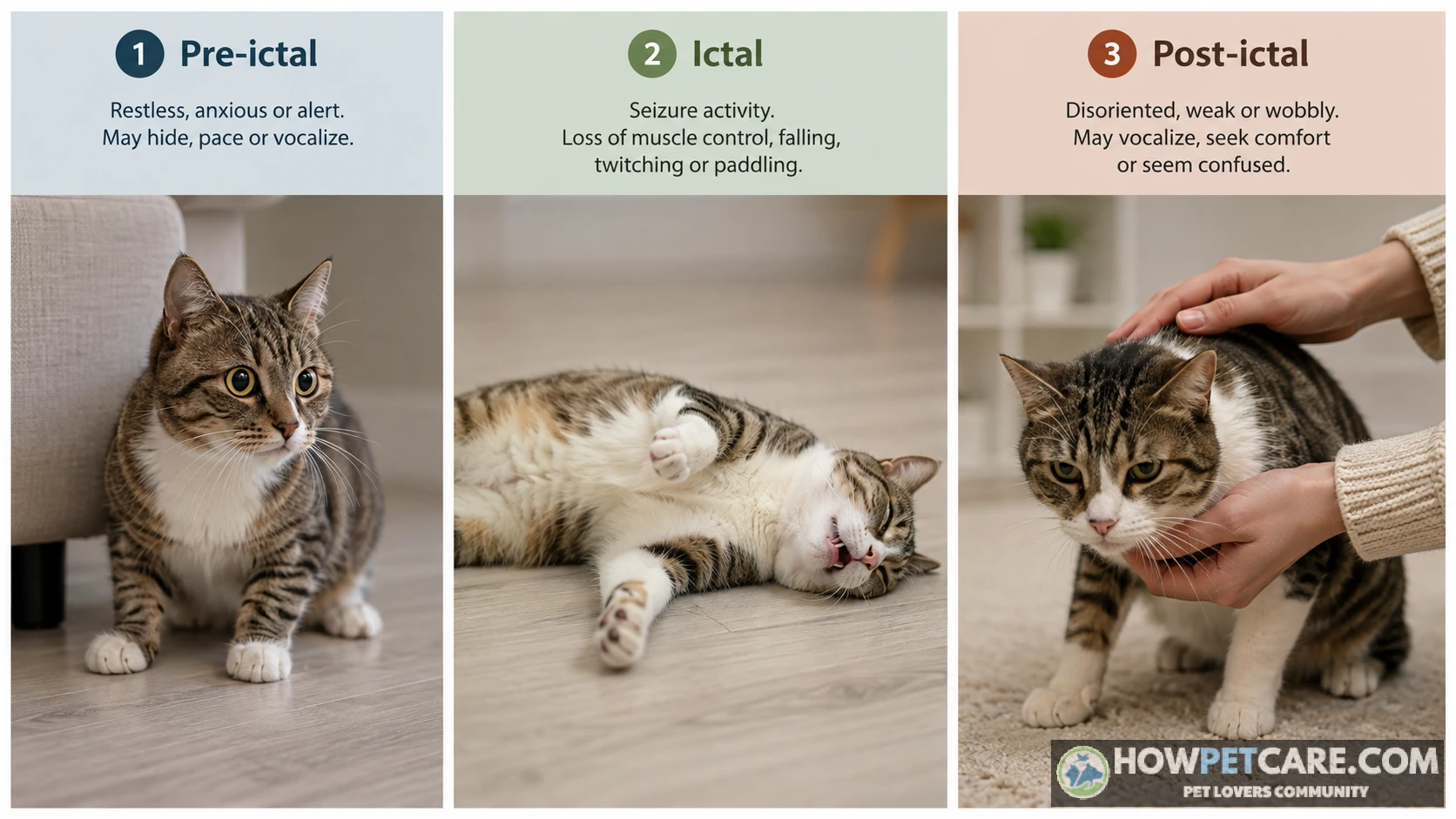
An episode can have three phases, though you may not notice them all:
- Pre-ictal phase, or aura: Before a seizure, a cat may hide, become clingy, seem restless, or vocalize. These signs can be subtle, and their timing varies.
- Ictal phase: This is the seizure itself. It may last seconds to minutes; many generalized seizures last about 1–3 minutes.
- Post-ictal phase: Afterward, a cat may pace, seem disoriented, walk unsteadily, temporarily appear blind, or show changes in appetite. Recovery can take minutes to hours, and sometimes longer.
For the first several minutes after an episode, keep your cat away from stairs and other hazards. Over the next hour, watch for a clear return toward normal awareness and movement. If your cat isn’t improving by about an hour, call an emergency clinic for guidance. Worsening signs, difficulty breathing, or another seizure need immediate help. Even if your cat is improving, tell the vet about lingering blindness, circling, or other neurological changes.
During a generalized seizure, a cat is usually unconscious or unaware, so the episode itself isn’t thought to be consciously experienced as pain. The recovery period can still be frightening, and nearby objects can injure your cat.
Was It Really a Seizure? Seizures vs. Sleep Twitching, Fainting, Tremors, and Vestibular Episodes
Responsiveness offers a clue, but it isn’t a definitive test. A cat having a generalized seizure is typically unresponsive, while a cat with a focal seizure may remain aware. The duration, movement pattern, setting, and recovery all help a veterinarian interpret the event.
| Event | Awareness during episode | Typical movements | Can you interrupt it? | Typical duration | What happens afterward | Next step |
|---|---|---|---|---|---|---|
| Generalized seizure | Usually unresponsive | Collapse, stiffening, then rhythmic movement or paddling | No | Often 1–3 minutes | May be dazed or unsteady | Seek immediate care for a first event, a prolonged event, or clusters; otherwise call your vet today. |
| Focal seizure | May be partly aware or less responsive | Localized twitching, repeated jaw movements, or staring | Usually not reliably interrupted | Seconds to minutes | May be briefly confused or appear normal | Record and report the episode; seek immediate care if it is the first suspected seizure or repeats. |
| Sleep twitching | Asleep; wakes normally | Small paw, whisker, facial, or tail twitches | Usually stops when the cat wakes | Brief bursts | Normal awareness after waking | If the pattern is unusual, happens while awake, or is hard to interrupt, call your vet. |
| Syncope, or fainting | Briefly unresponsive | Often a sudden limp collapse; brief movements can occur | No | Often seconds | Often recovers quickly | Seek prompt veterinary assessment; collapse can signal a serious heart problem. |
| Tremor | Often awake and responsive | Shaking affecting one area or the body | Responsiveness is usually preserved; shaking may persist | Variable | Usually no distinct dazed recovery phase | Call your vet; seek emergency care for suspected toxin exposure, weakness, or severe or persistent signs. |
| Vestibular episode | Often alert but unsteady | Head tilt, falling, rolling, or rapid eye movements | No | May persist rather than occur as a brief spell | Balance problems may continue | Obtain prompt veterinary evaluation; emergency care is appropriate for severe signs or collapse. |

Cat twitching in sleep: dreaming or seizure?
Small twitches while a cat sleeps can be normal. If it’s safe, quietly call your cat’s name or make a gentle sound. A sleeping cat will usually wake and respond normally. Don’t put your hands near the mouth or try to wake a cat who’s convulsing.
Cats can also have seizures while sleeping. An episode that continues after the cat appears awake, involves forceful whole-body movements, or is followed by confusion needs veterinary attention. If this is the first suspected seizure, seek immediate evaluation rather than waiting to capture another event.
Fainting, tremors, and vestibular attacks: key differences
If your cat is twitching or shaking, note whether they’re awake, whether a trigger such as cold or fear is apparent, and whether they return to normal right away. Tremors can also accompany pain, toxin exposure, low blood sugar, or other illness. An alert cat isn’t necessarily a healthy cat.
A cat that faints may collapse and recover quickly. A vestibular problem often leaves a cat visibly off balance. Neither pattern is safe to diagnose at home. Stroke and seizures can also be confused; sudden weakness, collapse, or a head tilt needs prompt veterinary assessment. Share a video if you have one, but don’t wait for another episode before getting help.
Missed It? How to Tell a Seizure Happened and Document the Next One for Your Vet
Clues of a seizure you didn’t see
If you come home to an unusual scene, look for details that may help your vet work out what happened:
- Urine or feces in an unusual location, or drool on fur or bedding.
- Displaced bedding, knocked-over objects, or a disturbed sleeping area.
- Scrapes or bruises, or a cat that seems unusually dazed, wobbly, exhausted, or hungry.
- New hiding, clinginess, or behavior that’s distinctly abnormal for your cat.

None of these clues proves a seizure. Accidents, illness, injury, and other events can leave similar evidence. If your cat is acting abnormally now, call a veterinarian promptly and describe what you found. Breathing trouble, collapse, or worsening signs warrant emergency care.
A pet camera aimed at a favorite sleeping or resting area may capture an event you would otherwise miss. Continuous recording or a pre-trigger buffer can help because motion-triggered clips may miss the beginning. Save the original clip and timestamp.
How to film an episode for the vet
If another episode happens and filming won’t delay care, keep your cat’s face and whole body in frame. Capture the beginning if you can, show the movement pattern and whether the eyes are open, and note whether your cat responds to your voice. Continue filming through recovery if it’s safe, or record a separate recovery clip. Say the time aloud or include a clock.

Don’t touch your cat just to test responsiveness during convulsions. A video helps, but timing the event, preventing injury, and getting emergency help come first.
Seizure log template
Copy this table into a notebook or spreadsheet. Use one row for each episode, and mark details you don’t know rather than guessing.
| Date and time | Duration | What the cat was doing before | Signs observed | Awareness and responsiveness | Recovery time | Possible triggers or changes | Video taken (Y/N) |
|---|---|---|---|---|---|---|---|
| Example: March 4, 2:15 a.m. | About 90 seconds | Sleeping on couch | Stiffened, legs paddled, drooled | Did not respond to name | About 20 minutes of pacing | Evening medication missed; houseguest present | Y |

A possible trigger is a clue, not proof of a cause. Record missed medication, new flea products, household chemicals, meals, heat, or unusual stress. Bring the log and video to the appointment, along with a medication and supplement list, details of flea and tick products, possible exposures, and your cat’s diet and vaccination history.
What Causes Cat Seizures, and What the Vet Visit Involves (Tests and Typical Costs)
Why seizures happen: the main causes, from hypoglycemia to brain tumor
A seizure signals abnormal brain activity; it isn’t a diagnosis on its own. Possible causes include:
- Problems inside the brain: A brain tumor, inflammation, infection, injury, or a vascular event such as a stroke.
- Problems affecting the brain from elsewhere: Hypoglycemia, liver or kidney disease, electrolyte disturbances, or toxin exposure. Some dog flea products containing permethrin are particularly dangerous to cats. High blood pressure may also be relevant to the workup.
- Idiopathic epilepsy: Recurrent seizures for which an appropriate evaluation doesn’t identify a specific underlying cause.
A seizure doesn’t automatically mean your cat has a brain tumor or feline epilepsy. If you suspect exposure to a flea product, medication, or another poison, bring the packaging or a photograph to the emergency clinic. Don’t induce vomiting unless a veterinarian specifically tells you to.
How veterinarians diagnose seizures in cats
The vet will ask what happened before, during, and after the event, review your video and log, and examine your cat. The initial assessment may include a physical and neurological exam, blood pressure measurement, diagnostic bloodwork to check blood cells, organ function, glucose, and electrolytes, and a urinalysis.
Depending on the findings, the vet may recommend thyroid, infectious disease, or liver-function tests. A veterinary neurologist may recommend MRI or CT imaging to look for structural changes, or cerebrospinal fluid analysis to investigate inflammation or infection. Not every cat needs these tests. An EEG, which records electrical activity in the brain, isn’t commonly part of a routine feline workup.
What a seizure workup might cost
U.S. costs vary substantially by region, clinic, time of day, and the care your cat needs. An emergency exam isn’t the same as stabilization. An imaging quote may or may not include anesthesia, interpretation, or hospitalization. Reliable price ranges for these services aren’t established by the evidence available here, so ask the clinic for a current, itemized estimate rather than relying on a national average.
| Service | What to ask the clinic |
|---|---|
| Emergency exam and stabilization | What is the examination fee, and what additional charges might apply for medication, monitoring, or hospitalization? |
| Basic bloodwork and urinalysis | Which tests are included, and are collection and laboratory fees separate? |
| Neurology consultation | Is the consultation separate from imaging and follow-up visits? |
| MRI or CT | Does the estimate include anesthesia, imaging interpretation, and recovery monitoring? |
| Cerebrospinal fluid analysis | Is anesthesia included, and would this be performed alongside imaging? |
| Medication and monitoring | What are the expected prescription, blood-test, and follow-up costs? |
Ask which tests are essential now and which can safely wait. The clinic can explain available payment options, including whether it accepts financing such as CareCredit. Read insurance terms carefully: a policy may exclude pre-existing conditions, so don’t assume signs that have already appeared will be covered.
Treatment, Medication Cautions, and Long-Term Outlook for Cats With Epilepsy
Common anticonvulsants and what to watch for
Treatment depends on the cause and seizure pattern. A vet may recommend an antiseizure medication after repeated or cluster seizures, a prolonged seizure, or findings that suggest an ongoing risk. One brief seizure doesn’t automatically mean lifelong medication. If the vet finds an underlying cause, treating it matters too.
Phenobarbital is a commonly used antiseizure medication. Vets may also consider levetiracetam, zonisamide, or another option for an individual cat. These choices reflect broader principles in veterinary seizure-management guidance, including ACVIM consensus recommendations, rather than a one-size-fits-all prescription.
Tell your vet about excessive sleepiness, wobbliness, increased appetite or thirst, weight changes, or any other new problem. Some early effects may lessen as a cat adjusts, but the clinic can advise whether a change needs attention. Monitoring may include bloodwork and medication-level checks; the schedule depends on the drug and the cat.
Potassium bromide is generally avoided in cats because of the risk of respiratory complications. Never give a human medication or a product prescribed for another animal. Don’t change or abruptly stop an antiseizure prescription without veterinary direction.

Can cats with epilepsy live a normal life?
Many cats with idiopathic epilepsy can have a good quality of life with an individualized care plan, though seizure control varies. Some still have occasional seizures despite treatment. Lifespan and outlook depend heavily on the cause, the cat’s response to treatment, and other health conditions. A structural problem such as a brain tumor can carry a more guarded outlook.
Ask your vet what improvement would be realistic for your cat. Track seizure frequency, recovery time, medication tolerance, and whether your cat can still eat, groom, rest, and play comfortably. Discuss a change in any of these measures, even if the number of seizures hasn’t changed.
Managing a seizure-prone cat at home
Give prescribed medication consistently, keep the seizure log, and maintain a safe, calm environment. Ask your vet for a written emergency plan that covers missed doses, changes that require a call, and whether a rescue medication is appropriate. Don’t assume stress or a particular food caused an event just because it came beforehand; record the pattern for your vet to assess, including possible cat epilepsy triggers you noticed.
Your Next Steps: A Decision Checklist for the Next 24 Hours
- If your cat is still seizing: Start timing, protect them from hazards, and call an emergency clinic as the episode approaches 3 minutes. Go immediately if it reaches 5 minutes.
- If this is a first suspected seizure or there have been repeated episodes: Contact an emergency clinic and arrange immediate care, even if your cat appears to recover.
- If a previously evaluated cat had one short episode and is recovering normally: Call your vet today to arrange the earliest recommended appointment, and follow the existing care plan.
- Document what happened: Save the video, record the duration and recovery, and note medications, missed doses, and possible toxin exposures.
- Prepare for the visit: Call ahead; bring the log, video, medication list, relevant product packaging, and a carrier lined with a towel. Keep your cat away from stairs and other hazards while you arrange transport.
This guide can help you organize your observations, but it can’t diagnose the episode or replace veterinary care.
1At what duration does an ongoing cat seizure reach the critical threshold where you should immediately leave for an emergency clinic?
Reaching 5 minutes indicates potential status epilepticus—a life-threatening prolonged seizure state requiring immediate emergency veterinary intervention.
2What action should a cat owner strictly avoid while their cat is actively having a seizure?
Cats do not swallow their tongues during seizures, and placing hands or objects near their mouth poses a serious risk of accidental biting.
3How are cluster seizures defined in feline emergency triage?
Multiple seizure episodes occurring within a 24-hour window constitute cluster seizures and warrant immediate emergency evaluation even if individual events are brief.
4How does a focal seizure typically differ from a generalized tonic-clonic seizure in cats?
Focal seizures begin in a localized brain region, often producing subtle behavioral changes such as eyelid twitching, repeated jaw movements, or vacant staring.
5Which phase refers to the dazed and disoriented recovery period following a seizure?
The post-ictal phase follows the seizure and is characterized by confusion, unsteadiness, pacing, or temporary blindness as the brain recovers.
6What simple test helps distinguish normal sleep twitching from a seizure occurring during sleep?
A sleeping cat experiencing normal dream twitches will wake up and act alert when gently called, whereas a cat having a seizure cannot be woken normally.
7Which external substance is explicitly noted as a dangerous toxin source that can cause severe seizures in cats?
Permethrin found in canine flea treatments is highly toxic to felines and frequently leads to severe neurological impairment and seizures.
8Why must owners wait until a cat is fully alert and steady before offering food, water, or oral medication post-seizure?
During post-ictal disorientation, normal swallowing reflexes may be impaired, making choking or aspiration likely if items are swallowed.
9Which antiseizure medication is generally avoided in feline treatment due to the risk of severe respiratory complications?
Potassium bromide is avoided in cats due to a high incidence of lower airway inflammation and dangerous respiratory complications.
10If a cat experiences a seizure and remains dazed, after about how long without clear improvement should an emergency clinic be contacted?
If a cat shows no clear signs of neurological improvement after approximately one hour, prompt emergency contact is recommended rather than waiting overnight.
| Event | Awareness during episode | Typical movements | Can you interrupt it? | Typical duration | What happens afterward | Next step |
|---|---|---|---|---|---|---|
| Generalized seizure | Usually unresponsive | Collapse, stiffening, then rhythmic movement or paddling | No | Often 1–3 minutes | May be dazed or unsteady | Seek immediate care for a first event, a prolonged event, or clusters; otherwise call your vet today. |
| Focal seizure | May be partly aware or less responsive | Localized twitching, repeated jaw movements, or staring | Usually not | Seconds to minutes | May be briefly confused or appear normal | Record and report the episode; seek immediate care if it is the first suspected seizure or repeats. |
| Syncope, or fainting | Briefly unresponsive | Often a sudden limp collapse; brief movements can occur | No | Often seconds | Often recovers quickly | Seek prompt veterinary assessment; collapse can signal a serious heart problem. |
| Vestibular episode | Often alert but unsteady | Head tilt, falling, rolling, or rapid eye movements | No | May persist rather than occur as a brief spell | Balance problems may continue | Obtain prompt veterinary evaluation; emergency care is appropriate for severe signs or collapse. |
| Tremor | Often awake and responsive | Shaking affecting one area or the body | No | Variable | Usually no distinct dazed recovery phase | Call your vet; seek emergency care for suspected toxin exposure, weakness, or severe or persistent signs. |
| Sleep twitching | Asleep; wakes normally | Small paw, whisker, facial, or tail twitches | Yes | Brief bursts | Normal awareness after waking | If the pattern is unusual, happens while awake, or is hard to interrupt, call your vet. |
FAQ
Can a cat die from a seizure?
Most brief seizures are not fatal, but prolonged seizures (over 5 minutes) or clusters can be life-threatening because of overheating, low oxygen, and brain injury. Seizures can also signal serious underlying conditions, so any seizure deserves a vet evaluation.
Are seizures painful for cats?
During a generalized seizure, a cat is usually unconscious or unaware, so it is not thought to feel the episode as it happens. The aftermath can be frightening and disorienting, and cats may be confused, wobbly, or temporarily blind while recovering.
Can stress or diet trigger seizures in cats?
Stress, missed medication, and certain toxins or metabolic problems such as low blood sugar can contribute to seizures in some cats. Trigger patterns are individual, so keeping a log helps your vet identify them.
Should I give my cat anything after a seizure?
Avoid giving food, water, or medication until your cat is fully alert and steady, because they may choke or be disoriented. Never give human or dog medications. Call your vet for guidance instead.
Can a cat seizure be mistaken for a stroke?
Yes. Both can cause collapse, loss of balance, or unusual behavior, and owners often can’t tell them apart at home. A vet exam and video of the episode help determine the cause.