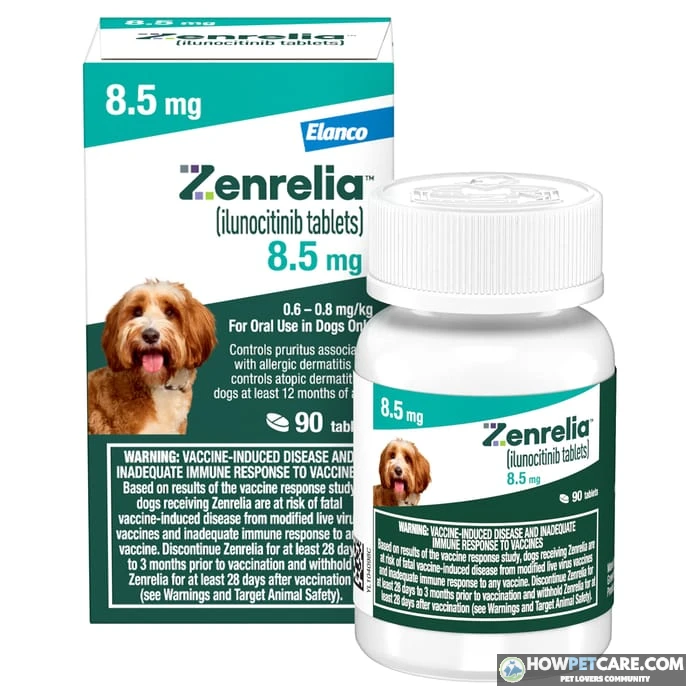

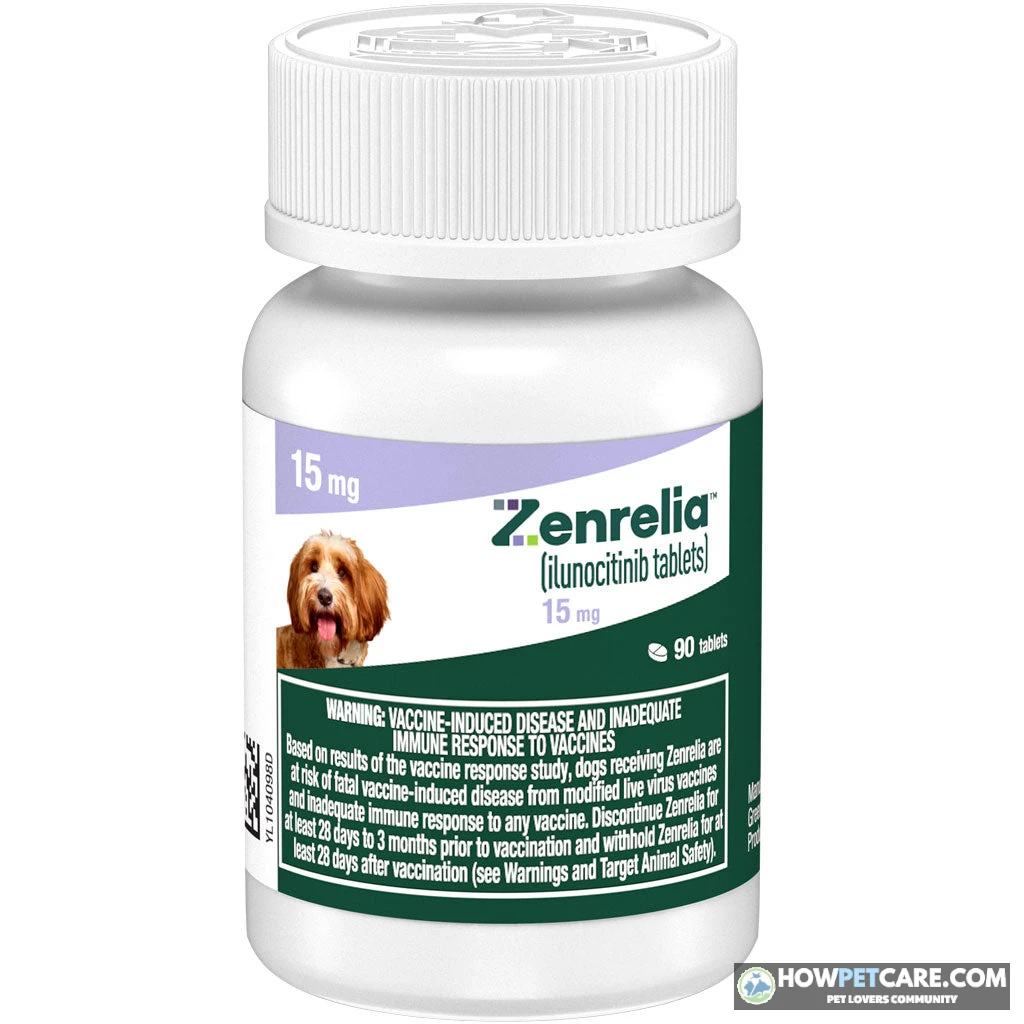
Zenrelia (ilunocitinib) is a once-daily prescription tablet for dogs 12 months and older, FDA-approved to control itching from allergic dermatitis and atopic dermatitis. It’s a JAK inhibitor made by Elanco; the US label carries a boxed warning about inadequate vaccine response.
What Zenrelia (ilunocitinib) Treats in Dogs and Who Can Take It
Zenrelia is a prescription tablet given once daily to dogs at least 12 months old. Made by Elanco, it contains ilunocitinib and is FDA-approved to control itching associated with allergic dermatitis and to control atopic dermatitis. Its vaccine warning changed in September 2025, but the label still warns about an inadequate vaccine response. This guide covers dosing, side effects, cost and comparisons to discuss with your veterinarian before starting or changing treatment.
Zenrelia is a Janus kinase, or JAK, inhibitor. It interferes with some of the signals involved in itching and inflammation, but it doesn’t remove the underlying allergen. If your dog’s signs improve, that means the condition is under control—not cured. Itching may return when treatment stops.
The 12-month age minimum is part of the approved indication. Don’t give Zenrelia to a younger puppy or to a cat. Ask your vet about alternatives for a younger dog rather than assuming a smaller dose is appropriate.
Your veterinarian must authorize the prescription. Depending on your clinic and state requirements, you may be able to fill it at the clinic or at a pharmacy that verifies the prescription. If you compare sources, check where to buy pet medications safely rather than chasing the lowest advertised price. Your vet can also check for skin infections, parasites and other causes of itching that may need treatment alongside allergy control.
Zenrelia Side Effects in Dogs: What’s Common and What Needs a Vet Call
Common side effects by frequency
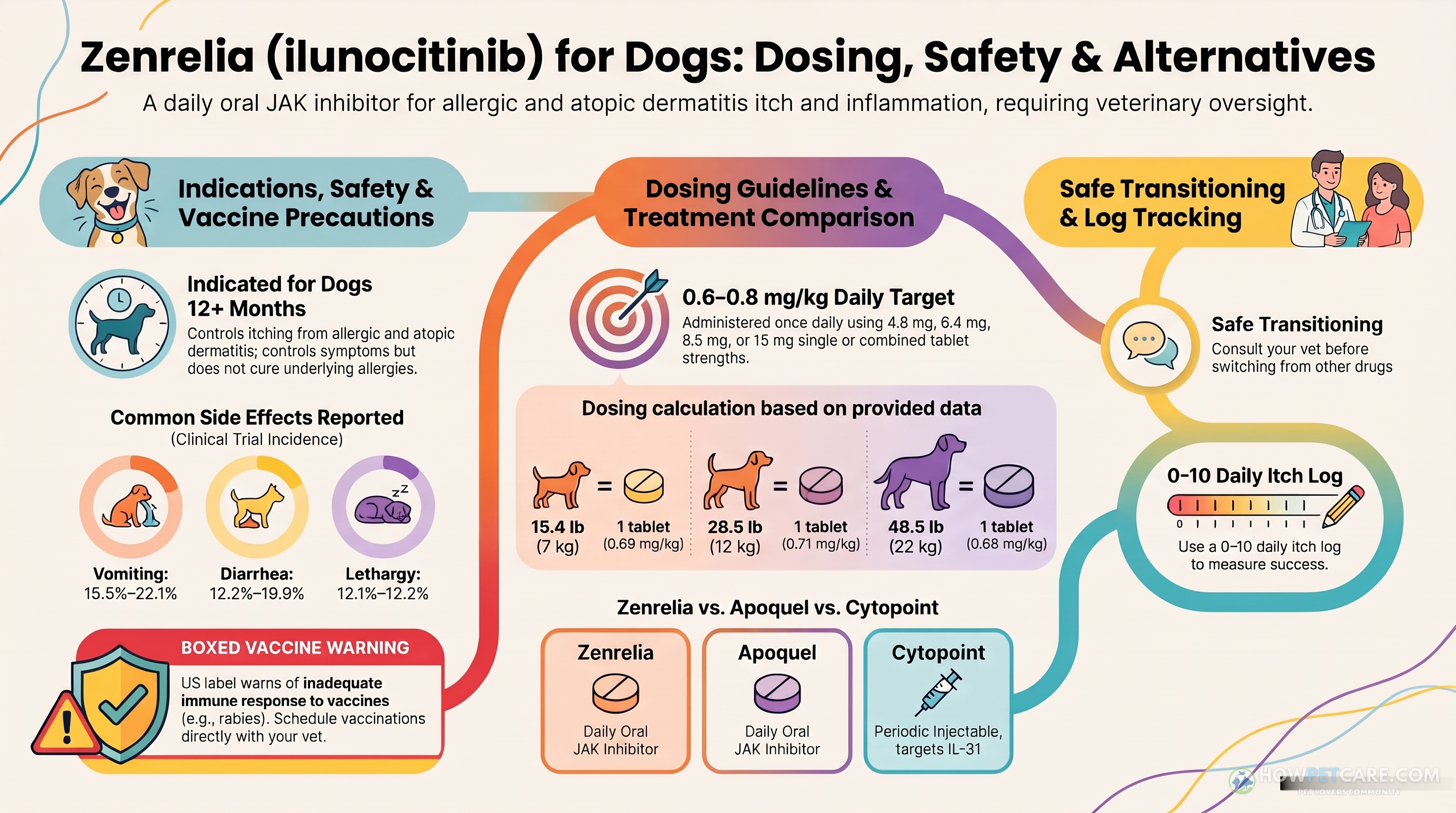
Vomiting, diarrhea and lethargy were among the most commonly reported adverse events in clinical trials. Rates varied across studies: vomiting or nausea occurred in 15.5%–22.1% of dogs, diarrhea in 12.2%–19.9%, and lethargy in 12.1%–12.2%. These figures describe trial populations; they don’t predict what will happen to an individual dog. An event reported during a study isn’t necessarily proven to have been caused by the medication.
Tell your vet when symptoms began, how often they occur and whether your dog is eating and drinking. Call promptly if your dog has repeated vomiting or diarrhea, blood in vomit or stool, marked lethargy, or refuses to drink. Even a mild symptom can matter more if your dog has another illness, so ask the prescribing clinic which changes it wants you to report.
Serious risks and warning signs to report to your vet
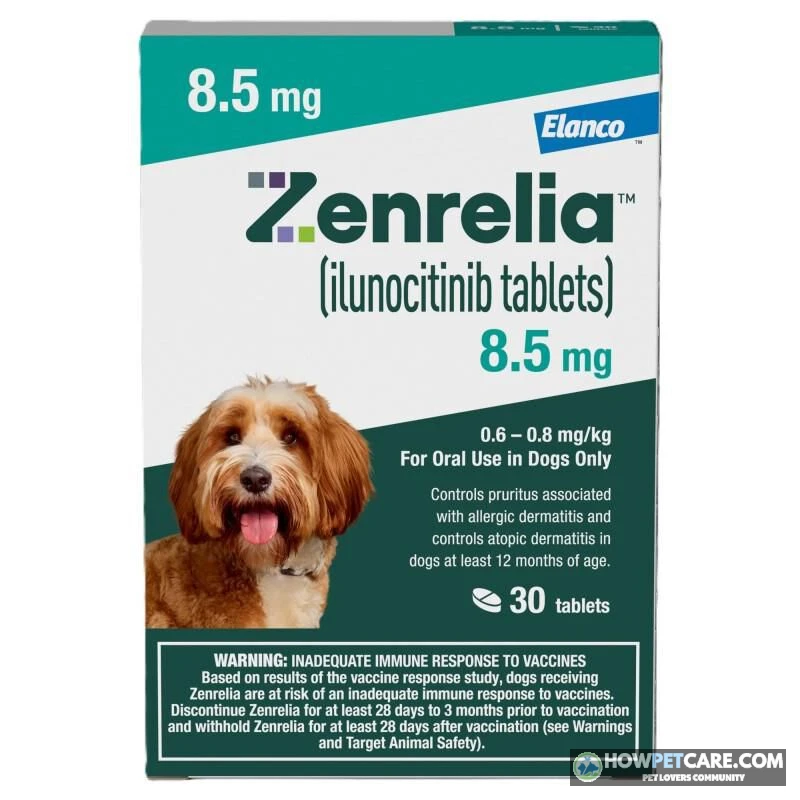
Because Zenrelia affects immune signaling, your vet should consider infections and other health problems when deciding whether it’s suitable. Report recurring skin or ear infections, worsening sores, new lumps, unexplained weight loss, unusual bruising or bleeding, or any other significant change in health. These signs don’t automatically mean Zenrelia is responsible, but they do warrant an assessment.
Before treatment, tell the vet about any active infection, history of cancer, or medications that affect the immune system. Mention if your dog is pregnant, nursing or intended for breeding, too. If a bacterial skin infection is already present, ask whether a treatment such as amoxicillin for dogs belongs in the plan. Your vet can check the current product information and discuss what’s known about those situations.
If your dog collapses, has trouble breathing, appears severely ill, or may have eaten extra tablets, contact a veterinarian or emergency veterinary clinic immediately.
Is long-term use safe, and does my dog need bloodwork?
Zenrelia may be part of an ongoing allergy-control plan, but no medication is risk-free. Ask your vet what monitoring makes sense given your dog’s age, health history and other medications. That may include a baseline blood test or periodic follow-up testing. A recheck also lets the vet assess whether the benefits still justify the cost and any side effects.
A newer medication has a shorter real-world track record than an older one. Talk through that uncertainty with your vet, especially if your dog has other medical conditions or is already doing well on another treatment.

Can Dogs on Zenrelia Get Vaccinated? What the September 2025 Label Update Changed
Dogs taking Zenrelia may still need vaccines, but plan vaccination with the prescribing vet. The September 2025 label revision removed the earlier warning language about fatal vaccine-induced disease. The US label still has a boxed warning about an inadequate immune response to vaccines, especially rabies. Removing the earlier wording does not mean vaccine response is no longer a concern.
What the 2024 warning said and why it caused concern
The original warning about fatal vaccine-induced disease was alarming because vaccines protect dogs against serious infections. If you find an older article repeating that language, check its date and compare it with the current US prescribing information. Don’t assume the older wording still applies.
What changed in September 2025
The FDA approved revised labeling after reviewing additional scientific data. The specific wording about fatal vaccine-induced disease was removed, but the warning about inadequate immune response remains. An inadequate response means a vaccinated dog may not develop the expected protection. It doesn’t mean a vaccine is automatically unsafe for every dog receiving Zenrelia.
How to schedule rabies and core vaccines around Zenrelia
Bring your dog’s vaccine record and the due dates for rabies and other core vaccines to the appointment. Ask your vet to check the current US label for the relevant vaccine and the timing of any interruption before or after vaccination. The supplied evidence describes intervals of 28 days to three months before vaccination and at least 28 days after vaccination, but doesn’t establish which interval applies in each circumstance. Don’t treat those numbers as a schedule to follow without checking the label and your vet’s instructions.
For example, if a rabies booster is due in two months, ask: “Should we address the booster before starting Zenrelia, or is there another appropriate plan for my dog?” Don’t postpone a legally required rabies vaccination or stop a prescribed drug on your own. Your vet can account for local requirements, vaccine type and your dog’s risk.

Zenrelia Dosage by Weight: Chart for the 4.8, 6.4, 8.5 and 15 mg Tablets
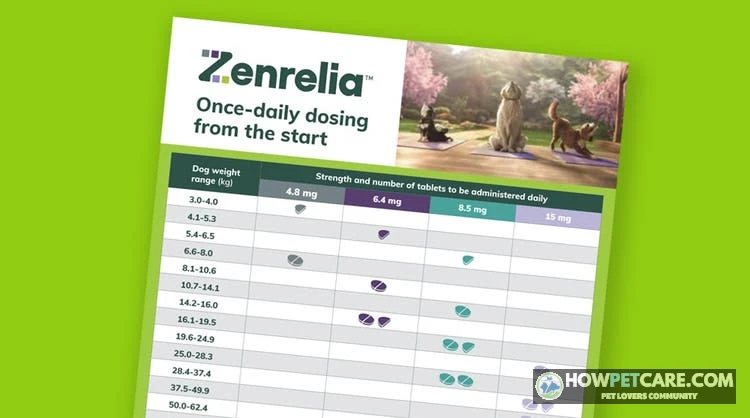
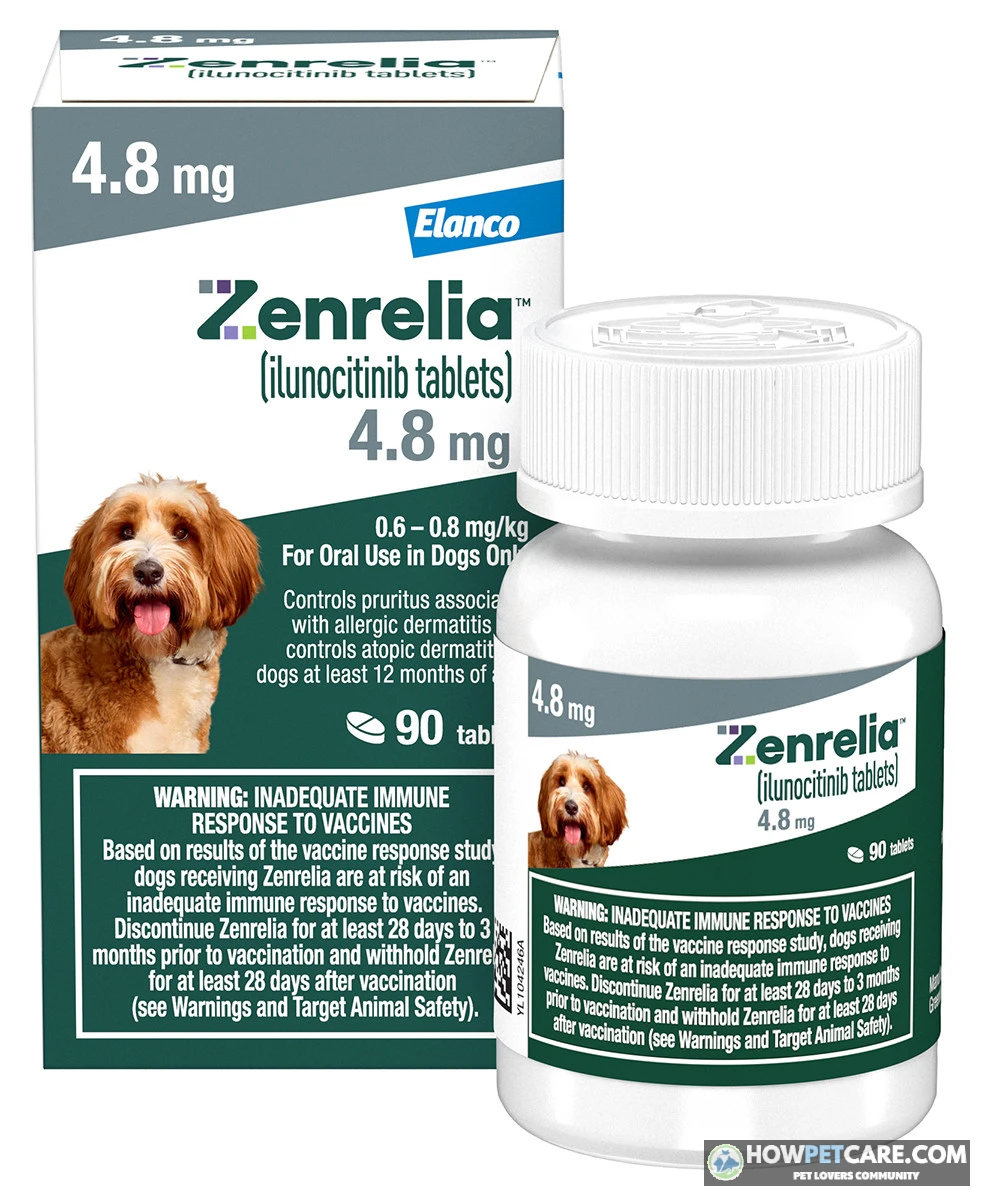
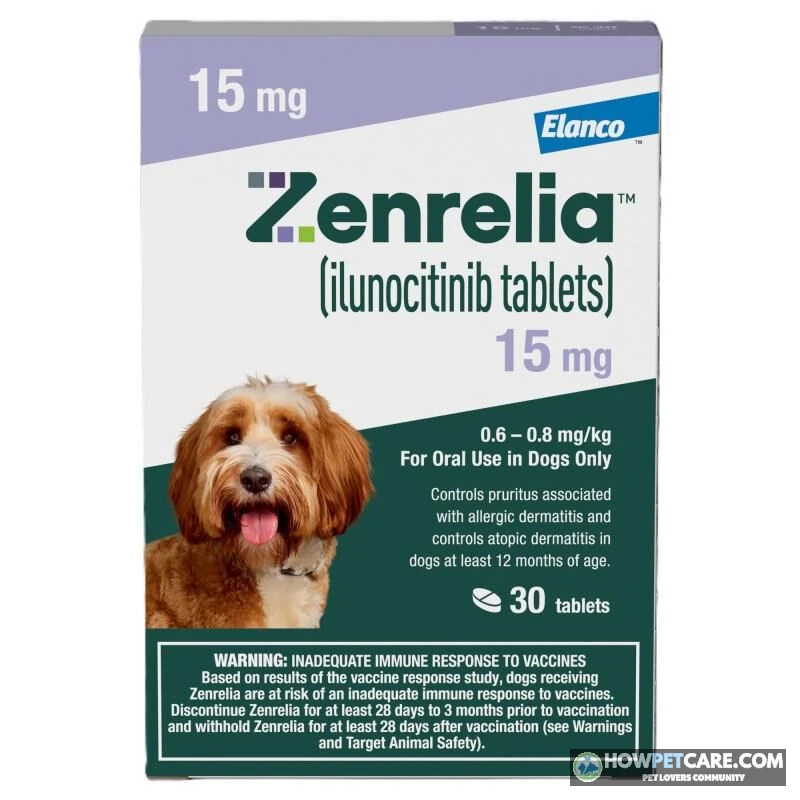
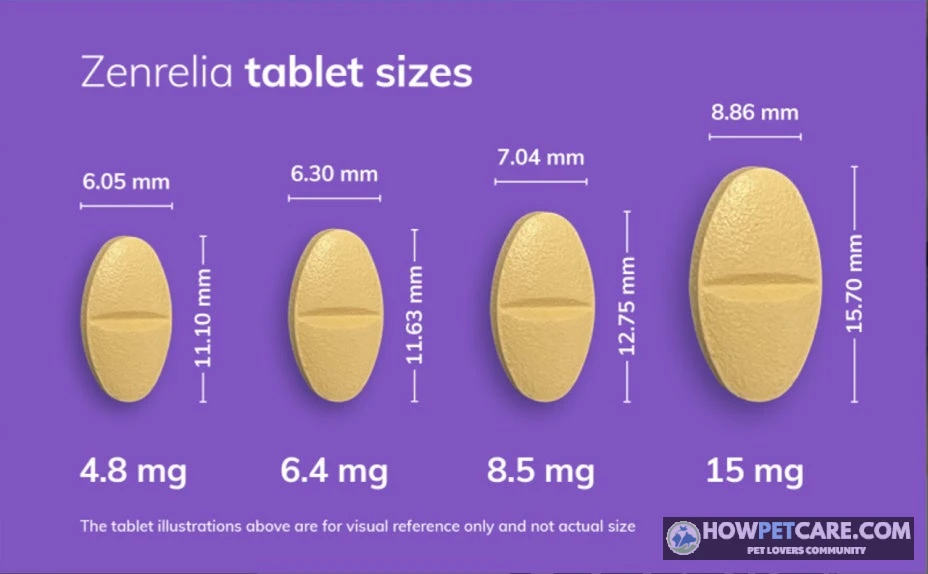
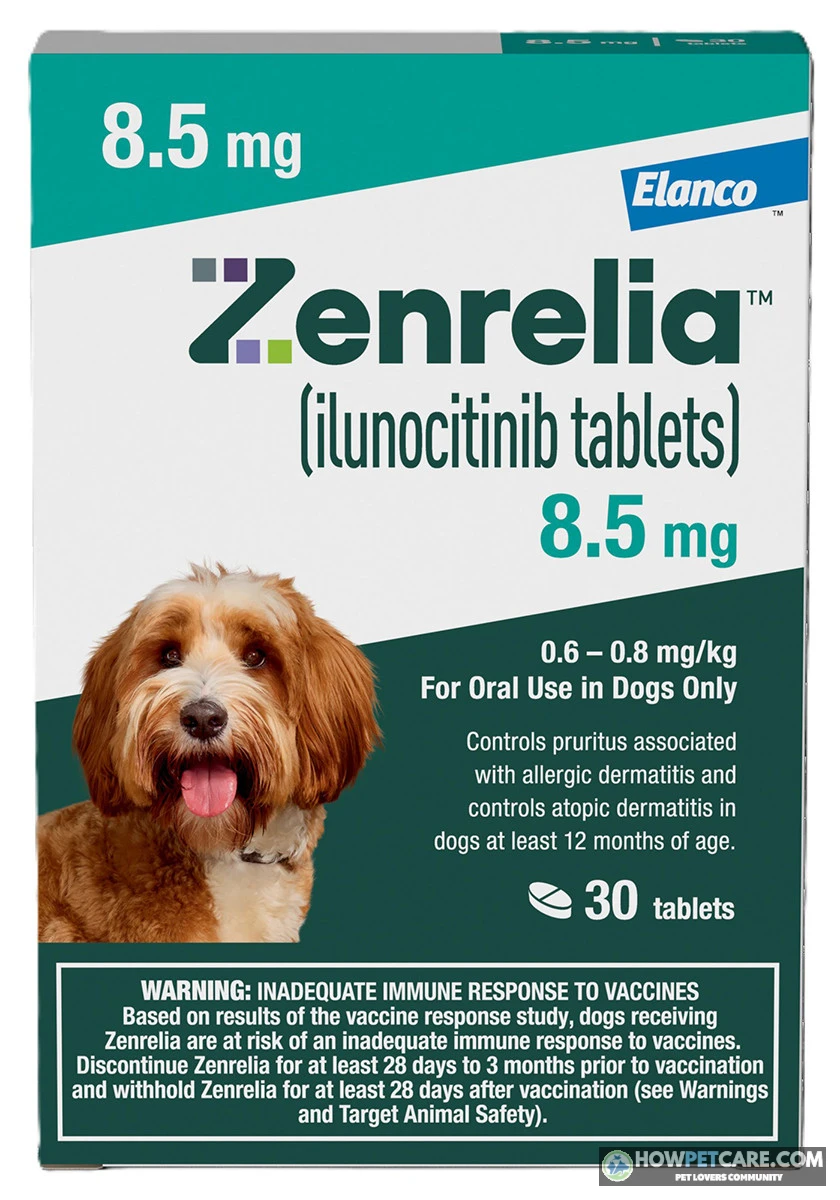
The recommended daily dose is 0.6–0.8 mg per kilogram of body weight, or approximately 0.27–0.36 mg per pound. Zenrelia comes in 4.8 mg, 6.4 mg, 8.5 mg and 15 mg tablet strengths. Your veterinarian will choose the tablet or combination prescribed for your dog’s actual weight.
The examples below show the arithmetic for a single whole tablet at selected weights. They are not the manufacturer’s complete weight-band chart or instructions for choosing a dose. Dogs between these example weights may need a different strength or combination. Check the exact FDA-label weight bands and splitting instructions with the prescribing vet.
| Example body weight | Approximate body weight | Example tablet strength | Whole tablets per day | Approximate dose delivered |
|---|---|---|---|---|
| 15.4 lb | 7 kg | 4.8 mg | 1 | 0.69 mg/kg |
| 19.8 lb | 9 kg | 6.4 mg | 1 | 0.71 mg/kg |
| 26.5 lb | 12 kg | 8.5 mg | 1 | 0.71 mg/kg |
| 48.5 lb | 22 kg | 15 mg | 1 | 0.68 mg/kg |
Worked example: A 55-pound dog weighs about 25 kg. Multiplying 25 kg by the labeled 0.6–0.8 mg/kg range gives approximately 15–20 mg per day. At that rounded weight, one 15 mg tablet works out to roughly 0.6 mg/kg. This calculation can help you understand a prescription, but it doesn’t determine which tablet combination your vet should prescribe. An accurate weight and the label’s actual dosing table matter, especially near a weight-band boundary.
How to give the tablet and handle split doses
Follow the pharmacy label for the amount and daily schedule. Ask the clinic whether your dog’s prescribed tablet can be split, how to divide it accurately and what to do if your dog refuses it. Don’t increase the amount because your dog is still scratching; the vet may need to reassess the diagnosis, timing or a possible infection instead.
The smallest body weight studied in the supplied evidence was 3.0 kg, or about 6.6 lb. If your dog is very small, ask the veterinarian specifically about the available evidence and an appropriate treatment plan.
Zenrelia vs Apoquel vs Cytopoint: How They Differ
Start the comparison with your dog: how well the current treatment works, whether daily tablets are practical, what other health conditions are present and what the full treatment plan costs.
| Factor | Zenrelia (ilunocitinib) | Apoquel (oclacitinib) | Cytopoint (lokivetmab) |
|---|---|---|---|
| Type | Oral JAK inhibitor | Oral JAK inhibitor | Injectable antibody targeting the itch signal IL-31 |
| Routine | Once-daily tablet | Tablets; typically twice daily initially, then once daily under the prescribing schedule | Veterinary injection, generally repeated at intervals according to response |
| Efficacy evidence | Manufacturer-sponsored comparison found non-inferiority to Apoquel at the primary day-28 endpoint | Comparator in the Zenrelia study; established option for allergic itch | Has its own efficacy evidence; don’t infer superiority from separate trials |
| Safety considerations | Vaccine-response boxed warning remains; discuss infections and other health risks | Discuss immune-related precautions and your dog’s medical history with the vet | Different mechanism and safety profile; discuss prior reactions and suitability with the vet |
| Cost and access | Veterinary prescription; price depends on strength and quantity | Veterinary prescription; price depends on strength and schedule | Ask the clinic for the injection price and any examination or visit charge |
Efficacy: what the studies showed versus “clinical remission” marketing
In a manufacturer-sponsored head-to-head study, Zenrelia was non-inferior to Apoquel at the primary endpoint on day 28. Non-inferior at that endpoint doesn’t mean it’s proven better for every dog. Studies can differ in outcome measures, enrollment rules and time points. A result from one comparison can’t establish that either tablet is better than Cytopoint.
One later measure reported the proportion of dogs with a pruritus visual analog scale, or PVAS, score below 2 on day 112: 77% for Zenrelia and 53% for Apoquel. PVAS is an owner-assessed itch measure. Read that result alongside the study design and primary endpoint, rather than treating it as a guarantee for your dog.
A separate result found treatment success for atopic dermatitis at day 28 in 83% of Zenrelia-treated dogs versus 31% of placebo-treated dogs. Placebo-controlled and active-comparator results answer different questions. Neither tells you in advance which treatment your dog will tolerate best.
“Clinical remission” describes a level of control used in study or marketing contexts; it doesn’t mean the underlying allergy has been removed. Ask which itch and skin scores were measured, over what period, and whether the dog was still receiving treatment.
Which option fits which dog and household
If giving a tablet every day is difficult, ask whether an injection is a practical alternative. If your dog is already comfortable on Apoquel, ask what meaningful benefit a switch is expected to bring. If vaccine timing, infections or another illness are your main concern, include those in the decision rather than assuming one option is safest for every dog.
Online Zenrelia reviews can suggest questions to ask, but individual anecdotes can’t establish how often a side effect occurs or whether a medicine caused it. The efficacy comparisons discussed here include manufacturer-sponsored evidence; independent long-term experience and your own vet’s assessment are important context.
How Much Zenrelia Costs per Month by Dog Size
There isn’t one reliable monthly price for Zenrelia. The prescription, tablet strength, pharmacy and location all affect the bill. The evidence provided here doesn’t include dated, verifiable US pharmacy quotes, so inventing per-tablet prices or monthly ranges would be misleading. Ask for an itemized quote for your dog’s exact prescription.
| Dog size | Tablet strength | Approximate tablets per month | Estimated monthly drug cost | Price source and date |
|---|---|---|---|---|
| Small | Prescribing vet to confirm | Daily tablet quantity × 30 | Quote needed | Record pharmacy and quote date |
| Medium | Prescribing vet to confirm | Daily tablet quantity × 30 | Quote needed | Record pharmacy and quote date |
| Large | Prescribing vet to confirm | Daily tablet quantity × 30 | Quote needed | Record pharmacy and quote date |
Size alone doesn’t tell you what prescription your dog needs; the strength and number of tablets matter. If your vet prescribes more than one strength, calculate each separately and add the results.
What affects the price you pay
Use this worksheet with a clinic quote and, if you wish, a quote from a pharmacy that will verify the prescription:
- Write down each prescribed strength, the number of tablets per day and the quoted price per tablet.
- Multiply the daily number of tablets by 30, then multiply by the price per tablet. Add the totals for any different strengths.
- Add the monthly equivalent of examination or recommended monitoring costs. Subtract a discount only after confirming that your purchase qualifies.
- For Apoquel, calculate the cost for the relevant dosing phase. For Cytopoint, add the injection and visit charges, divide by the number of weeks the effect lasts for your dog, and multiply by about 4.3 to estimate a monthly equivalent.
- Check whether your pet insurance covers prescription allergy treatment and whether deductibles, exclusions or reimbursement limits apply.
Elanco has promoted Zenrelia as less expensive than Apoquel, but a manufacturer price claim isn’t a quote for your dog. Compare the actual prescriptions and associated visit costs before deciding whether either option saves money.
Ask both the clinic and pharmacy for the same strength, quantity and refill period. Confirm whether any examination, shipping or prescription-processing charge is separate.
Switching from Apoquel or Cytopoint to Zenrelia: A Step-by-Step Transition Guide
Owners may consider a switch if itch control is incomplete, the dosing routine is difficult or the cost has become hard to manage. Your veterinarian needs to guide the transition. Don’t stop the current treatment or add Zenrelia on your own.
Switching from Apoquel
Apoquel and Zenrelia both affect JAK signaling. Ask the vet when to give the last Apoquel dose and the first Zenrelia dose, and whether your dog needs a gap between them. The evidence supplied here doesn’t establish a universal washout period or an approved overlap schedule. Don’t give both together unless the vet specifically directs you to.
If scratching increases during a gap, tell your vet rather than assuming it’s an expected adjustment. The vet can decide whether to change the plan or check for infection, fleas or another contributing problem.
Switching from Cytopoint
Write down the date of the last injection and tell your vet how long its benefit usually lasts for your dog. Its effect fades, rather than ending at a precisely predictable moment. Your vet can decide when to introduce Zenrelia and whether any overlap is appropriate; the supplied evidence doesn’t provide a universal transition schedule.

Tracking whether the switch is working
Before the appointment, record your dog’s current medication, dose, vaccine dates and known health problems. Note any active skin or ear symptoms and list every other medicine or supplement, including ear treatments like Tresaderm. Confirm that your dog meets the 12-month age requirement.
Keep a simple daily itch log from 0 to 10, using the same scale each day: 0 for no apparent scratching and 10 for near-constant scratching. Alongside the score, note sleep disruption, chewing, new sores and any stomach upset. This is a practical home log, not a validated diagnosis or substitute for a veterinary exam.
Agree on a recheck date, what improvement would count as success, which side effects warrant a call and what the backup plan is if the new treatment doesn’t help. Increased itching during a switch may reflect a gap in control; by itself, it doesn’t prove “rebound” or identify the cause.
Giving Zenrelia Day to Day: Missed Doses, Overdose, Stomach Upset and Other Medications
What to do if your dog misses a dose
Ask your vet or pharmacist what to do if your dog misses a dose. If you notice close to the next scheduled dose, call for guidance instead of doubling up. Don’t give extra tablets to make up for uncertainty about whether a dose was swallowed.
If your dog vomits after taking a tablet, ask the vet whether a replacement dose is appropriate. The answer may depend on when the vomiting happened and whether the tablet was actually expelled. Giving another dose without checking could mean your dog gets too much medication.
What to do if your dog takes too much
Call your veterinarian, an emergency veterinary clinic or a pet poison service immediately. Don’t wait for symptoms or induce vomiting unless a veterinary professional tells you to. Have the bottle ready and provide your dog’s weight, tablet strength, estimated number swallowed, time of exposure and any symptoms. Pet poison hotlines may charge a fee.
If vomiting or diarrhea starts after treatment, contact your vet for advice, especially if symptoms persist, recur or come with lethargy or poor drinking. Ask whether to give the next dose. Don’t assume that hiding a tablet in food will resolve a medication reaction.
Flea and tick preventatives, steroids and Atopica
Tell your vet about flea and tick products, including oral isoxazolines such as Bravecto, NexGard, Simparica and Credelio. The supplied evidence doesn’t include a complete interaction assessment for each product, so it can’t guarantee that every combination is safe. Your vet can check the specific products, your dog’s history and the current prescribing information.
Also disclose steroids, cyclosporine products such as Atopica and any other immune-affecting medication. Don’t start, stop or combine them with Zenrelia without a veterinary plan. Keep tablets in their original container and out of reach of children and pets.
Questions to Bring to Your Vet Before Starting or Switching to Zenrelia
Bring your dog’s current medication list, vaccine record, recent weight and itch log. These questions can help you leave with a specific plan:
- Is my dog a suitable candidate given their age, infections, health history and any history of cancer?
- Which vaccines are due, and what does the current Zenrelia label say about timing them for my dog?
- What exact tablet strength and number of tablets should I give, and what is the estimated monthly cost?
- Can the prescription be filled at an outside pharmacy, and are there additional fees?
- If switching from Apoquel or Cytopoint, when should I give the last current treatment and the first Zenrelia dose? Should there be a gap or overlap?
- What improvement should we expect, when should we recheck and what will we try if the itch remains uncontrolled?
- Which side effects require a same-day call, and do you recommend baseline or follow-up bloodwork?
- Can Zenrelia be used with my dog’s specific flea prevention and other prescriptions?

If your dog’s current treatment controls the itch, is well tolerated and fits your budget, ask whether staying with it makes sense. If control is incomplete or the routine or cost is difficult, use the answers to compare a vet-directed Zenrelia trial with the alternatives.
FAQ
Does Zenrelia require a prescription?
Yes. Zenrelia is a prescription-only veterinary drug, so your vet must examine your dog and authorize it. It can be filled at the clinic or through an online pharmacy that verifies the prescription.
Why can’t dogs under 12 months old take Zenrelia?
The label approves Zenrelia only for dogs 12 months and older. Safety and effectiveness were not established in younger dogs, whose immune systems are still developing.
Is ‘clinical remission’ the same as a cure for my dog’s allergies?
No. Remission is a term used in the manufacturer’s trial reporting for controlled itch and skin lesions while the dog is on treatment. Zenrelia does not cure the underlying allergy, and signs can return if it is stopped.
How long can my dog stay on Zenrelia?
The label allows ongoing daily use for chronic atopic dermatitis, but long-term data are limited compared with older drugs. Ask your vet how often to recheck your dog and whether periodic bloodwork is advised.
Is Zenrelia better than Apoquel?
It depends on the dog. Both are once-daily JAK inhibitors, and the head-to-head evidence cited for Zenrelia comes largely from manufacturer-sponsored work, so your vet’s judgment on your dog’s history, cost and tolerance matters more than a general claim.