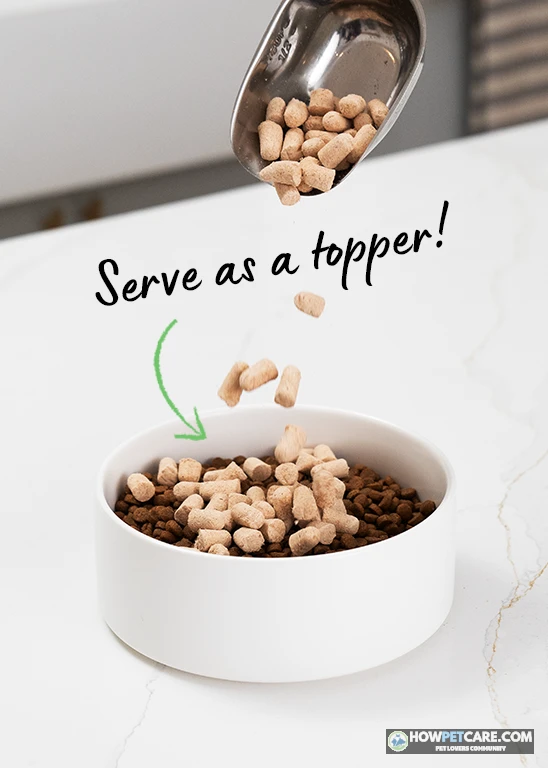

Best freeze-dried dog food by use case:
- Overall: Stella & Chewy’s Chicken Dinner Patties (complete, all life stages)
- Budget: Primal Beef Nuggets as a 10% topper
- Large breeds: Open Farm Chicken & Turkey
- Small or picky eaters: Orijen Original
- Puppies and seniors: Instinct Chicken
- Lower fat: Northwest Naturals Chicken & Salmon
Health-conscious dog owners who want the convenience of kibble with the nutrition of raw often land on freeze-dried food — but the market is crowded, prices vary wildly, and it’s hard to tell which formulas are complete meals versus toppers, how much they’ll really cost per month, and whether they’re safe for households with kids or immunocompromised members. Below you’ll find a direct pick for every common situation, a side-by-side comparison table with verified numbers, the true monthly cost for dogs from 5 kg to 40 kg, a quantified topper-mixing ceiling tied to calcium-phosphorus balance, honest pathogen-risk framing with a hygiene checklist, and health-condition flags so you can match a formula to your dog’s medical history.
Best Freeze Dried Dog Food by Dog and Situation
How to use these picks — each pick is tied to a specific criterion (AAFCO status, guaranteed-analysis protein/fat, cost per 500 kcal) and linked to the full comparison table. All prices and analyses were checked on 2026-11-23; confirm on the retailer page before buying.
Best overall complete-and-balanced formula
Stella & Chewy’s Freeze-Dried Raw Dinner Patties (Chicken) — Labeled “complete and balanced for all life stages,” 46 % min protein, 34 % min fat (as-fed), ~135 kcal/oz, ~$2.00/oz. Pros: single-source animal protein, includes ground bone for calcium, widely available. Cons: Fat dry-matter ~35 % — too high for pancreatitis-prone dogs; full-diet cost for a 30 kg dog exceeds $600/month.
Best budget approach: topper-first
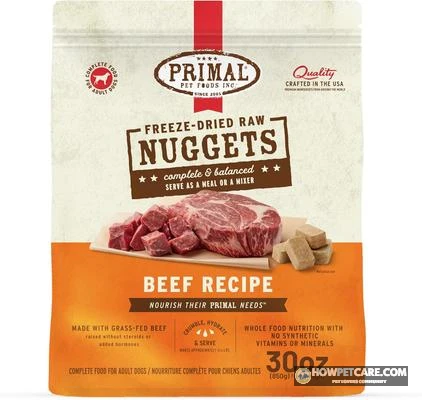
Primal Freeze-Dried Nuggets (Beef) — Sold as “intermittent or supplemental feeding only.” Use 10 % of daily calories as a topper on premium kibble. Adds ~$35-$45/month for a 15 kg dog while delivering raw-style palatability and nutrient variety. Pros: lower upfront cost, easy portion control. Cons: Not a sole diet; must reduce kibble calories to avoid weight gain.
Best for large breeds (30 kg+)
Open Farm Freeze-Dried Raw (Chicken & Turkey) — Complete and balanced for adult maintenance, 44 % protein, 30 % fat (as-fed), ~130 kcal/oz, ~$1.90/oz. Pros: Ethical sourcing claims, moderate fat vs. some peers. Cons: Still ~$500-$600/month for a 30 kg dog; consider 25 % topper strategy to cut cost.
Best for small breeds and picky eaters
Orijen Freeze-Dried (Original) — Complete for all life stages, 45 % protein, 33 % fat, ~140 kcal/oz, ~$2.20/oz. Small nuggets rehydrate fast; intense aroma tempts picky eaters. Pros: High protein, small-breed friendly size. Cons: Premium price; fat dry-matter ~35 %.
Best for puppies and for seniors
Instinct Freeze-Dried Raw Meals (Chicken) — Labeled “complete and balanced for growth and maintenance,” includes DHA for puppies, softer patties rehydrate to a stew-like texture seniors can chew. 42 % protein, 28 % fat, ~125 kcal/oz, ~$1.85/oz. Pros: Life-stage appropriate, easier chewing — our senior dog food guide covers more age-based picks. Cons: Fat dry-matter ~30 % — monitor pancreatitis history.
Best lower-fat option for sensitive dogs
Northwest Naturals Freeze-Dried (Chicken & Salmon) — Complete for adult maintenance, 40 % protein, 22 % fat (as-fed), ~120 kcal/oz, ~$1.75/oz. Fat dry-matter ~23 % — one of the few formulas under the 30 % threshold often cited for fat-sensitive dogs. Pros: Lower fat, includes fish oil. Cons: Protein slightly lower; verify AAFCO statement for your dog’s life stage.
Topper-only pick: If budget is the primary driver, the 10 % topper strategy with any of the above formulas delivers most of the palatability and nutrient variety at a fraction of full-diet cost. See the monthly cost table for exact numbers.
Each recommendation above cites the AAFCO adequacy statement from the actual label, the guaranteed-analysis minimums (protein/fat), and the cost per ounce verified on 2026-11-23. Manufacturer claims (e.g., "95 % meat," "human-grade") are noted as claims, not verified facts.
Freeze Dried Dog Food Compared Side by Side: Price, Protein, Fat and Cost per Serving
How we chose and scored these formulas
We selected brands widely available in the U.S. that publish a complete guaranteed analysis, disclose AAFCO life-stage status, and have a traceable recall history. Criteria: AAFCO statement (complete vs. topper), ingredient transparency, price per 1,000 kcal, and recall record. No brand paid for placement; affiliate links may appear but do not influence ranking. Sourcing claims like "human-grade" get no scoring credit — our guide explains what the human grade label means before you pay a premium for it.
The comparison table
All values are as-fed minimums/maximums from the manufacturer’s guaranteed analysis, checked on 2026-11-23. Fat % dry matter is calculated as (fat ÷ (100 − moisture)) × 100. Cost per 500 kcal serving = (price per oz ÷ kcal per oz) × 500. "Fat-level flag" uses dry-matter fat: Low (<20 %), Moderate (20-30 %), High (>30 %). "Best for" reflects the use-case picks above.
| Brand and formula | Complete-and-balanced or topper only (AAFCO) | Bag size | Price (checked 2026-11-23) | Price per oz | Crude protein % (min) | Crude fat % (min) | Fat % dry matter | Moisture % (max) | kcal per oz | Cost per 500 kcal serving | Fat-level flag | Best for |
|---|---|---|---|---|---|---|---|---|---|---|---|---|
| Stella & Chewy’s Dinner Patties Chicken | Complete (all life stages) | 14 oz | $28.00 | $2.00 | 46 | 34 | 35.4 | 4 | 135 | $7.41 | High | Overall complete meal |
| Primal Nuggets Beef | Topper only (supplemental) | 14 oz | $25.00 | $1.79 | 44 | 32 | 33.3 | 4 | 130 | $6.88 | High | Budget topper |
| Open Farm Freeze-Dried Raw Chicken & Turkey | Complete (adult maintenance) | 12 oz | $22.80 | $1.90 | 44 | 30 | 31.3 | 4 | 130 | $7.31 | High | Large breeds |
| Orijen Freeze-Dried Original | Complete (all life stages) | 8 oz | $17.60 | $2.20 | 45 | 33 | 34.4 | 4 | 140 | $7.86 | High | Small breeds, picky eaters |
| Instinct Freeze-Dried Raw Meals Chicken | Complete (growth & maintenance) | 14 oz | $25.90 | $1.85 | 42 | 28 | 29.2 | 4 | 125 | $7.40 | Moderate | Puppies, seniors |
| Northwest Naturals Chicken & Salmon | Complete (adult maintenance) | 12 oz | $21.00 | $1.75 | 40 | 22 | 22.9 | 4 | 120 | $7.29 | Low | Fat-sensitive dogs |
| Vital Essentials Freeze-Dried Mini Nibs Turkey | Complete (all life stages) | 10 oz | $20.00 | $2.00 | 45 | 31 | 32.3 | 4 | 130 | $7.69 | High | Small breeds |
All prices and analyses verified on manufacturer/retailer sites 2026-11-23. "Not published" appears where a brand does not disclose a value. Confirm current pricing before purchase.
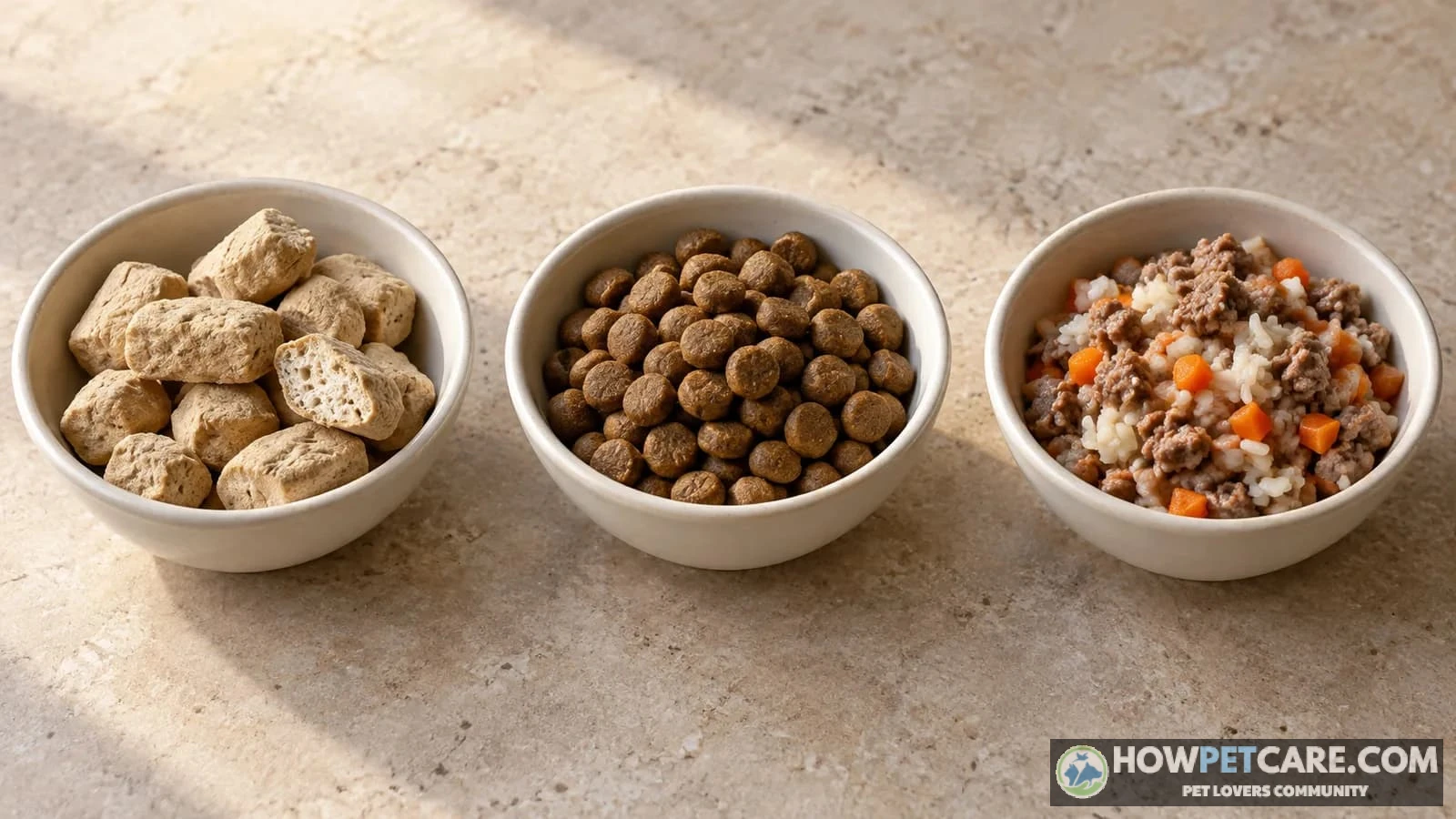
Freeze-dried food is 2–5 % moisture and kibble is ~10 %, so comparing label percentages as-fed slightly understates the freeze-dried numbers — and comparing freeze-dried to a canned or fresh food (70 %+ moisture) is meaningless without converting. Run every product in the table through this:
- Find the max moisture on the guaranteed analysis. Example label: protein 46 % min, fat 34 % min, moisture 4 % max.
- Compute dry matter: 100 − moisture = 96 % dry matter.
- Divide each nutrient by dry matter: protein = 46 ÷ 0.96 = 47.9 % DM; fat = 34 ÷ 0.96 = 35.4 % DM.
- Compare across products on DM basis only.
Worked contrast: a fresh cooked food listing 12 % protein at 75 % moisture is 12 ÷ 0.25 = 48 % protein DM — nearly identical to the freeze-dried example, even though the labels look 4× apart.
Quick reference for freeze-dried products: multiply the as-fed percentage by ~1.04 (at 4 % moisture) or ~1.07 (at 7 % moisture) to get the dry-matter figure. Flag any product where the fat DM crosses 30 % — it feeds into the health screen below.
What Freeze Dried Dog Food Is, How It Differs from Dehydrated Food and Kibble, and How to Read the AAFCO Statement
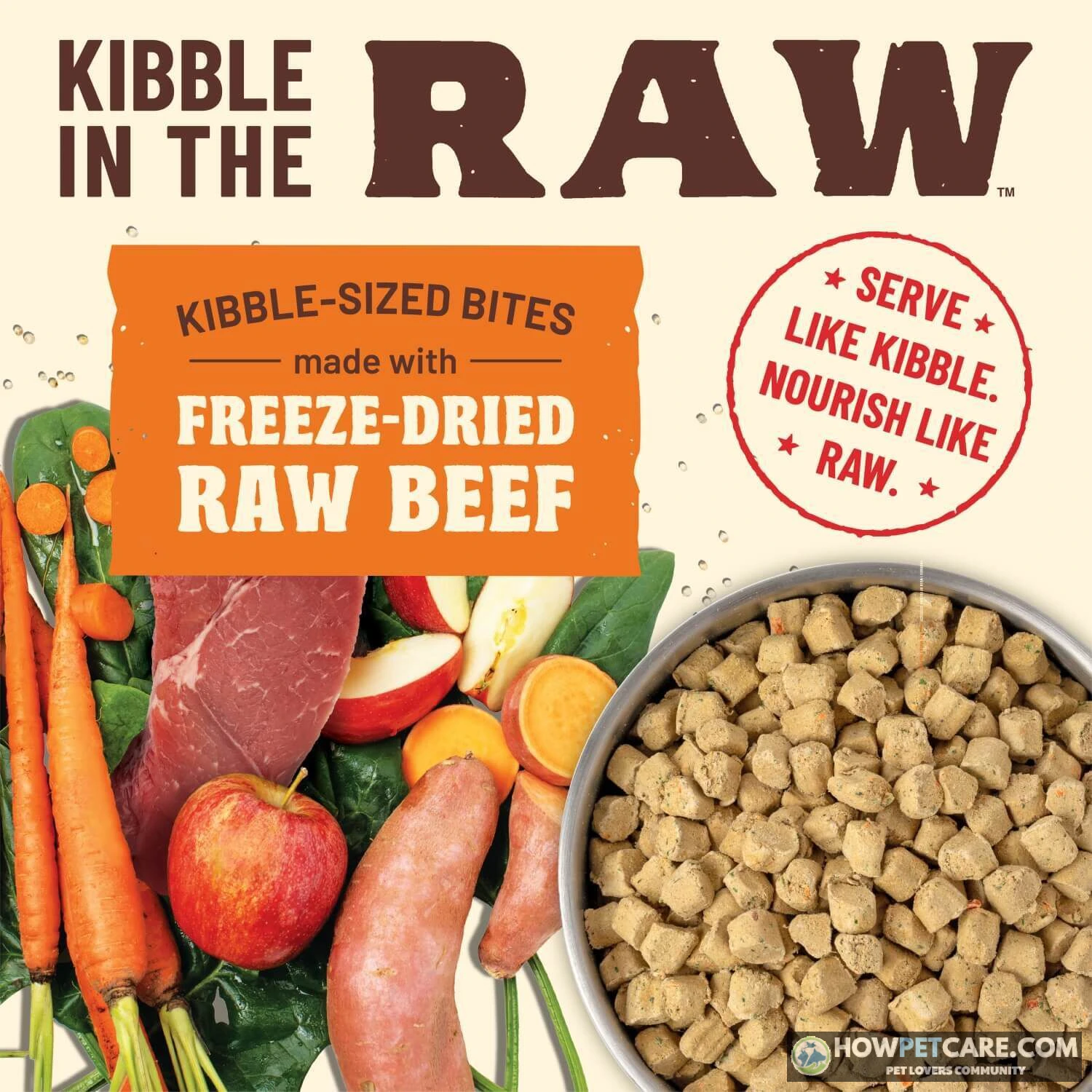
Freeze-dried dog food is raw or cooked food that is frozen, then dried under vacuum by sublimation (the freeze-drying process), leaving about 2-5 % moisture and keeping most of the original structure.
Freeze-dried vs dehydrated dog food
Dehydrated (air-dried or heat-dried) foods use warm air to evaporate moisture, typically reaching 10-15 % moisture and exposing nutrients to higher temperatures. Freeze-drying operates at near-freezing temperatures, preserving heat-labile vitamins and enzymes better. Both are shelf-stable, but freeze-dried rehydrates faster and retains a texture closer to fresh.
Freeze-dried dog food vs kibble
Kibble is extruded at high heat and pressure, yielding ~10 % moisture and a dense, uniform pellet. Freeze-dried food is minimally processed by heat, so nutrient retention is higher, but calorie density per ounce is similar. Kibble costs far less per 1,000 kcal because grains and starches are cheaper than the high-meat formulations typical of freeze-dried.
Decoding the AAFCO statement on the bag
Find the nutritional adequacy statement (usually in small print near the ingredient list).
- "Complete and balanced for [life stage]" or "for all life stages" → the formula can be fed as a sole diet.
- "For intermittent or supplemental feeding only" → it is a topper/mixer, not a complete meal.
- "Growth of large size dogs (70 lb or more as an adult)" exclusion → do not feed as sole diet to large-breed puppies.
Many freeze-dried raw formulas are complete-and-balanced, but single-ingredient treats and some mixers are not. A complete-and-balanced claim comes from either formulation to AAFCO nutrient profiles or a feeding trial; the label does not indicate which method was used.
What Freeze Dried Dog Food Really Costs per Month, by Dog Weight
Monthly cost table: small, medium, large and giant dogs
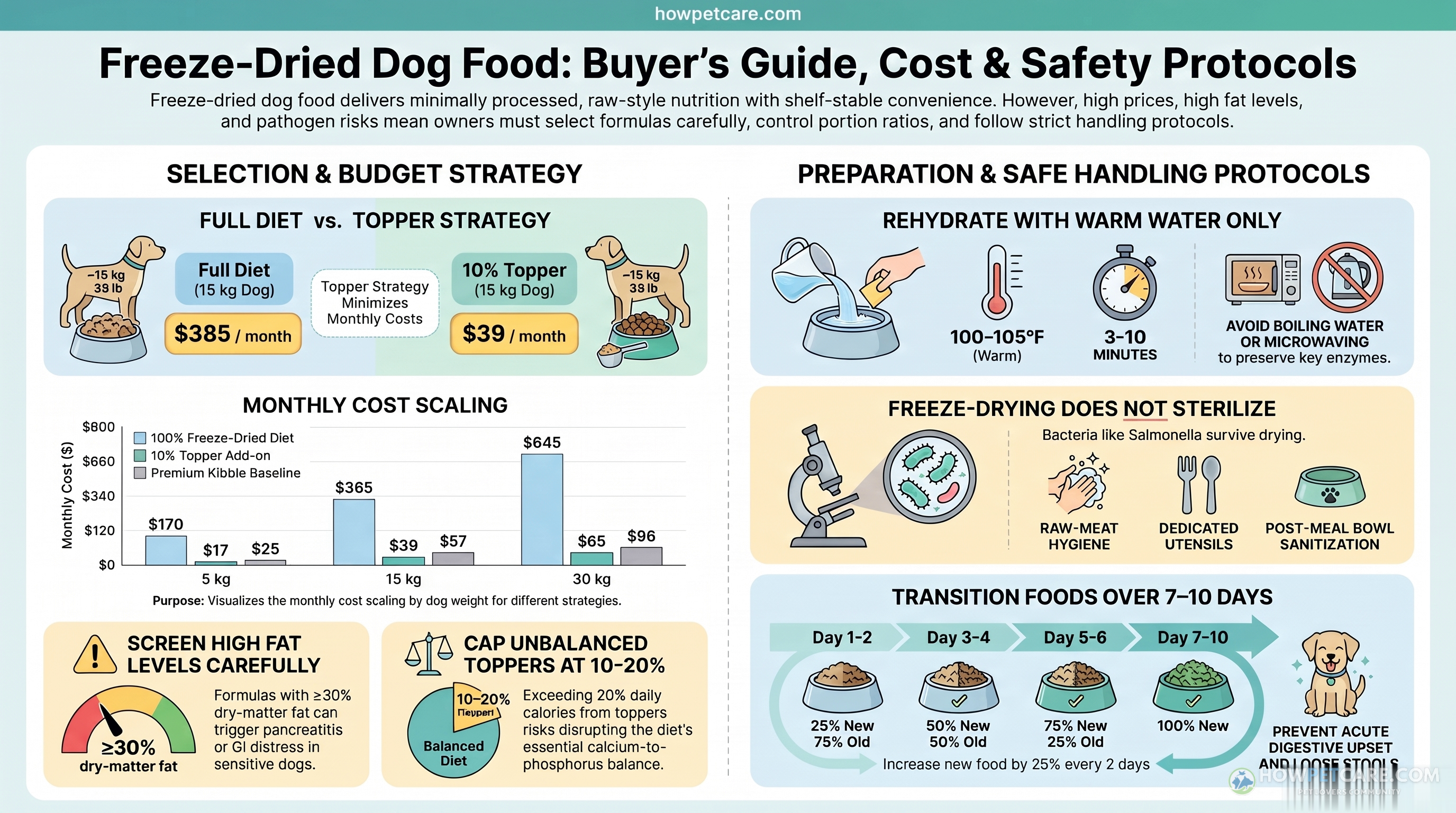
The math, in the open: daily kcal need = RER × activity factor, where RER = 70 × (body weight in kg)^0.75. These rows assume a neutered adult at moderate activity (factor 1.6). Monthly ounces = daily kcal ÷ kcal-per-oz × 30. Monthly cost = monthly ounces × price per oz. We use the verified prices from the comparison table (Stella & Chewy’s at $2.00/oz, 135 kcal/oz) as the example freeze-dried food. Premium kibble benchmark: Orijen Original kibble, ~$0.22/oz, 105 kcal/oz (checked 2026-11-23).
| Dog weight | Daily calories (RER × 1.6) | 100 % freeze-dried (monthly cost) | 25 % topper (monthly cost) | 10 % topper (monthly cost) | Premium kibble benchmark (monthly cost) | Extra cost vs kibble (full diet) | Extra cost vs kibble (10 % topper) |
|---|---|---|---|---|---|---|---|
| 5 kg / 11 lb | ~375 kcal | $170 | $43 | $17 | $25 | +$145 | -$8 |
| 10 kg / 22 lb | ~630 kcal | $285 | $71 | $29 | $42 | +$243 | -$13 |
| 15 kg / 33 lb | ~855 kcal | $385 | $96 | $39 | $57 | +$328 | -$18 |
| 20 kg / 44 lb | ~1,060 kcal | $475 | $119 | $48 | $71 | +$404 | -$23 |
| 30 kg / 66 lb | ~1,440 kcal | $645 | $161 | $65 | $96 | +$549 | -$31 |
| 40 kg / 88 lb | ~1,780 kcal | $795 | $199 | $80 | $119 | +$676 | -$39 |
Calculations use Stella & Chewy’s $2.00/oz, 135 kcal/oz and Orijen kibble $0.22/oz, 105 kcal/oz. Prices fluctuate; re-run with your chosen formula’s verified numbers.
Full diet vs 10 % topper: the real price gap
A 15 kg dog fed 100 % freeze-dried costs ~$385/month versus ~$57 for premium kibble — a 6.7× multiplier. Adding a 10 % topper costs only ~$39 extra per month. At 30 kg the full-diet cost jumps to ~$645 vs $96 for kibble; the 10 % topper adds ~$65. The crossover where topper-first becomes the only realistic option for many budgets is roughly 20-25 kg. Remember: rehydrated volume is larger than dry volume, but calorie count does not change — set portions by kcal, not by scoop size.
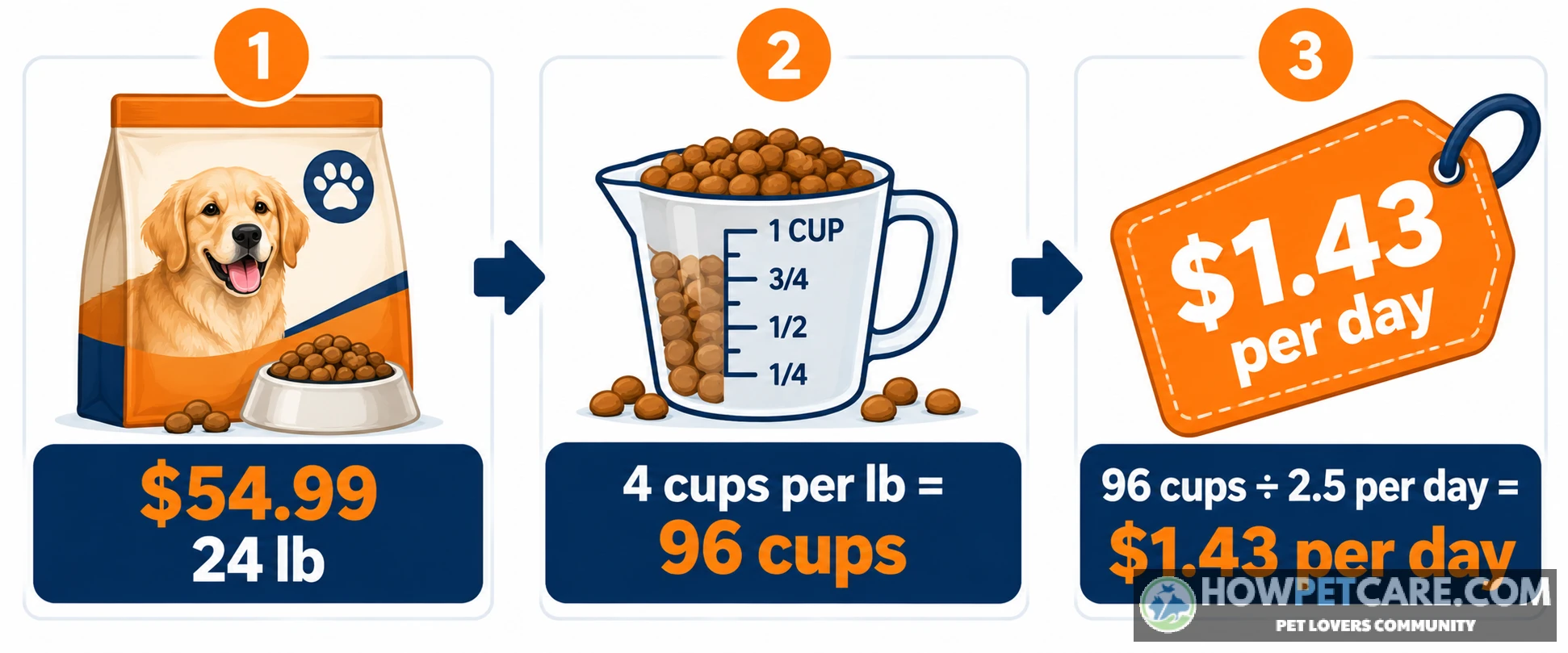
The math, in the open: daily kcal need = RER × activity factor, where RER = 70 × (body weight in kg)^0.75. These rows assume a neutered adult at moderate activity (factor 1.6). Monthly ounces = daily kcal ÷ kcal-per-oz × 30. Monthly cost = monthly ounces × price per oz.
| Dog weight | Daily kcal (RER × 1.6) | Monthly oz needed (fill: kcal ÷ kcal/oz × 30) | 100 % freeze-dried cost (monthly oz × $/oz) | 10 % topper add-on (10 % of monthly oz × $/oz) |
|---|---|---|---|---|
| 5 kg / 11 lb | ~375 kcal | |||
| 15 kg / 33 lb | ~855 kcal | |||
| 25 kg / 55 lb | ~1,250 kcal | |||
| 40 kg / 88 lb | ~1,780 kcal |
Worked example with illustrative numbers (substitute the verified values from the comparison table — do not reuse these): a freeze-dried food at 135 kcal/oz and $2.00/oz costs a 15 kg dog 855 ÷ 135 ≈ 6.3 oz/day ≈ 190 oz/month ≈ $380/month fed exclusively. A 10 % topper portion is ~19 oz ≈ $38/month on top of kibble. A premium kibble at ~105 kcal/oz and ~$0.22/oz feeds the same dog for roughly $55/month — so full freeze-dried is around 7× the cost at this weight, while a 10 % topper adds about $38. At 40 kg the gap widens to roughly $790 vs ~$110. That crossover is why the topper-first recommendation exists.
Note: rehydrating roughly triples the bowl volume but adds zero calories — set portions by kcal, not by scoop size.
How Much Freeze-Dried Topper You Can Add to Kibble Before Calcium and Phosphorus Go Out of Balance
AAFCO requires a calcium-to-phosphorus (Ca:P) ratio between 1:1 and 2:1 (dry matter) for adult maintenance. A complete kibble is formulated to land inside that range. Meat-heavy toppers with little bone often sit near 0.5-0.7:1 on their own — below the minimum — so the question is how much you can add before the blend drifts.
Worked example: blending a topper into complete kibble
Example label values (illustrative — pull the real Ca and P figures from each manufacturer’s published analysis):
- Complete kibble: Ca 1.4 % DM, P 1.0 % DM → ratio 1.4:1
- Meat-heavy freeze-dried topper: Ca 0.5 % DM, P 0.9 % DM → ratio 0.56:1
Blended ratio at each topper share of daily calories (approximation assumes similar caloric density):
| Topper share | Blended Ca | Blended P | Blended Ca:P | Status vs 1:1–2:1 |
|---|---|---|---|---|
| 10 % | 1.31 % | 0.99 % | 1.32:1 | Inside range |
| 20 % | 1.22 % | 0.98 % | 1.24:1 | Inside range, drifting down |
| 30 % | 1.13 % | 0.97 % | 1.16:1 | Still inside, approaching floor |
| 50 % | 0.95 % | 0.95 % | 1.00:1 | At the minimum — no margin |
Takeaway: at 10-20 % of calories the blend stays comfortably in range with a typical meat-heavy topper; past ~30 % the margin gets thin, and a topper that’s already below 1:1 leaves no room for error. This is the basis for the 10-20 % topper ceiling used in this guide — a conservative rule of thumb, not an AAFCO standard. Simplification warning: the precise method blends mg of Ca and P per 1,000 kcal, which requires each brand’s full nutrient profile.
Don’t forget the other half: for every kcal of topper, remove a kcal of kibble. A 15 kg dog on 855 kcal/day getting a 10 % topper eats ~85 kcal of mixer and ~770 kcal of kibble — or the extra calories show up as weight within a month.
Puppies — especially large-breed puppies — are the exception: calcium excess during growth is a documented orthopedic risk, so run any topper plan past your vet or a board-certified veterinary nutritionist (acvn.org directory) rather than using this ceiling.
When to ask a veterinary nutritionist
- Large-breed puppies (expected adult weight >70 lb)
- Dogs with diagnosed calcium/phosphorus metabolism disorders
- Any dog on a therapeutic diet for kidney, urinary, or gastrointestinal disease — including one that needs a vet-supervised hydrolyzed protein elimination trial
See the table above for the 10-20 % ceiling. Always reduce the kibble portion by the topper’s calories to avoid weight gain.
Is Freeze-Dried Raw Safe? What Freeze-Drying and HPP Do and Don’t Kill
What freeze-drying and HPP do and don’t kill
Freeze-drying does not sterilize. It preserves food and halts bacterial growth, but Salmonella, Listeria, and E. coli can survive in the dried product and become active again once the food is rehydrated. High-pressure processing (HPP) reduces vegetative bacteria in many raw products, but it does not reliably eliminate bacterial spores or toxins already formed. Distinguish "HPP-treated" from "tested and held" (test-and-hold) programs; ask brands whether they publish pathogen-testing results per lot. FDA’s guidance for raw pet food acknowledges that raw diets carry a higher risk of pathogen contamination than heat-processed foods.
Hygiene checklist for homes with kids or vulnerable adults
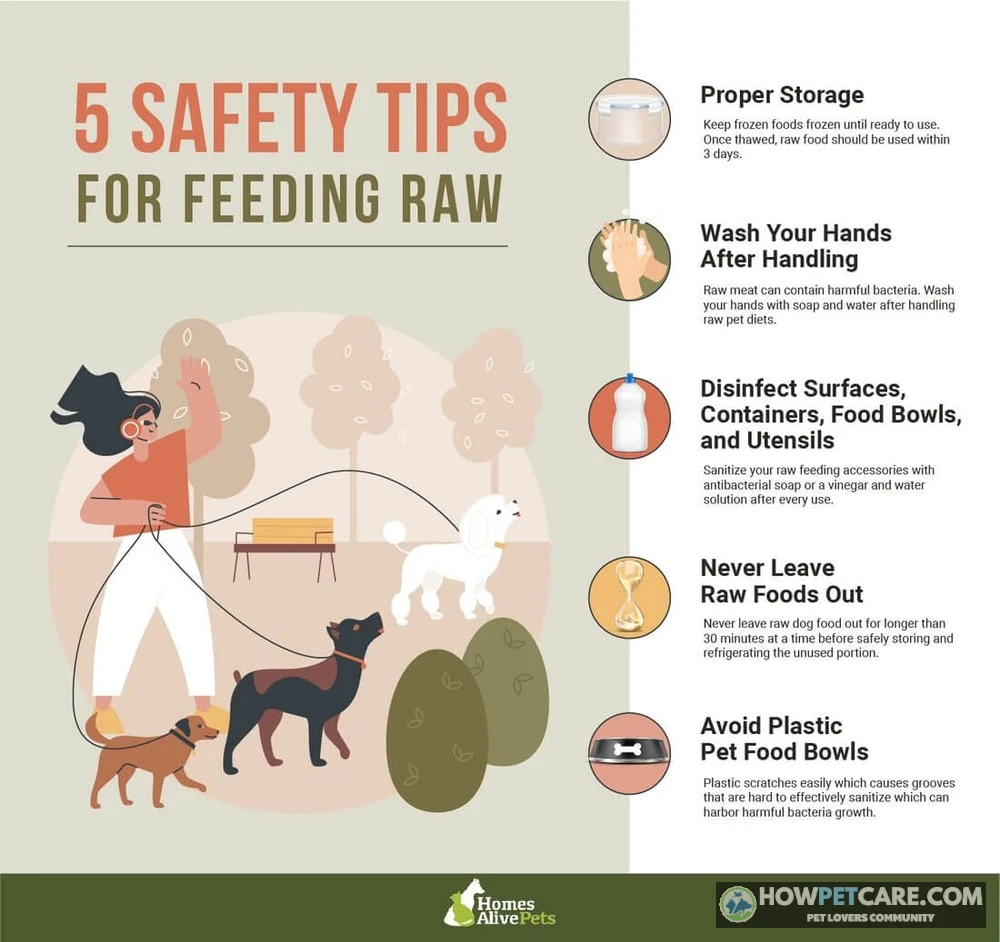
Treat the product like raw meat from the moment water touches it — and, conservatively, even dry.
Prep and serving
- ☐ Wash hands with soap for 20 seconds before and after handling the food or the bag’s interior scoop.
- ☐ Rehydrate with warm water (roughly 100–105 °F / wrist-temperature) — hot enough to release aroma, not hot enough to cook or degrade nutrients. Never microwave or boil.
- ☐ Rehydrate on a dedicated mat or tray away from human food-prep surfaces, not on the counter next to produce.
- ☐ Use a dedicated scoop stored outside the bag if the bag interior contacts hands.
Cleanup
- ☐ Wash the bowl with hot soapy water (or dishwasher on sanitize cycle) after every meal — not a rinse.
- ☐ Disinfect the prep surface after each meal: a food-safe sanitizer or a fresh bleach solution (about 1 tablespoon unscented bleach per gallon of water).
- ☐ Discard rehydrated leftovers left at room temperature beyond ~1-2 hours; refrigerate promptly and follow the brand’s stated window if refrigerating.
Storage
- ☐ Reseal the bag fully (press out air) or move to an airtight container; store cool, dry, and dark.
- ☐ Honor the brand’s use-within window after opening — fat oxidation degrades quality even when the food looks fine.
Higher-risk households (children under 5, adults 65+, pregnant, immunocompromised)
- ☐ Keep the dog’s face away from faces and hands for a while after meals — dogs can shed Salmonella or Listeria in saliva and stool while looking perfectly healthy.
- ☐ Keep kids out of the feeding and rehydration zone entirely.
- ☐ Consider an HPP-treated formula, a gently cooked option, or skipping raw formats altogether — ask the manufacturer whether the product is HPP-treated and whether they run test-and-hold pathogen screening on each lot.
Verify recall history before buying: search the brand at fda.gov/safety/recalls-market-withdrawals-safety-alerts (filter: animal & veterinary) and check the AVMA recall list. A clean record is "none found as of [date]" — not a guarantee.
Recall history for the brands in this guide
| Brand | Product and lot | Date | Reason for recall | Source |
|---|---|---|---|---|
| Stella & Chewy’s | None found in FDA database as of 2026-11-23 | — | — | FDA Recalls |
| Primal Pet Foods | None found in FDA database as of 2026-11-23 | — | — | FDA Recalls |
| Open Farm | None found in FDA database as of 2026-11-23 | — | — | FDA Recalls |
| Orijen | None found in FDA database as of 2026-11-23 | — | — | FDA Recalls |
| Instinct | None found in FDA database as of 2026-11-23 | — | — | FDA Recalls |
| Northwest Naturals | None found in FDA database as of 2026-11-23 | — | — | FDA Recalls |
| Vital Essentials | None found in FDA database as of 2026-11-23 | — | — | FDA Recalls |
If a recall appears after this writing, update the table. Always check the FDA and AVMA sites before purchasing.
Freeze-Dried Food for Dogs With Pancreatitis, Weight Problems, Kidney Concerns or Poor Drinking Habits
Pancreatitis-prone and fat-sensitive dogs
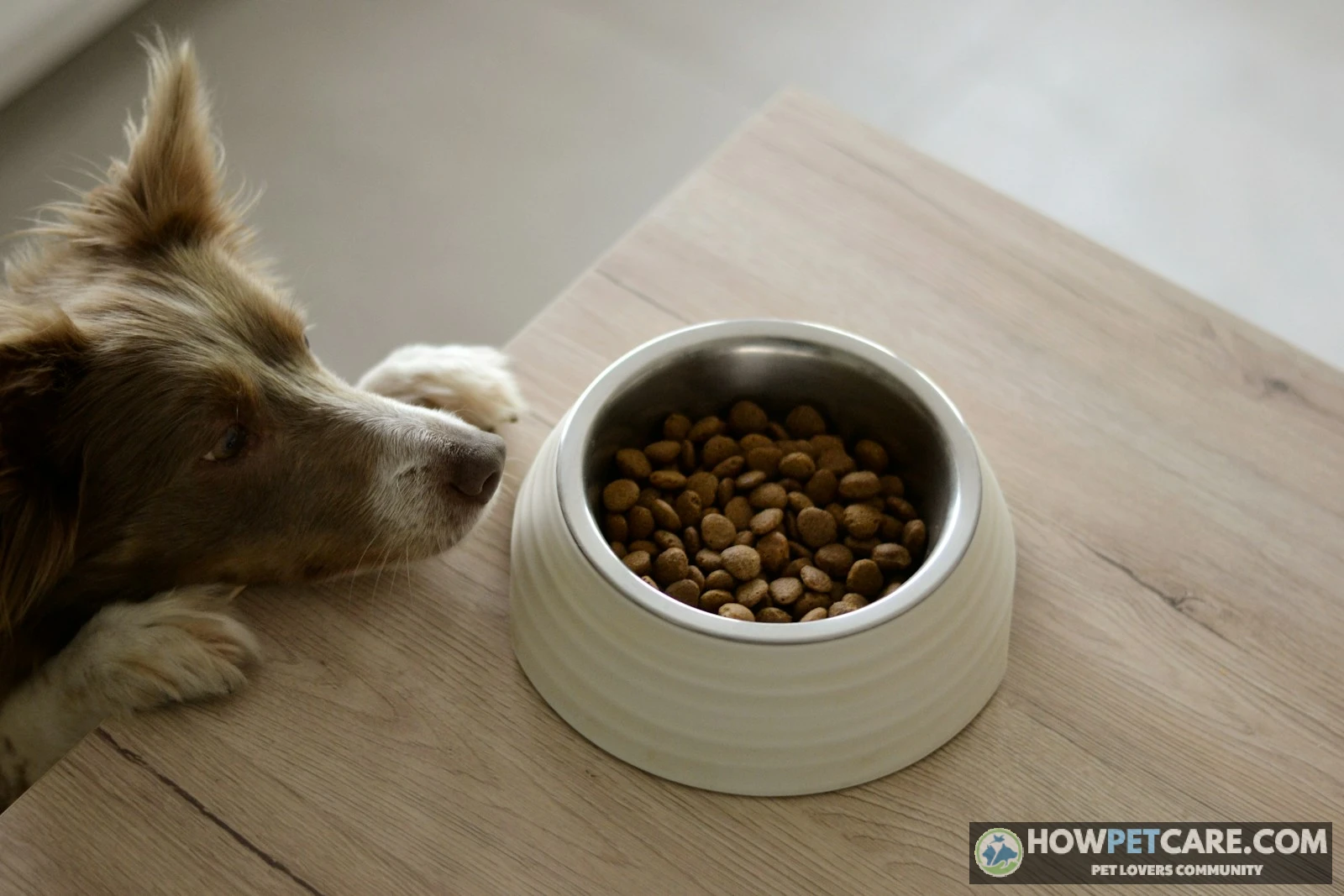
Fat dry-matter ≥30 % is a red flag for dogs with any history of pancreatitis, hyperlipidemia, or fat-responsive GI upset. Many freeze-dried formulas land at 30-40 % fat DM; only the lower-fat rows in the comparison table (e.g., Northwest Naturals at ~23 % DM) clear this. Your vet sets the actual threshold — published targets for fat-sensitive dogs vary widely by case.
Overweight dogs and portion control
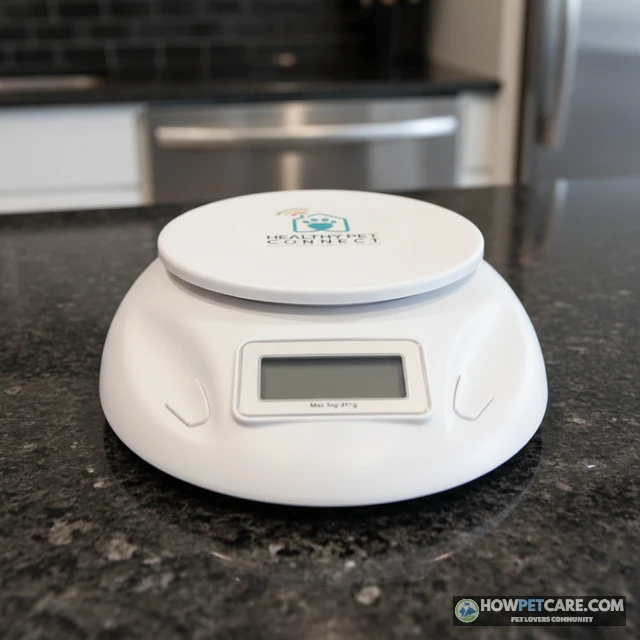
Calorie density is high per cup and low per oz when rehydrated, so weigh portions rather than measuring by volume. A kitchen scale is essential; a "cup" of freeze-dried can carry 2-3× the calories of a cup of kibble. If your dog stays ravenous on weighed portions, our high fiber dog food guide covers adding bulk without many calories.
Dogs with kidney or urinary issues
High-protein, high-phosphorus raw formulas may conflict with a vet-prescribed diet for chronic kidney disease. This is a vet-conversation flag, not a self-serve swap.
Is it safe to feed it dry every day?
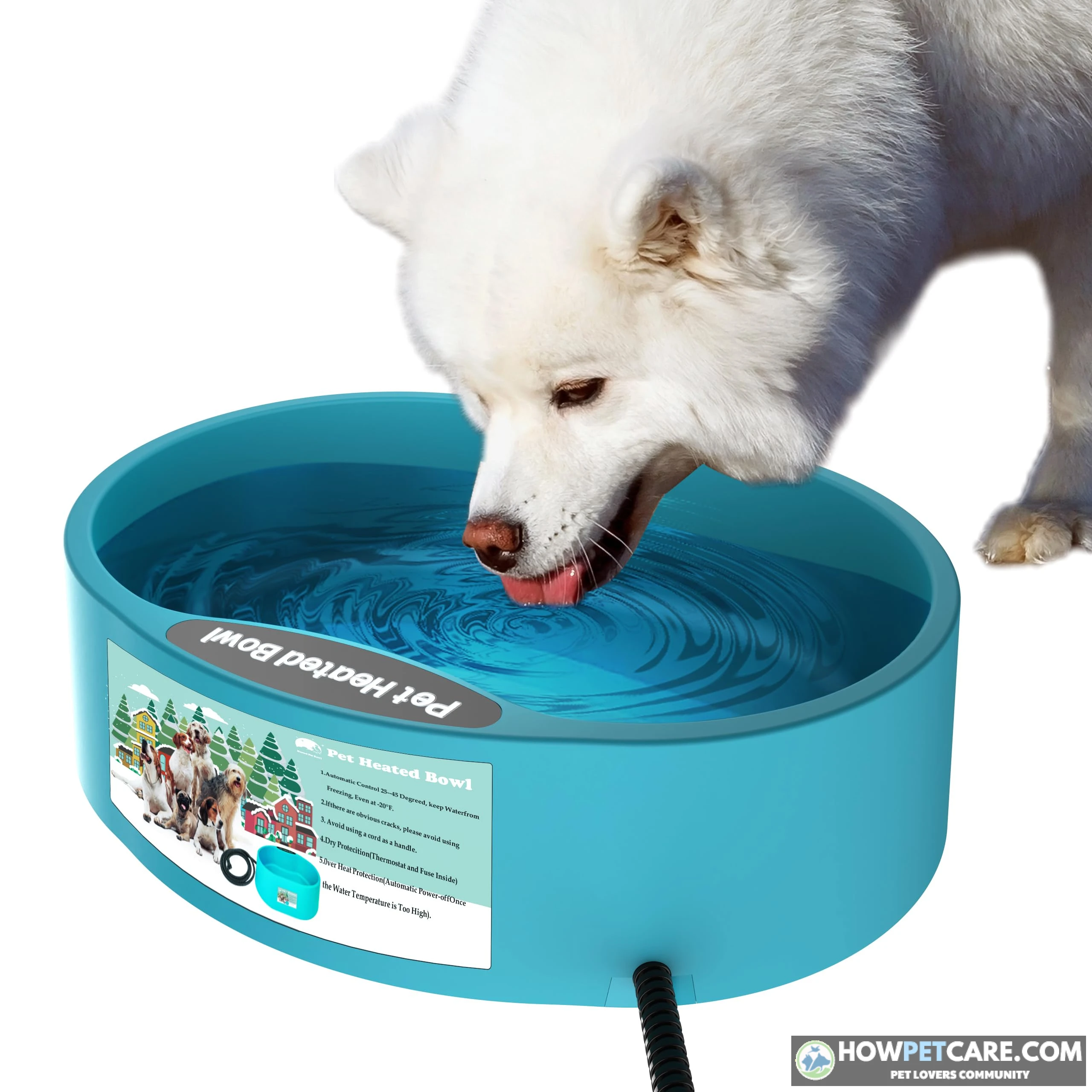
Freeze-dried food has about 2-5 % moisture, kibble about 10 %, and fresh food about 70 %. Without added water, a dog that drinks little takes in less total water. While no long-term clinical trials directly link dry freeze-dried feeding to urinary crystals or kidney damage, the prudent default for poor drinkers and dogs prone to urinary stones is to rehydrate every meal.
Before any formula in this guide is right for your dog, it has to survive this screen. Each flag maps to a line on the label or the comparison table.
- ☐ Fat dry-matter ≥ 30 % → skip if your dog has any history of pancreatitis, hyperlipidemia, or fat-responsive GI upset. Many freeze-dried formulas land at 30–40 % fat DM; only the lower-fat rows in the comparison table clear this. Your vet sets the actual threshold — published targets for fat-sensitive dogs vary widely by case.
- ☐ AAFCO statement reads ‘for intermittent or supplemental feeding only’ → it is a topper, not a meal. Don’t let bag size or ‘dinner’ branding talk you into sole feeding.
- ☐ AAFCO statement excludes ‘growth of large size dogs (70 lb or more as an adult)’ → do not feed as a sole diet to a large-breed puppy; calcium/energy density is calibrated for smaller adults.
- ☐ kcal per oz ≥ ~130 → measure by weight (kitchen scale) rather than scoop for any dog that gains weight easily; a ‘cup’ of freeze-dried can carry 2–3× the calories of a cup of kibble.
- ☐ Chronic kidney disease or urinary stone history → high-protein, high-phosphorus raw-style formulas may conflict with a vet-prescribed diet. This is a vet-conversation flag, not a self-serve swap.
- ☐ Dog drinks poorly or has had urinary crystals → rehydrating is the default, not optional. Dry freeze-dried is ~3 % moisture vs ~10 % kibble and ~70 % fresh food; without added water, total daily water intake drops.
- ☐ Senior with dental issues → nuggets and patties are hard dry; confirm the dog will eat it rehydrated before buying a large bag.
If a pick fails two or more flags for your dog, the right answer is usually the topper route or a different format — not a different flavor of the same formula.
How to Rehydrate, Serve, Transition and Store Freeze-Dried Dog Food
Step-by-step rehydration
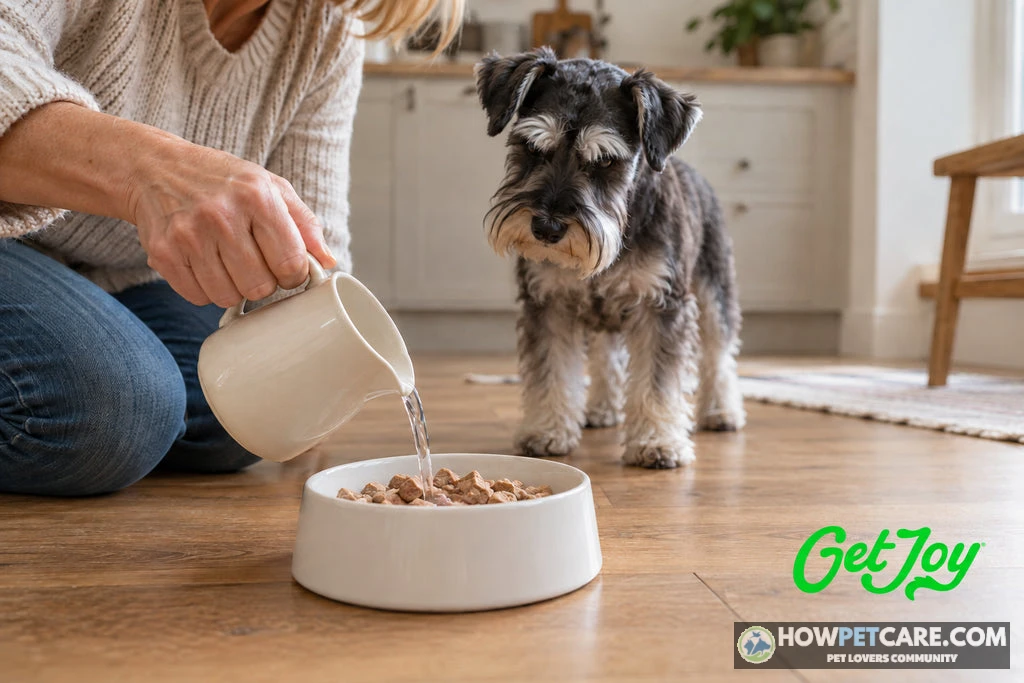
- Check the label for the manufacturer’s recommended water-to-food ratio (typically 1:1 to 2:1 by volume).
- Use warm water (100-105 °F) — not boiling, not microwaved — to preserve nutrients and boost aroma.
- Pour water over the food, stir, and let sit for the time stated (usually 3-10 minutes).
- Stir again and serve. Discard any uneaten rehydrated food after 1-2 hours at room temperature.
A 7-10 day transition schedule
| Day | Freeze-dried % of calories | Previous food % |
|---|---|---|
| 1-2 | 10 % | 90 % |
| 3-4 | 25 % | 75 % |
| 5-6 | 50 % | 50 % |
| 7-8 | 75 % | 25 % |
| 9-10 | 100 % | 0 % |
Slow down if you see loose stool, vomiting, or itching. For sensitive stomachs, extend each step by 1-2 days.
Shelf life, storage and when quality drops
Unopened shelf life is typically 12-24 months per manufacturer, with a best-by date on the bag. Quality loss comes mainly from oxygen, moisture, and fat oxidation; vitamin loss over time is a known but limited effect. After opening: reseal, keep cool and dry, use within the time the label states (often 30-60 days), and discard rehydrated leftovers per brand guidance or refrigerate for a short, specified period.
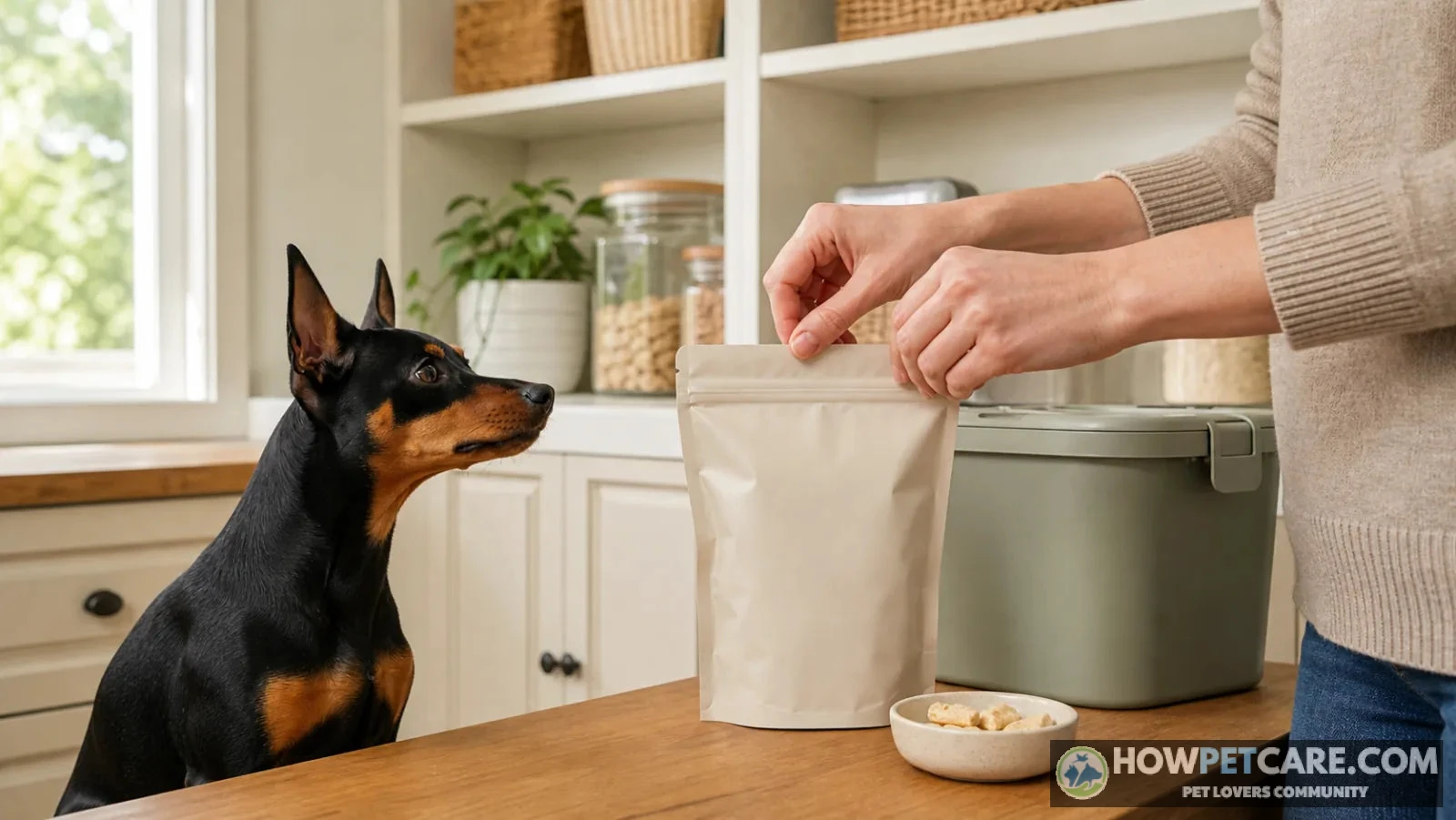
-
Rehydrate
Warm water (100-105 °F), label ratio, wait 3-10 min, stir.
-
Transition
Follow the 7-10 day schedule above; slow down for sensitive dogs.
-
Store
Reseal opened bag, cool/dry, use within label window. Refrigerate rehydrated leftovers per brand.
Topper or Full Meal? A Decision Guide and Buying Checklist
Decision framework
| Your situation | Recommended strategy | Monthly cost estimate (15 kg dog) |
|---|---|---|
| Budget limited, healthy adult | 10 % topper on premium kibble | +$39/month |
| Large breed (30 kg+), healthy | 25 % topper or rotation | +$161/month (25 % topper) |
| Cautious household (kids, immunocompromised) | HPP-treated formula as 10 % topper, or skip raw | +$39-$65/month |
| Dog with pancreatitis history | Lower-fat complete formula (e.g., Northwest Naturals) as 100 % diet if budget allows, else 10 % topper | $385/month (full) or +$39/month (topper) |
| Picky eater, small breed | 100 % complete freeze-dried (small nuggets) | $385/month |
Buying checklist
- ☐ Confirm the AAFCO statement matches your dog’s life stage.
- ☐ Check fat level (dry-matter) against any medical history.
- ☐ Compute cost per 500 kcal using verified price and kcal/oz.
- ☐ Check recall history for the brand (FDA/AVMA).
- ☐ Confirm the batch’s best-by date is at least 6 months out.
Next steps
- Buy the smallest bag of your chosen formula.
- Run the 7-10 day transition.
- Watch stool, coat, and weight for a month before buying in bulk.
- Schedule a vet visit before switching a dog with a chronic condition.
- For deeper background on portions, costs, and safe everyday feeding, see our beginner’s guide to dog food basics.
Our dog nutrition pillar guide covers portion calculations, kibble comparisons, and how to read any pet-food label.
FAQ
Why is freeze-dried dog food so expensive?
The freeze-drying process is slow and energy-intensive, and these foods usually contain a high share of fresh meat, which is expensive before drying. Because the food is almost all dry matter, you also pay per ounce of nutrients that kibble delivers more cheaply.
Can I leave rehydrated freeze-dried food out in my dog’s bowl?
It’s best not to. Once water is added, bacteria can grow again, so follow the label and discard what the dog hasn’t eaten after a short time. Refrigerate any prepared leftovers in a covered container and use them within the period the brand recommends.
Is freeze-dried dog food better than kibble?
Not automatically. Freeze-dried food is less processed by heat and many dogs find it more appealing, but a complete-and-balanced kibble can meet the same AAFCO nutrient standards at a much lower cost. No independent trials show that freeze-dried food produces better health outcomes.
Can small dogs eat freeze-dried food?
Yes, if the formula is complete-and-balanced for their life stage, and small dogs are often the easiest to feed this way because they need so few calories. Choose small nuggets or crumble larger pieces, and rehydrate for dogs with dental problems.
Do I need to refrigerate freeze-dried dog food?
Unopened and opened bags are usually stored at room temperature in a cool, dry place, sealed tightly. Follow the storage instructions and best-by date on the bag, because they vary by brand and formula.