

Yes. Raspberries are safe for most dogs in small amounts — roughly 1–2 berries a day for dogs under 5 kg, up to 15–20 for dogs over 40 kg. Their natural xylitol content is far too low to be toxic, but keep treats under 10% of daily calories and serve only plain fresh or unsweetened frozen berries.
Yes, raspberries are safe for most dogs in small amounts. They aren’t toxic, and their natural xylitol content is too low to harm a dog at normal treat portions. To find out how many your dog can have, check the weight-based portion chart below. If your dog has already eaten a pile of raspberries, go straight to the emergency triage section.
Keep three limits in mind: raspberries are a treat, not a meal, and treats should make up no more than 10% of daily calories. Serve only fresh or plain frozen berries, and avoid sweetened or flavored raspberry products.
For a wider list of dog-safe fruits and toxic foods for dogs, see our pillar guide on canine fruit safety.
How Many Raspberries Can a Dog Eat? Daily Portions by Weight
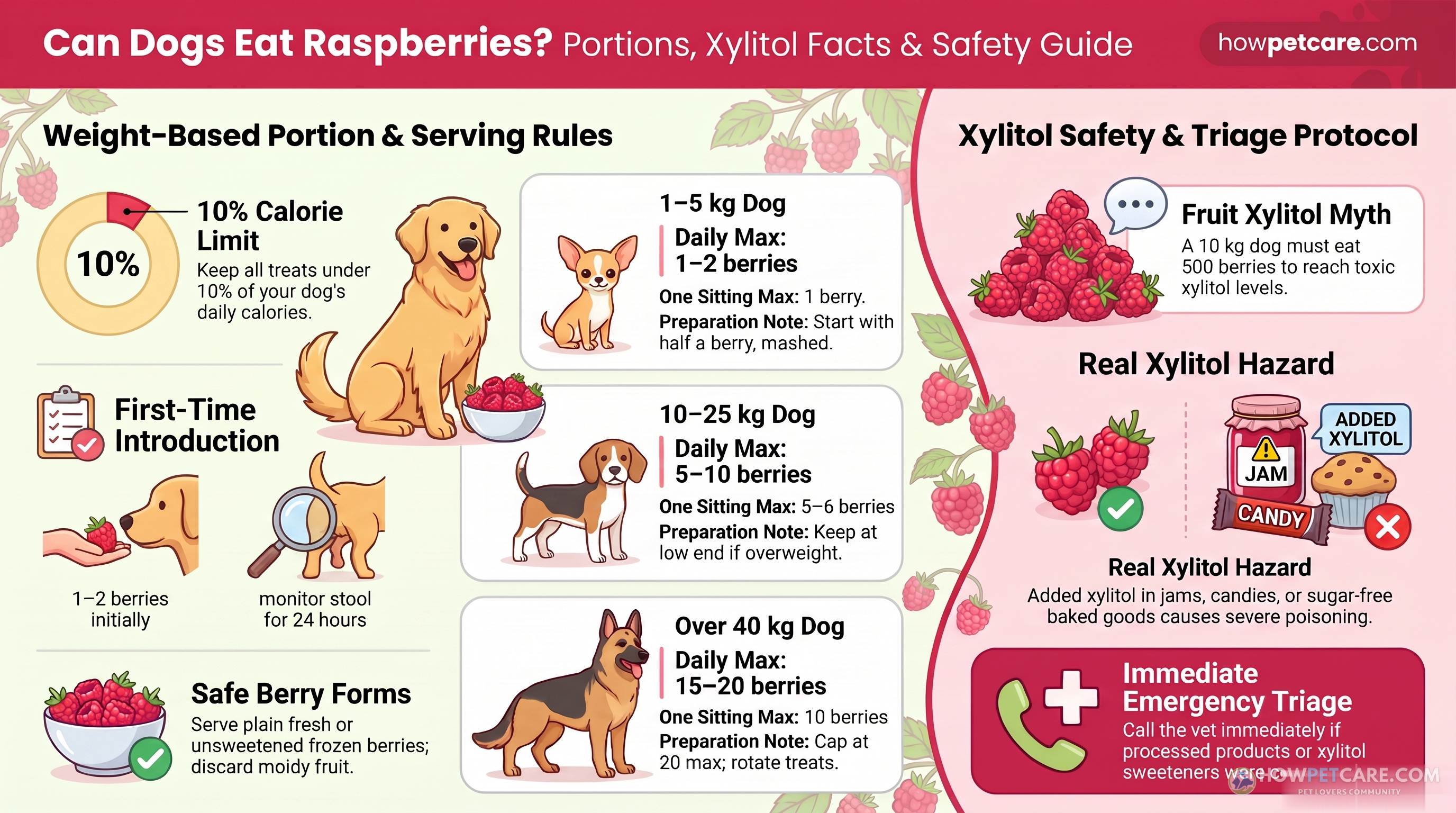
The chart gives you a more useful starting point than advice to feed "a few berries." It’s based on these assumptions: one raspberry weighs about 4–5 g and contains roughly 2–3 kcal, and treats stay under 10% of daily calories. The portions are also cross-checked against AKC feeding guidelines for treats.
Weight-based raspberry portion chart
| Dog weight | Raspberries per day (max) | Approx. grams | Max in one sitting | Notes for seniors, sensitive stomachs, or first-time feeding |
|---|---|---|---|---|
| 1–5 kg | 1–2 | 5–10 g | 1 | Start with half a berry, mashed; give the lowest amount to seniors or dogs with delicate stomachs |
| 5–10 kg | 3–5 | 14–25 g | 3 | First time: 1 berry, then watch stool for 24 h |
| 10–25 kg | 5–10 | 25–45 g | 5–6 | Overweight dogs: stay at the low end |
| 25–40 kg | 10–15 | 45–70 g | 8 | Split across the day if using as training rewards |
| Over 40 kg | 15–20 | 70–90 g | 10 | Giant breeds still cap at ~20; rotate with other treats |

Don’t feed the maximum every day. Rotate raspberries with other dog-safe fruits so they remain an occasional treat rather than a daily habit.
How to adjust for age, weight and sensitive stomachs
Sugar and fiber can cause gastrointestinal upset, such as loose stool or gas, before anything else. For senior dogs, overweight dogs, and dogs with sensitive stomachs, use the lower end of the weight band. Introduce raspberries gradually: offer one or two berries on the first day and watch for stool changes or allergic signs, such as itching, facial swelling, or vomiting, over the next 24 hours.
Weigh your dog, find the band, and count the berries. A kitchen scale makes it easy to verify the gram weight.
Are Raspberries Toxic to Dogs? The Xylitol Numbers
Claims that raspberries are "high in xylitol" often leave out the context. Natural xylitol in fruit isn’t the same as the added xylitol that can cause poisoning, such as the sweetener in gum, candy, baked goods, and some peanut butters.
Natural xylitol in raspberries versus added xylitol in products
Older fruit analyses report roughly tens of milligrams of natural xylitol per 100 g of raspberries. The exact figure varies with variety and ripeness, so treat any single number as approximate rather than exact. Added xylitol, by contrast, is concentrated and appears on ingredient lists as "xylitol" or "birch sugar."
Worked calculation: berries needed to reach a toxic dose
Veterinary toxicology references (Pet Poison Helpline, ASPCA Animal Poison Control) put the xylitol threshold for hypoglycemia risk at roughly 100 mg per kg of body weight. The risk of liver damage occurs at higher doses, around 500 mg/kg. Using a representative value of 40 mg xylitol per 100 g of raspberries:
- A 10 kg dog reaches the hypoglycemia threshold at 10 × 100 mg = 1,000 mg of xylitol.
- 1,000 mg ÷ 40 mg per 100 g = 2,500 g = 2.5 kg of raspberries.
- At ~5 g per berry, that’s roughly 500 berries eaten in one sitting.
The same calculation for other sizes:
- 5 kg dog: 500 mg needed → about 1.25 kg of raspberries, ~250 berries.
- 30 kg dog: 3,000 mg needed → about 7.5 kg of raspberries, ~1,500 berries.
A dog is unlikely to eat 250–1,500 berries; stomach upset from sugar and fiber would occur dozens of berries earlier. The realistic xylitol danger isn’t the fruit. It’s raspberry-flavored gum, candy, baked goods, or "sugar-free" products sweetened with added xylitol.

If the product label lists xylitol or birch sugar, treat it as an emergency regardless of the fruit content.
Fresh vs. Frozen Raspberries: How to Serve Them Safely
Fresh raspberries
Rinse the berries and check for mold, discarding any that are moldy or overripe. Serve them whole to medium and large dogs, or halve or mash them for small dogs. The tiny seeds are edible and pass through the gut; whole raspberries aren’t a cyanide concern the way apple seeds are.
Frozen raspberries
Plain, unsweetened frozen raspberries are fine and can be a cooling treat. Check the bag for added sugar or syrup. Thaw or crush the berries for small dogs and dogs that gulp, since hard frozen berries pose a choking and dental risk.
First-time introduction
Offer one or two berries and watch for stool changes or allergic signs over the next 24 hours. To keep portions controlled, use a few berries as training rewards, mash them into a lick mat, or freeze them in a small amount of plain water in an ice cube tray.
My Dog Ate a Pile of Raspberries: What to Do Right Now
First five minutes: what to check
- Remove any remaining fruit.
- Estimate how many berries your dog ate and note the dog’s weight.
- Check whether the raspberries were plain or part of a product (jam, yogurt, baked goods, candy), and whether the label lists xylitol or "birch sugar."

Symptoms and when they start
Gastrointestinal upset, including soft stool, diarrhea, gas, mild vomiting, or reduced appetite, usually appears within hours and may last up to a day or two. Signs of xylitol poisoning include vomiting, weakness, wobbling, collapse, and seizures. They usually begin within about 30–60 minutes but can be delayed.
Call the vet or monitor at home? A decision rule
| Situation | Likely symptoms and timing | Action |
|---|---|---|
| A few berries over the portion chart, plain fruit | Soft stool, gas, possibly mild diarrhea within a few hours; resolves in 12–24 h | Monitor at home, offer fresh water, and skip the next treat |
| A large pile of plain berries (cup or more), small breed | Diarrhea, possible vomiting, mild belly discomfort within hours; may last up to 1–2 days | Monitor at home; call the vet if vomiting repeats or the dog seems lethargic |
| The ‘raspberries’ were in jam, yogurt, candy, baked goods, or anything labeled ‘sugar-free’ | If xylitol is present: vomiting, weakness, wobbling, collapse, seizures — often within 30–60 minutes, sometimes delayed | Check the ingredient list for xylitol or ‘birch sugar’ now. If present or unknown, call a vet or poison hotline immediately; don’t wait for symptoms |
| Any symptoms beyond mild upset: repeated vomiting, tremors, weakness, collapse, swollen abdomen | Can indicate something more serious than fruit overload | Call the vet immediately |
| Dog is diabetic, a young puppy, or has a chronic condition | Blood sugar or digestion may not tolerate even moderate amounts | Call the vet for advice even if symptoms seem mild |
Save the numbers for ASPCA Animal Poison Control and Pet Poison Helpline — both are listed in the box below, and consultation fees may apply. Don’t induce vomiting at home unless a vet instructs you to do so.
ASPCA Animal Poison Control: (888) 426-4435 | Pet Poison Helpline: (855) 764-7661. Fees may apply.
Puppies, Diabetic Dogs, Pregnant Dogs and Dogs on Medication
Puppies under 6 months
Puppies can eat raspberries once they’re weaned and eating solid food reliably. Under 6 months, check with the vet first, start with a single mashed or halved berry, and keep treats very small relative to the puppy’s calories. Watch for signs of a food allergy.

Diabetic dogs
Raspberries have relatively low sugar and high fiber compared with many fruits, but any sugar affects blood glucose. Don’t add them without the vet’s approval, and count them into the feeding plan at a consistent time.
Pregnant and nursing dogs
Small amounts of the fruit aren’t known to be a problem, but raspberry leaf is traditionally used as a uterine stimulant in humans. There’s little evidence in dogs, so avoid leaves and leaf teas and ask the vet before offering them.
Dogs with kidney, bladder or pancreas issues
Raspberries contain oxalates and sugar, so check with the vet first. Fruit may also be off the menu for dogs on low-fat or prescription diets.
Senior dogs
Senior dogs can benefit from the fiber and soft texture of mashed berries, but they may have sensitive stomachs and dental problems. Use the lower end of their weight band.
Raspberry Jam, Yogurt, Dried Fruit, Leaves and Other Forms: What’s Safe
Jam, yogurt, ice cream and flavored products
Avoid jam, jelly, syrup, pie filling, and canned raspberries in syrup because of added sugar, and check for xylitol. Plain canned raspberries in water aren’t toxic, but they offer no advantage over fresh.
Raspberry yogurt, ice cream, and other flavored products may be sweetened with xylitol even if the front of the package doesn’t say so. Read the full ingredient list and avoid the product if xylitol, birch sugar, or "sugar-free" appears. Plain unsweetened yogurt in small amounts is a safer alternative, though lactose can upset some dogs.
Dried and canned raspberries
Sugar and calories in dried raspberries are concentrated by weight. Serve only a tiny fraction of the fresh portion, and only if the dried fruit is unsweetened and free of preservatives.
Black raspberries, golden raspberries, leaves and stems
Black and golden raspberries have the same general safety profile as red raspberries, and the same portion guidance applies. Don’t feed wild berries you can’t identify.
The plant itself isn’t a recognized major toxin, but leaves and stems aren’t food for dogs and may cause stomach upset. Remove them before serving. Don’t give raspberry leaf tea or supplements without vet advice.

Check every raspberry product against this list before sharing — the fruit itself is safe, but the processing usually is not.
- Raspberry jam, jelly, syrup, pie filling — concentrated added sugar; some ‘sugar-free’ versions contain xylitol. Do not serve.
- Raspberry yogurt, ice cream, or candy — may contain xylitol or ‘birch sugar’ even when the front label does not say so; read the full ingredient list. Do not serve if ‘sugar-free,’ xylitol, or birch sugar appears.
- Raspberry-flavored baked goods — fat, sugar, and possible xylitol sweetener or raisins. Do not serve.
- Dried raspberries — sugar and calories are concentrated by weight; many contain added sugar or preservatives. Only unsweetened, and only a small fraction of the fresh portion.
- Canned raspberries in syrup — heavy added sugar. Plain canned in water is not toxic but adds nothing over fresh.
- Raspberry leaf, leaf tea, or supplements — raspberry leaf is traditionally a uterine stimulant in humans; evidence in dogs is lacking, so skip it without vet approval.
- Stems and leaves still attached — not a major toxin, but not food either; remove before serving.
When in doubt: plain fresh or plain unsweetened frozen raspberries are the only forms worth serving.
Raspberries vs. Blueberries, Strawberries and Blackberries for Dogs
Berry comparison table
Figures per 100 g are approximate values based on USDA FoodData Central.
| Berry | Calories per 100 g | Sugar per 100 g | Fiber per 100 g | Natural xylitol context | Typical serving for a 10 kg dog |
|---|---|---|---|---|---|
| Raspberry | ~52 kcal | ~4.4 g | ~6.5 g | Highest trace xylitol of common berries — still far below any toxic dose | 3–5 berries |
| Blueberry | ~57 kcal | ~10 g | ~2.4 g | Negligible | 8–10 berries |
| Strawberry | ~32 kcal | ~4.9 g | ~2.0 g | Negligible | 1–2 medium berries, sliced |
| Blackberry | ~43 kcal | ~4.9 g | ~5.3 g | Low trace | 3–5 berries |
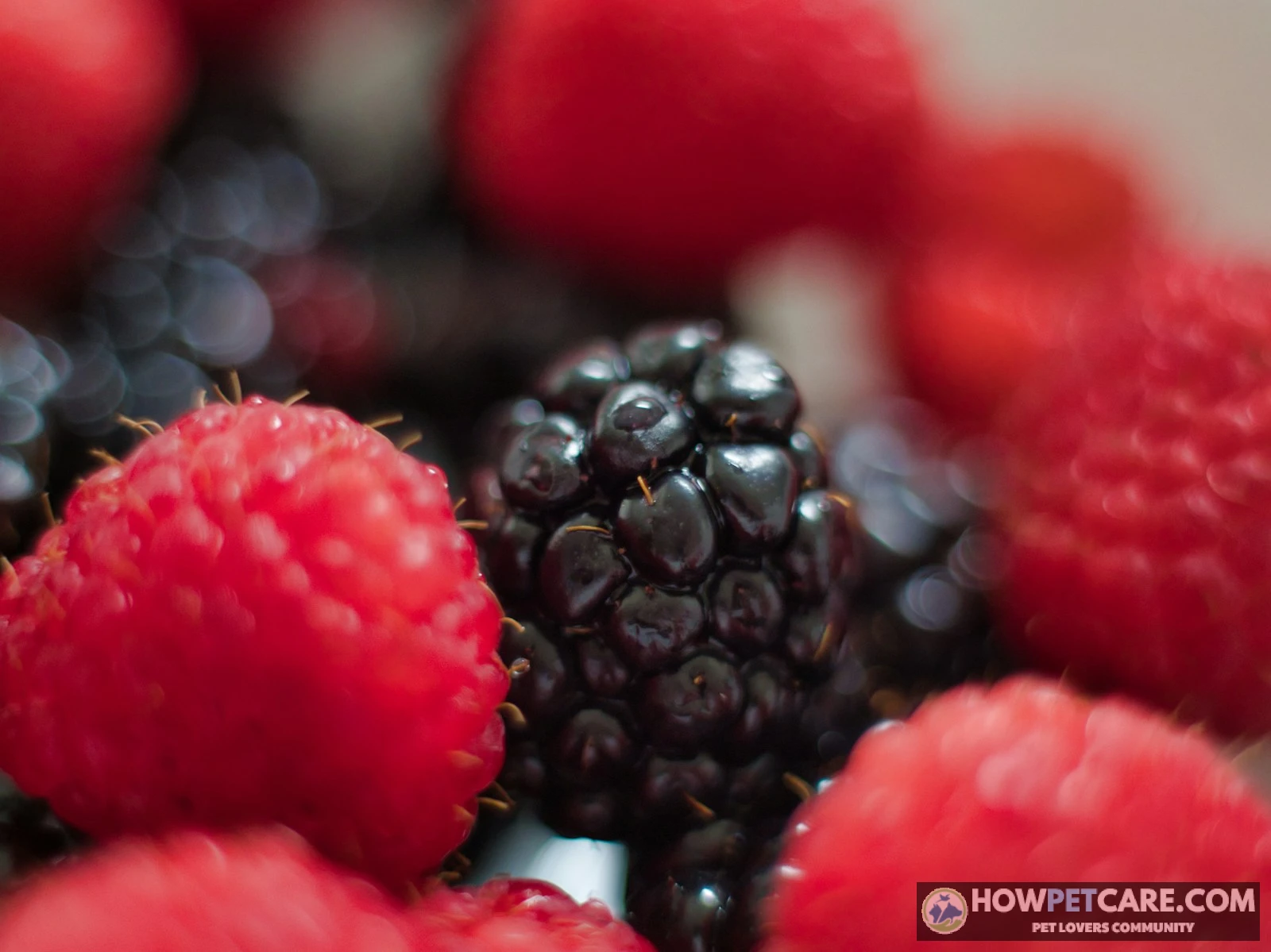
Raspberries are the highest-fiber, lower-sugar option. Their portion looks small despite being similar in calories because fiber limits tolerance. You can mix berries, but combine them within one treat allowance rather than giving each berry its full portion. Never feed grapes, raisins, or currants, which are toxic to dogs.
What raspberries actually offer: fiber, vitamin C, manganese and antioxidants
Raspberries supply vitamin C, manganese, and antioxidants such as anthocyanins and ellagitannins. Dogs make their own vitamin C, so it isn’t an essential dietary source. These are modest extras in a treat, not a health program.
Can you mix berries in one serving?
Yes, as long as the combined amount stays within one treat allowance. Don’t give each berry its full portion. Each berry type has its own portion and prep guidance, so keep mixed servings conservative.
| Berry | Calories per 100 g | Sugar per 100 g | Fiber per 100 g | Natural Xylitol Context | Typical Serving for 10 kg Dog |
|---|---|---|---|---|---|
| Blueberry | ~57 kcal | ~10 g | ~2.4 g | Negligible | 8–10 berries |
| Raspberry | ~52 kcal | ~4.4 g | ~6.5 g | Highest trace xylitol of common berries — still far below any toxic dose | 3–5 berries |
| Blackberry | ~43 kcal | ~4.9 g | ~5.3 g | Low trace | 3–5 berries |
| Strawberry | ~32 kcal | ~4.9 g | ~2.0 g | Negligible | 1–2 medium berries |
Your Raspberry Feeding Checklist for Dog Owners
Before feeding:
- Confirm that your dog has no vet restriction.
- Make sure the berries are plain and unmoldy.
- Check that the product has no xylitol.
Measure the portion using the weight chart, count it as a treat, and introduce it gradually.
If overfed:
- Check the label.
- Compare the amount against the chart.
- Follow the vet-versus-monitor rule.
- Keep the poison hotline number saved.
When in doubt about a product’s ingredients or your dog’s health condition, call the vet.
FAQ
Can dogs eat raspberries every day?
Most healthy dogs can have a few raspberries daily if the amount stays within their weight-based portion and treats stay under 10% of daily calories. Rotating with other dog-safe fruits keeps variety up and sugar intake down.
Are raspberry seeds dangerous for dogs?
No. Raspberry seeds are tiny and pass through the digestive tract in normal portions. Unlike apple seeds, they are not a cyanide concern.
What other berries are safe for dogs?
Blueberries, strawberries, blackberries and raspberries are generally safe in small portions. Avoid grapes, raisins and currants, which are toxic, and do not feed wild berries you cannot identify.
Why is my dog’s stool darker or looser after eating raspberries?
The fiber and natural pigments in berries can loosen stool or change its color for a day or so. Call a vet if the stool is black and tarry, contains blood, or the diarrhea lasts more than a day.
Can raspberries replace commercial dog treats?
They can stand in for some treats because they are low in calories. They do not provide complete nutrition, so keep them to a small share of the daily diet and feed them alongside a balanced dog food.