

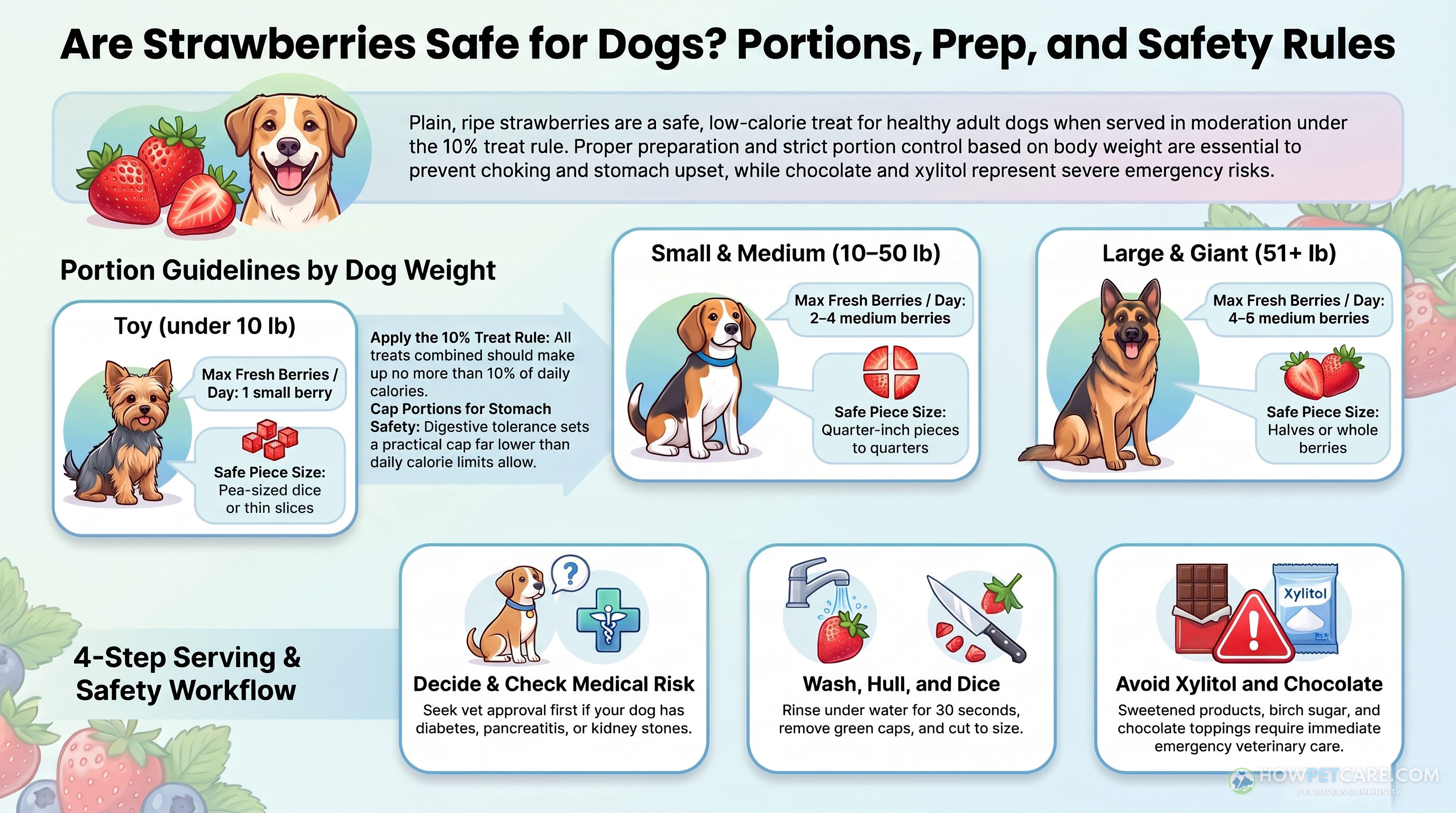
Yes — plain, washed, hulled strawberries are good for most healthy dogs in small amounts. A medium berry has about 4 kcal and 0.6 g of sugar; keep all treats within 10% of daily calories. Dogs with diabetes, pancreatitis, kidney disease, or bladder stones need vet approval first.
Yes, Strawberries Are Safe for Most Dogs in Small Amounts
Plain, ripe strawberries that have been washed and hulled are safe for most healthy adult dogs. They count as a low‑calorie treat within the 10 % treat rule. So, are strawberries good for dogs? Yes — most dogs can eat a small portion, but dogs with diabetes, pancreatitis, kidney disease, or calcium oxalate stones need vet approval first. A sweetened or chocolate‑covered strawberry, or a product containing xylitol, calls for emergency attention.
- Fine for most healthy adults – wash and cut the fruit into small pieces; use the weight‑based table below to set a portion.
- Ask a vet first – if your dog has diabetes, pancreatitis, kidney disease, or calcium oxalate bladder stones, is pregnant, or is on a strict elimination diet.
- Emergency – if the berry was in a product with xylitol (also listed as "birch sugar") or chocolate, follow the emergency checklist below.
Strawberries are on the dog‑safe fruits list, not the list of toxic foods for dogs. The risks come from the amount served, how the fruit is prepared, and any added ingredients. For a broader guide, see the pillar article on safe vs. toxic fruit.
What One Strawberry Gives Your Dog: Calories, Sugar and the 10% Treat Rule
Calories and sugar in a single strawberry
A medium strawberry (≈12 g) has roughly 4 kcal and 0.6 g of natural sugars (derived from USDA FoodData Central values of ~32 kcal and 4.9 g sugar per 100 g). These are estimates. The exact amounts vary with the berry’s size and ripeness.
Benefits worth knowing, and the ones that are overstated
Strawberries provide fiber, vitamin C, and antioxidants such as anthocyanins. Dogs make their own vitamin C, so think of the fruit as a low‑calorie treat, not a supplement. Fiber helps slow sugar absorption, but that sugar can still add up for tiny, overweight, or diabetic dogs.
Under the 10 % treat rule, treats should make up no more than 10 % of a dog’s daily calories. For a 10 lb dog (~250 kcal/day), that’s ~25 kcal (≈6 berries by calories alone). For a 50 lb dog (~850 kcal/day), it’s ~85 kcal (≈21 berries). In practice, stomach upset — not calories — sets the ceiling, so we recommend far fewer berries (see the portion table).
Worked Example: How Many Strawberries Can a 25‑lb Dog Have?
Meet Milo, a healthy, neutered 25‑lb adult dog. Here’s how to work out his portion:
Step 1 — Daily calories. A moderately active 25‑lb dog typically needs around 550–600 kcal per day, though your vet can give you an exact figure. We’ll use 550 kcal.
Step 2 — The 10 % treat budget. 10 % of 550 kcal = 55 kcal per day for all treats combined, not just fruit.
Step 3 — Subtract other treats. Milo already had a 30‑kcal training biscuit this morning. His remaining treat budget is 55 − 30 = 25 kcal.
Step 4 — Convert to berries. A medium strawberry has about 4 kcal. That makes 25 ÷ 4 ≈ 6 berries by calories alone.
Step 5 — Apply the practical cap. On a treat‑free day, Milo’s calories would allow ~13 berries — far more than a 25‑lb stomach wants at once. The weight‑table cap for a 25‑lb dog is 2–3 medium strawberries, cut into quarter‑inch pieces.
Answer: Milo gets 3 strawberries today, washed, hulled and cut up. That keeps him comfortably within both his calorie budget and his stomach’s limit.

The calorie cap is rarely the binding limit; stomach upset, sugar load, and the dog’s size set the practical ceiling first.
How Many Strawberries Can a Dog Eat? Portions by Weight, Fresh, Frozen and Freeze‑Dried
Daily strawberry limits by dog weight
The table gives conservative daily maximums for fresh, frozen, and freeze‑dried strawberries. Calorie figures are rough estimates for a typical adult dog; they vary with age, activity, and neuter status. A medium strawberry ≈12 g ≈4 kcal.
| Dog weight class | Approx. daily calories | 10% treat budget (kcal) | Max fresh strawberries per day | Frozen equivalent | Freeze‑dried equivalent* | Safe piece size |
|---|---|---|---|---|---|---|
| Toy (under 10 lb) | ~250 | ~25 | 1 small berry, cut up | Same weight as fresh; cut or partly thaw | ~1 g (1–2 small pieces) | Pea‑sized dice or thin slices |
| Small (10–25 lb) | ~500 | ~50 | 2–3 medium | Same weight as fresh; cut or partly thaw | ~2–3 g | Quarter‑inch pieces |
| Medium (26–50 lb) | ~850 | ~85 | 3–4 medium | Same weight as fresh | ~3–4 g | Halves or quarters |
| Large (51–90 lb) | ~1,300 | ~130 | 4–6 medium | Same weight as fresh | ~4–6 g | Halves or whole |
| Giant (over 90 lb) | ~1,800 | ~180 | 6–8 medium (small handful) | Same weight as fresh; whole berries OK | ~6–8 g | Halves or whole |
*Freeze‑dried conversion: removing water packs the same sugar into about 1/10 of the weight, so roughly 1 g freeze‑dried equals one 10–12 g fresh berry. Weigh the product or check the label instead of counting pieces.
The difference can be substantial: a toy dog’s 10 % budget of ~25 kcal would technically allow ~6 berries, but the recommended cap is 1. The caps are deliberately well below the calorie limit because stomach upset is the practical ceiling for most dogs. First serving? Start with a single small piece and watch the stool for 24 hours.
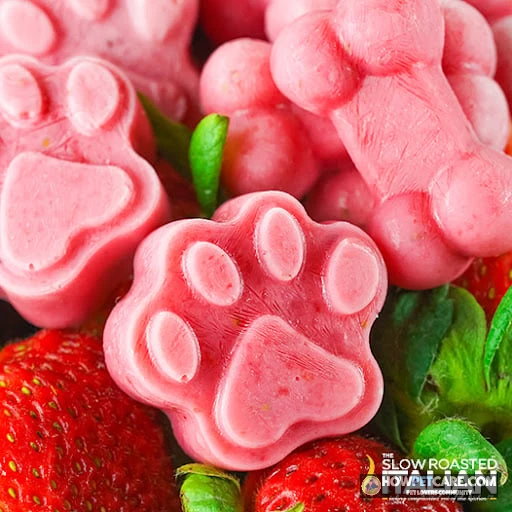
Frozen and freeze‑dried strawberries: how they convert
- Frozen – use the same portion by weight as fresh. Serve a whole frozen berry only to large dogs; cut or partly thaw it for small dogs to reduce the choking hazard.
- Freeze‑dried – the sugar is concentrated, so use the fresh‑weight equivalent (≈10 g fresh per 1 g freeze‑dried). A handful of pieces can contain many berries’ worth of sugar.
- Every day? A healthy dog can have a small portion most days if it stays within the weight‑based amount and the 10 % rule. Rotating treats and skipping days is a better habit. Dogs with medical conditions should have daily strawberries only if their vet approves.

How to Wash, Hull and Cut Strawberries for Your Dog
Washing and removing pesticide residue
Strawberries top the EWG Dirty Dozen list for pesticide residues. A small dog that eats berries regularly has greater residue exposure per pound of body weight. The effects of residues on dogs aren’t well studied, but a simple decontamination step reduces risk.
Step‑by‑step wash:
- Place the berries in a colander.
- Rinse them under cool running water for ~30 seconds, gently rubbing each berry.
- (Optional) Soak for 2–3 minutes in a solution of 1 part white vinegar to 3 parts water (or 1 tsp baking soda per cup water).
- Rinse thoroughly under running water again.
- Pat dry with a clean towel and use immediately.
Washing reduces residues but doesn’t eliminate them all. Organic berries are a reasonable choice for regular feeding.
If you feed strawberries more than once a week, the vinegar soak adds an extra safety margin.
Hulling and cutting: safe piece size by breed class
Remove the green cap (calyx) and stem. They’re tough, hard to digest, and a choking risk. Cut berries according to your dog’s size:
- Toy breeds – pea‑sized dice or thin slices.
- Small breeds – quarter‑inch pieces.
- Medium breeds – halves or quarters.
- Large & giant breeds – halves or whole berries (only if the dog chews well).
Cut smaller pieces for puppies and fast eaters. Choose ripe, soft berries, and discard any that are moldy or fermenting.
Strawberry leaves, stems and tops
The green parts aren’t known to be toxic, but their fibrous texture can cause stomach upset or choking. Remove them before serving. A dog that swallows a few leaves is usually fine; call the vet if your dog eats large amounts or vomits. Keep garden plants (leaves, runners) out of reach.
Strawberries for puppies
Once puppies are eating solid food, they can have tiny pieces of strawberry, mashed or finely diced. Keep portions very small because puppies have sensitive stomachs and tight calorie needs.
Strawberry Products That Are Dangerous and What to Do in the First 30 Minutes
Strawberry products to avoid
- Xylitol‑sweetened items (some yogurts, jams, baked goods, candy) — xylitol may be listed as "birch sugar".
- Chocolate‑covered or chocolate‑dipped strawberries.
- Canned strawberries, pie filling, or jam in syrup — these contain added sugar; some also contain xylitol.
- Strawberry‑flavored products with sugar alcohols.
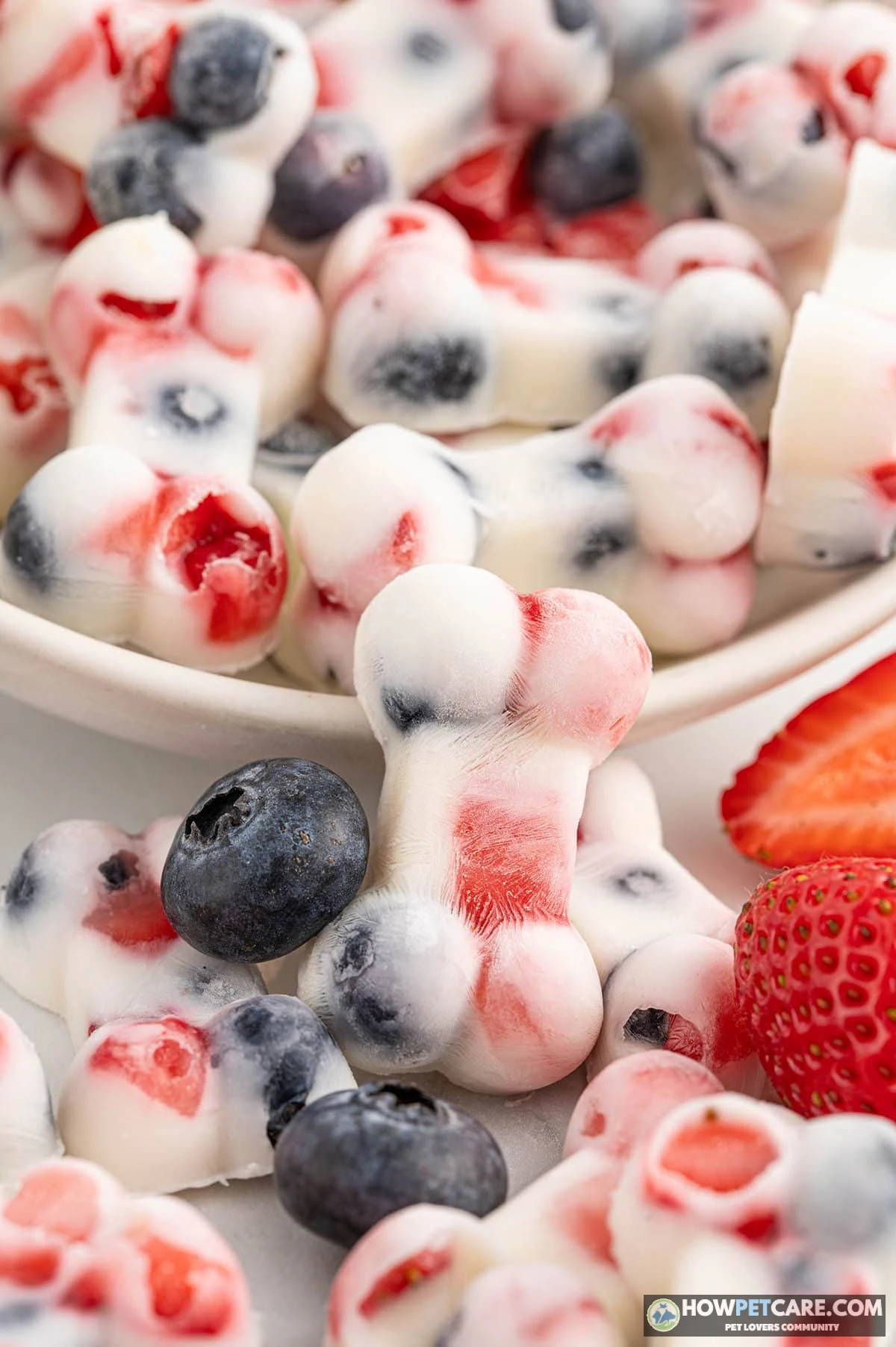
- Dried sweetened strawberries.

Most strawberry‑flavored foods contain little real fruit. Always check the ingredient label.
Emergency checklist: xylitol or chocolate‑covered strawberry
If your dog has just eaten something from the red zone, follow this list in order:
-
1. Remove access
Take the product and packaging away so no more is eaten.
-
2. Read the label
Look for xylitol (also "birch sugar"), chocolate, or other sugar alcohols.
-
3. Note amount & time
Estimate how much was eaten and when.
-
4. Note weight
Write down your dog’s weight.
-
5. Call a professional
Call your vet, an emergency clinic, ASPCA Animal Poison Control at (888) 426‑4435 or Pet Poison Helpline at (855) 764‑7661 (a consultation fee may apply). Verify numbers before publishing.
-
6. Do not induce vomiting
Unless a professional tells you to.
-
7. Bring packaging
If told to come in, bring the packaging.
Any suspected xylitol ingestion is an emergency even if your dog looks fine — signs can be delayed, and xylitol can cause a rapid blood‑sugar drop and, at higher doses, liver injury.
Chocolate: Toxicity depends on the type (dark and baking chocolate are worse), the amount eaten, and the dog’s weight. Call a vet immediately; don’t attempt home treatment.
Signs of too many plain strawberries and when to call the vet
Eating too many plain strawberries usually causes mild vomiting, loose stool, gas, or stomach upset that settles within a day. Contact a vet if you notice any of the following, or if your dog falls into an at‑risk group:
- Repeated vomiting
- Bloody stool
- Lethargy
- Swollen belly
- Dog is small, a puppy, or has a medical condition
Allergic reaction signs (rare): facial swelling, hives, intense itching, or trouble breathing. These are emergencies.
Are Strawberries Bad for Dogs With Diabetes, Pancreatitis, Kidney Disease or Bladder Stones?
Your dog’s vet makes the final call. This table outlines the usual guidance and questions you can bring to your appointment.
| Condition | Usual guidance | Why it matters | Question to ask your vet |
|---|---|---|---|
| Diabetes | Ask first; if approved, tiny amounts counted in the daily plan | Natural sugars still affect blood glucose | "Can I add strawberries, and how many fit the plan?" |
| Overweight / on a weight‑loss plan | Small amounts OK if vet approves; count toward the 10 % budget | Every treat calorie counts against the target | "Do strawberries fit my dog’s daily calorie target?" |
| Pancreatitis (current or history) | Ask first | Strawberries are low‑fat, but these dogs are usually on strict, consistent diets | "Is any fruit allowed on the prescribed diet?" |
| Kidney disease | Vet‑approved treats only | Potassium, phosphorus and the renal diet’s balance all matter | "Are strawberries compatible with the kidney diet?" |
| Calcium oxalate bladder stones | Usually avoid, or ask first | Strawberries contain oxalate; stone‑prone dogs are often told to limit high‑oxalate foods | "Should my stone‑prone dog avoid strawberries entirely?" |
| Pregnant or lactating | Tiny amounts unlikely to harm | Nutrition should come from the vet‑recommended diet; fruit shouldn’t displace it | "Is an occasional small berry okay right now?" |
| Sensitive stomach / elimination diet | Skip until the diet trial is cleared | New foods muddy the results of diet trials | "Can we trial strawberries after the elimination diet ends?" |

All condition‑specific guidance defers to a veterinarian; this article does not replace professional medical advice.
Diabetic and overweight dogs
Strawberries are relatively low in sugar for a fruit, but check any treat with your vet and count it in your dog’s daily plan. Don’t feed strawberries to adjust blood sugar.
Pancreatitis, kidney disease and calcium oxalate stones
Pancreatitis risk is driven mainly by fat. Strawberries are low‑fat, but dogs with a history of pancreatitis often need a strict diet, so check with your vet. Dogs with kidney disease need vet‑approved treats because potassium, phosphorus, and oxalate content matter. Dogs prone to calcium oxalate stones are usually advised to avoid high‑oxalate foods; strawberries contain oxalate, so ask your vet before offering them.
Pregnant and lactating dogs
Tiny amounts are unlikely to harm. A pregnant or lactating dog’s nutrition should come from the vet‑recommended diet; fruit shouldn’t displace it.
Strawberries vs. Blueberries vs. Raspberries: Sugar, Calories and Choking Risk
A comparison of these common berry treats can help you choose among them. Each has a different nutritional profile and preparation needs.
| Berry | Calories per 100 g | Sugar per 100 g | Calories per typical treat piece | Fiber (g/100 g) | Choking risk | Prep note |
|---|---|---|---|---|---|---|
| Strawberry | ~32 | ~4.9 | ~4 (12 g medium) | 2.0 | Medium – cut for small dogs | Wash, hull, cut |
| Blueberry | ~57 | ~10 | ~1 (1 g berry) | 2.4 | High for tiny dogs – whole berry can block airway | Rinse, serve whole or halved |
| Raspberry | ~52 | ~4.4 | ~1 (1 g berry) | 6.5 | Low – soft, but delicate | Rinse, serve whole; note trace natural xylitol |

Directional takeaways:
- Strawberries have less sugar and fewer calories per gram than blueberries; raspberries are lowest in sugar.
- Raspberries contain naturally occurring trace xylitol, so keep portions very small.
- Whole blueberries pose a choking hazard for tiny dogs and fast eaters. Strawberries need cutting; raspberries are soft but fragile.
Pick by situation:
- Small dog / weight‑managed → raspberries (tiny, low sugar) or strawberry pieces.
- Training treat → blueberry halves (tiny, easy to handle) if the dog chews well.
- General snack → strawberry pieces (low calorie, easy to portion).
See the sibling blueberry and raspberry articles for detailed portion tables.
| Dog Weight Class | Approx. Daily Calories | 10% Treat Budget (kcal) | Max Fresh Strawberries per Day | Frozen Equivalent | Freeze-Dried Equivalent | Safe Piece Size |
|---|---|---|---|---|---|---|
| Toy (under 10 lb) | ~250 | ~25 | 1 small berry, cut up | Same weight as fresh; cut or partly thaw | ~1 g (1–2 small pieces) | Pea‑sized dice or thin slices |
| Small (10–25 lb) | ~500 | ~50 | 2–3 medium berries | Same weight as fresh; cut or partly thaw | ~2–3 g | Quarter‑inch pieces |
| Medium (26–50 lb) | ~850 | ~85 | 3–4 medium berries | Same weight as fresh | ~3–4 g | Halves or quarters |
| Large (51–90 lb) | ~1,300 | ~130 | 4–6 medium berries | Same weight as fresh | ~4–6 g | Halves or whole |
| Giant (over 90 lb) | ~1,800 | ~180 | 6–8 medium berries (small handful) | Same weight as fresh; whole berries OK | ~6–8 g | Halves or whole |
Do Strawberries Whiten Dogs’ Teeth? Checking the Malic Acid Claim
The claim: Strawberries contain malic acid, a natural astringent that whitens teeth, so feeding them cleans your dog’s smile.
The verdict: not supported. Strawberries do contain small amounts of malic acid, and some human whitening products use it. But we found no peer‑reviewed evidence that eating strawberries whitens a dog’s teeth or removes tartar. The claim circulates as pet sites quote each other, not because it has been demonstrated in dogs.
The catch: Strawberries contain sugar and are mildly acidic, so they leave a little sugar and acid on the enamel — the opposite of what you want on teeth. Don’t rub mashed strawberry on your dog’s teeth.
What actually helps:
- Daily brushing with dog‑formulated toothpaste
- VOHC‑accepted dental chews and products
- Professional dental cleanings at your vet
One related note: Any breath‑freshening effect from fruit lasts minutes at best. Persistent bad breath usually signals dental disease; book a dental check rather than buying more berries.
For a complete dental‑care routine, see our guide on brushing and VOHC‑approved products.
1A dog owner wants to feed fresh strawberries to a healthy 25 lb adult dog with a daily requirement of 550 kcal. Given that a single medium strawberry has about 4 kcal, why is the recommended daily limit set to 2–3 medium strawberries rather than the 13 berries allowed strictly by daily calorie limits?
Even though a dog's daily treat caloric budget might allow for more berries, feeding that high volume at once routinely causes gastrointestinal upset, making digestive tolerance the practical limit.
2Which of the following canine health conditions require a dog owner to consult a veterinarian before introducing plain strawberries to their dog's diet?
Strawberries contain natural oxalates, which may need to be restricted in dogs prone to forming calcium oxalate stones.
3Some online sources claim that rubbing mashed strawberries on a dog's teeth whitens them due to the fruit's malic acid content. What is the main dental issue with applying strawberries directly to a dog's teeth?
Applying acidic and sugary fruit directly to tooth enamel promotes enamel erosion and bacterial growth, achieving the opposite of proper oral hygiene.
4When comparing strawberries, blueberries, and raspberries as dog treats, which of the following statements are accurate?
Whole blueberries are round and firm enough to block small airways in tiny dogs, whereas raspberries are soft and break down easily.
5Why does the consumption of a xylitol-sweetened strawberry item (such as commercial strawberry jam or yogurt) constitute an immediate veterinary emergency, even if the dog shows no outward symptoms?
Xylitol stimulates rapid insulin release in canines leading to life-threatening hypoglycemia and acute hepatic necrosis, which may not show immediate clinical signs.
6What is the primary reason for removing the green cap (calyx) and stem of a strawberry before offering it to a dog?
While the green tops are non-toxic, their tough, fibrous material is difficult to digest and can irritate the stomach or create a choking hazard.
Your Strawberry Serving Checklist: Decide, Portion, Prepare, Watch
Use this quick sequence at the counter:
- Decide – Does your dog have a condition on the vet‑first list (diabetes, pancreatitis, kidney disease, stones, pregnancy, elimination diet), or is the strawberry processed or sweetened? If so, skip it or call the vet.
- Portion – Look up your dog’s weight class in the portion table. Check that the amount fits within the 10 % rule alongside the day’s other treats.
- Prepare – Wash (rinse ± vinegar soak), hull, and cut the berry to the right size for your dog’s breed. Serve fresh or frozen.
- Watch – Observe your dog for 24 hours after the first serving. Watch for signs that mean you should call the vet (repeated vomiting, bloody stool, lethargy, swelling, allergic reaction).
Keep the emergency numbers somewhere visible and save the poison‑control hotlines in your phone. When in doubt — about a medical condition, repeated symptoms, or suspected toxic ingestion — ask a veterinarian.
FAQ
Can dogs eat strawberries every day?
A healthy dog can have a small portion most days if it stays within the weight-based amount and the 10 percent treat rule. Rotating treats and skipping days is a better habit, and dogs with medical conditions should only get daily strawberries if the vet approves.
Can dogs eat strawberry seeds?
Yes. The small seeds on the outside of the berry are harmless in the amounts a dog gets from a portion of fresh fruit and pass through the gut.
Can dogs be allergic to strawberries?
It is uncommon but possible. Itching, hives, facial swelling or vomiting after a first serving means stop feeding them, and trouble breathing or a swollen face needs emergency care.
How long can cut strawberries be kept for my dog?
Keep washed, cut berries in a sealed container in the fridge and use them within about two days. Throw out any that turn soft, moldy or fermented.
Can dogs have strawberry yogurt or ice cream?
It is better to skip them. These products often contain added sugar, dairy that upsets many dogs, and sometimes xylitol, so check the label and call a vet if any xylitol was eaten.