

Yes, dogs can eat strawberries in moderation when they’re fresh, washed, de-stemmed, and served plain. Keep portions within roughly 10% of daily calories, cut berries to size for small dogs, and refuse any canned, syrup-packed, chocolate-covered, or xylitol-containing products.
Yes, dogs can eat strawberries in moderation, provided they are fresh, washed, and served plain. However, sweetened, canned, syrup‑packed, chocolate‑covered, or xylitol‑containing products must be avoided outright. Dogs that are diabetic, overweight, have inflammatory bowel disease, are puppies, or belong to toy or flat‑faced breeds should consult a veterinarian before offering strawberries. Treats should stay within roughly 10% of a dog’s daily calorie budget, and berries should be cut to size so they never present a choking hazard.
How Many Strawberries Can a Dog Eat a Day? Grams, Calories, and Sugar by Weight Class
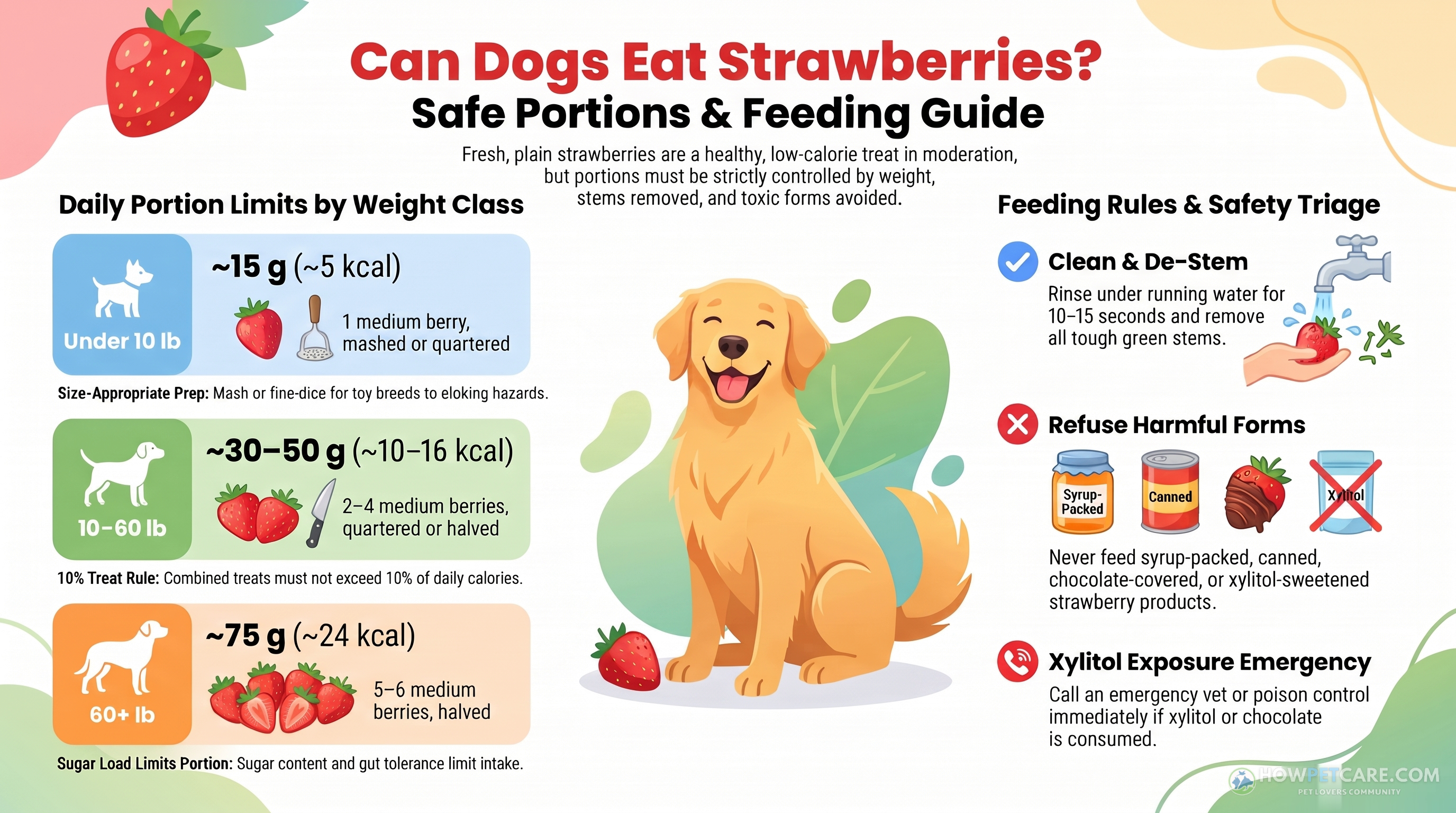
The portion numbers are calculated from the 10% treat‑calorie guideline and USDA FoodData Central values for raw strawberries (about 32 kcal and 4.9 g sugar per 100 g; one medium berry weighs roughly 12 g, providing ~4 kcal and ~0.6 g sugar). The table below shows the ceiling for a healthy adult dog in one day, assuming strawberries are part of the treat budget and other treats are counted within the same limit.
| Dog weight class | Max grams per serving | Approx. berries and cut size | Approx. calories | Approx. grams of sugar | Notes (puppy, diabetic, or toy‑breed adjustment) |
|---|---|---|---|---|---|
| Under 10 lb | ~15 g | 1 medium berry, mashed or quartered | ~5 kcal | ~0.7 g | Toy breeds: mash or fine‑dice to prevent choking. Puppies: start with a pea‑sized piece |
| 10–30 lb | ~30 g | 2 medium berries, diced or quartered | ~10 kcal | ~1.5 g | For a first serving, give half this amount and watch for stomach upset |
| 30–60 lb | ~50 g | 4 medium berries, halved | ~16 kcal | ~2.5 g | Halving is still the safer cut even for dogs that gulp |
| 60+ lb | ~75 g | 5–6 medium berries, halved | ~24 kcal | ~3.7 g | Large dogs can handle a whole berry, but halves remove the choking risk entirely |
Where the numbers come from: USDA FoodData Central lists raw strawberries at about 32 kcal and about 4.9 g sugar per 100 g; one medium berry weighs roughly 12 g (~4 kcal, ~0.6 g sugar).
Why the table is stricter than the 10% rule: the guideline says treats should stay within about 10% of daily calories. A 40 lb dog eating ~650 kcal/day has a ~65 kcal treat budget — which is nearly 200 g of strawberries on paper. The table stays far below that because sugar load, fiber bulk, and GI tolerance limit the serving long before calories do. No scale? A heaping tablespoon of sliced berries is roughly 15 g.
These ceilings already assume the day’s other treats are counted inside the same 10% budget. For diabetic or overweight dogs, treat the table as a maximum to clear with your vet, not an allowance.
How to Prepare Strawberries for Your Dog: Washing, Stems, Cutting, and the Organic Question
Step‑by‑step prep routine
-
Select
Choose firm, brightly colored berries and discard any with mold, white fuzz, or mushy spots. One moldy berry can spoil the container.
-
Rinse
Hold each berry under cool running water for 10–15 seconds, gently rubbing to remove surface residue. This is the minimum for every dog.
-
Soak (optional)
A plain‑water soak is fine; vinegar or baking‑soda soaks show limited residue reduction in studies and should be followed by a thorough rinse. Never use dish soap or chemical produce washes.
-
Dry
Pat the berries dry so they are not slippery in your dog’s mouth.
-
Remove top and stem
Twist or cut off the green calyx and stem. The leaves are not known to be toxic, but they are tough, fibrous, and a choking or GI‑upset hazard, so remove them.
-
Inspect again
Cut away soft or bruised spots; discard any moldy berries outright.
-
Cut to size
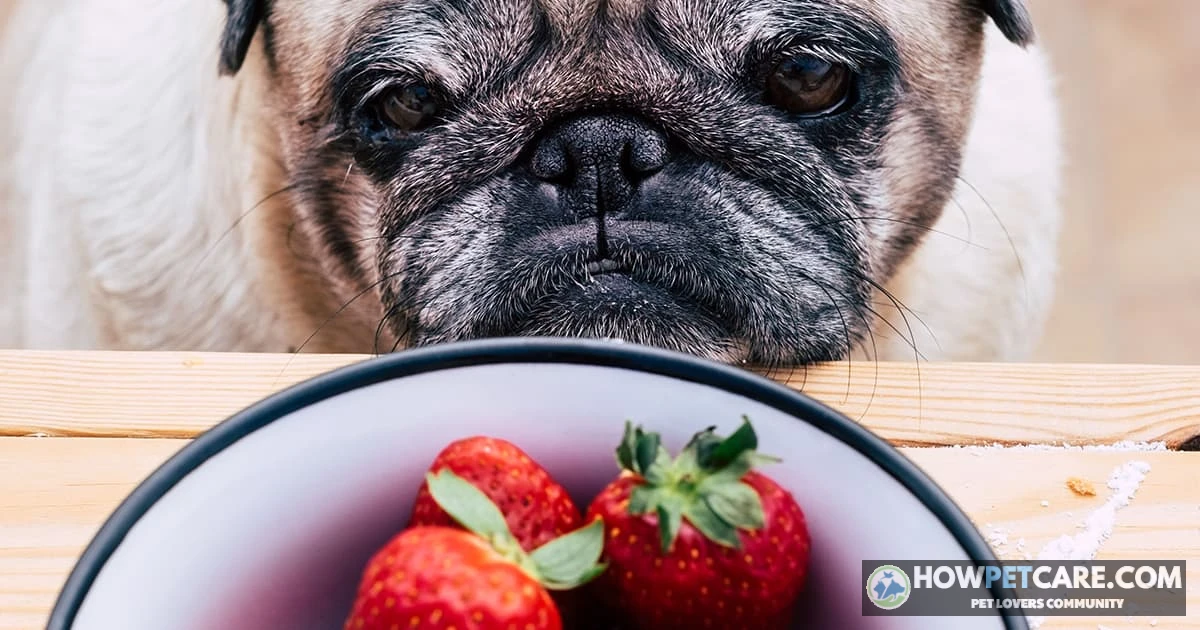
Toy and small breeds → mash or quarters; medium → quarters or small dice; large → halves; flat‑faced breeds (Pugs, Bulldogs, Frenchies) → mash or fine dice only.
-
Serve plain
Offer the prepared pieces without sugar, whipped cream, chocolate, or dips. First‑ever serving = one small piece, then wait and watch for gastrointestinal upset.
-
Store
Refrigerate cut leftovers in a sealed container and use within ~2 days; discard any moldy berries.
-
Organic?
Organic is a reasonable choice for small dogs or dogs that eat berries often, but it isn’t required for an occasional serving. A thorough rinse on every berry beats occasional organic; frequency matters more than any single berry.
Do dogs need organic strawberries?
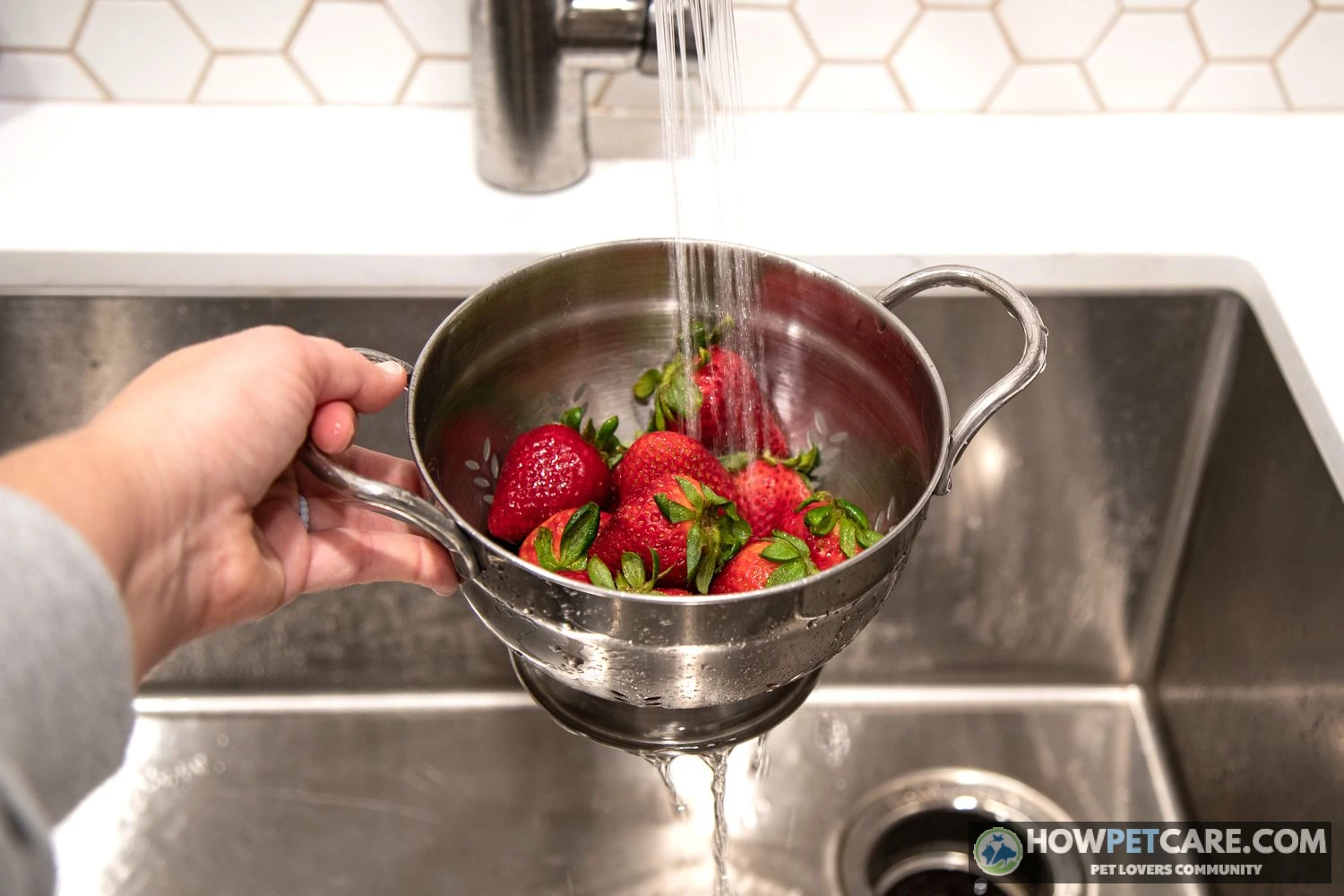
A thorough rinse is the minimum for every dog. Organic strawberries are a reasonable choice for small dogs or dogs that eat berries frequently, but they are not required for a single occasional serving. The key is consistent, thorough washing rather than relying on organic status alone.
Strawberry tops, stems, leaves, and seeds
The green calyx and stem are removed because they are tough and can cause choking or gastrointestinal upset, not because they are poisonous. Tiny edible seeds normally pass through a dog’s digestive tract without issue, but they may add bulk or irritation for dogs with IBD or very sensitive stomachs; if your dog has a sensitive gut, consider mashing the berries to remove seeds.
Fresh, Frozen, Freeze-Dried, Canned, or Syrup-Packed: A Verdict for Every Strawberry Form
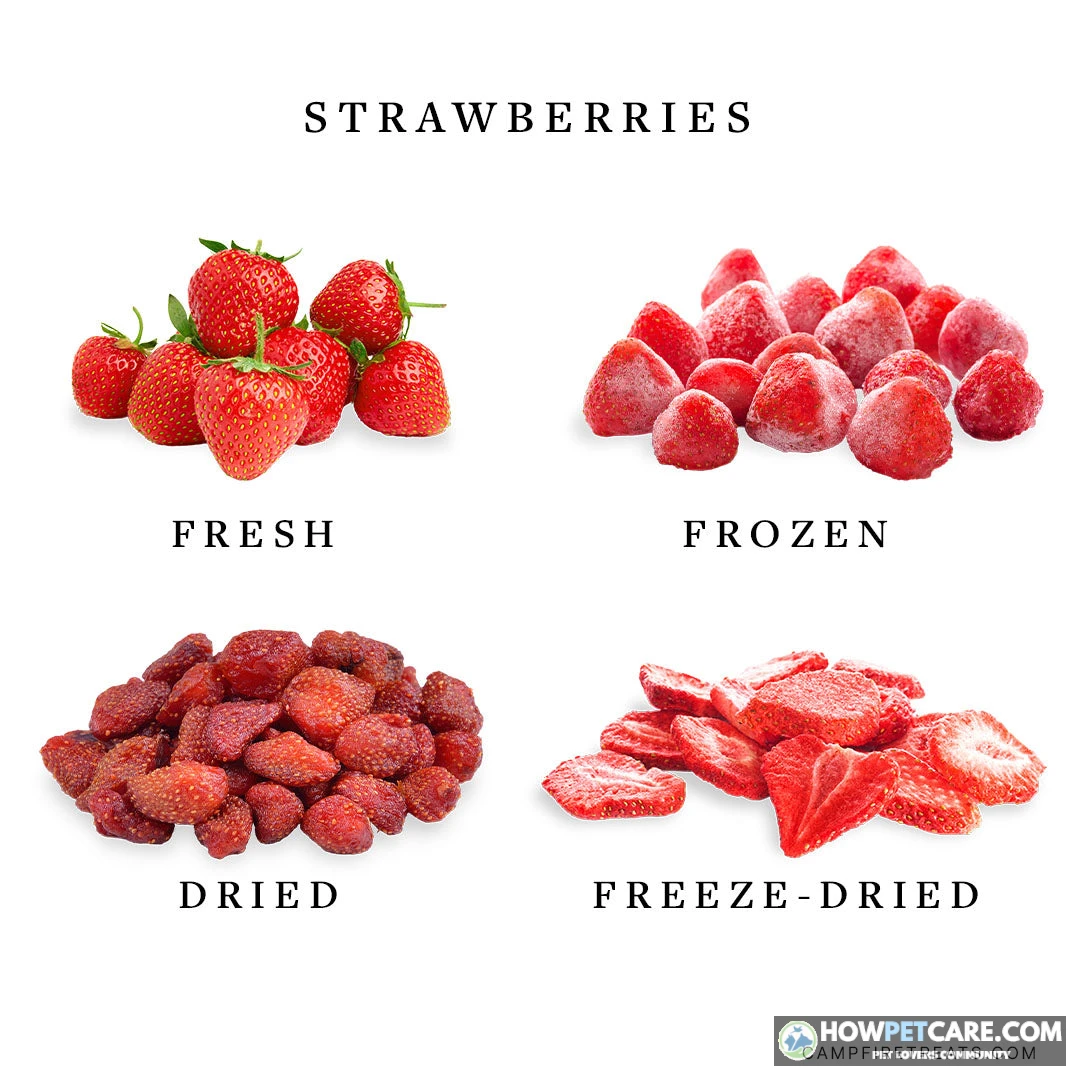
| Strawberry form | Verdict | Main risk | Serving rule | Notes on conflicting advice |
|---|---|---|---|---|
| Fresh, plain | OK | Choking if served whole to small dogs | Follow weight‑class table; wash, de‑stem, cut to size | Baseline safest option |
| Frozen whole | Limit | Choking and tooth fracture on hard berries | Thaw slightly or cut small; skip for small dogs and aggressive chewers | Cold is fine — rock‑hard is the problem |
| Frozen puree / ice cubes | OK | Minimal | Portion each cube so total fits the day’s gram ceiling | Easiest controlled frozen option |
| Freeze‑dried, plain/unsweetened | Limit — strict cap | Concentrated sugar by weight; easy to overfeed | ~1 g freeze‑dried ≈ one 12 g fresh berry; cap at a few small pieces | Hill’s warns against it while other sources endorse frozen; tiny amounts are acceptable; fresh‑weight ceiling does not apply directly |
| Dried/freeze‑dried with added sugar | Refuse | Added sugar, possible additives | — | Check labels: ‘infused with juice’ means sweetened |
| Canned in water or 100% juice | Limit (borderline) | Residual sugars, syrup traces | Rinse, small amount only — fresh is simpler | The only canned case worth considering |
| Syrup‑packed, jam, jelly, pie filling | Refuse | Heavy added sugar; possible xylitol in ‘sugar‑free’ versions | — | No safe portion exists in this category |
| Strawberry yogurt / ice cream | Limit | Lactose intolerance, added sugar, xylitol in low‑cal versions | Plain unsweetened yogurt base only, ingredient check first | Flavored products are the risk, not yogurt itself |
| Chocolate‑covered | Refuse | Theobromine in chocolate (dark and baking chocolate worst) | — | If already eaten, go straight to the triage section |
| Anything containing xylitol (‘birch sugar’) | Refuse — emergency if eaten | Rapid blood‑sugar drop and liver injury in dogs | — | Call poison control immediately; do not wait for symptoms |
Strawberries for Puppies, Diabetic Dogs, Overweight Dogs, and Sensitive Stomachs
Can puppies eat strawberries?
Puppies should wait until they are eating solid food reliably and their diet is stable before trying strawberries. Start with a pea‑sized mashed piece and clear it with your veterinarian. Because puppy diets must stay balanced, keep portions tiny and avoid daily feeding.

Diabetic and overweight dogs
Strawberries contain natural sugars, so diabetic dogs should only add fruit after veterinary approval and only as part of a consistent feeding schedule. One medium berry provides ~0.6 g sugar and ~4 kcal, which is modest but must be counted within the 10% treat budget. Overweight dogs can swap a strawberry for a lower‑calorie biscuit to manage total calorie intake.
IBD, sensitive stomachs, and strawberry seeds
Introduce strawberries one piece at a time and watch stool consistency. If your dog has IBD or a sensitive stomach, mash the berries and strain out seeds to reduce bulk and potential irritation. Evidence on seed toxicity is limited; individual tolerance varies.
Allergy signs and what to do
Itching, hives, facial swelling, vomiting, or diarrhea may indicate an allergy or intolerance. Stop feeding strawberries immediately, remove access, and monitor. For mild stomach upset, withhold food for 12 hours, offer fresh water, and call your vet if symptoms persist beyond a short period. Seek emergency care right away for facial swelling, breathing difficulty, or collapse.
Strawberry Health Benefits for Dogs: What the Evidence Supports and What It Doesn’t
Strawberries provide fiber, antioxidants (anthocyanins and other polyphenols), vitamin C, manganese, potassium, iodine, magnesium, folic acid, omega‑3s, and malic acid. These contributions are modest; a balanced commercial diet already supplies most of what dogs need.
Vitamin C
Dogs synthesize their own vitamin C, so extra from strawberries does not correct a deficiency and is simply excreted in urine.
Natural sugars
The main reason for portion limits is the sugar content. Tie back to the portion table: a 15 g serving for a small dog is ~0.7 g sugar, which is a small fraction of daily intake but still counts toward the treat budget.
Malic acid and teeth‑whitening claim
The malic acid claim is repeated everywhere but no controlled study in dogs supports meaningful teeth‑whitening. The acid can soften enamel in human research, and occasional berry consumption is unlikely to cause enamel erosion in dogs, but it is not a substitute for brushing or dental chews.
Comparison with blueberries
Both strawberries and blueberries are low‑calorie antioxidant fruits. Strawberries are slightly larger, which increases choking risk for small dogs, and they contain a bit more sugar per 100 g than blueberries. For a detailed blueberry guide, see the companion article on safe fruits for dogs.

My Dog Ate Something Dangerous or Too Many Strawberries: First‑Minutes Triage
Before anything else: take the product away, keep the packaging, and note what was eaten, how much, and when. Know your dog’s approximate weight — every hotline will ask.
| What your dog ate | Level of concern | Immediate action | Call | Symptoms that mean go to emergency care |
|---|---|---|---|---|
| Too many plain strawberries | Low | Remove remaining fruit, offer fresh water, monitor | Vet if vomiting/diarrhea is severe or doesn’t settle, or the dog is a puppy, toy breed, or diabetic | Repeated vomiting, blood in vomit or stool, swollen or painful belly, marked lethargy |
| Canned, syrup‑packed, or jam (no xylitol) | Moderate | Same as above; expect a larger sugar‑driven stomach upset | Vet if symptoms are more than mild | Same red flags as above |
| Anything listing xylitol or birch sugar | Emergency | Keep packaging. Do not induce vomiting or give anything by mouth | Vet/ER now, or ASPCA Poison Control (888‑426‑4435) / Pet Poison Helpline (855‑764‑7661) — before symptoms appear; fees may apply | Weakness, wobbliness, tremors, seizures, collapse — leave immediately, don’t call first |
| Chocolate‑covered strawberries | High — depends on chocolate type, amount, and dog weight | Note the chocolate type (dark and baking are worst), estimate amount and time | Poison line now — they run chocolate toxicity calculators; do not do the math yourself | Restlessness, rapid heart rate, vomiting, tremors, seizures |
| Unknown product or missing label | Treat as high | Save the packaging or photograph the label | Poison line for guidance on whether monitoring is enough | Any red‑flag symptom |
Never induce vomiting, give activated charcoal, or try home remedies unless a veterinary professional tells you to — whether it helps depends on the substance and timing, and it can make things worse.
Emergency red flags: collapse, weakness, tremors or seizures, repeated vomiting, blood in vomit or stool, a swollen belly, or breathing trouble mean go to the nearest emergency clinic now.
What to tell the vet: product name, ingredients (especially xylitol or chocolate), estimated amount, time of ingestion, dog’s weight, and any relevant health conditions.

Portion‑Matched Strawberry Treat Ideas for Dogs, Including Frozen Recipes
Frozen strawberry puree cubes
- Ingredients: 100 g fresh strawberries, 30 ml water, 1 g plain yogurt (optional).
- Blend until smooth, pour into ice‑cube tray, freeze.
- One cube (≈10 g) equals one serving for a 10–30 lb dog; for larger dogs, two cubes fit the gram ceiling.
Strawberry and plain yogurt freezer bites
- Ingredients: 50 g mashed strawberries, 50 g plain unsweetened yogurt, 1 g honey (optional, omit for diabetic dogs).
- Mix, spoon onto a silicone mat, freeze.
- One bite (≈8 g) is a single treat for a 30–60 lb dog; adjust portion size for smaller dogs.

Mashed strawberry topper for kibble
- Ingredients: 20 g mashed strawberries, 1 tsp warm water.
- Mix into a small spoonful of kibble; one spoonful equals one serving for a 10–30 lb dog.

Mixing fruits and yogurt
Strawberries can be combined with blueberries (see our blueberry guide for dogs), banana, or plain yogurt, but the total treat budget is shared. For example, a 10 g strawberry (≈5 kcal, 0.7 g sugar) plus a 10 g blueberry (≈6 kcal, 0.5 g sugar) totals ~11 kcal and 1.2 g sugar, still within the 10% limit for a 30 lb dog (≈65 kcal treat budget). Always keep the combined fruit and yogurt portion within the gram ceiling for your dog’s weight class.
Your Strawberry Safety Checklist: Pick the Right Serving for Your Dog
Three‑step decision path
- Is the product plain fresh, frozen, or unsweetened freeze‑dried? If it contains added sugar, syrup, chocolate, or xylitol, refuse it outright.
- Does your dog have a health condition or age flag (puppy, diabetes, IBD, weight problems)? If yes, get veterinary clearance before feeding.
- Look up the weight class and serve at or below the ceiling shown in the portion table.

Prep checklist
- ☐ Select: firm, brightly colored berries. Skip any with mold, white fuzz, or mushy spots — one moldy berry can spoil the container.
- ☐ Rinse: hold each berry under cool running water for 10–15 seconds, rubbing gently. Strawberries sit on the EWG Dirty Dozen list (advocacy‑group testing of produce for people, not a dog‑specific limit) — rinsing reduces surface residue but can’t remove everything, so make it a non‑negotiable minimum.
- ☐ Decide on soaking: a plain‑water soak is fine; vinegar or baking‑soda soaks show limited residue reduction in studies — if you do one, still rinse after. Never use dish soap or produce‑wash chemicals.
- ☐ Dry: pat dry so berries aren’t slippery in your dog’s mouth.
- ☐ Remove top and stem: twist or cut off the green calyx and stem. The leaves aren’t known to be toxic — you remove them because they’re tough, fibrous, and a choking/ GI‑irritation hazard, not because of poison.
- ☐ Inspect again: cut away soft or bruised spots; discard anything moldy outright.
- ☐ Cut to size: toy and small breeds → mash or quarters; medium → quarters or small dice; large → halves; flat‑faced breeds (Pugs, Bulldogs, Frenchies) → mash or fine dice only.
- ☐ Serve plain: no sugar, whipped cream, chocolate, or dips. First‑ever serving = one small piece, then wait and watch.
- ☐ Store: refrigerate cut leftovers in a sealed container and use within ~2 days; moldy means the whole berry goes in the trash.
- ☐ Organic — worth it or not? Reasonable for small dogs or dogs eating berries often; not required for an occasional serving. Frequency matters more than any single berry — a thorough rinse on every berry beats occasional organic.
Refuse list in one line: syrup, jam, canned in sugar, chocolate‑covered, anything with xylitol.
When to call the vet before feeding: before introducing fruit to puppies, diabetic dogs, and dogs on prescription diets.
Emergency numbers reminder: save the poison‑control hotline (888‑426‑4435) and your nearest 24‑hour clinic in your phone now.
FAQ
Do dogs like strawberries?
Many dogs enjoy them because of the sweet taste and soft texture, but preferences vary. If your dog refuses them, there is no nutritional need to push it.
What other fruits can dogs eat besides strawberries?
Blueberries, watermelon without seeds or rind, bananas, apples without seeds or core, and cantaloupe are commonly listed as safe in small amounts. Grapes and raisins are toxic and must be avoided.
Can dogs eat strawberry yogurt or strawberry jam?
Skip both. Jam is high in added sugar and may contain xylitol, and flavored yogurt often has added sugar or sweeteners. Plain unsweetened yogurt with a little mashed fresh strawberry is a safer choice.
Can dogs eat strawberry ice cream or strawberry-flavored treats?
Not as a habit. Ice cream is high in sugar and fat, can upset the stomach, and may contain xylitol. Check the label on any flavored product and call your vet if your dog eats something containing xylitol.
Can dogs eat strawberry tops, leaves, or stems?
The green tops and stems are not known to be toxic, but they are tough, fibrous, and a choking or stomach-upset hazard, so remove them before serving. Tiny seeds usually pass through without issue.
How many strawberries is too many for a dog?
It depends on weight: roughly 15 g for dogs under 10 lb, 30 g for 10–30 lb, 50 g for 30–60 lb, and 75 g for dogs over 60 lb per day. Eating well beyond these amounts typically causes diarrhea or stomach upset rather than toxicity.