

Yes, dogs can get hiccups — an involuntary diaphragm spasm that ends with the glottis snapping shut, producing the soft hic sound. Most episodes are harmless and stop on their own within minutes, especially in puppies. Breathing trouble, pale or blue gums, or a swollen belly are emergencies.
Normal Hiccup or Emergency? Run This 60-Second Check First
Yes, dogs can get hiccups, and the great majority of episodes are harmless. A hiccup is an involuntary diaphragm spasm followed about 35 milliseconds later by the glottis snapping shut, making the soft hic you hear. If your dog is alert and breathing comfortably between rhythmic jerks, you’re almost certainly seeing normal hiccups that will pass on their own.
Hiccups aren’t the only thing that can make a dog jerk and gulp, though. A couple of look-alikes are genuine emergencies, so run this 60-second check before deciding to wait and watch.
- Breathing: comfortable between jerks, with no choking signs such as pawing at the mouth, panic, or silence instead of moving air.
- Color: gums pink, not pale, gray, or blue.
- Awareness: alert, responsive to their name, and not collapsed.
- Belly: normal and soft, with no repeated unproductive retching or hard swelling.
If any one of these checks fails, treat it as an emergency and call your vet or the nearest emergency clinic now.
If all four checks pass and the jerks are rhythmic and regular, keep a timer running and read on. Hiccups that look like this are painless, if mildly annoying, for your dog. The hic sound is the main thing you’ll notice.
What to do in the next five minutes
Write down the start time. Leave your dog where they are rather than restraining or holding them down, and watch their chest and gums rather than their whole body. Film 10 to 20 seconds of video with sound; a clip can tell your vet more than a description. Keep the room quiet and stop play. If your dog is thirsty and breathing normally, offer two to four slow laps of room-temperature water, with nothing else by mouth.
A note on sourcing: this guide draws on veterinary reference summaries and the sources cited throughout. Where evidence is thin, such as how often hiccups occur across the dog population or exactly when puppies outgrow them, the wording reflects that uncertainty rather than supplying an invented statistic.
What Dog Hiccups Look and Sound Like in Puppies and Adults
A hiccup sounds nothing like a cough. Listen for a soft, repeated hic or a gulp-like click, evenly spaced in a rhythm steady enough to tap along to. Veterinary reference summaries put the rate at roughly 4 to 60 hiccups per minute, with each spasm-and-glottis cycle lasting about 100 to 300 milliseconds.
Most dogs hiccup while standing, sitting, or lying down, with a relaxed body and small jolts visible in the chest or flank. Their eyes look normal, they stay alert and respond to their name, and their breathing between jerks is unremarkable. Once the hiccups stop, they simply carry on. That clean recovery is one of the clearest signs you’re not watching a breathing emergency.

Use your phone’s normal camera, not slow motion, and keep the chest and face in frame for 10 to 20 seconds with sound on. A short clip lets you compare a future episode with a known-normal one, and it’s often more useful to a vet than a paragraph of description.
Puppy hiccups
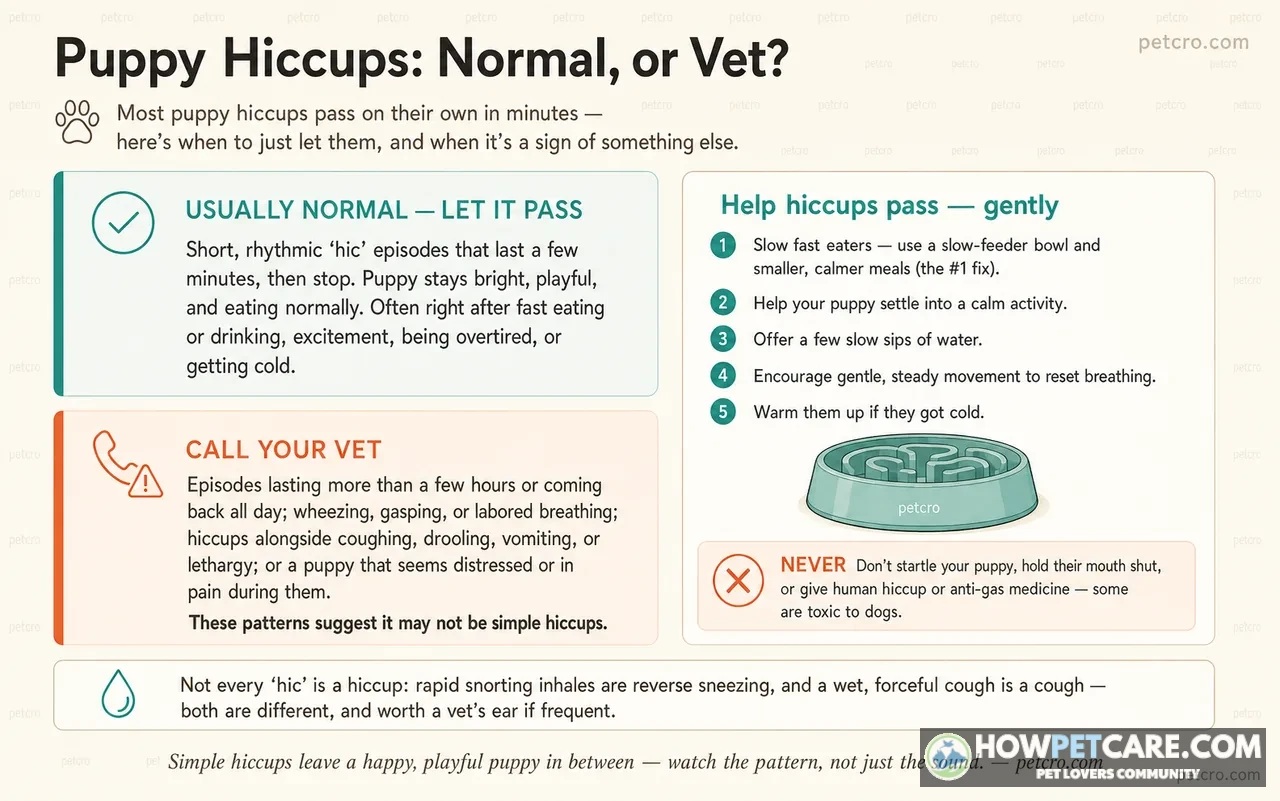
Puppies hiccup far more often than adult dogs. General veterinary summaries describe episodes several times a day in puppies versus weekly or less in adults. There are three reasons: an immature diaphragm and immature vagal and phrenic pathways that set the reflex off more easily, a lower threshold for triggering it, and puppies’ habit of eating fast and swallowing air.
It’s uncertain how long this phase lasts. Many puppies hiccup less as their eating habits and breathing control mature, but there’s no reliable age at which you can expect it to stop. Individual variation is wide. Treat frequent puppy hiccups as a normal developmental nuisance, and mention new or worsening episodes at your next veterinary checkup.
Adult dog hiccuping
Hiccups are less common and less expected in adults. A short episode after a fast meal or a big burst of excitement is unremarkable. New, frequent hiccupping in an adult dog, especially a senior, is worth a non-emergency conversation with your vet. Hiccups don’t point to a disease on their own, but a change from your dog’s normal pattern is easy to overlook and worth checking.
Why Dogs Get Hiccups: Eating Fast, Excitement, Stress and Cold Water
The reflex runs through the phrenic nerve, which drives the diaphragm, and the vagus nerve, which carries much of the sensory traffic that can set it off. Anything that distends or irritates the stomach, or disrupts the rhythm of breathing, can trigger a run of spasms. Veterinary summaries list respiratory malfunction or disease among the possible causes, though common triggers are far more mundane.
Hiccups after eating or drinking
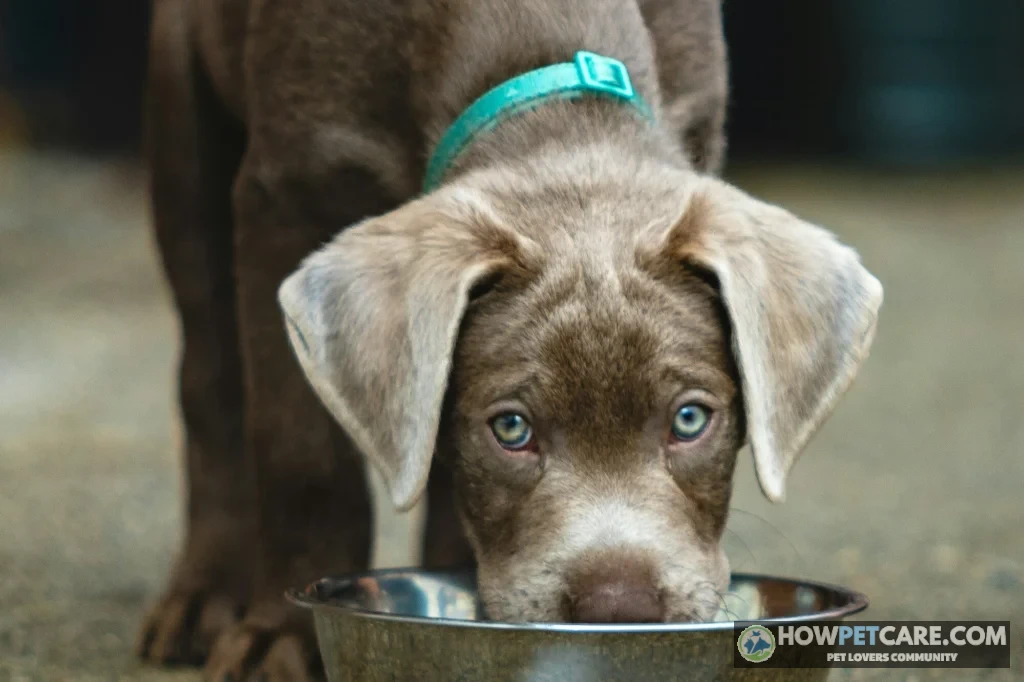
The most common trigger by far is speed, not ingredients. Eating quickly sends swallowed air, known as aerophagia, into the stomach. A distended stomach pressing against the diaphragm is enough to start the reflex. Dry kibble, cold food, and oversized meals make it more likely, but reports consistently point to how fast the food goes down rather than what it is. Quick drinks or very cold water produce the same effect.
Excitement, stress and post-play hiccups
Excitement and stress can disrupt breathing rhythm. A dog who’s just torn around the yard or worked themselves up at the front door is breathing fast and irregularly, setting the stage for diaphragm spasms. Veterinary summaries name abrupt excitement among the main causes. These episodes usually fade as the dog settles.

Why puppies hiccup more than adults
Immature breathing control, fast growth, lower reflex thresholds, and eating quickly all contribute to hiccups in puppies. Puppies also sleep more and play in wild bursts, both common times to notice hiccups. Two myths are worth putting aside: hiccups aren’t a sign of worms, and scaring a dog isn’t a cure.
Safe Ways to Stop Dog Hiccups at Home (and What Not to Do)
Most episodes stop without any intervention, and none of the measures below is a guaranteed cure. The goal is to help breathing settle and remove the trigger, not force the hiccups away. Give each step two or three minutes before adding the next.
-
Step 1: wait and watch
Note the start time and watch for two to three minutes. Most episodes end on their own during this time.
-
Step 2: reset the scene
Move to a quiet spot, stop play, speak normally, and let your dog stand or lie down wherever they choose.
-
Step 3: offer slow sips of room-temperature water
Offer two to four small laps; never pour or force the water. Very cold water can retrigger the reflex.
-
Step 4: settle the breathing
Slow, gentle petting along the chest or a calm three- to five-minute walk on a leash can help normalize fast, irregular breathing.
-
Step 5: hold food briefly
If the episode followed a meal or fast drinking, wait 20 to 30 minutes before offering anything else.
-
Step 6: gentle belly rub, only if your dog likes one
Stop immediately if your dog stiffens, guards their belly, vomits, or seems painful.
Don’t scare or startle your dog, hold their tongue, muzzle them, or press on their throat or chest. Skip sugar, honey, and any "human hiccup trick"; there’s no evidence behind them, and sugar adds unneeded calories. Never force chews or food into a dog mid-episode, and never give medication, human or pet, without veterinary advice. Stress worsens breathing, and a panicking dog may bite hands placed in their mouth.
Prevention that actually helps
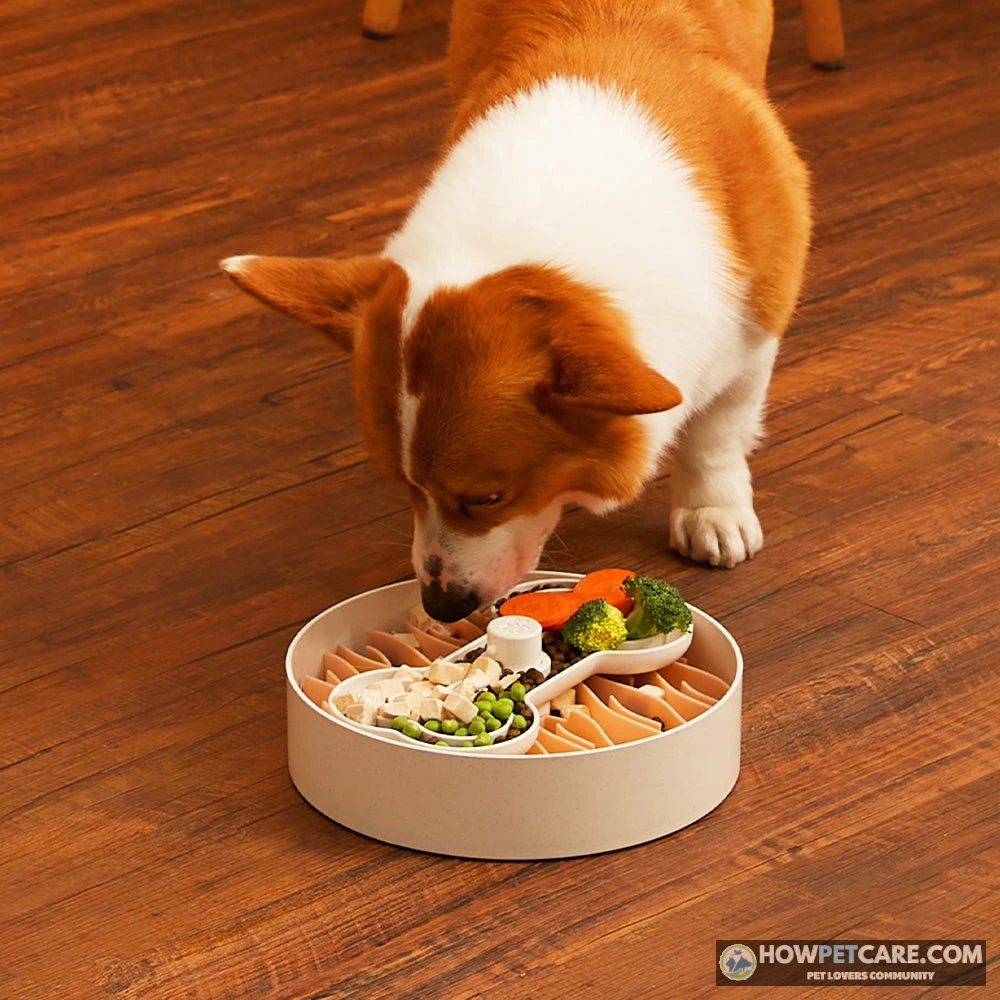
Focus on the triggers you can control. A slow feeder bowl or puzzle feeder, several smaller meals instead of one large one, a calm feeding area away from other pets, room-temperature water, and 20 to 30 minutes of rest after eating can remove most of them. Veterinary summaries point to slower drinking, calming the dog, and slower eating as the same three approaches. Switching to a slow feeder alone can remove the single most common trigger.
How Long Is Too Long? One Duration Rule That Reconciles 10 Minutes, 1 Hour and 48 Hours
The numbers you’ll find online measure different things, which is why they seem to contradict each other. Some describe a single harmless episode: seconds to 10–15 minutes. Others describe when persistent hiccups deserve a veterinary evaluation, such as a source flagging hiccups that continue beyond 48 hours. Still others quote about an hour as a practical caution line for owners. None is wrong; they answer three different questions. Here’s how to put them to use.
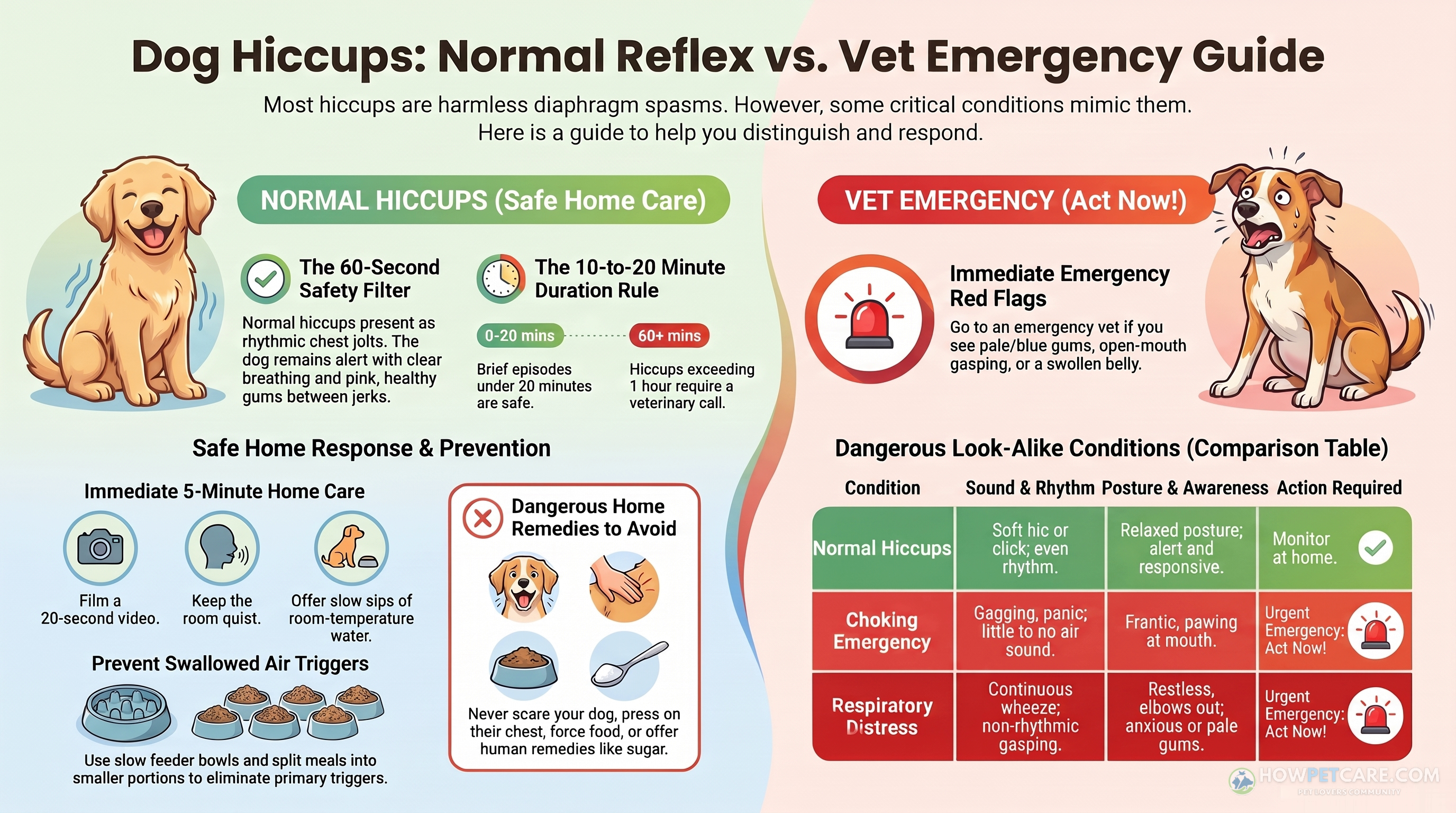
The rule: a single episode that resolves within about 10 to 20 minutes in a dog who is alert and breathing normally is almost certainly normal. If hiccups are still going after about an hour, or recur most days for more than a few days to a week, call your vet during office hours. Breathing difficulty, pale or blue gums, collapse, or a swollen painful belly override the clock entirely: go now.
| Situation | Typical timeframe | Risk level | What to do |
|---|---|---|---|
| Single episode in an alert dog breathing normally | Seconds to about 10–20 minutes, then gone | Usually low | Monitor; log it once if it’s new for your dog |
| Episode keeps restarting through the day, or runs toward about an hour | Repeated within one day, or around an hour | Caution | Call your vet during office hours, especially with vomiting, cough, lethargy, pain, or appetite loss |
| Episodes most days for several days to a week, or a clear change from your dog’s baseline | Recurrent over days | Caution | Book a non-emergency visit; bring video and the episode log |
| Continuous severe hiccuping, distress, vomiting, belly pain or swelling, cough, lethargy, pale or blue gums | Any duration | Urgent | Same-day or emergency vet; the clock doesn’t matter |
| Still happening after roughly 48 hours | Around two days | Urgent | Prompt vet visit even if your dog seems otherwise fine |
Exceptions that override the clock
Four signs make duration irrelevant: labored or open-mouth breathing, pale or blue gums, vomiting alongside hiccups, and a painful or hard, swollen abdomen. Lethargy, refusal to eat, a new cough, or an unwell very young puppy also lower the threshold for seeking help, however short the episode. Brachycephalic dogs such as Pugs, Bulldogs, and Boxers deserve the same lower threshold because their airways leave less margin when breathing goes off-pattern.

There’s no published number for "too often." Hiccups several times a day are described as typical for puppies, and weekly or less for adults. Your own dog’s baseline matters more: a dog who hiccups once a month and suddenly hiccups daily has a change worth reporting, even if each episode is brief.
The framework above is a consensus-style triage guide for owners, not a validated clinical standard or a diagnosis. Your vet’s assessment of your dog always outranks a rule of thumb on a website.
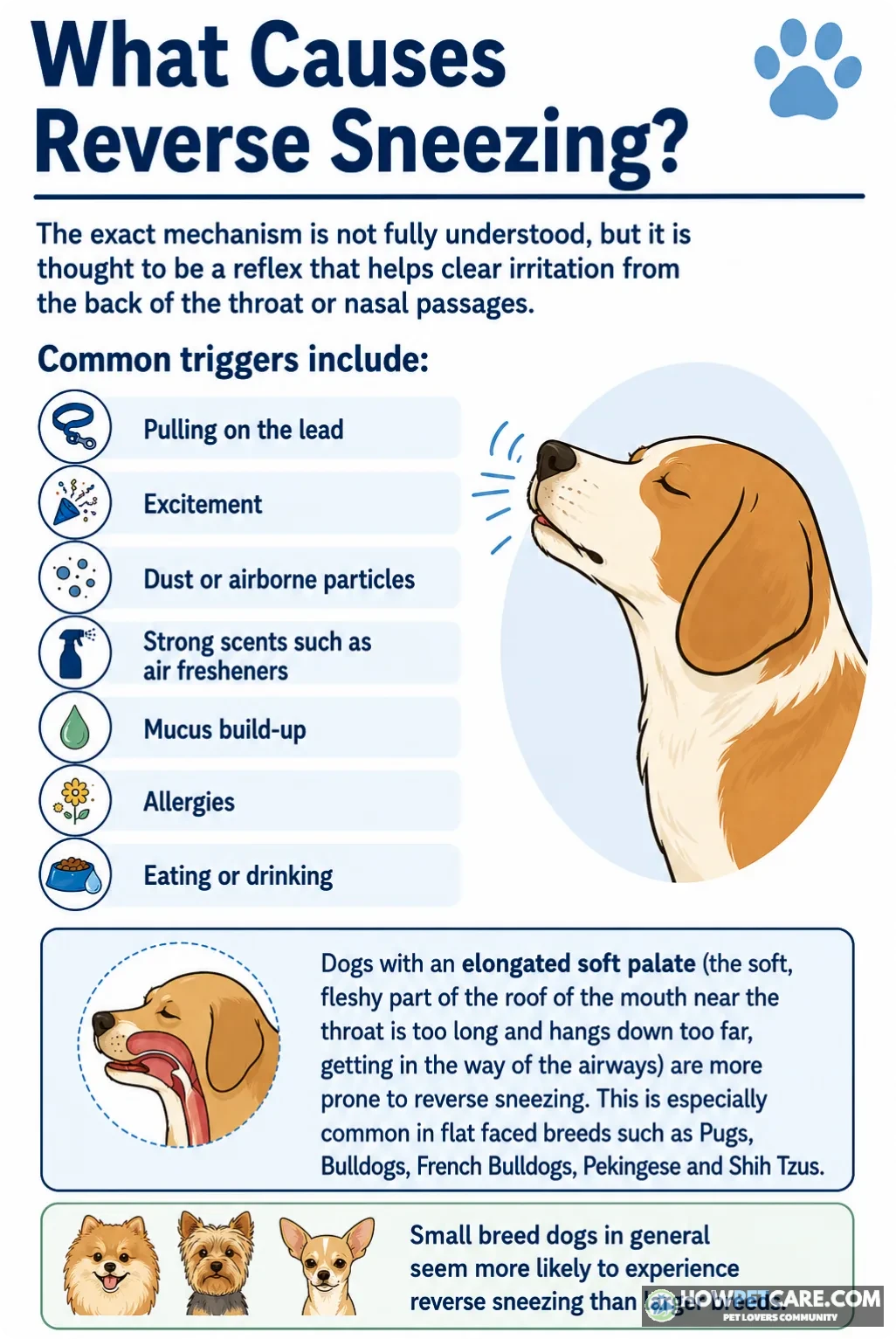
Hiccups vs Reverse Sneezing, Choking, Coughing, Respiratory Distress and Seizures
Five events can be mistaken for hiccups, and two are emergencies. Compare the features you can observe from across the room.
| Condition | Sound | Rhythm and duration | Posture and body | Eyes and consciousness | Breathing between episodes | Typical recovery | Action to take |
|---|---|---|---|---|---|---|---|
| Hiccups | Soft hic or gulp-like clicks | Even, metronome-like jerks; usually minutes | Relaxed; small chest or flank jolts while standing, sitting, or lying | Alert, normal eyes | Normal between jerks | Carries on normally | Monitor using the duration rule |
| Reverse sneezing | Loud snorting, snuffing inward | Rapid bursts, often 10–60 seconds | Neck extended, elbows out, may freeze | Alert | Normal after the burst | Normal immediately | Usually observe; film it if it recurs |
| Choking | Gagging, panic, little or no air sound | Irregular and escalating | Pawing at the mouth, drooling, frantic | Distressed but conscious | No or poor air movement | Does not settle | Emergency now |
| Coughing, gagging, retching | Honk, hack, or retch; may bring up foam | Clusters, variable | Head and neck extended, belly heaves | Alert or uncomfortable | May be normal between coughs | Depends on cause | Vet if persistent or paired with other signs |
| Respiratory distress | Wheeze, open-mouth breathing, noisy effort | Continuous, not rhythmic jerks | Restless, belly effort, elbows out | Anxious; gums may pale or turn blue | Labored throughout | Does not recover | Emergency now |
| Seizure | Often silent, or a cry; paddling sounds | Sudden, seconds to minutes, then dullness | Stiffening, paddling, drooling, possible urination | Reduced or absent awareness | Irregular during the event | Confused afterward | Emergency or urgent call now |
Reverse sneezing is loud and dramatic but brief, and the dog stays alert throughout. Choking looks different: little or no air movement, panicked pawing at the mouth, and no settling. A honking cough points toward throat irritation or kennel cough rather than hiccups. Respiratory distress involves continuous effort without a clean rhythm. A seizure takes awareness away entirely, which hiccups never do.
Quick tie-breaker questions
Check whether your dog responds to their name and seems aware, breathes normally between jerks, and has a steady rhythm with a soft sound rather than honking or gasping. Also look for a full recovery, with your dog carrying on afterward. Four yeses mean hiccups are most likely.
What to do while you decide
Don’t restrain your dog, and keep your hands away from their mouth if choking is possible. Note the time, and call your vet or an emergency clinic while you watch rather than afterward. If your dog stops breathing, collapses, or their gums change color, go immediately. Don’t wait for the episode to end.
Hiccups While Sleeping, After Vomiting, or for No Obvious Reason
Sleep hiccups
Hiccups during sleep are usually harmless and often occur alongside relaxed, slow breathing and dreaming. Unless the episode is long or your dog seems distressed, let them sleep. If you do wake them, do it gently; never shake a sleeping dog.
After vomiting
Hiccups can follow vomiting because the diaphragm and esophagus have just been irritated. Watch what happens next. Repeated vomiting, especially throwing up yellow bile, lethargy, abdominal pain, or an inability to keep water down all mean it’s time to call the vet today. In a deep-chested dog, hiccups with unproductive retching and a tight, swollen belly can signal a bloat emergency. Go now.
Random or frequent hiccups
Plenty of episodes have no obvious trigger and are still minor. Start the log and look for a pattern. Hiccups alone rarely point to a specific condition such as worms, heart disease, bloat, or pneumonia. The accompanying signs matter more than the hiccup itself, so don’t let a list of diseases overshadow what you’re observing in your dog.
Breeds and life stages that need extra attention
Flat-faced breeds such as Pugs, Bulldogs, and Boxers have less airway margin, so call with a lower threshold for any breathing change. Owners of deep-chested, large breeds such as Great Danes and Standard Poodles should know the signs of bloat in advance, because repeated gulped air and distress can overlap with a genuine bloat risk. Seniors with new-onset hiccups and puppies who bolt their food both warrant a closer look and a mention at the next checkup.
Recurring or Persistent Hiccups: Episode Log and What a Vet Will Do
If episodes repeat, record what you notice rather than guessing at a cause. One line per episode is enough, along with a short phone video.
Episode log template
| Date and time | Sleep or awake | Duration | Before it: meal and water timing, play, stress, cold water | Sound: hic, snort, honk, gag | Breathing between jerks | Other signs: vomiting, cough, lethargy, belly pain, appetite | What seemed to stop it |
|---|---|---|---|---|---|---|---|
| ____ | Awake / asleep | __ min | Food __ min before; water fast/slow/cold; play yes/no | ____ | Normal / labored | ____ | Alone / water / calm / unknown |
| ____ | Awake / asleep | __ min | ____ | ____ | ____ | ____ | ____ |
| ____ | Awake / asleep | __ min | ____ | ____ | ____ | ____ | ____ |
After three to five entries, circle any repeats: within 10 minutes of eating, after zoomies, only during sleep, after cold water, or after vomiting. A clear change from your dog’s normal pattern matters more than any single odd episode.
What the vet visit looks like
Your vet will usually start with a history, where your log and video can help, followed by a physical exam of the chest, abdomen, and airway. Depending on what they find, they may add fecal testing, bloodwork, or imaging such as X-rays or ultrasound. Possible explanations include dog digestive problems such as gastrointestinal upset, along with esophageal or airway irritation, and only rarely metabolic or neurologic causes. When the rhythm doesn’t fit, a vet may also consider a less common pattern called synchronous diaphragmatic flutter, a rhythmic diaphragm contraction sometimes mistaken for hiccups.
Persistent hiccup treatment options
Treatment addresses the cause rather than the symptom. That might mean feeding changes for a fast eater, treatment for gastrointestinal upset, or care for airway irritation. In rare refractory cases, veterinarians sometimes use prescription medication. Chlorpromazine is one occasionally discussed for persistent hiccups, but it should be used only under direct veterinary supervision and never from a human supply. Expect a plan and a follow-up, not a single guaranteed cure, and don’t self-medicate while you wait.
1A dog owner notices their 4-year-old Golden Retriever making a rhythmic, repeated involuntary chest contraction accompanied by a soft sound. The dog remains alert and breathes comfortably between spasms. Which physiological event directly causes the characteristic hic sound heard during this episode?
A hiccup is defined as an involuntary spasm of the diaphragm followed about 35 milliseconds later by the glottis snapping shut, which creates the soft hic sound.
2A dog owner observes their pet experiencing sudden rhythmic body contractions. Which physical finding during a 60-second check indicates a genuine medical emergency requiring immediate veterinary attention rather than home observation?
Abnormal gum color indicates poor oxygenation or circulation, which instantly elevates the situation to a critical emergency regardless of duration.
3Puppies experience hiccup episodes significantly more frequently than mature adult dogs. Which of the following developmental and behavioral factors contribute to this difference? (Select all that apply.)
Developing neural pathways in puppies lack full maturity, making the reflex loop far easier to trigger.
4During a walk, a Pug begins making rapid, loud inward snorting bursts with its neck extended and elbows turned out. The dog remains fully conscious and alert, returning to normal immediately after the 30-second episode ends. Which condition best describes this event?
Reverse sneezing features loud inward snorting bursts with an extended neck and elbows out, lasting 10 to 60 seconds with an immediate full recovery.
5An owner wants to safely manage a brief, mild hiccup episode in an alert, healthy adult dog at home. Which action is recommended?
Small sips of room-temperature water can help settle breathing without re-triggering the reflex or adding unnecessary physical stress.
6A deep-chested Standard Poodle exhibits frequent rhythmic gasping, unproductive retching, distress, and a hard, swollen belly after eating. How should the owner handle this situation?
Unproductive retching combined with a tight, swollen abdomen in a deep-chested dog indicates a potential bloat emergency, which overrides all wait-and-see guidelines.
7Which of the following clinical signs override standard hiccup duration rules and indicate an urgent situation requiring same-day or emergency veterinary evaluation? (Select all that apply.)
Breathing difficulty indicates potential respiratory compromise that bypasses standard monitoring timeframes.
8An owner observes their dog experiencing rhythmic hiccup movements while sleeping and dreaming. What is the most appropriate action?
Sleep hiccups are usually harmless and happen alongside relaxed breathing; letting the dog sleep is recommended.
9In rare cases of severe, persistent hiccups that resist basic interventions, which prescription medication may a veterinarian consider administering under direct supervision?
Chlorpromazine is occasionally discussed for persistent, refractory hiccups under strict veterinary guidance.
Your Next Steps: A Quick Decision Checklist for Dog Hiccups
Go now / call today / monitor
- Go now: trouble breathing, blue or pale gums, collapse, unproductive retching with a swollen belly, choking, or seizure signs.
- Call the vet today or tomorrow: episodes beyond your duration rule, hiccups with vomiting, lethargy, cough, or appetite loss, or a very young puppy who seems unwell.
- Monitor at home: brief episodes in an alert dog who is breathing normally, with the log running and a video saved.
For prevention, use a slow feeder bowl, split meals into smaller portions, feed in a calm spot, offer room-temperature water, and allow a rest period after eating before the next play session.
This article is general information, not a diagnosis, a treatment plan, or a replacement for veterinary care. If your dog is struggling to breathe, has changed gum color, or has collapsed, call an emergency clinic now instead of reading further. Otherwise, start the timer, run the four emergency checks, and write down the start time. That record can help answer questions your vet may ask later.
FAQ
Do dog hiccups go away on their own?
Yes, in most cases hiccups stop by themselves within minutes. Offer calm and small sips of room-temperature water if needed, and call a vet if episodes run long or come with other symptoms.
Is it normal for puppies to get hiccups?
Yes, hiccups are common in puppies and often tied to fast eating, excitement and development. Many puppies hiccup less as they mature, but the timing varies, so frequent new or worsening episodes should be mentioned to your vet.
Why does my dog get hiccups so often?
Common reasons are eating or drinking too fast, excitement, and swallowing air. A slow feeder bowl, smaller meals and an episode log help, and a vet should check dogs with frequent hiccups plus vomiting, coughing or low energy.
Can dog hiccups be a sign of something serious?
Rarely. Hiccups alone are usually harmless, but persistent episodes, or hiccups with breathing trouble, vomiting, lethargy or a swollen belly, deserve prompt veterinary attention.
Can I give my dog sugar or honey to stop hiccups?
It is best not to. There is no good evidence these work, and sugar adds unneeded calories or risks for some dogs, so stick to calming and small sips of water.