
How to adopt a dog, step by step:
- Search Petfinder, Adopt a Pet, and your local shelter’s site by ZIP code and filters.
- Confirm housing and budget first — written landlord approval, plus a $1,500 emergency reserve.
- Submit the application with references, vet contact, and lease pet clause.
- Do the meet-and-greet with all household members and resident pets.
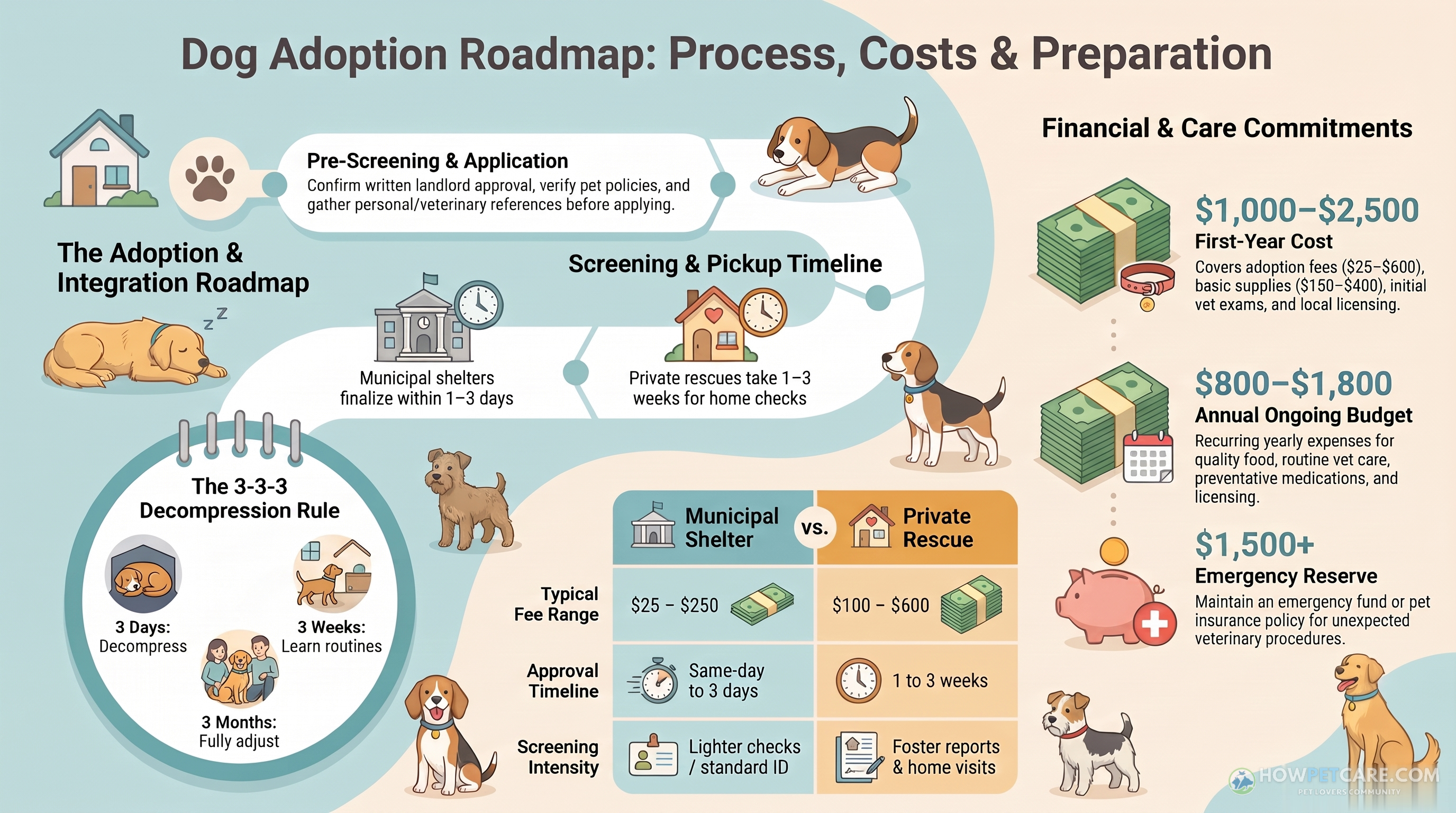
- Pay the fee ($25–$600 typical), register the microchip, and follow a 3-3-3 decompression plan.
Expect same-day to 3 days at a municipal shelter, 1–3 weeks at a rescue.
Where to Find Adoptable Dogs Near You
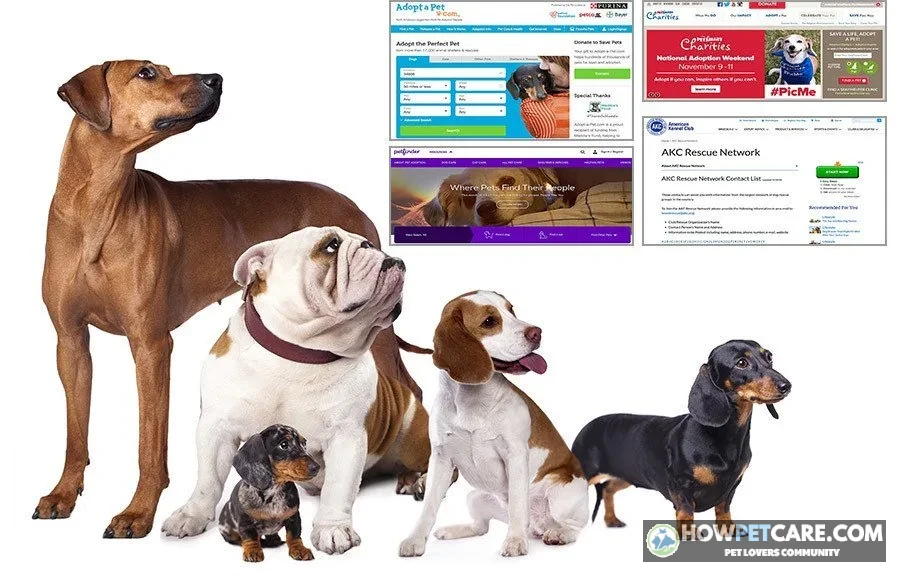
To see dogs available for adoption in your area, start by searching national aggregators by ZIP code. Petfinder and Adopt a Pet pull listings from more than 15,000 shelters and rescues, with filters for age, size, energy level, and compatibility with kids, cats, or other dogs. Cross‑check the results against your county or city animal shelter’s website — municipal sites often update faster than the aggregators.
Shelter vs. rescue: what each one means for your search
- Municipal or county animal shelter – run by local government, with dogs usually housed in kennels on‑site. Intake is open‑admission, so you’ll see a wide mix of breeds, ages, and behavioral histories. Dedicated adoption staff can make the process same‑day or a few days long.
- Private rescue organization – typically foster‑based, with dogs living in volunteer homes. You can get detailed notes on house‑training, crate behavior, and how a dog does with other pets. The trade‑off is a longer review period (often one to three weeks) while volunteers coordinate meet‑and‑greets and home checks.
- Breed‑specific rescue – focuses on a single breed or breed group. If you prefer a particular type, these groups can match you with dogs that fit the breed’s typical traits, though availability is narrower.
A legitimate listing always names an organization, provides a published adoption policy, and never asks for payment before an application is approved. Call ahead — availability changes daily.
How to search Petfinder and Adopt a Pet effectively
- Enter your ZIP code and set the radius (10–50 mi).
- Filter by age (puppy, adult, senior), size (small, medium, large), "good with kids," "good with cats," "house‑trained," and energy level.
- Read the behavior notes — staff and foster caregivers often describe leash manners, separation behavior, and any known triggers.
- Save your favorites and set up email alerts for new matches.
Adoption events and breed‑specific rescues
Many shelters hold weekend adoption events at pet‑supply stores or community centers. You can meet several dogs in one trip, and fees are sometimes reduced. Breed‑specific rescues often list dogs on their own sites and on Petfinder. They may ask you to complete a breed‑knowledge questionnaire before scheduling a meet‑and‑greet.
The Dog Adoption Process Step by Step, With Realistic Timelines
Knowing what happens at each stage can help you plan. Municipal shelters often move from application to pickup in a few days; foster‑based rescues commonly need one to three weeks.
Stage‑by‑stage timeline from application to pickup
-
1. Pre‑screen your household
Confirm landlord permission, weight/breed limits, and the pet deposit before applying. This is the #1 reason applications stall.
-
2. Submit the adoption application (30–60 min)
Have your landlord’s name and phone number, current vet contact (if you have pets), two personal references, and your lease’s pet clause ready.
-
3. Application review (1–7 days)
Rescues rely on volunteers, so expect days rather than hours. Help move things along by telling your references and landlord to expect a call and replying to follow‑up emails within 24 hours.
-
4. Landlord and vet verification (1–3 days, concurrent)
Applications can stall when landlords don’t return calls. Give the shelter a second contact method (email or office number).
-
5. Meet‑and‑greet (scheduled within a few days)
Bring every household member and any resident dog — many organizations require this before approving a multi‑dog home.
-
6. Home check or virtual walkthrough (rescues only, 2–7 days to schedule)
The rescue checks fencing, gates, and hazards, not housekeeping. A video walkthrough usually takes 15 minutes.
-
7. Approval, contract, and pickup (same‑day to 3 days after approval)
Bring ID, a leash and collar or harness, and a crate or secured carrier for the ride home.
Total realistic window: same‑day to 3 days at a municipal shelter; 1–3 weeks at a rescue. If you haven’t heard back in 5 business days, it’s appropriate to send a polite status email. Files do get buried.
What an adoption application actually asks
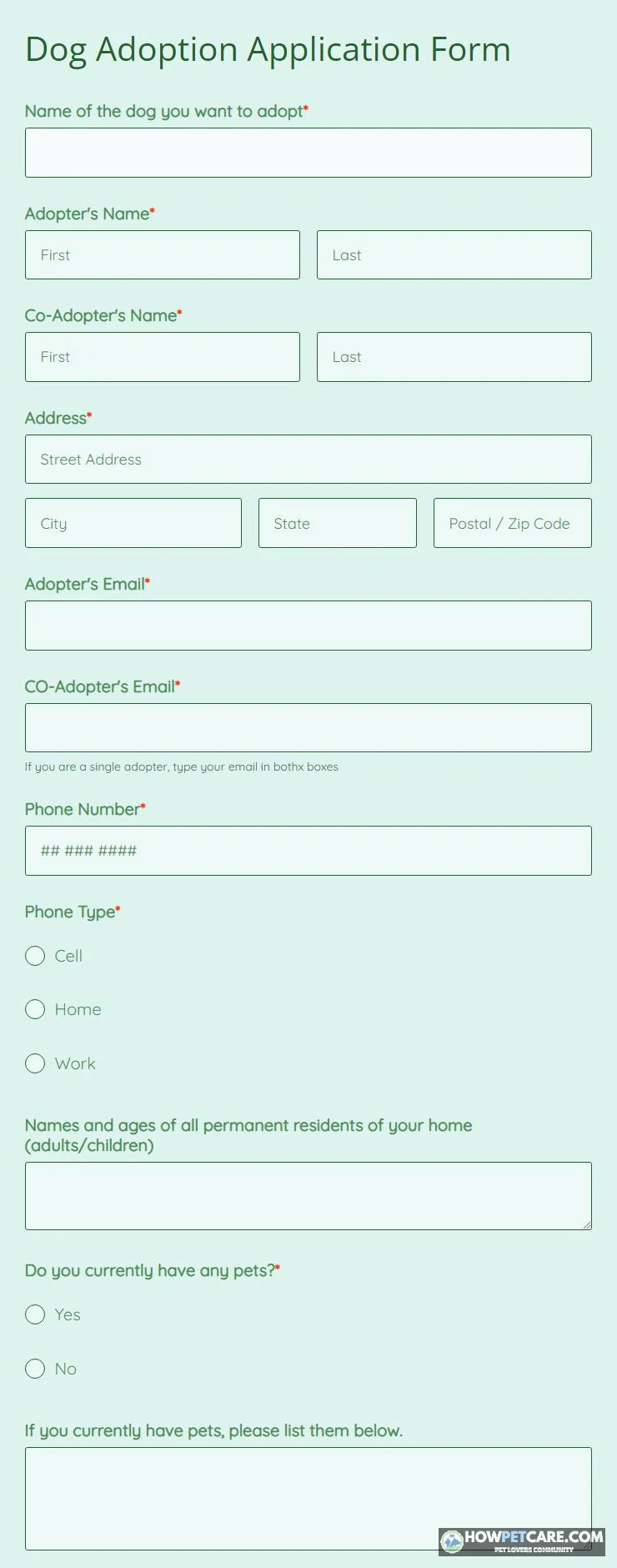
Typical fields include:
- Housing type (own/rent), landlord contact, lease pet clause
- Household members (ages, allergies)
- Current pets (species, ages, spay/neuter status, vet)
- Work schedule and typical hours alone
- Yard and fencing description
- Dog experience level
- Personal and veterinary references
Foster‑to‑adopt and trial adoption periods
Foster‑to‑adopt lets you take a dog home for a set period (often two weeks) to see how you fit together before finalizing the adoption. Terms vary: some rescues cover veterinary costs during the trial, while others require you to pay. A trial adoption period works similarly but may be shorter and is used more by municipal shelters.
Adopting a dog from out of state
Many rescues adopt across state lines. After approving your application and holding a virtual meeting, they arrange transport, often through volunteer drivers or pet‑transport services. Ask who pays for transport and health certificates, and confirm the return policy if the dog is far away.
What Shelters Check Before Approving You (and How Renters Can Qualify)
Screening is about fit, not judgment. Knowing what organizations check gives you time to prepare your application.
References, home checks, and landlord approval
Common checks:
- Landlord or lease verification – a call or email to confirm the pet policy.
- Vet references – verification of vaccinations and spay/neuter for current pets.
- Personal references – typically two non‑family contacts.
- Home check – more common with rescues; they look for secure fencing, safe indoor space, and obvious hazards.
- Agreement to spay/neuter and return clause – most contracts require you to return the dog to the organization if you can no longer keep it.
Adopting a dog as a renter
Renters are declined more often for paperwork gaps than for character. Take these steps before you fall for a dog:
- Read your lease’s pet clause. Note weight limits (often 25–50 lb), breed restrictions, and pet count.
- Get landlord approval in writing. A text or email is fine. Save the reply.
- Price out pet deposits and pet rent. Typical deposits $200–$500; pet rent $25–$75/month.
- Check renter’s insurance. Some policies exclude certain breed‑type dogs.
- Attach proof to your application. Include your landlord’s written approval and the lease pet‑clause page.
- Line up a pet reference. Ask a prior landlord, vet, or trainer who can vouch for your animal care.
- Pre‑answer the “what if you move?” question. Show that you’ll seek only pet‑friendly housing.
If a rescue has a strict lease‑verification policy and your landlord is slow to respond, apply to your municipal shelter in parallel. Municipal shelters often verify housing less intensively.
What to do if your application is denied
Ask for the specific reason. Common issues include missing landlord approval, unvaccinated current pets, long unsupervised hours, or a mismatch between the dog’s needs and your household. You can often address the issue, for example by providing a vet record, and reapply. You can also try an organization with a different policy.
Be honest. A mismatch caught later is worse for both you and the dog.
How Much It Costs to Adopt a Dog and What the Fee Includes
Fees are set locally. The figures below are typical ranges compiled from published shelter fee schedules and guidance from the ASPCA, Petfinder, and the Humane Society of the United States. Always ask the organization for its itemized fee list.
Adoption fee ranges by dog age and size
| Dog type | Municipal/county shelter (typical) | Private or breed‑specific rescue (typical) | Commonly included | Waiver/discount notes |
|---|---|---|---|---|
| Puppy (under 6 months) | $75–$250 | $300–$600 | Spay/neuter (or signed contract with return date), first vaccines, deworming, microchip | Highest demand, rarely discounted; very young puppies may go home unaltered with a contract |
| Adult dog (1–7 years) | $50–$200 | $200–$450 | Spay/neuter, core vaccines, rabies, microchip, often a health exam | Reduced‑fee events several times a year, especially at capacity |
| Senior dog (7+ years) | $25–$100 | $100–$300 | Same as adult, sometimes plus senior bloodwork panel | Frequently discounted or waived; many “seniors for seniors” programs |
| Small breed (under ~25 lb) | Often 10–30% above standard adult fee | $250–$600 | Same as adult | Small dogs move fastest, so shelters price higher to subsidize longer‑stay dogs |
| Large breed | Often at or below standard adult fee | $150–$400 | Same as adult; some rescues include a training voucher | Large dogs stay longest — deepest discounts appear here |
| Bonded pair or special‑needs | Often two‑for‑one or reduced | Often reduced | Same as adult | Organizations incentivize keeping bonded dogs together |
Two questions to ask before you apply: “What exactly does the fee include, in writing?” and “Are there any post‑adoption costs I’ll owe — like a spay/neuter deposit or license fee?” A $350 rescue fee that includes spay surgery, full vaccines, and a microchip often costs less than a $100 shelter fee plus $400 in à‑la‑carte vet work.
Municipal shelter vs. rescue: what you pay and what you get
| Factor | Municipal or county shelter | Private or breed‑specific rescue | What to ask before applying |
|---|---|---|---|
| Typical fee range | $25–$250 | $100–$600 | “What is the total fee and what does it cover?” |
| Screening intensity | Often same‑day, lighter home checks | 1–3 weeks, foster notes, home visit | “What does your review process involve?” |
| Timeline to pickup | Same‑day to a few days | 1–3 weeks | “When can I expect a decision?” |
| Medical inclusion | Core vaccines, spay/neuter, microchip | Same, often plus extra rehab, dental, behavior work | “Are any medical needs outstanding?” |
| Post‑adoption support | Basic behavior helpline, return policy | Trainer referrals, foster network, lifetime return | “What support do you offer after adoption?” |
Spay and neuter, vaccinations, and microchipping: what to confirm in writing
Most adult dogs leave already spayed/neutered, vaccinated (core plus rabies), and microchipped. Very young puppies may go home with a spay/neuter contract and a follow‑up date. Microchip registration is the adopter’s responsibility. Many shelters register the chip to themselves, so you must update the contact information immediately. Ask for the microchip number and registry website, and check the vaccination dates on the medical record you receive.
Request a printed or emailed itemized list of everything the fee covers — vaccines, spay/neuter, microchip, deworming, and any exam or license. It can help you avoid surprise bills later.
| Dog Category | Municipal Shelter Cost Range | Private Rescue Cost Range | Services Included | Discounts and Special Terms |
|---|---|---|---|---|
| Puppy (under 6 months) | 75–250 | 300–600 | Spay/neuter (or signed contract with return date), first vaccines, deworming, microchip | Highest demand, rarely discounted; very young puppies may go home unaltered with a contract |
| Adult dog (1–7 years) | 50–200 | 200–450 | Spay/neuter, core vaccines, rabies, microchip, often a health exam | Reduced‑fee events several times a year, especially at capacity |
| Senior dog (7+ years) | 25–100 | 100–300 | Same as adult, sometimes plus senior bloodwork panel | Frequently discounted or waived; many “seniors for seniors” programs |
| Small breed (under ~25 lb) | Often 10–30% above standard adult fee | 250–600 | Same as adult | Small dogs move fastest, so shelters price higher to subsidize longer‑stay dogs |
| Large breed | Often at or below standard adult fee | 150–400 | Same as adult; some rescues include a training voucher | Large dogs stay longest — deepest discounts appear here |
| Bonded pair or special‑needs | Often two‑for‑one or reduced | Often reduced | Same as adult | Organizations incentivize keeping bonded dogs together |
How to Choose the Right Dog for Your Household
A good match starts with your household’s constraints, not the dog’s photo.
Puppy, adult, or senior: which fits your schedule
- Puppy (under 6 months) – needs constant supervision, frequent potty breaks, socialization classes, and multiple vet visits for boosters.
- Adult (1–7 years) – size and temperament are more predictable; many are already house‑trained and know basic cues.
- Senior (7+ years) – typically calmer with lower exercise demand, but may have age‑related health costs (joint supplements, bloodwork).
Matching size and energy level to your home
Give shelter behavior notes and foster reports more weight than breed labels — breed guesses in shelters are often inaccurate. A low‑energy companion suits an apartment with short daily walks; a high‑energy dog needs a yard or daily running/jogging. Ask staff: “What does a typical day look like for this dog?”
Dogs that get along with kids, cats, or another dog
- Request documented cat‑tested or dog‑tested notes.
- Schedule a supervised introduction with your resident dog (many rescues require this).
- Ask about the dog’s history with children — look for calm, tolerant behavior, not just “good with kids” labels.

Questions to ask before adopting a rescue dog
- Any bite or reactivity history?
- How does the dog behave when left alone?
- Is the dog house‑trained?
- Why was the dog surrendered?
- How has the dog behaved in foster care or kennel?
These answers tell you more about the individual dog than a breed label can.
Dog Adoption Checklist: Prepare Your Home, Supplies, and Paperwork
Getting ready before pickup day means less scrambling and can help your dog settle in faster.
Supply list for adoption day
- ID tag (with your phone number) and collar or harness
- 6‑ft leash
- Crate or gated area
- Bed
- Food and water bowls
- The same food the shelter has been feeding (transition slowly if you switch)
- 2–3 chew toys
- Poop bags
- Enzymatic cleaner for accidents
- Baby gate for room‑by‑room access

Licensing, microchip registration, and breed restrictions
Most cities and counties require a dog license, usually tied to a current rabies vaccination. Check with your local animal services office for deadlines and fees. Register the microchip in your name the day you adopt — it’s a step many adopters forget. Check, too, whether your municipality, landlord, or insurer has breed‑specific legislation or weight limits that could affect the dog you’re considering.
Paperwork to keep: adoption contract, vaccination records, microchip number and registration confirmation, spay/neuter certificate, and the shelter’s return policy and post‑adoption support contacts.
Use the microchip number on the shelter’s paperwork to update the registry (often HomeAgain, AKC Reunite, or 24PetWatch) before you leave the parking lot.
The First Days and Weeks After Adoption: 3‑3‑3 Rule and a First‑Week Plan
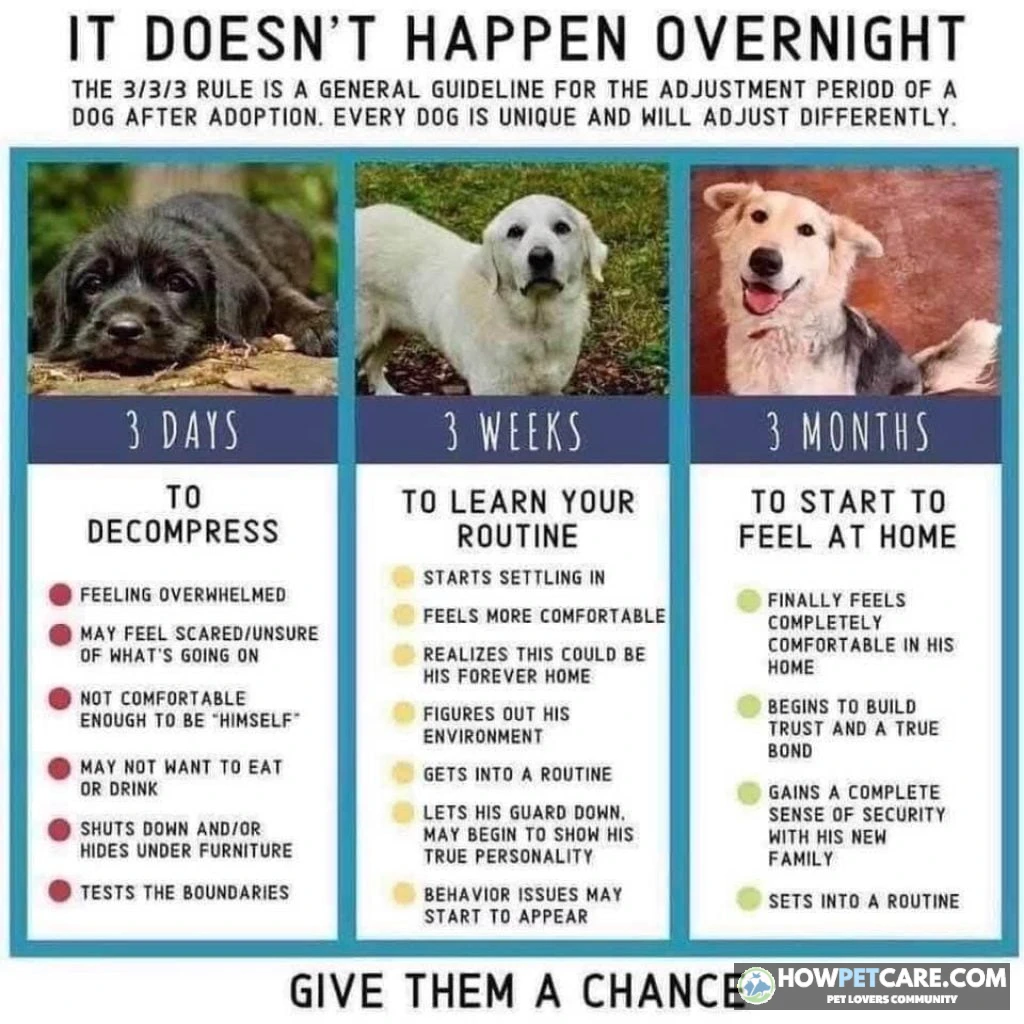
The 3‑3‑3 rule offers a rough guide: ~3 days to decompress, ~3 weeks to learn your routine, ~3 months to feel at home. Dogs vary, so use it as a framework, not a guarantee.
The 3‑3‑3 rule explained
- First 3 days: The dog is shutting down from shelter stress. Keep the environment quiet, limit visitors, and avoid dog parks.
- First 3 weeks: The dog learns your schedule for feeding, walks, and bedtime. Consistency builds confidence.
- First 3 months: The dog’s true personality emerges, training solidifies, and the bond deepens.
Your first‑7‑days plan
-
Day 1 — Ride home
Go straight home without stops. Crate or secure the dog in the car. Walk on leash around your yard or potty spot before entering, then give access to just one or two rooms.
-
Day 2 — Set the rhythm
Start the feeding and potty schedule you plan to keep. Take walks of 15–20 min in quiet areas. Skip dog parks, pet stores, and visitors.
-
Day 3 — Introduce the safe space
Feed meals in or near the crate with the door open. Pacing, whining, or refusing food is normal decompression — quiet and routine help.
-
Day 4 — First short departures
Leave for 5–10 min and return calmly. Build to 30–45 min by the end of the week. Offer a stuffed Kong when you leave instead of a long goodbye.
-
Day 5 — Expand slowly
Open one more room if the dog is settled. Start 2–3 short “name = treat” sessions daily. Keep resident‑pet introductions brief and positive.
-
Day 6 — Normal household sounds
Introduce the vacuum, TV, and doorbell one new thing at a time. Note fear reactions for the vet visit.
-
Day 7 — Vet check
Bring vaccination records, spay/neuter paperwork, and the microchip number. Register the microchip today if you haven’t.
Buy before pickup: ID tag, collar/harness, 6‑ft leash, crate or baby‑gated area, bed, bowls, same food as shelter, enzymatic cleaner, poop bags, 2–3 chew toys.
Housetraining and separation anxiety basics
- Take the dog out on a strict schedule: first thing in the morning, after meals, after naps, and before bed.
- Reward the dog immediately after it eliminates outside.
- Supervise indoors; use a crate or gated area when you can’t watch.
- Clean accidents with enzymatic cleaner. Don’t punish the dog.
- For separation stress, start with 5‑minute absences and gradually increase them. Provide a stuffed Kong or puzzle toy when you leave. If the dog shows panic‑level destruction, self‑injury, or refuses food past 48 hours, contact the shelter’s behavior line or a certified trainer.

If the adoption isn’t working: support and return options
Most shelters and rescues accept returns, and many require a return by contract rather than allowing you to rehome the dog yourself. Return windows, refunds, and support differ. Read the adoption contract and ask about behavior helplines or trainer referrals before deciding. A return is a last option after you’ve tried support.
What a Dog Costs After Adoption: Monthly and Annual Budget
The adoption fee is the smallest money you’ll ever spend on your dog. The estimates below draw on ASPCA cost‑of‑care figures and pet‑insurance industry surveys. Your costs will vary by size, age, coat, and location.
One‑time startup costs
| Cost category | One‑time or recurring | Typical range | What changes the cost | Your estimate |
|---|---|---|---|---|
| Adoption fee | One‑time | $25–$600 (see fee table above) | Organization type, dog age | $___ |
| Startup supplies (crate, leash, bed, bowls, gate) | One‑time | $150–$400 | Crate size for big dogs | $___ |
| Initial vet exam + any catch‑up care | One‑time | $75–$250 | Whether vaccines/spay‑neuter were included in the fee | $___ |
Monthly and annual cost of owning a dog
| Cost category | One‑time or recurring | Typical range | What changes the cost | Your estimate |
|---|---|---|---|---|
| Dog license | Annual | $10–$50 | Your city/county; cheaper for altered dogs | $___ |
| Food | Monthly | $30–$90/month | Body weight — a 70‑lb dog can cost 3× a 15‑lb dog to feed | $___ |
| Routine vet care (annual exam, vaccines, dental) | Annual | $200–$600 | Age; seniors need more visits and bloodwork | $___ |
| Flea/tick + heartworm prevention | Annual | $120–$350 | Weight‑dosed, so big dogs pay more | $___ |
| Grooming | Recurring | $0–$80/session | Coat type — DIY for short coats; doodles and double coats need pros every 6–8 weeks | $___ |
| Training | One‑time (usually) | $100–$300 for a group class | Puppies and reactive dogs need more | $___ |
| Pet insurance OR emergency fund | Monthly | $25–$70/month insurance, or save $50–$100/month | Dog’s age and breed; pre‑existing conditions aren’t covered | $___ |
| Boarding/dog walking | As needed | $25–$75/visit or night | Your work hours and travel | $___ |
Realistic totals: Most single‑dog households spend around $1,000–$2,500 in year one (including adoption and startup) and $800–$1,800 per year after that, before emergencies.
The line item people skip: An unexpected vet bill for an obstruction surgery or a torn ligament commonly runs $1,500–$5,000. Carry insurance or keep a dedicated $1,500+ emergency fund before you adopt. If neither fits the budget this year, that’s a “not yet” answer, not a “never.”

Pet insurance vs. an emergency fund
Pet insurance reimburses a percentage of eligible vet bills after a deductible; pre‑existing conditions are excluded. An emergency fund gives you immediate cash without claim paperwork, but takes discipline to build. Compare monthly premiums with your risk tolerance and the dog’s breed‑related health profile.
Your Dog Adoption Action Plan: What to Do This Week
Use this readiness check to turn your research into practical next steps.
Readiness check — answer yes/no:
- My schedule allows daily walks, feeding, and supervision.
- My budget covers the adoption fee, startup supplies, and at least $1,500 emergency reserve.
- My housing permits the size/breed I want (written landlord approval if renting).
- All household members agree on adding a dog.
- I know the energy level, size, and age range that fits my life.
Week‑one actions
- Confirm your landlord’s policy and get written approval.
- Pick two or three local shelters and rescues; bookmark their sites.
- Set up Petfinder and Adopt a Pet alerts for your ZIP code and filters.
- Gather application documents: lease pet clause, landlord contact, vet reference, two personal references.
- Purchase the supply list items so they’re home before pickup day.
Visit plan — when you go:
- Ask staff about the dog’s daily routine, known triggers, and any medical needs.
- Request a supervised meet‑and‑greet with all household members and resident pets.
- Compare dogs on fit criteria (energy, size, temperament), not just appearance.
If you’re not ready for a permanent commitment — consider foster‑to‑adopt or short‑term fostering first. Many rescues welcome foster homes, and fostering is a low‑risk way to experience dog ownership.
1A prospective adopter living in a rented apartment wants to minimize delays in their application review. Their landlord is notoriously slow to return phone calls. Which strategy best prevents the adoption application from stalling indefinitely?
Municipal shelters often verify housing policies less intensively than private foster-based rescues, preventing landlord communication delays from halting the entire process.
2An adopter brings home a rescue dog. Based on the 3-3-3 rule for dog decompression, which actions should the adopter take during the first three days?
Minimizing novel human interactions reduces sensory overload while the dog is shutting down from shelter stress.
3A prospective adopter is comparing fees between two organizations. Rescue A charges a 350 adoption fee that includes spay surgery, core vaccinations, and microchipping. Shelter B charges a 100 fee but leaves follow-up veterinary care and microchip registration à la carte. Why might Rescue A's option be more economical overall?
Paying retail prices for individual veterinary procedures post-adoption often totals around 400, making bundled rescue fees lower in net expenditure.
4An adopter specifically wants detailed information regarding how a rescue dog behaves inside a domestic home environment, including crate manners and house-training status. Which type of organization is best equipped to provide these insights?
Foster-based rescues place dogs in volunteer homes, allowing caregivers to observe real-world house manners, crate behavior, and pet compatibility.
5When budgeting for the ongoing monthly and annual costs of dog ownership after initial startup supplies are purchased, which recurring expenses should an owner anticipate?
Preventative treatments are weight-dosed medications that must be purchased regularly throughout the animal's lifespan.
6A full-time working professional living in an apartment wants to adopt a dog. They require a companion with predictable size and temperament who is likely already house-trained, but they cannot manage frequent daytime potty breaks or high senior health care demands. Which age category best fits this profile?
Adult dogs have established temperaments and physical traits, are frequently house-trained, and do not require the intensive supervision of puppies or the frequent medical monitoring of seniors.
FAQ
Can I return an adopted dog if it doesn’t work out?
Most shelters and rescues accept returns and many require it by contract rather than allowing you to rehome the dog yourself. Return windows, refunds, and support differ by organization, so read the adoption contract and ask about behavior helplines or trainer referrals before you decide.
What is foster-to-adopt?
Foster-to-adopt lets you take a dog home for a set period, often a couple of weeks, to see how it fits your household before you finalize the adoption. Terms and fees vary, so ask who covers vet costs during the trial.
Can I adopt a dog from another state?
Yes, many rescues adopt out of state and arrange transport after an application and a virtual meeting or video check. Ask who pays for transport and health certificates, and what the return policy is if the dog is far away.
Do I need a license for an adopted dog?
Most cities and counties require dog licenses, usually tied to a current rabies vaccination, and many require one within a set time after you bring the dog home. Check your local animal services office for deadlines and fees.
Can breed restrictions stop me from adopting a certain dog?
They can. Some cities, landlords, and insurers restrict certain breeds or breed-type dogs, and shelters may decline an adoption if they know your housing prohibits it. Check local rules, your lease, and your insurance policy before you apply.