

Yes, poinsettias are mildly toxic to dogs, but serious poisoning is rare. The milky sap irritates the mouth and stomach, typically causing drooling, vomiting, or mild skin and eye irritation. Most healthy dogs recover within 24 hours; call a vet for small dogs, large amounts, or persistent vomiting.
Are Poinsettias Poisonous to Dogs? Mildly Toxic, Rarely Serious
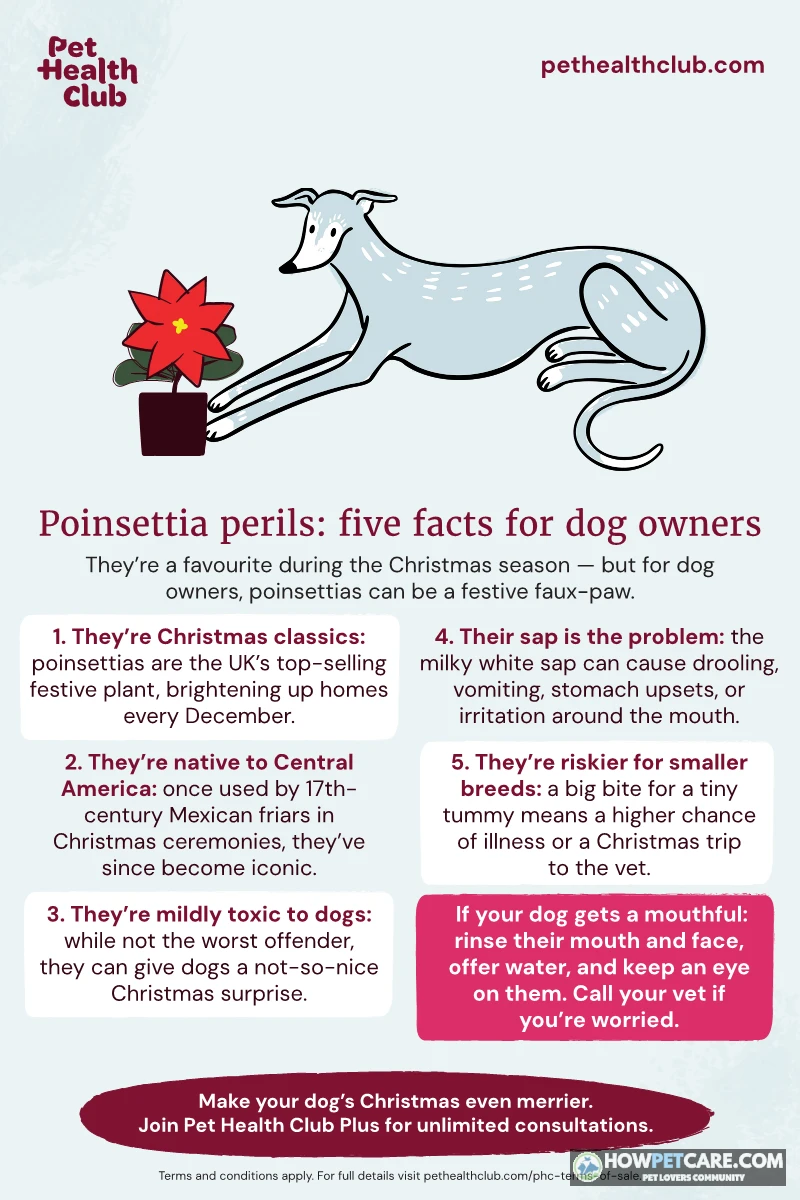
Poinsettias (Euphorbia pulcherrima) are mildly toxic to dogs and only rarely fatal. Most exposures cause gastrointestinal upset — drooling, lip‑licking, vomiting, sometimes diarrhea — or mild skin and eye irritation from the milky sap. Serious illness is uncommon. The ASPCA lists poinsettia as toxic to dogs, cats, and horses, with mild GI signs. Fearsome reputation aside, the plant is not harmless: the milky white sap contains diterpenoid euphorbol esters and saponins that irritate the mouth, skin, and eyes.
Can poinsettias be fatal to dogs?
Fatalities are essentially unheard of. The claim that poinsettias kill hundreds of pets each year circulates on social media, but no veterinary data supports it.
Are poinsettias poisonous to dogs and cats?
Yes. The ASPCA classifies poinsettias as mildly toxic to both species, typically causing drooling, vomiting, or skin irritation. Cats can also react to sap on their skin or in their eyes.
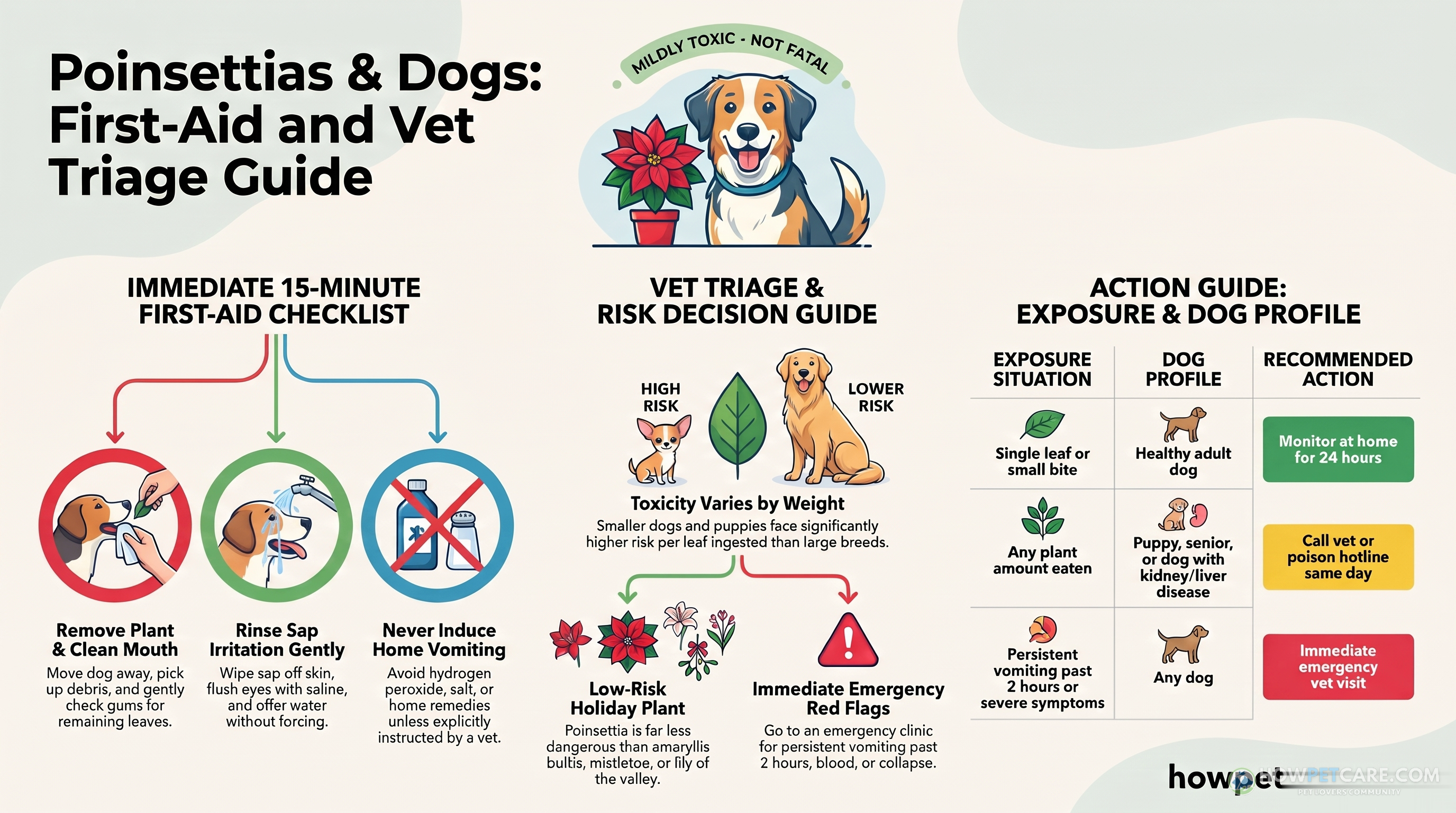
My Dog Ate a Poinsettia: First‑Aid Checklist for the Next 15 Minutes
Work through these steps in order. The whole list takes about 15 minutes.

-
Step 1: Remove dog and plant
Calmly move your dog away from the plant. Pick up any fallen leaves, bracts, or chewed pieces so your dog cannot go back for more.
-
Step 2: Check the mouth
If your dog allows, gently pull out any plant pieces stuck to the gums or tongue.
-
Step 3: Rinse the mouth
Offer a small bowl of water or let the dog lick a wet cloth. Rinsing washes away the irritating sap. Do not force water or use a hose — forced rinsing risks aspiration.
-
Step 4: Do NOT induce vomiting
Do not give salt, hydrogen peroxide, milk, or any home remedy unless a vet or poison control explicitly tells you to. Re‑vomiting re‑irritates the mouth and adds aspiration risk.
-
Step 5: Note details for a call
Write down your dog’s weight, what part was eaten (leaf, bract, stem, sap), roughly how much, and the time it happened. Also note any symptoms so far.
-
Step 6: Offer water, hold a big meal
Water is fine. Withhold a large meal for 2–3 hours if the dog seems nauseated.
-
Step 7: Run the triage table below
Decide: monitor at home, call today, or go now. Call your veterinarian or a poison hotline if any red flag applies.
- ❌ Induce vomiting — unless a vet or poison control explicitly tells you to.
- ❌ Give salt, hydrogen peroxide, milk, or any home remedy.
- ❌ Force water down the throat or use a hose — forced rinsing can send water into the lungs.
- ❌ Assume a chewed leaf left on the floor is harmless — pick it up; the sap is still irritating.
If poinsettia sap got on the skin or fur
Wipe the area with a damp cloth, then wash with mild pet‑safe shampoo and rinse thoroughly. The sap can cause redness and itching; if irritation persists, call your vet.
If sap got in your dog’s eyes
Flush the eye with lukewarm water or saline for several minutes. If redness, tearing, or squinting continues after rinsing, contact your vet the same day — eye exposure deserves a check.
If you did not see how much was eaten
Treat it as an unknown amount. Note the time you discovered the chewed plant, estimate the maximum possible ingestion, and use the triage table below. When in doubt, call a poison hotline.
Symptoms of Poinsettia Poisoning in Dogs and How Long They Last
Ingestion signs: drooling, lip‑smacking, pawing at the mouth, vomiting, nausea, reduced appetite, occasional diarrhea.
Sap contact signs: redness, itching, or mild dermatitis on skin; eye redness, tearing, and squinting if sap reaches the eyes.
Signs usually begin within a few hours of eating the plant, though published sources do not give a precise onset window. Mild cases generally settle within about a day with home care.
A typical mild poinsettia case, in plain terms:
- First few hours: drooling, lip‑smacking, maybe pawing at the mouth as the sap irritation registers.
- Within a few hours of eating: one or two episodes of vomiting is the most common outcome.
- By roughly 24 hours: a mild case should be back to normal — drinking, interested in food, normal energy.
Red flags that mean this is NOT a self‑limiting poinsettia case — call a vet the moment you see any of these:
- Vomiting that keeps going instead of stopping after an episode or two
- Blood in vomit or stool
- Lethargy, weakness, or refusal to drink
- Tremors, collapse, or trouble breathing
- Swelling of the face or around the eyes
These signs point to a different plant, a much larger ingestion, or an unrelated condition — not a mild poinsettia exposure.
What a typical mild case looks like hour by hour
- 0–2 hours: Drooling, lip‑licking, possible single vomit.
- 2–6 hours: Nausea may persist; dog may refuse food but should drink.
- 6–24 hours: Gradual return to normal appetite and energy.
Symptoms that suggest something more serious
Bloody vomit or stool, collapse, tremors, seizures, labored breathing, facial swelling. These require immediate veterinary attention — and they are the signs you would expect from the genuinely dangerous entries in our severity-ranked list of plants toxic to dogs, not from a poinsettia.
Monitor at Home or Call the Vet? Reconciling the 2‑Hour and 24‑Hour Rules
Current sources use two different clocks, and they answer different questions: the ~24‑hour window is how long to keep watching after any ingestion, and the ~2‑hour mark is when symptoms that haven’t stopped become a reason to call. Chewy advises contacting a vet if vomiting or diarrhea lasts more than 2 hours; Snopes and VEG ER suggest a ~24‑hour monitoring window for symptoms that don’t improve.
Call now or go to an emergency vet: repeated or uncontrolled vomiting, vomiting that keeps going past about 2 hours, bloody vomit or stool, lethargy or weakness, refusal to drink, signs of dehydration, trouble breathing, facial swelling, collapse, seizures, or eye symptoms that do not clear after rinsing.
Call a vet the same day: a puppy, toy breed, senior dog, or dog with GI, liver, or kidney disease that ate any amount; a large quantity eaten; unknown amount plus symptoms; or other plants or foods involved.
Safe to monitor at home for 24 hours: a healthy adult dog that ate a small bite or a leaf, has only mild drooling or one episode of vomiting, is bright, and is drinking.
Triage table: symptom, timing, and action
| Situation or symptom | Dog profile | How soon to act | Recommended action |
|---|---|---|---|
| Ate a leaf or small bite; drooling or one vomit; bright and drinking | Healthy adult dog | Watch for ~24 hours | Monitor at home — no call needed if the dog stays normal |
| Any amount eaten | Puppy, toy/small breed, senior, or a dog with GI, liver, or kidney disease | Same day | Call your vet or a poison hotline — vulnerable dogs get a lower threshold |
| Ate a large amount (several leaves, half a plant, chewed stem) | Any dog | Same day | Call your vet or poison control, even if no symptoms yet |
| Vomiting still happening around the 2‑hour mark | Any dog | Now | Call your vet or a poison hotline |
| Bloody vomit or stool, lethargy, refusal to drink, dehydration signs | Any dog | Now | Call your vet or go to an emergency clinic |
| Trouble breathing, facial swelling, collapse, seizures | Any dog | Immediately | Go to an emergency vet — skip the phone call |
| Sap in the eyes that still irritates after rinsing | Any dog | Same day | Call your vet — eye exposure deserves a check |
Still unsure after reading the table? Call. A poison‑hotline consult costs a fraction of an emergency visit, and ‘better safe’ is the right call for small or medically fragile dogs. This table is general guidance, not a substitute for the vet who knows your dog.
How Much Poinsettia Is Too Much? Dose, Body Weight, and Vulnerable Dogs
No source publishes a toxic dose for poinsettia in dogs — no leaf counts, no mg/kg figures. That is why guidance is qualitative. The principle: the same amount is a bigger relative dose for a small dog, and vomiting and dehydration affect small dogs faster.
Puppies and small breeds
A 5‑lb teacup puppy that chews several leaves and a stem receives a far larger relative dose than a 70‑lb Labrador eating one leaf. The puppy also dehydrates faster if vomiting starts.
Dogs with existing health conditions
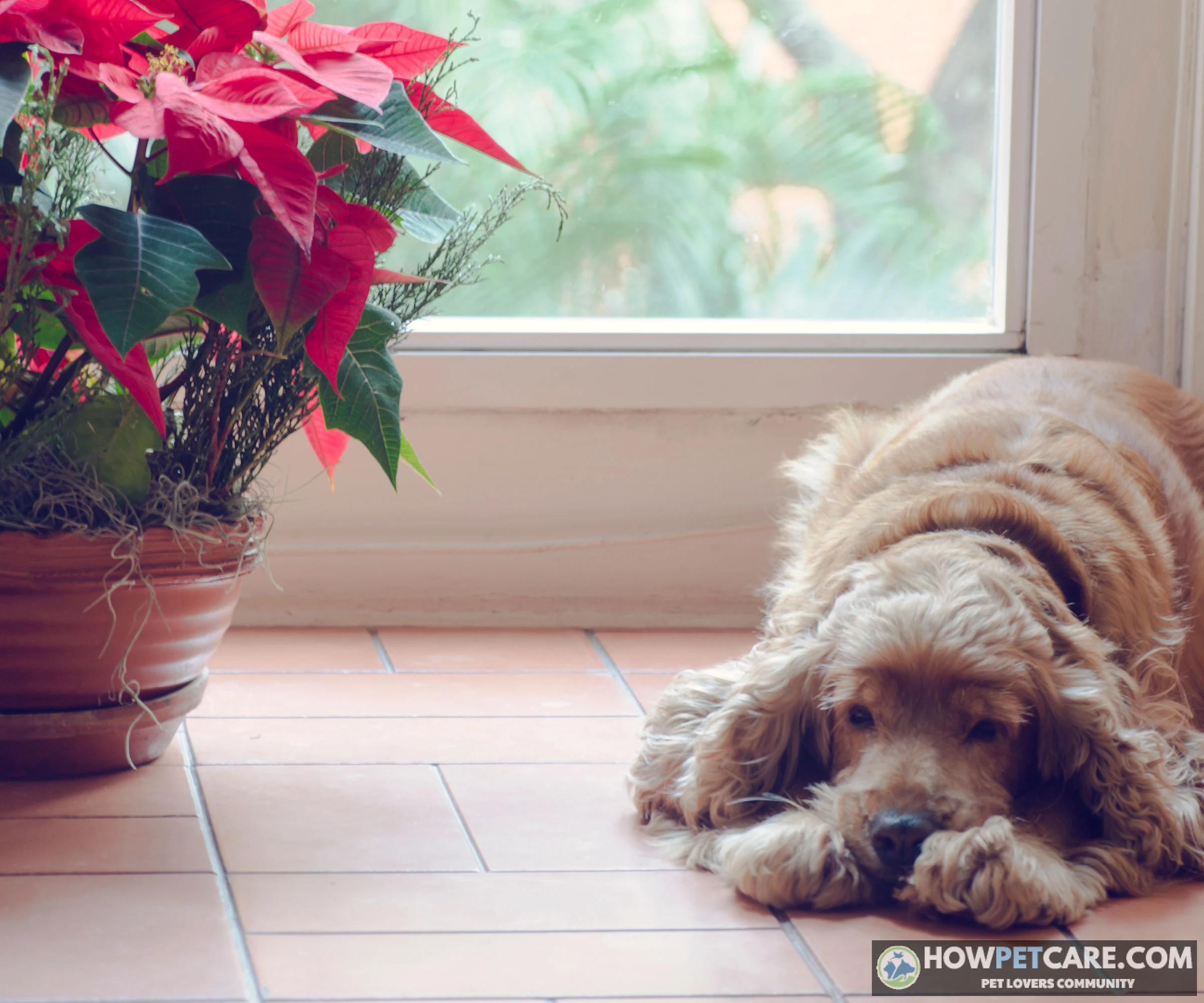
Dogs with GI, liver, or kidney disease have less reserve to handle fluid loss from vomiting or diarrhea. Even a small ingestion warrants a call.
Dried leaves, fallen bracts, and chewed stems
Sap and plant material stay irritating to some degree, so clean them up. No source quantifies the risk of dried versus fresh material, but the irritant compounds remain.
Two Dogs, Same Plant, Very Different Risk — a Worked Example
These are illustrative scenarios, not thresholds — no source publishes a toxic dose for poinsettia, which is exactly why body weight matters so much.
Scenario A: Daisy, 70 lb adult Lab. Daisy grabs one fallen leaf off the floor and swallows it. One leaf relative to a 70‑pound body is a tiny exposure. Realistic outcome: some drooling, possibly one vomit, back to normal by evening. Action: monitor at home for ~24 hours.
Scenario B: Peanut, 5 lb teacup puppy. Peanut chews through several leaves and part of a stem — most of a small plant. The same plant mass is a far larger relative dose for a 5‑pound body, and a puppy dehydrates faster if vomiting starts. Action: call the vet or a poison hotline the same day, even if Peanut seems fine right now.
The principle in one line: risk isn’t about how many leaves — it’s about how much plant per pound of dog. That’s why ‘a leaf’ is a non‑event for Daisy but ‘half a plant’ earns Peanut a phone call. When in doubt, weigh the dog (or check the last vet record) before you call — it’s the first thing the hotline will ask.
Pet Poison Control Numbers and Fees: ASPCA vs. Pet Poison Helpline
Quick contact card (numbers, fees, hours)
| Option | Phone or access | Cost | Best used when |
|---|---|---|---|
| Pet Poison Helpline | 855‑764‑7661 | ~$99 per incident (covers follow‑up consultation) | Unsure of amount, vulnerable dog, multiple plants/substances, no vet available after hours |
| ASPCA Animal Poison Control Center (APCC) | 888‑426‑4435 | Consultation fee applies (verify current fee on ASPCA site) | Same scenarios; both lines are available 24/7 |
| Your regular veterinarian | Clinic number | Exam fee + treatment | During business hours, stable patient |
| 24‑hour emergency vet clinic | Local emergency number | Emergency exam + treatment | Collapse, seizures, breathing trouble, ongoing vomiting |
Both hotlines are staffed around the clock. Have ready: dog’s age, weight, breed, plant part and amount, time eaten, symptoms, and any existing health conditions.

Hotline call vs. vet visit: which first?
- Call a hotline first if the dog is stable, you’re unsure of the amount, or it’s after hours and you want expert triage before driving.
- Go straight to a vet or emergency clinic if the dog is collapsing, seizing, having trouble breathing, or vomiting uncontrollably.
- Some pet insurance plans cover poison‑hotline consultations — check your policy.
What the Vet Will Do and What It Costs
Typical steps: exam, history (plant, amount, timing), hydration check, and supportive care only if needed.
Common interventions: anti‑nausea medication such as maropitant (Cerenia), subcutaneous or IV fluids if the dog is dehydrated, a bland diet afterwards, and sometimes eye or skin decontamination.
Decontamination (inducing vomiting, activated charcoal) is generally not a routine step for poinsettia; it’s the vet’s decision, not a home one.
Typical treatment for a mild case
- Physical exam and history
- Anti‑emetic injection (e.g., Cerenia) if vomiting
- Subcutaneous fluids if mildly dehydrated
- Bland diet (boiled chicken and rice) for 24–48 hours
Rough cost range and what changes it
- Exam fee: $50–$150 (varies by region and clinic)
- Anti‑emetic injection: $30–$60
- Subcutaneous fluids: $40–$80
- Total for a mild case: roughly $150–$350. Emergency clinics run higher. These are estimates; actual costs depend on location, clinic, and any additional diagnostics.
Aftercare at home
Feed small, bland meals for a day or two. Ensure water intake. Watch for recurrence of vomiting, diarrhea, or lethargy over the next 24 hours. Recheck with your vet if symptoms return or worsen.
Poinsettia vs. Lilies, Mistletoe, Holly, and Amaryllis: Which Holiday Plants Are Really Dangerous?
Put poinsettia in honest context so owners allocate worry correctly.
| Plant | Toxic compound | Typical symptoms in dogs | Severity | Urgency |
|---|---|---|---|---|
| Poinsettia | Irritant diterpenoid esters in milky sap | Drooling, vomiting, mild skin or eye irritation | Low | Usually monitor at home; call for small/vulnerable dogs or heavy ingestion |
| True lilies (Lilium spp.) | Unknown nephrotoxin (severe in cats; dogs mainly get GI upset) | Vomiting, GI upset in dogs; kidney failure risk is the cat problem | Low–moderate for dogs | Call if a dog eats a meaningful amount; treat any cat exposure as an emergency |
| Peace lily / calla lily (not true lilies) | Insoluble calcium oxalate crystals | Intense mouth burning, drooling, pawing, vomiting | Moderate | Call same day if swelling or symptoms persist |
| Lily of the valley | Cardiac glycosides | Vomiting, diarrhea, heart rhythm abnormalities, weakness | High | Emergency — call or go immediately |
| Mistletoe | Toxins vary by species (e.g., phoratoxin in American mistletoe; European species more dangerous) | GI upset; higher‑risk species can affect heart and blood pressure | Moderate–high depending on species | Call poison control; don’t wait for symptoms if species/amount unknown |
| Holly | Saponins; berries also a choking/obstruction risk | Vomiting, diarrhea, drooling | Low–moderate | Monitor or call same day for larger amounts |
| Amaryllis | Lycorine alkaloids — most concentrated in the bulb | Vomiting, diarrhea, drooling; larger ingestions can cause tremors and low blood pressure | Moderate | Call same day; bulb ingestion warrants a faster call |
| Christmas cactus | Generally listed as non‑toxic by the ASPCA | Possible mild GI upset if a lot is eaten | Very low | Monitor at home |
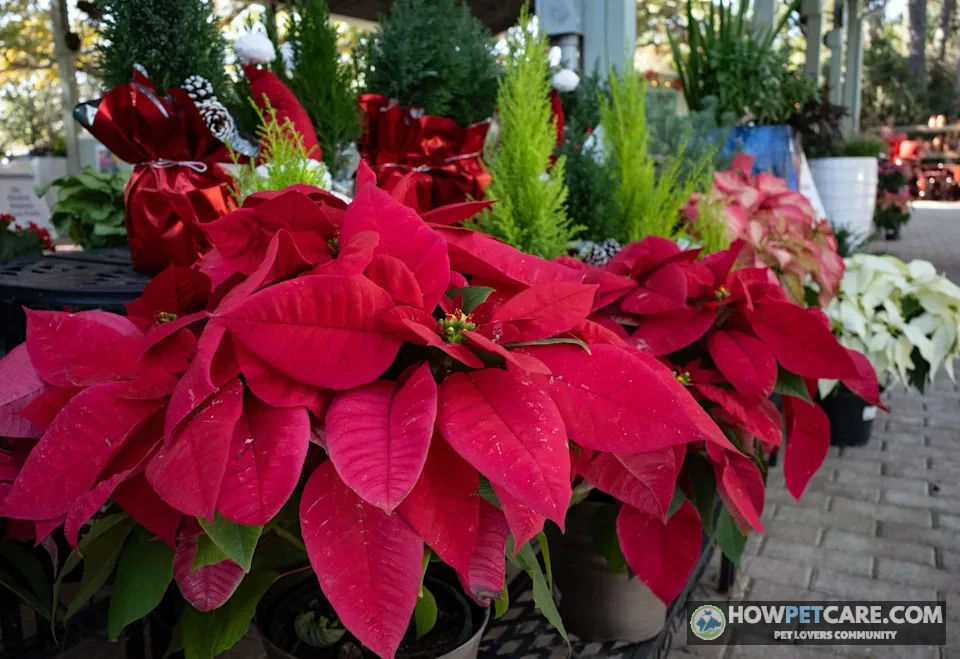
The takeaway: poinsettia sits at the low end of the holiday‑plant risk ladder. If a dog chews an unidentified holiday plant, check whether it’s lily of the valley, a risky mistletoe species, or an amaryllis bulb before relaxing — and remember non‑plant hazards like tinsel, chocolate, and Christmas tree water can be just as risky as any plant on this list.
Holiday plants that need a faster response
Lily of the valley, mistletoe (especially European), and amaryllis bulbs deserve a quicker call than poinsettia. True lilies are a separate case — lily toxicity in dogs is milder than the cat emergency, though a meaningful amount still earns a call.
Safer decoration options
Pet‑safe holiday plants per ASPCA: Christmas cactus, spider plant, Boston fern, African violet. Artificial poinsettias lack the irritating sap but chewed fabric, plastic, or wire can cause choking or blockage — keep them out of reach. If you extend the pet‑proofing to houseplants or garden beds, verify each species — even pleasant‑smelling ones raise questions like whether lavender is safe for dogs.
Keeping Dogs Safe Around Poinsettias: Your Action Plan
Placement and prevention checklist
- Put poinsettias on high shelves or in rooms the dog cannot enter. Hanging planters help; remember jumping dogs and counter‑surfers reach more than expected.
- Use baby gates or closed doors as barriers.
- Practice ‘leave it’ training; bitter sprays may not be reliable.
- Sweep up fallen leaves and bracts daily and wash hands after handling to avoid transferring sap to fur or skin.
- Consider pet‑safe alternatives or artificial plants (but supervise if your dog chews non‑food items), and apply the same species check outdoors where questions like hydrangea safety around dogs come up.

Save‑this decision guide
Monitor at home → Healthy adult dog, small bite, mild drooling or one vomit, drinking and bright.
Call same day → Puppy, toy/small breed, senior, or dog with GI/liver/kidney disease; large amount; unknown amount with symptoms; multiple plants.
Go now → Repeated vomiting past 2 hours, bloody vomit/stool, lethargy, refusal to drink, trouble breathing, facial swelling, collapse, seizures.
Save these numbers now: your vet clinic, nearest 24‑hour emergency vet, Pet Poison Helpline (855‑764‑7661), ASPCA APCC (888‑426‑4435).
FAQ
Are poinsettias toxic to cats too?
Yes. The ASPCA lists poinsettias as mildly toxic to both dogs and cats, usually causing drooling, vomiting, or skin irritation. Cats can also react to the sap on their skin or in their eyes.
Is it safe to keep a poinsettia in a home with a dog?
It can be, if the plant is completely out of reach and fallen leaves are cleaned up daily. If your dog is a chewer, a puppy, or a small breed, choose a pet-safe plant instead.
Are artificial poinsettias safe for dogs?
They do not contain the irritating sap, so they are not poisonous. Chewed fabric, plastic, or wire pieces can still cause choking or intestinal blockage, so keep them out of reach.
Does the color of a poinsettia change how toxic it is?
No source indicates that red, white, or pink poinsettias differ in toxicity. Treat all colors the same.
Should I throw out my poinsettia after my dog chewed it?
Not necessarily. Move it somewhere the dog cannot reach, or replace it with a pet-safe plant if your dog keeps going after it. A dog that has chewed it once is likely to try again.