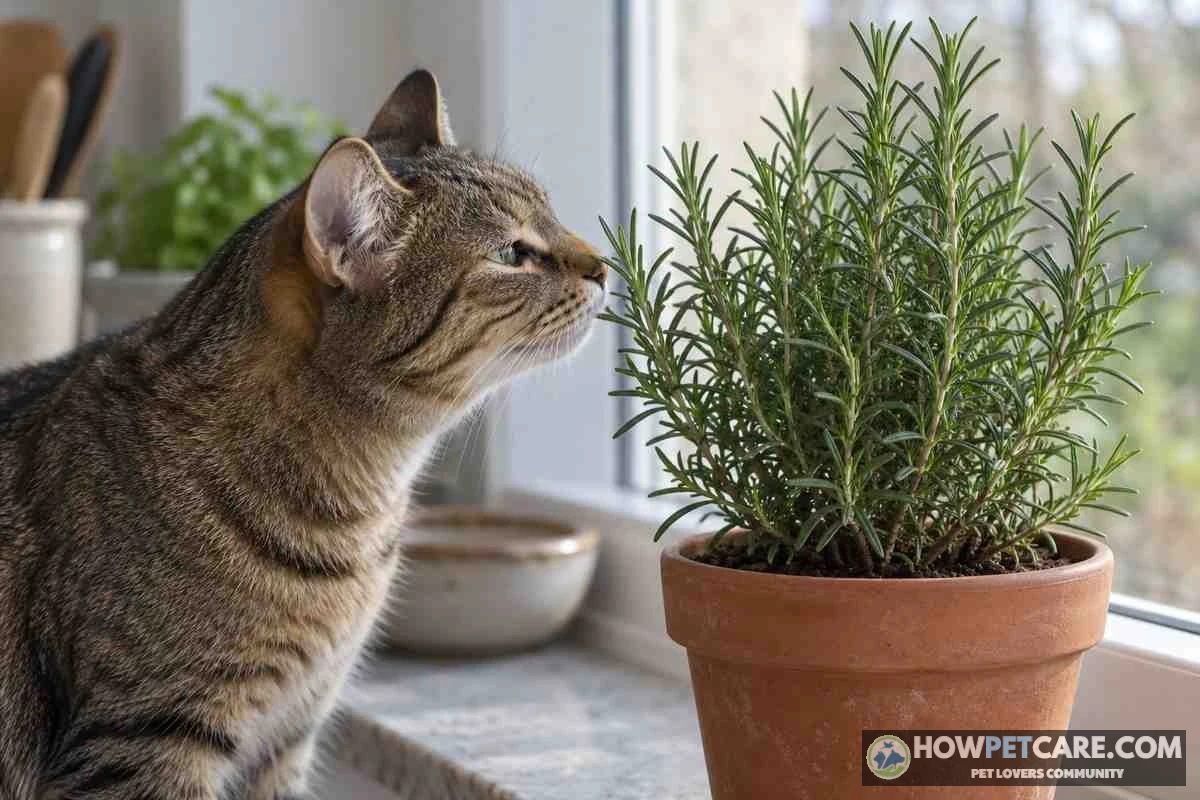

Yes—rosemary plant leaves are ASPCA-listed as non-toxic to cats, and a tiny accidental nibble is usually low concern. Large amounts can upset the stomach, while concentrated rosemary essential oil can be toxic by mouth, skin, or grooming exposure. Keep oil away and call a vet or poison control for oil contact, uncertain amounts, or symptoms.
Yes, with important limits. The ASPCA lists rosemary as non-toxic to cats, but not every rosemary product is safe. A small nibble of fresh or dried leaves is generally a low concern, while concentrated rosemary essential oil can pose a serious risk. Eating a large amount of the plant may also cause stomach upset.
Start by identifying what your cat encountered: leaves, rosemary extract in food, or essential oil. Note how much and when, then check for symptoms. If oil got on your cat, your cat ate an uncertain or substantial amount, or you see concerning symptoms, contact a veterinarian or animal poison-control service rather than waiting for a problem to develop.
Is rosemary safe for cats? The quick verdict by exposure type
Rosemary’s current botanical name is Salvia rosmarinus, though it’s also widely listed under its older name, Rosmarinus officinalis. The ASPCA’s non-toxic classification refers to the plant; it isn’t a blanket safety clearance for concentrated oil or every product containing rosemary.
A tiny accidental nibble of plain leaves is usually not an emergency for a healthy cat. Larger amounts can irritate the digestive tract, and essential oil is a different, much more concentrated exposure. When in doubt, keep the package or a plant sample and tell your veterinarian the form, amount, timing, and your cat’s condition.
Fresh rosemary, dried leaves, extract, and essential oil: compare the risks
The word “rosemary” can describe four different exposures. They aren’t interchangeable: plant leaves, a food preservative, and concentrated oil have different routes and levels of risk, which is why owners ask separate questions such as whether orchids are poisonous to cats.
| Form | Ingestion risk | Skin or grooming risk | Inhalation risk | Recommended response |
|---|---|---|---|---|
| Fresh leaves | A few leaves are generally low concern; a large amount may upset the stomach. | Plant contact is usually less concerning than oil; remove access if your cat is chewing it. | Ordinary plant presence is not the same as diffusing oil. | Observe after a small nibble; call a vet if the amount was large or symptoms develop. |
| Dried leaves | Small amounts are generally considered low risk; larger amounts can cause digestive upset. | Seasoning on fur or paws may be licked off; check for other ingredients. | Loose dried herb is not equivalent to concentrated airborne oil. | Check the recipe and monitor after a small taste of plain herb. |
| Rosemary extract in cat food | Used as a preservative in pet food; the food-use limit is not a per-cat dose. | Not typically a topical exposure. | Not typically an inhalation exposure. | Follow the food’s directions; ask your vet about an individual health concern. |
| Rosemary essential oil | Concentrated oil can be toxic to cats; do not let a cat lick it. | Oil on fur can be swallowed during grooming and warrants prompt professional advice. | Diffused compounds can expose cats through the air and may settle on fur. | Contact a veterinarian or poison control for ingestion or coat exposure; avoid direct use on cats. |
Fresh and dried rosemary leaves
A few leaves aren’t considered dangerous in the cited guidance, but cats aren’t adapted to eating large quantities of plant material. Too much can cause vomiting, diarrhea, or other digestive irritation. Wash fresh rosemary to remove possible surface contaminants, and don’t leave a plant where your cat can repeatedly graze; choose indoor plants safe for cats for reachable spots.

Rosemary extract in cat food
Rosemary extract is used as an antioxidant preservative in pet foods, treats, and supplements. It’s distinct from essential oil and shouldn’t be treated as the same exposure. The FDA’s 50 mg/kg maximum usage level concerns use in food; it isn’t a serving recommendation or a calculation of how much rosemary extract an individual cat can safely eat.
Rosemary essential oil and scented products
Essential oil is concentrated and shouldn’t be applied to a cat or offered by mouth. Cats may also swallow oil that lands on their coat when they groom. The evidence identifies rosemary essential oil as toxic to cats, so treat direct exposure more cautiously than contact with a culinary sprig.

How much rosemary can a cat eat? Use a cautious, evidence-based limit
The available evidence doesn’t establish a validated weight-based safe dose or toxic-dose threshold for rosemary leaves in cats. A teaspoon or pinch can’t be guaranteed safe for every cat, and body weight alone doesn’t settle the risk. The form, amount, recipe, health status, and symptoms all matter.
For a healthy cat, a tiny accidental nibble of plain fresh or dried rosemary is usually a low concern, not a recommended serving. The cited sources mention a pinch as feeding advice, but don’t establish a dependable teaspoon limit or a safe frequency for routine feeding. A pinch varies, and dried leaves are more concentrated by volume than fresh leaves. Don’t turn that informal suggestion into a precise dose or daily supplement.
If your cat licked seasoned food, inspect the full ingredient list. Onion and garlic are separate concerns; a dish’s fat, salt, and other seasonings may also make it unsuitable. For example, if a cat licks chicken seasoned with rosemary and garlic powder, call a veterinarian about the garlic exposure rather than assuming rosemary is the only issue.

Rosemary toxicity symptoms in cats: match signs to urgency
Symptoms can vary. Use the exposure and your cat’s overall condition to choose the next step; don’t wait for symptoms after a significant essential-oil exposure.
Monitor closely for mild stomach upset
After a small amount of plain leaf, watch for vomiting, diarrhea, drooling, reduced appetite, or mild salivation. These signs can reflect digestive irritation. If your cat remains comfortable and behaves normally after a tiny nibble, remove the plant and observe. Contact your veterinarian if any signs appear, recur, or worsen.
Call a veterinarian for persistent or worsening signs
Call your veterinarian about repeated vomiting or diarrhea, ongoing drooling, appetite loss, or skin irritation after contact. Tell them what form was involved and when it happened. Seek advice sooner if your cat is a kitten, senior, or has an underlying condition.
Seek emergency care for severe or neurological signs
Weakness, tremors, poor coordination, breathing difficulty, collapse, or marked lethargy are emergency warning signs. Go to an emergency veterinary clinic or call ahead for instructions. Essential-oil exposure on the coat or by mouth also merits prompt professional advice, even if your cat appears normal.
| Exposure or signs | Urgency tier | What to do | When to escalate |
|---|---|---|---|
| A few plain leaves eaten; cat acts normally | Monitor at home | Remove the source and observe for 24 hours. | Any symptoms, uncertain amount, or vulnerable cat: call a veterinarian. |
| Repeated vomiting or diarrhea, drooling, or mild skin redness | Call your veterinarian | Report the form, amount, time, and signs. | Worsening or persistent symptoms need prompt assessment. |
| Essential oil swallowed or on fur/skin | Act now | Prevent grooming and call a vet or poison control for guidance. | Do not wait for symptoms. |
| Tremors, weakness, poor coordination, breathing difficulty, collapse | Emergency | Go to an emergency clinic immediately. | These signs are already an emergency. |

What to do after rosemary ingestion or essential-oil contact
These steps can help you avoid overreacting to a leaf nibble or underreacting to a concentrated-oil exposure.
-
Remove the source
Move your cat away from the plant, food, or spilled product. Keep your cat from licking any oil on the coat. Save the packaging or a plant sample.
-
Record the exposure
Note whether it was fresh or dried leaf, extract, or essential oil. Estimate the amount and time, and write down your cat’s weight, age, health conditions, and symptoms.
-
Choose the right level of help
If your cat had a tiny taste of plain leaves and is acting normally, monitor at home. For a large or unknown amount, seasoned food, or symptoms, call your veterinarian. For oil ingestion or oil on the coat, promptly call a veterinarian or poison control.
-
Escalate severe signs immediately
For breathing difficulty, collapse, tremors, marked weakness, or poor coordination, go to an emergency veterinary clinic. Bring the product label if you can do so without delaying care.
Don’t induce vomiting or give home remedies unless a veterinary professional directs you to. If oil is on the fur or skin, prevent licking and ask the veterinarian or poison-control professional how to decontaminate safely. Don’t apply solvents, alcohol, or another oil, and don’t delay the call while trying an improvised cleanup.
In the United States, the ASPCA Animal Poison Control Center can be reached at (888) 426-4435, and Pet Poison Helpline at (855) 764-7661. A consultation fee may apply. Have the product name, estimated amount, exposure time, your cat’s weight and health history, and current symptoms ready.

Rosemary diffusers, candles, and wax melts: reduce airborne exposure
Diffusers and strongly scented products aren’t equivalent to a rosemary plant. Cats can inhale airborne compounds, and residue may settle on their fur and be swallowed during grooming. There’s no established universally safe run time, distance, or burn duration for rosemary scent around cats, so a specific number of minutes can’t be presented as a proven safe limit.
The most cautious choice is not to diffuse rosemary essential oil in shared indoor air. If you use a rosemary-scented candle or wax melt, keep your cat out of the room while it’s in use, supervise the product, and prevent access to flame, hot wax, and spills. Ventilate the room before allowing your cat back in. Don’t confine a cat in a scented room; provide access to unscented, well-ventilated space.
Stop using the product and move your cat to fresh, unscented air if you notice coughing, sneezing, watery eyes, drooling, unusual hiding, or other changes. Store oils and scented products securely. If oil spills on your cat, treat it as a direct-contact exposure and call for professional advice.

Extra precautions for kittens, senior cats, and cats with health conditions
Kittens, senior cats, and cats with liver or kidney disease may need individualized advice. Call your veterinarian after a larger or uncertain exposure rather than relying on a general rule for healthy adult cats. Seek professional guidance promptly for any symptoms or essential-oil exposure.
If your cat has diabetes or takes medication, ask the veterinarian before offering rosemary as food or a supplement. The available evidence doesn’t establish whether rosemary extract interacts with feline diabetes medication, so don’t assume either that an interaction occurs or that it can’t occur. Feline liver metabolism and underlying illness are additional reasons to avoid concentrated essential oils and unsupervised herbal products.
Rosemary extract in daily cat food and the next-step checklist
Rosemary extract may appear on a cat-food label as a preservative. FDA and AAFCO regulatory context matters: the FDA food-use level cited here is 50 mg/kg, and rosemary extract is used in pet foods as a preservative. That figure applies to use in food; it isn’t a per-cat dose, a feeding instruction, or a proven threshold for an individual animal.
The available evidence doesn’t establish that normal use in commercial food causes harmful accumulation in a cat’s liver or kidneys, nor does the regulatory limit prove zero risk for every cat. Don’t stop a complete diet solely because the label lists rosemary extract; judge other greenery separately—for example, whether spider plants are toxic to cats—before letting a cat graze. Follow the product’s feeding directions and discuss persistent symptoms, a medical condition, or a diet change with your veterinarian.

A quick exposure checklist
- Tiny nibble of plain fresh or dried leaves, no symptoms: remove access and observe for 24 hours.
- Large or uncertain amount, repeated grazing, or symptoms: call your veterinarian and provide the exposure details.
- Rosemary oil swallowed or on the coat: prevent licking and contact a veterinarian or poison control promptly.
- Breathing difficulty, collapse, tremors, or marked weakness: go to an emergency clinic now.
- Seasoned food or a cat with a health condition: assess the other ingredients and ask your veterinarian rather than relying on the rosemary verdict alone.
What the FDA extract limit does and does not mean
The 50 mg/kg figure is a food-use limit in the regulatory context, not a safe-dose calculation for a cat eating a serving of kibble. It doesn’t establish a feline toxic dose, prove long-term harm, or answer whether a particular cat’s medical condition changes the advice. For broader herb-garden safety, check each plant and product individually instead of assuming that all herbs are safe because rosemary leaves are listed as non-toxic.
| Form | Ingestion Risk | Skin or Grooming Risk | Inhalation Risk | Recommended Response |
|---|---|---|---|---|
| Rosemary essential oil | Concentrated oil can be toxic to cats; do not let a cat lick it. | Oil on fur can be swallowed during grooming and warrants prompt professional advice. | Diffused compounds can expose cats through the air and may settle on fur. | Contact a veterinarian or poison control for ingestion or coat exposure; avoid direct use on cats. |
| Fresh leaves | A few leaves are generally low concern; a large amount may upset the stomach. | Plant contact is usually less concerning than oil; remove access if your cat is chewing it. | Ordinary plant presence is not the same as diffusing oil. | Observe after a small nibble; call a vet if the amount was large or symptoms develop. |
| Dried leaves | Small amounts are generally considered low risk; larger amounts can cause digestive upset. | Seasoning on fur or paws may be licked off; check for other ingredients. | Loose dried herb is not equivalent to concentrated airborne oil. | Check the recipe and monitor after a small taste of plain herb. |
| Rosemary extract in cat food | Used as a preservative in pet food; the food-use limit is not a per-cat dose. | Not typically a topical exposure. | Not typically an inhalation exposure. | Follow the food's directions; ask your vet about an individual health concern. |

FAQ
Is rosemary poisonous to cats according to the ASPCA?
The ASPCA lists rosemary as non-toxic to cats. That listing concerns the plant and does not make concentrated rosemary essential oil safe; large amounts of plant material can also upset a cat’s stomach.
Is rosemary safe for cats and dogs under the same rules?
Do not assume the same advice applies to both species. This guide’s exposure and triage advice is for cats; ask a veterinarian about a dog’s specific exposure.
Is rosemary safe around cats indoors if I only use a candle?
A candle is not risk-free: fragrance may irritate some cats, while flame and hot wax pose separate hazards. Keep the cat out of the room during use, ventilate afterward, and stop if signs of irritation appear.
Is rosemary extract likely to build up in a cat’s body from kibble?
There is no established evidence here that normal food use causes harmful accumulation, nor a feline threshold that proves zero risk for every cat. If your cat has liver or kidney disease or develops symptoms, discuss the food with your veterinarian.