

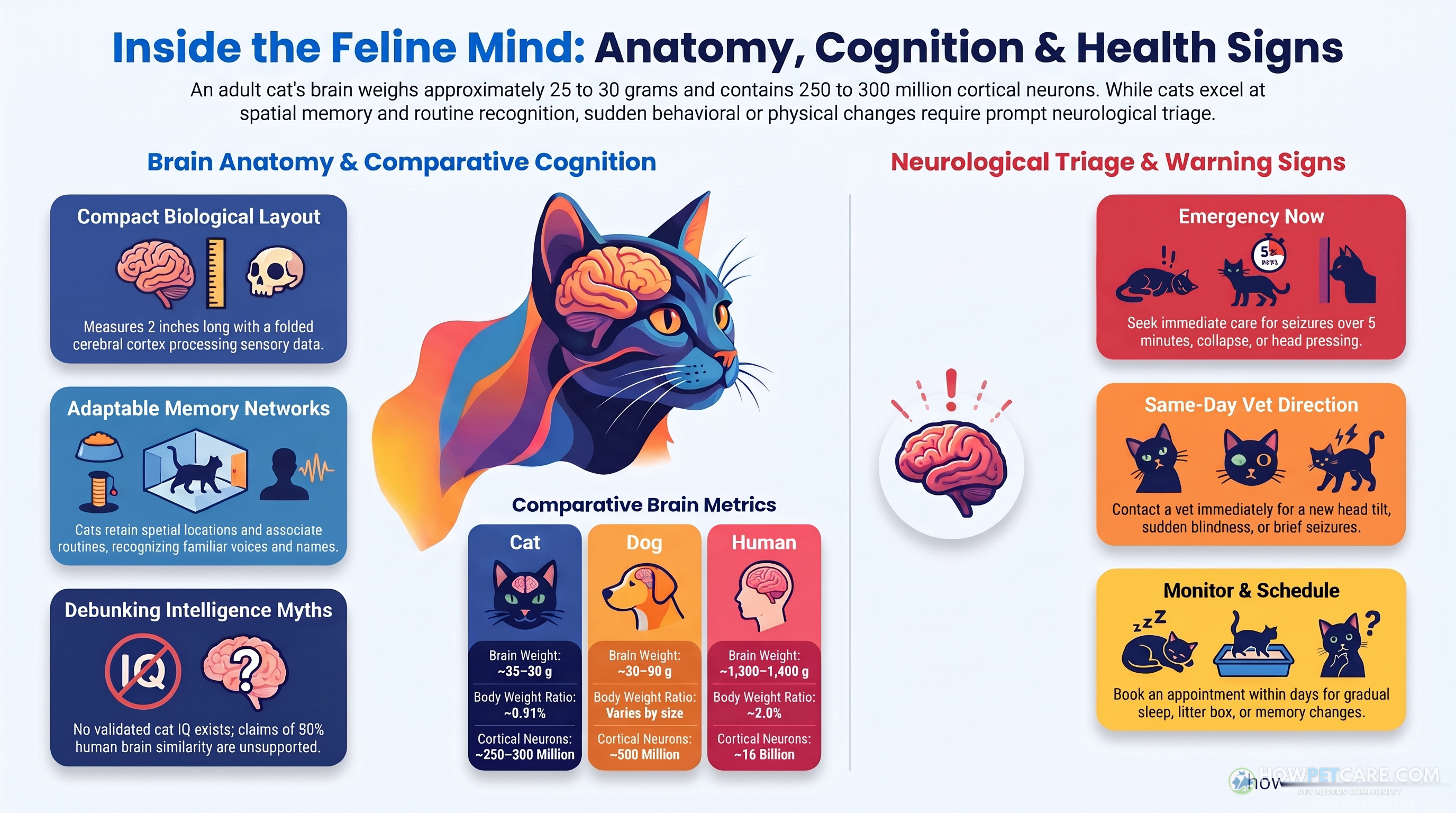
An adult cat’s brain is about 2 inches long, weighs 25–30 grams, and contains an estimated 250–300 million cortical neurons. Its folded cerebral cortex processes senses and learning, the cerebellum coordinates balance, and the brainstem controls vital functions like breathing.
An adult cat’s brain is about 2 inches long and weighs roughly 0.9 to 1.1 ounces (25–30 grams). Its folded outer layer, the cerebral cortex, helps process sensory information and supports learning. Published estimates put the number of cortical neurons in the hundreds of millions. Cats can learn routines, remember experiences, and recognize familiar voices and their own names. But there’s no reliable cat IQ score or human-age equivalent.
For owners, the key distinction is between curiosity and a sudden change. A cat that ignores a puzzle may simply have no interest in it. A cat that suddenly can’t stand, becomes unresponsive, or has a prolonged seizure needs emergency veterinary care.
How Big Is a Cat’s Brain? Weight, Size and Neuron Count vs. a Human’s
At about 2 inches long, a cat brain is small enough to fit in an adult’s palm. The often-cited adult weight of 25–30 grams is an approximation, not a target for every cat. A human brain weighs roughly 1,300–1,400 grams, though weight varies between individuals.
One commonly quoted estimate puts a cat’s brain at about 0.91% of its body weight. Human brains are often estimated at around 2% of body weight. These ratios vary by individual and don’t provide an intelligence score: a heavier cat doesn’t necessarily have a proportionately larger brain.
The cerebral cortex is the folded outer layer of the cerebrum. Its neurons, or nerve cells, help process information. Estimates for cats commonly range from 250 million to 300 million cortical neurons, but the counting method and animals studied matter. The comparison—and its limits—is explained below.
Cat Brain Anatomy: The Main Parts and What Each One Does
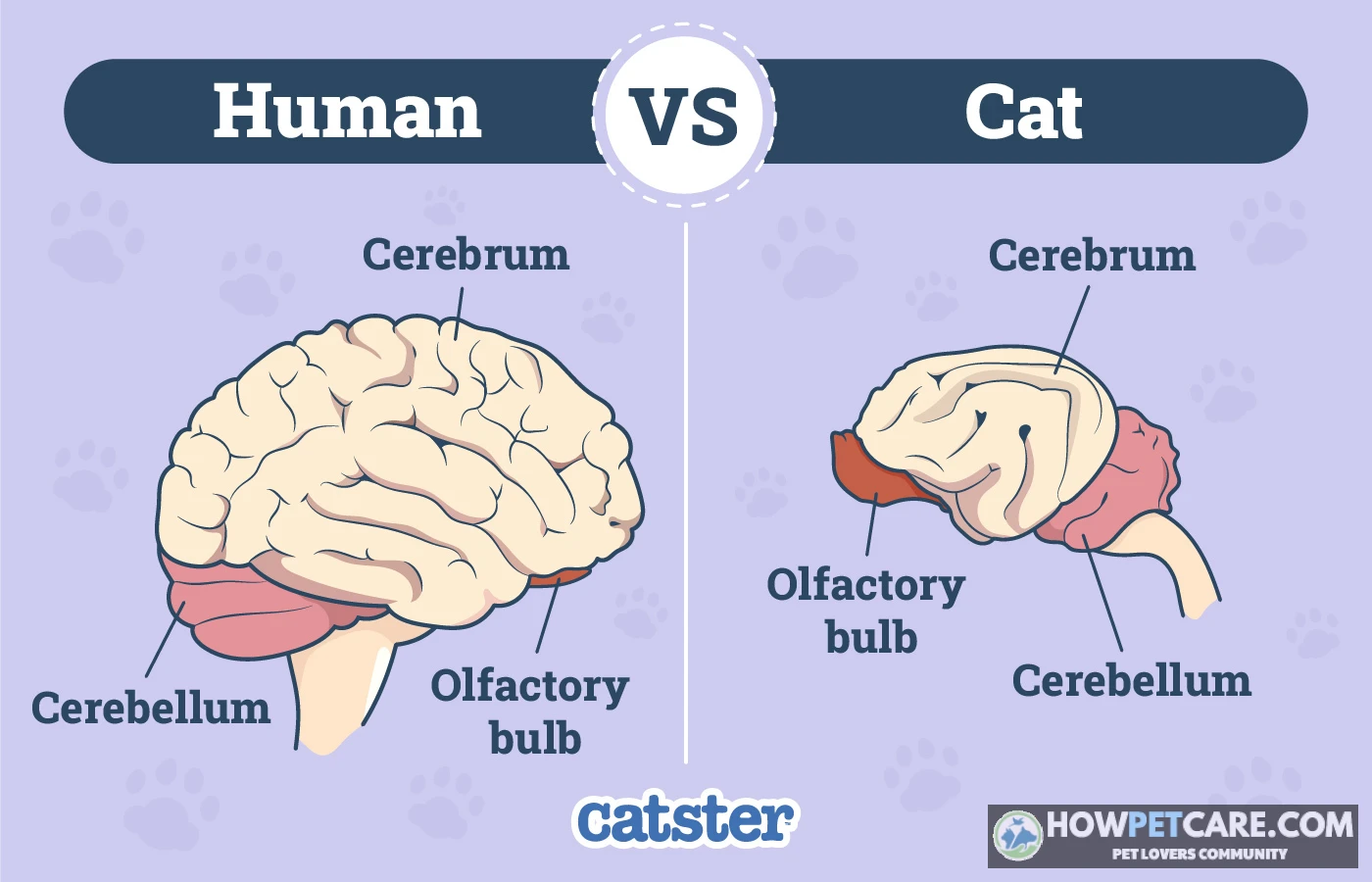
The feline brain shares the same broad mammalian layout as ours: a cerebrum, cerebellum, and brainstem. A cat’s cortex is folded, though its pattern is less elaborate than a human’s.
This simplified side-view map helps locate the main regions. It is not to scale; structures in parentheses lie inside the brain rather than on its surface.
FRONT / NOSE                                      BACK
Olfactory bulbs → Cerebrum and cerebral cortex → Cerebellum
                    (thalamus, hippocampus,          ↓
                     amygdala inside)             Brainstem → Spinal cord
From above, the larger cerebrum covers much of the front and middle of the brain; the smaller cerebellum sits toward the rear. Beneath and behind these regions, the brainstem connects the brain to the spinal cord. For labeled views of structures beyond the brain, the complete feline anatomy guide maps the rest of the body.
Cerebrum and cerebral cortex: thinking and senses
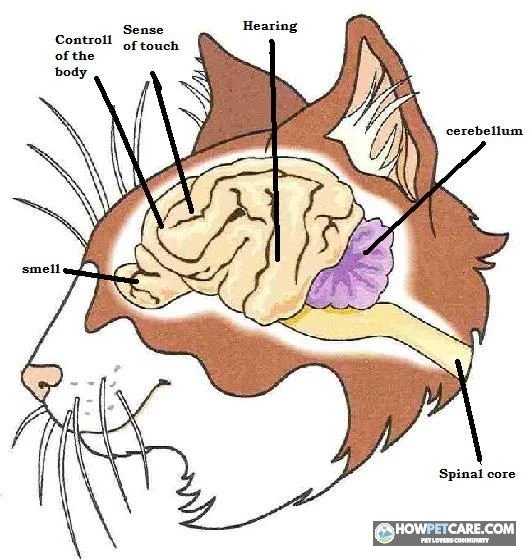
The cerebrum is the brain’s largest visible part. Its outer cerebral cortex helps process sensory information, guide voluntary movement, and support learning. Different cortical areas contribute to interpreting sight, sound, smell, and touch, including information from the whiskers.
The cortex is often described in lobes. Frontal areas help coordinate movement and behavior, while other areas contribute to processing touch, vision, and hearing. These regions work together; they aren’t isolated switches.
Deep in the brain, the thalamus relays much of the sensory information traveling to the cortex. At the front, the olfactory bulbs help process smells.
Cerebellum: balance and coordination
The cerebellum helps coordinate movement, posture, and balance. It helps a cat adjust the force and timing of a jump. Safe movement also depends on vision, muscles, the inner ear, and other parts of the nervous system.
Some kittens are born with cerebellar hypoplasia, which means the cerebellum didn’t develop normally. They may have a characteristic unsteady gait. But a new loss of balance in any cat shouldn’t be assumed to be a lifelong developmental condition.
Brainstem: the life-support switchboard
The brainstem connects the brain with the spinal cord and helps regulate essential functions such as breathing, heart rate, and wakefulness. It also carries signals between the brain and the rest of the body. Problems in this area can be serious, especially if a cat is unresponsive or having trouble breathing.
The brain and spinal cord together form the central nervous system. Nerves throughout the body carry sensory information in and movement instructions out.
Hippocampus and amygdala: memory and emotion
The hippocampus contributes to forming memories and navigating space. A cat learning where a familiar feeding spot is offers an everyday example, though no single structure acts alone.
The amygdala helps process emotionally significant information, including threats. A cat that becomes wary at the sight of a carrier may have learned to associate it with an unpleasant experience. That reaction involves networks across the brain, not just one region.
Cat Brain vs. Human Brain vs. Dog Brain: Side-by-Side Comparison
Cat vs. human vs. dog: the comparison table
These figures are approximations, not benchmarks for an individual animal. Dog brain size varies especially widely with body size and breed. Neuron counts are estimates, not direct measures of intelligence.
| Feature | Cat | Dog | Human | Source or qualification |
|---|---|---|---|---|
| Brain weight | About 25–30 g | Often roughly 50–90 g; varies widely | Roughly 1,300–1,400 g | Cat adult estimate; other values are broad comparative approximations |
| Brain relative to body weight | About 0.91% in one estimate | Varies substantially with body size | Roughly 2% | Cat estimate; ratios vary by individual |
| Cortical neurons | Commonly estimated at about 250–300 million | About 530 million in a widely cited study estimate | About 16 billion in a widely cited estimate | Cat range; estimates depend on sample and method |
| Whole-brain neurons | Far more than the cortical count; exact total uncertain | Exact total varies with animal and method | About 86 billion in a widely cited estimate | Whole-brain and cortical counts are not interchangeable |
| Cortex | Folded | Folded | Folded and greatly expanded | Cat folding documented in the supplied anatomy evidence |
| Memory and learning | Spatial and associative learning | Spatial, associative, and social learning | Spatial, associative, social, and complex autobiographical memory | These categories overlap; they are not a ranked test |
| Sensory emphasis | Hearing, smell, vision, and whisker touch | Strong reliance on smell and social cues | Strong reliance on vision, among other senses | Broad functional descriptions, not fixed shares of cortex |

Why the 250 million and 300 million cat neuron figures differ
The often-repeated cat figures of roughly 250 million and 300 million are estimates, not two exact counts of the same brain. The 2017 Jardim-Messeder and colleagues study estimated about 250 million cortical neurons for its cat specimen. It used a method that separates brain tissue into a suspension of cell nuclei for counting. Its dog estimates included roughly 530 million cortical neurons.
Online, the discrepancy is often framed as a 2016 versus 2017 conflict: roughly 300 million attributed to an earlier source versus about 250 million from the 2017 study. But popular accounts don’t consistently identify the 2016 source or its method, so its specimen details and counting approach can’t be reliably compared with the 2017 result. The difference shouldn’t be explained away as a proven effect of methodology: samples, anatomical boundaries, and counting approaches can all matter, and the evidence provided here doesn’t establish which caused this particular gap.
What neuron counts do and don’t say about intelligence
Cortical neuron counts describe one feature of a brain. They don’t measure every aspect of cognition or show how efficiently an animal solves a particular problem. A study with a small number of animals also can’t establish an exact count for every cat or dog.
Dogs have been studied extensively on tasks involving human cues. Cats have received less research attention and may not be equally motivated by the same setup. A higher dog cortical estimate doesn’t, by itself, settle which species is “smarter.”
Is a cat brain more like a human’s or a dog’s? All three share the main mammalian brain regions. Cats and dogs have broadly comparable layouts, while the human cerebral cortex is much larger and more expanded.
How Smart Are Cats? Memory, Dreaming and Recognizing You
Is there a cat IQ or a human-age equivalent?
There’s no validated cat IQ score or scientifically established human-age equivalent. A cat finding a hidden toy and a child using language are different abilities, measured in different ways.
Research into cat cognition explores skills such as object permanence—understanding that something can still exist after it disappears from view—and learning associations between actions and outcomes. A cat that paws at a cupboard before dinner may have learned that someone opening it predicts food. That behavior doesn’t necessarily show a detailed understanding of how the cupboard works.
Cat memory: what they remember and for how long
Cats use short-term information to navigate an immediate task and can retain learned associations and familiar locations over longer periods. Day to day, that might mean returning to a feeding place, anticipating a routine, or becoming nervous around a carrier associated with a difficult vet visit.
There’s no useful single number for “how long cats remember.” It depends on what they’re remembering, the test, motivation, and the individual cat. Missing a cue at home isn’t a memory diagnosis.
Do cats dream, and do they know who you are?
Cats experience rapid-eye-movement, or REM, sleep and may twitch or vocalize while asleep. REM makes dreaming plausible, but a twitch can’t tell us what a cat is experiencing or whether it’s dreaming about a particular event.
Studies have found that cats can distinguish their owner’s voice and respond to their own names, sometimes with subtle ear or head movements rather than approaching. Scent, sight, and learned routines may also help cats identify familiar people. Not coming when called doesn’t prove a cat failed to recognize the call.

Cat Brain Myths Fact-Checked: ‘90% Human,’ ‘Smart as a 2-Year-Old’ and More
Does a cat share 90% of its brain with humans?
Claim: A cat’s brain is 90% like a human brain. Verdict: Unsupported as a precise brain comparison.
Cats and humans share a mammalian brain plan, including the major regions described above. But “90% similar” has no clear meaning unless the claim says what was measured and how. Genetic similarities don’t establish a percentage of shared brain anatomy, function, or intelligence. The supplied evidence doesn’t identify a primary source that validates this brain-specific figure.
Is a cat really as smart as a toddler?
Claim: A cat is as smart as a 2-year-old. Verdict: Unsupported.
Some studies compare how species or age groups perform on a particular task. Resemblance on one task doesn’t translate into a general intelligence age. Cats and young children have different sensory abilities, motivations, and developmental histories.
Claim: Cats use only 10% of their brains. Verdict: False as a general rule. Different brain regions have different functions, and activity changes with what an animal is doing. There’s no basis for treating the rest of the brain as permanently unused.
What ‘cat brainrot’ and ‘cat brain freeze’ actually mean
“Cat brainrot” is internet slang, often used for compulsively entertaining or absurd cat content. It isn’t a veterinary diagnosis. Feline cognitive dysfunction, discussed below, is a real clinical concern and has nothing to do with the meme label.
“Brain freeze” is a brief cold-triggered headache described in humans. Whether cats experience the same sensation hasn’t been established. A cat recoiling from very cold food may be reacting to the temperature or another sensation; that doesn’t prove it has a headache. Don’t offer ice-cold food just to test it.

Find the original study, check which animals and how many were studied, and ask whether the result is an estimate or a direct observation. A single task result is not an overall intelligence ranking.
How a Cat’s Brain Changes From Kitten to Senior (and How to Support It)
Kitten brain development and the socialization window
Kitten brains develop rapidly. Early, gentle exposure to people, handling, ordinary household sounds, and appropriate animals can help kittens learn that these experiences are safe. The commonly described sensitive socialization period is roughly 2–7 weeks, but learning continues after that window closes.
Keep introductions brief and positive, and don’t force contact. Kittens also need adequate rest and a complete diet formulated for growth. Ask a veterinarian about feeding if a kitten is orphaned, ill, or not gaining weight as expected.
Adult prime: keeping the hunting brain busy
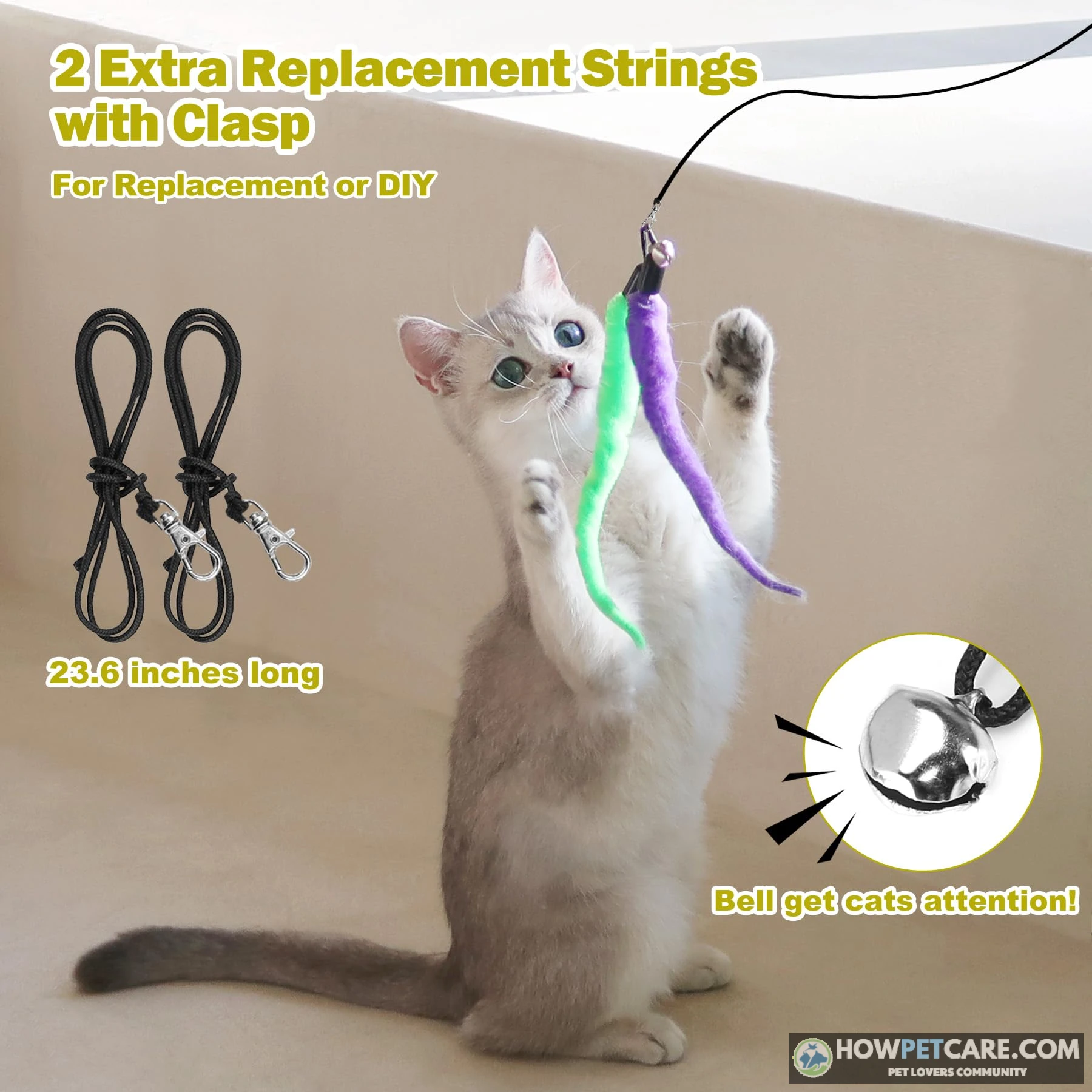
Adult cats keep learning. Short play sessions that let a cat stalk, chase, and pounce offer chances to practice natural behaviors. Puzzle feeding, safe climbing spaces, and rotating a few toys can add variety without expensive equipment.
Match the activity to the cat. A cat with arthritis, poor vision, or another health condition may prefer low, slow-moving play and easy-to-reach resting places.
Senior cats and feline cognitive dysfunction: early signs vs. normal aging
Some senior cats slow down, but don’t automatically dismiss a new behavior change as old age. Feline cognitive dysfunction describes age-associated cognitive decline that affects daily life; a veterinarian must also consider other explanations.
Watch for disorientation, changed interactions, altered sleep, house-soiling, changes in activity, or increased anxiety. A cat that yowls at night or seems lost may have cognitive changes. Pain, high blood pressure, kidney disease, thyroid disease, and sensory loss can cause similar signs, too.
Owner-survey figures are sometimes summarized as roughly 28% of cats aged 11–14 and 50% of cats aged 15 or older showing at least one behavior consistent with cognitive decline. These aren’t confirmed diagnosis rates: a reported sign can have several causes, and the underlying survey and diagnostic criteria matter. Whatever the cat’s age, discuss a new or progressive change with a veterinarian.

Brain-healthy nutrition and enrichment by life stage
| Life stage | What the brain is doing | Nutrition focus | Enrichment focus | Signs to raise with your vet |
|---|---|---|---|---|
| Kitten | Developing and learning about the environment | Complete food appropriate for growth | Gentle handling, age-appropriate play, safe exploration | Persistent wobbliness, tremors, or developmental concerns |
| Adult | Learning routines and adapting to experiences | Complete, balanced adult diet appropriate to health needs | Hunting-style play, climbing, simple food puzzles | New seizures, changes in balance, or a marked behavior change |
| Senior | Adapting to aging and possible sensory changes | Diet chosen with the vet for life stage and medical conditions | Predictable routines, accessible play, easy-to-reach resources | Disorientation, altered sleep, house-soiling, or a sustained decline |
Thiamine, or vitamin B1, is essential for normal nervous-system function; a deficiency can cause neurological signs. Complete diets are formulated to meet nutritional requirements, but an unbalanced homemade diet or inappropriate feeding plan can create risks. Omega-3 fatty acids such as DHA and EPA, along with dietary antioxidants, are also being studied for brain health. They don’t replace a veterinary assessment, and supplements aren’t automatically needed.
Ask your vet before changing a therapeutic diet or adding supplements, particularly if your cat has another medical condition.
5 At-Home Cat Cognition Tests You Can Run Step by Step
What you need and ground rules
These games let you observe your own cat; they aren’t validated diagnostic tests. Use a quiet room, an opaque cup, a small box or barrier, a toy, and a little of your cat’s usual food. Keep sessions short. Stop if your cat walks away, becomes frustrated, or seems uncomfortable. Count treats as part of its normal daily food allowance.
Hunger, hearing, vision, mobility, stress, and interest can all affect the result. Record what you see rather than assigning a score.
The five tests, step by step
1. Hidden-object search
- Show your cat a favorite toy or small treat.
- While the cat watches, cover it with a lightweight opaque cup.
- Pause and let the cat investigate. Note whether it looks at the cup, touches it, or searches around it.
Searching is consistent with tracking a hidden object, but scent or previous experience with cups may also guide the cat. Walking away doesn’t establish a cognitive problem.
2. Motion prediction
- Place a short cardboard barrier where you can see both ends.
- Move a toy across the floor and behind it while your cat watches.
- Note whether the cat looks toward the place where the toy might reappear. Repeat a few times, without forcing interaction.
Looking toward the exit may reflect anticipation. Looking at the entry or losing interest can be normal, too.
3. Name response
- Choose a calm moment when your cat isn’t already focused on you.
- Say several neutral, similar-length words in an even tone, pausing between them.
- Say your cat’s name in the same tone. Watch for an ear turn or head movement.
This is a simplified home observation, not a reproduction of a controlled study or a hearing test. A response may reflect a learned association; no response has several possible explanations.
4. Familiar-location search
- Put a small treat in the same accessible spot during several separate sessions.
- On a later occasion, make a minor change nearby without moving the treat spot.
- See whether your cat approaches the familiar location. Remove any uneaten food afterward.
Smell and routine can guide the search, so this doesn’t isolate memory. Keep the route safe, and don’t rearrange an anxious cat’s environment just for the game.
5. Simple problem-solving
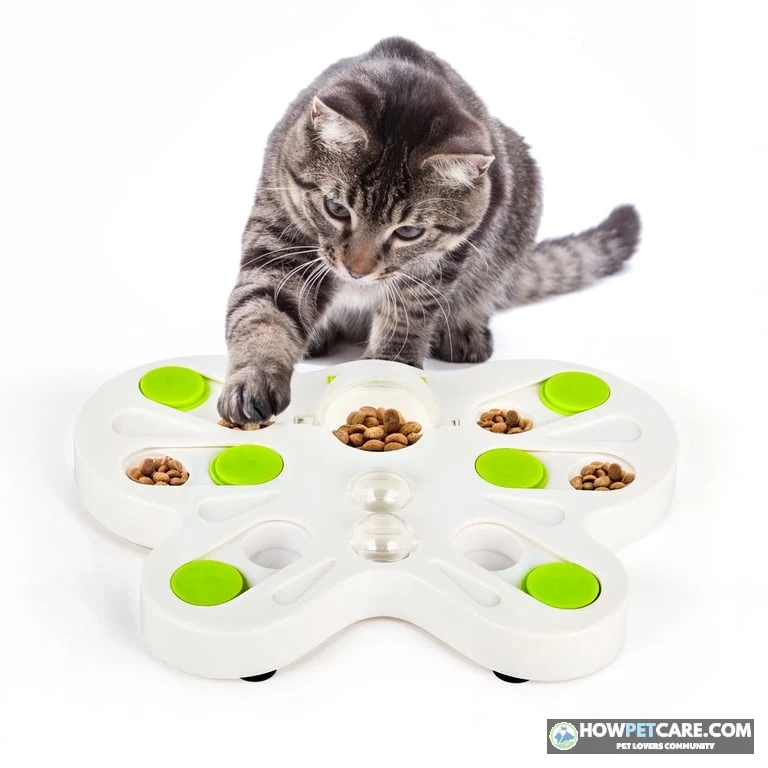
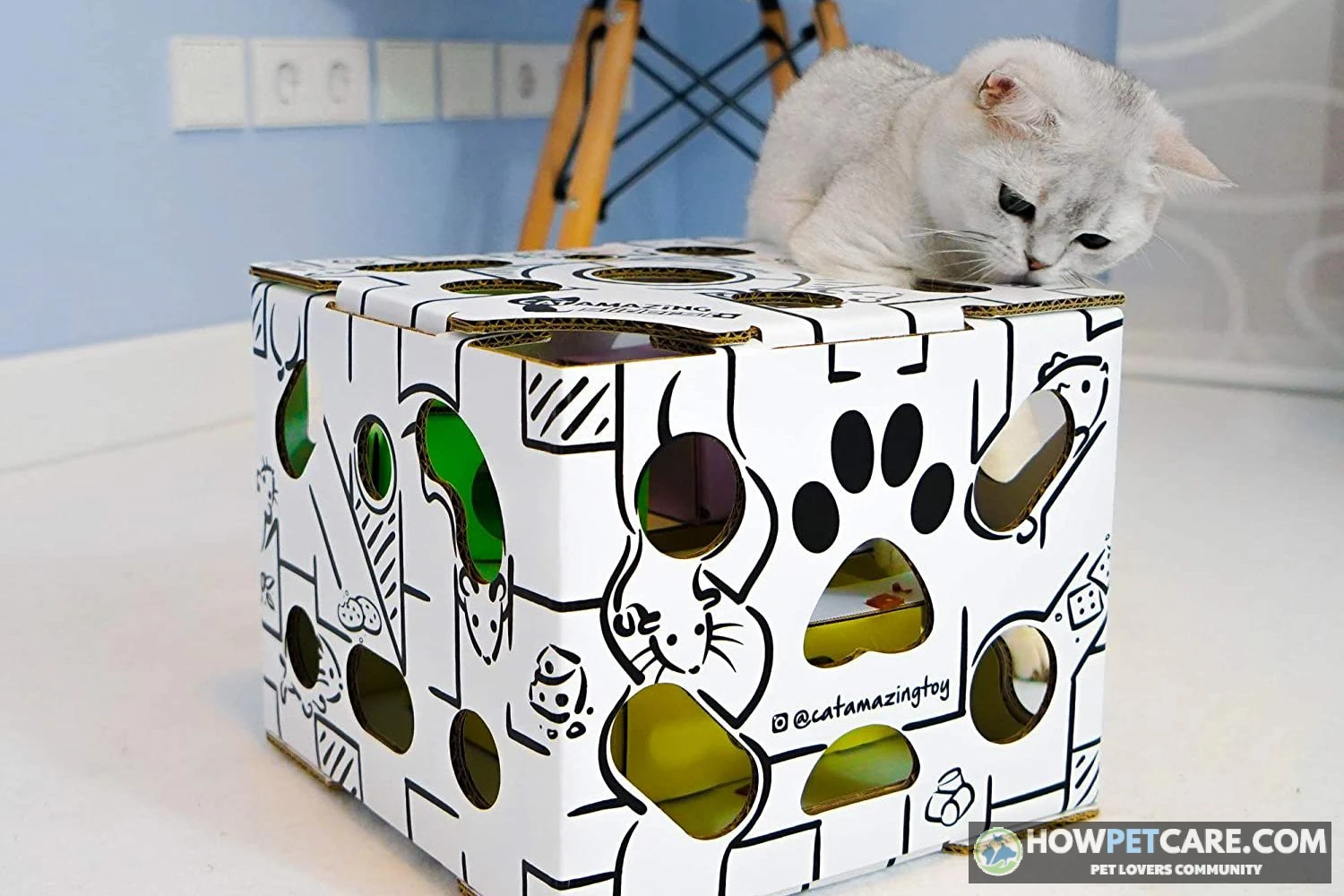
- Place a treat in an easy food puzzle or a shallow open cardboard box.
- Let your cat explore without tipping the container for it.
- Note the approaches it tries and whether it retrieves the food. Make the task easier if it becomes frustrated.
What a changed result may mean
Compare observations with your cat’s own usual behavior over time, not with another cat’s. One disinterested session means little. If a previously easy activity becomes consistently difficult, tell your vet. A sudden decline, or a change accompanied by loss of balance, vision change, or seizure, needs more urgent advice.
1An adult cat suddenly begins stumbling and losing balance while walking across the living room. How should an owner interpret this symptom compared to a condition like kitten cerebellar hypoplasia?
Cerebellar hypoplasia is a developmental condition present from birth, whereas a sudden loss of balance in an adult is an acute sign needing urgent evaluation.
2Which of the following statements accurately reflect the comparative brain characteristics and neuron counts of cats, dogs, and humans?
Published scientific estimates for feline cortical neurons generally fall within the 250–300 million range.
3During an at-home cognition game, an owner moves a toy across the floor and behind a cardboard barrier while the cat watches. Which cognitive skill is the owner observing if the cat looks toward the opposite end of the barrier?
Anticipating where a moving object will reappear after passing behind an obstacle demonstrates motion prediction.
4A cat twitches its whiskers and paws softly while sleeping. What is the most scientifically sound explanation for this observation?
Rapid Eye Movement (REM) sleep is associated with dreaming in mammals, but physical movements do not provide definitive evidence of what the cat is experiencing.
5Which of the following clinical signs in a cat constitute a critical emergency requiring immediate visit to an emergency veterinary clinic?
Prolonged or clustered seizures represent a grave neurological emergency that requires immediate medical intervention.
6Which nutrient deficiency is specifically recognized for potentially causing severe neurological symptoms in cats due to its essential role in nervous system function?
Thiamine is essential for normal central nervous system function, and a deficiency directly leads to acute neurological signs.
7When an older cat displays symptoms of cognitive decline such as night-time yowling or disorientation, which medical conditions must a veterinarian rule out before confirming Feline Cognitive Dysfunction?
High blood pressure can cause central nervous system signs, vocalization, and disorientation that mimic cognitive dysfunction.
Neurological Warning Signs in Cats: Emergency Now or Book an Appointment?
Triage chart: emergency, same-day call, or monitor
Similar signs can have different causes. A head tilt may involve the inner ear or another part of the balance system; seizures, circling, or behavior changes can have neurological, toxic, metabolic, or other causes. Use this table to judge how quickly to seek help, not to diagnose your cat.
| Sign | Urgency level | Possible meaning | What to do now |
|---|---|---|---|
| Seizure lasting 5 minutes or more, repeated seizures, or failure to recover | Emergency now | A prolonged or recurring neurological episode | Go to an emergency vet; call ahead if safe |
| Collapse, unresponsiveness, inability to stand, or severe sudden stumbling | Emergency now | Serious brain, balance, metabolic, or other illness | Go to an emergency vet immediately |
| Head pressing, serious trauma, or suspected toxin exposure with signs | Emergency now | Potentially serious illness or poisoning | Call an emergency clinic and go in; bring exposure details if safe |
| Sudden blindness, sudden circling, new head tilt, rapid eye flicking, or new tremors | Call a vet immediately for same-day direction | Eye, ear, nervous-system, blood-pressure, or other problem | Describe onset and severity; use an emergency clinic if the cat is severely affected or your vet directs you there |
| First brief seizure that has stopped, with apparent recovery | Call a vet immediately for same-day direction | A seizure can have several causes even if it stops | Arrange prompt assessment; emergency care if another seizure occurs or recovery is incomplete |
| Gradual sleep, litter-box, interaction, or memory changes | Monitor and book a visit within days | Pain, sensory change, medical illness, or cognitive decline | Record examples and arrange an appointment; call sooner if signs worsen |
A new head tilt isn’t a watch-and-wait problem. If it’s mild and the cat can walk, contact your vet promptly for same-day guidance. If the tilt comes with severe stumbling, inability to stand, collapse, or reduced responsiveness, go to emergency care. A previously diagnosed, unchanged tilt can be monitored according to your vet’s plan.
Sudden blindness or widely dilated pupils also warrant immediate veterinary contact: eye disease and high blood pressure can threaten vision. Don’t wait for a routine appointment if you can’t reach your regular vet.
What to do during a seizure, and what to tell the vet
- Start timing the episode and keep the room quiet and dim if possible.
- Move nearby hazards away, especially objects the cat could strike or fall from. Don’t restrain the cat unless needed to prevent immediate injury.
- Keep your hands away from the mouth. A cat can’t swallow its tongue, and a bite can happen involuntarily.
- Record a video if you can do so safely. Note the movements, duration, and how the cat behaves afterward.
- Call a vet as soon as it’s safe. For a seizure reaching 5 minutes, repeated seizures, or incomplete recovery, go to an emergency clinic.
If you’re unsure whether an episode was a seizure, call anyway. A first short episode that has ended still needs prompt advice; don’t wait to see whether it happens again.
Tell the clinic about any possible toxin, medication, fall, or injury. If your cat is unresponsive, cannot stand, or is having a prolonged or repeated seizure, seek emergency care rather than waiting for a callback.
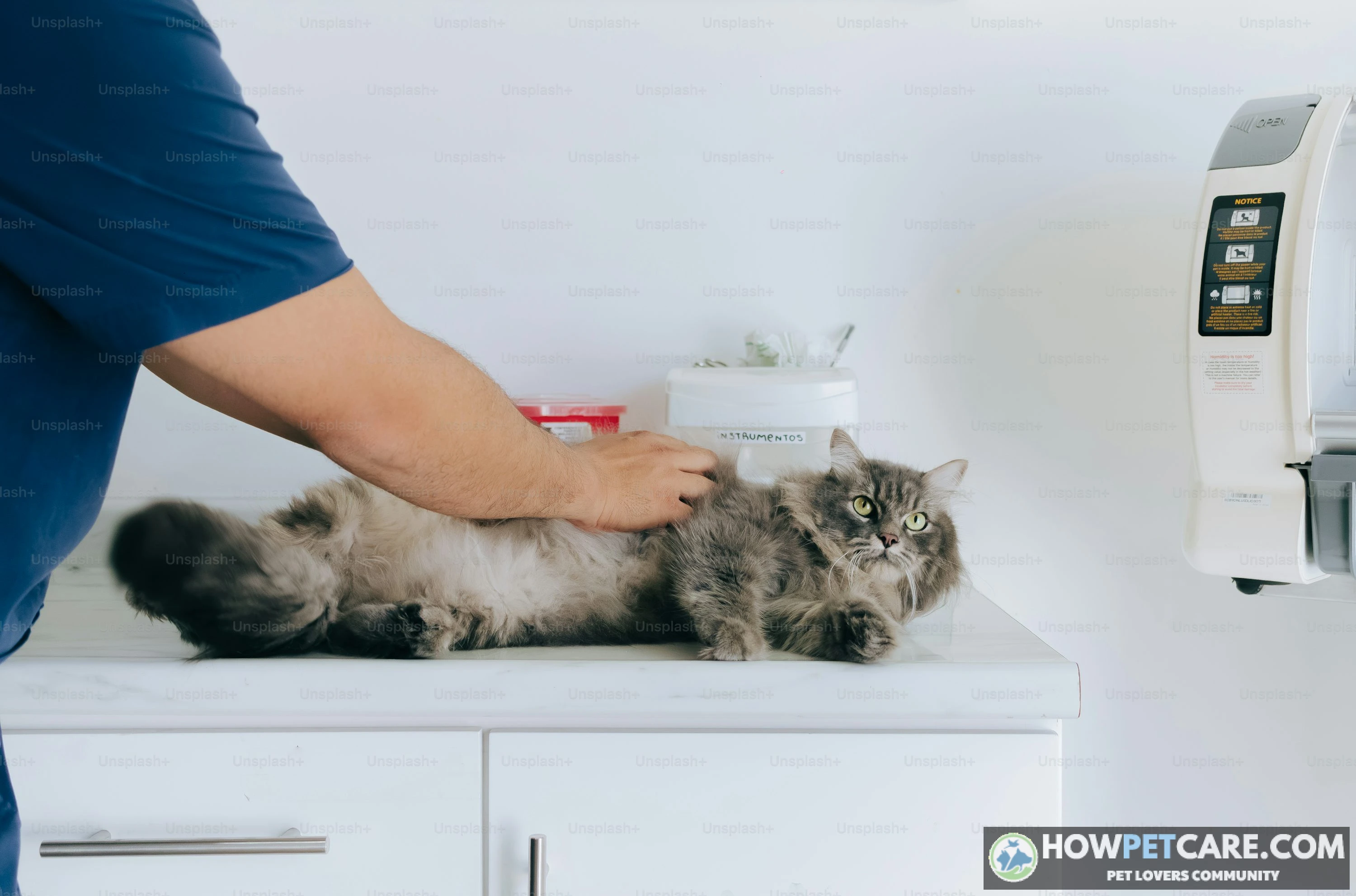
A veterinarian may investigate toxins, infections, metabolic disease, trauma, stroke, and tumors such as meningioma. A seizure or circling doesn’t, by itself, mean a cat has a tumor. Depending on the circumstances, the vet may recommend an examination, laboratory tests, or imaging.
Toxoplasmosis and ‘brain worm’: what owners need to know
Toxoplasma gondii is a parasite for which cats are the definitive host. Most infected cats don’t show obvious illness. Toxoplasmosis can affect the nervous system, but neurological illness is uncommon; risk and severity depend on the cat’s circumstances, including immune health. A suspected neurological problem calls for a vet’s assessment, not an assumption that a parasite is responsible.
Practical precautions include avoiding raw meat, limiting hunting where feasible, and scooping litter daily. Pregnant people and immunocompromised household members should follow their clinician’s advice about litter handling and food safety. Toxoplasmosis isn’t evidence that a parasite is controlling a cat’s or owner’s mind.
“Cat brain worm” is an informal search phrase, not one specific diagnosis. It may refer to toxoplasmosis or to rare parasites that can affect an animal’s nervous system. A vet can assess relevant exposure and signs; the phrase alone doesn’t identify a parasite or mean one is common.
Your Cat Brain Action Plan: Vet-Visit Checklist and Daily Brain-Care Habits
Vet-visit checklist you can save or print
Emergency clinic now
- ☐ A seizure lasts 5 minutes or more, seizures repeat, or my cat does not recover normally.
- ☐ My cat is unresponsive, collapses, cannot stand, or has severe sudden loss of balance.
- ☐ My cat is pressing its head against a surface, or has neurological signs after a suspected toxin exposure or serious injury.
Call a vet immediately for same-day direction
- ☐ My cat had a first seizure, even though it stopped and recovery seemed complete.
- ☐ My cat has a new head tilt, circling, eye flicking, tremors, sudden vision change, or marked behavior change.
- ☐ I cannot tell whether an episode was a seizure or whether the symptoms are urgent.
Book a visit within days
- ☐ My cat has gradual changes in sleep, orientation, interactions, activity, or litter-box use.
- ☐ A familiar game or routine has become consistently harder without an obvious reason.
Before the appointment, note when the change began, how long episodes last, and whether they’re getting worse. Bring a video if safely available, along with a list of medications, diet changes, and possible toxin or injury exposures. Tell the vet what’s normal for your cat.
A simple weekly brain-care routine
Offer short hunting-style play sessions throughout the week, adjusted to your cat’s health and interest. Try an easy puzzle or scent-based activity, provide safe places to climb and rest, and keep feeding and sleep routines predictable. No single number of play minutes suits every cat.
For a senior cat, repeat one or two familiar games periodically and mention sustained changes at the next veterinary visit. If a change is sudden or appears alongside a warning sign in the checklist, call sooner.

FAQ
Can cats get brain freeze?
There is no documented evidence that cats get brain freeze. In humans it comes from a cold stimulus to the palate and referred pain through the trigeminal nerve, and whether cats feel anything similar is unproven. Most cats avoid very cold food anyway.
Which cat breed has the smartest brain?
No reliable research ranks cat breeds by intelligence, so any breed ranking is opinion. Individual personality, early socialization, and enrichment influence how a cat learns far more than breed does.
What are the signs of a brain tumor in cats?
Common signs include seizures, behavior or personality changes, circling, vision problems, and unsteady walking. Those signs also occur with many other conditions, so a vet needs to do an exam and imaging such as MRI to confirm a cause.
Can cats have strokes?
Yes, but they are uncommon and often have an underlying cause such as high blood pressure or heart disease. Sudden loss of balance, head tilt, weakness on one side, or collapse needs prompt veterinary care.
Why does my cat stare at walls or seem confused?
Occasional staring is often a response to sounds or movement that people can’t detect. If the staring comes with disorientation, wandering, night-time yowling, or changes in litter box habits, ask your vet about cognitive dysfunction, especially in older cats.