
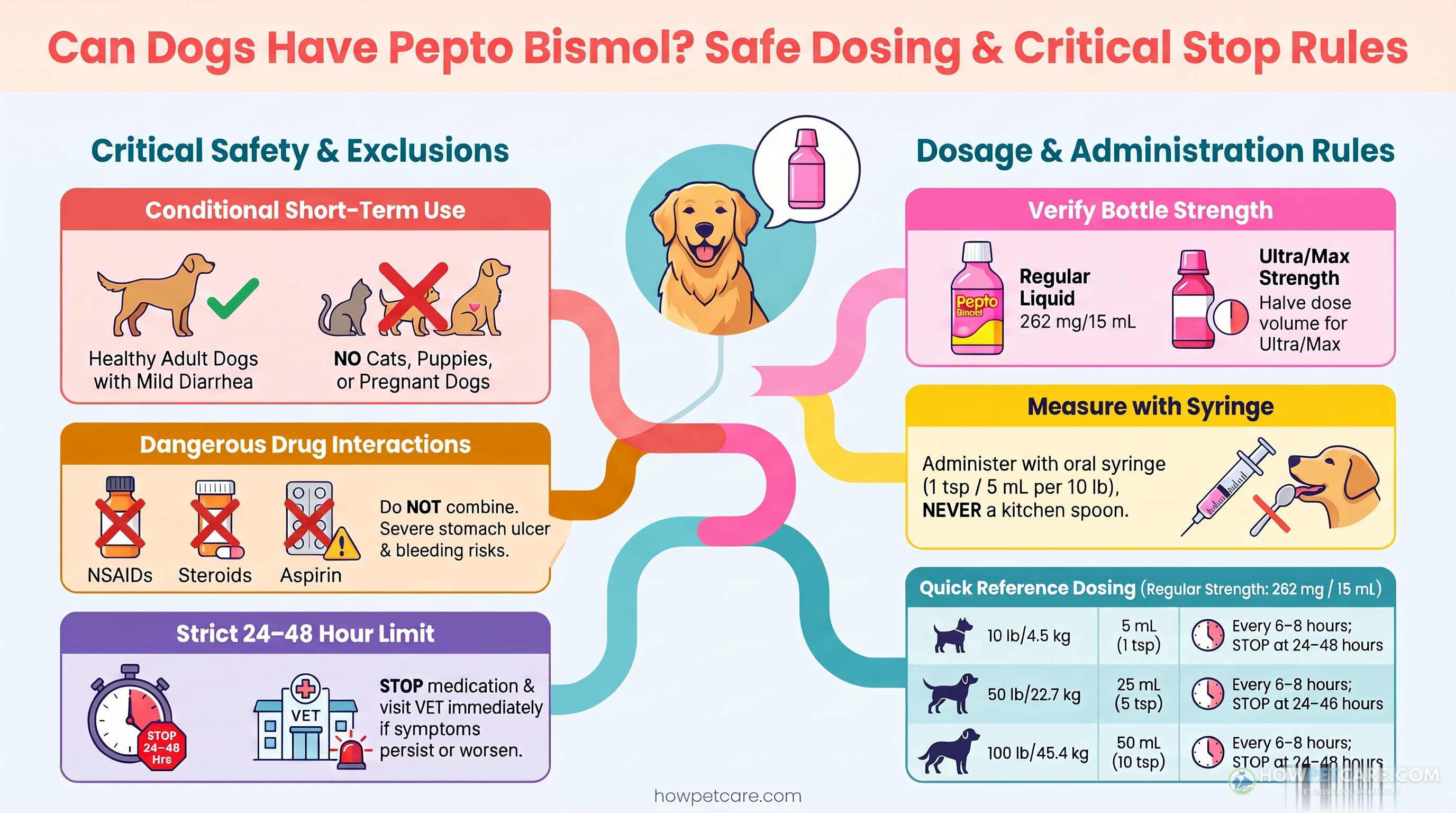
Yes — a healthy adult dog with mild diarrhea can have Pepto Bismol (bismuth subsalicylate) short-term: about 1 teaspoon of regular-strength liquid per 10 lb every 6–8 hours, for no more than 24–48 hours. Never give it to puppies, pregnant or nursing dogs, dogs on NSAIDs or steroids, or any dog vomiting or passing bloody stool.
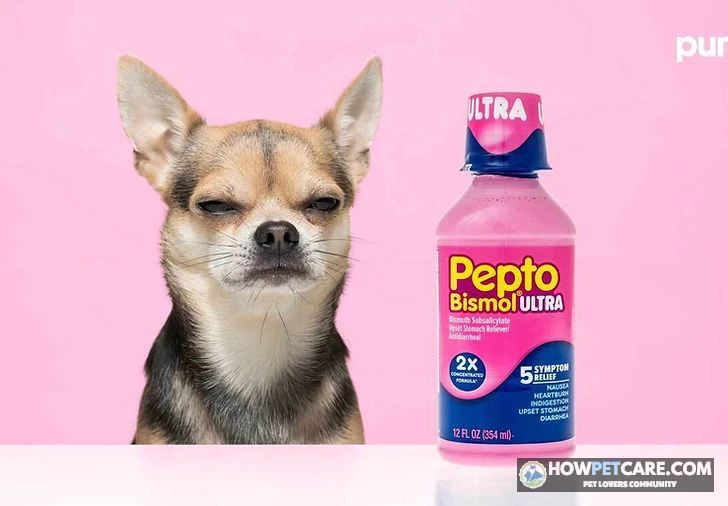
Verdict: a conditional yes — not a default home remedy. A healthy adult dog with mild diarrhea or a mild upset stomach can have Pepto Bismol (bismuth subsalicylate) for a short time at a vet-confirmed dose. It’s never appropriate for cats, and it’s a firm no for several groups of dogs.
Do not give Pepto Bismol if your dog:
- Is a puppy, pregnant, nursing, or has kidney or liver disease
- Has a bleeding disorder, an ulcer or GI bleeding, or surgery coming up
- Takes an NSAID (carprofen, meloxicam), a steroid, aspirin or another salicylate
- Already has black, tarry or bloody stool, repeated vomiting, lethargy, or a painful or bloated belly
- May have eaten a toxin, a sock, a toy or a bone
- Would need a dose you cannot measure from the exact bottle in your hand
If none of these applies, use the dose table below. If even one applies, skip the medicine and call your vet or an emergency clinic.
Can Dogs Have Pepto Bismol? The Short Answer and a Do-Not-Give Checklist
Pepto Bismol’s active ingredient is bismuth subsalicylate. The bismuth portion coats the stomach lining and helps firm up loose stool; the subsalicylate portion releases salicylate, a compound closely related to aspirin. That explains much of the caution around the drug: salicylates thin the blood, irritate the stomach lining, and are cleared by the kidneys.
The answer to "can dogs have Pepto Bismol" is narrower than much of the advice online suggests. It can be a reasonable short-term option for an uncomplicated case: an adult dog with normal energy, still drinking, mild loose stool, no blood, no vomiting, and no medications that clash. Veterinary practice guidance describes it as acceptable for a day or two for uncomplicated diarrhea, nausea or constipation, with an exam needed if the problem continues.
Both the dog and the bottle have to pass the screen.
The dog passes if it’s a fully grown, otherwise healthy animal with mild, recent signs, no chronic disease, no daily medication, and no blood in the stool. The dog also needs to be bright, drinking, and not vomiting.
The dog fails if any item from the checklist at the top of this page applies. These exclusions matter. A dog with kidney disease clears salicylate slowly; a dog on carprofen or another NSAID pain reliever already faces a stomach-lining risk; and a dog that’s vomiting may be dehydrated, making salicylate a poor addition.
The bottle passes if it contains bismuth subsalicylate at a strength you can measure, with no xylitol and no other active ingredients that change the calculation.
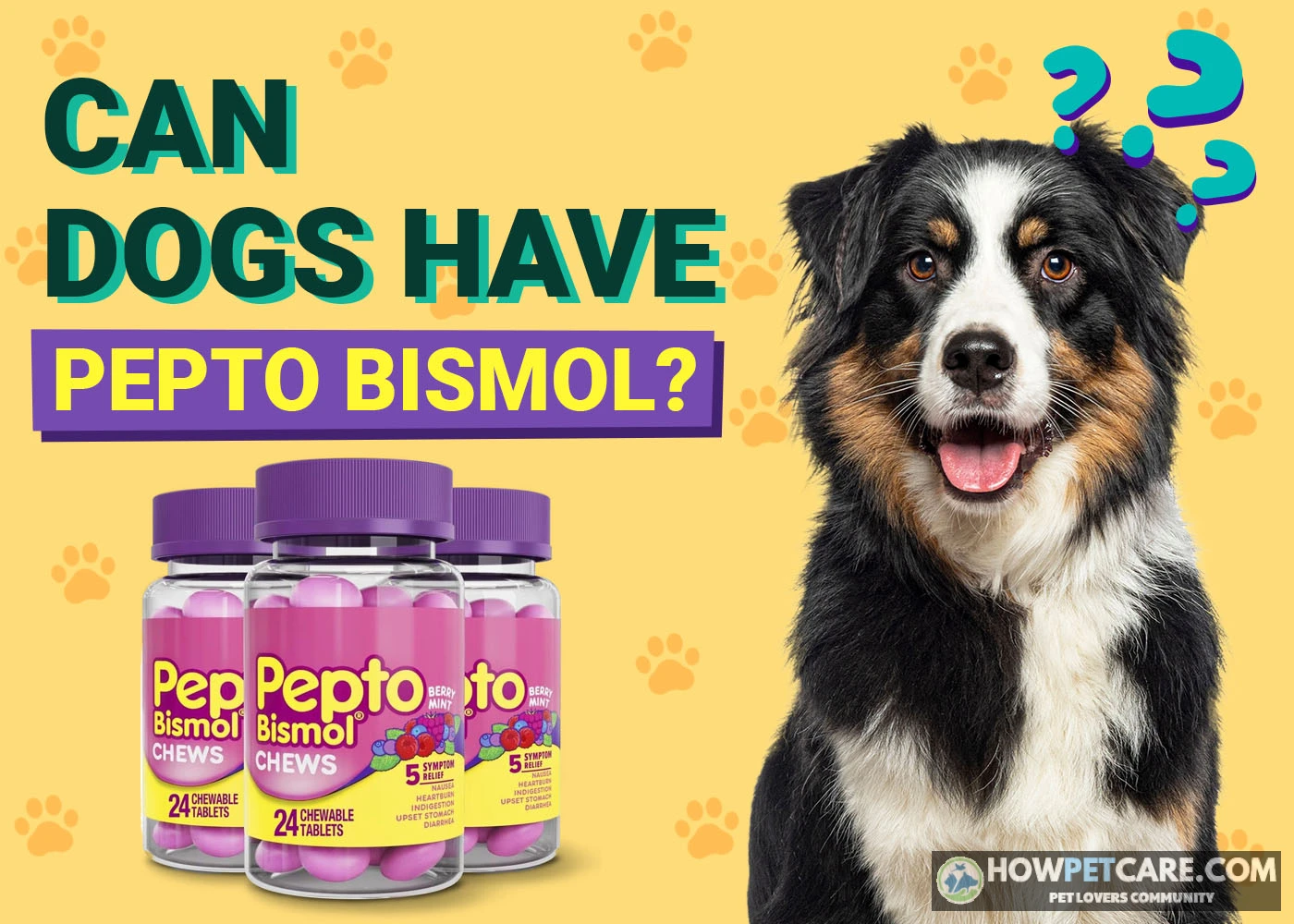
Do not give Pepto Bismol if any of these apply
Here’s why each exclusion matters for your dog:
- Puppies. Salicylate handling and dehydration risk are worse in small, fast-changing bodies, and young dogs can decline quickly.
- Pregnant or nursing dogs. Salicylate can reach fetuses and nursing puppies.
- Kidney or liver disease. The drug is cleared by the kidneys and processed by the liver.
- Bleeding disorders, ulcers, recent or planned surgery. Salicylate affects platelet function.
- Dogs on NSAIDs, steroids or aspirin. Combining these multiplies the risk of stomach ulcers and bleeding.
- Dogs with black, tarry or bloody stool, repeated vomiting, or a painful belly. These signs need investigation, not masking.
- Dogs that may have swallowed a foreign object or a toxin. Pepto can quiet the symptoms while the underlying problem continues.
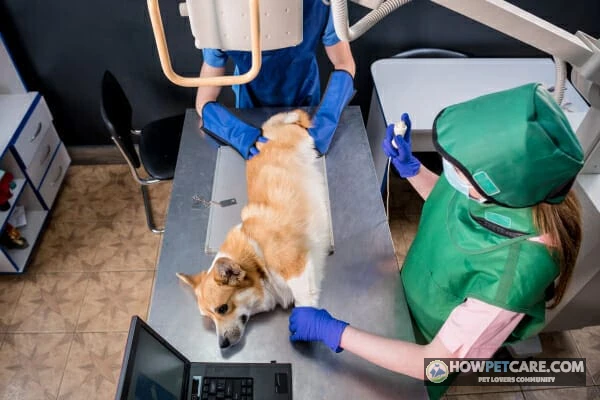
Read your bottle first: xylitol, bismuth-free formulas and Ultra or Max Strength
Before measuring a dose, check the panel for the active ingredient and its strength. Three details can make a difference.
Ultra and Max Strength are double strength. Regular Pepto Bismol liquid carries 262 mg of bismuth subsalicylate per 15 mL, while Ultra and Max Strength carry 525 mg per 15 mL. Use a regular-strength dose for an Ultra bottle and you’ll give roughly double the drug. Max Strength liquid doses are halved.
Chewables and flavored products need a xylitol check. Xylitol is toxic to dogs, and it can turn up in chewable and flavored products on the same shelf. Read the ingredient list on the exact package, not a photo of a similar box.
Bismuth-free formulas are not substitutes. Some store-brand "upset stomach" liquids contain no bismuth subsalicylate, and others use different active ingredients entirely. They won’t behave like Pepto Bismol in a dog, and a dose from this page doesn’t transfer to them. The current US Kaopectate formula is bismuth subsalicylate too, so it isn’t a safer swap.
If you can’t read the milligrams per dose on your bottle, you can’t safely use a table to dose your dog. Switch to a clearly labeled product under veterinary direction, or call the clinic.
Pepto Bismol Dosage for Dogs by Weight: Liquid, Caplets, Chewables and Ultra/Max Strength
Use this table only after the do-not-give screen is clear and your vet has agreed to a plan. First, confirm the strength on your label. The figures below assume regular liquid at 262 mg per 15 mL (about 17.5 mg per mL), Ultra or Max Strength liquid at 525 mg per 15 mL (about 35 mg per mL), and caplets or chewables at 262 mg each.
| Dog weight | Regular liquid, 262 mg/15 mL | Ultra / Max Strength liquid, 525 mg/15 mL | Caplet, 262 mg | Chewable, 262 mg | Interval and maximum duration |
|---|---|---|---|---|---|
| 10 lb / 4.5 kg | 5 mL (1 tsp) | 2.5 mL (1/2 tsp) | Not practical — use liquid | Not practical — use liquid | Every 6–8 hours; stop by 24–48 hours |
| 25 lb / 11.3 kg | 12.5 mL (2.5 tsp) | 6.25 mL (1.25 tsp) | About 0.8 — vet must confirm | About 0.8, only if breakable | Every 6–8 hours; stop by 24–48 hours |
| 50 lb / 22.7 kg | 25 mL (5 tsp) | 12.5 mL (2.5 tsp) | About 1.7 | About 1.7 | Every 6–8 hours; stop by 24–48 hours |
| 75 lb / 34 kg | 37.5 mL (7.5 tsp) | 18.75 mL (3.75 tsp) | About 2.5 | About 2.5 | Every 6–8 hours; stop by 24–48 hours |
| 100 lb / 45.4 kg | 50 mL (10 tsp) | 25 mL (5 tsp) | About 3.3 | About 3.3 | Every 6–8 hours; stop by 24–48 hours |
The liquid volumes follow the widely used 0.5 mL per pound figure, equivalent to 1 teaspoon per 10 pounds. Caplet and chewable counts follow the published veterinary tablet figure of 8.75 mg per pound every 4–6 hours, divided into 262 mg units. The interval column is deliberately conservative: practice guidance pairs the 1 teaspoon per 10 pounds rule with dosing every 6–8 hours and a one-to-two-day ceiling.
-
Read your label and note the strength
Ultra or Max Strength liquid is 525 mg per 15 mL, about double the regular 262 mg per 15 mL. Confirm that before you measure anything.
-
Start from the regular-liquid volume
For a 40 lb dog at 0.5 mL per pound, the regular-liquid equivalent is 5 mL × 4 = 20 mL.
-
Halve it for Ultra or Max Strength
20 mL ÷ 2 = 10 mL of the double-strength liquid.
-
Check the dose in milligrams to catch mistakes
10 mL × 35 mg/mL = 350 mg, which matches 20 mL × 17.5 mg/mL = 350 mg. If your label differs, redo this step with its own mg/mL figure.
-
Measure, record, and set a stop date
Use an oral syringe, write down the product, amount and time, and put a hard stop at 24–48 hours or at the first red flag.
How to convert the liquid dose to caplets, chewables and Ultra/Max Strength
Three conversions cover nearly every case:
- Regular liquid to Ultra or Max Strength: divide the regular volume by two, because the concentration doubles from 262 mg/15 mL to 525 mg/15 mL.
- Regular liquid to caplets or chewables: one 262 mg unit is roughly equal to 15 mL of regular liquid. At the 8.75 mg per pound reference rate, that works out to about 30 lb of dog per caplet.
- Anything to milligrams: multiply the volume by the mg/mL on your label. Milligrams are the number that stays comparable across products.
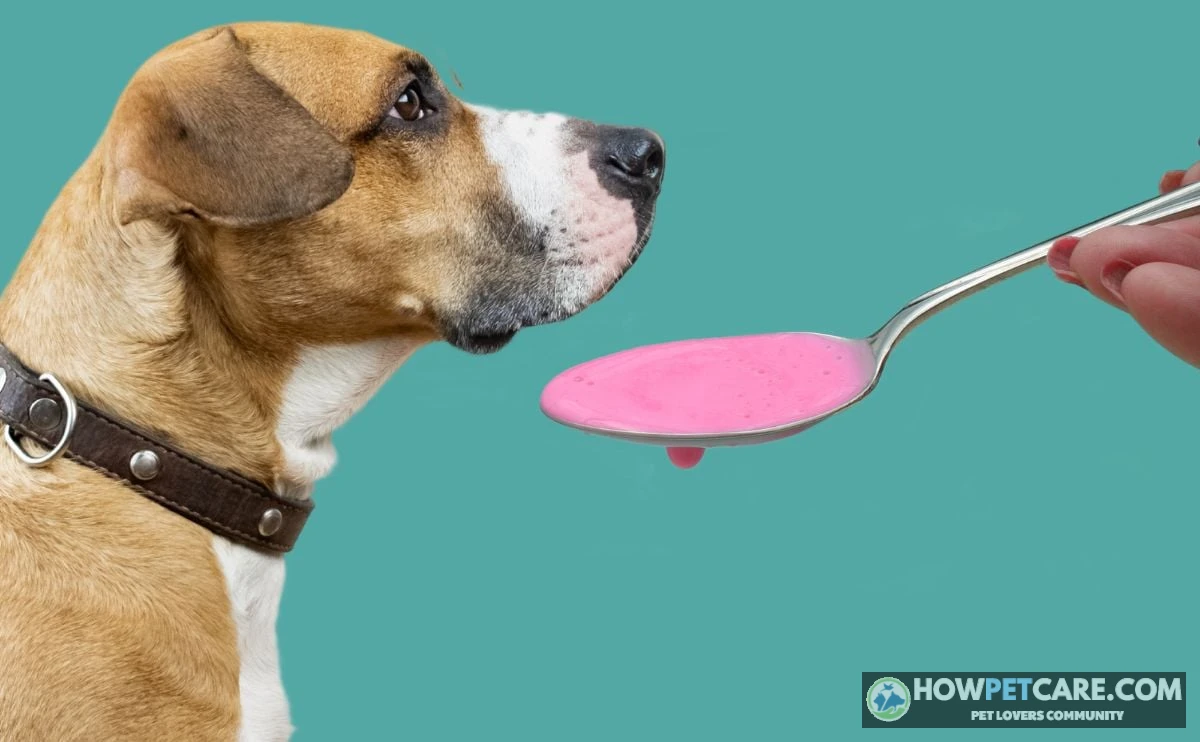
Rounding is the weak point of tablet dosing. A 262 mg caplet is a large step for a 10 lb dog, and many caplets aren’t scored, so splitting is imprecise. If the count comes out fractional, ask your vet whether to round down or switch to liquid rather than improvising. For toy breeds and dogs over about 90 lb, a phone call is worth more than the table.
Where the "1 teaspoon per 10 pounds" rule comes from, and what the veterinary references say
The rule is widespread, and it has a source. It restates 0.5 mL per pound of the original 1.75% liquid, which appears in veterinary practice guidance for dogs and in published veterinary drug figures for bismuth subsalicylate. Those figures list 0.5 mL/lb every 4–6 hours for up to 5 days, a ceiling of 0.9 mL/lb every 6–8 hours, and 8.75 mg/lb for tablets every 4–6 hours. The rule often appears without a citation, formulation note or stop date. This table includes those details.
Two cautions apply to the reference figures. First, Pepto Bismol is a human product with no dog label, so every dose here is off-label and depends on a vet’s agreement. Second, the references disagree on duration: the drug reference allows up to five days, while practice guidance describes one to two days for uncomplicated cases and then an exam. This article follows the shorter limit. If the problem isn’t clearly improving in a day or two, the medicine isn’t the answer.
How often, how long, and when to stop
Give the dose every 6–8 hours, and leave at least two hours before or after any other medication, since bismuth can interfere with absorption. Improvement is expected within 24–48 hours. If diarrhea, vomiting or constipation persists past that window, stop dosing and book an exam.
Shake the liquid well first and measure it with an oral syringe rather than a kitchen spoon. Don’t split caplets unless the label or your vet allows it. Keep a simple log of the product name, strength, amount, time, and what the stool looked like.

Which Dogs Should Never Get Pepto Bismol, and What Else It Interacts With
This table brings the dog groups and drug interactions together. A dog in any of these categories needs more than an at-home dosing decision.
| Dog group or medication | Why it is a problem | What to do instead |
|---|---|---|
| Puppies | Salicylate handling and dehydration risk, faster decline | Call the vet before any medication |
| Pregnant or nursing dogs | Salicylate can reach fetuses and nursing puppies | Vet-directed plan only |
| Kidney disease | Salicylate is cleared by the kidneys | Vet exam; avoid self-treatment |
| Liver disease | Drug processing is impaired | Vet exam before any dosing |
| Bleeding disorder, ulcer, GI bleeding, recent or planned surgery | Salicylate affects platelets and irritates the stomach lining | Do not give; call the vet |
| NSAIDs such as carprofen (Rimadyl), meloxicam, or deracoxib (Deramaxx) | Stacked stomach-ulcer and bleeding risk | Do not give; ask about a gastroprotectant |
| Corticosteroids such as prednisone | Compounding GI irritation | Do not combine without veterinary direction |
| Aspirin or other salicylates | Duplicate salicylate exposure | Do not give; count all products the dog already takes |
| Known aspirin or salicylate sensitivity | Prior reaction predicts a worse one | Do not give |
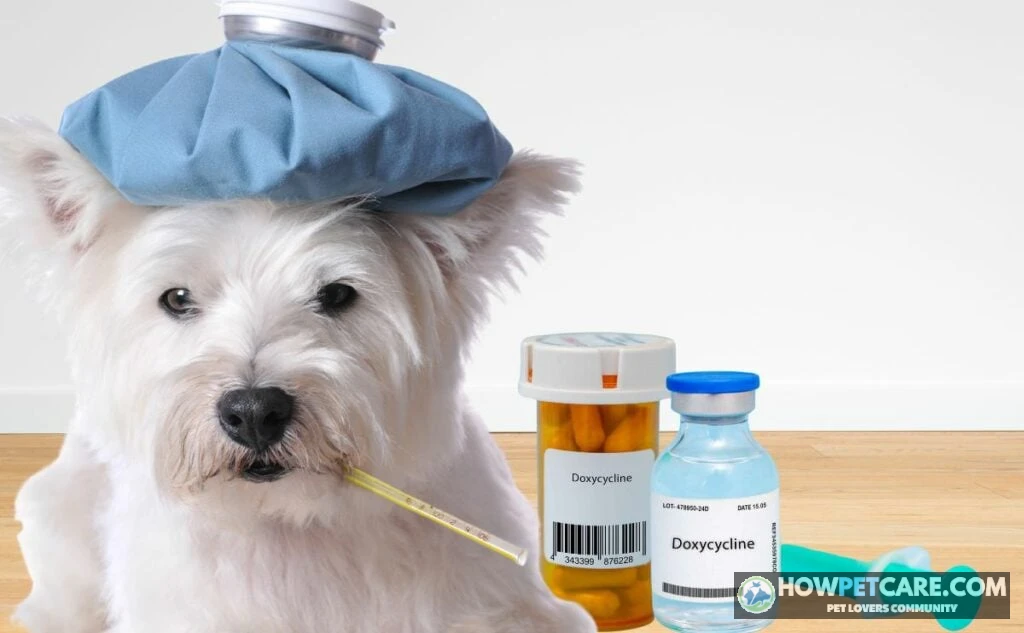
| Doxycycline and other tetracycline antibiotics | Bismuth can interfere with absorption | Ask the vet about spacing and timing |
| Black, tarry or bloody stool, repeated vomiting, painful belly | Signs of bleeding, obstruction or serious infection | Emergency or same-day vet visit |
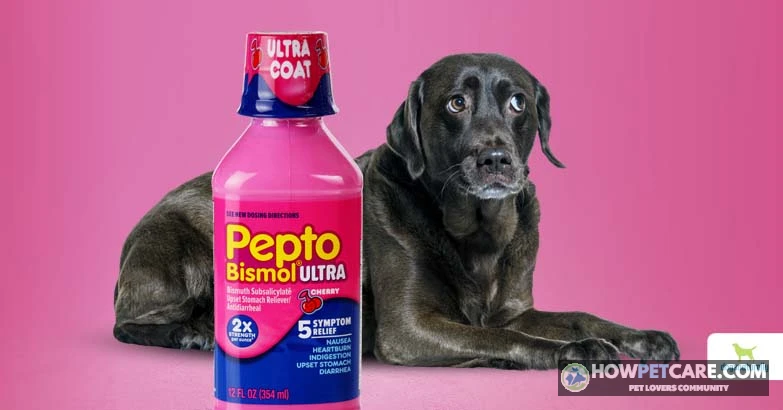
Puppies: how old or how heavy before Pepto is even an option
No reliable, citable age or weight threshold exists, so this article won’t invent one. A puppy shouldn’t receive Pepto Bismol unless a veterinarian directs it after examining the dog. Puppies dehydrate faster than adults, have less margin when they stop eating, and can go from mild diarrhea to being seriously sick within hours. If your puppy has diarrhea, call the vet.
Pregnant, nursing, senior and chronically ill dogs
Salicylate exposure is a concern for fetuses and nursing puppies, so pregnant and nursing dogs belong in the no column. Senior dogs and dogs with any chronic condition — especially kidney or liver disease — have less margin for error with clearance and hydration. These dogs aren’t excluded from veterinary care; they’re excluded from home dosing.

Medications that should not be combined with Pepto Bismol
NSAIDs are a major interaction: carprofen (Rimadyl), meloxicam, and deracoxib (Deramaxx) all raise the risk of stomach ulcers and bleeding when paired with a salicylate. Steroids add to the same irritation. Aspirin and other salicylate-containing products duplicate the active risk. Bismuth can also interfere with absorption of tetracycline-class antibiotics such as doxycycline. If your dog takes one, ask the vet about two-hour spacing rather than guessing.
Side Effects of Pepto Bismol in Dogs: Black Stool, Constipation and What It Can Hide
The most common effects are constipation, a temporarily more upset stomach, a dark coating on the tongue, and dark stool from the bismuth itself. Serious effects come from the salicylate: stomach-lining irritation, ulcers, bleeding, and, in overdose, salicylate toxicity.
Normal black stool versus bloody, tarry stool
Bismuth can turn stool dark gray or black without any bleeding. That’s an expected effect, but it’s also why Pepto can hide a real bleed.
The distinction matters: bismuth-dark stool is simply dark. Melena — digested blood from the upper GI tract — is tarry, sticky, foul-smelling, and usually comes with other signs such as weakness, pale gums or vomiting. If the stool is tarry or jelly-like, or your dog looks unwell as well, treat it as possible bleeding and call a vet rather than assuming it’s the medicine.
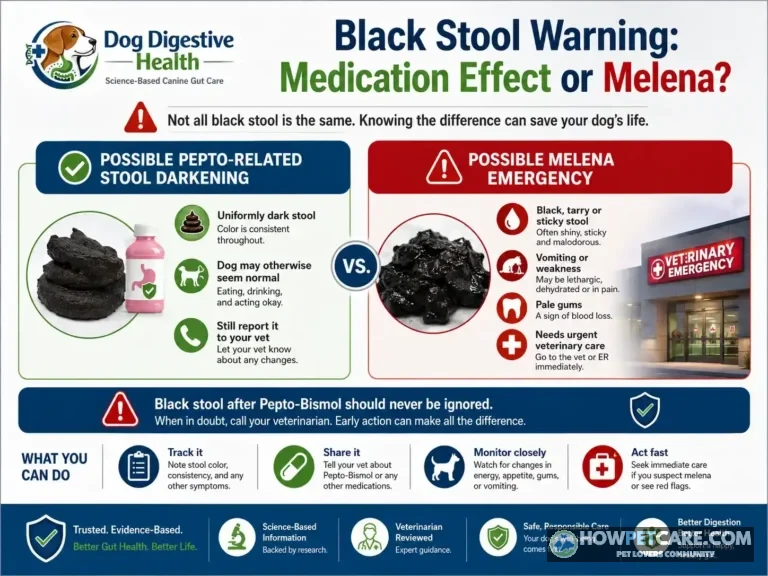
Pepto can darken stool and disguise a sign a vet would use to spot gastrointestinal bleeding. If you aren’t confident the color is bismuth-related, call instead of giving another dose.
Vomiting and upset stomach: when Pepto is the wrong tool
For simple diarrhea in a bright, drinking dog, short-term Pepto can be reasonable. For vomiting, it usually isn’t. A dog that vomits more than once or twice, can’t keep water down, or looks flat is at risk of dehydration. The priority is finding the cause rather than suppressing the sign. Repeated vomiting after a dose is itself a reason to stop and call.
Why Pepto can hide an obstruction or bleeding
A dangerous risk is easy to miss: Pepto can make a dog with a swallowed sock, a bone fragment, an obstruction, internal bleeding or a serious infection look temporarily brighter. If you know or suspect your dog ate something it shouldn’t have, the belly is bloated or painful, or the dog is retching without producing anything, don’t treat at home — go in.
Treat at Home or Call the Vet? A Symptom Decision Guide and the 24–48 Hour Stop Rule
Both symptoms and time help determine whether to monitor at home or visit a clinic. Check the action level first, then the time limit.
| Symptom or situation | Action level | Why | Time limit before escalating |
|---|---|---|---|
| Bloody or black tarry stool, pale gums, collapse, severe weakness | Go now | Possible bleeding, shock, anemia, toxin or obstruction | Immediate |
| Bloated or painful belly, retching with nothing produced, known swallowed object or toxin | Go now | Bloat, foreign body and toxins can be fatal, and Pepto can mask the signs | Immediate |
| Repeated vomiting, cannot keep water down, fever, dehydration signs | Call the vet today | Rapid decline and a contraindication to home dosing | Same day |
| Diarrhea in a puppy, senior dog, or a dog with chronic illness, or a dog on NSAIDs or steroids | Call the vet today | Higher risk and drug interactions | Same day |
| Mild diarrhea in a healthy adult dog that is eating, drinking and behaving normally, with no red flags | May monitor at home | Short supportive care can be reasonable | Re-check at 24 hours; hard stop by 48 hours |
Go to an emergency vet now if you see any of these
Blood in the stool or black tarry stool, pale or white gums, collapse, severe weakness, a swollen or painful abdomen, unproductive retching, a known toxin or foreign-body ingestion, or a seizure. These aren’t signs to watch and wait on, and none should be covered with an over-the-counter medicine.
Call your vet today if
Your dog is vomiting repeatedly, can’t hold water down, has a fever, is a puppy or senior, has a chronic illness, or takes an NSAID or steroid. Call today if you’re unsure about stool color, too. It’s better to ask than to miss a bleed.
Mild signs that can be watched at home for up to 24 hours
One or two soft stools in an otherwise normal dog, with normal appetite, drinking and energy and no vomiting, is the narrow category where monitoring is reasonable. Provide free access to fresh water and rest, and write down times and stool descriptions so you have details for the vet if you call.
Your 24-48 hour timeline
Improvement should be visible within 24–48 hours of starting. If there’s no clear improvement by about 24 hours, stop the medicine. If diarrhea, vomiting or constipation continues past 48 hours, stop and see a vet. The same clock applies to every home remedy you try instead of Pepto.
Dehydration: the check that overrides everything else
Gently lift the skin at the back of the neck. If it stays standing rather than snapping back, that’s a concern. Tacky or dry gums, sunken eyes, and refusing water are also warnings. A dehydrated dog can be an emergency regardless of what the stool looks like.

Pepto Bismol versus what a vet can actually do
Pepto buys time and quiets symptoms. A vet can examine the abdomen, check hydration, run stool or blood tests, give anti-nausea medication and fluids, and prescribe a dog-specific treatment. That’s the difference between suppressing a sign and treating a cause.
My Dog Already Took Pepto Bismol or Ate Too Much: Warning Signs and What to Do Now
-
Remove access to the bottle
Move it out of reach, including the trash, so there is no second exposure while you work.
-
Write down exactly what was consumed
Product name, strength in mg per dose, how many tablets or how many mL, and the time. Photograph the label.
-
Weigh the dog and gather history
Weight, age, health conditions, medications, current symptoms.
-
Call poison control or your vet immediately
Do not wait for symptoms. Do not induce vomiting unless a professional tells you to.
ASPCA Animal Poison Control Center: 888-426-4435. Pet Poison Helpline: 855-764-7661. Both typically charge a consultation fee, and both were current when this page was checked in 2026. Your local emergency clinic is also a valid first call.
Signs of salicylate toxicity in dogs
Watch for vomiting (sometimes bloody), black tarry stool, drooling, loss of appetite, lethargy or weakness, fast breathing, and in severe cases tremors or seizures. Signs can be delayed, so a dog that looks fine right after a large ingestion still needs the call. Risk depends on body weight, product strength, and kidney and liver status. Poison control can calculate the risk for your dog rather than relying on a general table.

You gave a normal dose: what to watch for next
Watch stool color and consistency, appetite, water intake, energy, and any vomiting in the next 24 hours. Expect some darkening of the stool from the bismuth itself. Stop further doses if vomiting starts, the dog gets flat, the stool becomes tarry, or there’s no improvement by roughly 24 hours — and don’t extend past 48 hours.
What Can I Give My Dog for Diarrhea Instead of Pepto Bismol?
If your dog is on the do-not-give list, or you don’t want to use an off-label human drug, there are other options.
Veterinary options. A vet can choose from the wider range of common medications used for dogs — dog-specific anti-diarrheal products, probiotics formulated for dogs, prescription anti-nausea medication, or gastroprotectants such as sucralfate instead. Prescription options offer alternatives to human products, which are a blunt instrument in a dog.
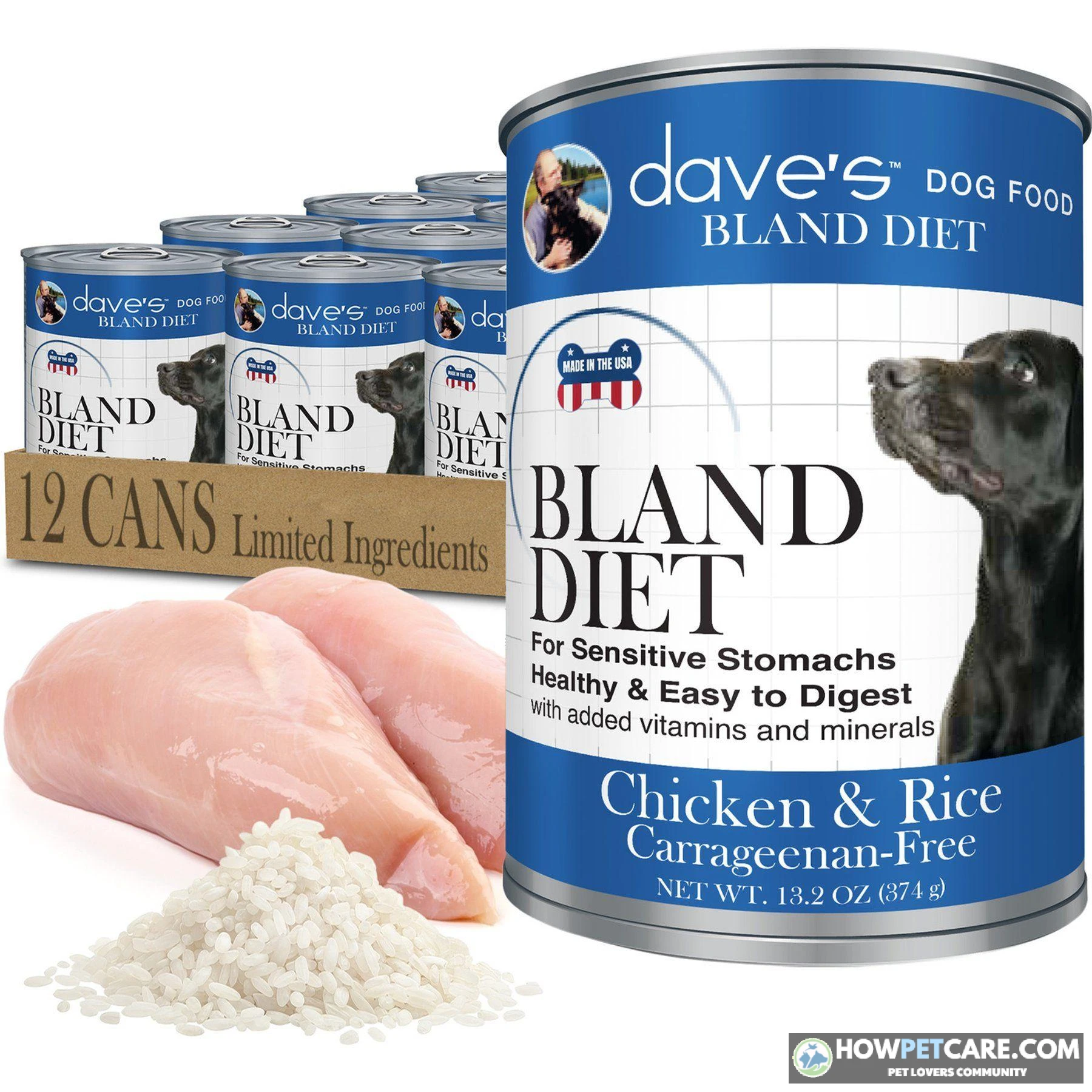
Supportive care at home. Free access to fresh water and a short bland-diet trial are standard non-drug steps. Your vet, rather than a forum post, should set the length of the trial.
Other human products are not a safe default. Loperamide (Imodium) can be dangerous for some breeds and conditions, and other human anti-diarrheals need veterinary approval before use. Kaopectate isn’t a safer swap — its current US formula is bismuth subsalicylate, so the same cautions apply.
Whatever you choose, the 24–48 hour rule applies: no clear improvement in about a day means a call, and signs past 48 hours mean an exam.
1Pepto Bismol contains bismuth subsalicylate. Why does the salicylate component present a severe risk to dogs with existing GI ulcers or those currently taking non-steroidal anti-inflammatory drugs (NSAIDs) such as carprofen?
Salicylates are closely related to aspirin, which inhibits platelet activity and causes gastric lining irritation, multiplying ulceration and bleeding risks when paired with NSAIDs.
2A pet owner has Ultra Strength Pepto Bismol liquid (525 mg per 15 mL) instead of regular strength (262 mg per 15 mL). If the standard calculated regular liquid volume for their dog is 20 mL, how much Ultra Strength liquid should be measured?
Because Ultra Strength contains roughly twice the concentration of active ingredient per unit volume (525 mg vs 262 mg per 15 mL), the required liquid volume is halved.
3In which of the following patient scenarios should Pepto Bismol be strictly withheld unless directly evaluated and prescribed by a veterinarian? (Select all that apply.)
Young puppies undergo rapid dehydration and handle salicylates poorly, while pregnant or nursing dogs can pass salicylates to fetuses or nursing offspring.
4Why must Pepto Bismol administration be separated by at least two hours from doses of tetracycline-class antibiotics like doxycycline?
Bismuth compounds bind to tetracycline antibiotics in the gastrointestinal tract, significantly reducing the amount of antibiotic absorbed into the bloodstream.
5Before giving a chewable or flavored human anti-diarrheal tablet to a dog, which specific toxic sweetener must be ruled out on the ingredient label?
Xylitol is an artificial sweetener commonly added to chewable human medications that causes severe hypoglycemia and liver damage in dogs.
6Why is modern US-formulated Kaopectate not considered a safer alternative to Pepto Bismol for dogs?
US Kaopectate was reformulated to use bismuth subsalicylate, meaning it shares the exact same salicylate toxicity and drug interaction profiles as Pepto Bismol.
7Which of the following symptoms in a dog with gastrointestinal signs warrant an immediate emergency veterinary visit rather than home treatment or waiting for a callback? (Select all that apply.)
Unproductive retching with abdominal distension can indicate gastric dilation-volvulus (bloat) or a complete obstruction, both of which are life-threatening emergencies.
8Based on published veterinary drug figures for bismuth subsalicylate (8.75 mg per pound), approximately how many pounds of dog weight correspond to one regular 262 mg caplet?
Dividing the total milligrams in a caplet (262 mg) by the reference rate (8.75 mg/lb) equals approximately 29.94 lb, rounding to 30 lb of dog per caplet.
Your 60-Second Action Plan Before You Give Pepto Bismol
-
Screen the dog
Run the do-not-give checklist at the top of this page. One checked box ends the home-treatment plan.
-
Read the bottle
Confirm bismuth subsalicylate, confirm the mg per dose, confirm no xylitol, and note whether it is regular, Ultra or Max Strength.
-
Match weight to that exact product
Use the row for your dog’s weight and the column for the bottle in your hand — not a dose remembered from another product.
-
Set a timer and a stop date
Record the dose and time, keep the interval at 6–8 hours, and mark a hard stop at 24–48 hours.
-
Escalate on any red flag
Bloody or black tarry stool, repeated vomiting, a painful belly, collapse or a known ingestion means a vet or poison control call now — not another dose.
Write down the dose, time and symptoms as you go. If you call a vet or poison control, that log gives them a usable history.
If there’s no clear improvement in about 24 hours, or signs last beyond 48 hours, stop the medicine and see a vet.
Sources and scope: dosing figures in this article follow the 0.5 mL per pound reference used in veterinary practice guidance and the published veterinary drug figures for bismuth subsalicylate, including the corresponding tablet rate of 8.75 mg per pound. Product strengths are taken from common US labels and must be verified against the bottle in your hand before measuring. This article is general information for US dog owners, not a diagnosis or a prescription, and it does not replace an examination by your own veterinarian. Emergency situations belong with a vet or an animal poison control service, not with a home remedy.
FAQ
Does Pepto Bismol contain aspirin?
No, but its active ingredient, bismuth subsalicylate, releases salicylate, which is closely related to aspirin. That is why dogs with aspirin sensitivity, bleeding problems or kidney disease should not have it.
Can I give my dog Kaopectate instead of Pepto Bismol?
Not as a safer swap. The current US Kaopectate formula also uses bismuth subsalicylate, so the same cautions apply. Check the label and ask your vet before using it.
Can cats have Pepto Bismol?
No. Cats are much more sensitive to salicylates than dogs, and Pepto Bismol should not be given to a cat unless a veterinarian specifically directs it.
Can I give my dog Pepto Bismol every day?
No. It is meant for short-term use only. If diarrhea or an upset stomach lasts beyond 24–48 hours, stop the medicine and have a vet find the cause.
Why is my dog’s stool black after Pepto Bismol?
Bismuth can turn stool dark gray or black without any bleeding. If the stool is tarry, sticky, foul-smelling, or your dog is weak, pale or vomiting, treat it as possible bleeding and call a vet.