
The right dewormer for a kitten depends on the worm, the kitten’s age and weight, and the exact product label:
- Suspected roundworms or hookworms: a cat-labeled pyrantel pamoate product whose age and weight limits the kitten meets.
- Suspected tapeworms: a cat-labeled praziquantel product (such as Elanco Tapeworm Removal Dewormer), plus flea control.
- Several worm types at once: ask a veterinarian about prescription Drontal (praziquantel + pyrantel).
- Kitten under 6 weeks, underweight, or ill: see a veterinarian or shelter clinic before buying anything.
Most kittens need a deworming plan, but the right medicine depends on their age, weight, health, and the parasite involved. Pyrantel pamoate treats certain roundworms and hookworms; praziquantel treats tapeworms. They aren’t interchangeable. For a very young, underweight, sick, or undiagnosed kitten, a veterinarian or shelter clinic is the safest place to start.
If your kitten is bright and eating, first check their age, current weight, previous treatments, and the label of any product you’re considering. Repeated vomiting, bloody stool, pronounced weakness, or trouble breathing calls for veterinary care—not a trip to shop for a dewormer.
Best dewormer for kittens: match the product to the worm and kitten
Quick verdicts by age, suspected worm, and access to veterinary care
- Best practical OTC route for a label-eligible kitten with suspected roundworms or hookworms: Choose a cat-labeled pyrantel pamoate product that specifically covers the suspected worm. Check the exact formulation’s age and weight directions before buying. A veterinarian can help confirm whether treatment is appropriate.
- Best OTC route for tapeworms: Consider a cat-labeled praziquantel product, such as Elanco Tapeworm Removal Dewormer, if the kitten meets every package requirement. Rice-like segments around the rear or in bedding are a reason to ask about tapeworms. Flea control matters, since cats can acquire a common tapeworm by swallowing infected fleas.
- Best prescription route when several intestinal worm types are a concern: Ask a veterinarian whether Drontal, which combines praziquantel and pyrantel, suits the kitten’s age, weight, and diagnosis. It covers more worm types than either ingredient alone, but not every parasite.
- Best route for a kitten under 6 weeks, underweight, ill, or with an uncertain history: Ask a veterinarian or shelter clinic for an individualized plan. Veterinary professionals commonly use pyrantel in young kittens, but retail products still have age and weight restrictions.
- Best option when monthly parasite prevention is also a priority: Ask whether a prescription product containing selamectin is appropriate for ongoing heartworm prevention. Its protection differs from a tapeworm treatment, so check the specific product’s label and your veterinarian’s plan.

Why there is no single best dewormer for every kitten
The right medicine for one kitten may be wrong for another, even if both have worms. The deciding factors are the parasite, the kitten’s condition, and the exact product label—not a “broad spectrum” claim or a string of good reviews.
| What you notice | What it could mean | Safest next step |
|---|---|---|
| Spaghetti-like worms in stool or vomit; kitten otherwise appears well | Roundworms are possible | Ask a veterinarian about identification and a suitable pyrantel product; use OTC medicine only if every label requirement is met. |
| Rice-like segments near the tail or on bedding | Tapeworms are possible | Ask about a cat-labeled praziquantel treatment and kitten-safe flea control. |
| Potbelly, diarrhea, or poor growth without visible worms | Worms or another illness are possible | Arrange a veterinary assessment and fecal exam instead of guessing at the ingredient. |
| Blood in stool, repeated vomiting, marked weakness, or collapse | Potentially serious illness or a heavy parasite burden | Seek urgent veterinary care. |
A visible worm can help with identification, but its appearance isn’t a complete diagnosis. Bring a fresh stool sample and any visible worms to the appointment if your clinic asks for them.
When kittens need deworming: schedule, symptoms, and fecal exams
How often should you deworm a kitten?
Kittens can start deworming as early as 3 weeks of age. One commonly described schedule repeats treatment every two weeks until 8–9 weeks, then monthly until at least 6 months. A veterinarian may adjust the plan based on the kitten and the medicine. Ask a rescue or breeder for records before giving another dose.
Repeat treatments matter because one treatment may not address every stage of a parasite’s life cycle. But a routine schedule isn’t permission to repeat an arbitrary product every two weeks. Use the treatment and follow-up directions your veterinarian recommends or those on the specific product label.
Monthly parasite prevention also isn’t automatically a substitute for a kitten’s initial deworming series. Ask which parasites the preventive covers and whether separate treatment or a follow-up test is needed.

Signs your kitten has worms—and when a stool test helps
Signs can include a pot-bellied appearance, bloating, diarrhea, and vomiting. Some kittens also have poor growth or visible worms. Infection can occur without obvious signs, so normal-looking stool doesn’t rule out worms.
A fecal exam helps a veterinarian look for evidence of intestinal parasites and choose treatment. A negative result doesn’t always rule out infection: immature worms may not yet be shedding eggs. Depending on the kitten’s history and symptoms, the veterinarian may recommend treatment, a repeat test, or further investigation.

A weak kitten, one with repeated vomiting or bloody diarrhea, or one that isn’t growing needs prompt veterinary advice. A fecal exam is useful, but collecting a sample shouldn’t delay urgent care.
Pyrantel, fenbendazole, and praziquantel: coverage, limits, and cost
Which ingredient treats which worm?
Use this comparison to guide a conversation and check a label—not to substitute one formulation for another. Coverage may vary by parasite species as well as active ingredient. The age and weight fields refer to the example or product category shown, not every medicine with that ingredient.
| Active ingredient | Worms treated | Important gaps | Minimum kitten age and weight | OTC or prescription | Example product and scenario verdict | Price and package size |
|---|---|---|---|---|---|---|
| Pyrantel pamoate | Certain roundworms and hookworms | Does not treat tapeworms | Depends on the exact cat product; check its label before buying | OTC products exist; veterinarians also use pyrantel | Cat-labeled pyrantel: a practical OTC route for a well kitten that meets the label requirements and needs coverage for a listed worm | A reliable product-specific 2026 price and package size aren’t established here; check the seller and label. |
| Praziquantel | Certain tapeworms | Does not treat roundworms or hookworms | Check the exact cat product’s kitten age and weight directions | OTC and prescription products exist | Elanco Tapeworm Removal Dewormer: an OTC option to check for a label-eligible kitten with suspected tapeworms; address fleas too | One retail listing showed prices from $19.97; verify the package size and 2026 price before buying. |
| Fenbendazole | Certain roundworms and hookworms; veterinarians may also use it for other susceptible parasites | Not a substitute for praziquantel against common flea tapeworms | Cat and kitten directions depend on the formulation and veterinary instructions; don’t infer them from a dog label | OTC formulations exist; use in kittens may require veterinary direction | Veterinarian-directed fenbendazole: worth discussing when a veterinarian identifies a susceptible parasite or recommends it for Giardia | Ask the clinic or pharmacy for the formulation, package size, and price. |
| Selamectin | Certain roundworms and hookworms, with other parasite protection depending on the product label | Does not cover tapeworms | Verify the exact cat product’s age and weight band; don’t assume all spot-ons have the same limits | Prescription for the veterinary products discussed here | Veterinarian-selected selamectin: an option when eligible kittens also need labeled ongoing parasite protection | Ask for the per-dose price and package size; a preventive plan may involve more than one dose. |
| Pyrantel pamoate plus praziquantel | Certain roundworms, hookworms, and tapeworms | Does not cover every intestinal parasite | Drontal’s kitten eligibility must be checked against the current package and the veterinarian’s directions | Prescription | Drontal: a broad-coverage option to discuss when the veterinarian wants to treat the listed roundworms, hookworms, and tapeworms | One retailer listed Drontal at $6.61; confirm tablet size, quantity, and the 2026 price before comparing totals. |

Don’t assume any ingredient or combination in this table covers every parasite. Giardia, in particular, isn’t a worm, and a product effective against one worm type won’t automatically treat Giardia.
How to compare label age and weight requirements
For any cat dewormer for kittens, check the package itself—not just a marketplace listing. Confirm the species, active ingredient, named parasites, minimum age, weight directions, route of administration, and repeat-treatment instructions. Some labels provide weight bands rather than a separate minimum weight. If the directions don’t clearly cover your kitten, ask a veterinarian.
If a label gives a dose per unit of weight, the arithmetic is weight × labeled dose = total mg, then total mg ÷ concentration = volume. For example, a hypothetical 2 lb kitten at 5 mg/lb needs 10 mg; at 50 mg/mL, that is 0.2 mL. The dosage section below walks through the same calculation in full.
Don’t use a dog product on a kitten unless a veterinarian specifically directs you to use that exact product. Ingredients, concentrations, and directions can differ. A product that’s safe for an adult cat isn’t necessarily right for a tiny kitten.

Kitten dewormer dosage by weight: read the label and calculate safely
Weigh your kitten close to treatment time using a scale that can measure small changes. Then follow the exact medicine’s directions or your veterinarian’s instructions. Age can’t stand in for weight, and a dose from one bottle can’t safely be transferred to another concentration.
For liquid medicine, calculate it this way: weight × prescribed or labeled dose per unit of weight = total dose in mg; total dose in mg ÷ concentration in mg per mL = volume in mL. If the label already gives the mL amount for your kitten’s weight, follow those directions instead of inventing an mg calculation.

mL calculation example using a hypothetical label
These examples show arithmetic only. They aren’t doses for a real kitten or recommendations for either ingredient. A veterinarian must decide whether a medicine, dose, and duration are appropriate. Use an OTC product according to its actual label.
| Hypothetical product and concentration | Kitten weight | Hypothetical dose basis | Calculation | Example amount | Caveat |
|---|---|---|---|---|---|
| Liquid, 50 mg/mL | 2 lb | 5 mg per lb | 2 lb × 5 mg/lb = 10 mg; 10 mg ÷ 50 mg/mL = 0.2 mL | 0.2 mL | Math demonstration only. Confirm the actual drug, concentration, and directions. |
| Liquid, 100 mg/mL | 4 lb, approximately 1.8 kg | 50 mg per kg | 1.8 kg × 50 mg/kg = 90 mg; 90 mg ÷ 100 mg/mL = 0.9 mL | Approximately 0.9 mL | Math demonstration only. Use the precise weight and the veterinarian’s rounding instructions for a real dose. |
| Hypothetical scored tablet | 2 lb | Label directs half a tablet for the relevant weight band | 1 tablet × 1/2 = 1/2 tablet | 1/2 tablet | Split a real tablet only if its label or veterinarian directs that fraction. |
-
Weigh the kitten
Record the current weight and convert pounds to kilograms only if the directions use kilograms.
-
Read the exact bottle
Identify the drug, concentration, dose directions, route, and kitten eligibility on the package you have.
-
Calculate and confirm
Use the label’s weight band or the veterinarian’s prescribed dose. Ask for help if the units or result are unclear.
-
Measure the dose
Use an appropriate oral syringe or the supplied device for liquids; follow the directions for administering the medicine.
Tablet and liquid measuring mistakes to avoid
A kitchen spoon isn’t an accurate substitute for an oral syringe. Check whether a liquid needs shaking, and measure at eye level. Don’t combine products without veterinary advice; two packages may contain the same active ingredient. If your kitten spits out or vomits a dose, call the veterinarian before giving more. You may not know how much was absorbed.
Deworming kittens under 6 or under 12 weeks: age-specific safety
For a kitten under 6 weeks, don’t choose a retail dewormer by guesswork. Veterinary teams commonly use pyrantel in kittens for treating roundworms and hookworms, and deworming can begin in the first weeks of life. But a professional needs to determine whether a particular kitten and formulation are suitable, and what dose to use. A shelter clinic can help if cost or access is a barrier.
For kittens under 12 weeks, some products may be suitable and others aren’t. There’s no single minimum age or weight for all pyrantel, praziquantel, or combination products. Check both the exact package and the kitten’s current weight. If either requirement is unclear, ask before dosing.

What to do for an 8-week-old kitten
An 8-week-old kitten may already have had one or more treatments. Get the dates and product names from the rescue, weigh the kitten, and arrange a veterinary visit—or ask the clinic how to continue the schedule. Don’t assume an earlier dose covered tapeworms or that an OTC product is appropriate just because the kitten has reached 8 weeks.
If you see segments or worms, photograph them or bring a sample as your clinic directs. Tell the veterinarian about fleas, diarrhea, vomiting, appetite, and previous medicines. They can use that history alongside a fecal exam to decide what’s needed.
When age or weight makes a vet visit the safer choice
Choose a clinic if the kitten is below a product’s minimum age, too small for its weight bands, or of uncertain age or weight. Seek prompt advice if the kitten is dehydrated, failing to grow, or appears to have a heavy worm burden. Repeated vomiting, bloody stool, severe weakness, and collapse warrant urgent assessment.
OTC, prescription, and natural dewormers: effectiveness and real costs
Vet visit versus OTC: compare total costs
An over-the-counter kitten dewormer can be a useful purchase when it matches the worm and the kitten meets the label requirements. It doesn’t include an examination, diagnosis, or follow-up. Prescription treatment requires veterinary authorization, and a visit may uncover a problem an OTC product would miss. Include the examination and any fecal-test fee in that route’s total.
The available evidence for this guide doesn’t establish dependable national prices for examinations or fecal tests. The table separates documented product listings from costs to request locally rather than inventing a total. Prices, stock, and package sizes can change in 2026.
| Treatment route | Product cost | Exam or fecal-test cost | Likely additional costs | Estimated total | Best-fit scenario |
|---|---|---|---|---|---|
| OTC praziquantel | Elanco listing from $19.97; confirm package size | None if purchased without a visit; a clinic may still recommend an exam or test | Appropriate flea control and any follow-up | Product listing plus any additional care; request current prices | A well kitten with suspected tapeworms that meets the exact label requirements |
| Veterinary prescription | One retailer listed Drontal at $6.61; confirm tablet size and quantity | Ask the clinic for its examination and fecal-test fees | Additional doses, testing, or treatment if recommended | Exam + any fecal test + prescribed medicine + other care | Mixed or uncertain parasite risk, symptoms, or a need for professional dosing advice |
| Shelter or low-cost clinic | Ask for the medicine cost or package price | Ask whether an exam or fecal test is included | Follow-up and flea control, if needed | Request an itemized quote | A young kitten, one with uncertain records, or an owner seeking lower-cost guidance |
When you call, ask whether the quoted fee includes the fecal exam, medication, administration, and a follow-up appointment. A low sticker price won’t help if the medicine doesn’t cover the parasite.
How to spot a supplement marketed as a dewormer
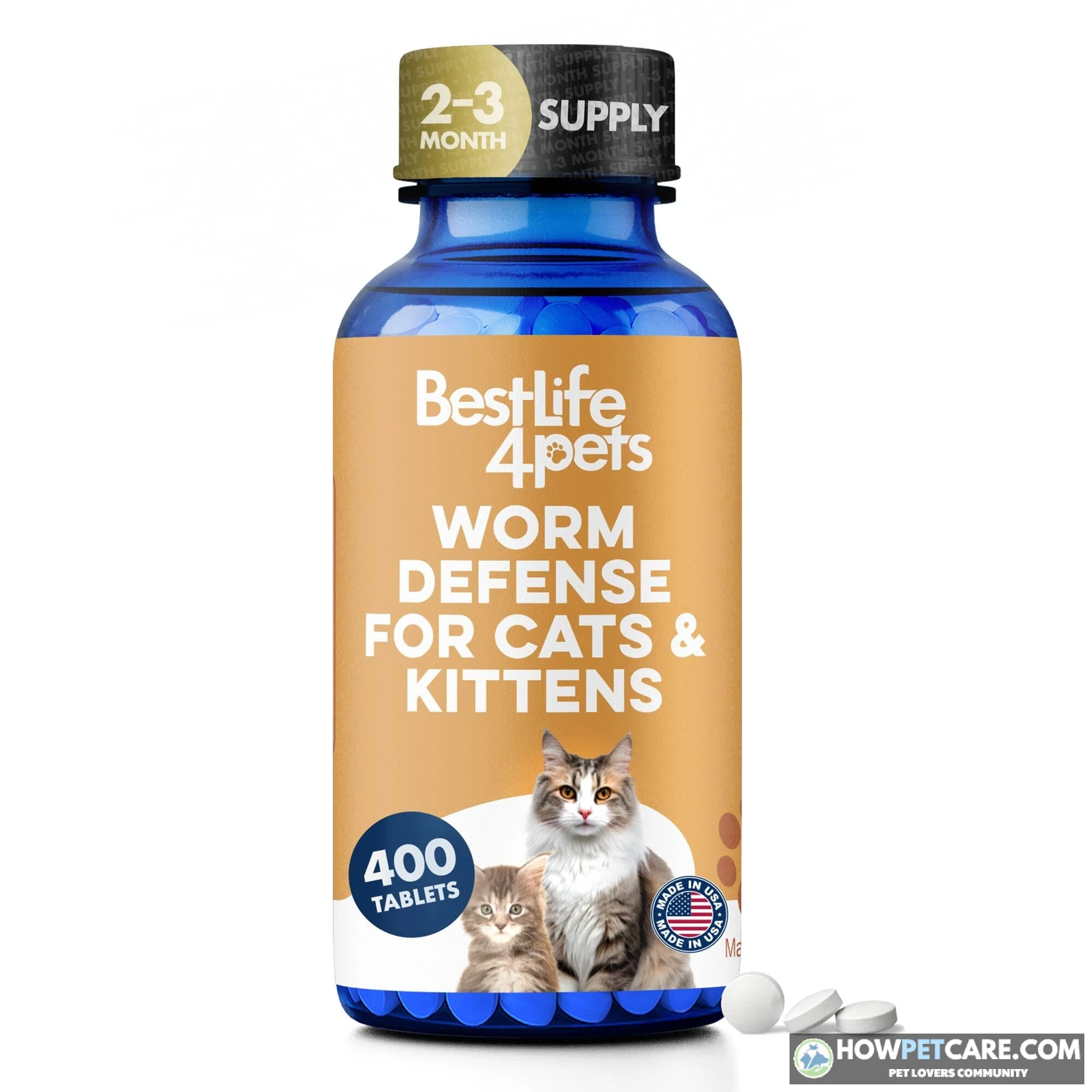
Retail search results can mix medicines with herbal products marketed for digestive or worm support. For example, a retailer listed BestLife4Pets Worm Defense alongside deworming products. Its appearance in a search result doesn’t establish that it’s an FDA-approved drug, treats a particular worm, or is safe for your kitten. Check the exact package and ask a veterinarian.
Herbal ingredients such as wormwood and black walnut aren’t substitutes for a proven, appropriately selected anthelmintic. Products marketed as supplements don’t have the same premarket drug-approval requirement to demonstrate safety and effectiveness for treating worms. That doesn’t mean every herbal product is harmful, but a marketing claim alone isn’t evidence that it will clear an infection. Ask a veterinarian about potential risks before giving a supplement to a kitten.
Before buying, check the following:
- Active ingredient: Does the label identify a recognized antiparasitic drug, or describe an herbal blend?
- Drug status and claims: Does the package identify an approved animal drug and name the parasites it treats, rather than promise a “cleanse” or digestive support?
- Species and kitten eligibility: Does the actual package—not just the listing title—identify the product as suitable for cats and provide applicable kitten directions?
- Dose and route: Are there directions for your kitten’s weight and the intended way to give the medicine?
- Treatment target: Does the label cover the suspected or diagnosed parasite?

If a detail is missing or confusing, don’t rely on a review or another product’s instructions to fill the gap. Ask the manufacturer or veterinarian. If you can’t confirm eligibility, choose another route.
After treatment: expected effects, warning signs, and retreatment
You may see dead or expelled worms in the stool after deworming, but you may not see any. Neither observation alone proves that treatment worked or failed. Follow your veterinarian’s advice about checking a sample and monitoring your kitten.
Some deworming medicines can cause mild digestive upset. Contact the veterinarian if vomiting or diarrhea is severe, persists, or concerns you. Seek urgent help for facial swelling, breathing difficulty, collapse, marked lethargy, or another serious reaction. Keep the package handy so the clinic can identify the drug and concentration.
Retreatment depends on the parasite, medicine, label, and kitten’s existing schedule. The routine every-two-week kitten schedule is a starting point for a veterinary plan, not a universal instruction to repeat every product. Before leaving the clinic, ask when the next dose or fecal exam is due.
To reduce reinfection, clean litter and soiled areas promptly, discuss age-appropriate flea control, and ask whether other pets need assessment. Don’t give other animals the kitten’s medicine unless their veterinarian advises it.

Choose your next step: a safe kitten deworming checklist
- Record the kitten’s age, current weight, symptoms, flea exposure, and every known previous deworming date and product.
- If the kitten is very young, underweight, ill, or has an uncertain diagnosis, contact a veterinarian or low-cost clinic before buying medicine.
- For an OTC product, check the actual package for cat and kitten eligibility, the named worms, dose by weight, route, and repeat-treatment directions.
- Match the ingredient to the suspected parasite. Pyrantel doesn’t replace praziquantel for tapeworms, and praziquantel doesn’t replace pyrantel for roundworms or hookworms.
- Save the package, record the dose and time, and write down the veterinarian’s follow-up or testing instructions. Call before repeating a dose or combining treatments.

| Active Ingredient | Worms Treated | Important Gaps | Minimum Kitten Age and Weight | OTC or Prescription | Example Product and Scenario Verdict | Price and Package Size |
|---|---|---|---|---|---|---|
| Pyrantel pamoate | Certain roundworms and hookworms | Does not treat tapeworms | Depends on the exact cat product; check its label before buying | OTC products exist; veterinarians also use pyrantel | Cat-labeled pyrantel: a practical OTC route for a well kitten that meets the label requirements and needs coverage for a listed worm | A reliable product-specific 2026 price and package size aren't established here; check the seller and label. |
| Praziquantel | Certain tapeworms | Does not treat roundworms or hookworms | Check the exact cat product's kitten age and weight directions | OTC and prescription products exist | Elanco Tapeworm Removal Dewormer: an OTC option to check for a label-eligible kitten with suspected tapeworms; address fleas too | One retail listing showed prices from $19.97; verify the package size and 2026 price before buying. |
| Fenbendazole | Certain roundworms and hookworms; veterinarians may also use it for other susceptible parasites | Not a substitute for praziquantel against common flea tapeworms | Cat and kitten directions depend on the formulation and veterinary instructions; don't infer them from a dog label | OTC formulations exist; use in kittens may require veterinary direction | Veterinarian-directed fenbendazole: worth discussing when a veterinarian identifies a susceptible parasite or recommends it for Giardia | Ask the clinic or pharmacy for the formulation, package size, and price. |
| Selamectin | Certain roundworms and hookworms, with other parasite protection depending on the product label | Does not cover tapeworms | Verify the exact cat product's age and weight band; don't assume all spot-ons have the same limits | Prescription for the veterinary products discussed here | Veterinarian-selected selamectin: an option when eligible kittens also need labeled ongoing parasite protection | Ask for the per-dose price and package size; a preventive plan may involve more than one dose. |
| Pyrantel pamoate plus praziquantel | Certain roundworms, hookworms, and tapeworms | Does not cover every intestinal parasite | Drontal's kitten eligibility must be checked against the current package and the veterinarian's directions | Prescription | Drontal: a broad-coverage option to discuss when the veterinarian wants to treat the listed roundworms, hookworms, and tapeworms | One retailer listed Drontal at $6.61; confirm tablet size, quantity, and the 2026 price before comparing totals. |
FAQ
Can I use a dewormer made for dogs on my kitten?
No—do not use a dog product unless a veterinarian specifically directs it. Species, concentration, ingredients, and dosing can differ, and some products may be unsafe for cats.
Do indoor kittens still need deworming?
Yes. Kittens can acquire roundworms from their mother before or shortly after birth, so even kittens that never go outside are commonly dewormed on a veterinary schedule. Ask your veterinarian what your kitten’s records show and what remains due.
Can I deworm my kitten at home?
A healthy kitten that meets every age and weight requirement on a cat-labeled product can often be treated at home with an over-the-counter dewormer matched to the suspected worm. Very young, underweight, sick, or undiagnosed kittens should be seen by a veterinarian or shelter clinic first.
Can humans catch worms from kittens?
Some kitten parasites, including certain roundworms and hookworms, can infect people—especially children or anyone handling contaminated soil, litter, or feces. Prompt deworming, good litter-box hygiene, and handwashing reduce the risk.
What should I do if my kitten vomits after a deworming dose?
Call your veterinarian before giving another dose, since you can’t be sure how much medicine was absorbed. Mild digestive upset can be normal, but repeated vomiting, facial swelling, breathing trouble, or collapse needs urgent veterinary care.