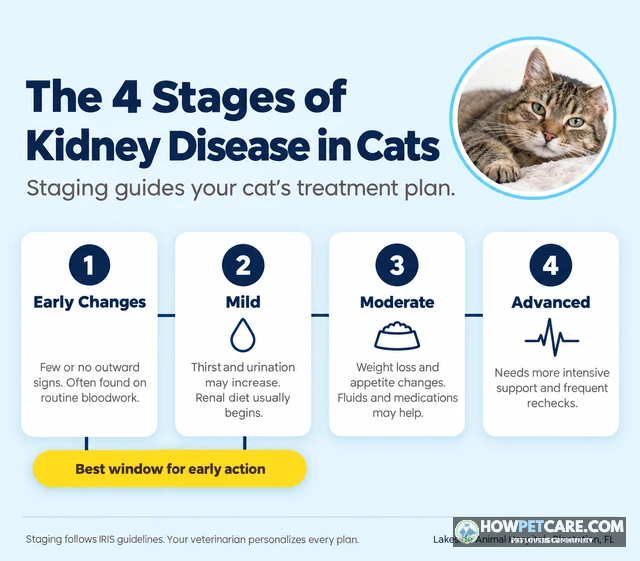

Chronic kidney disease in cats is a gradual, persistent loss of kidney function, most common in older cats. Early signs include increased thirst and urination, weight loss, and reduced appetite. A veterinarian confirms and stages it with bloodwork, urinalysis, and blood pressure; treatment centers on a renal diet, fluids, and managing complications.
If your cat is struggling to breathe, collapsing, having seizures, unable to urinate, or may have eaten a toxin such as a lily or antifreeze, get emergency veterinary care now. Call a veterinarian the same day for refusal to eat, repeated vomiting, marked lethargy, or a sudden decline in a cat already diagnosed with kidney disease. Increased thirst, larger urine clumps, gradual weight loss, and reduced appetite all warrant a prompt appointment—even if your cat otherwise seems comfortable.
Chronic kidney disease (CKD) means persistent loss of kidney function. It’s not the same as a sudden kidney injury or a urinary blockage. A veterinarian diagnoses and stages CKD using the cat’s history, examination, repeated lab results, urine testing, and blood pressure—not one number alone. Treatment is individualized and may include a renal diet, medication for specific complications, and sometimes prescribed fluids. The goal is practical: support comfort, nutrition, and daily function while watching for changes.
Signs of kidney disease in cats: emergency now or call today?
Kidney disease can develop quietly. Symptoms, once they appear, don’t identify the cause or establish a stage. Use the timeframe below to decide what to do next, then have a veterinarian assess your cat.
Emergency warning signs that cannot wait
Go to an emergency veterinary hospital now for collapse, seizures, difficulty standing, difficulty breathing or open-mouth breathing, suspected toxin exposure, or repeated vomiting with inability to keep water down. If you suspect lily or antifreeze exposure, don’t wait for symptoms; call an emergency clinic or animal poison service while you arrange care.
Straining in the litter box with little or no urine, crying while trying to urinate, or a painful, enlarged abdomen also needs emergency assessment. Inability to urinate can point to a urinary obstruction, not CKD, and it can become fatal. Don’t assume repeated litter-box trips are simply a kidney-disease symptom.
| Observable sign or situation | Care timeframe | What to do now | Important caution |
|---|---|---|---|
| Collapse, seizure, inability to stand, or severe weakness | Emergency now | Travel to an emergency veterinary hospital | Do not wait to see if the sign passes |
| Difficulty or open-mouth breathing | Emergency now | Seek emergency care immediately | Do not give fluids or medication unless a veterinarian directs you |
| Suspected lily, antifreeze, or other toxin exposure | Emergency now | Call an emergency clinic and go in | Do not wait for symptoms |
| Straining with little or no urine, or painful enlarged abdomen | Emergency now | Go to an emergency hospital | Possible urinary obstruction is a separate emergency |
| Repeated vomiting and cannot keep water down; sudden blindness | Emergency now | Seek emergency assessment | Severe dehydration or another urgent problem may be present |
| Refusal to eat for a full day, repeated vomiting, pronounced lethargy, or apparent dehydration | Call your veterinarian today | Describe when it began and any known CKD or medications | If severe, worsening, or unable to retain water, use emergency care |
| Sudden decline in a cat with diagnosed CKD | Call today; emergency if severe | Ask the veterinary team whether immediate assessment is needed | Do not assume this is inevitable CKD progression |
| New weight loss, increased thirst, or larger urine clumps | Prompt appointment | Record changes and arrange a veterinary visit | These signs suggest a problem but do not diagnose CKD |

Changes that warrant a same-day call
Call your regular veterinary team that day if your cat stops eating, vomits repeatedly, becomes unusually withdrawn or weak, or shows possible dehydration—tacky gums or sunken eyes, for example. Skin elasticity isn’t a reliable home test in every cat, so don’t use it to rule dehydration out. A cat with known CKD deserves a call after a sudden change, even a modest one.
If the regular clinic is closed, check its voicemail or website for after-hours instructions. When signs are severe, worsening, or involve breathing, collapse, seizures, inability to urinate, or inability to keep water down, go to an emergency hospital rather than waiting for a callback.
Subtle early signs worth booking a visit for
The early signs of kidney disease in cats often include polydipsia (drinking more) and polyuria (urinating more). You may notice larger or more frequent litter clumps, a water bowl that empties sooner, gradual weight loss, or less interest in food. Some cats seem normal otherwise at first.
More advanced illness can bring persistent nausea, vomiting, poor appetite, weakness, poor grooming, and obvious weight or muscle loss. These signs can also occur with many other conditions. A symptom list can’t tell you whether a cat has kidney disease or how advanced it is. Arrange an examination and testing instead of trying to stage the disease at home.

Understanding a new diagnosis: what kidney tests can and cannot tell you
Kidneys help remove waste and regulate water and electrolytes. A cat can lose substantial kidney function before obvious symptoms appear or some routine blood results change. SDMA may become abnormal earlier than creatinine, but neither test alone proves CKD or identifies its cause.

Chronic kidney disease versus acute kidney injury
CKD describes persistent kidney damage or dysfunction. Acute kidney injury (AKI) is a sudden decline, which may follow toxin exposure, severe illness, infection, or another insult. AKI can sometimes improve with prompt treatment, though recovery may be incomplete. A cat with CKD can also suffer an acute deterioration, so a sudden crisis shouldn’t automatically be labeled ordinary progression.
“Renal failure” is often used broadly, but it doesn’t mean every cat with kidney disease has the same level of impairment. Diagnosis and urgency depend on the whole clinical picture. A veterinarian may need to stabilize an ill cat before deciding whether abnormal results are chronic, acute, or both.
Bloodwork, urine testing, and blood pressure together
Creatinine and BUN (blood urea nitrogen) are waste products measured in blood. Creatinine can be influenced by muscle mass and hydration, and dehydration can change kidney-related results. SDMA provides another marker, but it also needs clinical context. The veterinarian weighs trends, physical examination, body condition, history, and whether the cat is stable and adequately hydrated.
Urinalysis helps assess urine concentration and other signs of kidney or urinary disease. A urine protein-to-creatinine ratio can quantify proteinuria when appropriate. Your veterinarian may recommend a urine culture to investigate a kidney infection, and imaging can help look for structural changes, stones, or obstruction. How a urine sample is collected depends on the question; your veterinarian can explain the best method for your cat.
Blood pressure matters because hypertension can accompany kidney disease and affect organs such as the eyes. Phosphorus, potassium, and a complete blood count help identify complications that may need attention. Kidney-related anemia can occur when damaged kidneys produce less erythropoietin, a hormone that helps stimulate red blood cell production.

Questions to ask about an abnormal result
Ask for a copy of the laboratory report, including units and reference ranges, plus the urinalysis findings. Clarify whether blood pressure was measured, whether the cat was dehydrated or acutely ill, and how the results compare with prior tests. Ask what cause the veterinarian suspects, whether urine culture or imaging would help, and when results should be repeated.
A hypothetical example shows why results are interpreted together. A stable 12-year-old cat has creatinine of 2.4 mg/dL and SDMA of 22 micrograms/dL, dilute urine, mildly elevated urine protein and blood pressure, high-normal phosphorus, normal potassium, low-normal packed cell volume, and a 0.4-pound loss over three months. Both kidney markers fall within the numerical stage 2 ranges below, yet the veterinarian still considers hydration, muscle condition, chronicity, and prior trends. Protein and blood pressure raise substaging questions, while weight and phosphorus trends help set follow-up priorities. This example isn’t a diagnostic shortcut: the individual results need veterinary interpretation.
Chronic kidney disease in cats stages: an IRIS roadmap
The International Renal Interest Society (IRIS) staging system helps veterinarians describe CKD and plan care. Staging applies after CKD has been diagnosed, when the cat is clinically stable and adequately hydrated. Stage 1 requires other evidence of kidney disease even if creatinine isn’t elevated. These numerical thresholds are a guide, not a home diagnosis. [#IRIS]
IRIS stages 1 through 4 at a glance
| IRIS stage | Creatinine range (mg/dL) | SDMA range (micrograms/dL) | Plain-language meaning | Typical monitoring when stable | Veterinarian-directed management priorities | Guideline source and version |
|---|---|---|---|---|---|---|
| 1 | Below 1.6 | Below 18 | Kidney disease is supported by other evidence; creatinine may remain within its usual range | Review weight, muscle condition, appetite, hydration, bloodwork, urinalysis or urine protein, and blood pressure as advised | Investigate possible cause, address contributing conditions, and track trends | IRIS feline CKD staging guidance; confirm current guidance with the veterinarian [#IRIS] |
| 2 | 1.6–2.8 | 18–25 | Mild azotemia; some cats feel well | Recheck blood and urine results, weight, appetite, hydration, and blood pressure at an individualized interval | Discuss nutrition, phosphorus and potassium, hydration, and concurrent conditions | IRIS feline CKD staging guidance; confirm current guidance with the veterinarian |
| 3 | 2.9–5.0 | 26–38 | Moderate disease; symptoms and complications become more likely | Often closer review of weight, intake, hydration, bloodwork, urine findings, and blood pressure | Address nausea, appetite, phosphorus, anemia, electrolyte changes, and fluids where indicated | IRIS feline CKD staging guidance; confirm current guidance with the veterinarian |
| 4 | Above 5.0 | Above 38 | Advanced disease; symptom control and comfort are central | Close, individualized reassessment of intake, hydration, weight, nausea, comfort, and relevant tests | Manage complications and agree on realistic comfort-focused goals and caregiver support | IRIS feline CKD staging guidance; confirm current guidance with the veterinarian |

The table gives the creatinine and SDMA intervals used in the supplied IRIS staging guidance. Because recommendations can be revised, ask your veterinarian to confirm the current official IRIS feline CKD staging and treatment guidance in use for your cat. [#IRIS]
Why one laboratory number is not the whole stage
IRIS staging isn’t intended for an acutely ill, dehydrated cat. Persistent disagreement between creatinine and SDMA needs veterinary interpretation; don’t average results or pick the more alarming number yourself. A low creatinine doesn’t rule out kidney disease, especially when muscle mass is low. Stage 1 can apply when other evidence supports kidney disease even though creatinine and SDMA are below stage 2 thresholds.
After numerical staging, veterinarians also assess proteinuria and hypertension. These substages can change priorities at any numerical stage. A cat’s treatment plan also depends on symptoms, other diseases, appetite, and how results change over time—not just the stage label.
How monitoring changes as disease advances
No single recheck schedule fits every cat or every stage. A stable cat may have a different plan from one with recent vomiting, weight loss, medication changes, rising blood pressure, or fluid adjustments. Ask the veterinarian to put the next recheck date and the tests to repeat in writing.
At follow-ups, the team may review weight and muscle condition, appetite, drinking, hydration, bloodwork, urinalysis or urine protein, and blood pressure. Earlier reassessment makes sense when a cat deteriorates or a treatment changes. Monitoring is meant to catch manageable complications and adjust care, not to chase every lab value in isolation.
Cat kidney disease treatment: what helps and what is safe at home
Treatment supports nutrition, hydration, and comfort while addressing complications. It generally doesn’t restore kidney tissue already lost to established CKD. The veterinarian may recommend different interventions depending on test results and symptoms. A cat doesn’t automatically need every medication or home fluid treatment because of its stage.
Treat symptoms and complications, not just a number

A veterinary plan may address nausea, poor appetite, high phosphorus, low potassium, proteinuria, hypertension, or anemia. Prescription medications can include anti-nausea or appetite support, blood-pressure treatment, or a phosphorus binder when indicated. Drug choice and monitoring depend on the cat. Don’t give human medications, change a prescription, or add supplements without veterinary approval.
A prescription renal diet and access to fresh water may be part of care. Hospital intravenous fluids are different from subcutaneous fluids given under the skin at home. A veterinarian decides whether fluids are appropriate, which type to use, and how to monitor them. Drinking more doesn’t by itself mean a cat needs fluids.
Subcutaneous fluids: training, boundaries, and warning signs
If the veterinary team prescribes subcutaneous fluids, ask for a hands-on demonstration and written instructions for your cat. Don’t estimate a volume or change the schedule based on a general article. The cat’s other conditions, including heart disease, can affect whether fluids are safe.

-
Confirm the prescription
Before starting, confirm the prescribed fluid, amount, schedule, storage, and what to do if a session is missed. Ask the clinic to demonstrate the full setup and technique.
-
Prepare as trained
Use clean supplies and follow the clinic’s instructions. Keep your cat as calm and comfortable as possible, and stop to contact the veterinary team if the instructions are unclear or the cat becomes distressed.
-
Record and dispose safely
Record each session and any reaction. Follow local and clinic instructions for safe needle disposal; ask how to obtain an approved sharps container.
-
Know when not to proceed
Call the veterinary team if the previous fluid pocket is not resolving as expected, your cat is newly unwell, or you are unsure about the prescription. Difficulty breathing is an emergency; seek emergency care rather than giving more fluid.
Making daily care manageable for an older cat
Place fresh water in easy-to-reach spots, and keep food, water, and litter accessible—especially for a cat with arthritis or weakness. Ask the veterinarian about low-stress ways to give medication, and say so if a treatment routine upsets your cat or is hard to sustain. A plan that looks good on paper but can’t be followed needs a practical adjustment.
Giving extra fluids, changing prescribed amounts, or adding over-the-counter supplements can cause harm or complicate treatment. Check with your veterinary team before making a change.
Renal diet recommendations and a plan for food refusal
A therapeutic renal diet is designed to support cats with CKD—restricting phosphorus and adjusting protein while supplying adequate calories. Clinical diets that restrict phosphorus and protein have been associated with longer survival than ordinary food in cats with CKD. The best choice for an individual cat is nutritionally appropriate, eaten willingly, available, and affordable—not a brand picked by a universal ranking.
What makes a renal diet different
Ask your veterinarian which prescription renal diets are suitable and whether a wet, dry, or mixed texture makes sense. The right option depends on the cat’s appetite, medical status, calorie needs, and preferences. Products such as Hill’s k/d, Royal Canin Renal Support, and Purina NF are examples of prescription renal food lines available in the United States; availability and formulation can vary. Your veterinary team can help assess suitability instead of assuming one product is best for every cat.

What to try when your cat refuses prescription food
If your cat eats less after a diet change, contact the veterinary team promptly. A prolonged standoff over renal food can leave a cat without enough calories. Don’t withhold all other food to force acceptance.
- Check intake and symptoms. Note what and how much your cat has eaten, when the refusal began, and whether nausea, vomiting, mouth discomfort, or a medication change could be involved.
- Call for an individualized plan. Ask whether the reduced intake needs same-day attention, what acceptable temporary food to offer, and whether nausea or appetite problems should be checked.
- If the cat is clinically well, transition gradually as advised. Offer small portions and try a different renal texture or flavor. Gently warming food may make it more appealing; don’t serve it hot.
- Prioritize adequate calories. Keep offering an acceptable food while you and the veterinarian work toward a sustainable renal-food plan. Don’t force-feed or syringe-feed unless the veterinary team has specifically instructed you how.
- Report continued refusal. Ask when to recheck and which changes mean the plan needs urgent review.
Wet food or added water may help some cats, but use only options your cat tolerates and discuss changes with the veterinary team. Don’t improvise a low-protein or meat-only diet.

When a professionally formulated home-cooked diet is an option
Home-cooked food can be considered for some cats that won’t eat commercial renal diets, but an internet recipe, meat-only meal, or improvised ingredient swap can be nutritionally unbalanced. Ask for a recipe formulated specifically for your cat by a board-certified veterinary nutritionist or an equivalently qualified veterinary nutrition professional, with follow-up as the cat’s condition changes. Don’t use a homemade diet as a substitute for veterinary care.
What managing feline kidney disease costs in the United States
Costs vary by location, clinic, cat size, disease complications, and the tests a veterinarian recommends. The figures below are planning ranges in U.S. dollars for 2026, not a survey-based national average or a clinic quote. Treat them as rough budgeting estimates and verify them with local written estimates; itemized local quotes are the reliable basis for decisions.
Initial diagnostics versus recurring expenses
| Expense category | What is included | Estimated U.S. dollar range | Unit or frequency | Factors that change the cost | Pricing source and date |
|---|---|---|---|---|---|
| Initial exam and diagnostic workup | Examination, CBC and chemistry, urinalysis; SDMA if separately billed | $250–$650 | Per initial visit | Region, clinic type, included tests, added testing | 2026 planning estimate; confirm with local clinic |
| Optional imaging or culture | Ultrasound, radiographs, or urine culture | $150–$700 | Per test or visit | Imaging type, sedation, referral, culture method | 2026 planning estimate; confirm with local clinic |
| Recheck exam and testing | Exam plus selected bloodwork, urinalysis, and blood pressure | $120–$350 | Per recheck | Tests selected, visit frequency, clinic pricing | 2026 planning estimate; confirm with local clinic |
| Therapeutic renal food | Prescription wet or dry renal food | $35–$140 | Per month | Cat size, calorie intake, texture, product, availability | 2026 planning estimate; confirm with local supplier or clinic |
| Common medication categories | Prescribed blood-pressure, nausea, appetite, or phosphorus management | $20–$120 | Per month | Drug, prescribed amount, compounding, dispensing fees | 2026 planning estimate; confirm with pharmacy or clinic |
| Prescribed subcutaneous-fluid supplies | Fluids and routine administration supplies | $30–$120 | Per supply set or month | Schedule, supplies, training visit, dispensing and sharps fees | 2026 planning estimate; confirm with clinic or pharmacy |

These ranges don’t guarantee that every listed expense applies. Fluid training, dispensing fees, lines, needles, and sharps disposal may be billed separately or handled differently by the clinic. Emergency hospitalization and specialty care can add substantial costs and aren’t included as routine maintenance.
Illustrative monthly and annual care budgets
For a rough planning exercise, a stable-care example might be $180–$420 per month, or $2,160–$5,040 per year. This illustration assumes renal food, one medication category, and a recheck every two to three months, with routine costs spread across the year. A higher-needs example might be $350–$850 per month, or $4,200–$10,200 per year, assuming monthly rechecks, multiple medication categories, and prescribed home fluids. These are illustrative totals, not validated national averages; actual invoices can fall outside them. They exclude initial diagnostics and emergency hospitalization, which should be budgeted separately.
First-year costs may be higher because the initial workup, repeat testing, imaging, or urine culture may be needed to establish a diagnosis or investigate complications. Costs can also rise with food refusal, concurrent disease, more frequent monitoring, or emergency care. Ask for a written estimate based on your cat instead of treating an example budget as a prediction.
How to discuss a limited budget with your veterinarian
Tell the veterinary team what you can manage financially. Ask which tests or treatments would change decisions now, which can be prioritized, and how often rechecks can be spaced safely for your cat. Request an itemized estimate and ask about payment plans or assistance resources. Don’t stop medication, alter fluid instructions, or skip urgent care without discussing the risks and a workable alternative with the veterinarian.
Ask the clinic to separate one-time diagnostic costs from recurring care, and to identify which items are optional, time-sensitive, or essential for monitoring your cat’s current problems.
Kidney disease in cats life expectancy: what stage can tell you
CKD may progress slowly, unevenly, or alongside sudden setbacks. A new episode of vomiting, refusal to eat, weakness, or dehydration calls for reassessment; don’t automatically dismiss it as inevitable progression. Prognosis depends on the cat’s overall health, test trends, complications, response to care, and comfort at home.
Expectations across stages 1 through 4
Stage 1 may be found through other evidence before obvious illness, and a cat can remain stable for a variable period. Stage 2 cats may still feel well, but the disease and concurrent problems need monitoring. In one evidence summary, median survival for cats diagnosed at stage 2 was reported as two to three years, while cats diagnosed at stage 4 had a median survival under six months. These figures are population-level estimates, not a deadline or a prediction for an individual cat; the study context and differences among cats matter.
Stage 3 and stage 4 often involve more symptom and complication management, but the evidence provided doesn’t support a reliable stage-specific survival estimate for every cat. Avoid treating a stage label as a clock. A veterinarian can explain how the individual cat’s appetite, weight, hydration, anemia, phosphorus, urine protein, blood pressure, other illnesses, and response to treatment affect the outlook.

Why progression differs between cats
A single result is less informative than a trend interpreted alongside the cat’s condition. Persistent poor intake, weight or muscle loss, dehydration, anemia, uncontrolled phosphorus, proteinuria, hypertension, and concurrent illness can make management harder. Some of these problems can be addressed, which is one reason reassessment matters. Conversely, a concerning result doesn’t by itself mean a cat has no comfortable time left.
How to interpret survival statistics without treating them as a deadline
Median survival is the midpoint in a studied group: half lived less time and half lived longer. Study populations, enrollment stage, care, other diseases, and decisions about euthanasia affect the result. Survival duration also doesn’t describe every day’s quality. Ask what the current plan is expected to improve, what response would count as meaningful, and when the team recommends reviewing the prognosis again.
Quality of life and when to discuss euthanasia
Quality of life is about the cat’s comfort and its ability to do things that matter to it, not just laboratory results. Persistent distress, inability to maintain nutrition or hydration despite treatment, repeated crises, or loss of valued activities are reasons to have a prompt, compassionate conversation with the veterinary team. No stage, creatinine value, or checklist score alone determines when euthanasia is right.
Track comfort and function, not only laboratory results
Use a simple daily record of voluntary eating, water use, urination, vomiting, mobility, comfort, grooming, medication or fluid tolerance, social engagement, and whether the day felt mostly good or bad. Note weight at the frequency your veterinarian recommends. A pattern across days can make gradual decline easier to describe than relying on memory during an emotional appointment.

| Daily observation | What to note |
|---|---|
| Appetite | Ate willingly, ate less, or refused food; approximate intake if known |
| Hydration and urination | Water use and any meaningful change in urine amount or litter-box habits |
| Nausea or discomfort | Vomiting, retching, hiding, restlessness, or signs of distress |
| Mobility and litter-box use | Ability to move comfortably and reach food, water, and the box |
| Grooming and connection | Grooming, seeking company, play, or other valued activities |
| Treatment burden | Whether medication or prescribed fluids are tolerated and manageable |
| Overall day | Mostly good or mostly bad, and what made it so |
Signs the current care plan is no longer enough
Contact the veterinary team when your cat’s comfort or daily function changes—especially if it’s eating very little, repeatedly vomiting, unable to stay hydrated, persistently distressed, no longer grooming, struggling to move, or having more bad days than good. Some setbacks may be treatable; others may continue despite reasonable adjustments. Ask whether there is a reversible problem to address, what comfort can realistically be restored, and how long a time-limited treatment trial should last before reassessment.
A simple log can structure that discussion:
| Day | Appetite | Water and urination | Vomiting | Weight, if scheduled | Treatment tolerance | Comfort and mobility | Grooming and engagement | Good or bad day |
|---|---|---|---|---|---|---|---|---|
| Monday | ||||||||
| Tuesday | ||||||||
| Wednesday | ||||||||
| Thursday | ||||||||
| Friday | ||||||||
| Saturday | ||||||||
| Sunday |
At the end of the week, write down the best day and why, the worst day and why, new signs, and questions for the veterinarian. Don’t wait to finish a week of tracking if your cat is in distress or has an emergency sign.
Questions for a compassionate end-of-life conversation
Ask which problems may be reversible, what palliative care can offer, how burdensome the treatment plan is for the cat, and what observable changes should trigger another call. You can ask about a time-limited treatment trial and agree in advance what improvement would look like. Discuss the practicalities of clinic or at-home euthanasia where available, as well as an after-hours plan, so you aren’t making every decision in a crisis.

Caregiver capacity and financial limits are part of real-world planning, not a reason for blame. A veterinarian can help identify a humane plan that fits the cat’s needs and the household’s circumstances. The goal is to prevent uncontrolled distress and protect comfort, not to wait for a particular laboratory value.
Your next veterinary visit: a kidney-care action checklist
Use this checklist to leave with a plan that fits your cat:
- If an emergency sign is present, use the triage guidance above and contact an emergency hospital now. Otherwise, note whether your cat is eating, drinking, and urinating, and call the regular clinic within the appropriate timeframe.
- Bring laboratory reports, medication and supplement lists, current food and approximate daily intake, weight history, vomiting history, and changes in thirst or litter-box output.
- Ask the veterinarian to confirm the diagnosis, whether your cat is stable and hydrated, its IRIS stage and substages, and what the results mean together.
- Agree on the treatment goals, the next recheck date, which tests are needed, and which changes call for same-day contact versus emergency care.
- Leave with written instructions for food refusal, medications, and prescribed fluids if applicable. Ask for an itemized estimate and daytime and after-hours contact details.
- Keep a home log of appetite, vomiting, activity, urine changes, treatment tolerance, and good versus bad days. Measure weight at the agreed frequency, but never let record-keeping delay urgent care.

A useful kidney-care plan is specific: it names the next action, who to call, what to monitor, and when the plan will be reviewed. Your veterinary team can help make those decisions with you as your cat’s needs change.

| IRIS Stage | Creatinine Range (mg/dL) | SDMA Range (mcg/dL) | Stage Description | Monitoring Protocol | Management Priorities |
|---|---|---|---|---|---|
| 1 | < 1.6 | < 18 | Non-azotemic CKD; kidney disease is supported by other evidence; creatinine may remain within its usual range | Review weight, muscle condition, appetite, hydration, bloodwork, urinalysis or urine protein, and blood pressure as advised | Investigate possible cause, address contributing conditions, and track trends |
| 2 | 1.6–2.8 | 18–25 | Mild azotemia; some cats feel well | Recheck blood and urine results, weight, appetite, hydration, and blood pressure at an individualized interval | Discuss nutrition, phosphorus and potassium, hydration, and concurrent conditions |
| 3 | 2.9–5.0 | 26–38 | Moderate disease; symptoms and complications become more likely | Often closer review of weight, intake, hydration, bloodwork, urine findings, and blood pressure | Address nausea, appetite, phosphorus, anemia, electrolyte changes, and fluids where indicated |
| 4 | > 5.0 | > 38 | Advanced disease; symptom control and comfort are central | Close, individualized reassessment of intake, hydration, weight, nausea, comfort, and relevant tests | Manage complications and agree on realistic comfort-focused goals and caregiver support |
FAQ
Can kidney disease in cats be cured?
Established chronic kidney disease generally cannot be cured, but treatment can support comfort and help manage progression and complications. Acute kidney injury may improve with prompt treatment, although recovery can be incomplete.
Can kidney disease in cats be prevented naturally?
There is no proven natural remedy that reliably prevents feline chronic kidney disease. Avoiding kidney toxins, providing access to fresh water, and arranging appropriate veterinary screening are sensible measures, but herbs and supplements should not replace veterinary care.
Is a kidney infection the same as chronic kidney disease?
No. A kidney infection is an infection involving kidney tissue, whereas chronic kidney disease describes persistent kidney damage or dysfunction; the two can coexist. A veterinarian may use urine culture and other tests to investigate infection and select treatment.
Is kidney disease in cats painful?
Chronic kidney disease does not always cause obvious pain, but nausea, dehydration, mouth ulcers, and weakness can cause substantial discomfort. Kidney infection, stones, or obstruction may be painful, so new distress or behavior changes warrant veterinary assessment.
At what age do cats usually develop kidney disease?
Chronic kidney disease can occur at any age, but it becomes more common as cats get older, especially in senior cats. Regular veterinary screening and bloodwork become increasingly valuable with age because early disease often causes no obvious symptoms.