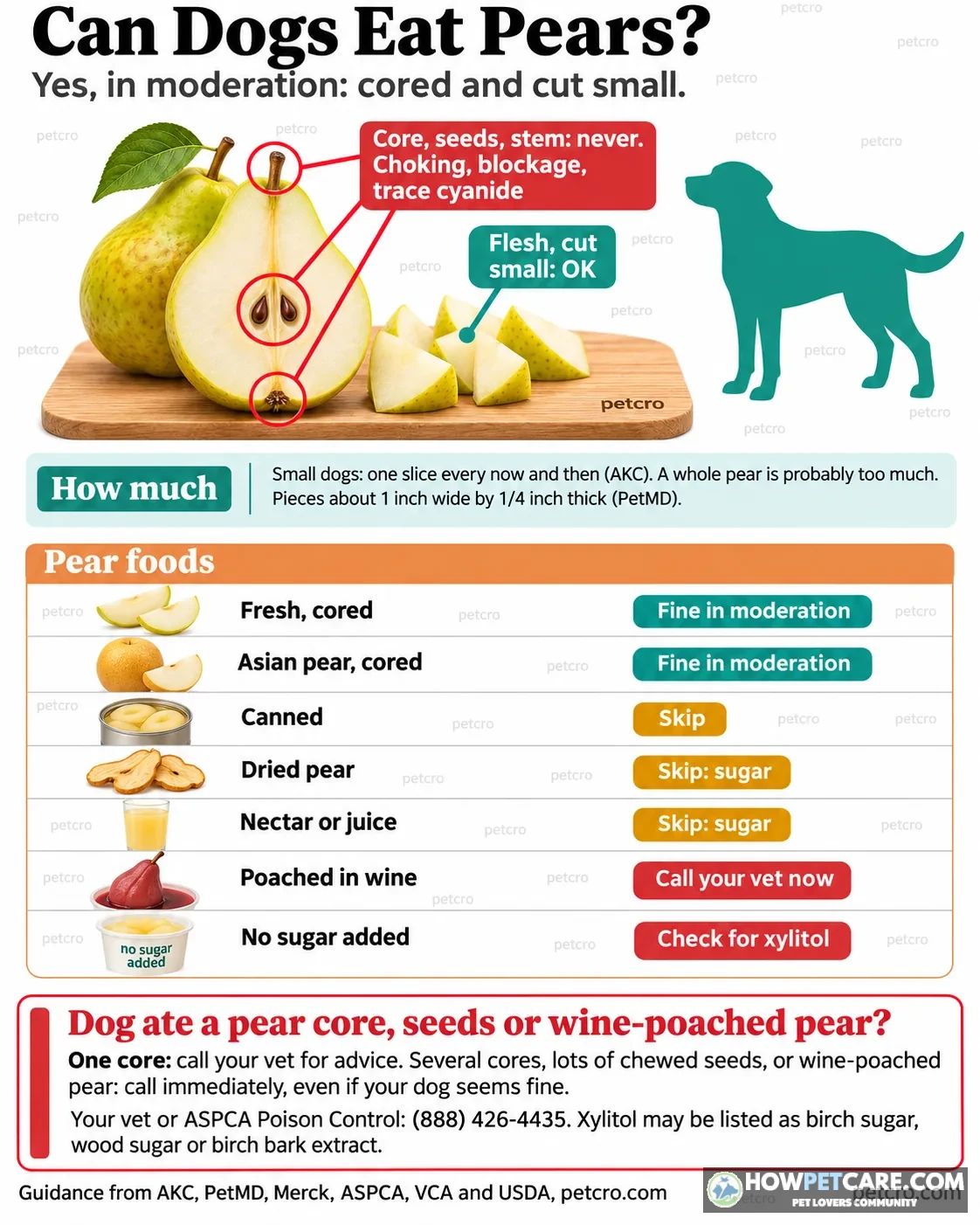

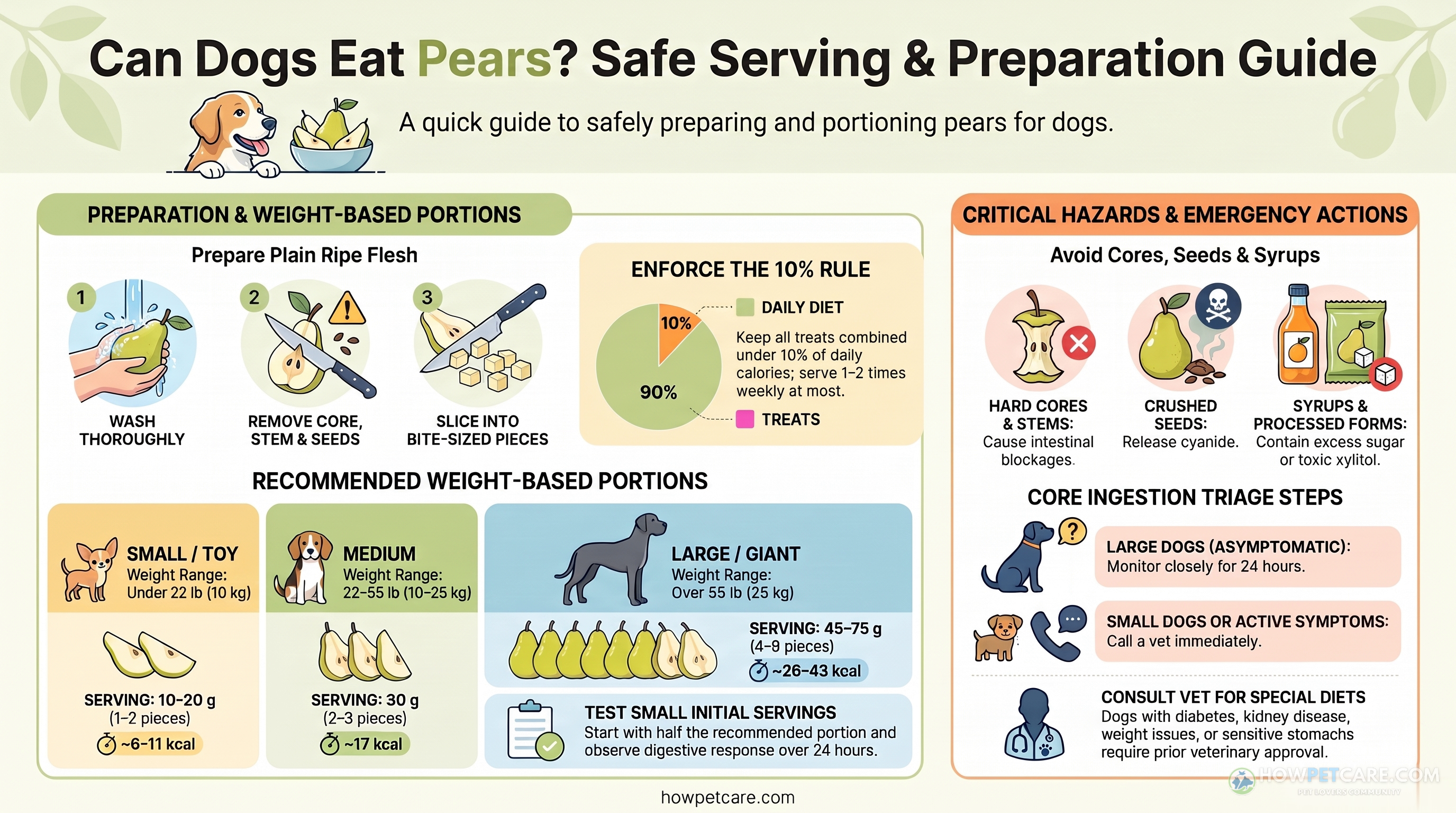
Yes, dogs can eat pears. Serve only ripe, fresh flesh with the seeds, core, and stem removed, cut into bite-size pieces. Keep portions under 10% of daily calories and offer pear once or twice a week at most. Dogs on prescription diets need vet approval first.
Yes — dogs can eat ripe, fresh pear flesh as an occasional treat once you remove the seeds, core, and stem and cut the fruit into bite-size pieces. Keep servings modest: treats should stay under 10% of a dog’s daily calories, and pears aren’t something dogs actually need.
Pears supply water, fiber, and potassium, but they also bring natural sugar. Since dogs synthesize their own vitamin C, pears are optional — not a necessary nutrient source. Check the serving chart below, and talk to your vet before giving pear to a dog with a medical condition or prescription diet. If you’re comparing pear with other snacks, our guide to whether dogs can eat fruit covers safe versus toxic choices and portions by size.
How Much Pear Can a Dog Eat? Serving Sizes by Weight and Frequency
Treat this chart as a conservative starting point, not a prescription. Piece counts are approximate — cut fruit to a size your dog can chew safely, and weigh a portion once if you want a reliable visual reference. Pears run about 57 calories and 10 grams of sugar per 100 grams, though exact amounts vary.
| Dog size | Weight range | Serving | Approx. pieces | Approx. calories | Max frequency per week |
|---|---|---|---|---|---|
| Toy | Under 11 lb (5 kg) | 10 g | About 1 small piece | About 6 kcal | 1–2 times |
| Small | 11–22 lb (5–10 kg) | 15–20 g | About 1–2 pieces | About 9–11 kcal | 1–2 times |
| Medium | 22–55 lb (10–25 kg) | 30 g | About 2–3 pieces | About 17 kcal | 1–2 times |
| Large | 55–100 lb (25–45 kg) | 45–50 g | About 4–5 pieces | About 26–29 kcal | 1–2 times |
| Giant | Over 100 lb (45 kg) | 60–75 g | About 6–8 pieces | About 34–43 kcal | 1–2 times |
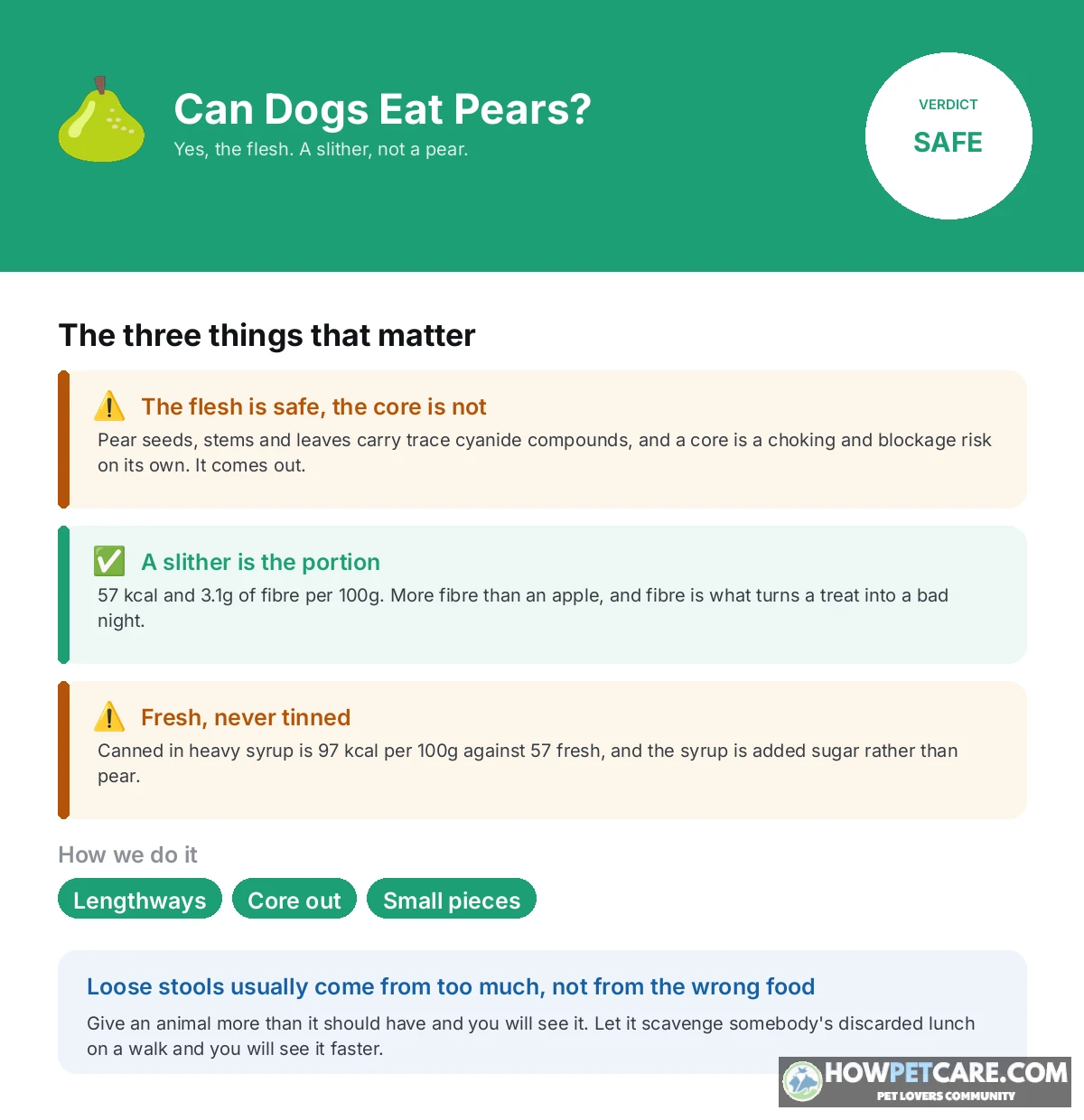
Start with half the listed amount the first time and watch for stomach or stool changes over the next 24 hours. Pears contain about 3.1 grams of fiber per 100 grams, and too much can trigger digestive upset.
Calories and sugar per serving
The 10% treat rule covers all treats combined, not each one separately. A 25-pound dog might need roughly 600–650 calories daily depending on activity, leaving about 60–65 calories for all treats. A 15-gram pear serving is roughly 9 calories. Treat calories add up fast, especially for overweight dogs — rely on your dog’s actual feeding plan, not a generic estimate. If you rotate treats, the same 10% cap applies to strawberry portions by dog weight.
Pears contain about 116 milligrams of potassium per 100 grams. Dogs on potassium-restricted diets shouldn’t get pear without veterinary approval.
Why the 10% rule matters more than the pear
A few pieces won’t blow a healthy dog’s treat budget, but frequent servings can displace balanced food and pile on sugar. Pears work best as an occasional treat — once or twice a week, not daily. Dogs on prescription diets need vet approval before any extras.
My Dog Ate Pear Seeds or Swallowed a Whole Core: What to Do Now
If your dog just ate part of a pear, remove any remaining fruit and follow these steps. The cyanide risk from a few intact seeds is usually less urgent than the choking or blockage hazard from a swallowed core, but the amount eaten and your dog’s size both matter. For a parallel seed-and-rind case, see watermelon seeds and rind risks.
Is the cyanide risk real? A realistic look at pear seeds
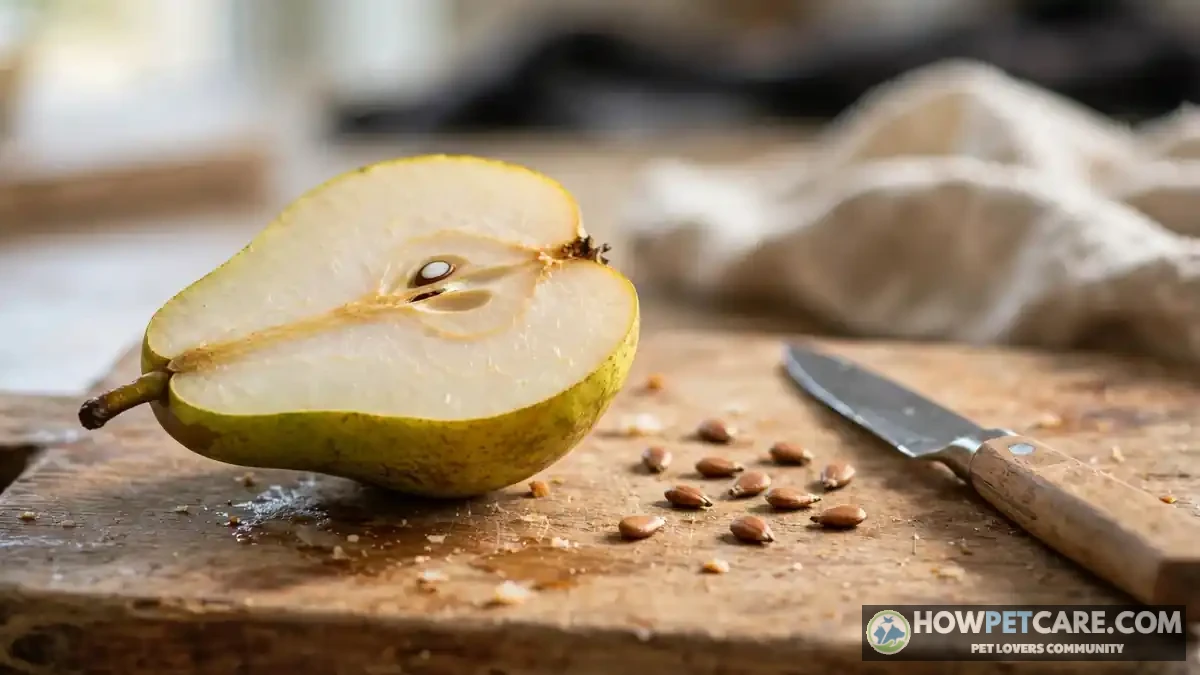
Pear seeds contain amygdalin, which can release cyanide when crushed or chewed. A seed swallowed whole is less likely to release it since the seed’s tough coat may pass through intact. A few seeds from one core rarely cause cyanide poisoning in a medium or large dog, but the risk rises if many seeds were chewed — especially by a small dog. No validated toxic seed count exists for dogs, so don’t treat any specific number as a guaranteed safe or lethal dose.
Remove seeds as a precaution. The core’s real hazard is often mechanical: it can cause choking or, if swallowed, an intestinal blockage.
Watch at home or call the vet: a decision path
- Remove and estimate. Take away the remaining fruit. Note your dog’s weight, how much core was eaten, how many seeds may have been swallowed, whether they were crushed, and when it happened.
- Watch at home only if the situation is low-risk. If a medium or large dog swallowed one core or a few whole seeds, is breathing normally, and shows no symptoms, monitor closely for 24 hours. Watch for retching, vomiting, diarrhea, drooling, lethargy, or a painful, swollen belly.
- Call a veterinarian or animal poison-control service now if risk is higher. Call if a toy or small dog swallowed a whole core, many seeds were eaten, seeds were chewed or crushed, or any symptoms appear. Trouble breathing, repeated vomiting, severe abdominal pain, wobbliness, dilated pupils, unusually bright-red gums, or collapse all warrant urgent veterinary attention.
- Do not induce vomiting unless a veterinarian or poison-control professional tells you to. Have your dog’s weight, the amount and time eaten, and any symptoms ready when you call.

In the United States, ASPCA Animal Poison Control can be reached at (888) 426-4435, and Pet Poison Helpline at (855) 764-7661. Consultation fees may apply. If your dog is choking or having trouble breathing, go straight to emergency veterinary care instead of waiting on a phone consultation.
Seeds, Core, Stem and Skin: Which Parts of a Pear Are Safe, and How to Prep It
The ripe flesh is safe for most healthy dogs. Skin is generally fine, but seeds, core, and stem must go. The same peel-and-pit logic explains why peeled and pitted mango is served flesh-only. The skin can irritate a sensitive stomach, and the hard core or large pieces create a choking hazard.
Can dogs eat pear skin and core?
Most dogs handle well-washed pear skin fine. It adds fiber, but peel the pear if your dog has a sensitive stomach or is trying it for the first time. Choose ripe fruit — unripe pears are firmer and harder to chew and digest. Never offer moldy or rotten fruit.
Step-by-step: preparing pear slices for dogs
- Wash the pear thoroughly.
- Cut it in half and remove the core, every visible seed, and the stem.
- Cut the flesh into pieces small enough for your dog to swallow safely. Use tiny pieces for small dogs and gulpers; mash the pear if chewing is difficult.
- Serve it plain. Skip sugar, sweet toppings, and spreads that might contain xylitol.
Canned, Dried, Juiced, Cooked: Which Pear Forms Are Safe for Dogs
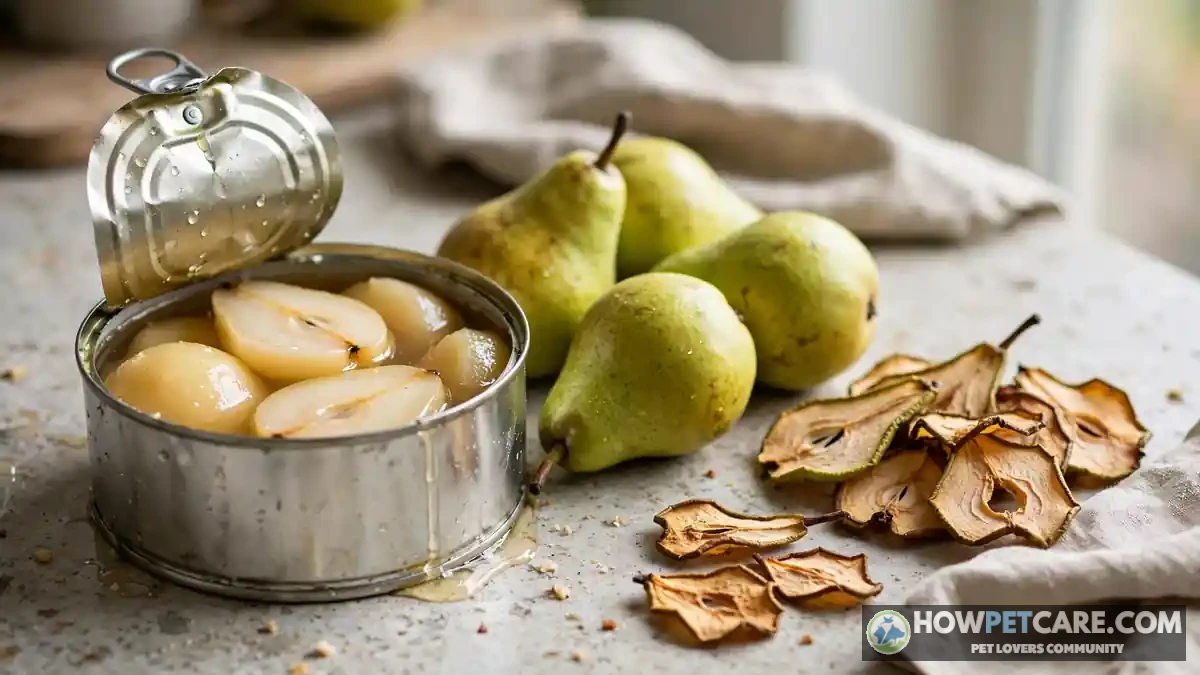
Can dogs eat pears that are canned, dried, or cooked? Fresh fruit is the simplest choice — processed forms can concentrate sugar or hide unsafe ingredients, so check the label before sharing.
| Pear form | Verdict | Main concern | Serving guidance |
|---|---|---|---|
| Fresh, ripe | Safe | Natural sugar; choking if pieces are too large | Follow the weight chart |
| Frozen cubes | Safe | Hard or large cubes can be a choking hazard | Use small pieces; count toward the fresh-pear portion |
| Canned in water, drained and rinsed | Limited | May contain added sugar | Offer rarely and use about half the usual portion |
| Canned in syrup | Avoid | High added-sugar content | Do not offer; syrup-packed pears are not recommended for dogs |
| Dried pear | Limited | Sugar and calories are concentrated; chewy pieces can choke | At most 1–2 small slivers, plain and unsweetened |
| Pear juice | Avoid | Sugar without the whole fruit’s fiber; sweetener risk | Skip it |
| Unsweetened pear sauce or puree | Limited | Easy to overfeed; may include spices or sweeteners | A teaspoon or two, if ingredients are plain |
| Plain cooked pear | Limited | Added ingredients may change the risk | A small amount of plain pear only |
| Pies, tarts, and spiced desserts | Avoid | Often contain sugar, butter, raisins, chocolate, or other unsuitable ingredients | Do not share |
| Product containing xylitol | Never | Xylitol is toxic to dogs | Keep away and call a veterinarian or poison control if eaten |
Read ingredient lists for xylitol (also called birch sugar), added sugar, and sulfites. Xylitol is a more urgent threat than the trace amygdalin in an intact pear seed — if your dog eats a product containing xylitol, contact a veterinarian or poison-control service immediately. Don’t assume a product is safe just because it’s labeled sugar-free or pear-flavored.
Asian, Bartlett, Bosc, Anjou and Comice: Do Pear Varieties Matter for Dogs?
These varieties aren’t inherently unsafe for dogs. Once the core and seeds are removed, choose based on ripeness and texture — firmer pieces need smaller cuts, especially for small dogs and gulpers. Sugar content varies by variety and ripeness, so the same portion guidance works as a sensible starting point.
| Variety | Sugar and sweetness | Firmness and texture | Choking risk | Prep tip |
|---|---|---|---|---|
| Asian | Often crisp and juicy | Firm and crunchy | Higher if served in large chunks | Cut into small pieces |
| Bartlett | Sweet when ripe | Soft and juicy | Lower when ripe, but pieces still need to be bite-size | Use ripe fruit and remove the core |
| Bosc | Mildly sweet | Dense and firm | Higher if pieces are large | Cut smaller or soften by mashing |
| Anjou | Mildly sweet | Smooth; softens as it ripens | Lower when ripe | Check that it is ripe and cut to size |
| Comice | Very sweet | Soft and juicy when ripe | Lower when ripe | Keep the portion modest and remove seeds |
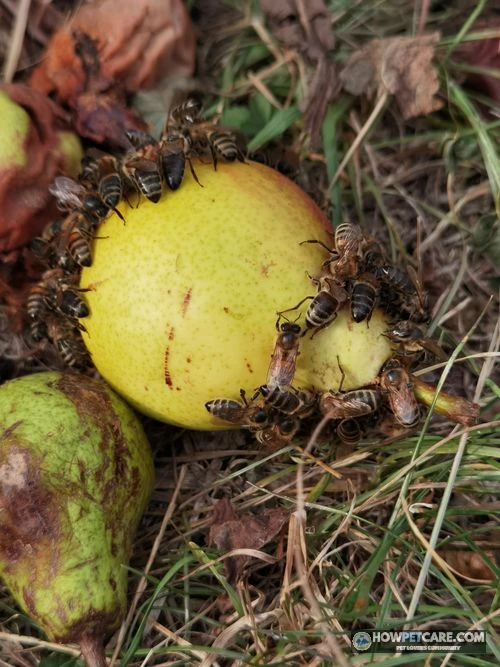
A dog eating fallen fruit in a yard or orchard faces different risks than one offered a clean, fresh slice. Rotten or moldy pears can harbor tremorgenic mycotoxins that affect the nervous system. They may also have fermented. Don’t feed moldy fruit, even if you cut away the visible mold — pick up windfalls and secure compost. Tremors, stumbling, agitation, or seizures after eating ground fruit warrant emergency veterinary care.
Puppies, Senior, Diabetic and Kidney-Disease Dogs: Who Should Limit Pear
- Puppies: Once a puppy is established on solid food, a tiny piece of ripe, peeled pear can be offered occasionally. Keep treats small so they don’t displace a complete, balanced puppy diet, and watch for digestive upset.
- Senior dogs: If dental trouble or swallowing difficulty makes chunks risky, skip them or offer a small mashed portion. New foods can also be harder for dogs with chronic digestive issues to tolerate.
- Diabetic dogs: A pear’s natural sugars can affect blood glucose. Ask your veterinarian before offering it; don’t adjust insulin timing or dose for a treat without veterinary direction.
- Overweight dogs: Count pear within the total treat budget. If you offer it, replace another treat rather than adding calories.
- Kidney or heart disease: Pears contain potassium, and some dogs need dietary restrictions or take medications that affect their diet. Ask the veterinarian managing the condition before sharing.
- Pancreatitis history or ongoing digestive disease: Check with your veterinarian before introducing pear or other new foods.
Stop offering pear if your dog develops a reaction. Contact your veterinarian for persistent vomiting or diarrhea, marked lethargy, or itching and swelling.
Your Pear-Feeding Checklist: Before You Hand It Over
For a healthy adult dog, the routine is straightforward: use ripe fruit, wash it, remove seeds, core, and stem, cut it to a safe size, and stay within the weight-based portion. Offer plain pear no more than once or twice a week, keeping all treats under 10% of daily calories.
If your dog is a puppy, has trouble chewing, follows a prescription diet, or has diabetes, weight concerns, kidney or heart disease, or a history of digestive illness, get veterinary advice before making pear a treat. If your dog already swallowed seeds or a core, follow the decision path above instead of trying to induce vomiting. Store cores in a closed bin so a curious dog can’t raid the trash or compost.
Skip pear altogether if your dog has reacted to it before or if you can’t verify the ingredients in a processed product. For any new treat, a small, plain portion and close observation beat a large serving.
FAQ
Can dogs eat pears every day?
Daily pear is not recommended. Pears contain natural sugar and fiber, so keep them to an occasional treat once or twice a week within the 10% treat limit. Dogs do not need pears for any nutrient.
Are pears better than apples for dogs?
Neither is better. Both are safe once the seeds and core are removed, and both have similar calories and sugar. Choose whichever your dog tolerates better, and pick softer pieces for small dogs.
Can pears help with constipation in dogs?
The fiber and water in pear may soften stool a little, but too much causes loose stools. Persistent constipation needs a vet visit rather than fruit treatment.
Can dogs eat frozen pear?
Yes. Frozen seedless pear cubes work as a cool treat, but cut them small so they are not a choking hazard and serve the same portion as fresh.
Why did my dog get diarrhea after eating pear?
Too much fiber and sugar, a piece that was too large, or unripe fruit can upset the stomach. Stop feeding pear, give water, and call a vet if diarrhea lasts over 24 hours or comes with vomiting or lethargy.