

Yes — plain fresh pineapple flesh is a safe occasional treat for most healthy adult dogs, in portions from about 10 g for toy breeds up to 80 g for giant breeds. Never feed the core, rind or leafy crown, and skip canned-in-syrup, dried and juiced forms entirely.
Yes — plain, fresh pineapple flesh is safe for most healthy adult dogs as an occasional treat, in portions that run from about 10 g for a toy breed to 80 g for a giant breed. Pineapple is not toxic, and it does not belong anywhere near the grapes-and-raisins list. The answer flips to "no" or "ask your vet first" in five specific situations:
- The core, rind, skin or leafy crown is still attached.
- The pineapple is canned in syrup, dried, juiced, or cooked into a human recipe.
- The dog is a puppy under six months old.
- The dog has diabetes, a history of pancreatitis, kidney disease or bladder stones.
- The dog takes blood thinners, antibiotics, NSAIDs, steroids or blood-pressure medication.
Two very different readers land on this page. If your dog has already swallowed the core or rind, skip straight to the emergency plan — it has the triage steps, the 72-hour monitoring window and the exact symptoms that mean "vet now." If you’re holding a piece of fruit and deciding whether to share it, the portion table and the 30-second checklist at the end are your tools.
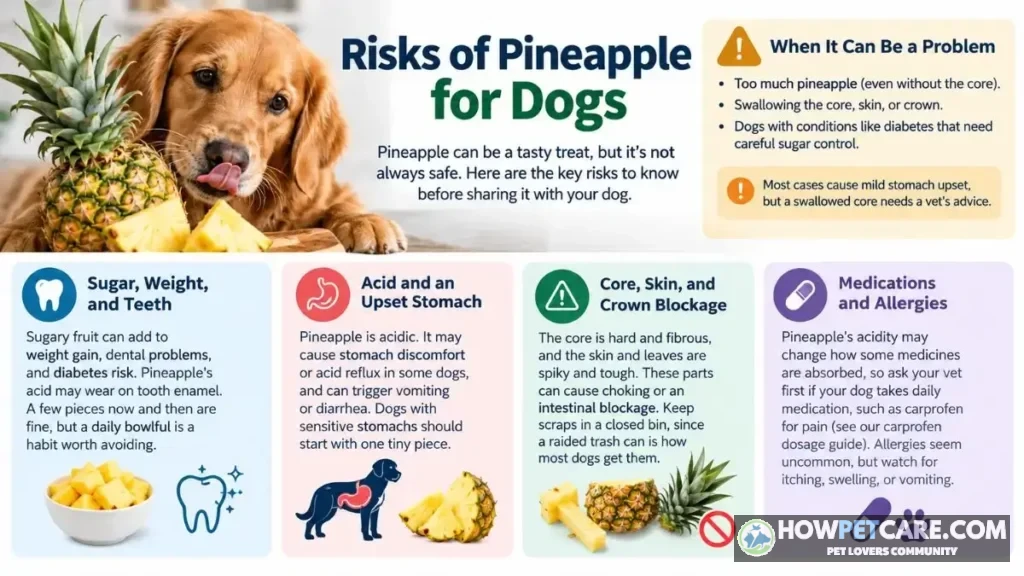
The risks here are real but modest, and they deserve precision rather than fear. Fresh pineapple carries roughly 10 g of sugar per 100 g of flesh, so "a few chunks" adds up faster than most owners expect, and repeated overfeeding can contribute to weight gain and dental problems. Its fiber and acidity can loosen stools or trigger reflux in a sensitive dog. The genuinely risky part isn’t the fruit at all — it’s the hard, fibrous core, rind and crown, which can lodge in the mouth or intestine. Veterinary nutrition guidance holds that all treats together should stay under 10% of a dog’s daily calories, with the rest coming from a complete diet. Set against the full fruit safety list, fresh, peeled, bite-sized pineapple fits that rule comfortably; syrup-packed pineapple does not.
Pineapple Core, Skin, Rind and Leaves: Which Parts Are Safe for Dogs
Only one part of the fruit is dog food: the soft flesh, peeled, de-cored and cut to size. Everything else is a physical hazard rather than a chemical one — the fruit isn’t poisonous, but a dense fibrous mass that won’t break down can wedge in the esophagus or block the small intestine. That distinction matters, because it tells you how to react: this is an obstruction question, not a poisoning question.
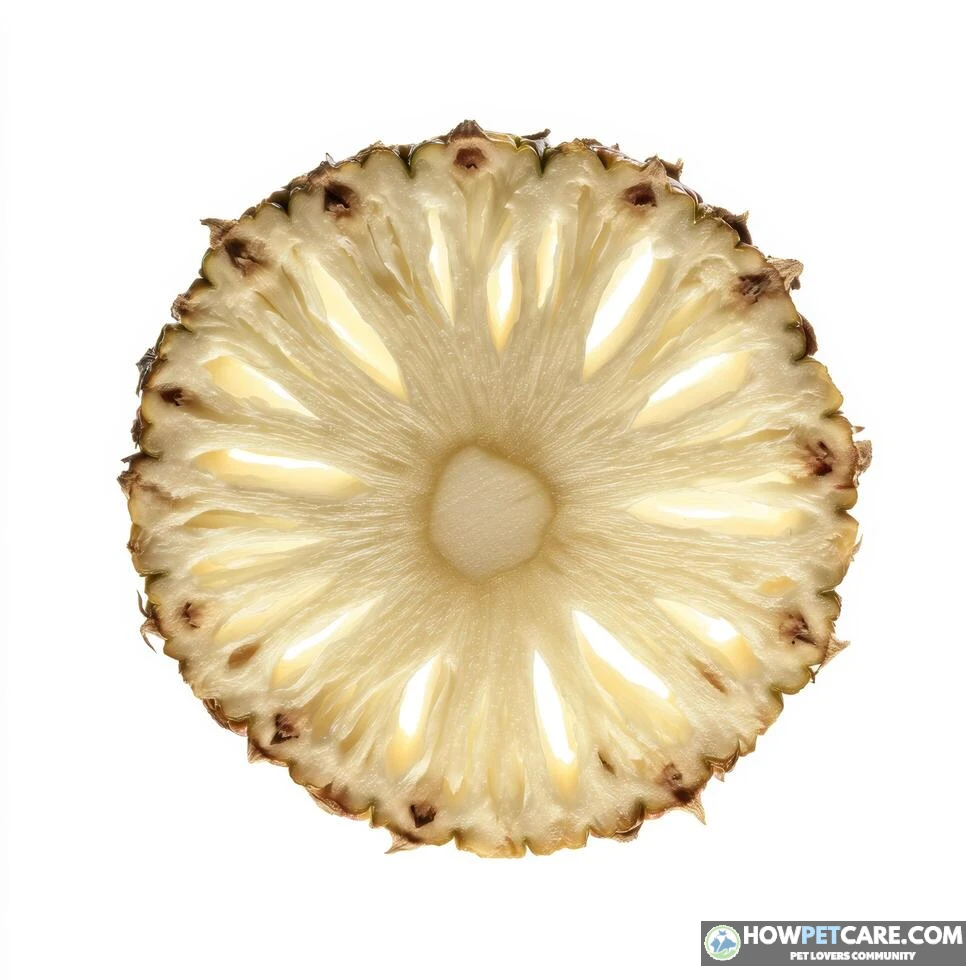
Can dogs eat pineapple core?
The core is not toxic, and some sources describe it as acceptable. Skip it anyway. It’s the toughest, most fibrous part of the fruit, and it arrives in exactly the shape — a firm cylinder — that a gulping dog swallows whole. For a small dog or a fast eater, that’s a choking and blockage risk out of proportion to any nutritional benefit. The core is also where bromelain is concentrated, which is the source of most of the supplement-style claims about pineapple, but treat-sized amounts of flesh deliver very little of it anyway. Remove the core every time, even from a core-friendly smoothie recipe you’re making for yourself.
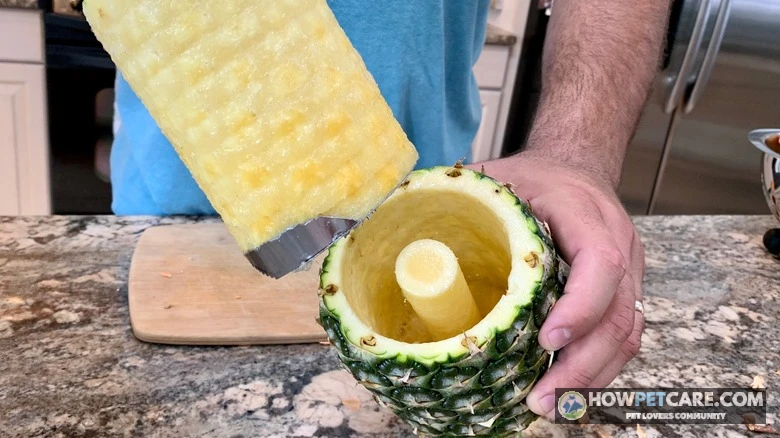
Can dogs eat pineapple skin, rind or leaves?
The rind is worse than the core. Its outer surface is spiky and abrasive, so it can injure the lips, tongue and throat on the way down, and the peel itself is indigestible and bulky — a bigger obstruction risk than a core chunk of the same size. The leafy crown is sharp and stringy, with the same injury and blockage potential. Never feed either one.
The practical consequence is about your trash can and your countertop, not just the fruit bowl. Trimmings, crowns and half-eaten rinds go straight into a lidded bin or a closed compost container, because a dog who counter-surfs will find them.
Most pineapple incidents don’t involve a dog being fed a slice — they involve a dog stealing a core or rind off the counter or out of the trash. Bag trimmings and put them out of reach before you start cutting.
Canned, Dried, Juice and Cooked Pineapple: Verdict for Each Form
The canned question is where the internet contradicts itself, so here is one verdict per form, with the reasoning attached.
| Form | Verdict | Why | Serving rule |
|---|---|---|---|
| Fresh flesh, peeled and de-cored | ✅ Yes — best choice | Hydrating, no added sugar, fiber intact | Follow the weight-based portion table; 1–2 times per week |
| Frozen plain chunks | ✅ Yes | Same nutrition as fresh; harder texture | Cut to size — a whole frozen chunk is a choking risk for dogs under about 10 kg |
| Canned in 100% juice, drained and rinsed | ⚠️ Rare, small amounts only | Juice adds sugar; rinsing removes surface syrup but not sugar absorbed into the fruit | Check the label: no added sweeteners, no xylitol. Use half the fresh portion |
| Canned in syrup | ❌ No | Heavy added-sugar load per piece; syrup may contain additives | Rinsing does not rescue it — skip it |
| Dried pineapple | ❌ Avoid | Drying concentrates sugar roughly 5× by weight (about 70 g sugar per 100 g versus about 10 g fresh); often has added sugar or sulfites | One fingernail-sized dropped bit is low concern — don’t feed it deliberately |
| Pineapple juice | ❌ No | Concentrated sugar with zero fiber; acidity can upset the stomach | No serving worth giving |
| Cooked into human food (pizza, ham glaze, desserts) | ❌ No | The recipe is the problem — onion, garlic, salt, fat, sugar, sauces — not the pineapple | One plain dropped chunk off a pizza is a low-concern event; don’t make it a habit |
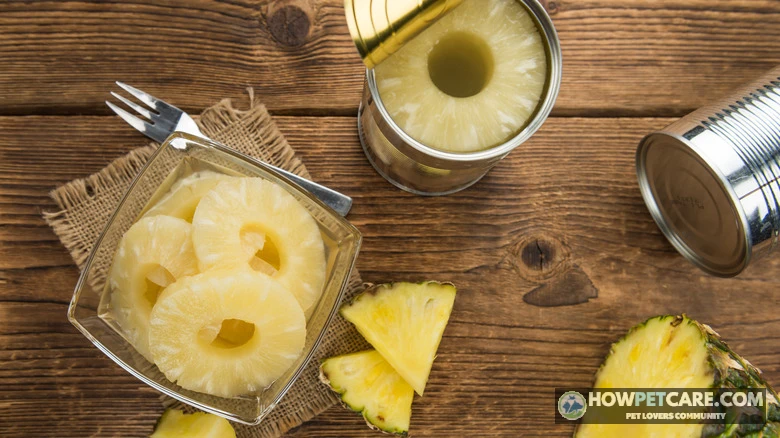
Can dogs eat canned pineapple or pineapple chunks in juice?
Syrup-packed pineapple should be a no, full stop: the canning liquid is essentially sugar water, and each piece now carries more calories and sugar than the fresh equivalent. Rinsing under the tap removes what’s on the surface but not what the fruit has absorbed during packing, so "rinsed syrup pineapple" is still a sweetened product.
Juice-packed, drained and rinsed is the one canned form with a defensible place — as a rare treat when fresh isn’t available. Check three things on the label: it says 100% juice, there’s no added sugar or sweetener, and there is no xylitol. Xylitol is a genuine emergency in dogs, so if it appears anywhere in the ingredient list, treat the can as toxic and call your vet if your dog has eaten any.
"Pineapple chunks in juice" longtail searches usually mean the canned product, not a glass of juice. Do not substitute a glass of pineapple juice for a treat: the fiber is gone and the sugar arrives faster.
Pineapple on pizza and in other human foods
Can dogs eat pineapple cooked into human meals? Not the meal itself. Pizza brings onion and garlic (both genuinely toxic to dogs), plus salt, cheese fat and sauce; Hawaiian-style ham dishes add cured-meat sodium; desserts add sugar and often chocolate or raisins. The pineapple is innocent in all of these, which is why a single dropped plain topping is a low-concern event rather than a reason for panic — but the dish as a whole is not dog food.

How Much Pineapple Can a Dog Eat? Portions in Grams, Chunks and Calories
This is the part most guides leave vague. "A few chunks" means nothing without a size, so define it: one chunk in the table below is a 2 cm (¾-inch) cube weighing about 10 g. Fresh pineapple runs roughly 50 kcal, 10 g sugar and 1.4 g fiber per 100 g of flesh (USDA FoodData Central), which makes each chunk about 5 kcal and about 1 g of sugar. Per serving figures below are derived directly from those numbers.
Pineapple portion table by dog weight
| Dog weight | Max grams per serving | Chunks (2 cm cubes) | Calories per serving | Sugar per serving | Suggested frequency |
|---|---|---|---|---|---|
| Toy — under 5 kg (Chihuahua, Yorkie) | 10 g | 1 chunk | ~5 kcal | ~1 g | Once a week |
| Small — 5–10 kg (Dachshund, Pug) | 20 g | 2 chunks | ~10 kcal | ~2 g | 1–2 times a week |
| Medium — 10–25 kg (Beagle, Border Collie) | 40 g | 4 chunks | ~20 kcal | ~4 g | 1–2 times a week |
| Large — 25–40 kg (Labrador, German Shepherd) | 60 g | 6 chunks | ~30 kcal | ~6 g | 1–2 times a week |
| Giant — 40 kg+ (Great Dane, Mastiff) | 80 g | 8 chunks | ~40 kcal | ~8 g | 1–2 times a week |
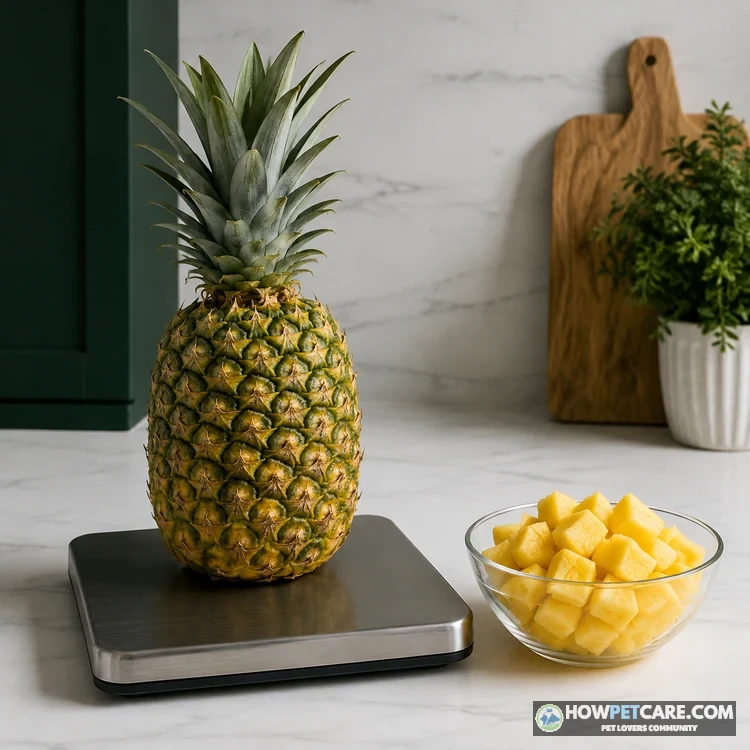
These portions sit deliberately well below each size’s 10% calorie ceiling, because pineapple shares that budget with every other treat your dog eats that day. The 10% cap is one shared pot, not a per-treat allowance.
Worked example — a 15 kg dog’s treat budget. Take a moderately active 15 kg (33 lb) neutered adult, roughly a Cocker Spaniel. She needs about 600 kcal a day, so her treat ceiling is 60 kcal across everything. From the table she gets up to 40 g of pineapple, about 20 kcal — one-third of the pot, leaving 40 kcal for the rest of the day. If she’s already had a 25 kcal dental chew, 35 kcal remains and the full 40 g serving still fits; add two training treats and you’d cut her pineapple to 20 g. The 10% rule sets the ceiling, but the table sets the serving — it’s the sugar, not just the calories, that the grams protect against.
How to prep and serve pineapple safely
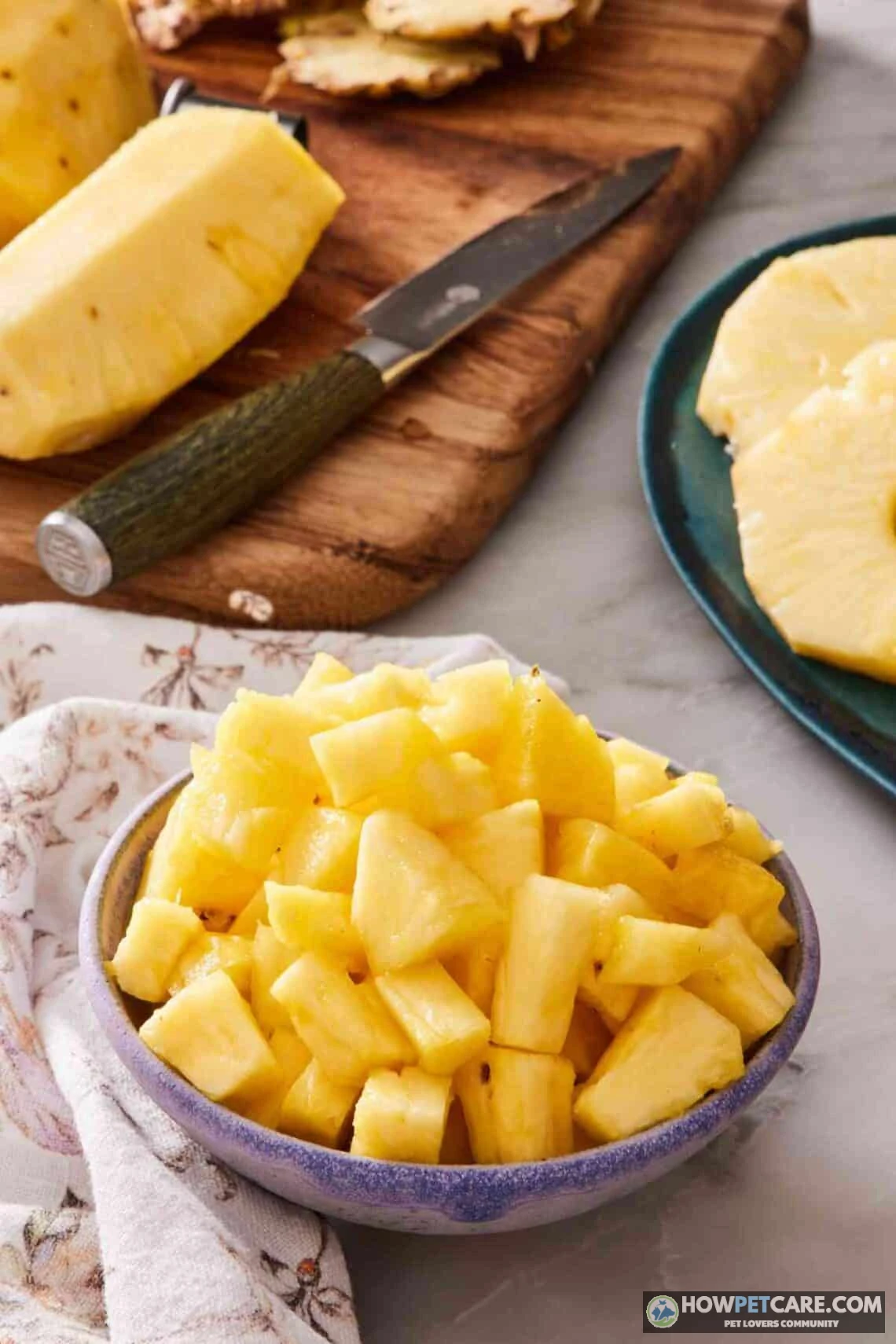
-
Wash and trim
Rinse the fruit, then cut away the leafy crown and the entire rind, including any eyes or fibrous outer layer.
-
Remove the core
Cut the flesh away from the central cylinder in whole slabs. Do not leave "just a little" core attached to a serving piece.
-
Cut to your dog's size
Use 2 cm cubes for medium and large dogs; halve them for dogs under 10 kg, and quarter them for toy breeds and gulpers.
-
Serve plain
Fresh at room temperature, or frozen plain with nothing added. No syrup, honey, yogurt, whipped cream or peanut butter coatings.
Introducing pineapple for the first time and spotting an upset stomach
Give one piece and wait 24 hours. Watch for loose stool, vomiting, itching, hives or lip swelling before you offer a second piece — pineapple allergy is uncommon but real, and facial swelling or difficulty breathing is an emergency. If the stool softens, back off to a smaller piece next time or switch to plain strawberries for dogs. Don’t introduce pineapple during a week when you’re also changing foods or trying other new treats, or you won’t know what caused the reaction.
My Dog Ate the Pineapple Core or Rind: What to Do Right Now
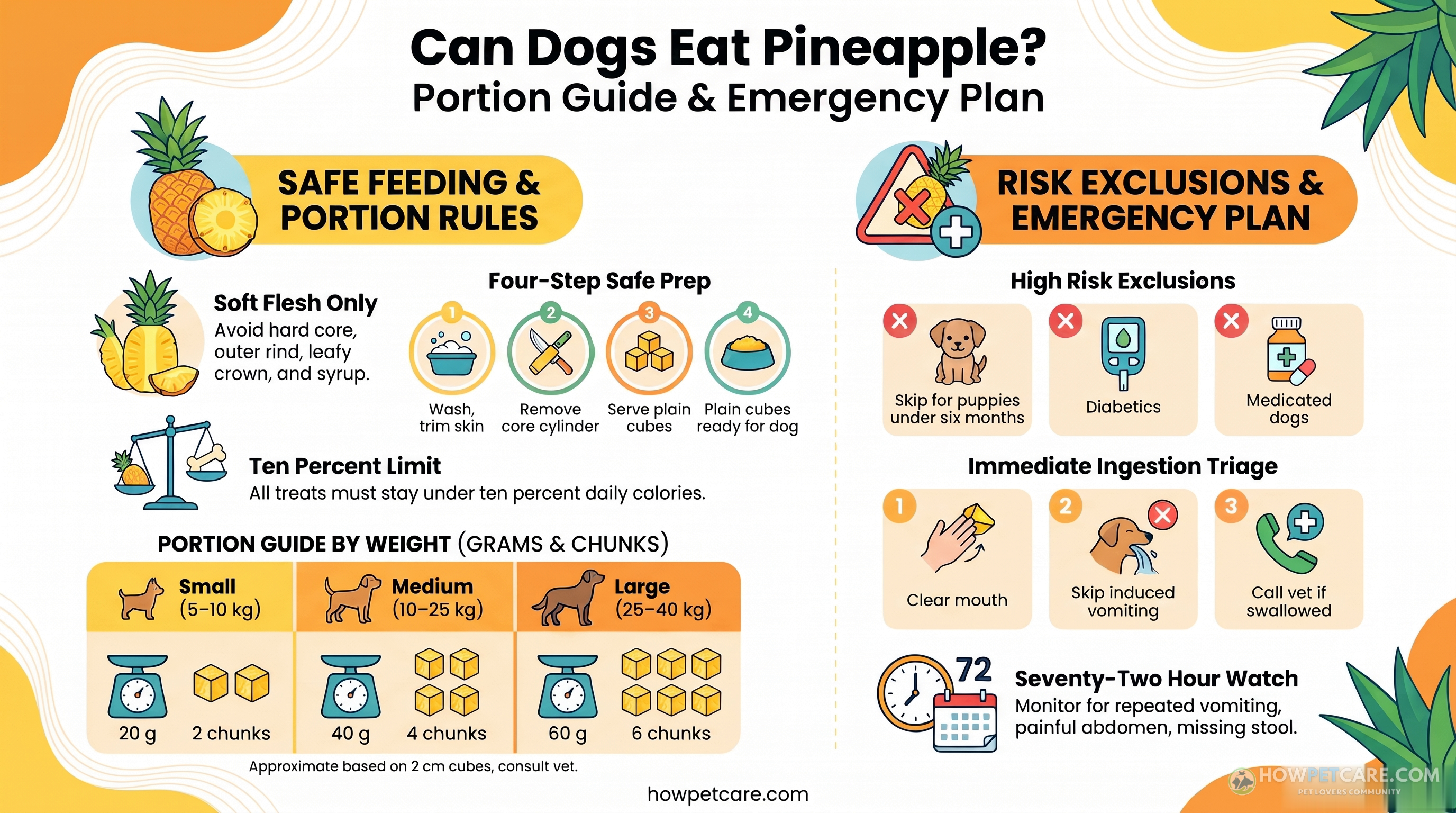
Stay calm and be accurate about what happened. One core or one rind is usually not a poisoning event; the concern is a blockage, and the risk depends on piece size relative to dog size. Work the steps in order.
-
First 5 minutes: clear and record
Take away any remaining fruit and check inside your dog’s mouth for stuck fragments. Write down which part was eaten (core, rind or crown), roughly how much, the time, and whether it was canned — check the can for xylitol, because xylitol ingestion is an emergency regardless of quantity.
-
Do not induce vomiting
Never make your dog vomit unless a veterinarian tells you to. A firm fibrous chunk can do more damage coming back up, and the timing window for safe induction is narrow.
-
Size check: call now or monitor
Call your vet or an emergency clinic immediately if a dog under about 10 kg swallowed a whole core or a rind piece larger than a golf ball, or if any dog swallowed the crown or several large pieces. A large dog that ate one small core fragment can usually be monitored at home.
-
Monitor for 72 hours
Watch appetite, stool output and belly comfort daily. Obstruction signs can appear within hours or take two to three days. If all three stay normal for 72 hours you’re likely in the clear; call your vet if anything changes.
Your dog’s weight, what part was eaten and roughly how much, the time of ingestion, and any symptoms you’ve seen. Emergency staff triage faster with those four facts.
Obstruction red flags and the 72-hour monitoring window
Go to an emergency vet now if any of these appear: repeated vomiting, inability to keep water down, a bloated or painful belly when touched, a hunched posture or the "praying" position, unusual lethargy, straining with no stool or no stool at all, drooling, gagging or retching, or refusing food for more than 24 hours. These are the classic signs of an intestinal blockage, and they do not improve on their own. A vet will typically examine the dog and use X-ray or ultrasound imaging, then decide between supportive care, endoscopy or surgery depending on what they find — and where the object sits.

Emergency decision flowchart: when to monitor and when to go to the vet
Ate the core, rind or crown → How big is the dog, and how big was the piece? → Small dog plus a large piece, or any dog plus a crown or several large pieces → call the vet or emergency clinic now. → Large dog plus one small piece → any red flag from the list above? → Yes: emergency vet now. → No: monitor for 72 hours and call your vet the moment symptoms start.
What if my dog drank the syrup from a can?
A whole can of syrup-packed pineapple is mainly a sugar and stomach-upset event: expect possible vomiting and diarrhea, and call your vet promptly for a small dog or a diabetic dog. Read the label first. If xylitol or another sweetener appears, treat it as an emergency and call immediately rather than monitoring at home. For a large, healthy dog that licked a spoonful of syrup, watch for GI upset and keep water available.
Puppies, Diabetic, Overweight, Pancreatitis, Kidney and Medicated Dogs: Who Should Skip or Limit Pineapple
Can puppies eat pineapple? Under 6 months vs. older
Puppies under six months should skip pineapple. Their digestive systems are still developing, they should be getting their calories from a complete puppy food, and sugar and fiber upset young stomachs more readily. Small mouths also raise the choking risk on any firm piece. After about six months — and with your vet’s agreement — a tiny piece cut very small is reasonable, starting at the lowest tier of the portion table. This is a genuine age-based line, not just "feed puppies less."
Diabetic, overweight and pancreatitis-prone dogs
Diabetic dogs should default to skipping pineapple. Ten grams of sugar per 100 g of flesh can disrupt glucose control, and the fiber content helps only marginally. If your vet approves it at all, use a fixed, weighed amount so the carbohydrate load is predictable rather than eyeballed.
For overweight dogs, pineapple is lower in calories than many commercial treats, but the calories still count. Use it as a swap for an existing treat, not an addition, and keep it inside the 10% pot.
Pancreatitis-prone dogs face a different issue: pineapple is low in fat, but sudden dietary change and sugar are poorly tolerated in dogs with a history of pancreatic inflammation. Get vet approval before feeding, and avoid canned or syrup forms entirely.
Kidney disease and bladder-stone dogs
This is the least-covered question on the entire subject, and honesty matters more than reassurance. Pineapple supplies potassium and small amounts of oxalate, both of which can matter for a dog on a prescribed renal diet or with a calcium-oxalate stone history. Veterinary sources flag the interaction between pineapple’s potassium and oxalate content and chronic kidney disease or bladder stones as an open question rather than a settled one, so treat it as vet-consult territory. Ask a specific question with a number in it — "Is 20 g of fresh pineapple twice a week compatible with her kidney diet?" — rather than a general "can she have fruit?"
Pineapple, bromelain and medication interactions
Bromelain has anticoagulant-like activity in laboratory settings, and whether it interacts with antibiotics, blood-pressure drugs or anticoagulants in dogs is not well established in the veterinary literature. The realistic framing is this: at treat-sized portions of flesh, bromelain exposure is small — most of it sits in the core and stem, which you’re removing anyway — so the risk is theoretical and low-level. But "low-level and theoretical" isn’t the same as "nothing," and dogs on blood thinners, antiplatelet drugs, long-term antibiotics, NSAIDs, steroids or blood-pressure medication should have pineapple cleared by their vet before it becomes a regular habit. Pineapple’s acidity can also irritate a stomach already stressed by NSAIDs or steroids.
Is Pineapple Good for Dogs? Honest Benefits, the Poop-Eating Myth, and How It Compares to Other Fruits
What pineapple actually does for dogs (and what it doesn’t)
The honest version: pineapple is a hydrating, low-calorie treat (about 86% water) that adds a little fiber and manganese. That’s a fair reason to use it as an occasional treat swap, and a poor reason to sell it as a supplement. Dogs synthesize their own vitamin C, so a "vitamin C boost" is not a meaningful benefit for them — pineapple’s vitamin C matters to the humans eating it. Bromelain, the enzyme behind most of the marketing, is concentrated in the core and stem rather than the flesh, and there’s no solid evidence that treat-sized servings deliver an anti-inflammatory or digestive effect in dogs. Say it plainly: it’s a nice treat, not a treatment.
Does pineapple stop dogs from eating poop?
The idea is that pineapple makes stool taste unpleasant and breaks the coprophagia habit. Studies of food additives and stool deterrents show no reliable effect, and owner reports are mixed at best. This claim is unsupported by evidence — not proven false in every individual dog, but not something to build a strategy on. If your dog eats feces, start with a vet visit to rule out digestive, parasitic and nutritional causes, then work on behavior (prompt cleanup, "leave it" training, keeping the yard clear) rather than adding fruit to the bowl.
Pineapple vs. blueberries, watermelon, strawberries and banana: sugar and calories
| Fruit | Calories per 100 g | Sugar (g) per 100 g | Fiber (g) per 100 g | Glycemic note | Best for |
|---|---|---|---|---|---|
| Pineapple | ~50 | ~10 | ~1.4 | Medium-high on human scales; no dog-specific data | Occasional treat, 1–2× weekly |
| Blueberries | ~57 | ~10 | ~2.4 | Low on human scales | Small, frequent training treats |
| Watermelon flesh | ~30 | ~6 | ~0.4 | High index but very low load per serving due to water content | Hydrating summer treat |
| Strawberries | ~32 | ~5 | ~2.0 | Low | Lower-sugar everyday option |
| Banana | ~89 | ~12 | ~2.6 | Medium, rising as the fruit ripens | High-value occasional treat |
Human glycemic values are only a rough proxy for dogs, since canine glucose responses aren’t well mapped. What the comparison does show reliably is sugar density: pineapple sits in the middle-to-higher band, while watermelon flesh, strawberries and low-sugar blueberries for dogs make easier regular choices — especially for diabetic or overweight dogs. Portion control still does more work than fruit selection.
30-Second Checklist Before You Feed Pineapple to Your Dog
Run this before the fruit goes in the bowl.
Part 1 — Eligibility (all boxes checked to proceed)
- Dog is over 6 months old.
- No diabetes, pancreatitis history, kidney disease or bladder-stone history — or the vet has already approved fruit treats.
- Not on blood thinners, antibiotics, NSAIDs, steroids or blood-pressure medication — or vet-approved.
- No previous reaction to pineapple (itching, swelling, vomiting).
- Treats today are still under 10% of daily calories.
Part 2 — Serving (all required)
- Fresh or plain frozen only — no syrup, juice, dried or sweetened forms.
- Rind, core and crown fully removed.
- Cut to size: 2 cm cubes, smaller for dogs under 10 kg.
- Portion taken from the weight table, not eyeballed.
- First time? One piece, then wait 24 hours.
Part 3 — Stop and call the vet if repeated vomiting or diarrhea follows, any swelling or itching appears, or any red flag from the core-and-rind plan shows up.
Pick a lower-sugar fruit from the comparison table, or ask one specific question: "Is 20 g of fresh pineapple twice a week okay with her current diet and medication?" A number in the question gets you a usable answer.
1Under which of the following conditions is plain, fresh pineapple flesh contraindicated or in need of prior veterinary approval before being fed to a dog?
NSAIDs and steroids stress the gastric mucosal lining, making the organic acids in fresh pineapple more likely to trigger stomach upset or ulceration.
2Which components of a fresh pineapple represent physical hazards that must be completely trimmed away and kept out of a dog's reach?
The outer peel is abrasive and indigestible, presenting severe oral tissue injury and intestinal obstruction risks.
3Why does rinsing pineapple that was canned in heavy syrup under tap water fail to make it safe for dogs?
Porous fruit tissue absorbs dissolved sugars throughout the canning process, meaning external washing cannot remove internal sweetness.
4A dog has swallowed a piece of pineapple core off the counter. What is the correct immediate action to take within the first 5 minutes?
Gathering facts and checking oral tissues prevents further trauma, whereas inducing vomiting can cause severe esophageal damage or obstruction.
5Which of the following clinical signs indicate a potential intestinal blockage following the ingestion of a pineapple core or rind, requiring immediate emergency veterinary care?
Frequent retching or inability to hold fluid indicates that physical transit through the stomach or intestine is fully blocked.
6Why should pineapple be completely excluded from the diet of puppies under six months of age?
Young puppies have delicate digestive tracts easily disrupted by raw fruit acidity and sugar, alongside small airways vulnerable to firm chunks.
7When selecting a fresh fruit treat for an overweight or diabetic dog, why are strawberries or watermelon flesh generally preferred over pineapple?
Fresh pineapple contains about 10 g of sugar per 100 g, whereas strawberries (~5 g) and watermelon (~6 g) deliver lower sugar density per serving.
FAQ
Can dogs eat pineapple every day?
Daily pineapple is not necessary and not recommended for most dogs because of its sugar and calories. Offer it once or twice a week in the portion for your dog’s weight, and keep all treats under 10% of daily calories.
Can dogs eat frozen pineapple?
Yes, if it is plain fresh pineapple flesh that was frozen without sugar or syrup. Cut the pieces small enough for your dog’s size, because hard frozen chunks can be a choking risk for small dogs.
Can dogs be allergic to pineapple?
It is uncommon, but it can happen. Itching, hives, lip or face swelling, vomiting, or diarrhea after eating pineapple are signs of a reaction. Facial swelling or trouble breathing needs an emergency vet visit right away.
Is pineapple good for a dog with an upset stomach or diarrhea?
No. Pineapple’s acid, sugar and fiber can make loose stool or nausea worse, and it is not a treatment for stomach upset. Call your vet if vomiting or diarrhea lasts more than a day, or sooner for puppies, small dogs and seniors.
Can dogs eat pineapple tops or the leafy crown?
No. The crown is sharp and fibrous, and it can injure the mouth or throat or cause a blockage. Remove it and keep it out of the trash within your dog’s reach.