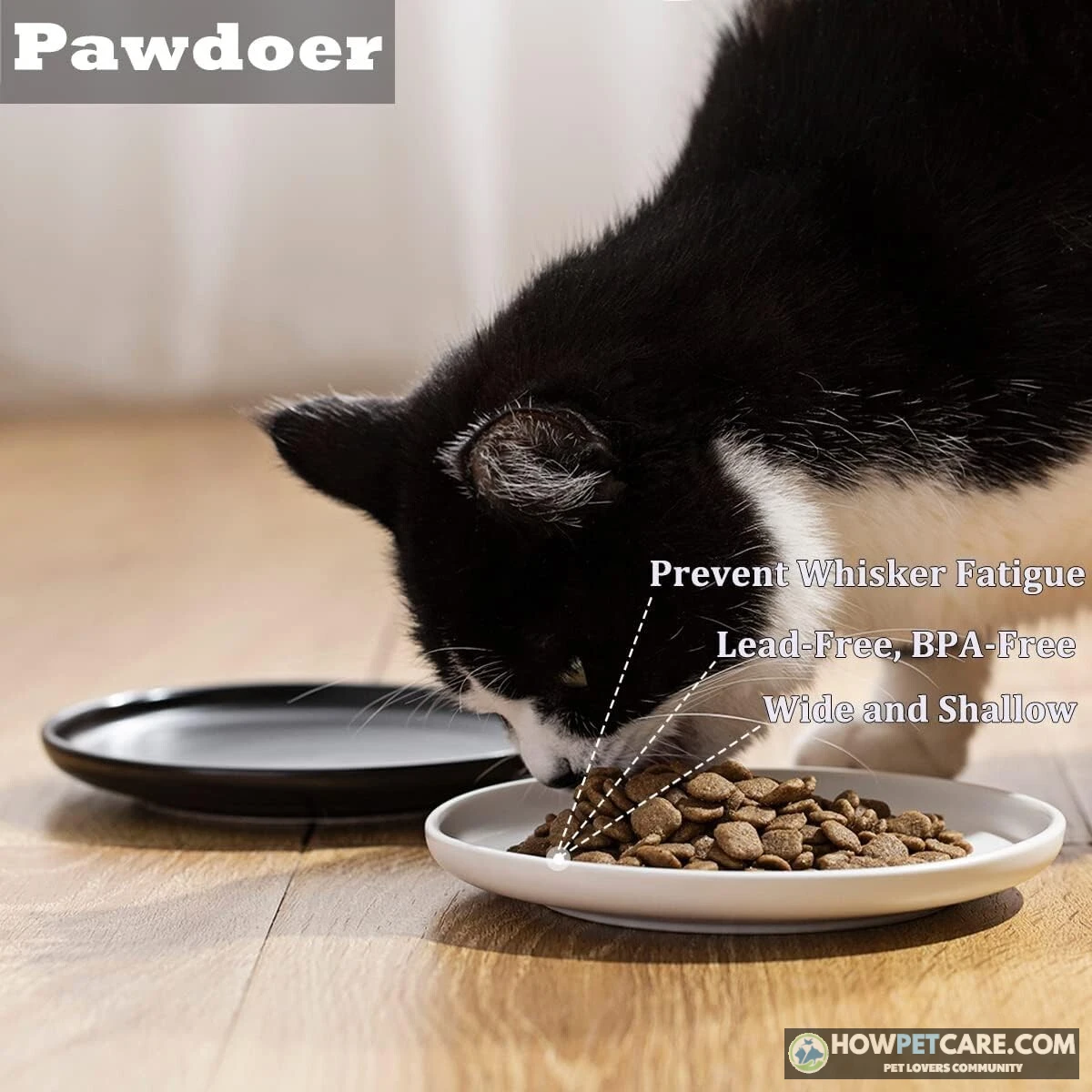

Whisker fatigue is an informal, unproven idea that repeated whisker contact with a deep or narrow bowl may make eating uncomfortable. The behavior is real, but whiskers aren’t confirmed as the cause — try a wide, shallow plate and see your vet if appetite drops or red flags appear.
What Is Whisker Fatigue in Cats — and Is It Actually Real?
Whisker fatigue, also called whisker stress, is an informal term for the idea that repeated contact with a food or water bowl may make a cat’s whiskers uncomfortable. It’s a plausible explanation for why some cats avoid a bowl, but it isn’t a confirmed disease or diagnosis. A small study found no significant difference in eating time, food consumed, or food dropped between dish types, although some cats preferred the wider dish when given a choice.
If your cat hesitates at a deep bowl, that distinction matters. The behavior is real, but whiskers aren’t necessarily the cause. Dental, gastrointestinal, kidney, and other medical problems can also change how a cat eats. Check for warning signs before assuming the bowl is the answer.
Cat whiskers, or vibrissae, are thick hairs anchored in tissue rich in nerves and blood vessels. They help the feline sensory system detect contact and support proprioception, or awareness of body position. A narrow, deep bowl may repeatedly bring its walls into contact with those sensitive whiskers, but it isn’t well established whether that contact causes a clinically meaningful problem.
Whisker Fatigue vs. Whisker Stress: Same Idea, Different Labels
Both terms generally describe the proposed effect of repeated whisker contact. Neither means a cat is in pain. There are no standardized diagnostic criteria or severity grades, and large clinical studies haven’t established the underlying mechanism. The available evidence doesn’t show how common the proposed problem is, whether it’s a usual cause of picky eating, or whether bowl contact causes pain rather than an ordinary dislike of a particular dish.
The study commonly cited in this discussion, published in the Journal of Feline Medicine and Surgery in 2021, compared feeding outcomes and dish preference. The lack of a significant difference in the measured feeding outcomes doesn’t mean owners are imagining their cats’ behavior. It means those measurements didn’t establish a general feeding impairment from the dishes tested. A preference for one dish doesn’t establish why a cat prefers it, either.

Whisker Fatigue Symptoms: What the Behavior Looks Like vs. Ordinary Picky Eating
There’s no definitive set of whisker fatigue symptoms. Behaviors sometimes attributed to bowl contact include:
- Pawing food out of the dish or carrying kibble onto the floor.
- Eating from the center while leaving food around the edge.
- Approaching a deep bowl, eating tentatively, or returning for several short visits.
- Eating the same food more readily when it’s served on a flat surface.

That last pattern makes the dish setup worth investigating: the food hasn’t changed, but the eating surface has. It doesn’t prove whiskers are responsible. A plate also changes the food’s presentation, the cat’s viewing angle, and how easily the food can be reached. Food preferences, stress, and illness are still possible explanations.
Cats may have preferences about water dishes, too, and might paw at water or drink elsewhere. Those behaviors alone don’t establish whisker stress or tell you how much a cat is drinking. A fountain may appeal to an individual cat, but it isn’t a proven whisker-fatigue treatment. Keep a familiar, accessible water source available while trying another option, and contact your vet if drinking or urination changes.
Bowl or Vet? An At-Home Differential Check Before You Buy Anything
Start by looking at your cat, not the bowl. If there are no warning signs and your cat is otherwise eating normally, try the same food on a clean, flat plate in the usual feeding location. Watch the first few minutes without crowding your cat. Eating more comfortably on the plate makes a dish-related preference plausible, but it can’t rule out illness or identify whisker contact as the cause.
| Observable sign | What it could point to | Next action |
|---|---|---|
| Eats the same food on a plate but hesitates at the bowl | Dish shape or another aspect of the setup | If appetite is otherwise normal and there are no red flags, observe the plate setup. |
| Drags food out or leaves food around the bowl’s edge | A dish preference, feeding habit, or medical problem | Try the plate only if the cat is otherwise well; call the vet if the behavior is new or persists. |
| Drools, paws at the mouth, chews on one side, or drops previously manageable kibble | Dental or other oral disease | Call the vet; don’t rely on a bowl trial. |
| Vomits or has a declining appetite | Gastrointestinal disease, nausea, or another illness | Contact the vet promptly. |
| Drinks or urinates more, loses weight, or gradually eats less | Kidney disease or another medical condition | Arrange a veterinary appointment promptly. |
| Refuses the same food on a plate | Food preference, stress, or illness | Contact the vet rather than assuming fussiness. |
These are clues, not diagnoses. Oral, digestive, and kidney problems can overlap, and some cats show few obvious signs. A cat with a medical problem can also eat from a plate.
Red Flags That End the Bowl Trial Immediately
If your cat has eaten nothing for 24 hours, contact a veterinarian immediately. Call sooner for a kitten, a cat with a known illness, or a cat that seems unwell. Repeated vomiting, marked lethargy, breathing difficulty, or inability to urinate warrants urgent veterinary advice; don’t wait for a feeding experiment to finish.
Contact your vet promptly for drooling, obvious difficulty chewing, weight loss, increased thirst or urination, or a meaningful decline in appetite. A cat that approaches food but can’t eat comfortably needs attention, even if it eats a little. Tell the clinic what and how much your cat has eaten and when the change began.

This article is educational and isn’t a substitute for a veterinary examination. Home observation can’t rule out dental disease, nausea, kidney disease, or other illness.
If the Plate Test Fails: What to Check Next
If your cat refuses the plate too, stop experimenting and contact your vet for advice. Note whether your cat is interested in food but backs away, whether chewing looks difficult, and whether vomiting, thirst, urination, or weight have changed. Bring those observations to the appointment.
If appetite is normal but food-dragging continues, a vet can help assess whether it’s a harmless habit or whether the mouth and other potential causes need checking. There isn’t enough prevalence evidence to name one explanation as the most likely for an individual cat.
Bowl Fit in Numbers: How Wide and Shallow a Cat Bowl Actually Needs to Be
The aim is to let your cat reach food without repeatedly bending whiskers against a high wall. No study has established a precise whisker-span formula or ideal bowl depth, so use the following measurements as starting points, not veterinary standards or guarantees. Watch your cat at the dish; the actual fit matters more than the label.

Measure Your Cat’s Whisker Span in 2 Minutes
-
Wait for a relaxed moment
When your cat is calm, look at the whiskers in their natural resting position. Don’t restrain a distressed cat or pull the whiskers.
-
Estimate the span
Hold a ruler or soft tape near the face and estimate the distance from the outer whisker tips on one side to those on the other. Don’t bend or stretch the whiskers. A rough visual estimate is enough.
-
Compare the eating area
As a practical starting point, choose a dish whose usable inner width is at least the estimated span. Watch as your cat reaches the center and edges; choose a wider or flatter surface if whiskers bend against the sides.
For example, if the relaxed span is about 8 inches, start with a dish offering at least 8 inches of usable inner width. A flat plate around 9 to 10 inches across may work, provided the eating area is accessible and the plate is stable. Width alone can’t guarantee clearance: sloping walls, food placement, and the cat’s eating angle all matter.
| Fit variable | What to measure | Rule of thumb | Why it matters |
|---|---|---|---|
| Usable width | Inner eating area and relaxed whisker span | Start with an inner width at least as wide as the estimated span. | Gives the face more room; observe actual contact. |
| Rim and food position | Height of the rim above the food your cat is reaching | Prefer a flat plate or a low, gently sloped rim; aim for food near the rim’s height without overfilling. | A high wall can make the cat reach deeper into the dish. |
| Dish depth | Bottom-to-rim height | A shallow dish roughly 1–2 inches deep can be a starting point, but a plate may provide better access. | Nominal depth doesn’t show how much of the wall the cat must reach past. |
| Shape and surface | Wall angle, corners, stability, and cleanability | Choose a stable, smooth dish with an open shape. | Easy access and cleaning matter more than a marketing claim. |
| Water access | Width, water level, and how the cat drinks | Offer a broad, stable dish with accessible water; refresh it regularly. | A low water level in a deep container can still place the face near the walls. |
A stainless steel bowl or a smooth, food-safe ceramic or glass dish can work. Wash it regularly, check for damage, and use a non-slip surface if it moves while your cat eats. Don’t fill a dish so high that food spills or water becomes inaccessible.

An elevated cat feeder changes posture, not the width of the eating area. Depending on the angle, a raised deep bowl can still put whiskers against its sides. If elevation helps a cat reach food comfortably, use a wide, accessible dish and check that the cat can approach it easily.
For water, don’t restrict access to the existing supply to force a test. If you add a broad dish or fountain, keep the familiar source available and monitor use. A fountain’s moving water may change a cat’s preference, but it doesn’t establish that whisker contact was the issue.
Flat-Faced vs. Long-Faced Cats: Why “Shallow” Means Different Things
A flat-faced cat may need to bring more of its face close to the food surface to reach a meal. Begin with a flat plate or particularly low, sloping rim, and check that the nose and muzzle have room. For a long-faced cat, check clearance as the muzzle reaches the last bites. A dish that looks wide from above may narrow considerably at the bottom.
For example, a cat with an estimated 6-inch whisker span could start with a usable eating area at least 6 inches wide. That’s a floor for the experiment, not a breed-specific prescription. If the whiskers bend on the rim or the cat struggles to reach the food, try a wider or flatter surface regardless of the measurement.

The Free-Plate-First Cost Path: Plate vs. Shallow Dish vs. Specialty Bowl
A clean plate already in your kitchen is a sensible first test if it’s stable, food-safe, and large enough for your cat. If food slides off or your cat finds it difficult to pick up, try an ordinary shallow dish with a gentle rim. You don’t need to buy a specialized feeder just to start the comparison.
Are Whisker-Friendly Bowls Worth It? A Function-First Cost Comparison
“Whisker-friendly” is a product description, not proof that a dish will fit your cat or treat a medical condition. Compare usable width, rim height, stability, and ease of cleaning rather than relying on the name.
| Option | Approximate cost | Meets fit criteria? | Practical trade-offs |
|---|---|---|---|
| Household plate | No new cost if owned | Often, if the eating surface is wide and accessible | Easy first test; food may slide or spill. |
| Ordinary shallow dish or saucer | No new cost if owned; purchase price varies | Depends on usable width and rim | A gentle rim may contain food better; some saucers are too narrow. |
| Specialty whisker-friendly bowl | Purchase price varies | Check the actual dimensions and your cat’s fit | May add convenience features such as a non-slip base; the label doesn’t guarantee a better result. |

A specialty bowl may be worth buying for stability, cleaning, or containing portions if an ordinary dish doesn’t meet those needs. It’s a convenience choice, not a proven treatment. If your cat still has trouble eating, another purchase isn’t a substitute for a veterinary assessment.
The 14-Day Bowl Switch Protocol: Checkpoints, Timelines, and What “No Improvement” Means
This is a practical observation schedule, not a medically established recovery period. Use it only when your cat is otherwise well and eating normally. You don’t need to wait 14 days to call a vet, and you shouldn’t let a cat go hungry to complete the experiment.
Keep the same food, feeding location, and schedule. At each meal, note approximately how much is offered and eaten, whether food is dragged out, and whether eating looks hesitant. A photo before and after can help. If the household has multiple cats, observe each cat separately so you know who ate what.
| Days | Action | What improvement looks like | Decision |
|---|---|---|---|
| 1–3 | Offer portions of the usual meal in the familiar bowl and on a clean plate in the usual feeding area. Record what happens. | The cat readily eats the same food from the plate, with less hesitation or food-dragging. | A difference supports trying the plate, but doesn’t prove whisker stress. If intake drops or a warning sign appears, call the vet. |
| 4–7 | If the cat is eating well from the plate, use it for meals while keeping food, place, and schedule unchanged. | Normal intake continues, and the previously observed behavior is reduced. | If the cat won’t eat from the plate, offer the familiar setup and contact the vet rather than withholding food. |
| 8–14 | Continue the same setup and observe every usual meal. | The improvement remains consistent, rather than appearing at only one meal. | Keep the setup if it works. If signs persist or improvement is only partial, contact the vet and check fit. |

At day 14, sustained improvement makes a dish-related preference more plausible, not certain. If nothing has changed, the bowl is a less convincing explanation; schedule a vet visit rather than buying more dishes. If there’s partial improvement, check for a moving plate, a rim that still catches whiskers, or difficulty reaching food. Don’t use adjustments to postpone a medical assessment for persistent signs.
For cats on a different feeding schedule, use their normal meals rather than forcing two meals a day. Remove leftover wet food promptly; in warm conditions, the supplied research recommends removing it within 30 minutes.
Whisker Care Myths: Should You Ever Trim Your Cat’s Whiskers?
Never trim, cut, or pull a cat’s whiskers to address bowl discomfort. Whiskers provide sensory information for spatial awareness and navigation; interfering with them can leave a cat disoriented, and pulling them can be painful. Change the dish setup instead, and seek veterinary advice if eating remains uncomfortable.
Finding an occasional shed whisker isn’t the same as trimming one. If you notice repeated breakage, substantial loss, irritated skin, or a change around the face, ask your vet to check it rather than attempting whisker trimming or another home remedy.

Your Next Steps: A One-Page Checklist for the Bowl-or-Vet Decision
- Check your cat first. Call the vet promptly for mouth discomfort, vomiting, weight loss, changed thirst or urination, or declining appetite. If your cat has eaten nothing for 24 hours, contact a veterinarian immediately.
- Try a plate if your cat is otherwise well. Offer the same food in the same feeding area and observe without pressure. Don’t withhold food to force a choice.
- Check fit. Estimate the relaxed whisker span, start with an eating area at least that wide, and watch for actual contact with the rim. Use a stable, clean, low-sided surface.
- Record the pattern. Follow the checkpoints for up to 14 days while keeping food, location, and schedule consistent. Improvement means normal intake with less of the behavior that concerned you, not merely choosing a new dish once.
- Act on the result. Keep a setup that works. For partial or absent improvement, persistent eating difficulty, or any new warning sign, contact your vet rather than extending the trial.
| Observable Sign | What It Could Point To | Recommended Next Action |
|---|---|---|
| Eats the same food on a plate but hesitates at the bowl | Dish shape or another aspect of the setup | If appetite is otherwise normal and there are no red flags, observe the plate setup. |
| Drags food out or leaves food around the bowl's edge | A dish preference, feeding habit, or medical problem | Try the plate only if the cat is otherwise well; call the vet if the behavior is new or persists. |
| Drools, paws at the mouth, chews on one side, or drops previously manageable kibble | Dental or other oral disease | Call the vet; don't rely on a bowl trial. |
| Vomits or has a declining appetite | Gastrointestinal disease, nausea, or another illness | Contact the vet promptly. |
| Drinks or urinates more, loses weight, or gradually eats less | Kidney disease or another medical condition | Arrange a veterinaryhttps://howpetcare.com/whisker-fatigue/ appointment promptly. |
| Refuses the same food on a plate | Food preference, stress, or illness | Contact the vet rather than assuming fussiness. |

FAQ
Does whisker fatigue cause real pain, or just mild annoyance?
There is no clinical evidence that whisker contact causes pain; the honest reading is that it may produce mild irritation or annoyance that some cats avoid and most ignore. Persistent signs of pain while eating point to dental disease, not whisker stress, and warrant a vet visit.
How common is whisker fatigue — is it behind most picky eating?
No reliable prevalence data exists, and whisker fatigue should be treated as a possible explanation for specific bowl-avoidance behaviors rather than a common condition. Picky eating, dental problems, and nausea are far better-documented causes of tentative eating.
Why did the 2020 study find no difference in eating time or dropped food?
The study measured outcomes like eating duration and food dropped, and found no significant difference between dish types, though some cats showed a preference for the wider dish. A null result on those measures doesn’t prove the behavior owners report is imaginary — it shows the effect, if real, is subtle and not universal.
Do elevated feeders help with whisker fatigue?
Elevation changes joint and neck posture, not whisker contact — a raised deep bowl can make wall contact worse. If you raise a feeder for mobility reasons, pair it with a wide, shallow dish.
Is there an official veterinary position or severity scale for whisker fatigue?
No major veterinary body has issued a position statement, and there are no standardized diagnostic criteria or severity grades. It remains an informal, owner-observed pattern, which is why a structured at-home trial and a vet check for red flags matter more than any label.