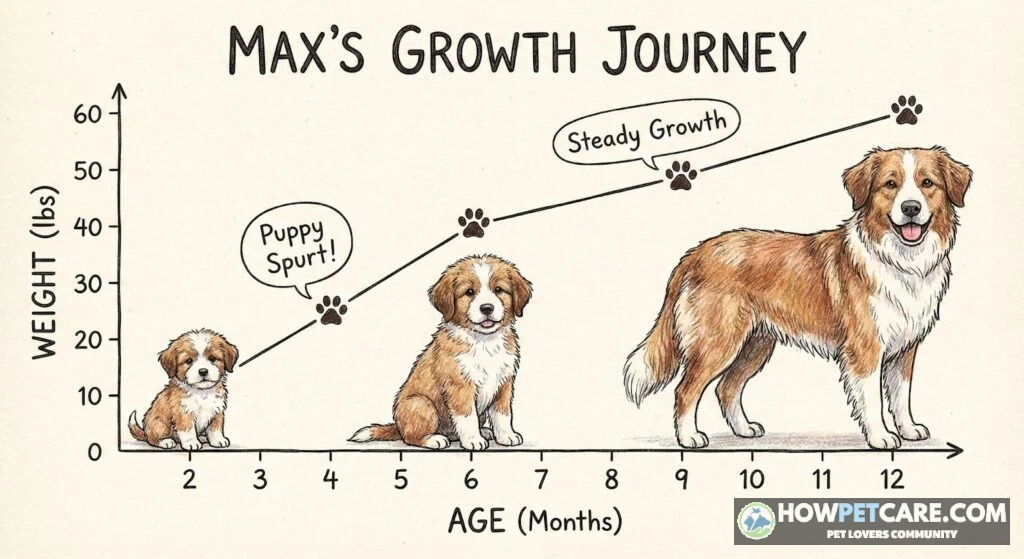

Most dogs stop growing on a breed-size timeline: toy/small dogs usually reach adult height by 8–12 months, medium dogs by 10–14 months, large dogs by 12–18 months, and giant dogs by 18–24 months. Filling out, muscle, and skeletal maturity can continue for months after height plateaus.
Dogs don’t all stop growing at the same age. Toy and small breeds usually reach adult height by 8–12 months and finish filling out by 10–14 months. Medium breeds often reach adult height by 10–14 months and finish filling out by 12–18 months. Large breeds commonly reach adult height by 12–18 months and finish filling out by 18–24 months. Giant breeds may not reach adult height until 18–24 months and can keep filling out until 24–36 months.
"Fully grown" isn’t one moment. A dog can stop getting taller while still gaining muscle, chest depth, bone density, and mature behavior. Growth-plate closure ties to skeletal maturity, and owners can’t confirm that at home; it requires veterinary assessment, often including imaging.
When Dogs Stop Growing by Breed Size
Toy and Small Breeds
Toy and small breeds usually reach adult height by 8–12 months and finish filling out by 10–14 months. Their shorter growth window means early nutrition and weight control still matter, but the period of rapid skeletal change is comparatively brief.
Medium Breeds
Medium breeds usually reach adult height by 10–14 months and finish filling out by 12–18 months. They often look nearly adult in height before their chest, shoulders, and hindquarters have finished developing.
Large Breeds
Large breeds often reach adult height by 12–18 months and finish filling out by 18–24 months. Their longer growth window makes controlled calories, balanced minerals, and joint protection especially important.
Giant Breeds
Giant breeds may not reach adult height until 18–24 months and can keep filling out until 24–36 months. At five months, large-breed puppies may already be at roughly 50% of adult weight, which is one reason early estimates can mislead.
| Breed Size | Adult Height Reached | Finished Filling Out | Skeletal Maturity |
|---|---|---|---|
| Toy and small | 8–12 months | 10–14 months | About 12–15 months |
| Medium | 10–14 months | 12–18 months | About 12–18 months |
| Large | 12–18 months | 18–24 months | About 18–24 months |
| Giant | 18–24 months | 24–36 months | About 24–36 months |

These windows describe typical development. Individual dogs can fall outside them because of genetics, sex, nutrition, health, and mixed ancestry.
Named Breed Milestones: Height, Filling Out, and Skeletal Maturity
The table below separates adult height, filling out, skeletal maturity, and behavioral maturity. Behavioral maturity often lags physical maturity by months or years.
| Breed | Adult Height | Filling Out (weight/muscle) | Skeletal Maturity | Behavioral Maturity |
|---|---|---|---|---|
| Chihuahua | ~9–12 months | ~12 months | ~12–15 months | ~12–18 months |
| Labrador Retriever | ~12–15 months | ~18–24 months | ~18–24 months | ~2–3 years |
| Golden Retriever | ~12–15 months | ~18–24 months | ~18–24 months | ~2–3 years |
| German Shepherd Dog | ~15–18 months | ~24 months | ~24 months | ~2–3 years |
| Pitbull-type dog | ~12–15 months | ~18–24 months | ~18–24 months | ~2–3 years |
| Great Dane | ~18–24 months | ~24–30 months | ~24–30 months | ~2–3 years |

Use these as typical windows, not promises. A dog can be within one window for height and another for filling out.
Pitbull-type dogs deserve special caution because the label describes a broad type rather than one breed. Adult size can vary substantially, so treat any timeline as a range and confirm concerns with a veterinarian.
Height vs. Weight vs. Skeletal Maturity vs. Behavioral Maturity
Adult height means vertical growth has largely slowed because growth plates near the long bones have largely closed. Filling out means muscle, chest depth, and body condition continue developing after height stalls. Skeletal maturity means growth plates have closed and bones are fully mineralized. Behavioral maturity—impulse control, calmness, and reliable manners—often lags physical maturity by months or years.
A dog can look "done" in height while still building bone density and muscle. That’s why a tall adolescent dog may still need controlled exercise and a growth-appropriate diet.

Big paws, one puppy weigh-in, or a tall adolescent dog don’t prove final adult size or growth-plate closure. Adult size depends on breed mix, sex, nutrition, health, and genetics. Growth-plate closure can’t be confirmed at home.
How to Estimate Your Puppy’s Adult Weight (With Worked Examples)
Common Formulas and Their Math
Common estimation methods include doubling weight at 16 weeks for small breeds, multiplying by about 2 to 2.5 for medium breeds, and using breed-average adult ranges. These are planning tools, not guarantees.
Example 1 — Purebred medium-to-large puppy
- Puppy weight at 16 weeks: 24 lb (10.9 kg)
- Estimate: 24 lb x 2 = 48 lb (21.8 kg)
- Reasonable planning range: 45–55 lb (20.4–24.9 kg)
- Note: this is a planning estimate, not a guarantee; large-breed puppies often keep filling out well after height slows.
Example 2 — Mixed-breed puppy
- Puppy weight at 16 weeks: 18 lb (8.2 kg)
- Likely parent-size clues: one medium parent, one unknown
- Planning estimate: 30–45 lb (13.6–20.4 kg)
- Track monthly and compare with breed-size growth curves before narrowing the range.
Why Formulas Fail
Single weigh-ins, paw size, and "double at 16 weeks" rules are unreliable. A puppy may be temporarily underweight, overweight, or growing on a different curve than the breed average. Large-breed puppies in particular can keep gaining healthy muscle and body weight after height plateaus.
A Better Estimation Method
A better approach is repeated weigh-ins plotted against breed-size growth curves. Record the same time of day, use the same scale, and look for a smooth trend. Compare weight with body condition—ribs easy to feel, waist visible—rather than treating one number as a diagnosis.

Mixed-Breed Puppies and DNA Tests: What They Can and Cannot Predict
For a mixed-breed puppy, combine current growth trend, visible build, and likely parent size rather than relying on one signal. DNA breed tests estimate breed composition probabilities; they don’t produce a deterministic adult size. Accuracy is lower for mixed-breed dogs, especially when small-breed ancestry is present or unknown, so treat results as one input alongside growth tracking.
A practical mixed-breed plan is to start with a broad range based on the largest likely parent, track monthly weight and body condition, and ask a veterinarian for a physical assessment if growth looks unusually fast, slow, or uneven.
Growth Plates: What Owners Can and Cannot Tell at Home
What Growth Plates Do
Growth plates, or physes, are cartilage zones where new bone forms and lengthening occurs. They close and mineralize as skeletal maturity approaches. Owners can’t confirm closure at home; that requires veterinary assessment, often including X-rays.
A Simple At-Home Monitoring Framework
At home, track recurring weight, body-condition scoring, and height measurements. Normal variation is expected, so a growth chart is a trend tool, not a diagnosis. Guessing growth-plate closure from paw size or "knobby knees" is unreliable.
| What to Track | How Often | What It Tells You |
|---|---|---|
| Weight | Weekly to monthly | Growth trend and rate changes |
| Body condition | Weekly | Whether weight gain is appropriate |
| Height or length | Monthly | Whether vertical growth is slowing |
| Activity tolerance | Weekly | Recovery, stamina, and possible discomfort |
| Appetite and stool | Daily | Basic health and nutrient absorption |

Copy and fill in one row each month:
| Month | Date | Age (weeks/months) | Weight | Body condition notes (ribs easy to feel? waist visible?) | Food change made | Activity tolerance (walk length, play recovery) | Questions for next vet visit |
|---|---|---|---|---|---|---|---|
| 1 | |||||||
| 2 | |||||||
| 3 | |||||||
| 4 |
Tips: weigh at the same time of day, use the same scale, and look for a smooth trend rather than one perfect number.
Feeding, Exercise, and Veterinary Care for Healthy Growth
Nutrition by Breed Size
Large- and giant-breed puppies need controlled calories and balanced calcium-to-phosphorus ratios. Excess calories and calcium supplements can accelerate unhealthy growth and increase orthopedic risk during development. Excess calories and obesity in large-breed puppies also increase risk of developmental orthopedic disease such as hip dysplasia.
This isn’t a feeding prescription. Ask your veterinarian to choose a diet formulated for your puppy’s size, age, and health status, and avoid adding calcium supplements unless specifically directed.
Activity and Joint Protection
While joints and growth plates are developing, avoid repetitive high-impact activities such as long runs, stair climbing, and jumping from heights. Short, low-impact play and leash walks are generally safer while growth plates are still developing. Prolonged running on hard surfaces can be especially harmful to puppies under 14–18 months.
Checkup Schedule
Routine veterinary checkups and growth-monitoring milestones by age help catch problems early. A typical schedule includes visits every 3–4 weeks during early puppyhood, then periodic checks as growth slows. Your veterinarian can track weight, body condition, gait, and skeletal development more accurately than home observation.
Spay/Neuter Timing Considerations
Spay or neuter timing intersects with orthopedic development by breed size. Early sterilization before growth plates close may allow a dog to grow taller than typical and can increase orthopedic risk. There’s no universal age that fits every dog; discuss timing with your veterinarian based on breed, size, behavior, and health.
Red Flags: When to Contact Your Veterinarian About Growth
- Slowing growth rate after a growth spurt: usually normal if appetite, energy, and body condition stay steady.
- Temporary small weight fluctuation: normal if the puppy is eating, drinking, and playful.
- Call the vet for lameness, limping, or reluctance to move.
- Call the vet for persistent pain, crying when touched, or stiffness after rest.
- Call the vet for visible limb asymmetry, bowing, twisting, or abnormal posture.
- Call the vet for sudden appetite change, excessive hunger, or weight that outpaces height.
- Call the vet for stalled growth, weight loss, or no weight gain for several weeks.
- Call the vet if breed-size timelines are missed by a wide margin.
Intestinal parasites such as hookworms and roundworms can reduce nutrient absorption and interfere with height and weight gain, so stool checks and parasite prevention are part of healthy growth monitoring.
If your puppy is gaining too fast, too slowly, or showing symptoms, contact a veterinarian. A single off-chart weight isn’t a diagnosis; look for a consistent trend over several weeks and compare it with body condition rather than a single number.
Lameness, persistent pain, visible limb deformity, or stalled growth in a growing puppy warrants veterinary attention rather than home monitoring alone.

| Breed or Breed Size | Adult Height Timeline | Filling Out Timeline | Skeletal Maturity Timeline | Behavioral Maturity Timeline |
|---|---|---|---|---|
| Toy and small | 8–12 months | 10–14 months | ~12–15 months | Not in source |
| Chihuahua | ~9–12 months | ~12 months | ~12–15 months | ~12–18 months |
| Medium | 10–14 months | 12–18 months | ~12–18 months | Not in source |
| Large | 12–18 months | 18–24 months | ~18–24 months | Not in source |
| Labrador Retriever | ~12–15 months | ~18–24 months | ~18–24 months | ~2–3 years |
| Golden Retriever | ~12–15 months | ~18–24 months | ~18–24 months | ~2–3 years |
| Pitbull-type dog | ~12–15 months | ~18–24 months | ~18–24 months | ~2–3 years |
| German Shepherd Dog | ~15–18 months | ~24 months | ~24 months | ~2–3 years |
| Giant | 18–24 months | 24–36 months | ~24–36 months | Not in source |
| Great Dane | ~18–24 months | ~24–30 months | ~24–30 months | ~2–3 years |
FAQ
How many months after reaching adult height can a dog keep gaining muscle and body weight?
Most dogs continue filling out for 2–6 months after height plateaus, and large or giant breeds may continue for 6–12 months. Muscle development also depends on nutrition and activity, so the timeline varies individually.
What should a mixed-breed puppy owner expect from a DNA-based adult-size prediction?
A DNA test estimates breed composition and gives a probable adult-size range, not a precise number. Accuracy is lower for mixed-breed dogs, especially when small-breed ancestry is present or unknown, so owners should treat results as one input alongside growth tracking.
How should an owner interpret a puppy weight trend that does not match a generic breed-size chart?
A single off-chart weight is not a diagnosis; look for a consistent trend over several weeks and compare it with body condition rather than a single number. If the puppy is gaining too fast, too slowly, or showing symptoms, contact a veterinarian.
Why should large- and giant-breed puppies avoid excess calories and calcium supplements?
Excess calories and unbalanced calcium can accelerate growth and increase orthopedic risk during development. Controlled growth diets formulated for large-breed puppies help support steadier skeletal development.
What exercise should be limited while a large-breed puppy’s joints and growth plates develop?
Avoid repetitive high-impact activities such as long runs, stair climbing, and jumping from heights until skeletal maturity. Short, low-impact play and leash walks are generally safer while growth plates are still developing.