
No, dogs do not get periods in the human sense. While intact female dogs bleed vaginally, canine bleeding signals the start of the fertile estrous cycle (heat) triggered by rising estrogen. In contrast, human menstruation sheds the uterine lining after an unfertilized cycle ends. A dog’s bleeding indicates she is preparing to ovulate.
No, dogs do not have periods in the way humans do. An unspayed female dog can have vaginal bleeding, but canine bleeding is not menstruation. In humans, menstruation marks the end of a reproductive cycle: when an egg is not fertilized, the body sheds the vascular uterine lining. In female dogs, vaginal bleeding signals the opposite. It marks the beginning of a fertile window within the canine estrous cycle, driven by rising estrogen levels that prepare the reproductive tract for potential mating and pregnancy.
If you have noticed blood droplets on the floor, bedding, or your dog’s fur, there is no need to panic. Your dog is likely experiencing what people commonly call "heat" or "season." A basic understanding of canine reproduction can help you keep her comfortable, manage hygiene at home, and prevent unintended breeding.
Do Dogs Get Periods? The Direct Answer and Biological Difference
To understand why dogs bleed, start with the hormones involved. Human menstruation follows a steep drop in progesterone and estrogen when fertilization does not occur. The vascular endometrial lining then breaks down and leaves the body as menstrual blood.
A female dog bleeds during the first phase of her estrous cycle, called proestrus, because estrogen rises sharply. This hormone surge makes the blood vessels within the uterus engorged and more permeable. Red blood cells and serous fluid pass through intact capillary walls in a process called diapedesis. The fluid mixes with vaginal secretions and leaves through the vulva as bloody discharge.
The discharge does not mean an unfertilized cycle has ended. It shows that the dog’s body is preparing to ovulate and become receptive to male dogs.

Dog Heat vs. Human Menstruation: Key Biological Differences
Human menstruation and canine estrus differ in their underlying physiology.
| Feature | Human Menstruation | Canine Estrous Cycle (Heat) |
|---|---|---|
| Biological Purpose | Sheds unneeded uterine lining after an egg goes unfertilized | Signals hormonal preparation to ovulate and accept mating |
| Cycle Timing | Occurs at the very end of the cycle (luteal phase collapse) | Bleeding occurs at the beginning of the cycle (proestrus) |
| Primary Hormone Shift | Triggered by a steep drop in progesterone and estrogen | Triggered by a sharp surge in blood estrogen levels |
| Source of Bleeding | Direct sloughing and shedding of vascular endometrial tissue | Red blood cells leak through intact uterine capillaries (diapedesis) |
| Fertility Status During Bleeding | Generally infertile; marks the end of the reproductive window | Entering fertile window; ovulation follows shortly as bleeding lightens |
| Cycle Frequency | Roughly every 28 days (monthly year-round) | Typically every 6 to 7 months (breed ranges: 4 to 12 months) |
| Lining Shedding | Complete monthly physical discharge of the functional lining | Minimal; lining is mostly reabsorbed internally by the body |

Because the two processes differ, terms such as "female dog menstruation" and "dog period" can create dangerous misunderstandings. If you assume a bleeding dog is at the end of her fertile cycle, you may expose her to intact males when she is most capable of conceiving.
Never assume a dog cannot become pregnant while bleeding. Male canine sperm can survive in the female reproductive tract for up to a week. If mating occurs late in the bleeding phase, viable sperm will be waiting when she ovulates days later.
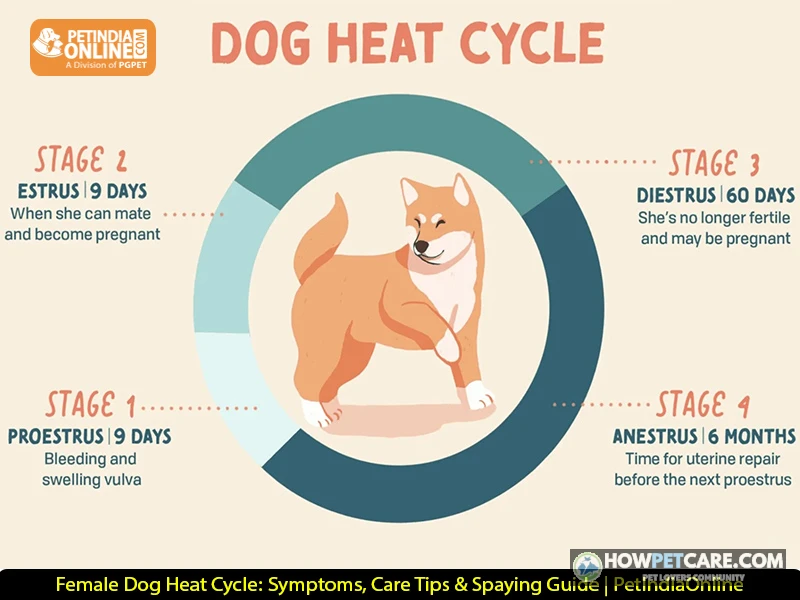
The 4 Stages of the Dog Estrous Cycle
The canine estrous cycle has four physiological stages: proestrus, estrus, diestrus, and anestrus. An intact female moves through these stages throughout her life unless she is spayed. Dogs do not experience menopause. Unspayed females continue cycling into their senior years, although the interval between cycles may lengthen.
| Stage | Average Duration | Discharge & Vulva Appearance | Fertility & Male Interest | Owner Action |
|---|---|---|---|---|
| 1. Proestrus | 7–10 days (range: 3–17 days) | Swollen, firm vulva; bright red, bloody discharge | Attracts males via pheromones, but actively refuses mounting (tucks tail, growls, or sits) | Fit protective diapers indoors; initiate strict leash-only containment outdoors. |
| 2. Estrus | 5–10 days (range: 3–21 days) | Vulva softens; discharge shifts to pinkish, salmon, or straw-colored | Peak fertility window; female flags tail sideways and allows mounting | Total isolation from intact males; never leave dog outdoors unsupervised even in fenced yards. |
| 3. Diestrus | 60–90 days | Discharge stops completely; vulva swelling gradually regresses | Receptive window closed; female rejects all male mating advances | Monitor energy, appetite, and temperature; watch for uterine infection indicators across the next 8 weeks. |
| 4. Anestrus | 4–5 months (breed dependent) | Normal resting anatomy; no discharge | Complete sexual and reproductive quiescence | Optimal surgical window to discuss and schedule elective spay procedures. |

Proestrus and Estrus: When Bleeding and Ovulation Happen
Proestrus is the first stage that novice dog owners often identify as a "period." It lasts between 6 and 11 days on average. The vulva swells noticeably and becomes enlarged and firm. Bloody vaginal discharge appears. Estrogen levels climb toward a peak that typically occurs 1 to 2 days before estrus begins. Intact male dogs detect the pheromones in her urine and discharge and may show intense interest. The female, however, is not yet physiologically ready to mate. If a male approaches, she may sit, tuck her tail between her hind legs, or growl and snap to keep him away.
Estrus is the mating stage, often called "standing heat." It typically lasts 5 to 9 days, although it can range from a single day up to 20 days. Estrus follows a surge of luteinizing hormone (LH), with ovulation occurring within 48 to 72 hours. As estrogen falls and progesterone begins to rise, the discharge changes. Heavy, dark red blood usually becomes watery pink, salmon, or clear straw-colored fluid. The vulva stays enlarged but becomes soft and flaccid.
The female also becomes receptive. When touched near the hips or approached by another dog, she may show "flagging" by holding her tail high and moving it firmly to one side, exposing the vulva. This is the period of peak fertility.
Diestrus and Anestrus: Hormonal Rest and Recovery
Diestrus begins when the female stops standing and refuses to mate. It lasts approximately 60 to 90 days. Whether or not she was bred or became pregnant, her body produces high amounts of progesterone during this phase. Progesterone levels peak around 2 to 3 weeks after ovulation, remain elevated for 1 to 2 weeks, and then gradually return to baseline. Because hormone levels stay high, non-pregnant females can occasionally experience a "false pregnancy" (pseudopregnancy), with nesting behavior, enlarged mammary glands, and temporary milk production.
Anestrus is the extended quiet phase between cycles and lasts roughly 4 to 5 months. The uterine lining repairs itself, hormone levels remain low and stable, and the reproductive tract rests.
Dogs cycle twice per year on average, or approximately every 5 to 11 months. Breed makes a substantial difference. Small and toy breeds may cycle three times a year, while giant breeds like Great Danes and Mastiffs, along with basal breeds such as the Basenji and Tibetan Mastiff, may cycle only once every 12 months. A female dog typically has discharge for 14 to 21 days across proestrus and estrus.


First-Time Heat Signs: What to Look and Watch For
A female dog has her first heat cycle between 6 and 24 months of age. Toy and small-breed dogs mature quickly and may enter their first heat as early as 4 to 6 months. Large and giant breeds may take 18 to 24 months to reach reproductive maturity.
Look for a combination of physical and behavioral changes:
- Vulvar Swelling: The vulva may swell to two or three times its normal resting size. The surrounding tissue becomes firm and prominent.
- Excessive Self-Grooming: Your dog may lick her genital area repeatedly. Fastidious dogs can clean away discharge as quickly as it appears, hiding visible bleeding.
- Bloody Spots: Small red or pink spots may appear on dog beds, light-colored carpets, furniture, or hard floors.
- Frequent Urination (Scent Marking): Estrogen can cause a dog to urinate smaller amounts more often during walks. This deposits pheromones that signal her reproductive state to nearby dogs.
- Appetite and Energy Fluctuations: Some females become mildly sluggish and lose interest in food during early proestrus; others become restless.
- Clinginess or Agitation: Hormonal changes may make a dog unusually affectionate, needy, or skittish. Some females become irritable or guard resources around other household pets.

Young dogs can also have a "silent heat." Ovulation occurs internally, but there is little or no visible vulvar swelling or bloody discharge. The dog still produces pheromones, attracts males, and can become pregnant if bred.
Managing a Bleeding Dog: Diaper Sizing, Hygiene, and Home Care
Managing bleeding at home means keeping the house clean without damaging your dog’s skin. Dog diapers can protect furniture, rugs, and car seats from discharge, but incorrect use can cause painful skin problems.
How to Measure and Fit a Dog Heat Diaper
Dog diapers are available as disposable styles, similar to human baby diapers with adjustable adhesive tabs, and reusable, machine-washable fabric wraps. Correct sizing matters: a loose diaper leaks, while a tight one can cause friction burns and chaffing in the groin folds. Keep in mind that diapers exist solely for indoor cleanliness and never provide physical contraception against determined intact males.

-
Measure Circumference and Tail Clearance
Use a flexible measuring tape around your dog’s waist directly in front of her hind legs. If her measurement falls between sizes, select the larger size to avoid groin constriction. For tailless or bobtail breeds (such as French Bulldogs or Boston Terriers), choose tail-hole-free diapers or securely seal pre-cut tail openings with waterproof medical tape.
-
Select Reusable vs. Disposable by Flow Volume
Use disposable diapers with resealable tabs during days 1 to 5 when vulvar swelling fluctuates rapidly. Once swelling stabilizes, switch to washable fabric wraps lined with disposable human panty liners for cost-effective, absorbent daily protection.
-
Fit with the Two-Finger Tension Test
Fasten the diaper and slide two flat fingers between the waistband and your dog’s belly. The diaper should fit snugly without pinching skin folds or sliding down the haunches when your dog sits, stretches, or lies down.
-
Enforce a 3-to-4-Hour Changing Protocol
Remove the diaper every 3 to 4 hours and immediately before outdoor bathroom breaks. Never allow urine or wet discharge to sit against the vulva; trapped moisture rapidly fosters bacterial dermatitis and ascending urinary tract infections (UTIs).
-
Inspect Skin and Troubleshoot Chafing
At each change, gently clean the vulva, groin, and inner thighs with an unscented, alcohol-free canine wipe and pat the skin completely dry. If you see friction redness along leg seams, apply a thin layer of pure medical-grade petroleum jelly and consider using a loose canine diaper suspender harness to relieve band tension.
Skin Care and Daily Diaper Changing Routine
Do not leave a dog in a diaper 24 hours a day. She needs diaper-free time for air to reach the skin and for normal grooming.
Set up a confined safe zone in an uncarpeted area, such as a tiled kitchen, laundry room, or bathroom. Use an easy-to-clean bed covered with washable waterproof mattress pads or fleece blankets. Let your dog rest there without a diaper overnight or during naps. Wash bedding regularly in hot water with hypoallergenic, fragrance-free laundry detergent to limit skin irritation.

For long-haired breeds (such as Golden Retrievers, Shih Tzus, or Spaniels), ask a groomer for a sanitary trim around the perianal area before heat begins, or carefully trim the fur around the vulva with round-tipped safety shears. Keeping hair short prevents discharge from matting into the coat.
Preventing Unplanned Mating: Why Diapers Are Not Contraception
A common misunderstanding among first-time owners is treating a dog diaper like a chastity belt. A diaper will not prevent pregnancy.
An intact male driven by pheromones can push aside, shred, or remove a fabric or disposable diaper within seconds. Mating can even occur through displaced diaper material. A diaper cannot replace physical separation and supervision.
Intact male dogs can detect a female in estrus from miles away on wind currents. During standing heat, males may dig under fences, scale chain-link enclosures, break through screens, and wait outside doors. The female may also try to escape to find a mate.
Containment Protocol During Heat
To prevent unintended mating, use strict containment for a minimum of 28 days from the first drop of blood:
- Zero Unsupervised Yard Time: Never leave your dog alone in a fenced yard, even for two minutes. A male can breed with a female through wire mesh or chain-link fencing if she backs up against it.
- Leash-Only Elimination Breaks: Take your dog outside on a sturdy, 6-foot non-retractable leash, holding the loop securely even inside a private, fully fenced yard.
- Avoid Public Spaces: Cancel visits to dog parks, dog daycare, pet supply stores, outdoor restaurant patios, and busy hiking trails. A female in heat can trigger sudden, intense aggression between other dogs in public spaces.
- Double-Door Security: Make sure everyone in the household knows to open exterior doors cautiously. Keep the female behind a second barrier, such as an interior door or tall exercise pen, before opening an exterior entryway.

Managing Multi-Dog Homes with Intact Males
If an intact male lives with a female in heat, the household may become stressful. Male dogs may vocalize, whine, pace, refuse food, or try to break through doors and gates. Owners should also understand penile anatomy and emergency signs in male dogs.
Follow this containment checklist to keep the dogs apart:
Layered Containment Checklist: Blocking Unplanned Mating
Outdoor Safety & Boundary Security
- ☐ Assume diapers offer zero mechanical protection: Male dogs can displace or tear through diapers, and breeding can occur around them within seconds.
- ☐ Eliminate solo yard turnout: Accompany your dog on a short handheld 6-foot leash for every elimination break, even in a private, fully fenced backyard.
- ☐ Inspect perimeters daily: Check the clearance under fence panels. Intact males can breed through chain-link or dig under fences within minutes.
- ☐ Cancel social outings: Suspend visits to dog parks, public trails, daycare, group training classes, and pet-friendly retail stores for a minimum of 28 days from first bleeding.
In-Home Multi-Dog Management (Intact Males Present)
- ☐ Establish two-door separation barriers: Keep two closed, locked physical barriers, such as a closed crate inside a locked spare bedroom, between intact males and the female at all times.
- ☐ Avoid tension triggers: Feed the dogs in fully separate rooms, since estrus pheromones can increase food aggression and male redirected frustration.
- ☐ Coordinate rotated turnout times: Do not let male and female dogs share hallways, entryways, or exercise yards without a physical barrier between them.

For many owners, boarding the intact male with a trusted friend, family member, or boarding facility for two weeks during the female’s estrus stage is the safest and least stressful option.
Triage Guide: Normal Heat Discharge vs. Emergency Symptoms and Pyometra
Bloody discharge is expected during an estrous cycle, but vaginal bleeding can also result from a serious medical emergency, traumatic injury, or urinary tract disease. Pay attention to the discharge and your dog’s overall condition.
Spotting the Signs of Pyometra
The most serious condition owners of unspayed female dogs should understand is pyometra, a life-threatening uterine infection.
During diestrus, progesterone remains elevated for weeks while the body prepares the uterine lining for pregnancy. If pregnancy does not occur over multiple cycles, the lining can become thickened and prone to cystic changes (cystic endometrial hyperplasia). Bacteria, most commonly Escherichia coli, can travel upward from the vagina into the uterus during estrus, when the cervix is open. Once diestrus begins and the cervix closes, bacteria can become trapped in a warm, hormone-rich environment, filling the uterus with toxic pus.
Pyometra typically develops 2 to 8 weeks after the heat cycle has finished. It occurs in two clinical forms:
- Open Pyometra: The cervix remains partly open. Foul-smelling, thick, purulent discharge, resembling cream, gray pus, or dark brownish-red gravy, drains from the vulva.
- Closed Pyometra: The cervix is completely closed, so no discharge is visible. Pus accumulates inside the expanding uterus and releases lethal endotoxins into the bloodstream. The uterus can rupture into the abdominal cavity, causing septic peritonitis, shock, and death.
If an unspayed female dog exhibits increased thirst, increased urination, lethargy, or vomiting within two months after a heat cycle, she must be examined by a veterinarian immediately. Closed pyometra can kill a dog within 24 to 48 hours if left untreated.
When Bleeding Demands Immediate Veterinary Attention
Use this framework to judge whether the signs fit a normal heat or need veterinary care:
| Symptom Category | Normal Heat Characteristics | Schedule Routine Vet Visit | Seek Emergency Care Immediately |
|---|---|---|---|
| Discharge Consistency & Color | Bright red thinning to watery pink or clear straw | Dark brown spotting outside expected cycle dates; persistent discharge past 28 days | Creamy white, yellow, gray, or cloudy brownish pus; profuse, flowing dark blood clots |
| Odor | Mild, metallic, or musky scent | Distinctly sour or stale odor (possible vaginitis) | Putrid, foul, rotting, or sickeningly sweet dead-tissue odor |
| Systemic Behavior | Alert, active, eating well; mild clinginess or restlessness | Low energy, intermittent pickiness with food, frequent licking without heat progression | Severe lethargy, stupor, collapse, refusal to stand, or extreme weakness |
| Gastrointestinal & Thirst | Normal water intake and normal stools | Mild decrease in water intake | Excessive, unquenchable thirst (polydipsia), massive urination volume (polyuria), persistent vomiting, diarrhea |
| Physical Anatomy | Symmetrical vulvar enlargement, soft during estrus | Asymmetrical swelling; focal lumps or masses on the vulva | Distended, rigid, or painful abdomen; pale or blueish gums; high fever or subnormal body temperature |
Bleeding in Spayed Dogs
A spayed dog should never have cyclical vaginal bleeding. If a spayed female bleeds from the vulva, an underlying medical problem requires diagnostic workups:
- Ovarian Remnant Syndrome (ORS): A small fragment of functional ovarian tissue left behind during surgery can re-vascularize and produce estrogen. The dog may show signs of heat, including vulvar swelling and bloody discharge. ORS requires surgical exploration to locate and remove the remnant tissue.
- Urinary Tract Infection (UTI) or Bladder Stones: Severe bladder infections or uroliths can cause blood in the urine (hematuria), which owners often mistake for vaginal discharge.
- Vaginitis or Neoplasia: Bacterial infections of the vaginal vault or tumors of the reproductive tract can cause intermittent bleeding or discharge.
- Coagulopathy or Toxin Ingestion: Anticoagulant rodenticides (rat poison) can cause spontaneous internal hemorrhaging, which may first appear as bleeding from the urogenital tract.
Spaying Considerations and Post-Cycle Veterinary Planning
Spaying, medically called an ovariohysterectomy (removal of the ovaries and uterus) or ovariectomy (removal of the ovaries alone), is the definitive way to eliminate heat cycles, stop bleeding, and prevent unplanned litters.
Spaying also offers long-term health benefits. It eliminates the risk of pyometra, which affects roughly 25% of unspayed female dogs by 10 years of age. It also substantially lowers the risk of malignant mammary tumors (breast cancer), especially when performed early in life.
Surgical Timing: Why Post-Heat Waiting Matters
If your dog is bleeding, veterinarians generally advise against scheduling an immediate elective spay.
During proestrus and estrus, blood flow to the reproductive tract increases sharply. The ovarian and uterine arteries dilate, and surrounding tissues become engorged and fragile. Spaying during active heat can increase the risk of intraoperative hemorrhage, prolonged anesthesia, and surgical complications.
Veterinarians routinely recommend waiting approximately 2 to 3 months (8 to 12 weeks) after a heat cycle ends before an elective spay. This places the dog in anestrus, the resting phase when hormone levels have normalized, uterine blood vessels have returned to baseline size, and surgical risks are lowest.

Veterinary Cost Considerations: Elective Spay vs. Emergency Pyometra
An elective spay during anestrus is generally safer and less expensive than treating a reproductive emergency later.
- Elective Spay Surgery (2026 Averages): A scheduled routine spay typically ranges from $200 to $600 at private veterinary clinics, or $75 to $250 through non-profit low-cost spay/neuter clinics. Costs depend on geographical region, the dog’s weight, pre-anesthetic blood screening, intravenous catheterization, fluid therapy, and take-home pain medications.
- Emergency Pyometra Surgery (2026 Averages): If an unspayed dog develops pyometra, an emergency ovariohysterectomy is the primary life-saving treatment. The procedure must be performed on an unstable, septic patient with fragile, pus-filled uterine tissue. Emergency stabilization, intensive care hospitalization, IV antibiotics, blood transfusions, complex surgery, and postoperative monitoring can bring treatment to $1,800 to $5,000+.
Discussing Spay Timing with Your Veterinarian
There is no universally ideal age for every dog. Current veterinary guidance takes breed, projected adult weight, lifestyle, and orthopedic development into account:
- Small and Toy Breeds (< 45 lbs adult weight): Commonly spayed around 6 months of age, often before their first heat cycle, without elevated risk for joint disorders.
- Large and Giant Breeds (> 45 lbs adult weight): Sex hormones help regulate closure of the bone growth plates. In breeds such as Golden Retrievers, German Shepherds, Labradors, and Rottweilers, spaying too early can increase the risk of certain joint conditions, including hip dysplasia and cranial cruciate ligament tears. Many veterinarians advise waiting until large-breed dogs reach physical maturity, typically between 12 and 18 months of age.
Use this worksheet to prepare for a discussion with your veterinarian:
PATIENT REPRODUCTIVE PROFILE
- Patient Name: ____________________   Breed: ____________________
- Current Age: ________ months         Current Weight: ________ lbs
- First Day of Most Recent Heat Bleeding: ____ / ____ / ________
- Date Bleeding Fully Subsided:           ____ / ____ / ________
- Calculated Diestrus Window (+60 Days):   ____ / ____ / ________
- Target Elective Spay Window (Anestrus):  ____ / ____ / ________

VET CONSULTATION & ESTIMATE CHECKLIST
[ ] What is the clinic's policy on waiting post-heat? (Standard: 8–12 weeks)
[ ] Is a pre-anesthetic blood panel required and included in the base quote?
[ ] Does the base estimate cover IV catheterization and continuous fluid support?
[ ] Are surgical monitoring (ECG, SpO2, blood pressure, capnography) included?
[ ] What post-operative pain management (take-home analgesia) is provided?
[ ] Does the clinic quote include an Elizabethan collar/recovery suit and suture removal?

FINANCIAL RANGE LOG
- Low-Cost / Spay-Neuter Clinic Estimate: $___________
- Private General Practice Estimate:      $___________
- Line-Item Add-ons (Microchip, Bloodwork): $___________
Recording your dog’s heat dates gives your veterinarian useful clinical information for scheduling her spay during an appropriate window and planning her care.
| Stage Name | Average Duration | Discharge & Vulva Appearance | Fertility & Male Interest | Owner Action |
|---|---|---|---|---|
| 1. Proestrus | 7–10 days (range: 3–17 days) | Swollen, firm vulva; bright red, bloody discharge | Attracts males via pheromones, but actively refuses mounting (tucks tail, growls, or sits) | Fit protective diapers indoors; initiate strict leash-only containment outdoors. |
| 2. Estrus | 5–10 days (range: 3–21 days) | Vulva softens; discharge shifts to pinkish, salmon, or straw-colored | Peak fertility window; female flags tail sideways and allows mounting | Total isolation from intact males; never leave dog outdoors unsupervised even in fenced yards. |
| 3. Diestrus | 60–90 days | Discharge stops completely; vulva swelling gradually regresses | Receptive window closed; female rejects all male mating advances | Monitor energy, appetite, and temperature; watch for uterine infection indicators across the next 8 weeks. |
| 4. Anestrus | 4–5 months (breed dependent) | Normal resting anatomy; no discharge | Complete sexual and reproductive quiescence | Optimal surgical window to discuss and schedule elective spay procedures. |
FAQ
Can female dogs get pregnant while they are actively bleeding?
Yes. Although canine bleeding is heaviest in proestrus before peak fertility, sperm can survive inside the female reproductive tract for up to a week. If mating occurs late in the bleeding phase, viable sperm can fertilize eggs released during estrus.
Can a spayed dog go into heat or have vaginal bleeding?
No, a fully spayed dog should not go into heat or bleed. If a spayed dog exhibits heat behavior or bloody discharge, it usually points to ovarian remnant syndrome (a small piece of functioning ovarian tissue left behind), a urinary tract infection, or vaginitis, requiring veterinary evaluation.
At what age do dogs get their first period or heat cycle?
Most dogs experience their first heat cycle between 6 and 12 months of age. Toy and small breeds can start as early as 4 to 6 months, while large and giant breeds may not enter their first cycle until 18 to 24 months.
How long does a dog bleed while in heat?
Visible bleeding typically lasts 7 to 10 days during the proestrus phase. As the cycle transitions into true estrus, the discharge usually thins and turns watery pink or straw-colored for another 5 to 10 days.