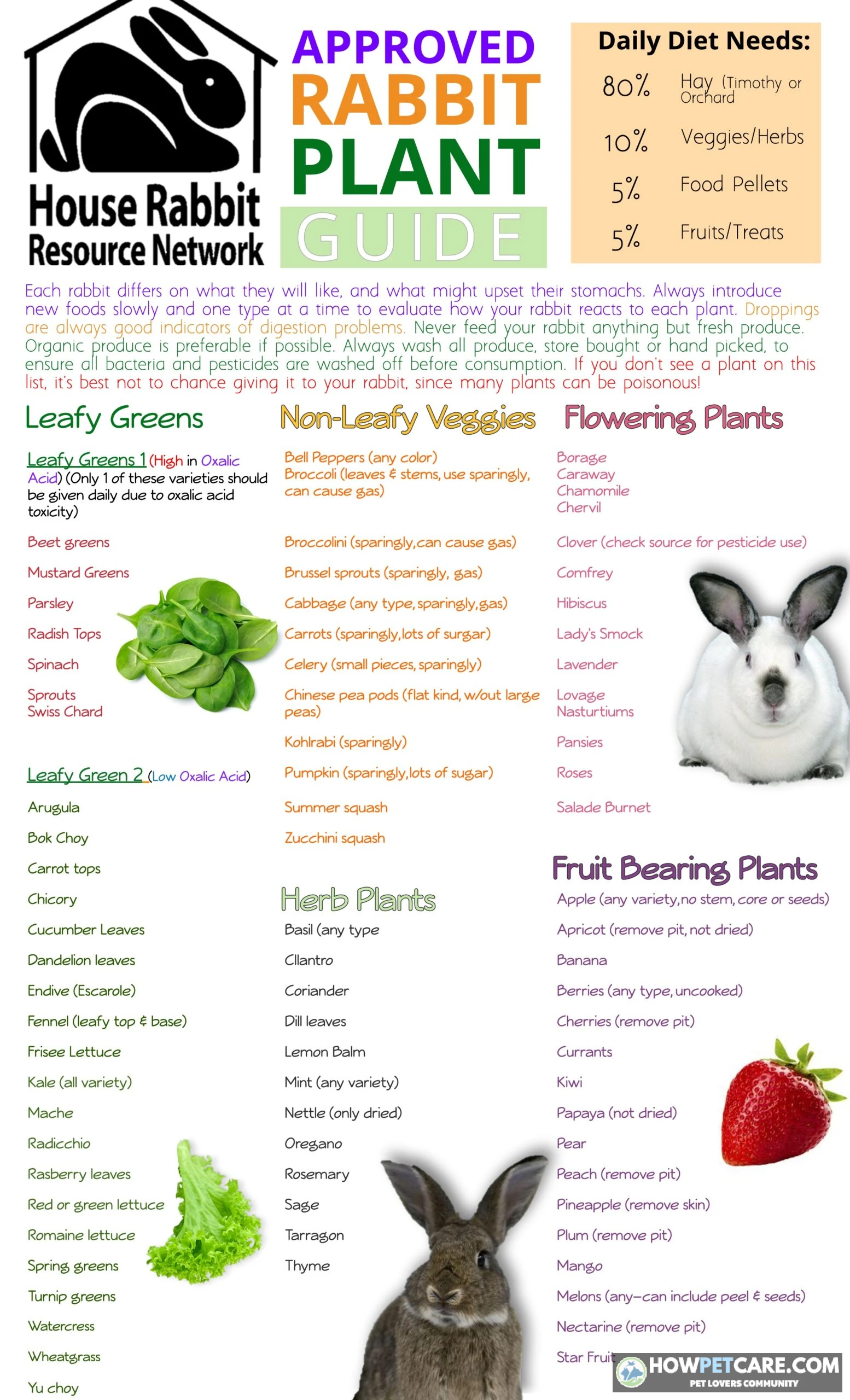

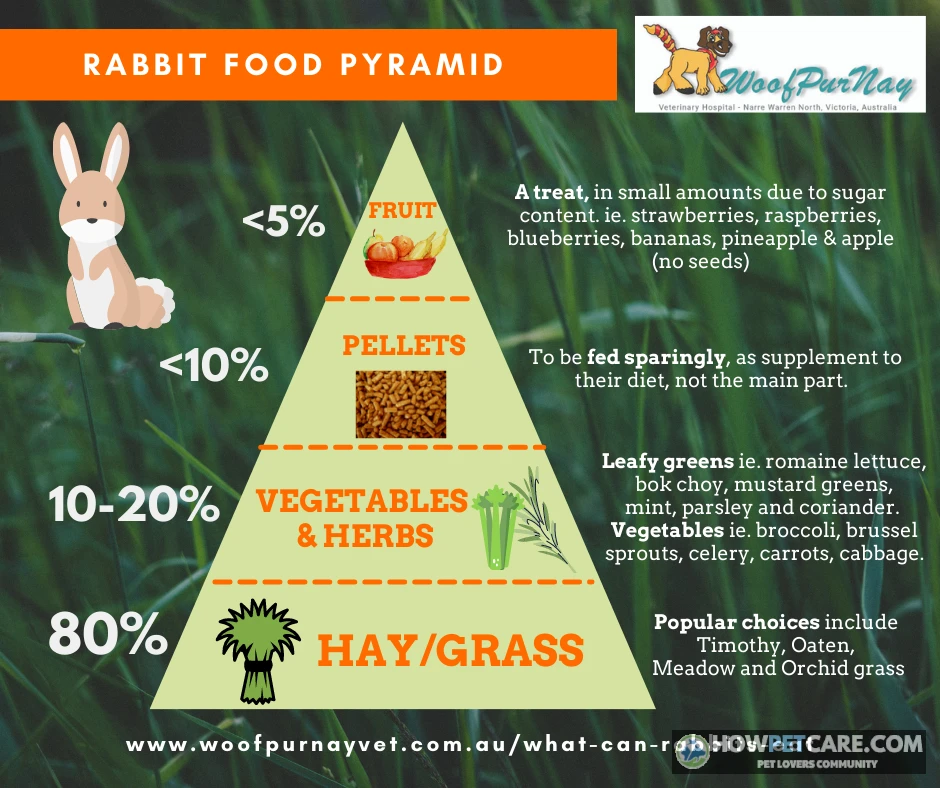
A healthy adult rabbit’s daily diet comes down to a simple ratio:
- ~85% grass hay — unlimited timothy or orchard, a body-size pile refilled twice daily
- ~10% fresh leafy greens — about 1 packed cup per 2 lb of body weight, split morning and evening
- ~5% plain timothy pellets — measured by weight, never free-fed
- Tiny treats — a teaspoon or two of fruit or carrot, a few days a week
- Unlimited fresh water — changed daily, ideally in a heavy ceramic bowl
What rabbits eat every day is simpler than the internet makes it look: about 85% grass hay, about 10% fresh leafy greens, about 5% plain pellet feed, a small treat allowance, and unlimited fresh water. This guide turns that ratio into a working bunny diet — exact portions by weight, a hay buyer’s comparison, safe and toxic food lists, water requirements, life-stage adjustments, and the appetite-loss signs that mean a same-day vet visit. Written for first-time owners in the US, especially families who just brought a rabbit home and need to know what goes in the bowl today.
What Bunnies Eat Every Day: The 85/10/5 Breakdown in Real Amounts
The one-sentence version for today’s bowl
Fill a rack with unlimited grass hay (timothy or orchard grass for a healthy adult), offer about 1 packed cup of fresh greens per 2 lb of body weight split across the day, measure pellets by weight (table in section 3), and keep treats to a teaspoon or two a few days a week. Refill hay morning and evening, and change water daily.
Why the ratio works: fiber, teeth and gut motility
Hay makes up roughly 80-85% of what bunnies eat in practice because the fiber requirement drives the whole system. Rabbit teeth grow continuously, and the circular side-to-side chewing of long-strand hay wears them down evenly; without it, serious dental disease follows. The same roughage keeps the gut moving, and a rabbit whose gut slows risks GI stasis, a potentially fatal slowdown that usually first shows up as a rabbit that stops eating. Wild rabbits graze 6-8 hours a day; a pet needs that same chewing time, which is why unlimited hay beats any measured ration.
Two normal oddities, briefly. Rabbits produce hard dry droppings plus soft moist cecotropes, which they eat directly to recover nutrients — normal, and never something to prevent. And the ‘what do bunnies eat and drink’ question has a second half: water, covered in section 6.
You will never measure 85% of anything. Weigh pellets on a kitchen scale, cup the greens, and keep hay unlimited. The ratio describes the bowl; it is not a recipe to calculate.
Concrete amounts, a full sample day, and adjustments come next.
Hay for Rabbits: Timothy, Orchard, Meadow, Oat or Alfalfa?
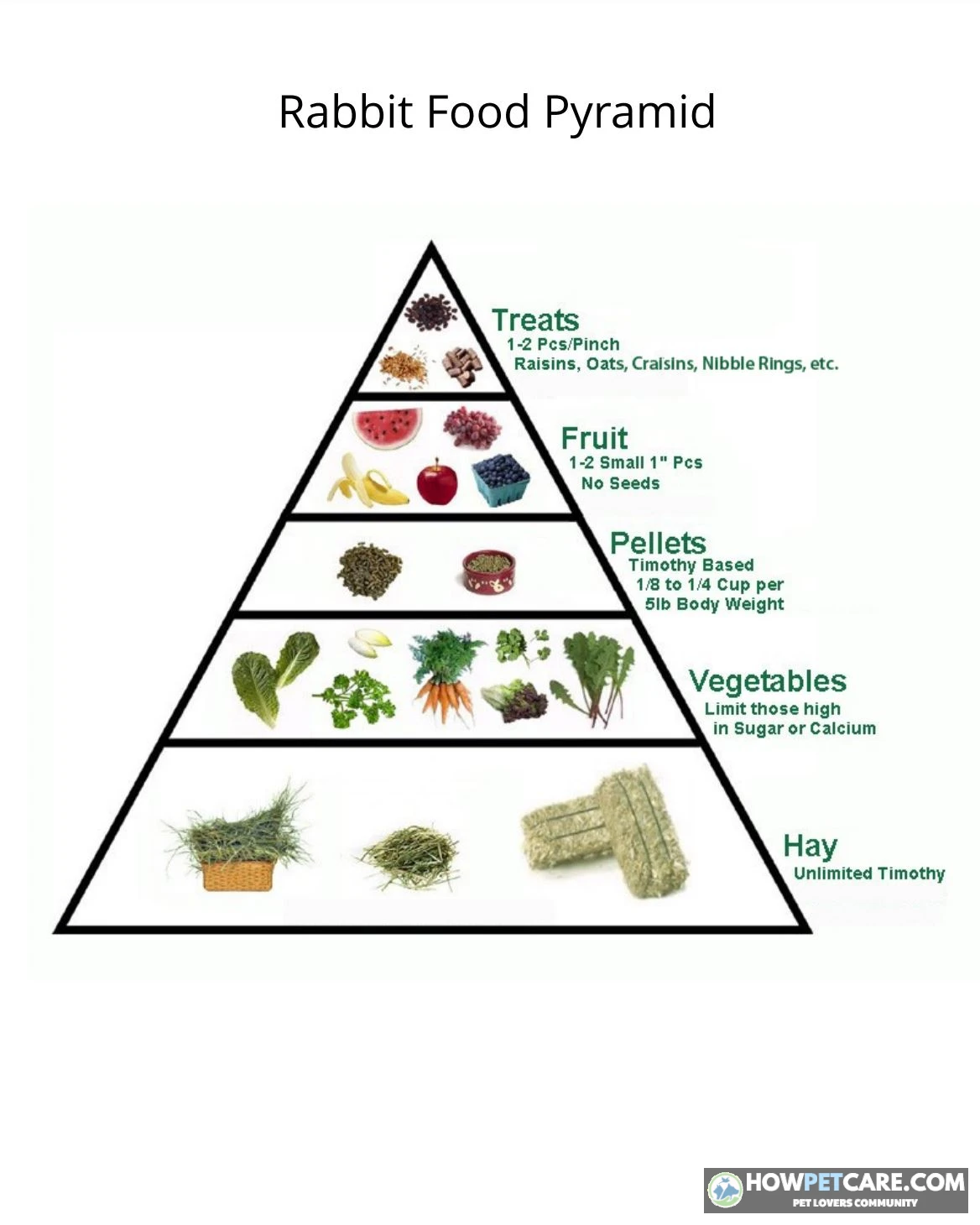
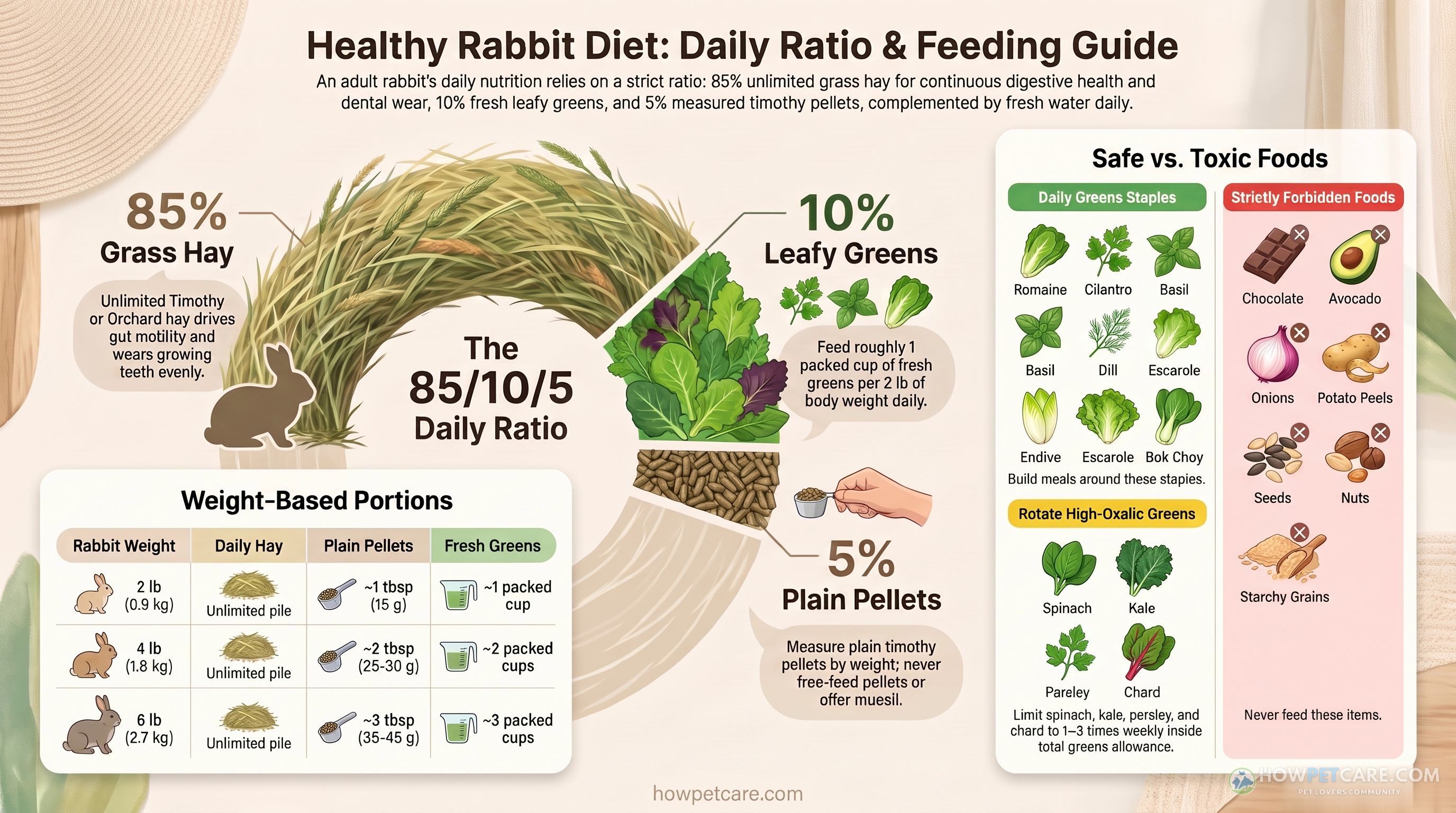
Hay is the bulk of the house rabbit diet, so the bale you buy matters more than the pellet brand. How much hay should a rabbit eat per day? Unlimited — a pile at least the size of the rabbit’s body, refilled at least once or twice daily, with hay available overnight.
Use this as a buyer’s shortcut, not a lab spec: exact nutrients vary by cut and supplier, so smell and look still matter.
| Hay type | Fiber | Protein | Calcium | Best for | Notes |
|---|---|---|---|---|---|
| Timothy | High | Moderate | Low-moderate | Most healthy adults | Classic adult staple; second cut is leafier, first cut is coarser for chewing. |
| Orchard grass | High | Moderate | Low-moderate | Adults; owners sensitive to timothy dust | Softer and often sweeter-smelling; useful for picky eaters. |
| Meadow | Variable, usually high | Variable | Low-moderate | Adults that like mixed textures | Blend of grasses; check for weeds, mold, or lots of seed heads. |
| Oat | High | Moderate | Moderate | Adults needing variety | Oat heads can be richer; feed as a mix-in, not the only hay. |
| Alfalfa | Lower fiber than grass hays | High | High | Kits, juniors, pregnant or nursing does, underweight rabbits under vet guidance | Not a daily staple for healthy adults; too rich for routine maintenance. |
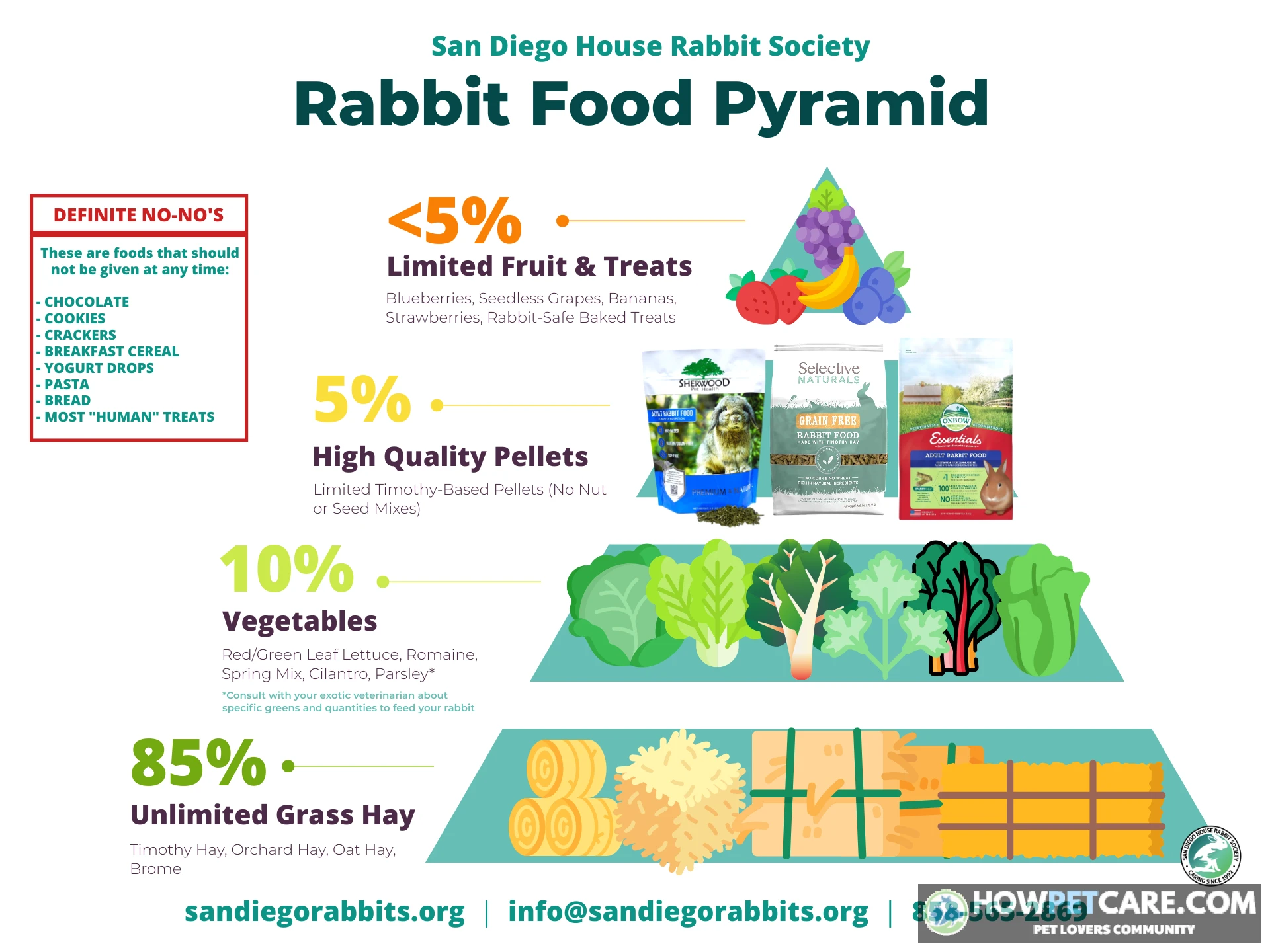
Quick pick: adult maintenance = timothy or orchard; bored or picky adult = timothy plus orchard or meadow mixed; growing junior = alfalfa until roughly 6-7 months, then transition to grass hay. Mixing two grass hays keeps variety and encourages eating. Hay cubes and hay-based treats are supplements, not substitutes for loose hay.
Quick buyer’s pick by age and situation
- Healthy adult: timothy hay or orchard grass hay.
- Picky eater or texture fatigue: a timothy-plus-orchard or meadow mix.
- Growing junior (under about 6-7 months): alfalfa hay with alfalfa-based pellets, then transition to grass hay.
- Dust-sensitive household: orchard grass hay tends to be softer and less dusty.
Alfalfa vs timothy: when each makes sense
Alfalfa hay is higher in protein and calories, which suits kits, growing juniors, pregnant or nursing does, and underweight rabbits under vet guidance. For healthy adults it is too rich: the extra calcium is linked to bladder stones and sludge. Timothy stays the adult staple; first cut is coarser for heavy chewers, second cut leafier for picky grazers.
Hay cubes and compressed treats help, but they do not replace loose long-strand hay. The tooth wear rabbits need comes from the chewing motion that loose hay produces.
How Much to Feed a Rabbit by Weight: Portion Table and Sample Day
These figures are starting points for healthy adults, not rules. Compare them with the label and your vet: welfare guidance includes PDSA’s 1 tablespoon a day under 3.5 kg and 2 tablespoons over, RSPCA UK’s roughly 25 g of pellets per kg of body weight, and PetMD’s 1/4 to 1/2 cup per 4-5 lb. The table below sits at or below those ceilings, because pellet needs vary with age, activity, and brand.
Daily portions by rabbit weight — hay stays unlimited at every size.
| Rabbit weight (lb / kg) | Hay | Pellets (grams / tbsp or cups) | Fresh greens (packed cups) | Treats (fruit / carrot) |
|---|---|---|---|---|
| 2 lb / 0.9 kg | Unlimited; fresh pile at least body-size | ~15 g / 1 tbsp | ~1 packed cup | Max ~1 tsp, a few days/week |
| 4 lb / 1.8 kg | Unlimited; refill AM + PM | ~25-30 g / 2 tbsp | ~2 packed cups | Max ~2 tsp, a few days/week |
| 6 lb / 2.7 kg | Unlimited; refill AM + PM | ~35-45 g / 3 tbsp (about 1/8 cup) | ~3 packed cups | Max ~1 tbsp, a few days/week |
| 8 lb / 3.6 kg | Unlimited; refill AM + PM | ~50-60 g / 4 tbsp (about 1/4 cup) | ~4 packed cups | Max ~1-1.5 tbsp, a few days/week |
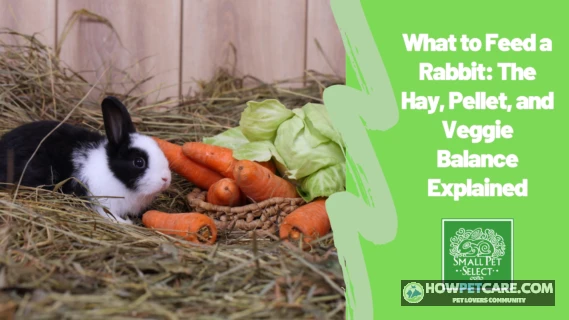
Welfare guidance often cites roughly 1-2 cups of greens per 4-6 lb of body weight, so treat the packed-cup column as a generous starting ceiling: trim greens before hay if your rabbit gains weight. Introduce new vegetables one at a time, in small amounts, over several days.
Pellets: what to buy and how much
Choose plain timothy-based pellet feed with 18-22% crude fiber, no colored pieces, no seeds, no muesli. Weigh the portion with a kitchen scale; tablespoons drift badly between brands.
Sample feeding schedule from morning to night
Worked sample day for a 6 lb / 2.7 kg adult:
- 7:30 AM: check the water bowl, refill the hay rack, offer 1.5 packed cups of greens (romaine + cilantro + a little kale).
- 8:00 AM: measured pellets, about 3 tbsp / 35-45 g.
- 1:00 PM: top up hay if the rack looks flat; droppings check while refreshing the litter area.
- 6:30 PM: second greens serving, 1.5 packed cups (endive + basil + a small amount of carrot tops).
- 8:00 PM: hay refill again; treat only on marked days, e.g. 1 tbsp of apple.
- Night: confirm water and a body-size pile of hay remain overnight.
Adjusting portions when weight changes
Weigh weekly. Feeling the spine and ribs beats the scale alone: gaining and lazy? Cut pellets and treats first, never hay. Losing weight on the adult diet? See the senior section before adding richness back, and loop in your vet. Droppings are the other dashboard: smaller, fewer, or misshapen pellets mean the gut is slowing down.
Best Vegetables and Safe Foods for Rabbits (with Serving Guidance)
When new owners ask what can rabbits eat besides hay, the answer is fresh vegetables built on leafy greens first, other vegetables second, fruit last. Serving shorthand: a ‘cup’ means loosely packed leafy greens; treat sizes assume an average 5-6 lb rabbit. Introduce any new food one at a time.
| Category | Feed this way | Foods | Portion guardrail |
|---|---|---|---|
| Daily staple greens | Build most veg intake here; aim for 3+ kinds/day | Romaine, green/red leaf lettuce, cilantro, basil, dill, endive, escarole, bok choy, carrot tops, mint | ~1 packed cup per 2 lb body weight/day, split AM/PM |
| Rotate, don’t daily | Higher oxalic acid or calcium, stronger flavors | Spinach, parsley, chard, beet greens, kale, mustard greens | Small amounts 1-3x/week inside the greens total |
| Occasional treat | Sugary; reward, not staple | Carrot, apple (no seeds), banana, berries, pear, peach (no pit) | ~1 tsp-1 tbsp depending on size, a few days/week |
| Never feed | Toxic or predictable gut trouble | Chocolate, avocado, onion/garlic/leek/chive, rhubarb leaves, potato sprouts/green peels, beans, bread/crackers/cereal/rice/pasta, seeds/nuts, muesli mixes, iceberg-heavy meals | 0; if eaten, call exotic vet/poison line promptly |
| Caution plants | ‘Natural’ still unsafe | Lily, tulip/daffodil bulbs, foxglove, ivy, oleander, yew, tomato leaves | Assume unsafe unless a rabbit-safe source confirms otherwise |
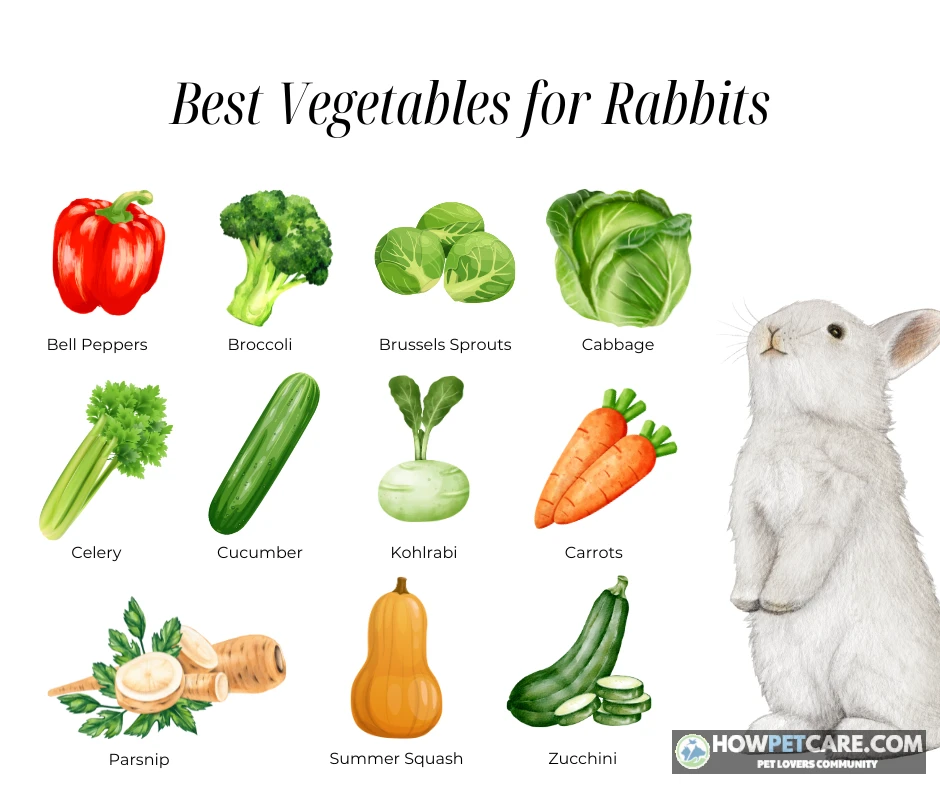
This is the rabbit food list to pin inside the pantry door.
-
Wash and dry one new green
Rinse it well and serve it dry; wet greens spoil faster and can loosen stool.
-
Offer a thumbnail-sized portion alone
Introduce only one new food at a time so you know which one caused any problem.
-
Wait 24-48 hours and check droppings
Normal droppings and energy? Add it to the rotation. Loose stool? Pull it and call your vet if it persists.
Daily greens vs occasional greens
Aim for at least 3 kinds a day from the daily-staple row — romaine lettuce, cilantro, basil, endive, and bok choy rotate well. Greens higher in oxalic acid (spinach, parsley, chard, beet greens) or calcium (kale, mustard greens) get rotated in small amounts a few times a week instead of daily, which keeps the oxalic acid and calcium load reasonable without banning nutritious plants.
Fruits and treats: how much is too much
Yes, rabbits can eat carrots — but carrots as treats, not staples: they are sweeter and lower in fiber than the myth suggests. Rabbit-safe fruits follow the same rule: about a teaspoon for a small rabbit, up to a tablespoon for a large one, a few days a week. Keep total treats within about 5-10% of intake, and skip sugary yogurt drops entirely. Non-leafy vegetables (pepper, broccoli stem, zucchini) cap at about 2 tablespoons a day.
Foods Rabbits Should Never Eat
Toxic foods and plants
Chocolate; avocado; onion, garlic, leeks and chives; rhubarb leaves; potato sprouts and green peels; raw or dried beans; tomato leaves and plants; apple seeds; and toxic houseplants and garden plants such as lily, tulip and daffodil bulbs, foxglove, ivy, oleander and yew. ‘Natural’ does not mean safe — many ornamental plants are poisonous to rabbits.
Foods that aren’t poisonous but cause gut trouble
Bread, crackers, cereal, rice, pasta, seeds and nuts, muesli mixes, and iceberg-heavy salads: starchy or sugary human foods wreck the gut, drive obesity, and wear teeth wrong. Muesli specifically invites selective feeding — rabbits eat the sugary bits and leave the fibrous ones, leading to deficiency, obesity and dental disease. Iceberg lettuce and cabbage-family foods are disputed rather than proven poisons; they add little and can cause gas, so avoid or strictly limit them.
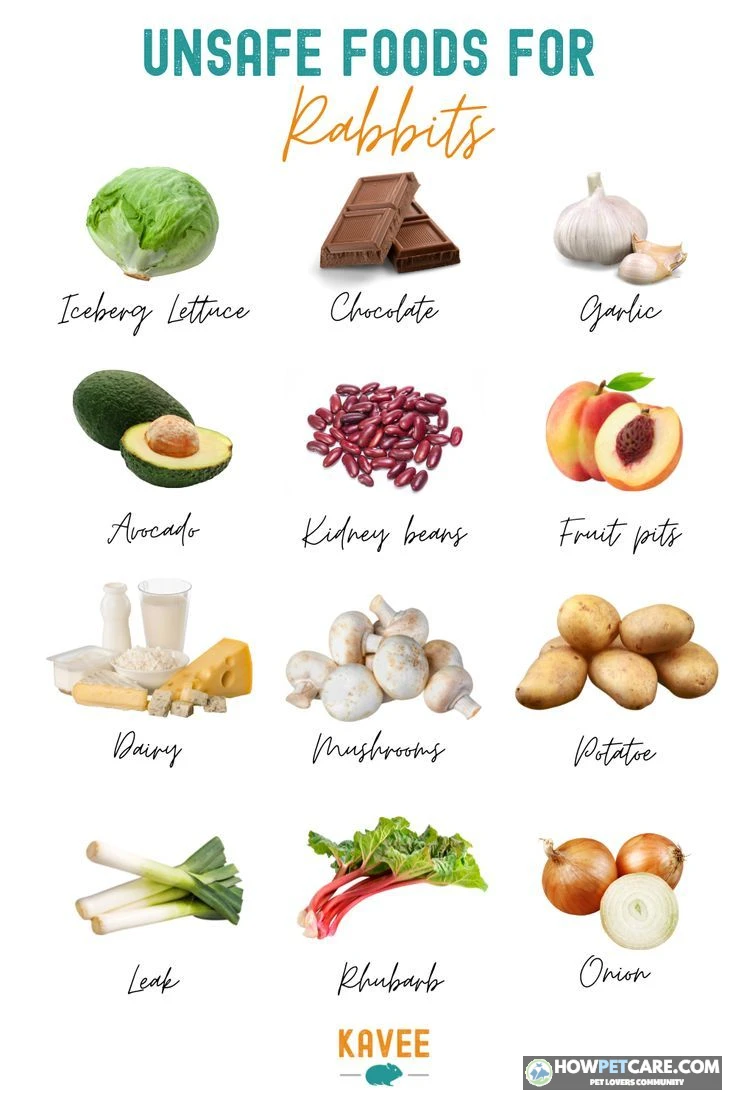
Call an exotic-pet vet or a poison hotline immediately, even before symptoms appear. Note what and how much was eaten, and do not wait overnight to see whether signs develop.
Water for Rabbits: Daily Amounts and Bowl vs Bottle
How much water a rabbit drinks
The range usually cited is roughly 50-150 ml per kg of body weight per day — about 1.5-4.5 oz for a 5 lb rabbit — but real intake swings with heat, how many water-heavy greens your rabbit eats, and pellet intake. Pregnant or nursing does drink more. Signs of too little: thick saliva, scant urine, appetite dropping — call the vet.
Bowl or bottle?
A heavy ceramic bowl wins on drinking posture and total intake; scrub it daily because food and fur collect in it. A bottle works but check the valve every day by pushing the ball and watching for drips, and watch for leaks that soak bedding. Offer both during the first week in a new home. Fresh water daily; in summer, check twice; in winter, watch bottles freeze and switch to a wide indoor bowl.
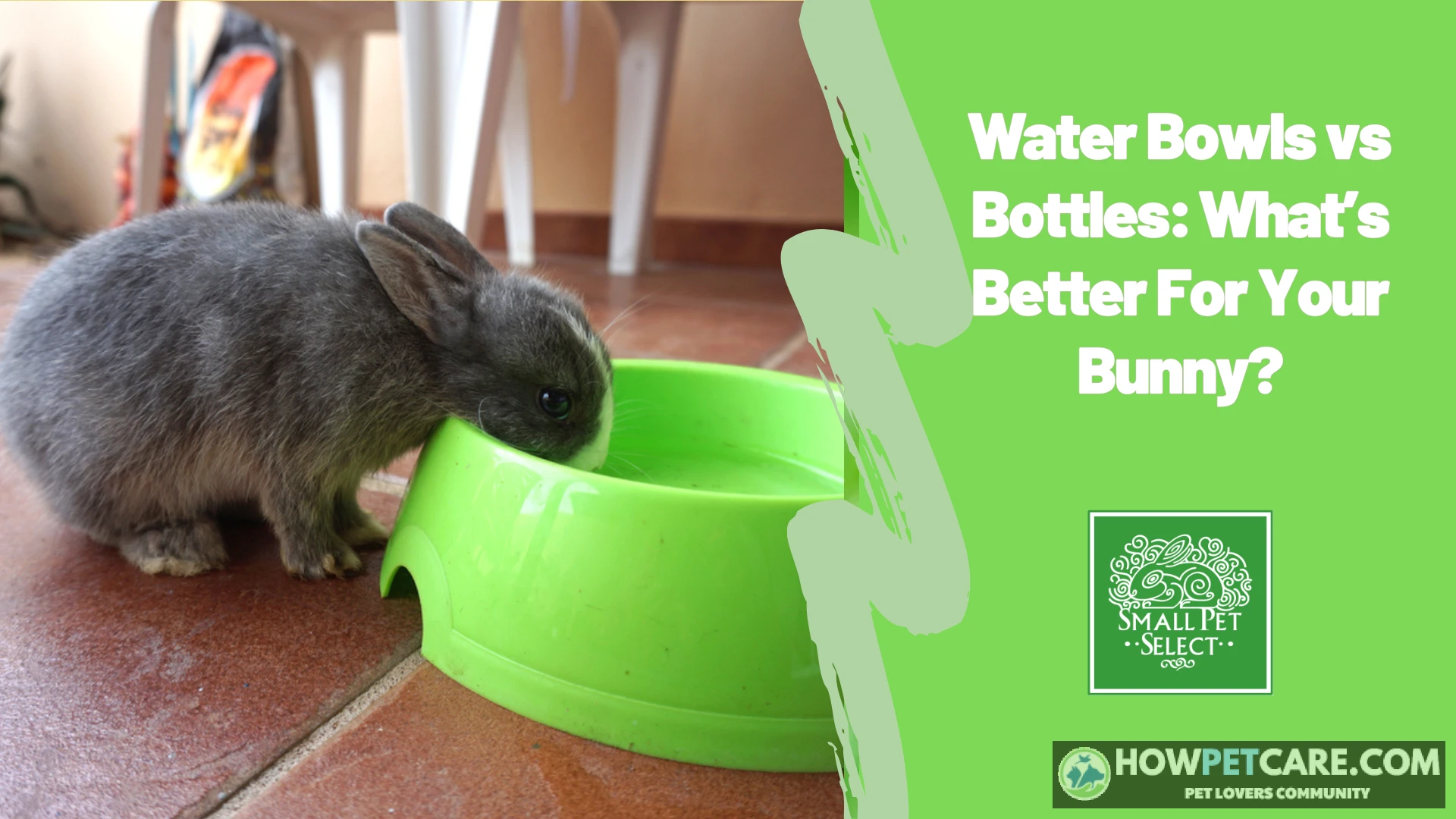
Offer a bowl and a bottle for the first week. Some rabbits arrive bottle-trained, some bowl-trained; whichever they drink more from wins.
What Baby, Adult and Senior Rabbits Eat
What do pet rabbits eat as they age? The same base, adjusted.
Baby bunnies (0-12 weeks)
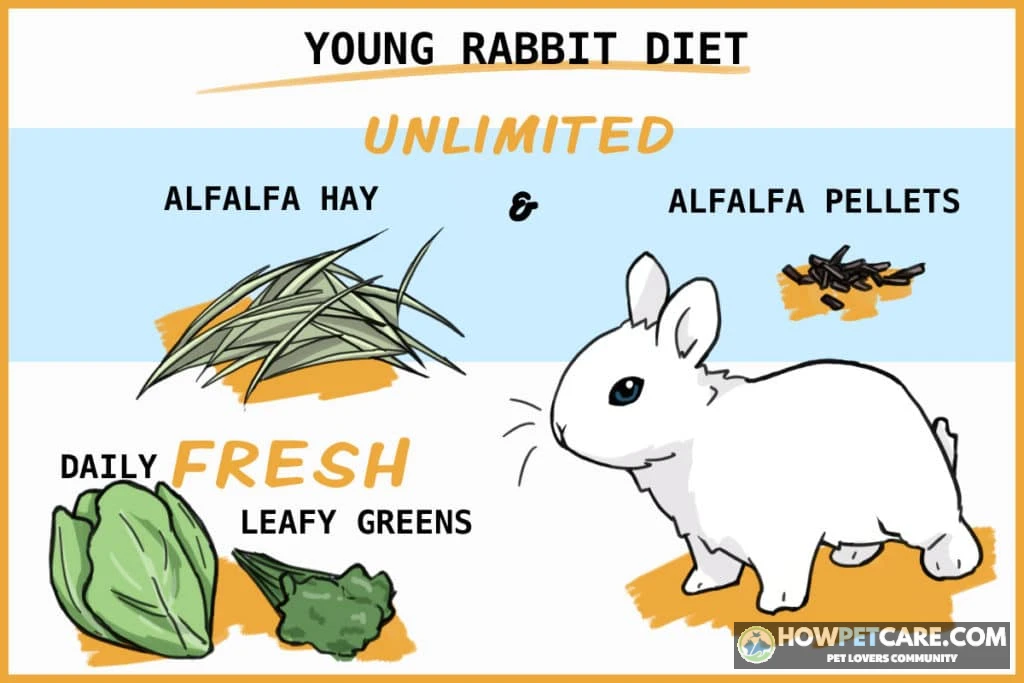
Mother’s milk until about 3 weeks, then gradual alfalfa hay and alfalfa pellets, with small greens introductions after weaning. Orphaned kits need a vet or wildlife rehabilitator — cow’s milk is wrong and dangerous, not a substitute.
Juniors and adults
Juniors stay on alfalfa-based pellets and alfalfa hay until roughly 6-7 months, then transition over 2-3 weeks to a timothy-based adult diet by mixing hays and shifting pellets. Adults hold the 85/10/5 maintenance diet; after spay or neuter, metabolism often slows, so watch weight and trim pellets before anything else.
Senior rabbits losing weight
Older rabbits drift toward dental pain, which makes hay hard to chew, and toward weight loss. Soften the routine: more frequent vet dental checks, palatable greens, soaked or softer hay offerings, and — only under vet guidance, and only if the rabbit is underweight — a richer pellet portion or a little alfalfa hay. Senior diets are condition-specific, never a blanket rule.
What Wild and Backyard Bunnies Eat, and Whether You Should Feed Them
Wild bunny diet by season
Wild bunnies eat grasses, clover, weeds, leaves, and stems in spring and summer; in winter they switch to bark, twigs, buds, and dried grasses, still grazing 6-8 hours when conditions allow. That is a wild digestive system built for constant roughage, not a pet menu.
Should you feed a backyard rabbit?
Generally no. Feeding encourages dependence, concentrates animals where disease and predators find them, and can break local rules. If you want to help in winter, leave natural cover, brush piles, and browse instead of tossing vegetables. A pet rabbit cannot forage like a wild one: lawns carry pesticide and fertilizer residue, unknown plants are a gamble, and mower clippings ferment fast.
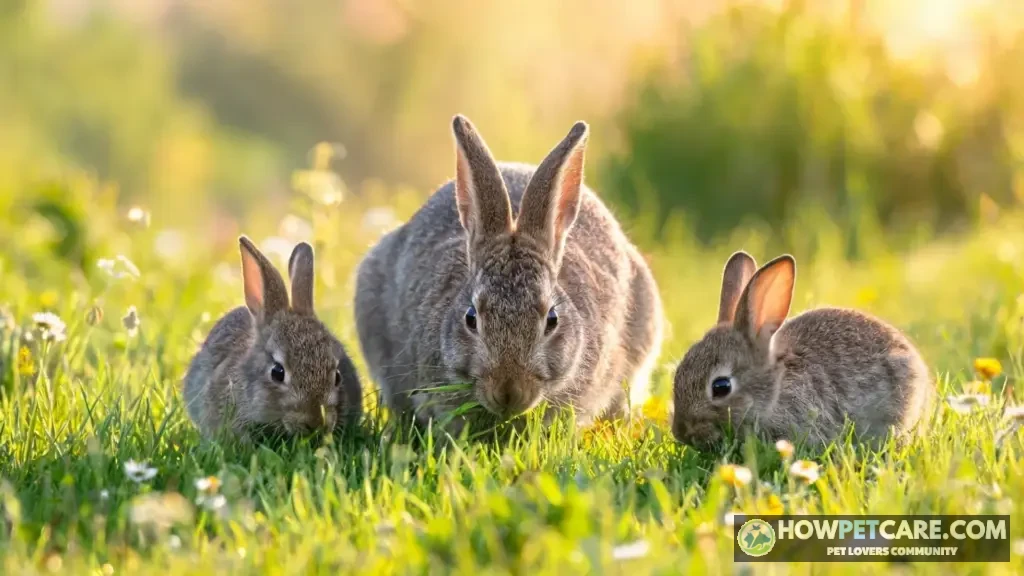
Leave it alone unless it is injured or cold; the mother usually feeds at dawn and dusk and returns. Call a wildlife rehabilitator for guidance rather than feeding it yourself.
Hay Quality, Storage and Monthly Feeding Cost
How to spot moldy or poor hay
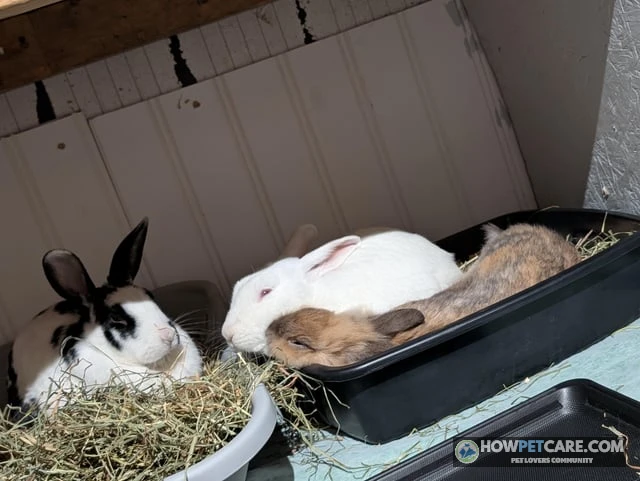
Good hay: green to golden, sweet-smelling, dry, long strands, little dust. Bad hay: musty, moldy patches, damp, brown, dust clouds when moved — discard it; moldy hay can trigger respiratory and digestive problems. Store a bale or bag cool, dry, ventilated, off the floor; never seal damp hay in plastic. Buy about 4-6 weeks of supply and check bag bottoms first.
Monthly cost breakdown
Approximate 2026 US cost for one 5-6 lb adult on the standard hay-based diet; region and bulk access swing the totals. Litter and vet costs stay separate from food.
| Item | Typical monthly amount | Estimated cost range | Money-saving tip |
|---|---|---|---|
| Grass hay | ~6-10 lb eaten/available; unlimited means waste happens | Pet-store bags: $25-60. Bulk 25-50 lb farm/online box averaged monthly: $10-25 | Buy a bale or large box, split with another rabbit owner, store dry/off floor |
| Pellets | ~1.5-3 lb for measured adult portions | $8-18 | Choose plain timothy pellets; skip muesli and colorful mixes |
| Fresh greens | ~5 packed cups/week, rotating 3+ kinds | $20-45 | Use grocery greens in season; prioritize romaine/cilantro over clamshell ‘gourmet’ mixes |
| Treats | Small fruit/carrot amounts | $3-10 | Use part of normal produce; don’t buy sugary rabbit yogurt drops |
| Water/storage misc. | Bowl washing, hay bin, small containers | $2-8 averaged | A sturdy ceramic bowl beats replacing chewed bottles |
Working total: roughly $38-108/month buying hay in pet-store bags, or $23-78/month when bulk hay is practical. If a bale quote looks too cheap, check dust, mold, and delivery fees first.
A 25-50 lb bale or box from a farm supplier or online usually halves hay costs versus pet-store bags, provided you have dry storage and someone to split it with.
Picky Rabbit? How to Move a Pellet-and-Treat Lover onto Hay (and When Not Eating Is an Emergency)
A pellet-addicted rabbit does not fix itself, but a gradual taper usually works in about two weeks. Dental pain is the other cause of hay refusal — a rabbit that drops food, drools, or loses weight while ‘picky’ needs a vet exam, not a menu change.
A 4-step transition plan for pellet-and-treat lovers
-
Measure, then taper pellets
Weigh the current pellet portion for two days, then cut it about 10-25% every 3-4 days until you reach the adult target for your rabbit’s weight.
-
Remove the slot-machine foods
Stop muesli, seed mixes, colored bits, yogurt drops, and daily fruit; keep one tiny treat hidden in the hay as a training tool.
-
Make hay easy and interesting
Refill a body-size pile twice daily, offer 2-3 hay types side by side for a week, keep hay near the litter area, and try a light mist or hay stuffed into a cardboard tube.
-
Score progress for 14 days
Track hay-pile disappearance, dropping size and number, and weight. Hay up and weight stable means continue; weight down or droppings smaller means stop the taper and call the vet.
Appetite-loss triage: normal, watch, emergency
Normal picky: eats hay and greens, ignores some pellets, normal droppings and energy — keep the routine. Watch closely: eating noticeably less for 4-8 hours, smaller droppings, still bright — remove treats, offer favorite safe greens, recheck within a few hours; call the vet if not improving. Emergency: no food interest for 8-12 hours, very few or no droppings, hunched or bloated, quiet, teeth grinding, or rapid breathing — possible GI stasis or dental crisis; contact an exotic vet now. Offer water, keep warm on the way, and do not force-feed unless the vet directs it.
Never wait out an emergency overnight: gut stasis moves fast, and the difference in outcomes is hours, not days.

Your Rabbit Feeding Checklist and 7-Day Rotation
7-day greens rotation — keep daily totals inside the packed-cup column from section 3; kale, spinach, parsley and chard count as rotate foods.
| Day | Greens rotation (split AM/PM) | Treat |
|---|---|---|
| Mon | Romaine + cilantro + basil | — |
| Tue | Green leaf lettuce + dill + endive | — |
| Wed | Romaine + mint + bok choy | 1 tsp apple |
| Thu | Cilantro + escarole + carrot tops | — |
| Fri | Romaine + basil + small handful kale | — |
| Sat | Red leaf lettuce + dill + endive | 1 tsp blueberries |
| Sun | Romaine + cilantro + mint | — |
Shopping list: timothy plus orchard or meadow hay; plain timothy-based pellets; 3+ rotating greens with romaine and cilantro as anchors; heavy ceramic bowl plus a spare bottle; kitchen scale; ventilated hay bin.
Daily checklist: hay refilled AM and PM; water changed and bowl scrubbed; greens cupped and pellets weighed; droppings checked for size, number, and cecotropes.
Weekly check: weight, teeth, coat, and hay stash. Call the exotic-pet vet when anything moves — weight, droppings, appetite — rather than waiting for the next routine visit.
Your next step is one shopping trip and one calendar note: weigh your rabbit this week, write the number down, and set the pellet scoop to match. Everything else in this plan holds steady from there.
1An adult house rabbit is currently healthy and maintaining a stable weight. Which of the following hay options is recommended as the primary daily staple?
Timothy hay provides high fiber and low-to-moderate calcium, making it an ideal long-strand staple for adult maintenance.
2Which of the following items should be strictly excluded from a rabbit's diet due to severe toxicity or the risk of fatal gut disruption?
Avocado contains toxic compounds dangerous to rabbits and must never be fed.
3How does eating long-strand grass hay help prevent serious dental disease in pet rabbits?
Rabbit teeth grow constantly, and the circular side-to-side mechanical grinding of loose hay strands maintains proper dental length and wear.
4A rabbit owner is creating a weekly salad menu. Which green should be rotated in small amounts 1 to 3 times a week rather than served every day, due to higher oxalic acid content?
Spinach contains higher levels of oxalic acid, so it should be rotated occasionally rather than fed as a daily staple.
5Which of the following dietary practices are appropriate when raising a growing junior rabbit under 6 to 7 months of age?
Alfalfa hay supplies the extra energy, protein, and calcium needed for bone and tissue development in young rabbits.
6Before starting a gradual pellet reduction plan for a 'picky' rabbit that refuses to eat hay, what crucial step must be taken first?
Rabbits often stop eating hay because overgrown teeth or oral pain make chewing coarse strands painful, requiring medical treatment before dietary changes.
FAQ
Do rabbits need pellets, or is hay enough?
Hay is the essential staple, and many healthy adult rabbits do well on hay plus fresh greens with a small measured portion of plain pellets. Pellets help fill nutritional gaps, but they should stay a small part of the diet.
Can rabbits eat lettuce?
Romaine and other dark leafy lettuces are fine in moderation. Avoid iceberg lettuce, which offers little nutrition.
Can rabbits eat bread, crackers or cereal?
No. These starchy human foods can upset the gut and contribute to obesity and digestive problems.
What do bunnies eat in the winter?
Pet rabbits eat the same diet year-round: unlimited hay, greens, and measured pellets. Wild rabbits switch to bark, twigs, buds, and dried grasses.
Can rabbits eat grass from the lawn?
Fresh untreated grass is a natural food, but avoid lawns treated with pesticides or fertilizer and don’t offer clippings from a mower, which ferment quickly.
How often should I give my rabbit treats?
Keep treats to a small amount a few times a week at most. Choose fruit or carrot in tiny portions over commercial sugary treats.