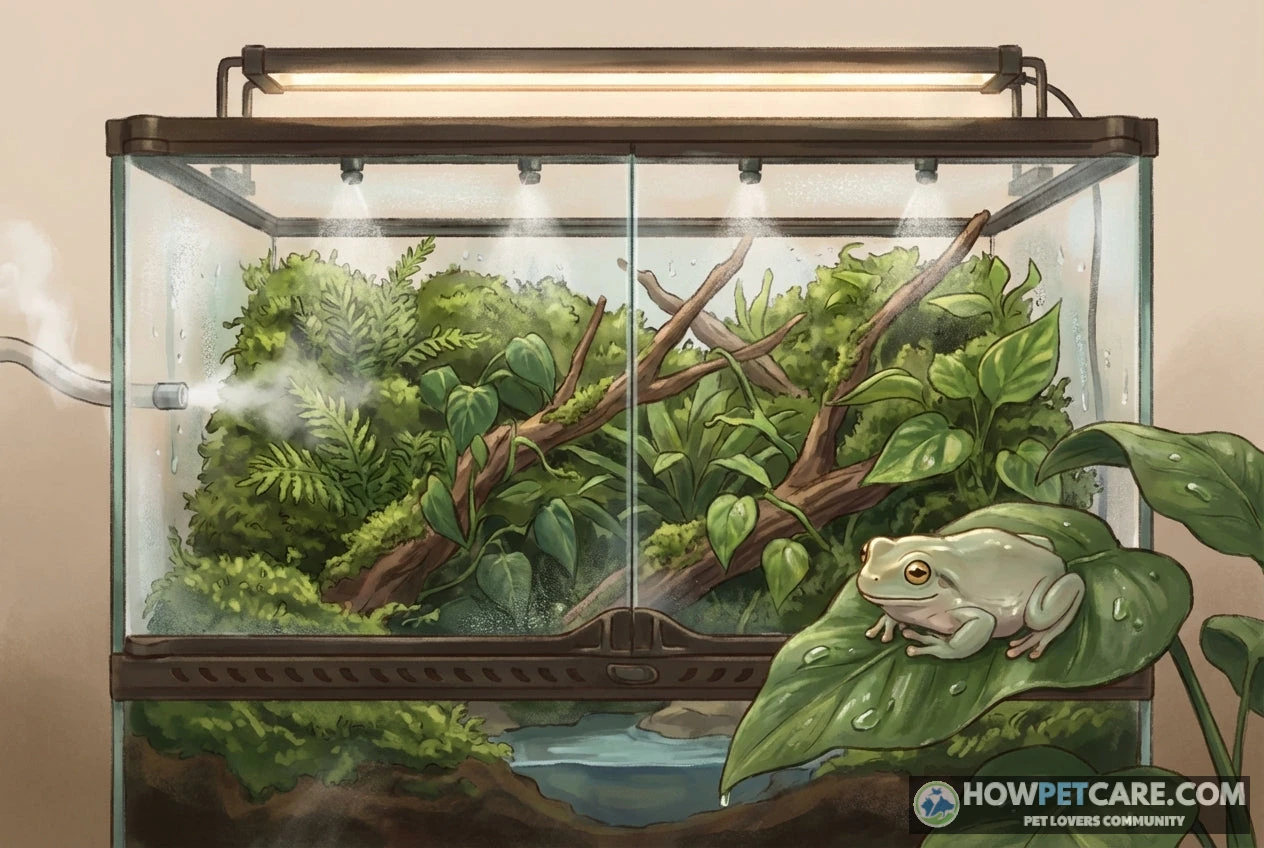

Caring for a pet frog comes down to a repeatable routine:
- Pick the species first and match the enclosure to it — tall for tree frogs, floor space for pacman frogs, a filtered aquarium for aquatic frogs.
- Hold the right environment: a warm/cool temperature gradient, species-appropriate humidity, and a consistent 10–12-hour light cycle.
- Use only treated water — conditioner that neutralizes chlorine and chloramine — for dishes, misting, and water changes.
- Feed appropriately sized live insects (or species-specific aquatic food), gut-loaded and dusted per a vet-directed supplement plan.
- Clean on a schedule: fresh dish water daily, weekly spot-cleaning, and regular water testing for aquatic setups.
- Limit handling, wash hands, and keep an amphibian-experienced vet lined up before you need one.
Choose the frog before buying the tank. A climbing White’s tree frog, a burrowing pacman frog, and an aquatic African dwarf frog need different homes. For a first-time owner who wants a climbing display animal, a captive-bred White’s tree frog is a reasonable choice. A pacman frog suits someone with less vertical space who is happy with a relatively inactive pet. Both are primarily look-don’t-touch animals, and both require daily checks and long-term care.
This frog care guide compares beginner options, walks through an enclosure build, and covers water, feeding, cleaning, and budget decisions. Use the figures as planning starting points, not interchangeable prescriptions. Before buying a frog, confirm its exact species’ needs with an amphibian-experienced veterinarian and a reliable species-specific care sheet.
Choose Your Frog First: Which Beginner Species Fits Your Budget, Space, and Time
An enclosure should match the frog’s way of life: tree frogs need height and climbing surfaces, pacman frogs need floor space and burrowing substrate, and African dwarf frogs need a properly managed aquarium.
Best beginner frogs compared side by side
Start with the space you have and the work you’re willing to do:
- Pacman frog: A solitary, burrowing frog for someone comfortable with live insects and a pet that may spend much of its time buried.
- White’s or American green tree frog: A better fit if you want a climbing display animal and have room for a tall enclosure.
- Dart frog: An option for a keeper prepared to manage high humidity, ventilation, and very small live feeders. It isn’t the easiest first frog.
- African dwarf frog: A fully aquatic option for someone willing to learn aquarium cycling and water testing.

Which species need UVB and which can do without it
A modern husbandry source recommends low-output UVB for White’s tree frogs and pacman frogs, while another veterinary source describes modest UV exposure as potentially helpful rather than universally mandatory. Discuss that difference with an amphibian veterinarian, along with your exact species, lamp, and supplement plan. Don’t assume one bulb or supplement schedule works for every frog.
Keepers also commonly provide low-level UVB for terrestrial dart frogs and green tree frogs. Whether it’s essential depends on the species and its complete diet; don’t substitute a generic bulb for a species-specific plan. An African dwarf frog can have an ordinary day/night light cycle without a dedicated UVB lamp, provided its diet and care are appropriate.
Match the frog to your tolerance for hands-off care
Frogs have sensitive skin and generally tolerate little handling. If a child wants a pet to carry around, choose another animal. An adult should be ready to manage feeders, equipment, cleaning, and veterinary decisions for years. A simple, well-maintained enclosure can work; a bioactive vivarium with live plants and a cleanup crew is an optional upgrade, not a prerequisite.
Beginner Frog Species Comparison: Tank Size, Temperature, Humidity, Diet, Lifespan, Difficulty
The table offers conservative planning starting points for healthy adults; it isn’t a substitute for a care sheet. Temperatures describe the enclosure’s usable air range unless otherwise stated. A warm area and cooler retreat matter more than making every corner identical. Humidity is relative humidity. Before buying equipment, check the species’ adult size, sex, local availability, and specific housing needs.
| Species | Minimum enclosure size | Temperature: day / night | Humidity | Primary diet and adult feeding frequency | Typical lifespan | UVB | Difficulty |
|---|---|---|---|---|---|---|---|
| White’s tree frog | 20-gallon tall enclosure for one adult | 75–85°F / 65–72°F | 50–70% | Gut-loaded crickets or roaches; generally every 2–3 days | 15–20 years | Low-output UVB recommended | Beginner |
| Pacman frog, also called Argentine horned frog | 10–20-gallon horizontal enclosure for one; allow deep substrate | 75–85°F / 70–75°F | 60–80% | Appropriately sized insects; adults commonly 1–2 times weekly | 10–15 years | Low-output UVB recommended; discuss alternatives with a vet | Beginner |
| American green tree frog | At least 12 × 12 × 18 inches for one small adult | 70–80°F / 65–70°F | 50–70% | Small crickets and other suitable insects; generally every 1–2 days | 5–8 years | Low-level UVB can be provided; confirm setup and diet with a vet | Beginner to moderate |
| Dyeing dart frog, Dendrobates tinctorius | At least 18 × 18 × 18 inches for a compatible pair; more space is useful | 70–78°F / 65–72°F | 80–100%, with ventilation | Flightless fruit flies and other tiny cultured prey; daily or every other day | 10–15+ years | Low-level UVB can be provided with shaded retreats | Moderate |
| Fire-bellied toad | At least 10 gallons for a small group, with accessible land and water | 70–78°F / 60–68°F | Moist land area and clean water; avoid stagnant conditions | Small crickets and suitable worms; generally every other day | 10–15 years | Low-level UVB may be provided; confirm the diet plan | Beginner to moderate |
| African dwarf frog | At least 5 gallons, fully aquatic and filtered | Water 72–78°F / 72–78°F | Not applicable: fully aquatic | Suitable sinking aquatic-frog food and varied species-appropriate foods; generally daily or every other day | About 5 years, sometimes longer | Dedicated UVB generally not required | Moderate: water management |
The supplied husbandry guidance supports the White’s and pacman enclosure orientations, their common beginner status, and the 50–70% and 60–80% humidity ranges respectively. The other figures are practical starting estimates, not verified values from that guidance; consult a species-specific source before relying on them. Individual frogs and care recommendations vary.
A White’s tree frog needs sturdy climbing branches and may grow larger than a new keeper expects. Skip a pacman frog if you want an active animal, and skip a delicate green tree frog (see green tree frog care basics) if handling matters to you. Dart frogs need dependable supplies of tiny feeders. Fire-bellied toads have irritating skin secretions, so careful hygiene matters. An African dwarf frog isn’t a good fit if you don’t want to maintain and test an aquarium.
Keep a pacman frog alone. Don’t mix species, and don’t assume frogs of the same species can share an enclosure. Research compatibility, space, feeding competition, and quarantine first.

 You might be wonderingChinchilla care guideChinchilla Care Guide: Setup, Costs, Vet Care & Daily RoutineRead the answer
Temperature, Humidity, and UVB Lighting: Setting the Right Environment
Building a thermal gradient
Measure conditions where the frog actually rests, in both warm and cool areas. Use digital thermometers with probes; a separate surface-temperature reading can help you identify an overheated perch. Check the table for a starting range, then verify it for your frog.
Your room may already provide suitable temperatures. Heat lamps can overheat small enclosures, so don’t install a powerful lamp by default. If extra heat is necessary, choose a species-appropriate source and control it with a thermostat. Keep the frog from touching the heater and follow the equipment instructions. Heat mats can create hot spots, particularly under a burrowing frog, so place them carefully and measure the substrate temperature. Never use a heat rock. All heat sources should be thermostat-controlled.

Humidity control without constant misting
Put a digital hygrometer where it measures the frog’s living space, not directly in the mist stream or against a wet wall. Use treated water, moisture-retaining substrate where appropriate, and ventilation suited to the species. Mist according to the readings rather than a fixed number of sprays. An enclosure can be humid without being waterlogged or airless.
High humidity does not mean zero ventilation. Persistent condensation, foul smells, or saturated substrate are reasons to reassess drainage, airflow, and cleaning.
UVB: when it is needed and when it is optional
UVB exposure and dietary vitamin D3 both affect the supplement plan. One modern guide recommends low-output UVB for both White’s tree frogs and pacman frogs. Provide shaded hides, place the lamp outside the animal’s reach, and follow the manufacturer’s distance instructions for the actual fixture and mesh. Bulb strength alone doesn’t tell you what reaches the frog. An appropriate UV meter is useful when available.
Use a timer for a consistent day/night cycle; approximately 10–12 hours of daytime lighting is a common starting point. Provide darkness at night instead of leaving a colored viewing light on. Replace UVB bulbs according to the manufacturer’s schedule, even if they still glow. Ask your vet how the lamp changes the need for dietary D3.

How to Set Up Your First Frog Tank at Home: Step-by-Step Checklist With Itemized Costs
Shopping list in buying order
These are illustrative U.S. planning allowances for 2026, not verified retailer quotes. Prices vary by region, retailer, enclosure size, and whether equipment is bundled. Choose a species before picking a column: the least expensive enclosure may not meet its needs.
| Item | Why you need it | Budget option | Mid-range option | Upgrade option | Must-have or nice-to-have |
|---|---|---|---|---|---|
| Enclosure and locking lid | Correct floor space or height; escape prevention | $30–$70 | $120–$200 | $250–$400 | Must-have |
| Digital thermometer and hygrometer | Check temperature and humidity | $15–$25 | $25–$45 | $50–$80 | Must-have for terrestrial setups |
| Thermostat and heat source | Control supplemental heat if the room is unsuitable | $30–$50 | $60–$95 | $100–$160 | Conditional; both required if heating |
| UVB fixture and bulb | Species-appropriate UVB provision | $40–$65 | $70–$110 | $120–$160 | Include when recommended for your plan |
| Substrate | Provides appropriate footing, moisture, or burrowing depth | $5–$10 | $15–$25 | $40–$80 | Must-have for the chosen setup |
| Hides, plants, and climbing material | Shelter and species-appropriate enrichment | $15–$30 | $30–$60 | $60–$120 | Suitable cover is essential |
| Shallow water dish | Access to treated water for terrestrial frogs | $5–$10 | $10–$20 | $20–$30 | Must-have for terrestrial setups |
| Spray bottle and water conditioner | Misting and treatment of tap water | $10–$20 | $20–$35 | $35–$50 | Must-have when using tap water and misting |
| Timer | Consistent lighting cycle | $8–$15 | $15–$25 | $25–$40 | Strongly recommended |
| Aquarium filter, heater, and liquid test kit | Maintain and monitor an aquatic habitat | $55–$85 | $85–$130 | $130–$200 | Must-have for the aquatic setup as appropriate |
| Live plants and cleanup crew | Optional bioactive enrichment | Not included | $20–$50 | $60–$120+ | Nice-to-have |

A basic terrestrial equipment basket using the low ends of the first nine rows is about $158; using the high ends makes it about $295. A mid-range basket is roughly $365–$615. These examples include supplemental heat and UVB but exclude the frog, feeders, supplements, taxes, and veterinary care. Actual costs can fall outside the allowances. An aquatic basket uses different equipment rather than every terrestrial item, so price that habitat separately. A published overview places basic setups broadly around $100–$300 and planted or bioactive setups around $300–$800 or more.
Assembly steps
- Buy the right enclosure. Choose height for a tree frog and floor space for a pacman frog. Check that the lid or doors latch securely and that ventilation is adequate.
- Choose a safe location. Keep the tank away from direct sun, drafts, and places where it could be knocked over. Leave room for cleaning and equipment checks.
- Add the substrate. For a pacman frog, moisten suitable coconut fiber or soil and provide approximately 3–6 inches for burrowing; avoid gravel, bark chips, and sand that can be swallowed. For other species, follow their care sheet instead of copying the pacman setup.
- Add shelter and structure. Provide cover in both warmer and cooler areas. Use stable branches and broad-leaf live or artificial plants for tree frogs, and make sure nothing can fall onto the animal.
- Add water and equipment. Place a shallow, easily exited dish on the land area. Install probes, any thermostat-controlled heat source, and the selected light and timer. Secure cables and openings.
- Run and adjust the enclosure. Measure day and night conditions before arrival. Check that the frog can move between appropriate temperatures and find shelter without contacting equipment.

Test run before the frog comes home
Run a terrestrial setup for several days, including overnight, and correct temperature or humidity swings before adding the frog. Confirm that the thermostat switches the heat as intended and the lid stays secure. An aquatic tank needs more than a short equipment test: establish its biological filter and verify water parameters before introducing an African dwarf frog.
Budget tiers: basic, comfortable, upgraded
A basic setup prioritizes correctly sized housing, measurement, shelter, treated water, and any necessary heat and lighting. A comfortable setup adds more accessible doors, better controls, or more furnishings. An upgraded bioactive vivarium may add a drainage layer, plants, and cleanup organisms, but it still needs monitoring and spot-cleaning. Don’t trade enclosure size or a thermostat for decorative upgrades.
Frog Water Needs: Dechlorination, Water Parameters, and Change Frequency
Treating tap water step by step
- Check your water utility’s treatment information, then use a conditioner labeled to neutralize both chlorine and chloramine. Follow its dose for the volume of replacement water.
- Treat water in a clean, pet-only container before adding it to the enclosure. Letting water stand overnight isn’t a dependable way to remove chloramine.
- Use treated water for dishes, misting, and aquatic changes. Match replacement water closely to the aquarium’s temperature.
- If using reverse-osmosis or distilled water, follow a species-specific remineralization plan rather than assuming mineral-free water is suitable for prolonged contact.
Water-change schedule by frog type
For a terrestrial frog, empty and refill the shallow dish daily and whenever it’s soiled. Scrub it at least weekly using a safe cleaning method, then rinse thoroughly. A semi-aquatic setup needs both clean land and a managed water area; test and maintain a larger filtered water section like an aquarium.
For an African dwarf frog or a filtered aquatic section, aim for 0 ppm ammonia, 0 ppm nitrite, and nitrate below 20 ppm where practical. Use a freshwater liquid-drop test kit and follow its directions. As a starting maintenance plan, change about 20–30% of the water weekly with treated, temperature-matched water; test results and stocking may require more frequent changes. If ammonia or nitrite appears, address it promptly with treated-water changes and check the filter and feeding practices.

Cycling establishes beneficial bacteria that process waste. Test during cycling, and don’t assume a new filter is biologically ready just because it’s running. Avoid replacing all filter media at once, which can remove much of that bacterial colony.
What Pet Frogs Eat: Feeder Insects, Portions, Gut-Loading, and Supplement Schedule
Prey size and portion rules
If you are asking what to feed a frog, most terrestrial species in the comparison eat live insects, including crickets, roaches, and appropriately sized alternatives. A useful starting rule is to offer prey no wider than the space between the frog’s eyes, then adjust for the species and its ability to swallow. Dart frogs need much smaller prey; African dwarf frogs need an aquatic diet rather than dusted crickets.
Growing juveniles often need food daily or nearly daily. Many adult tree frogs eat every two to three days, while adult pacman frogs may eat once or twice weekly. These are starting schedules, not fixed portions. Ask your vet to assess body condition, growth, and feeding response. Remove uneaten insects, especially crickets that could injure a resting frog. Avoid wild-caught insects because their pesticide and parasite exposure is unknown.

Gut-loading in practice
Keep feeder insects in a clean, ventilated container and feed them nutritious produce or a suitable commercial gut-load for approximately 24–48 hours before offering them. Follow feeder-care instructions for moisture and remove spoiled food. Gut-loading improves what the frog receives from the insect; it doesn’t automatically replace a species-specific supplement plan.

Supplement calendar
There is no safe universal D3 dose or rotation for every frog. Product concentrations, diet, UVB exposure, age, and species all matter. Use the following as a discussion template, not a prescription. Have an amphibian veterinarian specify the products and frequency before the frog arrives.
| Life stage | Plain calcium | Calcium with D3 | Multivitamin |
|---|---|---|---|
| Growing juvenile | Often used on most insect feedings when appropriate | Vet-directed frequency based on UVB and diet | Vet-directed frequency; some plans use approximately weekly supplementation |
| Adult | Often used on scheduled insect feedings | Vet-directed frequency based on UVB and diet | Vet-directed frequency; often less frequent than in a growing juvenile |

Lightly coat the feeders immediately before offering them, following the product instructions and the vet’s plan. Don’t automatically add D3 at every feeding or assume that a UVB bulb eliminates all dietary D3 needs. Aquatic prepared foods have different nutritional formulations; ask about the complete diet rather than applying this insect-dusting table.
Daily, Weekly, and Monthly Frog Care Routine (Printable Checklist)
First 30 days plan
Begin with the animal in its prepared quarantine enclosure. Keep a simple daily log of temperatures, humidity, meals offered and eaten, waste, and any unusual skin or behavior. Minimize handling and give a newly arrived frog cover and quiet. Arrange a wellness appointment with an amphibian-experienced vet and ask whether to bring a fresh fecal sample.
Printable checklist
Daily
- Check warm and cool temperatures and humidity; adjust misting or equipment only as needed.
- Replace dish water with treated water and remove waste or uneaten prey.
- Observe posture, breathing, skin, and activity; feed and dust insects according to the species-specific plan.
- Check that doors, lids, and cable openings remain secure.

Weekly
- Scrub the water dish, rinse thoroughly, and replace soiled substrate patches.
- Wipe enclosure surfaces as needed; clean tools separately from food-preparation equipment.
- For aquatic setups, test water and perform the planned partial change; test more often if the tank is new or results are unstable.
- Review feeding, supplements, and body condition rather than adding supplements without a schedule.
Monthly and periodically
- Inspect substrate and replace it as needed; a simple non-bioactive enclosure may need a substantial or full change, while a healthy bioactive enclosure is managed differently.
- Clean and inspect décor, verify equipment readings against a reliable reference, and check cords and thermostat operation.
- Check the UVB manufacturer’s replacement interval and schedule veterinary wellness care as advised.
Before travel, brief a competent caregiver on the exact feeding, water, and equipment plan, and leave the vet’s contact details. If the owner is a child, the adult remains responsible for checking that the work gets done.
What Frog Ownership Costs: Setup, Monthly Expenses, and Captive-Bred vs. Wild-Caught
Upfront vs. monthly cost breakdown
The equipment basket is only the beginning. Add the frog, initial food and supplements, a quarantine enclosure if needed, and an initial veterinary visit. Ask local clinics about examination and emergency fees before committing.
These are illustrative monthly allowances, not verified 2026 price quotes. They vary with species, local electricity rates, feeder supply, and veterinary costs.
| Expense | What it covers | Estimated monthly allowance | Notes on reducing cost |
|---|---|---|---|
| Feeders or aquatic food | Live insects, cultures, or suitable aquatic food | $10–$30 | Culture suitable feeders only if you can keep them healthy |
| Supplements | Calcium and multivitamin averaged over container life | $1–$4 | Buy appropriate products, not unnecessary duplicates |
| Substrate and cleaning supplies | Replacement material and pet-only supplies | $3–$10 | Spot-clean promptly; do not skip needed changes |
| Electricity | Heat, lighting, or filter operation | $3–$15 | Use efficient equipment sized to the enclosure |
| UVB bulb reserve | Replacement cost spread across its rated service life | $2–$6 | Follow the bulb’s replacement schedule |
| Water care and testing | Conditioner and replacement test supplies | $1–$5 | Treat measured volumes accurately |
| Vet fund | Savings toward examinations and unexpected care | $10–$30+ | Ask a local exotic clinic for realistic fees |
That planning range totals approximately $30–$100 or more per month, including the vet reserve, or roughly $360–$1,200 a year. Over 10 years, the same simple arithmetic is $3,600–$12,000, before the initial purchase and any expenses beyond the reserve. These are budgeting scenarios, not guaranteed costs; an emergency can exceed the amount saved.
Buying captive-bred and legal checks
Choose a documented captive-bred frog from a responsible breeder or rescue when possible. Captive breeding can reduce pressure on wild populations and make feeding history easier to establish, but it doesn’t guarantee an animal is disease- or parasite-free. Ask the seller for the species’ scientific name, approximate hatch date, current diet, recent feeding record, housing conditions, and health or return policy.

Check state and local rules, along with any applicable federal requirements, before purchase, transport, or collection. Don’t assume a native wild frog is legal or appropriate to keep. Never release an unwanted pet or its enclosure contents outdoors; contact an experienced rescue or veterinarian instead.
How to quarantine a new frog
Use a separate, secure enclosure with appropriate heat, humidity, hides, and simple, easy-to-clean surfaces. Keep it away from existing amphibians, use dedicated tools, and wash hands between enclosures. Observe appetite, weight or body condition, waste, and skin; ask an amphibian vet about examination and testing.
A 30–90-day quarantine is a practical discussion range, not proof that an animal is pathogen-free. Your veterinarian may recommend a different period or tests based on the species and collection. Don’t introduce frogs to one another merely because the calendar has elapsed. Confirm that the species can safely share space and that the animals remain healthy.
Handling, Hygiene, and Health: Safe Contact, Warning Signs, and When to Call an Exotic Vet
Safe handling rules
A frog’s skin is easily damaged and can absorb residues, so keep handling brief and necessary. When moving a frog, use a clean, ventilated container where possible. If contact is unavoidable, use clean, powder-free gloves moistened with treated water, or clean hands thoroughly rinsed free of soap and other residues. Support the body without squeezing.
Frogs and their enclosure water can carry Salmonella. Wash hands with soap and running water after contact with the animal, water, feeders, or equipment. Keep supplies out of kitchen sinks and food-preparation areas. Young children, older adults, pregnant people, and people with weakened immune systems should take particular care; an adult should supervise children’s hygiene.
Common illness signs
Watch for poor appetite, inability to catch prey, red or damaged skin, unusual posture, inability to jump, a malformed jaw, or tissue protruding from the vent. Other concerns include weight loss, swelling, cloudy eyes, marked lethargy, or persistent abnormal shedding. These signs have multiple possible causes. A name such as red-leg syndrome isn’t a diagnosis you can make from color alone.
When to see an exotic vet
Find a veterinarian who treats amphibians before you need one. Call promptly for red skin or lesions, bloating, weakness, tremors, a prolapse, trouble moving, injury, or rapid deterioration. Weakness or jaw changes can be associated with metabolic bone disease, but need veterinary assessment rather than a home diagnosis. Don’t treat suspected infection, metabolic bone disease, or red-leg syndrome with over-the-counter medication without veterinary direction.
A small frog can deteriorate quickly. If a juvenile misses its expected feeds or any frog refuses food and also loses weight, appears weak, or behaves abnormally, contact an amphibian-experienced vet rather than waiting for a generic deadline.
Fixing Common Beginner Problems: Food Refusal, Stuck Shed, and Escapes
Frog won’t eat
Check measured temperatures, humidity, water quality where relevant, and secure hiding places. Confirm the prey is the right size and type, remove uneaten insects, and reduce disturbance. A recent move or an approaching shed can affect feeding, but neither rules out illness. For a juvenile missing scheduled meals, call the vet early; for an adult, ask for advice if refusal persists beyond its normal feeding pattern. Call promptly if you see weight loss, weakness, bloating, or redness.
Stuck or incomplete shed
Frogs shed their skin and may eat it, so the process is easy to miss. If skin appears retained, check the species’ humidity, hydration, ventilation, and water supply. Don’t pull at skin or apply oils or human creams. Contact a vet if material remains around the eyes or toes, skin looks raw, or the frog seems distressed; ask before attempting a soak.
Escape prevention and recovery
Close doors immediately, keep people and other pets out, and search quietly around the enclosure, along walls, and in dark, damp sheltered spaces. Check behind furniture carefully before moving it. If you find the frog, use a clean container and damp, treated paper towel for temporary transport. Prevent another escape and contact a vet if it’s injured, dry, weak, or has been missing for an unknown period. Don’t force water into its mouth.
| Problem | First action | Vet threshold |
|---|---|---|
| Red or pink skin | Check water and substrate; provide clean, appropriate conditions | Call promptly; infection or irritation requires assessment |
| Swelling or bloating | Check conditions and avoid squeezing or force-feeding | Call promptly |
| Weak legs, tremors, or jaw changes | Check the setup and supplement records | Call promptly; bring diet and lighting details |
| Weight loss despite eating | Record meals and collect a fresh fecal sample if the vet requests one | Arrange an examination |
| Cloudy eyes | Check cleanliness without applying medication | Contact the vet, promptly if injured or the frog is otherwise unwell |
Avoid preventable repeat problems: undersized housing, unregulated heat, untreated tap water, mixed species, overfeeding, and skipping quarantine.
Your First-Week Action Plan: Decide, Buy, Build, and Start the Routine
- Choose the animal. Compare its adult space needs, activity, live-food requirements, expected lifespan, and handling tolerance. Confirm the scientific name and legal requirements.
- Set the budget. Price a suitable enclosure and required equipment locally; add food, supplements, quarantine supplies, and an initial vet appointment. Decide how you’ll fund an emergency.
- Find your support. Identify an amphibian-experienced vet and a captive-bred source. Ask the seller what the frog is eating and request its care history.
- Build and test. Assemble the species-appropriate enclosure and check conditions through several day/night cycles. For an aquatic frog, complete cycling and verify water quality before arrival, even if that takes longer than a week.
- Bring the frog home only when ready. Begin quarantine, keep a daily log, and follow the feeding and maintenance plan. Adjust with veterinary advice rather than making several changes at once.
- Make the household decision. Confirm that an adult will take responsibility during school days, vacations, and veterinary visits—and that everyone understands this is a long-term display pet, not a toy.
 You might be wonderingChicken care guideChicken Care Guide: Everything Beginners Need to KnowRead the answer
FAQ
How long do pet frogs live?
It varies widely by species: an African dwarf frog may live about 5 years, an American green tree frog 5–8, while pacman frogs, fire-bellied toads, and dart frogs often reach 10–15 and White’s tree frogs can live 15–20 years in good care. Lifespan depends on genetics, diet, and husbandry, so plan for a long-term commitment.
Can I keep more than one frog in the same tank?
Often not. Some species, like pacman frogs, are solitary and may eat tank mates, and mixing species can spread disease or cause stress. If you want a group, research species-specific housing and always quarantine new animals first.
Do pet frogs need to be kept in the dark at night?
Yes, they do best with a consistent day/night cycle, usually about 10 to 12 hours of light followed by darkness. Use a timer and avoid colored or bright night lights that disrupt natural rhythms.
Can I use tap water for my frog?
Only after treating it with a conditioner that removes chlorine and chloramine, or by using suitable bottled or RO water. Untreated tap water can irritate and harm a frog’s permeable skin.
Is a frog a good pet for a child?
A frog can be a rewarding display pet, but it is not a cuddly one, and an adult must handle the daily care, live feeders, and hygiene. Strict handwashing and limited handling are essential.