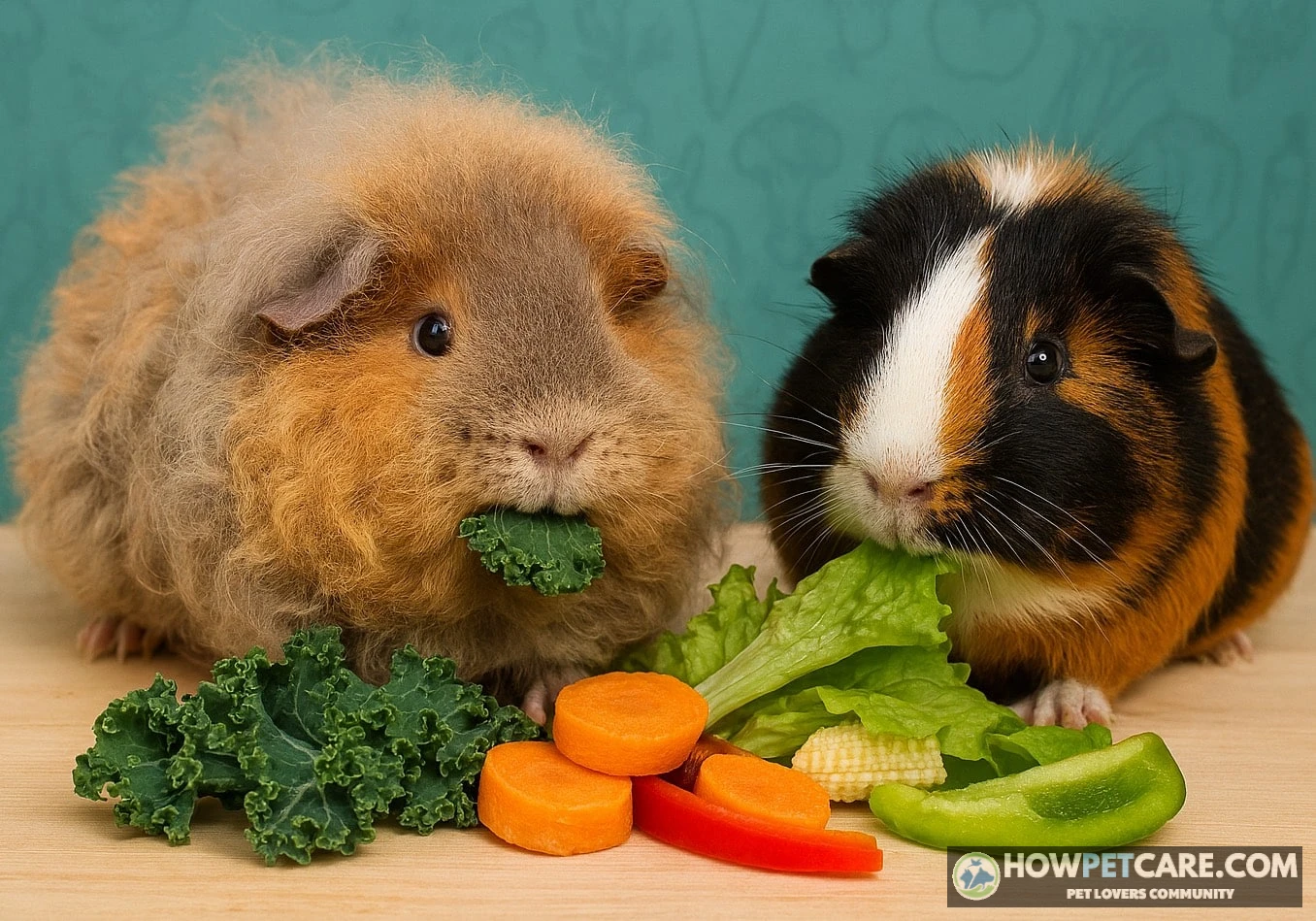

Guinea pigs eat a hay-based diet built on four daily components:
- Unlimited grass hay — timothy or orchard grass, available at all times for digestion and tooth wear
- Plain timothy-based pellets — about ⅛ cup (15–20 g) per adult per day, fortified with vitamin C
- Fresh vegetables — about 1 cup daily of 3–4 kinds, including vitamin-C-rich bell pepper
- Clean water — constantly available in a checked sipper bottle
Guinea pigs cannot make their own vitamin C, so it must come from food every day.
Guinea pigs are herbivores built for grazing. Their natural diet is fibrous grasses, and that fact shapes everything about how you feed them. The foundation is simple: unlimited grass hay, fresh water always available, a measured portion of plain pellets, and a daily serving of varied vegetables. Get those proportions right from day one and you’ll avoid the most common nutrition problems — scurvy, dental overgrowth, bladder stones, and life-threatening gut stasis.
What guinea pigs should eat every day: the simple bowl plan
Daily amounts: hay, pellets, vegetables, and water
| Component | Daily amount (adult) | Why it matters |
|---|---|---|
| Grass hay (timothy, orchard grass, meadow) | Unlimited, always available | Drives digestion, wears continuously growing teeth, mimics natural grazing that occupies up to 70 % of waking time |
| Plain guinea pig pellets (uniform, not muesli) | ~⅛ cup (≈15–20 g) per adult | Supplies balanced nutrients and fortified vitamin C; avoids selective feeding seen with seed mixes |
| Fresh vegetables | ~1 cup total, 3–4 different types | Provides vitamin C, micronutrients, and hydration; bell pepper is a top vitamin C source |
| Clean water | Continuous, sipper bottle checked twice daily | Prevents dehydration; water-bottle vitamin C degrades quickly and can alter taste |

Hay, pellets, and vegetables: what each contributes
- Hay is the non-negotiable base. Offer timothy or orchard grass free-choice; alfalfa hay is reserved for juveniles, pregnant, or nursing pigs because its high calcium and protein can promote bladder stones in adults.
- Pellets should be a plain, timothy-based formula. Muesli mixes encourage selective feeding, obesity, and dental issues.
- Vegetables round out the diet. Rotate romaine, green leaf, bell pepper, cilantro, zucchini, and other safe greens so no single item dominates.
This guide is for educational purposes only and does not replace advice from a licensed exotic-animal veterinarian. If your guinea pig shows signs of illness — appetite loss, few or no droppings, swollen abdomen, sudden weight change — contact a vet immediately.
How to portion hay, pellets, and vegetables by weight
A practical pellet measuring rule
Pellet recommendations look contradictory because sources use different measures. The three most common rules, converted to grams:
| Recommendation you will hear | What it means in grams* | When it applies |
|---|---|---|
| "⅛ cup per adult per day" (common label rule) | About 15–20 g | Most healthy adults on grass-hay diets |
| "1–2 tablespoons per pig per day" | About 7–20 g | Same idea with a wider range; 2 tbsp = ⅛ cup |
| "Roughly 1.5–2 % of body weight" | About 15–20 g for a 1 kg pig | Cross-check when the pig is over- or under-weight |

*Grams vary by pellet size and density — weigh your actual brand once, write the number on a sticky note inside the pellet bin, and scoop with the same cup every day.
Worked examples
- 700 g juvenile (under ~6 months): Growth takes priority. Offer age-appropriate (often alfalfa-based) pellets more liberally — roughly 2 tablespoons (≈15–20 g) or per the product label — alongside alfalfa hay, and let appetite guide you with a vet’s sign-off.
- 1 kg adult: Start at ⅛ cup. If that weighs 18 g on your scale, that’s your number (~1.8 % of body weight — right in range). If weekly weigh-ins show a steady gain with pellets left over, step down to ~15 g.
- 1.2 kg senior: Weight alone doesn’t justify cutting pellets. Keep ~15–20 g unless the scale shows climbing weight, then trim in ~5 g steps. A senior losing weight may actually need pellets topped up — pair any change with a vet check, since weight loss at this age often means dental trouble.
Guardrail: never restrict hay to compensate — hay stays unlimited at every weight.
How to weigh your guinea pig and assess trends
- Use a digital kitchen scale (0.1 g resolution).
- Place a small container on the scale, tare it, then gently set the pig inside.
- Record the weight in grams before the morning vegetable serving.
- Weigh weekly on the same day; a slide or spike over 2–3 weeks matters more than a single 10–30 g wobble.

A small plastic bowl with a non-slip mat keeps the pig calm and the reading stable.
A safe-food chart for daily vegetables, occasional treats, and foods to avoid
How to read the safe, caution, and never-feed chart
The table below consolidates every common food into three tiers. "Daily rotation" means the item can be part of the ~1 cup of varied vegetables offered each day — rotate 3–4 different vegetables rather than serving the same one every day. "Limited" items are treat-sized portions a few times a week — that tier also answers questions like whether guinea pigs can have grapes (one halved grape, at most weekly). "Never" items are toxic, pose a mechanical hazard, or cause severe metabolic upset.

| Food | Safety tier | Serving size and frequency | Preparation | Reason or caution |
|---|---|---|---|---|
| Timothy hay | Daily (unlimited) | Constant supply | Fresh, dry, dust-free | Foundation of the diet; digestion and tooth wear |
| Orchard grass hay | Daily (unlimited) | Constant supply | Fresh, dry, dust-free | Good alternative or mix-in for timothy hay |
| Meadow/botanical hay | Daily (unlimited) | Constant supply | Fresh, dry | Adds variety; check for dusty batches |
| Alfalfa hay | Limited / life-stage only | Free access for young, pregnant, or nursing pigs only | Fresh, dry | Legume hay, high in calcium and protein — not an adult staple |
| Romaine lettuce | Daily rotation | 1–2 leaves per day | Washed | Nutritious, well tolerated staple green |
| Green or red leaf lettuce | Daily rotation | 1–2 leaves per day | Washed | More nutritious than iceberg |
| Bell pepper (any color) | Daily rotation | ⅛–¼ pepper per day | Washed, seeds removed | One of the best vegetable sources of vitamin C |
| Cucumber | Daily rotation | 2–3 thin slices | Washed | Low calorie; mostly water, so pair with nutrient-dense greens |
| Cilantro | Daily rotation | A few sprigs | Washed | Well tolerated, most pigs like it |
| Zucchini | Daily rotation | 2–3 slices | Washed | Mild, low calcium, good for variety |
| Celery | Daily rotation | ¼–½ stalk, chopped small | Washed, strings removed | Stringy fibers can be a choking risk if left long |
| Endive / escarole | Daily rotation | 1–2 leaves | Washed | Good leafy green for rotation |
| Radicchio | Daily rotation | 1 leaf | Washed | Fine in rotation, slightly bitter |
| Green beans | Daily rotation | 1–2 beans | Fresh, raw | Feed whole pods, not dried beans |
| Carrot | Limited | 1 baby carrot or 2–3 coins, 2–3× per week | Washed | High in sugar; a treat, not a staple |
| Cherry tomato | Limited | Half a tomato, 2–3× per week | Washed, ripe only | Acidic; unripe tomatoes and leaves/stems are unsafe |
| Parsley | Limited | A few sprigs, 2–3× per week | Washed | High in calcium — rotation food, not a daily staple |
| Kale | Limited | 1 small leaf, 1–2× per week | Washed | High calcium and oxalates; overfeeding linked to bladder stone risk |
| Spinach | Limited | 1 small leaf, 1–2× per week | Washed | High oxalates; keep occasional |
| Broccoli | Limited | 1 small floret, 1–2× per week | Washed | Gas-producing; too much can cause uncomfortable bloating |
| Cauliflower | Limited | 1 small floret, 1–2× per week | Washed | Gas-producing |
| Cabbage (green/red) | Limited | 1 small leaf, 1–2× per week | Washed | Gas-producing; introduce very gradually |
| Brussels sprouts | Limited | Half a sprout, 1× per week | Washed | Gas-producing |
| Bok choy | Limited | 1 leaf, 1–2× per week | Washed | Mildly gassy; contains calcium |
| Apple | Limited | 1 thin slice, 1–2× per week | Seeds and core removed | High sugar; apple seeds are unsafe |
| Banana | Limited | 1 thin coin, 1× per week | Peeled | Very high sugar |
| Strawberry | Limited | Half a berry, 1–2× per week | Washed | High sugar |
| Blueberries | Limited | 1–2 berries, 1–2× per week | Washed | High sugar |
| Orange / citrus | Limited | 1 small segment, 1× per week | Peeled | Acidic and sugary; can cause mouth sores in some pigs |
| Grapes | Limited | 1 grape cut in half, 1× per week | Washed, halved | High sugar |
| Watermelon | Limited | 1 small cube, 1× per week | Seedless, rind removed | High sugar and water; overfeeding causes loose stools |
| Iceberg lettuce | Avoid | Not recommended | — | Not toxic, but nearly nutrient-free and causes loose stools when overfed |
| Chocolate | Never | None | — | Toxic compounds; also fatty and sugary |
| Avocado | Never | None | — | Persin toxicity risk plus dangerously high fat |
| Onion, garlic, leeks, chives | Never | None | — | Allium compounds damage red blood cells |
| Potato (especially green/sprouted) | Never | None | — | High starch, plus solanine in green or sprouted skins |
| Rhubarb | Never | None | — | High oxalates; leaves are toxic |
| Lawnmower clippings | Never | None | — | Ferments rapidly, causing severe bloat; often contaminated with fuel or pesticides |
| Bread, crackers, cereal | Never | None | — | Processed starch a cavy gut cannot handle |
| Nuts and seeds | Never | None | — | Choking hazard, too high in fat |
| Meat or dairy | Never | None | — | Guinea pigs are strict herbivores |
| Fruit pits and apple seeds | Never | None | — | Contain cyanide compounds |
| Raw or dried beans | Never | None | — | Toxic lectins and indigestible starch |
| Mushrooms | Never | None | — | Not a natural food; toxicity risk |
| Houseplants and garden ornamentals | Never | None | — | Many common ones (lily, ivy, daffodil, foxglove) are toxic |
Why some foods need limits or should never be offered
- Oxalates (spinach, kale, parsley) bind calcium and raise bladder-stone risk.
- Calcium-to-phosphorus ratio: excess calcium from alfalfa or high-calcium greens can precipitate stones in adults.
- Gas production (cruciferous vegetables) can trigger bloat, a life-threatening condition.
- Sugar and acidity (fruit, citrus) cause digestive upset and mouth sores when fed daily — which is why sugary fruits such as bananas for guinea pigs are capped at a thin coin a week.
- Toxicity (chocolate, avocado, alliums, rhubarb) is well documented in small mammals.
- Lawnmower clippings ferment within hours, producing gas that can cause fatal bloat.
Even a handful of fresh clippings can ferment in the gut within hours, leading to painful bloat. Always offer hand-picked, pesticide-free grass instead.
Vitamin C: daily needs, reliable sources, and early scurvy signs
Food sources and supplement cautions
Guinea pigs cannot synthesize vitamin C and must obtain it daily from food. The most reliable dietary sources are:
- Bell pepper (any color) — one of the highest vegetable concentrations.
- Fortified timothy-based pellets — but vitamin C degrades with light, heat, and time.
- Leafy greens such as parsley, kale, and mustard greens (fed in limited amounts due to calcium/oxalates).

Adding vitamin C to the water bottle is unreliable: it oxidizes within hours and may change the taste, causing reduced water intake. Routine supplements (drops, tablets) should only be used under veterinary direction, especially when the diet already includes fortified pellets and vitamin-C-rich vegetables.
Signs that need a veterinarian
Early scurvy can appear within 2–3 weeks of deficiency. Watch for:
- Reluctance to move or hop; stiff gait.
- Painful, swollen joints (especially hocks and knees).
- Poor appetite and weight loss.
- Rough, unkempt coat.
- Bleeding or sore gums, sometimes with loose teeth.
If you see any of these, contact an exotic-animal veterinarian the same day — do not attempt to self-treat with high-dose supplements.

Pellets lose vitamin C quickly once opened. Store them in a cool, dark, airtight container and use within 60 days for best potency.
A complete daily feeding schedule from morning hay refill to evening checks
Sample morning-to-evening routine
The following time-stamped plan turns the diet proportions into a repeatable cage-side routine. Adjust the clock times to your schedule; consistency matters more than the exact hour.
| Time | What to offer or check | Example amount | Purpose |
|---|---|---|---|
| 07:00 AM | Top up hay rack with fresh timothy/orchard hay; remove wet or flattened hay | Unlimited | Keeps fiber intake constant, supports tooth wear |
| 07:05 AM | Water bottle: squeeze spout to confirm flow, refill with fresh water | Full bottle | Prevents dehydration; checks for leaks |
| 07:10 AM | Measured pellets (level scoop) | ⅛ cup (≈18 g) | Supplies balanced nutrients and fortified vitamin C |
| 07:15 AM | Quick visual check: is the pig moving, interested in food? | — | Early appetite indicator |
| 12:00 PM (optional) | Peek at hay supply; top up if rack empty | — | Hay must never run out |
| 12:10 PM (optional) | Offer half the day’s vegetables or a small vitamin-C item (⅛ bell pepper) | ~½ cup | Spreads veggie intake, useful if you’re home |
| 06:00 PM | Vegetables: ~1 cup washed, chopped, 3–4 different kinds | 1 cup total | Meets daily veggie quota, provides vitamin C |
| 06:15 PM | Remove any uneaten fresh food from earlier servings | — | Prevents spoilage and selective eating |
| 06:20 PM | Water bottle: check for leaks, refill if low | — | Ensures overnight hydration |
| 06:30 PM | Count droppings in usual spots — normal pile? Same size as yesterday? | — | Monitors gut motility |
| 06:40 PM | Spot-clean wet bedding | — | Keeps environment hygienic |

Changing foods without upsetting digestion
Transition new pellets or vegetables gradually over 14–28 days (2–4 weeks) to avoid digestive disruption. Mix a small amount of the new food with the current one, increasing the proportion every few days while monitoring appetite and droppings.
-
Day 1–3
75 % current food, 25 % new food
-
Day 4–7
50 % current, 50 % new
-
Day 8–14
25 % current, 75 % new
-
Day 15+
100 % new food

How feeding changes for babies, adults, seniors, and pregnant guinea pigs
Life-stage feeding comparison
| Life stage | Hay | Pellets | Vegetables | Monitoring or special notes |
|---|---|---|---|---|
| Juvenile (birth–~6 months) | Alfalfa hay unlimited; grass hay can also be offered | Age-appropriate pellets, often alfalfa-based, more liberal than adult ration — follow label and vet guidance | Introduce gradually; build toward ~1 cup/day | Rapid growth needs extra calcium and protein; weekly weighing catches slow growers |
| Adult (~6 months–4 years) | Grass hay (timothy, orchard) unlimited | Measured — start ~⅛ cup (15–20 g) per day | ~1 cup varied daily, bell pepper for vitamin C | The baseline plan; adjust only by weight trend, appetite, and droppings |
| Senior (~4+ years) | Grass hay unlimited; keep it easy to reach | Same measured amount unless weight trend says otherwise | ~1 cup daily; chop smaller if dental wear is an issue | Watch for dental problems, reduced mobility, weight loss — losing weight usually means more support, not less food |
| Pregnant / nursing | Alfalfa hay unlimited alongside grass hay | Increased ration per vet guidance | ~1 cup+ daily, vitamin-C-rich foods emphasized | Higher calorie, calcium, and vitamin C demands — get a vet to tailor the plan early |
| Recovering / ill | Unlimited, always reachable | Per vet instructions only | Per vet instructions | Appetite loss or shrinking droppings = call the vet, not an improvised diet change |

When a veterinarian should tailor the plan
Any deviation from the baseline — persistent weight change, dental disease, pregnancy, illness, or medication — warrants a vet-approved adjustment. Don’t guess pellet amounts for a pregnant sow or a pig on antibiotics; the wrong calcium or vitamin C level can cause stones or scurvy.
For detailed reproductive nutrition, consult the latest exotic-animal veterinary texts or your clinic’s nutrition handout.
Track weight and droppings to spot digestive trouble early
Weekly weight and daily appetite checks
- Weigh each guinea pig weekly on a kitchen scale, in grams, before the morning veggies — record the number.
- Note appetite: normal / reduced / refusing food.
- Note droppings: normal number and shape / fewer / smaller / misshapen / none seen.
- Note anything odd: hunched posture, less movement, wet chin (drooling can mean teeth trouble).
Trend matters more than any single weigh-in — small wobbles of 10–30 g are common; a slide or spike over 2–3 weeks is not.
Bloat, gut stasis, and droppings changes
| Observation | Likely concern | Action |
|---|---|---|
| Very few, tiny, misshapen, or no droppings | Possible gut stasis (dangerously reduced gut movement) | Call an exotic vet same day; do not wait |
| Swollen, tight, or drum-like belly; teeth-grinding; hunched posture | Possible bloat (gas accumulation) | Emergency vet visit — do not force-feed or give home remedies |
| Soft stool right after a new vegetable | Dietary upset from that item | Pull the new vegetable, monitor 24 h; if resolves, reintroduce later in smaller amount |
| Weight drop of ~50 g or more in a week, or steady loss over several weeks | Underlying illness, dental disease, or inadequate intake | Vet evaluation required |

Do not do these while waiting: no force-feeding, no home remedies, no withholding food "to rest the gut" — a blocked or bloated gut is an emergency, not a diet problem.
If your guinea pig stops eating and produces few or no droppings for more than 12 hours, treat it as a veterinary emergency. Time is critical.
| Food | Safety Tier | Serving Size and Frequency | Preparation | Reason or Caution |
|---|---|---|---|---|
| Timothy hay | Daily (unlimited) | Constant supply | Fresh, dry, dust-free | Foundation of the diet; digestion and tooth wear |
| Orchard grass hay | Daily (unlimited) | Constant supply | Fresh, dry, dust-free | Good alternative or mix-in for timothy hay |
| Meadow/botanical hay | Daily (unlimited) | Constant supply | Fresh, dry | Adds variety; check for dusty batches |
| Romaine lettuce | Daily rotation | 1–2 leaves per day | Washed | Nutritious, well tolerated staple green |
| Green or red leaf lettuce | Daily rotation | 1–2 leaves per day | Washed | More nutritious than iceberg |
| Bell pepper (any color) | Daily rotation | ⅛–¼ pepper per day | Washed, seeds removed | One of the best vegetable sources of vitamin C |
| Cucumber | Daily rotation | 2–3 thin slices | Washed | Low calorie; mostly water, so pair with nutrient-dense greens |
| Cilantro | Daily rotation | A few sprigs | Washed | Well tolerated, most pigs like it |
| Zucchini | Daily rotation | 2–3 slices | Washed | Mild, low calcium, good for variety |
| Celery | Daily rotation | ¼–½ stalk, chopped small | Washed, strings removed | Stringy fibers can be a choking risk if left long |
| Endive / escarole | Daily rotation | 1–2 leaves | Washed | Good leafy green for rotation |
| Radicchio | Daily rotation | 1 leaf | Washed | Fine in rotation, slightly bitter |
| Green beans | Daily rotation | 1–2 beans | Fresh, raw | Feed whole pods, not dried beans |
| Alfalfa hay | Limited / life-stage only | Free access for young, pregnant, or nursing pigs only | Fresh, dry | Legume hay, high in calcium and protein — not an adult staple |
| Carrot | Limited | 1 baby carrot or 2–3 coins, 2–3× per week | Washed | High in sugar; a treat, not a staple |
| Cherry tomato | Limited | Half a tomato, 2–3× per week | Washed, ripe only | Acidic; unripe tomatoes and leaves/stems are unsafe |
| Parsley | Limited | A few sprigs, 2–3× per week | Washed | High in calcium — rotation food, not a daily staple |
| Kale | Limited | 1 small leaf, 1–2× per week | Washed | High calcium and oxalates; overfeeding linked to bladder stone risk |
| Spinach | Limited | 1 small leaf, 1–2× per week | Washed | High oxalates; keep occasional |
| Broccoli | Limited | 1 small floret, 1–2× per week | Washed | Gas-producing; too much can cause uncomfortable bloating |
| Cauliflower | Limited | 1 small floret, 1–2× per week | Washed | Gas-producing |
| Cabbage (green/red) | Limited | 1 small leaf, 1–2× per week | Washed | Gas-producing; introduce very gradually |
| Brussels sprouts | Limited | Half a sprout, 1× per week | Washed | Gas-producing |
| Bok choy | Limited | 1 leaf, 1–2× per week | Washed | Mildly gassy; contains calcium |
| Apple | Limited | 1 thin slice, 1–2× per week | Seeds and core removed | High sugar; apple seeds are unsafe |
| Banana | Limited | 1 thin coin, 1× per week | Peeled | Very high sugar |
| Strawberry | Limited | Half a berry, 1–2× per week | Washed | High sugar |
| Blueberries | Limited | 1–2 berries, 1–2× per week | Washed | High sugar |
| Orange / citrus | Limited | 1 small segment, 1× per week | Peeled | Acidic and sugary; can cause mouth sores in some pigs |
| Grapes | Limited | 1 grape cut in half, 1× per week | Washed, halved | High sugar |
| Watermelon | Limited | 1 small cube, 1× per week | Seedless, rind removed | High sugar and water; overfeeding causes loose stools |
| Iceberg lettuce | Avoid | Not recommended | Not in source | Not toxic, but nearly nutrient-free and causes loose stools when overfed |
| Chocolate | Never | None | Not in source | Toxic compounds; also fatty and sugary |
| Avocado | Never | None | Not in source | Persin toxicity risk plus dangerously high fat |
| Onion, garlic, leeks, chives | Never | None | Not in source | Allium compounds damage red blood cells |
| Potato (especially green/sprouted) | Never | None | Not in source | High starch, plus solanine in green or sprouted skins |
| Rhubarb | Never | None | Not in source | High oxalates; leaves are toxic |
| Lawnmower clippings | Never | None | Not in source | Ferments rapidly, causing severe bloat; often contaminated with fuel or pesticides |
| Bread, crackers, cereal | Never | None | Not in source | Processed starch a cavy gut cannot handle |
| Nuts and seeds | Never | None | Not in source | Choking hazard, too high in fat |
| Meat or dairy | Never | None | Not in source | Guinea pigs are strict herbivores |
| Fruit pits and apple seeds | Never | None | Not in source | Contain cyanide compounds |
| Raw or dried beans | Never | None | Not in source | Toxic lectins and indigestible starch |
| Mushrooms | Never | None | Not in source | Not a natural food; toxicity risk |
| Houseplants and garden ornamentals | Never | None | Not in source | Many common ones (lily, ivy, daffodil, foxglove) are toxic |
Use this first-week checklist to put the feeding plan into practice
- ☐ Set up unlimited fresh grass hay (timothy or orchard), a clean working water bottle, and a measured adult pellet portion appropriate to the pig’s life stage.
- ☐ Choose a small rotation of washed vegetables (e.g., romaine, bell pepper, cilantro, zucchini); introduce unfamiliar foods gradually using the 2-week transition.
- ☐ Use the safe-food chart before offering any treat; keep fruit and high-calcium greens to the limited tier — that includes checking details like whether guinea pigs can eat apples before sharing a slice.
- ☐ Record weekly weight on the same day; log appetite and droppings daily.
- ☐ Store hay in a cool, dry, ventilated place; discard damp, dusty, or musty hay. Never feed lawnmower clippings.
- ☐ Contact an exotic-animal veterinarian promptly for any warning signs: not eating, very few/no droppings, swollen belly, weight drop ≥50 g in a week, hunched posture, labored breathing.
With this chart, schedule, and monitoring habit, you’ll have a complete, evidence-backed feeding system that works at the cage — not just on the screen.
FAQ
Can guinea pigs eat grass from the yard?
They can eat clean, pesticide-free grass introduced gradually, but avoid areas contaminated by chemicals, animal waste, or traffic. Never feed lawnmower clippings, which can heat and ferment quickly and may cause digestive problems.
How should I store hay and tell whether it is fresh?
Store hay somewhere dry, cool, and ventilated, away from damp floors and direct moisture. Good hay smells fresh and grassy; discard hay that is damp, dusty, discolored, or musty.
Do I need to give a vitamin C supplement if the pellets are fortified?
Not necessarily: fresh vitamin-C-rich vegetables and properly stored fortified pellets may provide a reliable dietary source. Ask an exotic-animal veterinarian before supplementing, and do not rely on adding vitamin C to drinking water.
Is citrus safe for guinea pigs?
A small piece of citrus can be an occasional treat for many guinea pigs, but its acidity and sugar make it unsuitable as a daily food. Introduce it sparingly and stop if it causes mouth irritation or digestive upset.
Do guinea pigs eat their own droppings?
Yes, and it’s essential: guinea pigs produce soft droppings called caecotrophs and re-ingest them to absorb B vitamins, protein, and other nutrients. You rarely see it happen, but a pig that suddenly can’t or won’t should be checked by a vet.