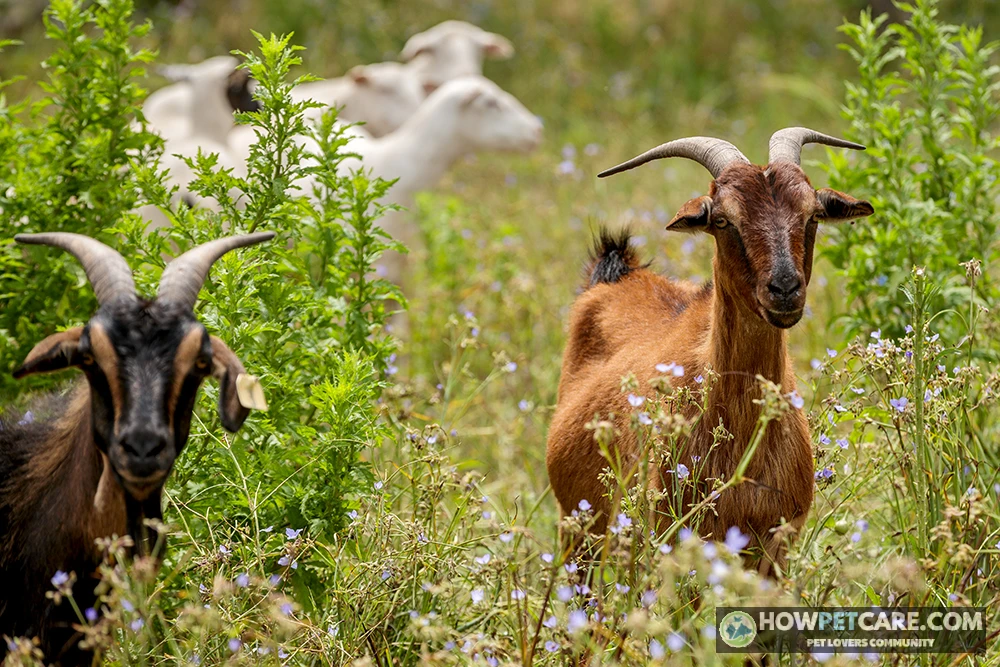

Goats eat mostly forage, including good-quality hay, suitable pasture, and safe browse such as leaves and tender twigs. Provide clean water and a goat-formulated mineral every day. Grain is not necessary for many healthy adult pet goats when their forage meets their needs; amounts depend on size, age, body condition, and life stage.
Goats eat mostly forage: good-quality hay, suitable pasture plants, and safe browse such as leaves and tender twigs. A practical daily plan also includes clean water and a goat-formulated mineral. Many healthy adult pet goats don’t need grain if their forage meets their needs.
The right amount depends on a goat’s size, age, body condition, and whether she’s pregnant or producing milk. Use the examples below as starting points. If you’re unsure, adjust the plan with help from a goat-experienced veterinarian or livestock nutritionist.
What goats should eat every day: the quick feeding plan
The daily basics: forage, water, and minerals
Start with clean, good-quality forage. When safe pasture and browse are scarce, hay provides the foundation. Keep fresh water available at all times, and offer a loose mineral formulated for goats according to its label.
A common starting estimate for total daily dry-matter intake is 2%–3% of body weight, though actual needs vary. Dry matter is what remains after water is removed from feed. It includes everything the goat eats—not just hay—and isn’t the same as the weight of fresh grass or hay offered.
Goats are ruminants. Their four-compartment stomach includes the rumen, where microbes help digest forage. They tend to browse leaves, shoots, and twigs as well as graze. That browsing behavior doesn’t mean every plant within reach is safe.

Why pet and Pygmy goats may need less concentrate, not less care
A Pygmy goat or other small pet can often maintain its weight on suitable forage without grain. But a small pen doesn’t provide much food simply because it contains grass. Supply enough hay to replace missing forage, check the ground for hazardous plants, and keep an eye on each goat’s condition.
Grain and concentrated goat feed pellets can help when forage alone doesn’t meet a goat’s needs. They aren’t automatic additions to every diet. Increasing grain too quickly can cause serious digestive problems.
Build a daily ration by age, weight, and life stage
The table below assumes limited usable pasture for the hay examples. Treat these amounts as daily starting estimates, not prescriptions. A goat that eats substantial pasture or browse will generally need less hay. A lactating doe or fast-growing youngster may need a more individualized plan. Flake and cup measures depend on the weight of your own hay and feed; the examples below use the sample weights explained after the table.
| Goat type or life stage | Forage and hay guidance | Pellets or grain guidance | Water and minerals | Notes and cautions |
|---|---|---|---|---|
| Nursing kid | Mother’s milk or properly prepared kid goat milk replacer; offer a little clean, soft hay as the kid begins exploring feed | Offer an age-appropriate starter only as directed by its label or veterinarian | Provide clean water; discuss mineral access with your veterinarian | Milk amount and frequency depend on age, weight, and product. Confirm that a newborn receives colostrum promptly. |
| Weaned kid | Provide palatable hay and suitable browse; intake depends on age and growth | A measured kid or growing-goat feed may be appropriate; follow its label and weigh the cups | Fresh water and an age-appropriate goat mineral | Weaning and feed changes should be gradual and guided by the kid’s development. |
| 25-pound adult Pygmy or small pet | Start around 0.5–0.75 lb hay as fed daily when usable pasture is limited | Often none for a healthy maintenance goat | Fresh water and free-choice goat mineral | Weigh the goat and monitor condition; actual intake and waste vary. |
| 50-pound adult pet or wether | Start around 1–1.5 lb hay as fed daily when usable pasture is limited; approximately one to one-and-a-half flakes at the sample flake weight below | Often none if forage maintains condition | Fresh water and free-choice goat mineral | Avoid adding rich concentrate without a reason, especially for male goats. |
| 100-pound growing goat | Roughly 2–3 lb total diet dry matter is a starting estimate, not a fixed hay portion | Growing-goat feed may be appropriate; use the label, weigh the cups, and check the whole ration | Fresh water and goat mineral | Growth and forage quality can change requirements substantially. |
| 100-pound late-gestation doe | Provide high-quality forage; ask a professional to assess total intake and nutrient density | Add a suitable concentrate only as the individual plan requires; weigh the cups | Fresh water and an appropriate goat mineral | Litter size and limited appetite can complicate feeding; arrange a pregnancy plan. |
| 100-pound lactating doe | Provide plentiful, palatable forage; intake can exceed maintenance estimates | A suitable lactation feed may be needed; base the amount on the whole ration and weigh the cups | Fresh water at all times and an appropriate goat mineral | Milk output and body condition matter more than a fixed grain scoop. |
A hay flake doesn’t have a standard weight, and a cup of pellets doesn’t have a universal weight. Weigh several flakes and one level cup of your own feed before relying on those measures. Hay offered includes waste; dry-matter intake is what the goat actually eats, with moisture removed.
Example portions for a 50-pound pet goat
For example, a healthy 50-pound wether with little usable pasture could start with approximately 1–1.5 pounds of suitable grass hay over the day. If a flake from your bale weighs 1 pound, that’s approximately one to one-and-a-half flakes. If it weighs 2 pounds, it’s roughly half to three-quarters of a flake. Flake weights vary; these are examples, not standards.
Put hay in a feeder in the morning and check it again in the evening. Keep forage available while limiting waste, and adjust the amount offered to account for hay left behind or pulled onto the ground. Check body condition regularly. If the goat is gaining or losing weight, ask for advice.

If a feed label or professional plan calls for pellets, weigh a level cup of that particular feed. For example, if your cup weighs 4 ounces and the plan calls for 8 ounces daily, that equals 2 level cups. Don’t assume another pellet weighs the same, or take this example as a recommendation to feed 2 cups.
Kids, wethers, and breeding does need different plans
Unweaned kids need milk, not an adult hay-and-grain ration. Follow the milk replacer’s mixing and feeding directions or your veterinarian’s plan. Improper preparation or abrupt feeding changes can be dangerous. Ask your veterinarian about a suitable weaning schedule.

Wethers are neutered males. Urinary stones occur particularly in male and neutered goats. Excess dietary phosphorus from grain and an unbalanced calcium-to-phosphorus ratio contribute to the risk. Don’t routinely add grain or urinary supplements without reviewing the whole diet.
Late-pregnant does carrying multiple kids can develop pregnancy toxemia if they don’t get enough energy. A doe that eats less near kidding needs prompt veterinary attention, not an improvised increase in grain.
Safe goat food list: hay, browse, pellets, and garden produce
The safest everyday goat food list starts with identified forage and clean feed suited to the animal. Produce is an extra, not a replacement for hay or a balanced ration.
| Food or plant | Category | Practical guidance | Key caution |
|---|---|---|---|
| Clean grass hay, safe pasture, identified browse | Forage foundation | Offer hay when pasture and browse are insufficient | Avoid mold, contamination, and unidentified plants. |
| Alfalfa or other legume hay | Suitable in the right ration | Consider for goats with higher nutrient needs or where the overall diet calls for it | Richer hay isn’t automatically the right choice for every pet goat. |
| Goat feed pellets or grain | Supplemental feed | Choose a product for the goat’s age and purpose when a supplement is needed | Follow the label and introduce gradually. |
| Carrot, plain pumpkin, suitable leafy greens | Limited treat | Wash and cut into small pieces; offer a little at a time | Stop if digestive upset occurs; don’t feed spoiled produce. |
| Apple | Limited treat | Remove the core and seeds and cut the flesh into small pieces | Avoid whole large pieces and excessive fruit. |
| Bread, cereal, mixed table scraps | Avoid as routine feed | Keep out of the normal ration | Starch, salt, sugar, and unknown ingredients make mixed scraps a poor choice. |
| Yew, oleander, azalea, rhododendron | Toxic hazard | Prevent access to plants and trimmings | Contact a veterinarian immediately after suspected ingestion. |
| Wilted cherry leaves and other potentially cyanogenic leaves | Toxic hazard | Keep wilted branches and unidentified trimmings away | Risk depends on the plant and its condition; verify local plants. |
| Chocolate, caffeine, alcohol, moldy feed | Avoid | Secure household foods and discard spoiled feed | Contact a veterinarian if ingestion is suspected. |
Safe fruits and vegetables, with modest portions
For a medium-sized adult goat accustomed to treats, a few small pieces of carrot or cored apple, or a small handful of chopped plain pumpkin or suitable leafy greens, makes a conservative occasional serving. Offer less to a small goat. Introduce one food at a time, and keep treats to a small part of the total diet. Ask your veterinarian before offering extras to a young kid or a goat with digestive or urinary problems.
Can goats eat table scraps? Choose plain, fresh produce from the kitchen rather than a mixed plate. Skip moldy leftovers, heavily salted food, sweets, seasoned dishes, and unfamiliar scraps. Cut firm produce into manageable pieces and remove pits, apple cores, and seeds.

Hay, pasture grazing, and browse are the diet’s foundation
Grass hays, including suitable Bermuda grass hay, can work well for many maintenance goats. Mixed grass-and-legume hay is another option. Alfalfa is a legume hay that may suit goats needing a more nutrient-dense ration, but its place depends on the entire diet. A forage test and local advice are more useful than choosing hay by name alone.
Goats may browse suitable, positively identified brambles, leaves, and tender woody growth. Wild goats also eat available shrubs, shoots, grasses, and herbs; what they eat changes with habitat and season. Don’t treat a goat’s nibbling as proof that a backyard plant is safe.
Foods and plants to keep out of a goat’s reach
Common backyard and garden plant hazards
Keep yew, oleander, rhododendron, azalea, wilted cherry leaves, and unknown ornamental clippings away from goats. Also secure moldy feed, pesticides, chocolate, caffeine, alcohol, and feed intended for other livestock.
This isn’t a complete list of toxic plants. Common names can refer to different species, and risk can depend on the plant, its growth stage, and local conditions. Walk the fence line and pasture, including areas goats can reach through the fence. Ask your local extension office or veterinarian to identify questionable plants before goats have access.
Don’t dump lawn, hedge, or garden clippings into a pen. A pile may contain unidentified ornamentals or contaminated material, and goats can eat it quickly before you notice a problem.

What to do after a suspected toxic ingestion
Remove access to the suspected material and call a veterinarian or animal poison service promptly, even if the goat seems normal. Keep a sample or clear photo of the plant, packaging, or feed for identification. Don’t induce vomiting, give a home remedy, or wait for symptoms unless a veterinarian specifically tells you to act.
Goat minerals, salt, and water: what to offer and how
Loose minerals versus a salt lick
Offer a loose mineral formulated for goats in a dry, covered feeder, following the product label. A plain salt lick supplies salt but doesn’t replace a complete mineral mix. Protect the feeder from rain and manure, and monitor use.
Goats and sheep don’t necessarily have interchangeable mineral needs. Goats have a higher copper requirement than sheep, and some sheep feeds containing sodium molybdate can contribute to copper deficiency in goats. Ask a local veterinarian or livestock nutritionist which mineral suits your forage and region. Don’t stack products or add copper supplements on your own.
Water needs vary with body size, weather, feed, and milk production. The supplied research reports a range of roughly 0.75–1.5 gallons per goat daily, though an individual goat may drink a different amount. Keep clean, fresh water available at all times; don’t treat that range as a limit. Check containers frequently in heat and prevent freezing in winter.

When pregnancy mineral advice conflicts
A calcium-to-phosphorus ratio around 2:1 is commonly discussed for the total ration, particularly in relation to urinary-stone prevention. That ratio describes the combined diet. It isn’t a target to reach by adding calcium to a mineral feeder without knowing what the goat already eats.
Advice about calcium before kidding can seem contradictory: some approaches restrict dietary calcium before birth, while others emphasize supplementation. The right plan depends on the doe and her complete ration. Don’t restrict calcium or add multiple supplements near kidding on your own. Ask your veterinarian to review the forage, feed, minerals, and kidding plan together.
Winter hay, spring pasture, and safe feed changes
When winter pasture isn’t available, provide enough good-quality hay to replace the forage goats would otherwise eat. Store it off the ground in a dry, ventilated place protected from rain and rodents. Discard musty or moldy hay. Cold weather, forage quality, and body condition can change how much hay a goat needs. Check the feeder and the animals instead of relying on a fixed flake count.

In spring, give goats hay before allowing short, supervised access to new pasture. Increase turnout gradually over roughly one to two weeks if appetite, manure, and behavior remain normal. Pasture time isn’t equivalent to a measured amount of hay; growth, plant composition, and how actively goats eat all affect intake.
A gradual feed-switch calendar
Use this illustrative schedule when replacing one hay or prepared feed with another. Percentages describe the portion of the feed being changed, by weight—not the entire ration if other feeds remain unchanged. Keep the overall amount appropriate for the goat. A slower transition may be needed, especially when feeds differ substantially or the goat is sensitive.

| Days | Current feed | New feed | What to monitor |
|---|---|---|---|
| 1–2 | About 90% | About 10% | Appetite, droppings, chewing, and normal activity |
| 3–4 | About 75% | About 25% | Pause the change and seek advice if manure softens or appetite drops. |
| 5 | About 50% | About 50% | Check each goat, including timid animals at shared feeders. |
| 6 | About 25% | About 75% | Continue only if the goat is eating and behaving normally. |
| 7 | About 10% | About 90% | Move to all new feed afterward only if the transition is going well. |
Don’t use this table to calculate pasture hours. Replacing a feed is also different from adding grain to a diet that previously had none. Ask your veterinarian or feed adviser for an appropriate target and introduction plan rather than making a sudden increase. Abrupt ration changes and excess rapidly fermented starch can contribute to bloat, rumen acidosis, and other serious problems.
Bloat warning signs and urgent response
A visibly swollen left abdomen, distress, difficulty breathing, collapse, or rapid deterioration calls for an immediate call to a veterinarian. Frothy bloat can become an emergency; don’t assume every swollen abdomen has the same cause.
Remove access to the suspected feed if you can do so safely, keep the goat calm, and follow the veterinarian’s instructions. Don’t drench, pass a tube, or give oil or other remedies unless the veterinarian directs you.
A practical small-herd checklist before you feed
Daily feeding checklist for a backyard herd
- Check each goat’s age, estimated weight, body condition, and life stage before deciding on portions.
- Offer clean forage in a feeder and account for useful pasture or browse. Remove spoiled or contaminated leftovers.
- Refill clean water and check the covered goat-mineral feeder.
- Feed any prescribed or labeled supplement in measured amounts; make sure timid goats can eat.
- Watch appetite, droppings, and behavior. Contact your veterinarian promptly if a goat stops eating or appears distressed.
- Keep feed containers closed and inspect fences for toxic plants, trimmings, and other hazards.

Keep a simple ration and cost log
Record the hay offered and left behind, any measured pellets, treats, body-condition changes, and supply costs. Weigh a sample flake and a level cup whenever you change hay bales or pellet products. Include mineral, bedding, veterinary care, and delivery in the household budget rather than counting feed alone.
For an illustrative 30-day month, two 50-pound adult pets eating 1–1.5 pounds of hay each per day would consume about 60–90 pounds in total before accounting for additional waste. If you budget for 15% waste, plan for approximately 70–106 pounds of hay purchased. At an assumed $12 per 40-pound small square bale, two to three bales cost $24–$36 before delivery; three bales provide 120 pounds and a margin in this example.
Those figures are an arithmetic planning example, not a verified local price. Bale weights and costs vary by supplier and region, so use your own measurements and current quotes. Bring the log and feed labels to your veterinarian if a goat’s weight changes, a doe is approaching kidding, or you’re unsure whether the ration is complete.
| Goat Type or Life Stage | Forage and Hay Guidance | Pellets or Grain Guidance | Water and Minerals | Notes and Cautions |
|---|---|---|---|---|
| Nursing kid | Mother's milk or properly prepared kid goat milk replacer; offer a little clean, soft hay as the kid begins exploring feed | Offer an age-appropriate starter only as directed by its label or veterinarian | Provide clean water; discuss mineral access with your veterinarian | Milk amount and frequency depend on age, weight, and product. Confirm that a newborn receives colostrum promptly. |
| Weaned kid | Provide palatable hay and suitable browse; intake depends on age and growth | A measured kid or growing-goat feed may be appropriate; follow its label and weigh the cups | Fresh water and an age-appropriate goat mineral | Weaning and feed changes should be gradual and guided by the kid's development. |
| 25-pound adult Pygmy or small pet | Start around 0.5–0.75 lb hay as fed daily when usable pasture is limited | Often none for a healthy maintenance goat | Fresh water and free-choice goat mineral | Weigh the goat and monitor condition; actual intake and waste vary. |
| 50-pound adult pet or wether | Start around 1–1.5 lb hay as fed daily when usable pasture is limited; approximately 1–1.5 flakes at the sample flake weight below | Often none if forage maintains condition | Fresh water and free-choice goat mineral | Avoid adding rich concentrate without a reason, especially for male goats. |
| 100-pound growing goat | Roughly 2–3 lb total diet dry matter is a starting estimate, not a fixed hay portion | Growing-goat feed may be appropriate; use the label, weigh the cups, and check the whole ration | Fresh water and goat mineral | Growth and forage quality can change requirements substantially. |
| 100-pound late-gestation doe | Provide high-quality forage; ask a professional to assess total intake and nutrient density | Add a suitable concentrate only as the individual plan requires; weigh the cups | Fresh water and an appropriate goat mineral | Litter size and limited appetite can complicate feeding; arrange a pregnancy plan. |
| 100-pound lactating doe | Provide plentiful, palatable forage; intake can exceed maintenance estimates | A suitable lactation feed may be needed; base the amount on the whole ration and weigh the cups | Fresh water at all times and an appropriate goat mineral | Milk output and body condition matter more than a fixed grain scoop. |

FAQ
What do goats eat naturally in the wild?
Wild goats browse leaves, shoots, shrubs, and other available plants, and may graze grasses and herbs. Their choices vary by habitat and season, so wild browsing is not a safe guide to which plants are suitable in a backyard.
What do goats eat in the winter when pasture is gone?
Good-quality hay is the main winter forage when pasture is unavailable, with clean water and goat-formulated minerals still available. Adjust the amount to forage quality, body condition, and weather, and introduce any feed changes gradually.
What do goats eat for treats?
Small pieces of suitable produce, such as carrot or apple, can be occasional treats for many goats. Keep treats modest, introduce them one at a time, and avoid spoiled or heavily processed foods.
How much water does a goat need each day?
Water needs vary with size, temperature, diet, and whether a doe is lactating; a commonly cited range for adults is about 1 quart to 1.5 gallons daily. Provide clean fresh water continuously rather than rationing it.