

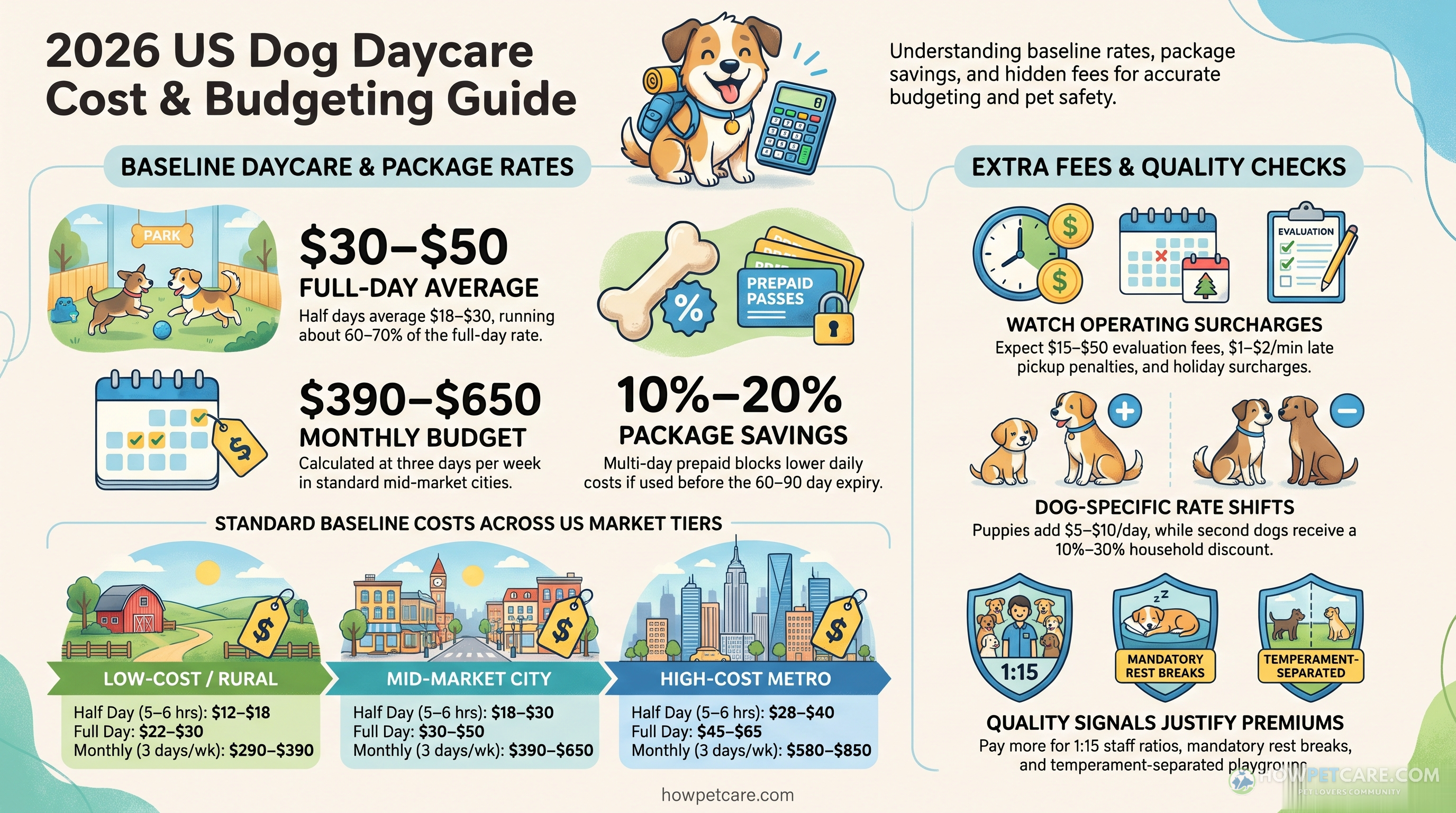
Typical US dog daycare prices in 2026:
| Rate type | Typical range |
|---|---|
| Half day (up to 5–6 hours) | $18–$30 |
| Full day | $30–$50 |
| 10-day package, per day | $27–$45 |
| Monthly, 3 days a week | $390–$650 |
| Monthly, 5 days a week | $540–$1,190 |
How Much Dog Daycare Costs per Day in the US: Half-Day and Full-Day Ranges
A full day of dog daycare in the United States costs about $30 to $50 in 2026, within a national range of roughly $25 to $65 depending on your market. Half days typically run $18 to $30, which is about 60 to 70 percent of the full-day rate rather than an exact half. At three days a week, that lands most owners between $390 and $650 a month. As a working rule of thumb: budget $35 a day for a mid-market city and $50 a day for a coastal metro, then adjust for your dog and your facility.
Half-day pricing surprises people more than full-day pricing does. A facility quoting $44 for a full day will often charge $28 to $31 for a session of up to five or six hours, because staffing, cleaning, and insurance costs do not shrink when the clock does. Ask for both rates in writing before you decide a half day is the cheaper option for your schedule.
National full-day and half-day daily rate ranges
| Rate type | Typical most-market range | Low-cost or rural market | High-cost metro | Notes |
|---|---|---|---|---|
| Half day (up to 5–6 hours) | $18–$30 | $12–$18 | $28–$40 | Priced at roughly 60–70% of the full-day rate |
| Full day | $30–$50 | $22–$30 | $45–$65 | National average sits near $40 a day |
| 5-day package, per day | $30–$45 | $22–$28 | $40–$58 | About 15% off the daily rate |
| 10-day package, per day | $27–$45 | $20–$27 | $40–$58 | About 10% off the daily rate |
| 20-day package, per day | $24–$40 | $18–$24 | $36–$52 | About 20% off the daily rate |
| Monthly, 3 days a week | $390–$650 | $290–$390 | $580–$850 | 13 attendance days per month |
| Legacy published range | $12–$38 | — | — | Older cost-reference figures that predate recent increases |
Where these dog daycare prices come from and when they were collected
The ranges above were compiled in 2026 from three inputs: published facility rate cards and public price pages sampled across US markets, consumer cost surveys that publish national bands, and the per-day equivalents implied by package and membership pricing. They were then cross-checked against three independent published ranges — a 2026 survey placing the national average near $40 a day with a $25 to $65 spread, a $20 to $50 national band split into $35 to $50 urban and $20 to $35 suburban or rural, and a $30 to $50 full-day, $20 to $25 half-day band from a pet-industry cost guide. Where those sources disagree, this guide shows the spread instead of picking a single number.
No operator’s rate card is used as the national average, and no facility is recommended anywhere in this article. Facility names appear only where a name is part of the underlying data.
Some widely quoted numbers — $12 to $38 for a full day, $240 to $550 for a monthly package — come from legacy cost-reference pages that still rank well in search but predate the most recent round of price increases. Treat them as a historical floor, not a 2026 budget number. If a page gives you a range with no date and no source, assume the lower end has expired.
If you want the recurring-budget answer before the details: at two days a week most owners spend roughly $260 to $480 a month, and at five days a week, roughly $540 to $1,190.
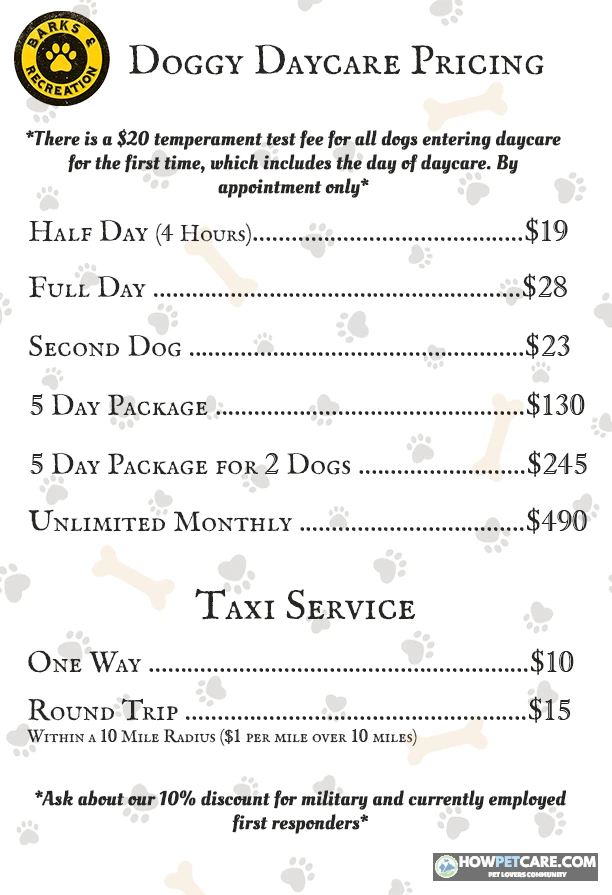
How Much Doggy Daycare Costs per Month and per Year at 1x to 5x per Week
Recurring cost is where daycare budgets actually break. The math is simple: daily rate multiplied by days per week, multiplied by about 4.33 weeks in a month, then by 12 for the year. The variation comes from two places — your local rate and how many days you actually book.
Most owners attend between two and five days a week, which produces recurring costs of roughly $180 to $900 or more per month depending on market. The table below models three market tiers: a low-cost market at $25 a day, a mid-market city at $35 a day, and a high-cost metro at $55 a day.
Worked monthly and annual budget table
| Days per week | Low-cost market monthly | Mid-market monthly | High-cost market monthly | Mid-market annual | Package or membership per-day equivalent (mid-market) |
|---|---|---|---|---|---|
| 1 | $108 | $152 | $238 | $1,820 | $33 with a 5-day package |
| 2 | $217 | $303 | $476 | $3,640 | $31.50 with a 10-day package |
| 3 | $325 | $455 | $715 | $5,460 | $31.50 with a 10-day package |
| 4 | $433 | $606 | $953 | $7,270 | $28 with a 20-day package |
| 5 | $541 | $758 | $1,190 | $9,100 | $28 on a 20-day package, about $27 on a membership |
Those figures use the pay-as-you-go daily rate and round the month to 4.33 weeks. They do not include the one-time and occasional fees covered later — a fee allowance of 3 to 5 percent is realistic for most households.
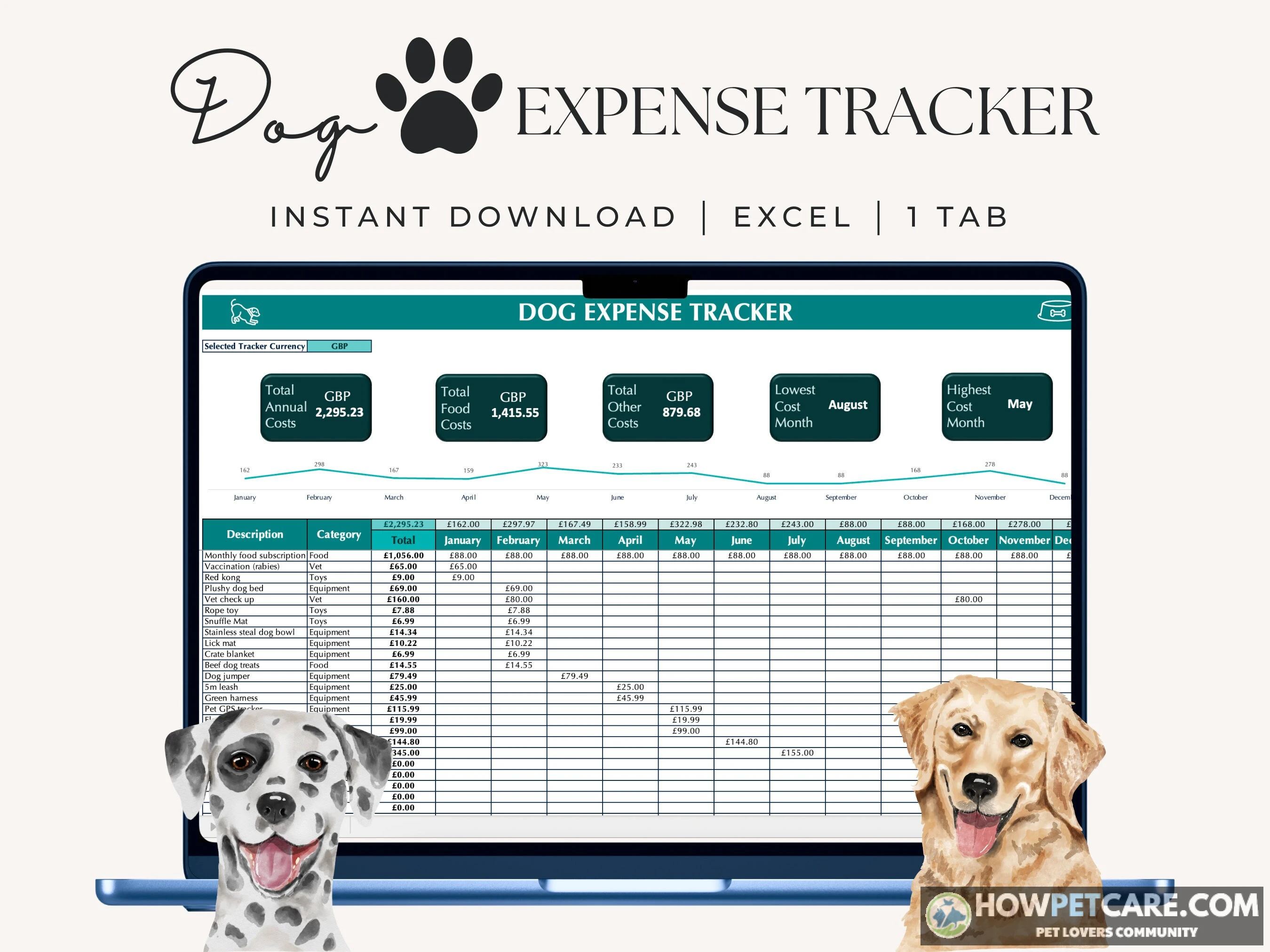
Daily rate vs monthly package vs membership: when each saves money
Multi-day packages typically save 10 to 20 percent, with deeper discounts on larger prepaid blocks — roughly 15 percent on a 5-day package, 10 percent on a 10-day package, and 20 percent on a 20-day package. That is why a package can beat the sticker daily rate without being a bargain: the savings only materialize if you use every day before it expires.
Here is the break-even logic. If the drop-in rate is $35 and a 10-day package costs $315, the package price per day is $31.50 and you break even after nine visits. Visit ten times and you save $35. Visit six times and you have paid more than you would have at the daily rate, because the unused days rarely convert back to cash.
Membership plans — the monthly subscription model some franchises use — make sense mainly for households attending three or more days a week. Below that, pay-per-day or a small package usually wins. Fixed monthly fees do not flex when you travel, when your dog is sick, or when your office goes remote for a week.
A 20-day package at 20 percent off is a real saving only if you will use 20 days inside the window. Expiry periods commonly run 60 to 90 days, and unused days typically do not roll over. Divide the package days by your weekly attendance to confirm you can burn through them — a household attending twice a week needs about 10 weeks to use 20 days.
For the irregular-schedule owner, the calculus flips. If you need daycare two or three days a month rather than two or three days a week, a package is dead weight. Pay the drop-in rate, accept the higher per-day price, and watch for last-minute booking premiums instead — those are the fees that bite when you cannot plan ahead.
One honest note on attendance: five days a week is a convenience choice for the owner, not a requirement for the dog. Many dogs do fine on two or three days, and a mix of daycare and a midday walker often costs less than a full week of daycare while producing a calmer dog.
Worked example: one dog, three days a week, mid-market city
Meet Dana in Columbus, Ohio, with one 40-pound adult dog attending three days a week. Local full-day rates run $28 to $34, so use the midpoint of $32: $32 × 3 days × 4.33 weeks is about $416 a month, or roughly $4,990 a year.
The facility sells a 10-day package for $290, which is $29 a day. The same schedule now costs about $377 a month — a saving of roughly $39 a month, or $470 a year. Then add the fees that actually show up: a $30 evaluation credited to the first visit (net zero), a $25 annual registration fee, two late pickups at $20 each, and one holiday-week day at a 20 percent surcharge. Realistic annual spend lands near $4,560 rather than the $4,990 the sticker rate implies. The gap between the advertised day rate and the real annual number is exactly why you need both package math and a small fee allowance.
The package sanity check matters as much as the price. Thirteen days a month at $29 is $377, but the package expires in 60 days. Dana uses about 13 days a month, so 20 days burn in roughly 46 days — comfortable. Three weeks of travel would erase the discount entirely.
What Makes Dog Daycare Prices Vary Between Facilities
Daycare pricing is driven by stay duration, facility amenities, geographic location, dog size and breed, vaccination requirements, and the staff-to-dog ratio. The same list appears in most published analyses of price drivers: location, facility quality, staff-to-dog ratio, included services, and package structure. Two facilities a mile apart can differ by $20 a day, and the difference is usually explainable.
Location, facility type, and amenities
Local cost of living and commercial rent set the floor. Prices run up to 30 percent higher in large cities and on the East and West coasts, and urban facilities commonly sit in the $35 to $65 range while suburban and rural operations run $20 to $40.
Facility type matters next. An independent operator with one location carries different overhead than a franchise with a membership model, a vet-attached daycare carries medical staffing costs, and a boarding kennel that adds daytime play spreads its building costs across both services. Amenities — indoor-outdoor play yards, pools or splash pads, webcams, transport — inflate the sticker price whether or not your dog uses them.

Staff ratios, rest periods, and cameras: when a higher price is justified
Staffing is the line item that genuinely costs money to maintain, and it is the one worth paying for. A facility that keeps attendants in the playroom, separates groups by size and temperament, and enforces scheduled rest periods is spending more per dog per hour than one that opens a door and monitors from a desk. Supervised rest periods matter more than owners expect: overtired dogs play rougher, and behavioral guidance from professional animal behavior bodies consistently treats adequate rest as part of a healthy daycare day.
A temperament evaluation and verified vaccination requirements screen the playgroup, and stricter screening usually signals a better-run facility — one that will also cost more. Neither is a marketing gimmick; both reduce the odds your dog spends the day managing a chaotic room.
Ask for the staff-to-dog ratio during active play, the camera policy, the length and enforcement of rest breaks, and a written list of what the base rate includes. A facility that answers all four in specifics is probably charging for supervision. A facility that deflects the ratio question is charging for location, branding, or nothing at all.
Add-ons inflate the quoted price too: training sessions, grooming, webcam access, one-on-one enrichment, and transport are usually priced separately and are not part of the daily rate.
Is a higher price actually worth paying? The quality signal check
Signals that cost real money to maintain, and that justify a premium:
- Staff-to-dog ratio of 1:15 or better during active play (1:10 for puppy or mixed-size groups)
- Mandatory rest or nap periods built into the day
- Playgroups separated by size and temperament, not one open room
- A real evaluation process: vaccinations verified for rabies, distemper-parvo, and Bordetella, plus an observed trial session before full group access
- Trained attendants in the room at all times, not cameras watched from a front desk
- Live webcam access or scheduled photo updates
- A written emergency protocol and a veterinary relationship within 15 minutes

Nice, but not worth much of a premium: pools, agility equipment, splash pads, report cards, birthday parties, themed photo days.
Red flags at any price: no ratio disclosure when asked directly, dogs in group play for six or more hours with no enforced rest, and no vaccination proof required at intake.
Dog Daycare Prices by City and State, Including Rural Benchmarks
The honest answer to what dog daycare costs near you is that no national average will survive contact with your zip code. Across the rate cards sampled for this guide, the spread between the priciest and cheapest markets ran close to 2x. State-level patterns follow metro patterns: Northeast and West Coast states carry the highest rates, Midwest and Plains states the lowest, with Sun Belt metros sitting in the middle and climbing.
City and state rate table
All figures below are benchmark ranges modeled from sampled rate cards by market tier, not quotes from any single facility. Confirm locally before you budget.
| Region | City or state | Market type | Half-day range | Full-day range | Date collected / source |
|---|---|---|---|---|---|
| Northeast | New York, NY | Urban | $30–$40 | $50–$65 | Nov 2026 benchmark |
| Northeast | Boston, MA | Urban | $25–$35 | $45–$58 | Nov 2026 benchmark |
| Northeast | Suburban Pennsylvania | Suburban | $18–$26 | $30–$42 | Nov 2026 benchmark |
| Southeast | Atlanta, GA | Urban | $20–$30 | $35–$48 | Nov 2026 benchmark |
| Southeast | Fort Lauderdale, FL | Urban | $24–$34 | $38–$55 | Nov 2026 benchmark |
| Southeast | Charlotte, NC | Suburban | $18–$25 | $28–$38 | Nov 2026 benchmark |
| Midwest | Chicago, IL | Urban | $20–$30 | $34–$48 | Nov 2026 benchmark |
| Midwest | Columbus, OH | Suburban | $16–$24 | $28–$34 | Nov 2026 benchmark |
| Midwest | Rural Iowa | Rural | $12–$18 | $22–$30 | Nov 2026 benchmark |
| Southwest | Austin, TX | Urban | $22–$32 | $38–$50 | Nov 2026 benchmark |
| Southwest | Phoenix, AZ | Suburban | $18–$26 | $30–$42 | Nov 2026 benchmark |
| West | Los Angeles, CA | Urban | $25–$38 | $45–$65 | Nov 2026 benchmark |
| West | Anaheim, CA | Suburban | $24–$34 | $40–$55 | Nov 2026 benchmark |
| West | Denver, CO | Urban | $22–$32 | $36–$48 | Nov 2026 benchmark |
| West | Rural Montana | Rural | $12–$20 | $25–$35 | Nov 2026 benchmark |
Published city-level estimates for three-days-a-week attendance in Los Angeles, Denver, Austin, Fort Lauderdale, and Anaheim land between $360 and $708 a month, which is consistent with the daily ranges above. Cities with thin data — most smaller metros and rural counties — should be treated as indicative only; the range is wide because the sample is small.
How to price dog daycare near you in 15 minutes
- Search your zip code plus dog daycare, then pull the public rate pages for three to five facilities within a 20-minute drive.
- Convert every package and membership price to a per-day equivalent so you are comparing like with like.
- Email or call each facility and ask for the full-day rate, the half-day rate, the evaluation fee, and the late-pickup policy in writing.
- Compare answered rows, not advertised prices — a facility with a $5 higher day rate and no evaluation fee can be cheaper in year one.
- Recheck every 6 to 12 months. Rates move faster than facility websites get updated.
Commute distance is part of the price. A facility 25 minutes away adds roughly 50 minutes of driving to every daycare day, and downtown facilities often charge more than suburban ones within the same metro. A $6 daily saving rarely justifies an extra 40 minutes of round-trip traffic.

Puppy Surcharges, Large Breeds, and Multi-Dog Discounts: The Dollar Differences
The base day rate is only the starting quote. Age, size, medical needs, and how many dogs you own all shift the number, sometimes by 40 percent.
Puppies
Most facilities set a minimum age, usually somewhere between 12 and 16 weeks and tied to completed vaccination series. Puppies who clear the age bar but still need closer watching often carry a surcharge — commonly $5 to $10 a day or a 10 to 25 percent uplift — that typically disappears between six and twelve months of age. Ask when the surcharge ends, because it is usually a written policy rather than a judgment call.
Small vs large dogs
Size tiers exist at some facilities and not others. Where they exist, large and giant breeds typically add $0 to $5 a day. Roughly half of facilities have no size-based pricing at all, so ask rather than assume a big dog costs more. Small-dog groups are common and rarely cost extra; a small-dog discount of $2 to $5 a day occasionally appears.
| Your dog’s profile | Typical price effect | What to check |
|---|---|---|
| Puppy under about 6 months | +$5–$10 a day, or a 10–25% surcharge | Minimum age often 12–16 weeks, tied to completed vaccinations; surcharge usually ends at 6–12 months |
| Small dog (under about 25 lbs) | Base rate; occasional $2–$5 a day small-dog discount | Small-dog playgroups are common and rarely cost more |
| Large or giant breed (70+ lbs) | +$0–$5 a day where size tiers exist | About half of facilities have no size-based pricing — ask |
| Needs medication | +$1–$5 per dose, or $5–$10 a day flat | Injections and timed doses cost more than pills |
| Senior or special needs | +$5–$15 a day for extra supervision, or a separate tier | Some facilities decline dogs who cannot handle group play |
| Intact (not spayed or neutered) | Surcharge or refusal past puppy age | Many facilities require alteration by 6–12 months for group play |
| Second dog, same household | −10% to −50% off the second dog’s rate; −20% most common | May apply to daily rates only, or to packages too — verify |
| Reactive or needs solo care | Often ineligible for group daycare | Solo programs run 1.5–2x the group rate where offered |

Two or more dogs: worked example
Multi-dog discounts run 10 to 30 percent off the additional dog, and larger discounts appear on prepaid plans. Take two dogs, three days a week, mid-market city. The base rate is $35, so without a discount the household pays $70 a day, $303 a week, and about $910 a month.
With a 20 percent second-dog discount, the second dog costs $28, so the daily total is $63 — $819 a month. That is roughly $91 a month, or about $1,090 a year, off the bill.
Two things determine whether you actually capture that. First, whether the discount applies to packages as well as daily rates; many facilities apply it to one or the other. Second, whether it stacks with a prepaid package. Ask both questions in the same message, and get the answer in text rather than by phone.
Every Fee on the Bill: Hidden Dog Daycare Charges With Dollar Amounts
Daycare rate cards show the day rate. They rarely show the full fee schedule. Here is the ledger to expect, with typical dollar amounts.
Fees that appear before your first visit
Applications and evaluations are the entry costs. Older published fee lists show application fees of $3 to $30, while current rate cards commonly land between $15 and $50 for a temperament evaluation. Some facilities credit the evaluation toward your first day or package; some do not. Registration or annual fees of $10 to $40 appear more often at franchises and are sometimes bundled with the evaluation.
Fees that appear at pickup or at booking time
The operating fees — late pickup, holiday surcharges, last-minute booking, and cancellation — are where a monthly budget quietly breaks.
| Fee | Typical amount | When it hits | Notes |
|---|---|---|---|
| Temperament evaluation / assessment | $15–$50 one-time | Before first visit | Often credited toward the first day or package; ask before paying |
| Registration or annual fee | $10–$40 per year | Signup or renewal | More common at franchises; sometimes bundled with the evaluation |
| Late pickup | $1–$2 per minute, or $15–$25 flat per 15 minutes | At pickup | Grace period is usually 5–15 minutes; 30 minutes late can cost $15–$45, an hour $25–$75 |
| Holiday surcharge | 10–25% of the day rate, or a flat $5–$10 | Days booked near major holidays | Applies to daycare days, not just boarding |
| Drop-in or last-minute booking | $5–$15 premium per day | Same-day or next-day booking | Reserving 24+ hours ahead usually avoids it |
| Cancellation or no-show | 50–100% of the day rate | Cancelling inside the notice window | Notice windows run 24–72 hours; package holders may lose a day credit instead of paying cash |
| Medication administration | $1–$5 per dose, or $5–$10 per day | Every day while meds run | Injections and time-critical dosing sit at the top of the range |
| Facility-provided food | $2–$5 per meal | Only if you forget to pack food | Most facilities expect you to supply pre-portioned meals and treats |
| Webcam access | Free to $10 per day | Optional add-on | About half of facilities include it |
| One-on-one enrichment or extra play | $5–$20 per 15–30 minute session | Optional add-on | Common upsell for dogs who do not suit group play |
| Transport or pickup and delivery | $5–$10 each way | Per trip | Published fee lists put pickup and delivery in this band |
Late pickup deserves its own math. A $2-per-minute policy sounds trivial until you hit traffic: 30 minutes past the grace period is $60, and an hour is $120. Flat per-15-minute fees are usually gentler at the short end and harsher at the long end. Know your facility’s grace period, and know the number for an hour late before you need it.
Boarding kennels layer nightly rates, peak-season surcharges, extended-stay fees, and holiday deposits on top of the day rate. A daycare day booked over a holiday week may pick up a 10 to 25 percent surcharge even though your dog comes home that evening. Quotes for one service do not predict the other.
What is included in dog daycare rates and what is not
A proper daily rate should include supervised playtime and socialization with other dogs or staff. In practice, most base rates bundle supervised group play, water, scheduled rest periods, and size-separated playtimes. Food, treats, medication administration, transport, grooming, training, and webcam access usually sit outside the rate. If the marketing copy is vague about what is included, assume it is not.
Dog Daycare vs Dog Walker vs Pet Sitter vs Boarding: Side-by-Side Cost Comparison
Daycare is one of four ways to cover a workday. The right answer depends on how many hours you need covered and how much of that time you want another person or dog involved.
| Option | Typical price per visit or day | Monthly cost at a typical schedule | Supervision and hours of care | Socialization | Best fit |
|---|---|---|---|---|---|
| Dog daycare, full day | $30–$50 (urban $45–$65) | $455–$715 at 3 days a week | 8–10 hours of supervised care with rest breaks | High — group play with other dogs | Long workdays, high-energy social dogs |
| Dog daycare, half day | $18–$30 | $270–$450 at 3 half days a week | 4–6 hours | Moderate | Puppies, seniors, shorter absences |
| Dog walker, 30 minutes | $20–$35 per walk | $435–$650 for one walk a day, 5 days a week | 30 minutes of solo attention | None | Dogs who need a midday bathroom break |
| Dog walker, 60 minutes | $30–$45 per walk | $650–$975 for one walk a day, 5 days a week | 60 minutes of solo attention | None | Moderate exercise without group play |
| Pet sitter, drop-in visit | $25–$40 per visit | $540–$870 for one visit a day, 5 days a week | 20–30 minutes per visit | None | Multi-pet households, shy dogs |
| Pet sitter, in-home overnight | $75–$150 per night | $2,250–$4,500 for 30 nights | Overnight presence | Low | Travel, anxious dogs, medical needs |
| Boarding kennel | $40–$75 per night (premium $85–$125) | $1,200–$2,250 for 30 nights | 24-hour housing, play time often extra | Varies; often an add-on | Overnight trips, not workdays |
Two crossovers matter most. First, daycare versus walker: a single 30-minute walk costs roughly $20 to $35, and two walks a day on the same three days runs $40 to $70 — usually more than a $35 to $50 daycare day, while covering far less time. Daycare wins on cost per hour of supervision almost immediately; the walker wins when your dog needs one bathroom break and no group play.
Second, daycare versus boarding: overnight boarding is structured as a nightly rate plus add-ons, and typically runs $40 to $75 a night at standard facilities, so a single overnight costs roughly what a full daycare day costs or a little more. Boarding is not a substitute for a workday — it is what you buy when nobody is home overnight.
Is daycare worth the money? Framed as cost per hour of supervision, a $40 day covering nine hours is about $4.40 an hour for supervised care and socialization — cheaper per hour than almost any alternative, and the only one that tires a high-energy dog out. It is a poor fit for dogs who find group play stressful: anxious, reactive, or low-energy dogs often do better with a walker or an in-home sitter, and no discount makes a bad day good.
Plain decision rules: long workdays plus a high-energy, sociable dog favor daycare. Short absences, senior dogs, or a dog who avoids other dogs favor a walker or drop-in sitter. Overnight travel favors a sitter or boarding kennel. A mix — daycare two or three days, a walker on the others — is often the cheapest arrangement that still fits the dog.

How to Pay Less for Dog Daycare Without Cutting Corners
Cheap dog daycare options that do not compromise safety: half days instead of full days, off-peak days (Tuesday through Thursday are often quieter and occasionally discounted), smaller independent operators, and daycare attached to a vet clinic or boarding kennel where overhead is shared. Neighbor swaps and shared sitter arrangements also work for households with flexible schedules.
Package tactics matter more than coupon hunting. Buy the smallest package that matches your real attendance rather than the largest discount on offer, check expiry and rollover rules in writing, and avoid prepaying a franchise membership you will not fully use. A 20 percent discount on days you never attend is a 100 percent loss.
Multi-dog discounts, referral credits, and first-visit promotional offers are all worth asking about — plainly, once, in the same message where you request rates. Loyalty or referral credits are common at independent facilities and rarely advertised.
Lower attendance is the biggest single lever. Daycare two or three days a week plus a walker on the others frequently costs less than five days of daycare, and produces a less exhausted dog.

Never skip the evaluation, never choose a facility that will not disclose its staff-to-dog ratio, and never accept a playgroup with no vaccination requirement. Those three shortcuts are the ones that produce vet bills, and a vet bill erases a year of $5 daily savings.
Your Pre-Booking Checklist: Estimate Your Spend and Choose With Confidence
-
Set your real attendance
Count the days per week you genuinely need coverage, not the days you might use. Two or three is typical; five is a lifestyle choice.
-
Pull your local daily rate
Find your city or nearest benchmark in the city and state table, then confirm it against three to five local rate cards.
-
Apply dog-specific adjustments
Add the puppy surcharge, size tier, or medication fee that applies, and subtract the multi-dog discount if you have a second dog.
-
Convert packages to per-day prices
Divide the package price by its day count and compare it with the drop-in rate. Check the expiry window against your attendance.
-
Add a fee allowance
Add 3 to 5 percent for evaluation, registration, an occasional late pickup, and a holiday surcharge.
-
Multiply out and decide
Monthly equals daily rate times days per week times 4.33; annual is that figure times 12. Compare it against the alternatives table before you commit.
Questions to ask before you book
Ask each facility, in writing: staff-to-dog ratio during play, the length and enforcement of rest periods, camera access, vaccination requirements, the evaluation fee and whether it is credited, the late-pickup grace period and per-minute charge, the holiday surcharge policy, the cancellation window, and the package expiry rule. Add the size, puppy, and medication surcharges if they apply to your dog.
A single email can capture all of it. Send this to three facilities within your drive radius:
Hi — I am pricing daycare for my dog and comparing a few facilities. Could you confirm the following in writing?
- Your current full-day and half-day rates, and your minimum age and vaccination requirements.
- Whether there is an evaluation or registration fee, how much it is, and whether it is credited toward a first visit or package.
- Package and membership options: price, per-day equivalent, expiry window, and whether unused days roll over.
- What the base rate includes — is food provided or do I supply it? Is webcam access included?
- Your late-pickup policy: grace period, then the fee per minute or per block.
- Holiday or peak surcharges, and the cancellation and no-show policy.
- Any surcharge for puppies, large breeds, or medication administration.
- Whether you offer a multi-dog discount, and whether it stacks with package pricing.
- Your staff-to-dog ratio during playgroups, and whether dogs get scheduled rest periods.

Thanks — I am comparing quotes this week.
Facilities that hesitate on the late-pickup policy, the ratio question, or the rest-period question are telling you something the rate card will not. Compare the answered rows rather than the advertised day rates, and rerun the same message every 6 to 12 months, since fees and rates change faster than websites do.
Finally, write the number down. A realistic 2026 budget for a mid-market city is roughly $455 a month at three days a week, $5,460 a year, plus a 3 to 5 percent fee allowance — and that figure, not the advertised day rate, is the one to weigh against a walker, a sitter, or a boarding kennel.
1A dog owner is evaluating whether to purchase a 10-day daycare package priced at 315 or pay a standard 35 drop-in rate for each visit. Assuming the package has no expiration constraints, after how many visits does the owner reach the break-even point where the package begins to yield actual savings?
At 9 visits paying the drop-in rate of 35 per day, the total spend reaches 315, matching the cost of the package so that the 10th visit provides net savings.
2Why do dog daycare facilities typically price half-day sessions at 60% to 70% of full-day rates rather than exactly 50%?
Facilities maintain constant overhead costs for labor, safety, intake, and sanitation regardless of whether a dog stays for five hours or nine hours.
3Which of the following operational standards justify paying a premium rate for a dog daycare facility? (Select all that apply)
Mandatory rest periods require active scheduling and attendant management to prevent overstimulation and rough play.
4Why do animal care cost guides warn pet owners against relying on widely published daycare price ranges of 12 to 38 per full day?
Legacy figures frequently linger on high-ranking cost search pages but understate modern operating costs and actual 2026 market rates.
5Which of the following dog profiles are likely to incur an additional fee or surcharge above a facility's standard adult base rate? (Select all that apply)
Puppies under six months often carry a 10% to 25% surcharge or a 5 to 10 daily fee due to higher attentional demands.
6An owner attends daycare only once a week and buys a 20-day prepaid package at a 20% discount. What is the primary financial drawback if the package carries a strict 60-day expiry window?
At once per week, the owner uses only about 8 days within 60 days, causing the remaining 12 prepaid days to be forfeited.
7According to 2026 US price benchmarks, which of the following ranges represents the typical full-day rate for urban facilities in high-cost metro areas like New York or Los Angeles?
High-cost urban metros reflect higher commercial rent and labor costs, pushing standard full-day pricing into the 45 to 65 range.
FAQ
Do dog daycares require vaccinations, and who pays for them?
Most facilities require current rabies, DHPP (distemper/parvo), and Bordetella vaccinations before the first visit. You pay your vet for these shots, not the daycare, so budget for them separately, especially for a puppy still finishing its series.
How many days a week should a dog go to daycare?
Many dogs do well with two or three days a week, which also keeps cost down. Five days a week can leave some dogs overtired or overstimulated, so match attendance to your dog’s energy and temperament rather than your work schedule alone.
Does pet insurance cover dog daycare?
Typically no. Standard pet insurance covers veterinary care, not daycare or boarding, though some policies reimburse boarding costs if you are hospitalized. Check your policy wording to confirm.
Can I use dog daycare occasionally without buying a package?
Yes, most facilities offer a pay-per-day rate, but it is usually the highest per-day price. Some also add a drop-in or same-day booking fee, so ask whether reserving ahead lowers the cost.
What happens if my dog fails the daycare temperament evaluation?
The facility will usually decline group play, and the evaluation fee is often not refunded. Alternatives include a retest after training, a facility with smaller or separated groups, or a dog walker or in-home pet sitter.