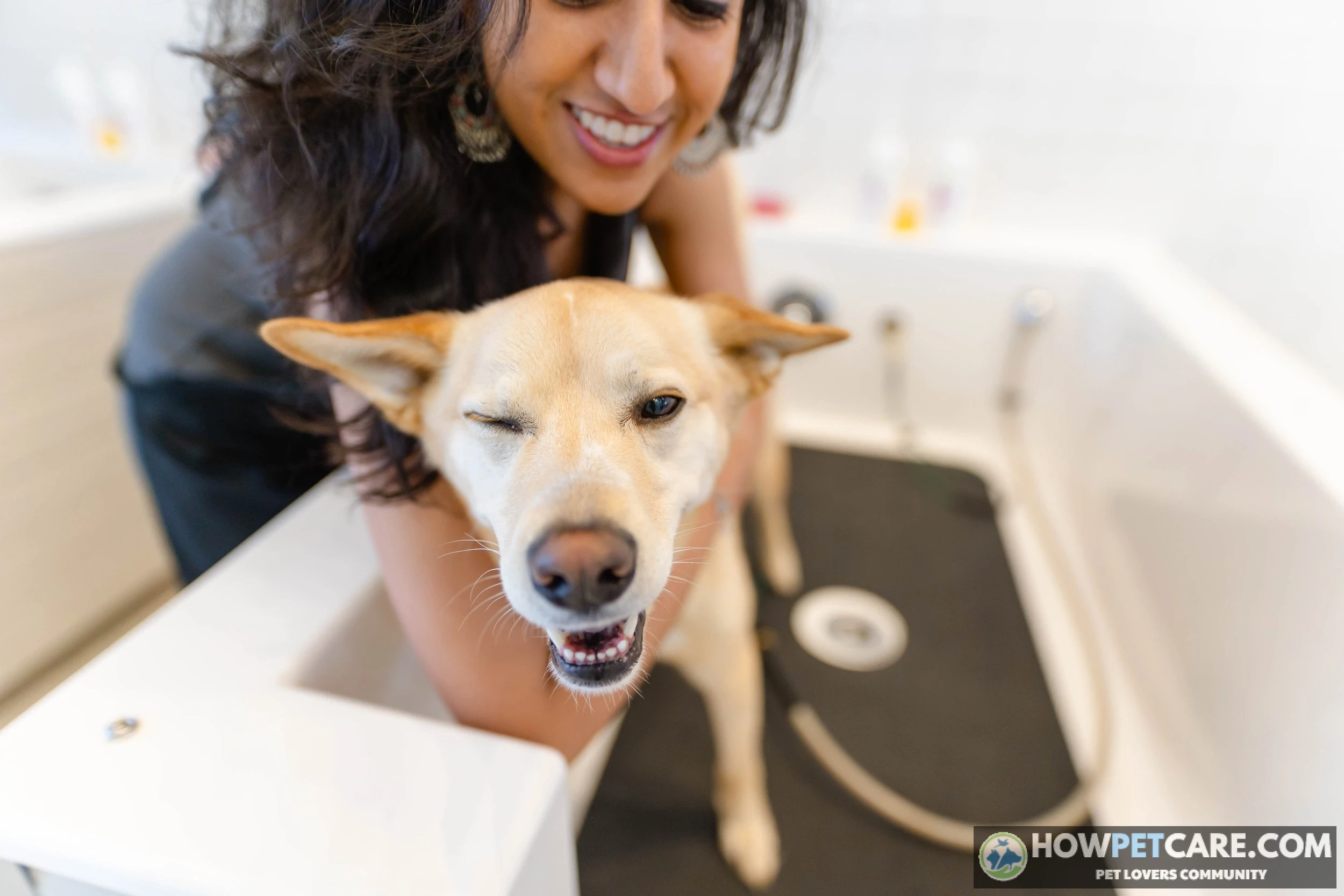

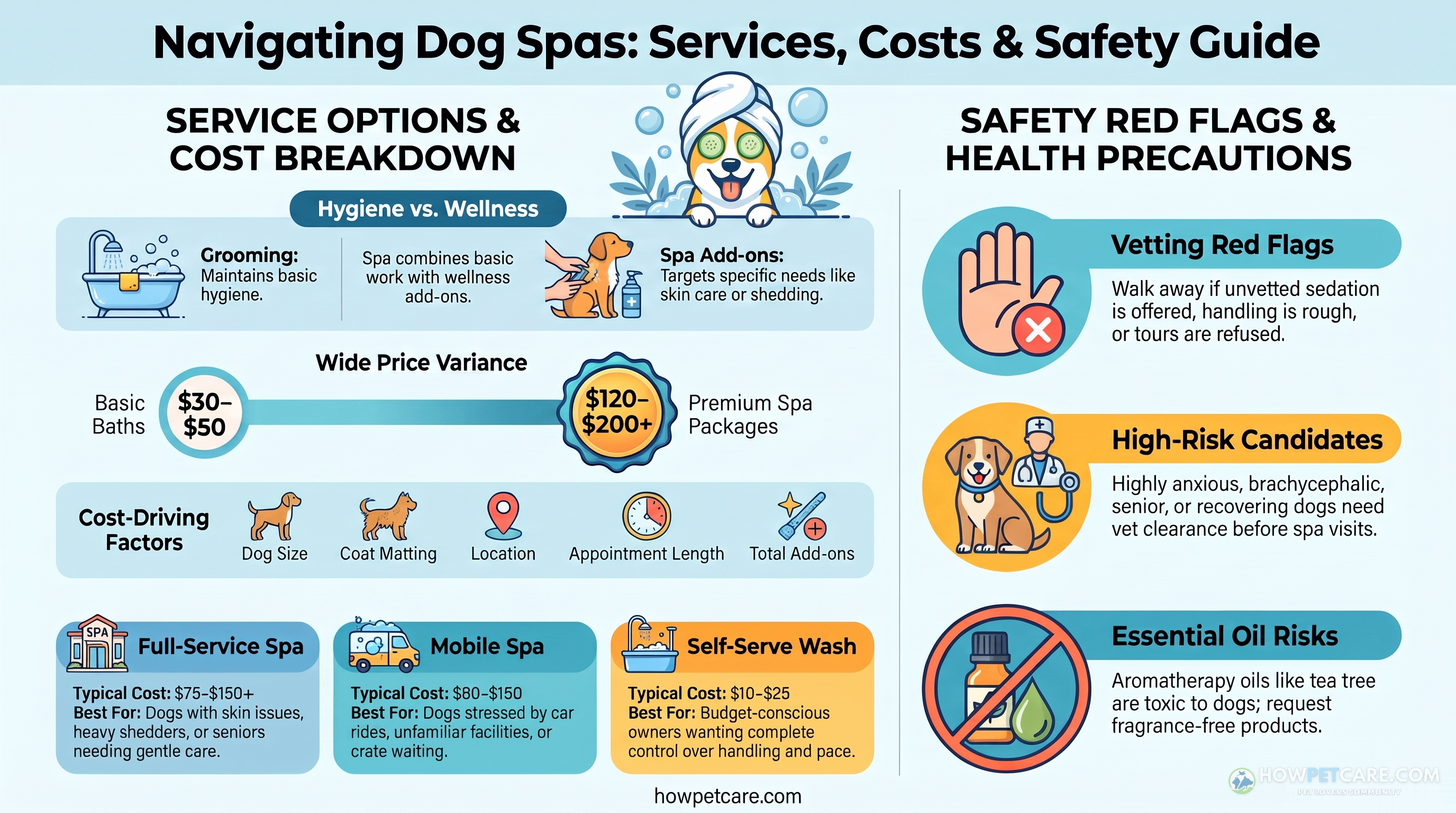
A dog spa is a grooming business that adds wellness-style extras—such as hydrotherapy baths, coat conditioning, massage, and pawdicures—to a standard bath and haircut. The term is a marketing label, not a licensed category, so services vary widely; always compare the itemized service list rather than the name.
What Is a Dog Spa? A Plain-English Definition
A dog spa, also called a pet spa, is a grooming business that adds wellness-style extras to a standard bath and haircut. Those extras can include a hydrotherapy bath, coat conditioning, massage, and a pawdicure. The term ‘dog spa’ is a marketing label, not a regulated or licensed category. Services vary widely from one business to the next, so the name alone doesn’t tell you what you’ll get. At its core, a dog spa does the same hygiene work as a groomer—bath, dry, brush-out, nail trim, ear cleaning—plus optional add-ons aimed at comfort, coat and skin condition, and relaxation. You will run into four main facility types: regular groomer, full-service spa, mobile spa, and self-serve wash. This guide compares them side by side so you can decide which fits your dog and your budget.
Dog Spa vs Regular Grooming: What Is Actually Different?
The overlap is significant. Both provide a bath, blow-dry, brush-out, nail trimming, and ear cleaning, and many groomers already offer spa-style add-ons under other names. The real differences come down to appointment length, specialty products (oatmeal, medicated, or conditioning treatments), add-on therapies, and often a slower pace with one-on-one handling. Where the difference is mostly branding, a ‘spa package’ may be just a bath plus a scented rinse. Compare the itemized service list, not the name. A useful rule of thumb: grooming maintains hygiene and appearance, while spa add-ons target a specific need such as dry skin, heavy shedding, or sore joints.
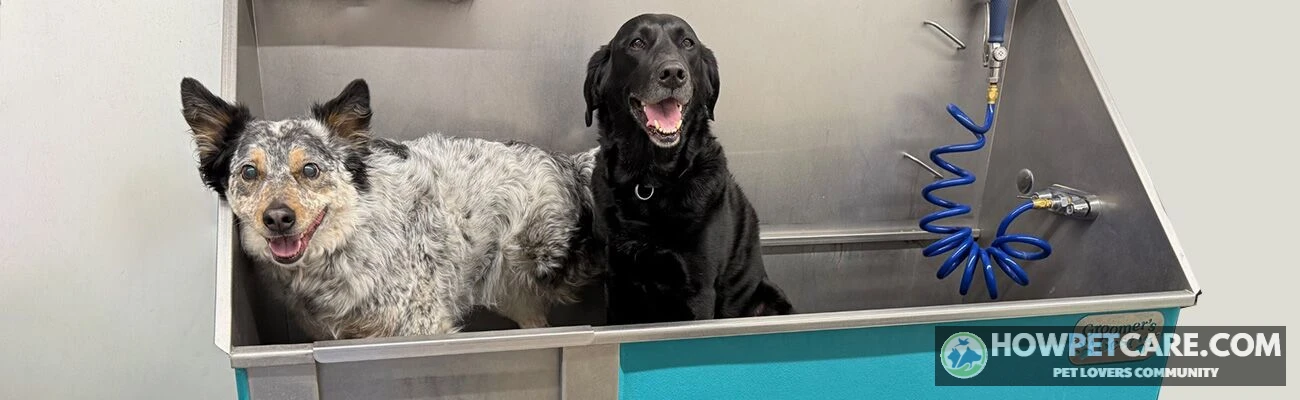
Dog Spa Services and Treatments Explained (What Each One Does and Its Limits)
Core hygiene services found almost everywhere
Nearly every dog spa offers a bath and blow-dry, nail trimming, ear cleaning, coat conditioning, and a de-shedding treatment. The de-shedding treatment removes loose undercoat with tools and a high-velocity dryer and works best on double-coated breeds.
Skin and coat treatments
- Hydrotherapy bath: warm water and jets that loosen dirt and may relax muscles. It is not the same as veterinary hydrotherapy or underwater treadmill rehab.
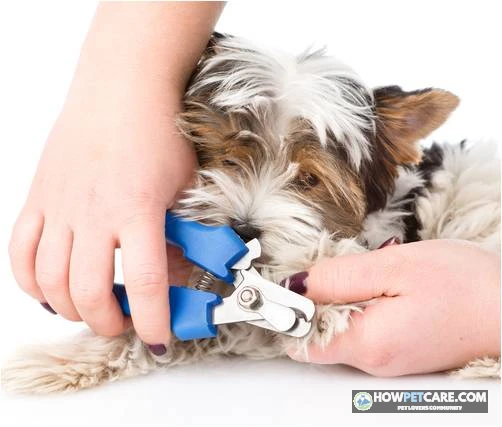
- Pawdicure: nail trim, paw-pad hair trim, and pad moisturizer. Overgrown nails alter gait and can crack, so regular maintenance matters.
- Blueberry facial: a gentle face wash with a blueberry-based product. It is mostly tear-stain and face cleaning, with limited evidence for other benefits.
- Mud bath treatment: clay or mud masks for skin and coat. Results vary, and skin sensitivity is a risk.
Relaxation and wellness add-ons
- Massage therapy for dogs: light relaxation massage by groomers differs from certified canine massage therapy. Treat any health claims with caution.
- Aromatherapy for dogs: usually means diffusing pet-safe essential oils such as lavender or chamomile. See the safety section for risks.
Research indicates the pet grooming market is growing (global market $6.89B in 2024, 7.33% CAGR) and the massage & spa segment for dogs is growing at 7.67% CAGR. A widely repeated claim that 80% of owners believe their dog feels better after grooming is unsourced, so treat it as unverified rather than fact.
How Much Does a Dog Spa Visit Cost? Price Ranges and What Drives Them
Typical price ranges by service
All ranges are typical US estimates—confirm with a local quote before booking. A city-center location, such as a pet spa in Las Vegas, can run 50–100% above a suburban shop.
| Service or package | Typical US price range | What is included | Factors that raise the price | Worth it for |
|---|---|---|---|---|
| Basic bath (groomer) | $30–$50 small dog; $50–$90 large dog | Shampoo, rinse, blow-dry, brush-out | Dog size, coat condition, matting | Healthy short-coated dogs |
| Full groom (bath + haircut) | $50–$120 | Bath plus breed or maintenance haircut | Coat length, trim complexity, doodle/poodle coats | Continuously growing coats |
| Mid-tier spa package | $75–$120 | Full groom plus one or two extras (conditioning mask, pawdicure, or facial) | Number of add-ons, premium product lines | Dogs with dry skin or heavy shedding |
| Premium spa package | $120–$200+ | Groom plus hydrotherapy bath, massage, facial, pawdicure, teeth or breath treatment | Breed size, appointment length, stylist experience | Seniors needing slow handling, owners wanting a bundled treat |
| Pawdicure add-on | $15–$25 | Nail trim or grind, paw-pad hair trim, pad balm | Severely overgrown nails | Dogs with overgrown nails or cracked pads |
| De-shedding treatment | $20–$45 | Undercoat removal with tools and high-velocity dryer | Undercoat density, shedding season | Double-coated breeds (labs, huskies, shepherds) |
| Blueberry facial | $10–$15 | Gentle face wash, tear-stain cleaning | Rarely varies | Mostly cosmetic — skip it if budget matters |
| Massage add-on | $20–$50 | 15–30 min relaxation massage | Session length; certified canine massage therapists charge more | Anxious or senior dogs — hedge expectations on health claims |
| Hydrotherapy bath add-on | $15–$40 | Warm jetted soak | Bath duration | Muscle relaxation and deep cleaning — not a substitute for vet rehab |
Hidden costs to ask about before booking: matting surcharges ($10–$30+), flea or tick treatment fees if found at check-in, cancellation or no-show fees, and whether a tip is expected.
What makes the price go up
Dog size and weight, coat type and condition (including matting surcharges), breed, city, add-on count, appointment length, and the stylist’s experience all move the price.
When a spa is worth the premium and when it is not
It’s worth it for dogs with skin or coat problems, heavy shedders, or seniors who need gentle handling. It’s often not worth it for a short-coated, healthy dog that only needs a bath.
| Service or Package | Typical US Price Range | What Is Included | Factors That Raise the Price | Worth It For |
|---|---|---|---|---|
| Full groom (bath + haircut) | 50–120 | Bath plus breed or maintenance haircut | Coat length, trim complexity, doodle/poodle coats | Continuously growing coats |
| Mid-tier spa package | 75–120 | Full groom plus one or two extras (conditioning mask, pawdicure, or facial) | Number of add-ons, premium product lines | Dogshttps://howpetcare.com/what-is-a-dog-spa/ with dry skin or heavy shedding |
| Premium spa package | 120–200+ | Groom plus hydrotherapy bath, massage, facial, pawdicure, teeth or breath treatment | Breed size, appointment length, stylist experience | Seniors needing slow handling, owners wanting a bundled treat |
| Basic bath (groomer) | 30–50 small dog; 50–90 large dog | Shampoo, rinse, blow-dry, brush-out | Dog size, coat condition, matting | Healthy short-coated dogs |
| De-shedding treatment | 20–45 | Undercoat removal with tools and high-velocity dryer | Undercoat density, shedding season | Double-coated breeds (labs, huskies, shepherds) |
| Pawdicure add-on | 15–25 | Nail trim or grind, paw-pad hair trim, pad balm | Severely overgrown nails | Dogs with overgrown nails or cracked pads |
| Massage add-on | 20–50 | 15–30 min relaxation massage | Session length; certified canine massage therapists charge more | Anxious or senior dogs — hedge expectations on health claims |
| Hydrotherapy bath add-on | 15–40 | Warm jetted soak | Bath duration | Muscle relaxation and deep cleaning — not a substitute for vet rehab |
| Blueberry facial | 10–15 | Gentle face wash, tear-stain cleaning | Rarely varies | Mostly cosmetic — skip it if budget matters |
What Happens at a Dog Spa Appointment: A First-Visit Walkthrough
How to prepare your dog beforehand
1–2 weeks before: confirm vaccination requirements (most spas ask for rabies, DHPP, and Bordetella), verify flea and tick prevention, book a short meet-and-greet for anxious dogs, and flag anything the spa must know (bite history, skin allergies, arthritis, heart conditions, past bad experiences, fear of dryers).
The day before: brush out tangles and loose undercoat at home. Arriving matted means extra fees and a longer, more stressful visit. Write down sensitivities: products that caused reactions, ear infection history, sore joints, spots that hurt when touched.
Day of the visit: feed a light meal 2–3 hours before, give real exercise and a potty break, bring vaccination records, your vet’s number, and an emergency contact. Budget 1.5–4 hours depending on coat and services; ask for a pickup window. At drop-off, ask which drying method they use and request hand-drying if your dog is nervous, senior, or flat-faced.
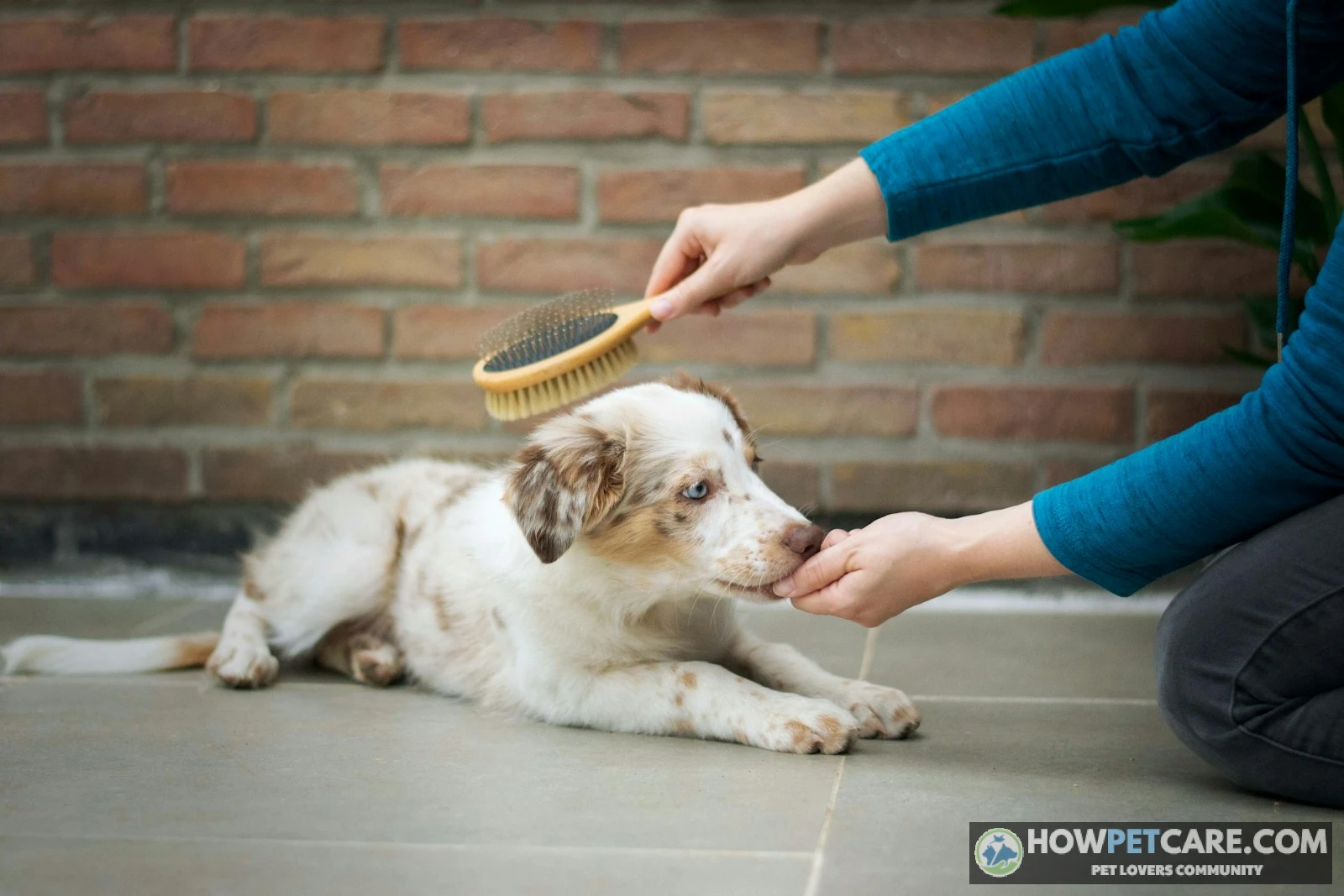
What the appointment looks like step by step
- Check-in and consultation
- Coat and skin check
- Temperament check
- Bath and treatments
- Drying (cage or hand dry—ask which)
- Finishing touches
- Pickup and a report
What to check at pickup
Ask what the staff noticed: any lumps, hot spots, ear redness, or skin issues worth a vet call. Watch your dog’s behavior that evening. Quiet is normal, but limping, raw skin, or unusual fear around the facility next time is data.
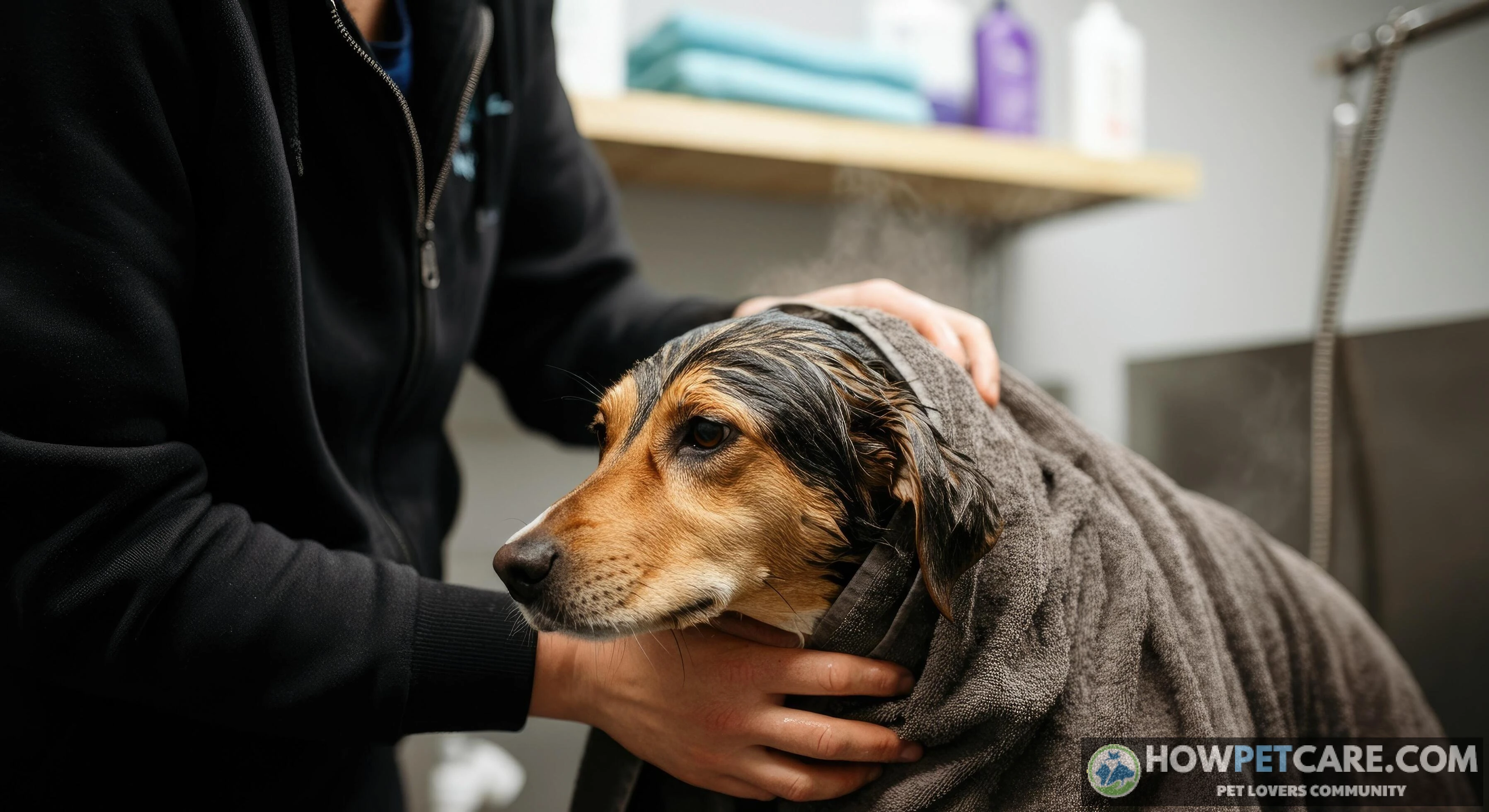
1–2 weeks before
- ☐ Confirm vaccination requirements—most spas ask for rabies, DHPP, and Bordetella; get records from your vet
- ☐ Verify your dog is current on flea and tick prevention
- ☐ If your dog is anxious, book a short meet-and-greet or acclimation visit instead of a full appointment
- ☐ Flag anything the spa must know on the intake form: bite or reactivity history, skin allergies, arthritis, heart conditions, past bad grooming experiences, fear of dryers
The day before
- ☐ Brush out tangles and loose undercoat at home—arriving matted means extra fees and a longer, more stressful visit
- ☐ Write down sensitivities: products that caused reactions, ear infection history, sore joints, spots that hurt when touched
Day of the visit
- ☐ Feed a light meal 2–3 hours before, not right before—a full stomach plus stress can mean nausea
- ☐ Give your dog real exercise and a potty break so they arrive tired, not wired
- ☐ Bring vaccination records, your vet’s number, and an emergency contact
- ☐ Budget 1.5–4 hours depending on coat and services; ask for a pickup window, not a vague ‘we’ll call you’
- ☐ At drop-off, ask which drying method they use and request hand-drying if your dog is nervous, senior, or flat-faced
At pickup
- ☐ Ask what the staff noticed: any lumps, hot spots, ear redness, or skin issues worth a vet call
- ☐ Watch your dog’s behavior that evening—quiet is normal, but limping, raw skin, or unusual fear around the facility next time is data
Are Dog Spa Treatments Safe? Risks, Red Flags, and Dogs That Should Skip Them
Which dogs should skip or modify spa treatments
Highly anxious or reactive dogs, seniors with arthritis or heart or respiratory conditions, dogs with open wounds or active skin infections, dogs recovering from recent surgery or vaccination, brachycephalic breeds (heat and drying stress), and pregnant dogs. Ask your vet first.
Are essential oils and aromatherapy safe for dogs?
Some oils, such as tea tree, are toxic to dogs. Dogs have a strong sense of smell and can react to diffusers. There is no universal dilution standard for dogs. Ask which products are used and request fragrance-free.
Red flags to watch for when evaluating a facility
- Sedation offered without vet involvement (hard red flag)
- Rough handling
- Dogs left unattended on grooming tables or in cage dryers
- No vaccination checks
- Dirty facility
- Refusal to let you see the work area
- Pressure to buy add-ons
Hygiene and credentials checklist
Tubs, tables, and tools should be disinfected between every dog. Ask them to describe the process. Credentials: groomer certifications (NDGAA, IPG, or similar—note most US states do not require a grooming license), pet first-aid/CPR training, and certified canine massage training for massage services.
Call or visit and check off what you can verify. Any unchecked warning item is a reason to ask follow-up questions—or walk away.
Policies and credentials
- ☐ Requires proof of rabies vaccination (and ideally DHPP/Bordetella)—no vaccination checks means every dog there is a risk to yours
- ☐ Can show groomer certification (NDGAA, IPG, or similar) or explain staff training—note that most US states do not require a grooming license, so certification is voluntary proof of skill
- ☐ Has pet first-aid/CPR trained staff on site
- ☐ Massage services are done by someone with canine massage training, not just ‘a groomer who rubs dogs’
Safety and handling
- ☐ Does NOT sedate dogs—sedation without a vet involved is a hard red flag; leave immediately
- ☐ Dogs are never left unattended on grooming tables or in cage dryers
- ☐ Will tell you whether they cage-dry or hand-dry, and lets you request hand-drying
- ☐ Lets you tour the work area—refusal to show you where your dog will be is a warning sign
Products and hygiene
- ☐ Can name the products they use and provide ingredient lists on request
- ☐ Offers a fragrance-free option and can tell you exactly which essential oils, if any, are used (tea tree oil is toxic to dogs—ask directly)
- ☐ Tubs, tables, and tools are disinfected between every dog—ask them to describe the process, not just confirm it happens
- ☐ Facility smells clean, not like wet dog or heavy fragrance cover-up
Business practices
- ☐ Gives an itemized price list before you book, including matting and de-shedding surcharges
- ☐ Does not pressure you into add-ons at check-in or pickup
Groomer, Full-Service Spa, Mobile Spa, or Self-Serve Wash: How to Choose
Side-by-side comparison of the four options
All ranges are typical US estimates—confirm with a local quote before booking.
| Option | Typical cost range | Typical services | Level of one-on-one attention | Stress considerations | Hygiene points to check | Best for |
|---|---|---|---|---|---|---|
| Regular groomer | $30–$90 | Bath, dry, brush-out, nail trim, ear cleaning; some offer add-ons | Moderate — dogs may rotate between bath, dryer, and groomer | Kennel noise and other dogs nearby; waits in crates are common | Ask how tubs and tools are disinfected between dogs | Routine hygiene for healthy, social dogs |
| Full-service spa | $75–$150+ for packages | Everything a groomer does plus hydrotherapy bath, massage, facial, pawdicure, specialty conditioning | Highest — usually a longer appointment with one handler | Slower pace helps some dogs; longer total time away from you can stress others | Same as groomer, plus ask whether spa equipment (jets, soaking tubs) is flushed between uses | Dogs with skin or coat issues, heavy shedders, seniors needing gentle handling |
| Mobile spa | $80–$150 | Bath, dry, nails, ears at your curb; fewer add-on therapies | High — your dog is the only client in the van | No kennels or other dogs, but the van is a small, enclosed space — some anxious dogs do better, some do worse | Ask how the van’s tub, table, and dryer are cleaned between appointments | Dogs stressed by car rides or unfamiliar facilities, owners who want convenience |
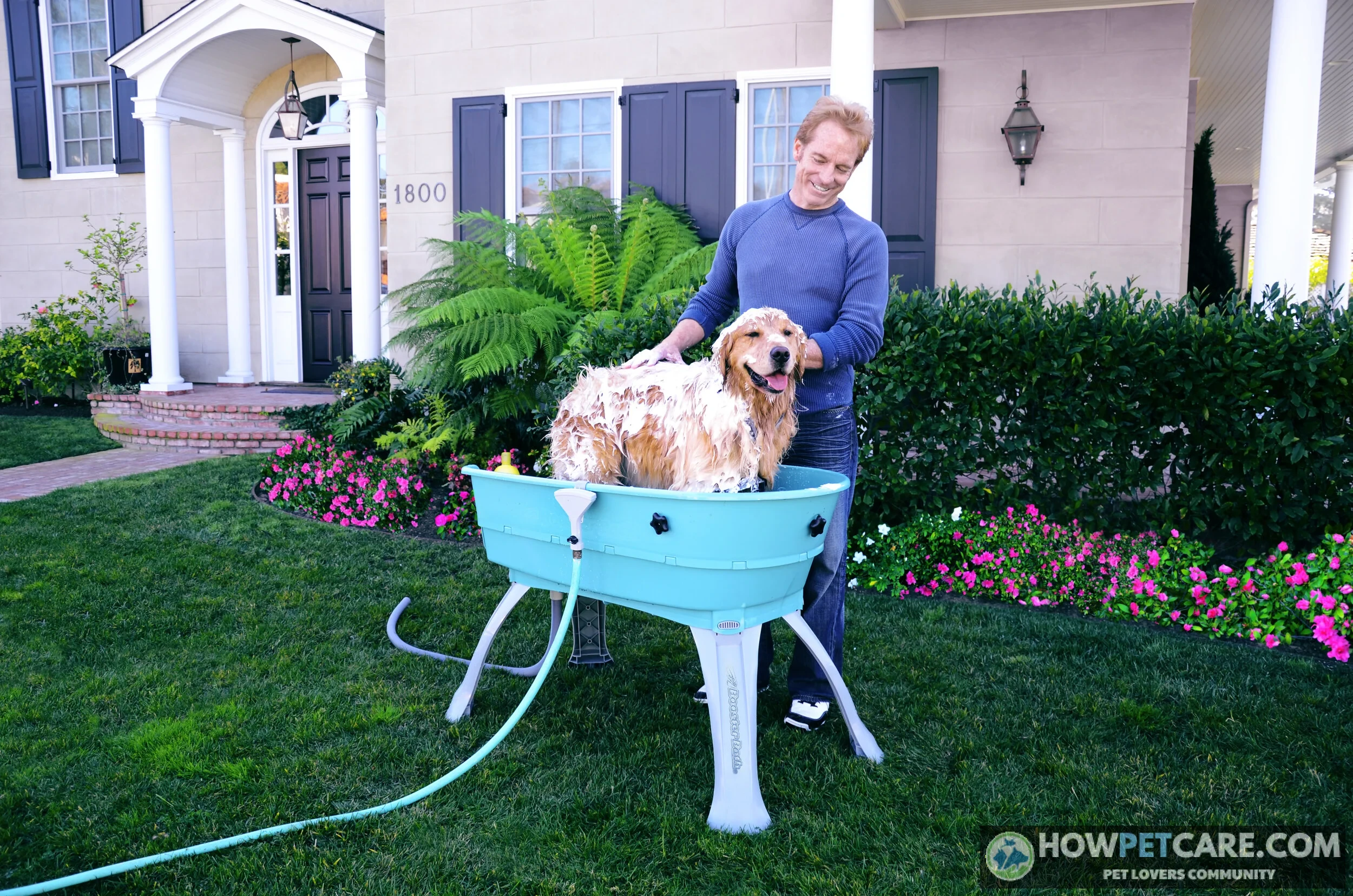
| Self-serve wash | $10–$25 | You do the work: shared tub, shampoo, dryer, towels provided | None — you are the handler | Lowest for dogs that are calmer with their own person; you control pace and products | Critical: ask staff how and when tubs are disinfected, and wipe surfaces yourself | Budget-focused owners, dogs that need frequent baths, owners comfortable doing the work |
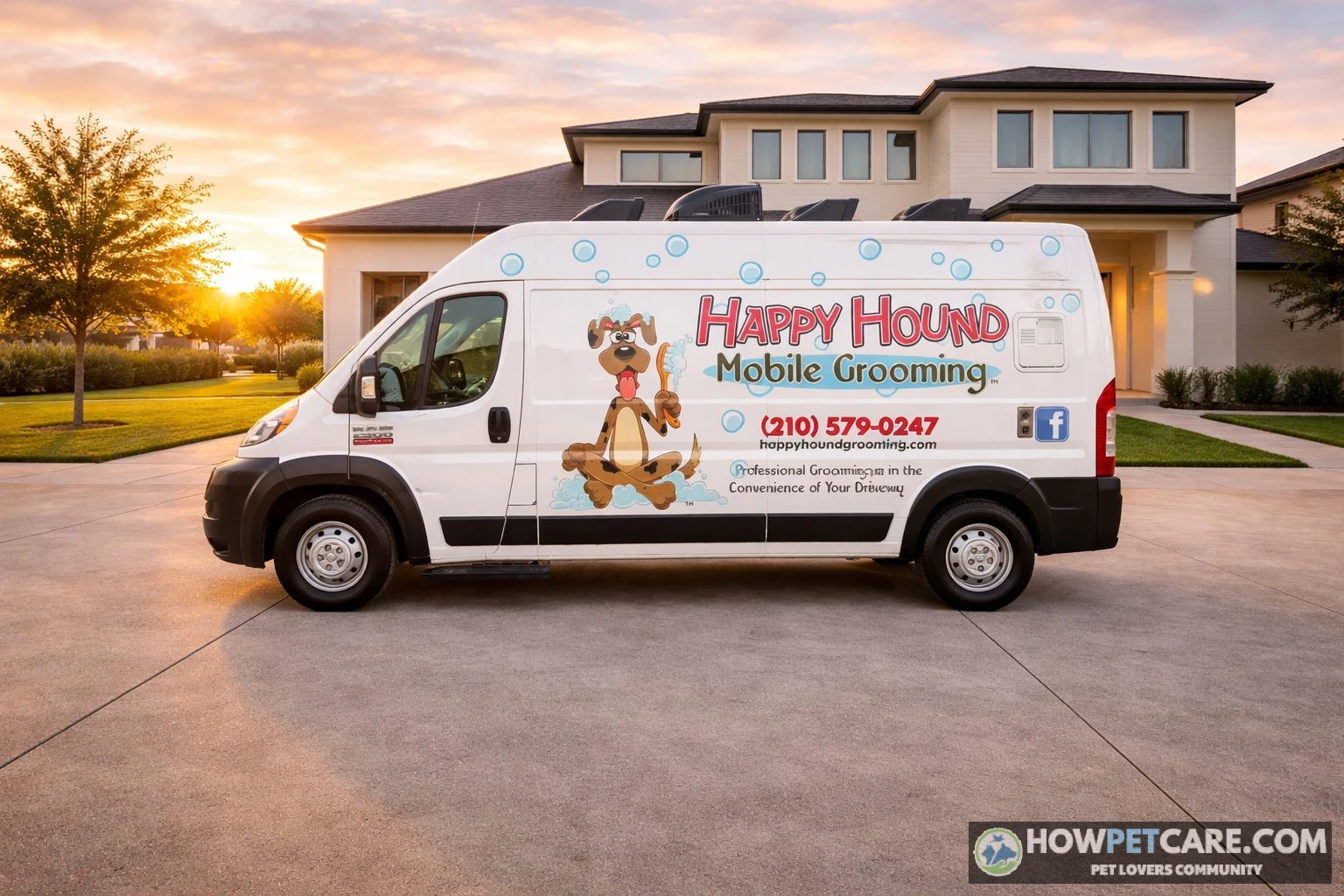
Which option fits which dog
- Anxious or senior dog: mobile spa (if the van is calm) or full-service spa with hand-drying and short appointments.
- Budget-focused owner: self-serve wash or regular groomer.
- Heavy-shedding double coat: full-service spa with de-shedding treatment.
- Show or maintenance trim: regular groomer or full-service spa with an experienced stylist.
- Skin-condition dog: full-service spa that can follow vet-prescribed shampoo.
Before you book with any provider, run the red-flag checklist in the safety section above.
How Often to Visit a Dog Spa and What to Do at Home Between Visits
Visit frequency by coat type and lifestyle
| Coat type or dog profile | Example breeds | Suggested visit interval | Notes and adjustments |
|---|---|---|---|
| Continuously growing, curly, or hair-like coats | Poodles, doodles, bichons, shih tzus | Every 4–6 weeks | Skipping visits means matting, and mats must be shaved, not brushed out |
| Double coats | Labs, huskies, golden retrievers, German shepherds | Every 6–8 weeks | Book extra de-shedding visits in spring and fall shedding seasons; never shave a double coat |
| Short, smooth coats | Beagles, boxers, vizslas, pit bulls | Every 8–12 weeks | A bath at home often covers the gap; spa visits mainly earn their cost for nails and ears |
| Long, silky coats | Yorkies, Maltese, collies | Every 4–6 weeks | Needs daily home brushing between visits or the interval must shrink |
| Skin-condition or medicated dogs | Any dog on vet-prescribed shampoo | As directed by your vet | Bring the vet’s instructions; a spa is not a substitute for dermatology care |
| Seniors and mobility-limited dogs | Any older dog | Every 6–10 weeks | Prioritize short appointments and hand-drying over add-on treatments |
| Puppies | Under 6 months | Short intro visits every few weeks | Goal is acclimation — a 20-minute happy visit beats a full groom they hate |
| Lifestyle: swimmers, mud-rollers, working dogs | Any | Add a visit or home bath as needed | More baths are fine, but keep spa add-ons occasional — over-bathing strips natural coat oils |
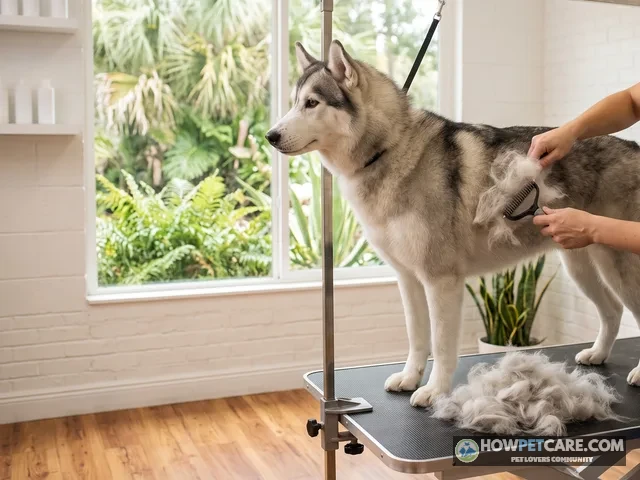
Book sooner if you see: matting you cannot brush out, persistent odor that survives a bath, scratching or hot spots, or nails clicking on floors.
Stretch the interval if: the coat brushes out cleanly, skin is calm, and nails are still short.
A simple at-home routine between appointments
Regular brushing suited to the coat, a gentle dog-safe shampoo, ear checks, paw balm, nail grinding or trimming, dental care, and a quick mat check. For a DIY at-home spa day: warm bath, brushing, gentle paw massage—avoid human products and essential oils.
Your Dog Spa Decision Checklist: Next Steps Before You Book
Step 1: Decide what your dog needs (hygiene, shedding, skin, or relaxation) and whether your dog is a good candidate. Check with your vet if there are health concerns.
Step 2: Shortlist two or three facilities and request an itemized price list and the vaccination policy.
Step 3: Run the quick vetting checklist (credentials, product ingredients, sedation policy, hygiene, handling, and whether you can tour).
Step 4: Book a short first visit and a basic package, then add treatments only if your dog tolerates it well.
Step 5: After the visit, assess your dog’s mood, skin, and coat, then adjust the schedule.
1A pet owner notices that two local businesses offer identical basic services consisting of a bath, blow-dry, brush-out, nail trim, and ear cleaning. However, one advertises as a 'Regular Groomer' and the other as a 'Full-Service Dog Spa.' What factor primarily differentiates the term 'dog spa' from standard groomer branding?
The term is not state-regulated or officially licensed, so it functions as a marketing label while underlying hygiene services remain similar.
2An owner of a Siberian Husky, a double-coated breed undergoing heavy spring shedding, seeks grooming care. Which approach is safest and most effective for this specific coat type based on industry guidelines?
High-velocity drying and undercoat tools effectively loosen trapped undercoat hair without altering the protective outer guard hairs.
3An owner is preparing an anxious dog for a first visit to a full-service spa. Which of the following pre-visit steps are recommended to lower stress and avoid extra fees?
Acclimation visits help nervous dogs adjust to the facility environment and staff without the immediate pressure of grooming.
4A budget-conscious pet owner brings a large dog needing heavy undercoat removal and nail care to a spa. Reviewing the available add-on options below, which service is strictly cosmetic and can be omitted without impacting physical health or coat hygiene?- Pawdicure (15–25) - De-shedding treatment (20–45) - Hydrotherapy soak (15–40) - Blueberry facial (10–15)
A blueberry facial is primarily a tear-stain face wash with mostly cosmetic benefits, making it an easy candidate for omission when cutting costs.
5Which of the following canine profiles or health conditions signal that a dog should skip standard grooming spa treatments or have them heavily modified under veterinary advice?
Flat-faced breeds struggle with thermoregulation and respiratory clearance, making cage dryers and high heat dangerous.
6An owner seeks a grooming setup for a dog that experiences severe motion sickness during car rides and reacts aggressively to the noise of communal kennels. Which facility choice best addresses both constraints?
Mobile spas park directly at the owner's curb, eliminating car travel and removing communal kennel noise.
FAQ
What is a self-serve dog spa and how does it work?
A self-serve dog spa is a facility with raised tubs, warm water, shampoo, towels, and dryers that you rent by the session to wash your own dog. Staff usually only supply the equipment and cleanup. It costs less than full service, but you do all the handling.
Is a dog spa the same as a pet spa?
Yes. The terms ‘dog spa’ and ‘pet spa’ are used interchangeably, although a pet spa may also serve cats and other animals. Neither term is regulated, so check the actual service list.
Do dogs enjoy going to a spa?
It depends on the dog. Dogs that tolerate handling and water often do well, while anxious or reactive dogs may find the noise, dryers, and strangers stressful. Watch your dog’s body language and start with short visits.
Do dog spas require vaccinations?
Most do. Expect to show proof of rabies and DHPP vaccination, and often Bordetella. Requirements vary, so confirm them when booking.
Can puppies go to a dog spa?
Many facilities accept puppies once they have completed their core vaccinations, usually at around 12 to 16 weeks. A short, gentle first visit helps puppies get used to handling. Ask your vet when your puppy is ready.