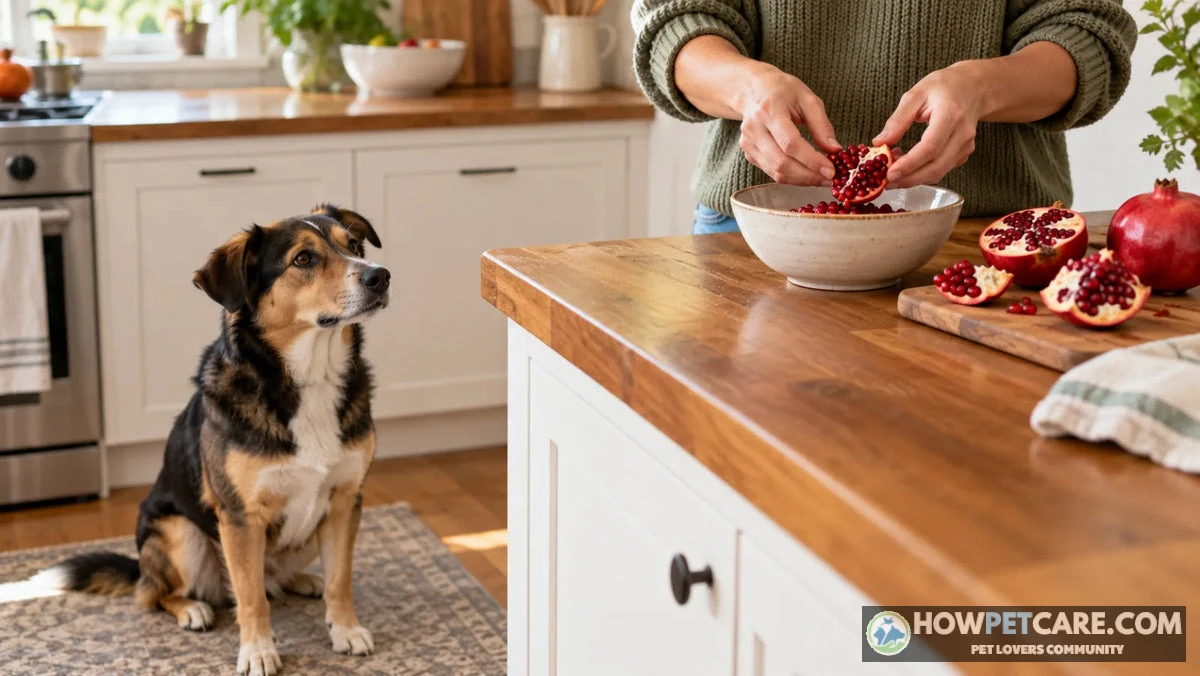

Yes, dogs can eat pomegranate arils in small amounts — the fruit isn’t toxic. The rind, pith and whole fruit are the real hazards: they can cause choking or intestinal blockage. Offer only a few weight-appropriate arils as an occasional treat, and call your vet if your dog ate rind or a whole fruit.
Can dogs eat pomegranate? The fruit is not classed as toxic to dogs, but the rind, pith and whole fruit pose blockage and digestive risks. Offer only a small portion of arils as an occasional treat, using the weight-based table below. Pomegranate does not appear on standard canine toxic-food lists such as the ASPCA’s, but its physical hazards deserve attention. This guide covers each part of the fruit, a portion table based on calorie needs, what to do after accidental ingestion, and precautions for dogs with diabetes, pancreatitis, obesity or medications. If your dog has already eaten pomegranate, go to the My Dog Ate Pomegranate: What to Do Right Now section for an action plan.
Reviewed by Dr. Chyrle Bonk, DVM, November 2026. Any new food can cause digestive upset in an individual dog. This article offers general guidance and is not a substitute for advice from your dog’s own veterinarian.
Can Dogs Eat Pomegranate? The Short Answer by Part
Pomegranate is not classed as toxic to dogs and does not appear on the ASPCA’s standard list of poisonous plants and foods. The rind, pith and whole fruit, however, present significant blockage and digestive risks. Offer arils only in small, weight-appropriate portions as an occasional treat. Non-toxic does not mean safe in any amount: eating too much or eating the wrong parts can still cause problems. If your dog has just eaten pomegranate, use the decision tree in the My Dog Ate Pomegranate: What to Do Right Now section.
Pomegranate Arils, Seeds, Rind and Pith: What Is Safe and What Is Not
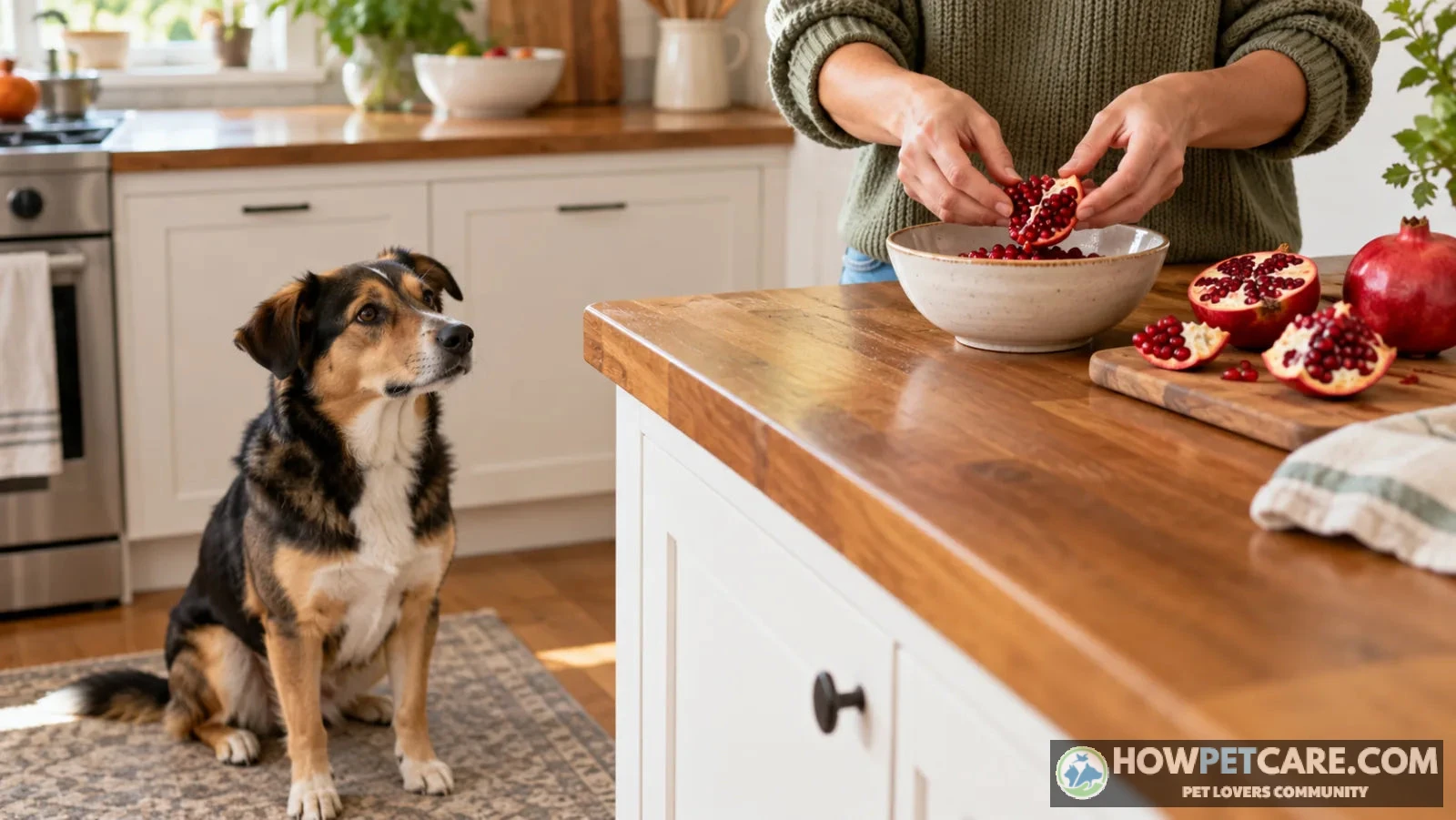
Arils, the juicy red sacs, can be offered in small amounts. The tiny crunchy seed inside each aril is edible, and a few usually pass without trouble. Larger quantities bring more fiber and natural sugar, along with a greater risk of loose stool.
Seeds embedded in arils are not a separate hazard beyond the volume eaten, although a very large quantity of seeds can contribute to a gastrointestinal obstruction in a small dog.
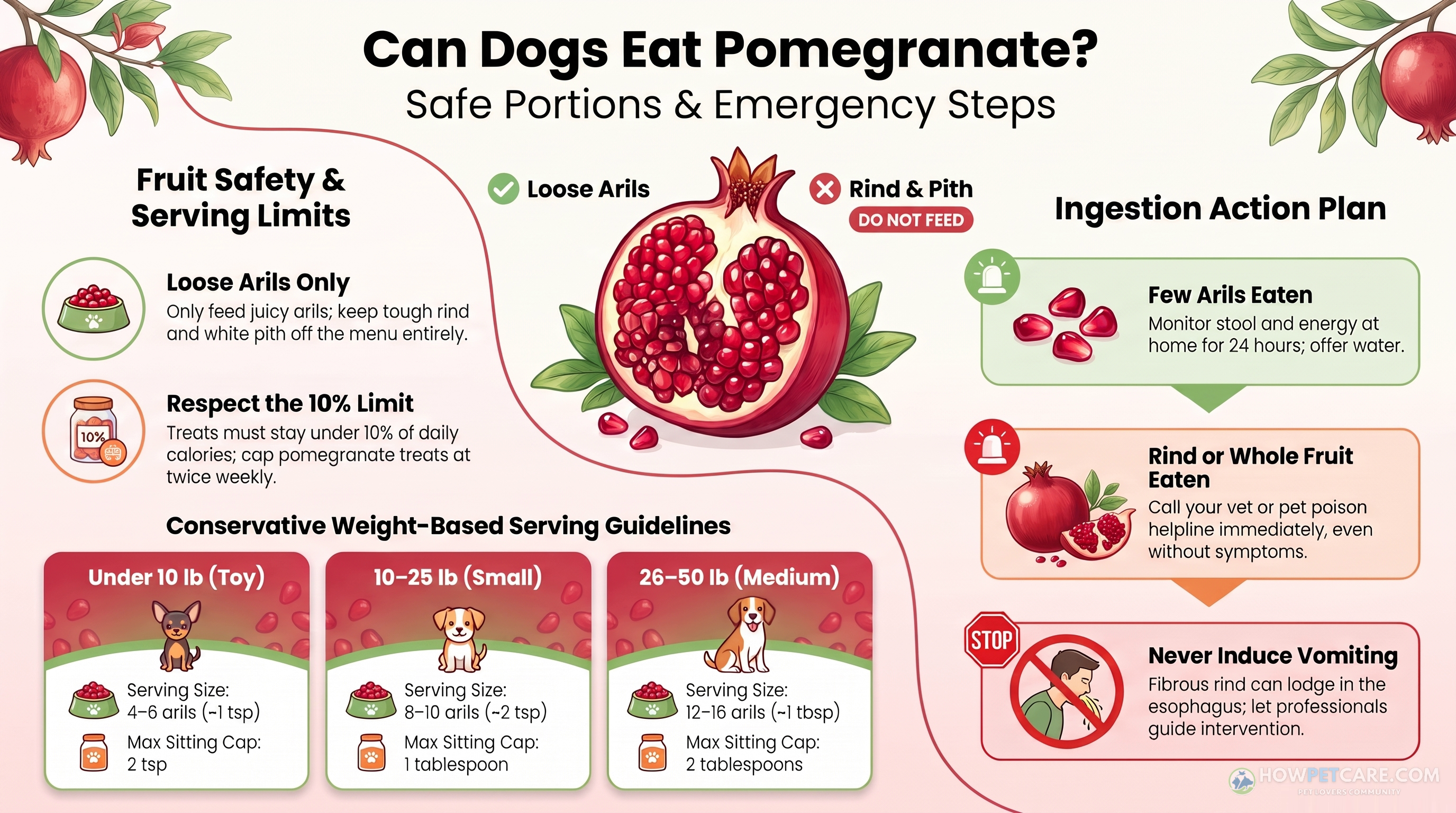
The rind and white pith surrounding the arils are tough, bitter and fibrous. They contain tannins, which can irritate the stomach and intestinal lining. Don’t offer either part to your dog. Rind in particular can cause an obstruction, especially in small or toy breeds.
Whole fruit, crown pieces and leathery skin chunks can cause choking or a blockage, especially in small dogs. Keep whole pomegranates out of reach.
Tannins and punicalagins are compounds concentrated in the peel and juice. Their astringent properties can upset a dog’s gut. No established toxic dose exists for dogs, so the concern is physical irritation and blockage rather than chemical poisoning.
How Much Pomegranate Can a Dog Eat? A Weight-Based Portion Table
Treats should account for no more than about 10% of a dog’s daily calories. Pomegranate arils have about 3 calories and 0.5 g of sugar per teaspoon (roughly 4 arils). The portions for each weight band stay well under the 10% ceiling and limit the total volume of seeds, since quantity rather than toxicity is the main risk. Online charts sometimes conflict, with some allowing 3x more; this table uses the conservative lower number.
| Dog weight | Size category | Arils or teaspoons per serving | How often | Do not exceed per sitting |
|---|---|---|---|---|
| Under 10 lb | Toy | 4–6 arils (~1 tsp) | Occasional treat, max 2x/week | 2 tsp |
| 10–25 lb | Small | 8–10 arils (~2 tsp) | Occasional treat, max 2x/week | 1 tablespoon |
| 26–50 lb | Medium | 12–16 arils (~1 tablespoon) | Occasional treat, max 2x/week | 2 tablespoons |
| 51–90 lb | Large | 20–24 arils (~2 tablespoons) | Occasional treat, max 2x/week | 3 tablespoons |
| Over 90 lb | Giant | 24–30 arils (~3 tablespoons) | Occasional treat, max 2x/week | ¼ cup |
Notes: These portions are for a healthy adult dog with no conditions; see the health-conditions section for adjustments. Start with the smallest amount in your dog’s band and watch for 24 hours before offering more. Advice to give a few seeds often overlooks the fact that a tablespoon of arils is ~15% of a 10-lb dog’s treat budget. That’s why the table uses teaspoons rather than handfuls.
My Dog Ate Pomegranate: What to Do Right Now
This decision tree, reviewed by Dr. Chyrle Bonk, DVM, matches what your dog ate to the appropriate action. First, gather the 4 facts your vet will ask for:
- Part eaten: loose arils only, rind/pith pieces, or whole/halved fruit
- Estimated amount (a few, a handful, half a fruit, a whole fruit)
- Time since ingestion
- Your dog’s weight and any existing conditions or medications
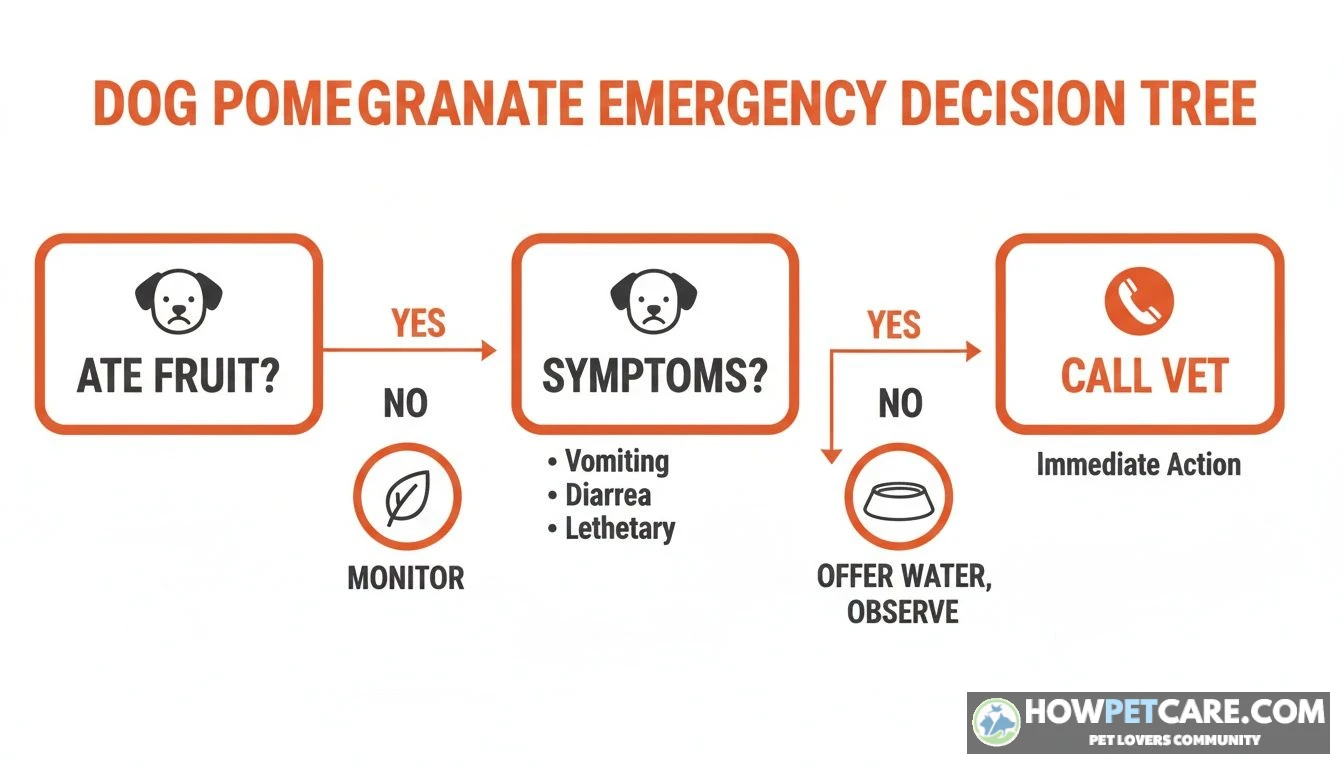
Branch 1 — A few loose arils (roughly under a tablespoon), any size dog, no symptoms yet
→ Monitor at home. Offer water, skip other treats today, and watch your dog’s stool and energy for 24 hours. You don’t need to call the vet unless symptoms appear.
Branch 2 — A large handful of arils, medium or large dog
→ Monitor at home for stomach upset. Soft stool, gas or one vomiting episode is common. Call your vet if symptoms last past 24 hours or get worse.
Branch 3 — A large quantity of arils in a toy/small dog, OR any rind, pith, or crown pieces, OR part of a whole fruit
→ Call your vet, an emergency clinic, ASPCA Animal Poison Control (888-426-4435) or Pet Poison Helpline (855-764-7661) now, even if your dog looks fine. Consultation fees may apply. Be ready to describe the 4 facts.
Branch 4 — Whole or halved fruit eaten, OR any dog already vomiting, bloated, or lethargic
→ Go to an emergency vet now. Don’t wait for symptoms to develop.
One rule for every branch: Do NOT induce vomiting at home unless a veterinarian or poison control explicitly tells you to. Rind and fibrous material can lodge in the esophagus on the way back up, and some dogs should never be made to vomit. A professional can weigh that risk.
This rule applies in every scenario — do not attempt to make your dog vomit at home.
Symptoms and Timeline: Stomach Upset vs. Intestinal Blockage
Mild digestive upset in dogs often resolves within a day, but signs of a blockage can appear hours later. Use this timeline to judge when home monitoring is reasonable and when to contact a vet.
Hours 0–6 — expected window for mild GI upset:
- ☐ Soft stool, gas, or one vomiting episode → a normal response to a new food; offer water and withhold treats
- ☐ Red or pink tint in stool or vomit → likely fruit pigment, not blood
- ☐ Still eating, drinking, and acting normal → keep monitoring
Hours 6–24 — the gap that fools people:
- ☐ A dog who looks fine at hour 2 is NOT cleared — obstruction signs typically take 12–24+ hours to develop
- ☐ Re-check appetite and energy at each meal; a skipped meal counts as a symptom
- ☐ Call your vet today if vomiting repeats, even if mild
Hours 24–72 — obstruction red-flag window (this is when rind or large-quantity ingestions show trouble):
- ☐ Repeated vomiting or can’t keep water down → ER now
- ☐ Swollen, hard, or painful belly → ER now
- ☐ Straining to defecate or no stool → ER now
- ☐ Lethargy, hunched/’praying’ posture, whining → ER now
- ☐ Refusing food entirely → vet visit today
- ☐ Pale gums, collapse, or can’t pass urine → ER immediately
- ☐ Black, tarry, or bloody stool → vet visit regardless of timeline
After 72 symptom-free hours, the risk of blockage from a single ingestion drops sharply. Confirm the monitoring window with your vet, who may recommend a different one based on your dog’s size and what was eaten.

Pomegranate Juice, Yogurt, Dried Fruit, Molasses, Oil and Extract: Which Products to Avoid
| Product | Verdict | One-line reason |
|---|---|---|
| Loose fresh arils | ✅ Yes (small amounts) | Only form with a safe portion — see the weight table |
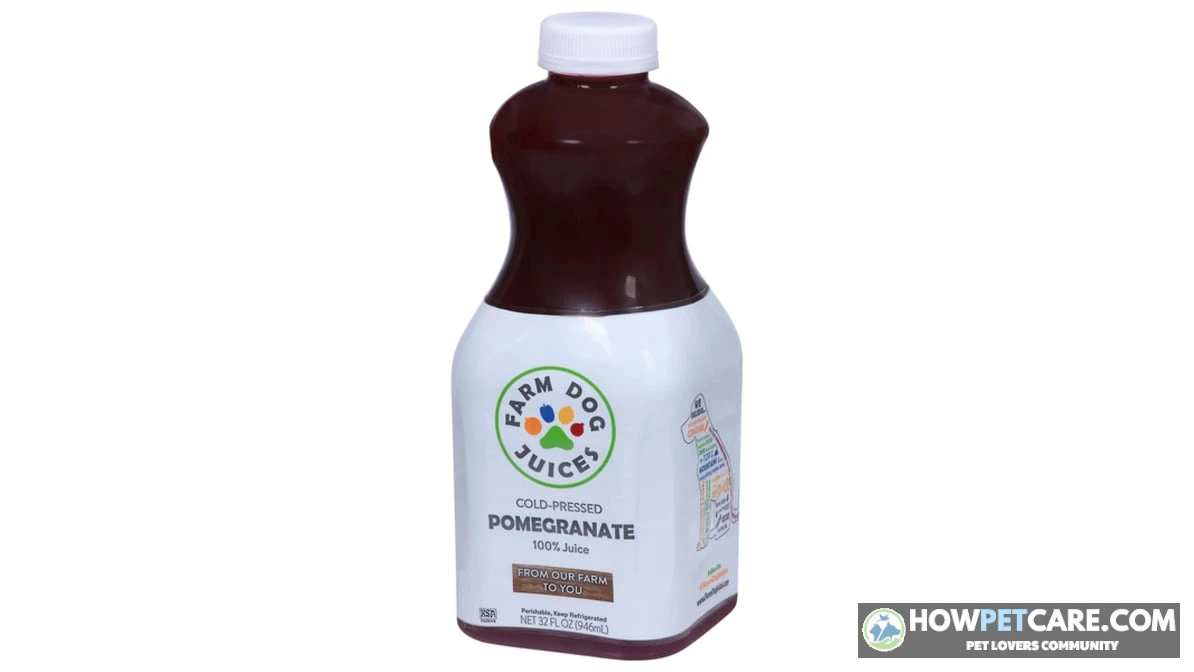
| Pomegranate juice | ⚠️ Avoid offering | Concentrated sugar, no fiber; check labels for xylitol and blends — a small accidental sip isn’t an emergency |
| Pomegranate yogurt | ❌ No | Added sugar, possible artificial sweeteners, and lactose most dogs tolerate poorly |
| Popsicles / sorbet | ❌ No | Sugar plus xylitol risk in ‘low sugar’ versions — xylitol is toxic to dogs |
| Dried/dehydrated arils | ⚠️ Tiny amount max | Sugar is concentrated per gram and pieces are hard and sticky |
| Molasses, syrup, grenadine | ❌ No | Pure concentrated sugar with no offsetting value |
| Pomegranate oil / extract supplements | ❌ Not without your vet | No established canine dose; concentration far exceeds food use |
| Extract as an ingredient in commercial dog food | ✅ Generally fine | Trace amounts in a formulated food ≠ feeding the fruit — check the maker’s feeding directions, and don’t add extra |
For any human product containing pomegranate, check the full ingredient list for ‘xylitol,’ ‘birch sugar,’ or ‘artificial sweetener’ before assuming pomegranate is the only concern.
Pomegranate for Dogs With Diabetes, Pancreatitis, Obesity, Sensitive Stomachs or Medications
Some health conditions change the risks of feeding pomegranate. Use the checklist below to see whether to ask your vet first.
| Condition | Caution Level | Key Point |
|---|---|---|
| Diabetes | ⛔ Ask first | The natural sugar in arils can affect blood glucose; never add them to a managed diet on your own. |
| Pancreatitis history | ⛔ Ask first | Arils are low in fat, but novel/high-sugar treats can trigger GI flare-ups in these dogs. |
| Overweight or on a weight plan | ⚠️ Caution | Count every aril in the 10% treat budget, or choose a lower-sugar swap (blueberries, cucumber). |
| Sensitive stomach or recovering from GI illness | ⚠️ Caution | One or two arils maximum, or skip them entirely this month. |
| Puppy | ⚠️ Caution | The diet should be ~all complete puppy food; if your vet agrees to a taste, cap it at 1–2 arils. |
| On liver-metabolized medication | ⛔ Ask first | Pomegranate has been studied for its effects on drug-metabolizing enzymes, mostly in lab/human research. Evidence in dogs is thin, but juice and extract are concentrated enough to warrant a call. |
| Healthy adult dog, no meds, none of the above | ✅ Proceed | Use the portion table. |
For these dogs, the concern is the sugar load, novelty, or drug interaction rather than the fruit itself. Don’t assume ‘a little won’t hurt’ until you’ve checked the relevant conditions.
Puppies and Toy Breeds: Extra Cautions for Small Bodies
A small amount of fruit makes up a larger share of a toy dog’s daily calories, and smaller digestive tracts are more vulnerable to obstruction. Puppies have sensitive digestion and should eat mostly complete puppy food. Wait and ask your vet before introducing treats like pomegranate or lower-sugar options such as blueberries for small dogs; if the vet agrees, offer one or two arils at most. For toy breeds, use the smallest band in the portion table, cut or crush arils if choking is a concern, and never leave a whole fruit within reach. A toy dog or puppy that eats rind or whole fruit needs a vet call right away.

Are Pomegranate’s Health Benefits for Dogs Real? What the Evidence Shows
Arils contain antioxidants, including punicalagins (concentrated in the peel and juice), as well as vitamin C and fiber. Dogs make their own vitamin C and don’t need it from fruit. Claims about heart health, arthritis and cancer come mostly from human, lab or animal studies, often using concentrated peel extract rather than a few arils. There is no good evidence that feeding fruit treats prevents disease in dogs. Results from extract studies can’t be assumed to apply to raw fruit, and the doses used in studies are far above a treat portion. Pomegranate is an occasional low-stakes treat, not a health intervention. Don’t use it to treat a condition or replace a vet-recommended diet. Sources: peel extract studies (accessed November 2026); USDA FoodData Central nutrient profiles.
Your Pomegranate Safety Checklist and Safer Fruit Swaps
Before feeding pomegranate, check your dog’s health conditions and medications, strip away all rind and pith, and use the portion table for your dog’s weight. Offer a small portion of loose arils and watch for 24 hours. If your dog has already eaten pomegranate, use the decision tree, gather the four facts, call the vet or poison helpline, and don’t induce vomiting unless told to. Store whole fruit and trimmings out of reach, including in countertop bowls and bins. For the bigger picture, see which fruits dogs can eat.
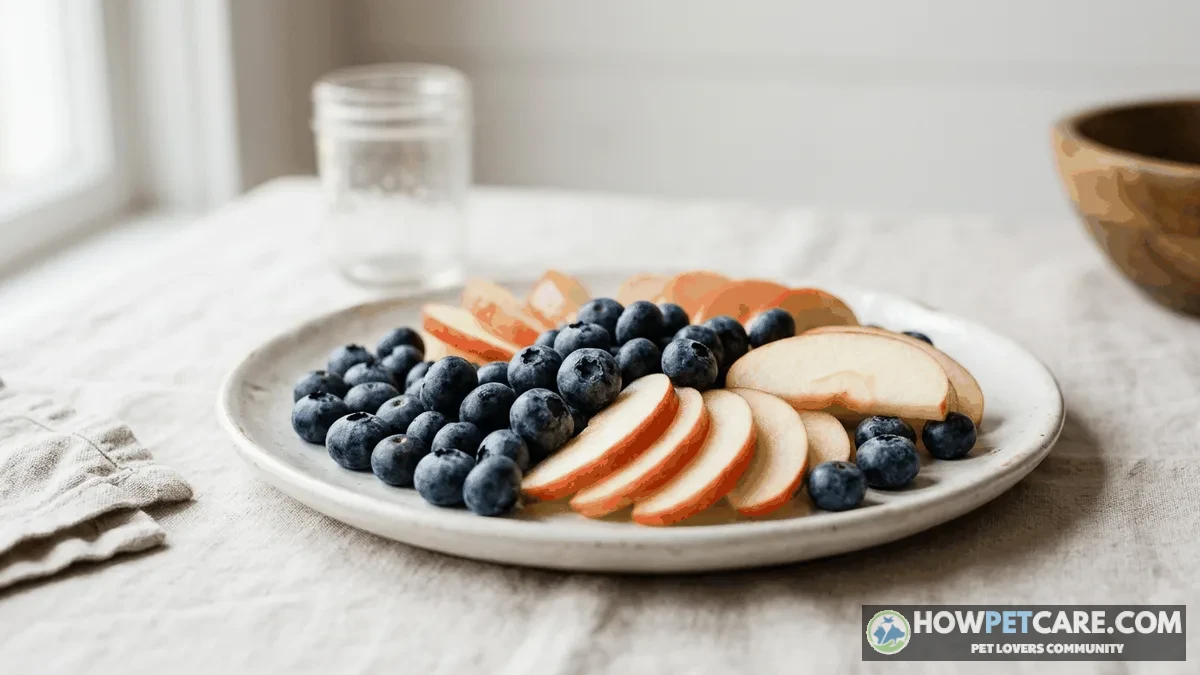
Safer fruit alternatives include blueberries (antioxidant-rich and low-sugar), seedless watermelon flesh (hydrating, with the rind removed), and peeled apple slices without seeds (fiber-rich, with the core removed). Related guides cover these swaps and the full safe-vs-toxic fruit list in more detail. Ask your vet about any new food when your dog’s health conditions or medications call for it.
FAQ
Can I give my dog pomegranate every day?
It is better as an occasional treat than a daily food. Treats should stay under about 10% of a dog’s daily calories, and the sugar adds up. Ask your vet if you want to feed it regularly, especially for a dog with health conditions.
Why is my dog’s stool or vomit red after eating pomegranate?
The fruit’s red pigment can tint stool or vomit, which can look like blood. Black, tarry or clearly bloody stool, or vomit with blood, needs a vet visit whatever your dog ate.
What fruits are safer alternatives to pomegranate for dogs?
Blueberries, seedless watermelon flesh and apple slices with the seeds and core removed are common options that need no rind or pith removal. Portion size still applies, so check the guide for each fruit.
Can dogs eat pomegranate seeds if they swallow them whole?
A few swallowed seeds from arils usually pass without trouble in a healthy dog. A large amount, especially in a small dog, can cause stomach upset or a blockage, so call your vet if your dog ate a lot.
Is pomegranate toxic to cats or other pets too?
This guide covers dogs only, and the answer can differ for other species. Ask a vet before sharing pomegranate with a cat or other pet.