

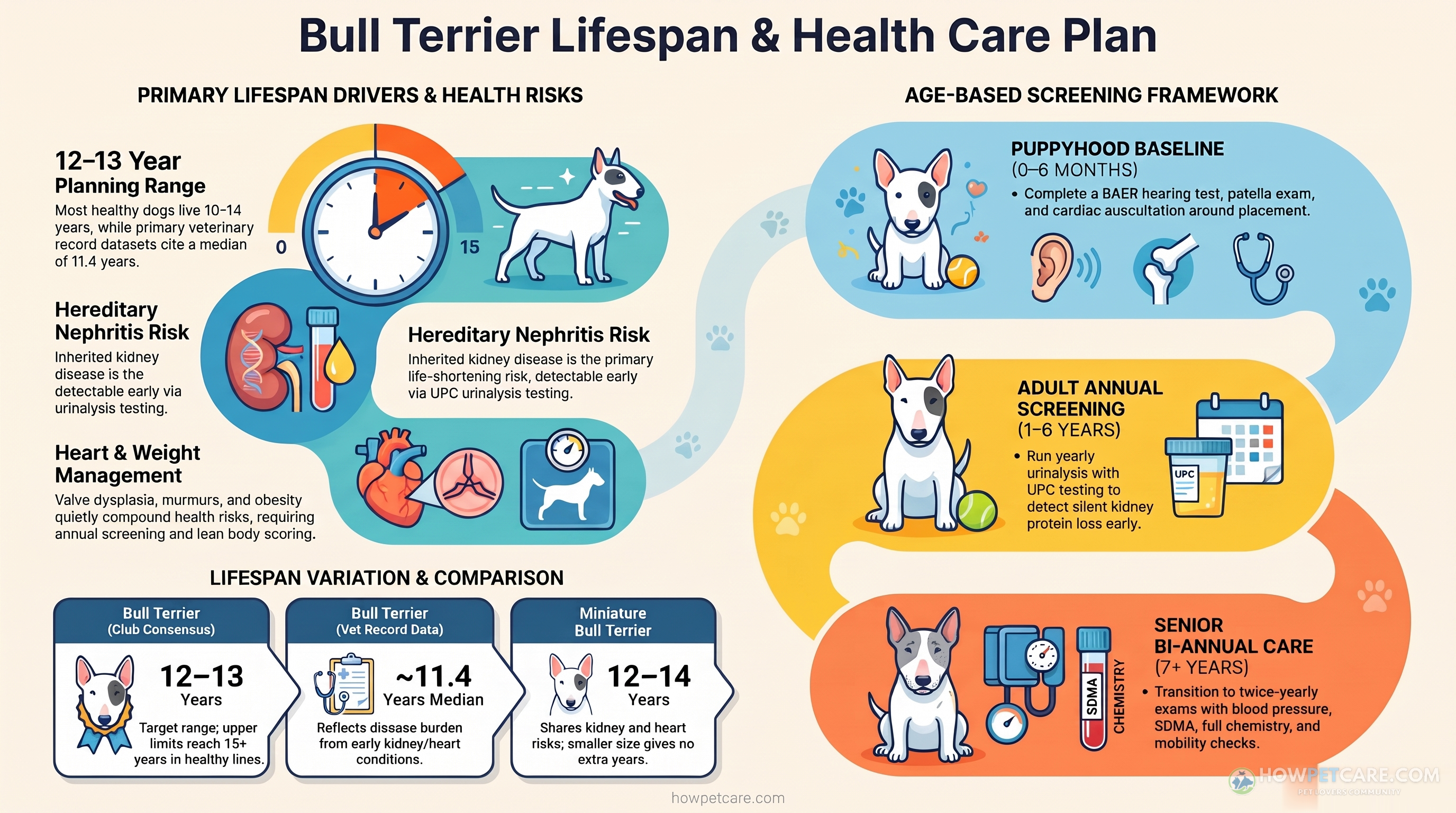
Bull Terriers typically live 12–13 years, with most healthy dogs falling in a 10–14 year range. Inherited kidney disease, heart disease, congenital deafness, and body weight are the biggest variables — annual kidney and heart screening plus weight control are what push an individual dog toward the top of the range.
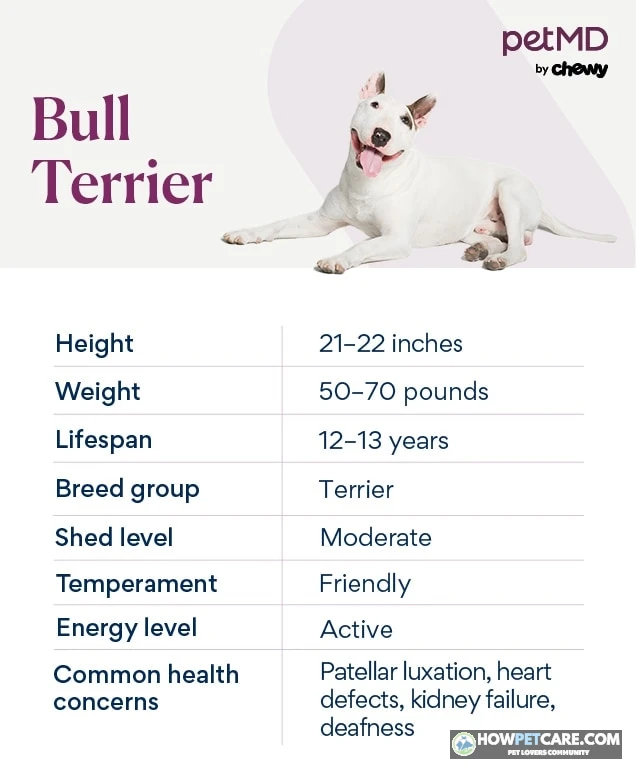
Bull Terriers typically live 12 to 13 years, and many healthy dogs fall somewhere in the roughly 10 to 14 year range depending on genetics, inherited disease risk, and the care they receive along the way. That 12–13 year figure is the working consensus drawn from Bull Terrier Club of America guidance and Kennel Club health statements. This guide shows you exactly where the number comes from, how far to trust it, and what you can actually do to move your own dog toward the upper end of that range.
The realistic spread matters as much as the average. Some Bull Terriers stay lean, clear their kidney and heart screening, and reach 14 or 15 years, while a smaller number inherit severe kidney disease and die young. Understanding both ends of that curve is the difference between planning for a statistic and planning for your dog.
Four factors move a Bull Terrier most within that range: inherited kidney disease, heart disease, congenital deafness, and body weight. The sections below cover each one, along with breed comparisons, the sex and neutering questions, and the age-based screening schedule most articles on this topic leave out.
A note on terminology: in this article, "English Bull Terrier" and "Bull Terrier" mean the same breed. The Miniature Bull Terrier is a separate, smaller breed, and we compare the two directly later.
How long do English Bull Terriers usually live?
English Bull Terriers usually live about 12 to 13 years, with a research median reported near 12.0 years, which lines up with other medium-sized, muscular terriers. White-coated Bull Terriers are sometimes cited in the 11 to 13 year range, a figure worth keeping in mind because white dogs carry a higher rate of congenital deafness. Treat these as overlapping estimates rather than separate verdicts; the honest answer to "how long do English Bull Terriers usually live" is that most well-cared-for dogs land in the low teens.
The range most owners should plan around
For planning purposes, expect a healthy Bull Terrier to reach roughly 10 to 14 years, with 12 to 13 as the central estimate. The upper edge is real but uncommon: dogs that stay lean, avoid serious kidney or heart disease, and get consistent veterinary care are the ones reported living into their mid-to-late teens. Anchor your expectations to the low teens, treat 15 or more as a genuine bonus rather than a target, and focus your energy on the controllable factors.
Where the 12–13 Year Figure Comes From and How Far to Trust It
Every competitor page states 12–13 years and moves on. Almost none show their work. Here is the provenance behind the number, because knowing where a statistic comes from tells you how much weight it can bear.
The 12–13 year figure is a convergence of several source types rather than a single controlled study. Breed-club statements, kennel-club health guidance, veterinary-record datasets, and owner surveys all point roughly toward the low teens, but they measure different things and disagree in predictable ways. The table below lays out the main source categories, what each one measured, and where the confidence limits sit.
| Source | Year | Country | Sample size | Median or mean lifespan | Limitations |
|---|---|---|---|---|---|
| Bull Terrier Club of America breed health guidance | Current club materials (2026) | USA | Not a population sample | Commonly states about 12–13 years; notes some dogs exceed 15 | Consensus, breeder-facing guidance, not a controlled mortality dataset; upper ages are reports, not a median |
| UK Kennel Club and UK breed-club health statements | Varies by survey cycle | UK | Varies; survey-based, not full registry | Often consistent with a low-teens planning range | Owner and breeder response bias; living dogs and healthy lines can be overrepresented |
| O’Neill et al. / VetCompass-style veterinary-records longevity work | 2010s dataset | England | Large primary-care dog population | Breed-level figure often discussed around ~11.4 years where reported | Vet-visited dogs only; skews toward dogs sick enough to be seen; reports median longevity, not maximum age |
| AKC and general registry / breed listings | Current listings (2026) | USA / UK | Not applicable | Usually list about 12–13 years | Secondary consensus; repeats club figures rather than measuring survival directly |
| Owner anecdotes and memorial posts | Ongoing | Mixed | Uncontrolled | Includes claims into the mid-to-late teens | Useful for maximum-reported-age context only; cannot support an average |

Summary of the main sources and what each measured
Three source families carry the weight. First, the Bull Terrier Club of America and its UK counterparts publish a 12–13 year planning figure and note that some dogs live past 15. Second, veterinary-record studies such as the O’Neill et al. work on dogs under primary veterinary care in England report lower breed medians, with the figure most often discussed sitting near 11.4 years. Third, registry listings like the AKC repeat the 12–13 year number, but they are copying club consensus rather than independently measuring survival.
Here is the part most articles skip: the spread between a 12–13 year consensus and an ~11-year dataset median is not a contradiction. It reflects two different sampling problems.
Owner surveys skew toward dogs that lived long enough for someone to answer a questionnaire, and toward healthier lines whose owners stay engaged. Vet-record datasets skew the other way: they only capture dogs that made it to a clinic, and a subset of those dogs die young from inherited disease they never recovered from. When a breed has a bimodal survival pattern like this one, the vet-record median lands lower even when the breed club’s planning figure is accurate.
Why veterinary datasets show a lower number than breed-club statements
The roughly 11.4-year veterinary figure and the 12–13 year club figure are measuring different populations with different methods. The dataset figure is a median: half the vet-visited dogs in that sample died before it, half after. It is not a promise that your dog will die at 11.4, and it is not a maximum age. Club figures lean on living-dog surveys and long-lived examples, which can float the number upward.
For US readers specifically, no rigorous Bull Terrier-only survival study tied to a US population exists in the sources reviewed here. The most-cited US body, the Bull Terrier Club of America, publishes a planning consensus rather than a mortality dataset. So the honest position is this: treat 12–13 years as a reasonable planning figure, and treat any dataset median near 11 years as evidence of the breed’s inherited disease burden, not as a sentence on your individual dog.
A few distinctions worth holding onto. Median lifespan is the age by which half the dogs in a sample have died. Mean lifespan is the average of all individual ages, pulled up by unusually long-lived dogs and down by early deaths. Maximum reported age is simply the oldest dog anyone has recorded — useful for knowing the ceiling exists, useless for prediction.
Do Female Bull Terriers Live Longer? Sex, Neutering, and Coat Color
The autocomplete bar fills with "do female bull terriers live longer than males" for a reason, so let us answer it straight: no Bull Terrier-specific study in the sources reviewed here quantifies a male-versus-female lifespan gap. Anyone who gives you a hard number for this breed is guessing.
Male versus female Bull Terrier life expectancy
Across dogs generally, females tend to show a small longevity edge in some large population studies, but the effect is inconsistent, varies by breed, and is nowhere near large enough to plan around. For Bull Terriers specifically, the honest label is unknown. Plan for the same 12–13 year window regardless of sex, and put your attention on the factors that do have evidence behind them: kidney screening, heart screening, and weight.

Spay and neuter status
Large dog-population studies on spay/neuter and lifespan show results that depend heavily on breed and on the age at which surgery happens. In some breeds, early neutering is associated with certain joint and behavioral risks; in others, it correlates with modest lifespan differences in either direction. No Bull Terrier-specific quantification is established in the sources reviewed here, so treat this as suggestive at best, not established.
What that means practically: make the neutering decision with your vet, weighing your individual dog’s kidney status, joint risk, and weight-management needs rather than a breed-wide rule of thumb.
White versus colored dogs and congenital deafness
White Bull Terriers carry a higher rate of congenital deafness than colored dogs. The breed traces to all-white pit-fighting dogs of 1800s Britain, with colored versions developed later through brindle Staffordshire crosses, so the color split is built into the breed’s history.
Here is the key distinction: deafness itself is not shown to shorten a dog’s life. The risk is indirect. A deaf dog cannot hear a car, a raised voice, or a warning, which raises accident risk, and that is where a lifespan concern enters. A hearing-impaired Bull Terrier living in a fenced yard, walked on leash, and trained with hand signals carries very little added lifespan risk. A deaf dog loose near traffic carries a great deal.

| Breed or Group | Typical Lifespan Range | Data Source / Authority | Primary Life-Limiting Conditions | Key Screening Tests |
|---|---|---|---|---|
| Bull Terrier | ~12–13 planning range; realistic spread roughly 10–14+ | Breed-club consensus; lower vet-dataset medians reported separately | Hereditary nephritis / kidney disease, cardiac disease, congenital deafness as safety issue, obesity, skin disease | UPC ratio, renal ultrasound, cardiac auscultation / echocardiography, BAER test |
| Miniature Bull Terrier | Broadly similar low-teens range | Breed-club / registry guidance | Shares Bull Terrier-type kidney and heart concerns; patellar luxation may be more clinically relevant | UPC ratio, renal ultrasound, cardiac auscultation / echocardiography, patella exam |
| Staffordshire Bull Terrier | Often ~12–14 | UK club / registry guidance and survey-type figures | Hereditary cataracts and L-2-HGA in some lines, skin allergies, neoplasia with age | Not in source |
| American Pit Bull Terrier / pit bull-type | Often ~12–14 | Shelter / registry / insurance estimates vary | Category is loosely defined; figures less reliable because "pit bull" may mean several breeds or mixes | Not in source |
| Mixed-breed dogs | Commonly ~11–14 depending on size | Vet-record and insurance studies | Size predicts longevity more than mix status alone; hybrid vigor is real but modest and variable | Not in source |
| All-dog average under veterinary care | Around low-12s median | O'Neill / VetCompass-type primary-care data | Population spans many breeds and care levels; use as context, not a breed verdict | Not in source |
Bull Terrier vs. Miniature Bull Terrier, Staffordshire Bull Terrier, Pit Bulls, and Mixed Breeds
Comparison shoppers weigh longevity before choosing between these look-alike breeds, so here is the breed-comparison table the current page-one results omit entirely.
| Breed or group | Typical lifespan (years) | Source | Common life-limiting conditions |
|---|---|---|---|
| Bull Terrier | ~12–13 planning range; realistic spread roughly 10–14+ | Breed-club consensus; lower vet-dataset medians reported separately | Hereditary nephritis / kidney disease, cardiac disease, congenital deafness as safety issue, obesity, skin disease |
| Miniature Bull Terrier | Broadly similar low-teens range; smaller size is not a guarantee of longer life | Breed-club / registry guidance | Shares Bull Terrier-type kidney and heart concerns; patellar luxation may be more clinically relevant |
| Staffordshire Bull Terrier | Often ~12–14 | UK club / registry guidance and survey-type figures | Hereditary cataracts and L-2-HGA in some lines, skin allergies, neoplasia with age; kidney risk less emblematic than in Bull Terriers |
| American Pit Bull Terrier / pit bull-type | Often ~12–14, but label-dependent | Shelter / registry / insurance estimates vary | Category is loosely defined; figures less reliable because "pit bull" may mean several breeds or mixes |
| Mixed-breed dogs | Commonly ~11–14 depending on size | Vet-record and insurance studies | Hybrid vigor is real but modest and variable; size predicts longevity more than mix status alone |
| All-dog average under veterinary care | Around low-12s median in large vet datasets | O’Neill / VetCompass-type primary-care data | Population spans many breeds and care levels; use as context, not a breed verdict |
Miniature Bull Terrier lifespan
The Miniature Bull Terrier life expectancy question comes up constantly, and the answer surprises people: the smaller size does not buy meaningfully more years. Miniatures land in a broadly similar low-teens range and share the breed’s defining inherited risks — kidney disease and heart disease. Patellar luxation tends to be more clinically relevant in the smaller frame. If you are choosing between the two on longevity alone, you are choosing between two breeds with similar headline lifespans and overlapping genetic watch-lists, not trading years for size.

Staffordshire Bull Terrier and pit bull-type comparisons
Staffordshire Bull Terriers often land around 12–14 years, but their emblematic inherited risks differ — hereditary cataracts and L-2-HGA (a metabolic disorder) in some lines, plus skin allergies, with kidney disease less central than in the Bull Terrier. Pit bull-type dogs often land in the same 12–14 range, but the "pit bull" label is a loose category spanning several breeds and mixes, so its lifespan figures are inherently less reliable than purebred registry data.
Mixed-breed dogs do show a longevity advantage in some vet-record and insurance studies, commonly around 11–14 years depending on size — but that hybrid-vigor effect is modest and varies by study. Size remains a stronger predictor of longevity than whether a dog is a mix.

The takeaway for someone choosing on longevity alone: switching between Bull, Miniature Bull, and Staffordshire Bull Terriers changes your dog’s specific inherited risks far more than it changes the headline lifespan. The bigger controllable levers, wherever you land, are kidney and heart screening, weight control, injury prevention, and health-tested parent lines.
Health Problems That Shorten a Bull Terrier’s Life, Ranked by Impact
The single biggest threat to a Bull Terrier’s lifespan is inherited kidney disease, not any of the more visible conditions. Here is the ranked view of what actually shortens life in this breed, and what each condition costs.
Hereditary nephritis and kidney disease
Hereditary nephritis is the breed’s defining, life-shortening risk. It is an inherited kidney disease in which the kidneys progressively lose the ability to filter, spilling protein into the urine long before obvious symptoms appear. Because it is heritable and screenable, it is also the condition where owner action matters most: urine protein-to-creatinine ratio (UPC) testing and renal ultrasound can catch it early.
Polycystic kidney disease — in which cysts slowly replace functional kidney tissue — carries the same endgame of progressive renal failure and belongs in the same screening conversation as a breed-level inherited renal risk.
How much lifespan does hereditary nephritis actually cost? Here is the honest answer: no reliable cited average exists, so do not accept a made-up "it takes X years" figure. What the evidence does show is a wide range. Severely affected puppies can die before age three, while milder or later-progressing cases may still live into the normal low-teens range. That spread is exactly why the breed can post a respectable 12–13 year consensus and still produce a lower veterinary-dataset median — a subset of genetically unlucky dogs dies young from kidney failure, dragging the dataset average down while most dogs land in the low teens.
Hereditary nephritis in Bull Terriers is not just a senior-dog problem. Severe inherited disease can be fatal before about age 3 in badly affected dogs, while milder cases may still reach the normal range. This bimodal pattern — many dogs reaching the low teens, some dying young — helps explain why club figures and vet-record figures do not match. Do not convert this into a fake average cost; the individual forecast depends on UPC trend, creatinine/SDMA, blood pressure, ultrasound findings, and how fast the disease progresses.
Lethal acrodermatitis, a genetic skin disorder, is another breed-specific condition that can threaten lifespan. It is severe and heritable, typically fatal in affected puppies, and it belongs on any breeder-screening conversation.
Heart disease
Heart disease is the second pillar of breed risk. Mitral valve problems — dysplasia in young dogs, degenerative valve disease later in life — should be checked at every annual exam, with any murmur followed up by imaging rather than watchful waiting. Aortic stenosis is another congenital concern in the breed. Cardiac auscultation is the cheap first filter; echocardiography is what confirms and stages a problem. Catching a murmur early changes the monitoring plan and can meaningfully affect how long a dog lives comfortably.

Deafness, patellar luxation, skin allergies, and obesity
Congenital deafness is common enough, especially in white dogs, that BAER hearing testing is recommended. Deafness mostly affects safety and training rather than lifespan directly — the risk is accidents, not the deafness itself.
Patellar luxation (a slipping kneecap) is more of a quality-of-life and mobility issue, and in Miniatures it can be more clinically relevant. Skin allergies are common in the breed and, left unmanaged, drive chronic discomfort and secondary infections. Obesity is the quiet lifespan thief across every breed, and in a stocky, muscular dog like this one it is easy to miss. None of these typically kill a Bull Terrier outright, but allergies, orthopedic pain, and excess weight all compound over years and can indirectly shorten a comfortable life. Each maps to a specific screening step in the next section.
Bull Terrier Health Screening Schedule by Age
Longevity in this breed is a schedule of owner actions, not a fixed number. Here is the age-based screening framework that turns the lifespan question into something you can act on. Adapt it with your own vet, but do not skip the kidney and heart lines — those are where Bull Terrier years are won or lost.
| Age or life stage | Test | What it detects | Why it matters for lifespan | Follow-up if abnormal |
|---|---|---|---|---|
| Puppy, ideally around placement or first months | BAER hearing test; baseline physical, patella exam, heart auscultation | Congenital deafness; murmur; early orthopedic red flags | Deafness rarely shortens life directly but raises accident risk; early heart findings change monitoring | Deafness: adapt training and safety; murmur: echocardiography; abnormal patella: orthopedic plan |
| 6–18 months, then yearly young-adult baseline | Urinalysis + urine protein:creatinine ratio (UPC); creatinine/SDMA chemistry if advised | Early kidney protein loss before uremia | Hereditary nephritis can precede obvious signs; trend data matters more than one result | Confirm on repeat samples; rising or persistent UPC → renal ultrasound, blood pressure, IRIS-style workup via vet |
| Adult 2–6 years, annual | Physical exam; UPC + chemistry/urinalysis; cardiac auscultation; body-condition score; patella/skin/dental check | Proteinuria trend, renal function, new murmur or arrhythmia, weight drift, luxation | Silent kidney and heart disease and obesity are cheapest to catch here | New murmur → echo; persistent proteinuria → nephrology workup; body condition above target → measured weight plan |
| Mature adult ~5–7 years | Annual exam plus blood pressure and renal ultrasound when risk or abnormal labs appear | Hypertension, renal architecture, cystic disease suspicion, cardiac change | Separates normal aging from early organ decline; informs diet before symptoms | Ultrasound changes or abnormal BP → staged monitoring; discuss protein/phosphorus only under veterinary direction |
| Senior ~7+ years | Twice-yearly exam; UPC, urinalysis, chemistry, CBC, creatinine/SDMA, BP; cardiac echo if murmur or history; mobility assessment | CKD progression, anemia, metabolic disease, valve disease, pain and mobility loss | Earlier intervention preserves quality and often extends functional life | Escalate frequency if UPC/SDMA/creatinine trend upward; build a pain, appetite, hydration, and quality-of-life plan |
Puppy and adolescent tests
Start with a BAER hearing test in puppyhood, ideally around or just after placement, plus a baseline patella exam and heart auscultation. This gives you a clean reference point against which to read every later change. If you bought from a breeder, ask now whether the parents’ kidney and heart results — UPC values, cardiac auscultation or echo notes — are available. Those records are worth more than almost anything else you can collect.

Adult annual checks
From young adulthood onward, run a urinalysis with a UPC ratio yearly and record the exact number, not just a dipstick protein reading. Ask your vet to plot the UPC over time, because a rising trend is the earliest warning that inherited kidney disease may be starting. Add a cardiac auscultation at every annual exam and follow any murmur to echocardiography rather than waiting.
Senior panels
Around age 7 and beyond, shift to twice-yearly exams with a fuller panel: UPC, urinalysis, chemistry and CBC, creatinine/SDMA, and blood pressure, plus cardiac echo if there is any murmur or heart history. Add a renal ultrasound when labs drift or risk is elevated, and a mobility assessment at each visit.
How to read a UPC result in plain language: the number tells your vet how much protein is leaking into the urine relative to creatinine. A low, stable value is reassuring. A rising or persistently elevated value is a signal to investigate, not a diagnosis and not something to self-treat. Rising values trigger a follow-up conversation with your vet, full stop.
Say this to your vet: "Please run a urinalysis with a UPC ratio and record the exact value, not just dipstick protein. If it is elevated, I want repeat testing, sediment review, blood pressure, creatinine/SDMA, and a discussion of renal ultrasound." This schedule is a framework to individualize with the dog’s own vet, not a substitute for diagnosis.
How to Help Your Bull Terrier Live Longer
Six factors shape longevity in this breed: nutrition, environment and conditions, housing and exercise, size and growth, breeding history, and healthcare. Breeding history is largely settled before you get the dog. The other five are where your daily decisions move the needle.
Weight, diet, and exercise for a Bull Terrier
Keep the dog lean. This is the single highest-leverage thing most owners control, and it is hardest to judge on a breed built like a fireplug. Assess body condition by feel, not by eye: you should be able to feel the ribs under a thin layer of muscle with light pressure, and see a waist when you look down from above. Aim for a body condition score in the lean-to-ideal range, roughly 4 to 5 on the standard 9-point scale, and confirm the target with your vet. On a stocky breed, "he looks solid" is often how dogs drift into overweight.

Feed a balanced diet appropriate to life stage. Puppies need more calories and growth-supporting nutrients; seniors may need lower-calorie diets, with protein adjusted to their kidney status. Only consider protein and phosphorus restriction as something to discuss with your vet if kidney values actually change — do not put a healthy dog on a renal diet based on a blog.
Exercise suits the breed’s joints and energy, with two guardrails. Favor patellar-luxation-friendly activity: steady walks and controlled play over repetitive hard jumping. And respect the coat — short-coated Bull Terriers tolerate cold poorly, raising the risk of illness and hypothermia, while the same thin coat leaves white and light-colored dogs prone to sunburn and overheating. Adjust duration and gear to the weather rather than pushing through it.
Preventive care that actually changes outcomes
Manage skin allergies early, before chronic scratching drives secondary infections, and protect skin from sun, especially on white dogs. Keep up daily tooth brushing to prevent periodontal disease, which is linked to broader health decline, and stay current on parasite prevention.
Treat deafness-related safety as a genuine part of lifespan: fenced yards, leash use, and hand-signal training are what keep a hearing-impaired dog out of harm’s way. And keep the preventive veterinary cadence — vaccines, annual exams, and the screening schedule above — because early detection and routine checkups are consistently named as the key to longevity in this breed.
Consider a pet-insurance policy or a dedicated savings fund for kidney and heart care only if it helps you act on this plan without hesitation. The plan is worthless if cost stops you from running a UPC or an echo when one is due.
Senior Bull Terrier Care: Aging Signs, Unknown Ages, and Quality of Life
Most guides about Bull Terrier lifespan stop at the puppy years. This section is for the owners of older dogs, and for the large group of adopters who inherit a dog with no records at all.
When is a Bull Terrier a senior?
A Bull Terrier is generally considered a senior at around 7 years, with the transition to twice-yearly vet visits and fuller bloodwork panels starting there. The life stages roughly break down as: puppy to about 6 months, adolescent 6–18 months, adult 1.5–6 years, and senior 7 years and up. These are planning bands, not sharp lines — an individual dog’s organ health matters more than its birthday.
How to estimate the age of an adopted Bull Terrier
If you adopted a dog with no paperwork, treat any vet age estimate as accurate to within several years, not to the month. Combine clues rather than trusting one: tooth wear and tartar, cloudiness in the eyes (lenticular sclerosis), graying around the muzzle, muscle tone over the back and hips, and stiffness on rising. A veterinary exam ties these together, but the margin of error stays wide — an estimate of "somewhere between 4 and 8" is more honest than a false single number. Build records from day one so future trends, not a guessed age, drive your decisions.

Watch for a graying muzzle, morning stiffness, reduced stamina on walks, weight and muscle changes, and declining vision or hearing. These typically show up gradually in the 7-and-older years. Any of them appearing faster than expected is worth a vet visit rather than a wait-and-see.
Geriatric diet and daily care
Senior diets usually shift toward calorie control to counter a slowing metabolism, high-quality protein to protect muscle, and joint support where mobility is declining. If kidney values have changed, your vet will guide kidney-aware adjustments to protein and phosphorus — directed by testing, not guessed. Move to twice-yearly vet visits with blood and urine monitoring so small changes get caught before they become crises.
Judging quality of life
As a dog approaches the end of its life, use a recognized framework such as the HHHHHMM quality-of-life scale — Hurt, Hunger, Hydration, Hygiene, Happiness, Mobility, and More good days than bad. It turns a hard emotional question into something you can assess honestly, day by day. Discuss palliative options and, when the time comes, euthanasia with your vet early rather than in a crisis, so the decision comes from a plan rather than an emergency.

1Why do primary-care veterinary datasets for Bull Terriers report a lower median lifespan (around 11.4 years) compared to the 12–13 year planning consensus published by breed clubs?
Veterinary record datasets skew toward dogs sick enough to require clinical care, including puppies dying young from severe hereditary nephritis, while club surveys rely on engaged owners of longer-lived, healthy dogs.
2Which of the following statements accurately compare the longevity and genetic health profile of the Miniature Bull Terrier to the standard Bull Terrier?
Both breeds share an overlapping genetic watch-list centered primarily on hereditary nephritis and cardiac disease.
3A white Bull Terrier is diagnosed with congenital deafness. What is the primary mechanism by which this condition poses a risk to the dog's life expectancy?
Deafness does not cause organ failure or shorten life directly; the lifespan risk is secondary and stems from heightened accident risks.
4An owner wants to maintain an ideal body condition score (roughly 4 to 5 on a 9-point scale) for a stocky Bull Terrier. Which assessment technique provides the most accurate judgment of body condition?
Hands-on palpation of the ribs combined with a visual check for an abdominal tuck/waist accurately identifies lean muscle versus excess body fat in muscular breeds.
5Which of the following healthcare practices are recommended when managing a senior Bull Terrier (around 7 years of age and older)?
Semi-annual veterinary checkups allow early detection of organ changes before noticeable clinical crises occur.
6During an annual physical examination, a veterinarian detects a new heart murmur in a 4-year-old Bull Terrier. According to breed health recommendations, what is the appropriate follow-up step?
Echocardiography is the definitive diagnostic imaging tool needed to investigate the structural cause and severity of a heart murmur detected during auscultation.
7When comparing the main inherited life-shortening health risks of Staffordshire Bull Terriers to standard Bull Terriers, which distinction is correct?
While both are terrier breeds living around 12–14 years, Staffordshire Bull Terriers face emblematic risks like L-2-HGA and cataracts, whereas hereditary nephritis is the defining condition for standard Bull Terriers.
Your Bull Terrier Longevity Checklist: What to Do This Year
Lifespan stops being abstract the moment you turn it into this year’s appointments. Here is what to do, grouped by your situation.
New puppy owner
- Ask for both parents’ BAER results and any kidney or heart testing, including UPC values and cardiac auscultation or echo notes.
- Book a BAER test if it hasn’t been done, and record a baseline patella exam and heart auscultation.
- Start a health log: exact weight every 2–4 weeks, body-condition photos, and the date and result of every UPC.
Adult Bull Terrier, roughly 2–6 years
- Schedule a urinalysis plus UPC and chemistry this year even if the dog seems healthy, and keep the numeric UPC in your records.
- Request a cardiac auscultation, and ask whether any murmur warrants echocardiography now rather than "watch and wait."
- Weigh the dog on the same scale each time, set a target weight and body-condition range with your vet, and measure meals instead of free-feeding.
Senior Bull Terrier, about 7+ years
- Move to twice-yearly exams with UPC, urinalysis, chemistry and CBC, creatinine/SDMA, and blood pressure.
- Keep a monthly note on mobility, appetite, sleep, breathing effort, and any house-soiling for the vet.
- Review quality of life with a recognized tool such as the HHHHHMM scale before a crisis, not during one.
Adopted dog of unknown age
- Treat vet age estimates as accurate to within several years, combining teeth, eye cloudiness, coat graying, muscle loss, and joint stiffness rather than trusting one clue.
- Assume no prior screening: run a baseline BAER if hearing status is unknown, a heart exam, bloodwork, urinalysis with UPC, and blood pressure.
- Build records from day one so future trends, not a guessed age, drive care.
If you do only three things this year, make them these: book a UPC and kidney check, schedule a cardiac exam and a hearing test if your dog has never had them, and weigh the dog to set a target weight.
Bring to the appointment: prior records, breeder or rescue paperwork, parents’ test results if you have them, a full medication and supplement list, exact food and treat amounts, and a one-page list of changes you have noticed.
The realistic bottom line: the typical bull terrier life expectancy is about 12–13 years, and it is a planning range, not a promise. Screening cadence, early kidney and heart detection, weight control, and injury prevention are what determine where your own dog lands within it. Do those consistently, and you give a well-built, long-lived breed its best shot at the top of the range.
FAQ
Can a Bull Terrier live past 15 years?
It is uncommon but possible, and it is usually reported in dogs that stayed lean and had no serious kidney or heart disease. Typical lifespan is 12–13 years, so treat 15 or more as an exception, not a plan.
Is hereditary nephritis curable in Bull Terriers?
No cure exists. Early detection through urine protein:creatinine testing lets a vet monitor kidney function and manage the disease, which can improve comfort and may slow progression.
Are Bull Terriers a healthy breed overall?
They are generally sturdy, but the breed has several inherited risks, including kidney disease, heart disease, deafness in white dogs, patellar luxation, and skin allergies. Health testing of parents and regular screening reduce the impact.
Does a Bull Terrier’s lifespan differ in the United States and the United Kingdom?
Published breed-specific figures differ by data source and survey method, not clearly by country. Treat 12–13 years as the planning figure in both places.
How often should a senior Bull Terrier see the vet?
Twice a year is a common recommendation for senior dogs, with blood work and urine testing at those visits. Your vet may adjust this for your dog’s kidney or heart status.