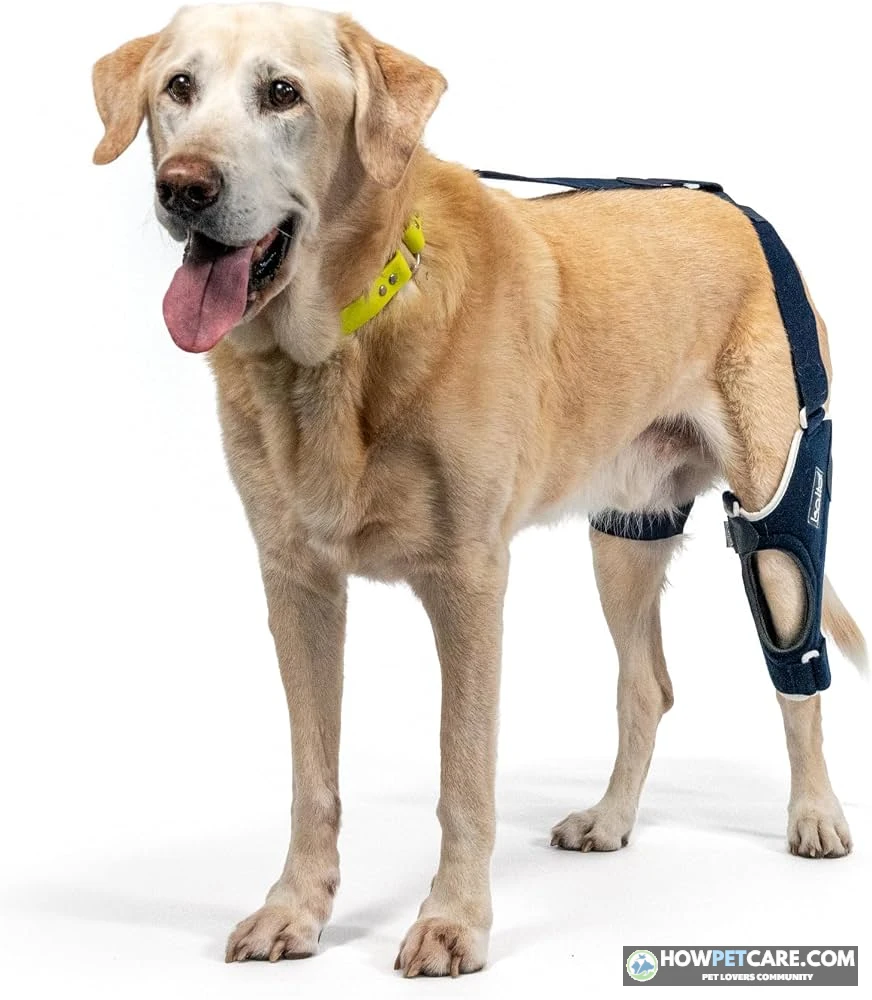

Approximate US budgeting ranges for the main types of dog braces:
| Brace type | Approximate cost | Notes |
|---|---|---|
| Off-the-shelf leg brace | $40–$300 | Device only; exam, imaging and fitting extra |
| Custom leg brace | $500–$1,700+ | Made to measure; refits and rehab may cost more |
| Dog dental braces | ~$1,000–$3,000+ | Treatment-level pricing; request an itemized quote |
These are planning estimates, not market averages. Get a veterinary diagnosis and an itemized quote before buying.
Dog braces can support an injured leg or move teeth that cause pain, but these are two very different treatments. If you suspect a knee injury, ask a veterinarian about a stifle or CCL brace. If a tooth is injuring your dog’s mouth, ask about a referral to a veterinary dentist. Neither treatment should be chosen based on symptoms alone.
For initial budgeting, an off-the-shelf leg brace may cost roughly $40–$300, while a custom leg brace may cost $500–$1,700 or more. Dog dental braces may cost roughly $1,000–$3,000 or more when associated treatment is included. These are broad planning estimates, not verified market averages or guaranteed package prices. Ask for an itemized quote. One custom-brace seller lists devices from $995 to $1,690, including a knee brace at $1,690.
If your dog hasn’t been diagnosed, book an exam before buying a brace. If a veterinarian confirms a CCL tear, discuss whether rehabilitation, bracing or surgery makes sense for the injury. Acute lameness, significant pain, swelling or a suspected fracture calls for prompt veterinary attention.
Which Dog Braces Does Your Dog Need? Quick Match by Condition and Price
Leg brace types at a glance
Use the affected joint and a veterinary diagnosis to narrow the choices. The ranges below are approximate, device-only budgeting guides—not a survey of current prices. Custom and stock products vary considerably, and a brace isn’t right for every dog in a given category.
| Suspected or diagnosed problem | Support to ask about | Approximate stock cost | Approximate custom cost | Important decision point |
|---|---|---|---|---|
| CCL injury at the rear knee | Stifle or dog knee brace | $100–$300 | $800–$1,700+ | Complete tears, substantial instability or suspected meniscal injury warrant a surgery discussion. |
| Achilles injury or hock instability | Hock or tarsal brace | $80–$200 | $600–$1,700+ | A ruptured tendon may need surgical assessment. |
| Front-wrist weakness or carpal hyperextension | Carpal brace | $70–$180 | $500–$1,700+ | Severe collapse may call for a different treatment, including possible surgery. |
| Toes dragging or paw knuckling | Paw-positioning or toe-lift aid | $40–$120 | Quote required if custom | A neurological or orthopedic exam comes first; a device doesn’t treat the underlying cause. |
| Hind-leg osteoarthritis or weakness | Joint-specific support or a lifting harness | $60–$250 | $700–$1,700+ if a custom orthosis is appropriate | A harness assists with lifting; it doesn’t stabilize every joint. |
| Teeth injuring the mouth | Veterinary dental appliance | Not a retail purchase | Roughly $1,000–$3,000+ for treatment; quote required | A veterinary dentist decides whether an appliance, another procedure or no treatment is appropriate. |

One published starting price for a carpal support is $92. It illustrates why similar-looking stock supports still need product-specific quotes.
Dental braces: a functional-health decision, not a cosmetic one
Dog dental braces are veterinary appliances used in selected cases to move teeth that interfere with a healthy bite. They aren’t cosmetic accessories. A dog can have an obvious underbite without needing correction, while a less obvious malocclusion can be painful if a tooth contacts the palate or another tooth.

Dog Leg Braces by Condition: Stifle, Hock, Carpal, and Hind-Leg Weakness
Stifle/CCL brace
The stifle is the dog’s knee. Its cranial cruciate ligament, or CCL, helps stabilize the joint; owners often call an injury to it a dog ACL tear. A stifle brace is intended to limit unwanted motion and support the leg as part of a veterinary-led plan. It can’t repair a torn ligament or reliably resolve meniscal damage.
There isn’t one best dog knee brace for every torn ACL. The right choice depends on the diagnosed injury, limb shape, activity level, skin tolerance and whether the dog is also receiving rehabilitation or surgery.

Hock and tarsal braces
The hock, also called the tarsus, is the rear-leg joint above the paw. A hock brace may be considered for instability or certain tendon injuries, sometimes as part of post-operative care. The injury determines the required joint angle and how much motion to restrict; a generic sleeve may not support a damaged tendon adequately.

Carpal braces
The carpus is the front-leg wrist. A carpal brace may support a weak or hyperextended wrist, but severe hyperextension can call for surgical evaluation. Stock products differ. One published carpal support describes use for mild-to-moderate hyperextension and other specified conditions—not every wrist injury.

Hind-leg weakness, dragging and knuckling
Dog braces for back legs that drag aren’t interchangeable with knee braces. A toe-lift or paw-positioning aid may help keep the paw from scraping during movement. A rear-support harness can help an owner assist a dog while standing or walking. Neither device identifies why the foot is dragging.

Knuckling can have neurological as well as orthopedic causes. Arrange an exam before ordering, and seek urgent advice if weakness comes on suddenly, walking worsens rapidly or your dog loses bladder or bowel control. A veterinarian may use an X-ray to assess bones and joints, but soft-tissue injury or nerve disease may call for a different examination or additional testing.
Arthritis and senior dogs
For osteoarthritis, a joint-specific brace may help selected dogs when instability is part of the problem. It doesn’t cure arthritis. For some dogs, a harness, pain-management plan, weight management or canine rehabilitation may be more useful than a rigid brace.
Dog braces can be safe for older dogs when they’re selected and monitored appropriately. Ask the vet to consider fragile skin, circulation, other illnesses and whether your dog can comfortably tolerate the device. Age alone doesn’t determine whether bracing or anesthesia is appropriate.
Dog Brace Costs in the US: Custom vs Off-the-Shelf vs Dental
These are broad 2026 budgeting estimates, not verified national averages. Prices depend on the design and treatment plan; the supplied published prices don’t establish a complete market range for dental care, surgery or every brace category.
| Brace type | Approximate US price range | What may be included | What may cost extra | Best suited for |
|---|---|---|---|---|
| Off-the-shelf leg support | $40–$300 | The device and standard straps | Exam, imaging, shipping, fitting help and replacement parts | A vet-approved need that matches the product’s size and support level |
| Custom leg brace | $500–$1,700+ | A made-to-measure device; sometimes a casting kit or fitting support | Exam, imaging, shipping, refits, rehab and replacements | A specific joint-support need where stock fit or design is inadequate |
| Dental or orthodontic appliance | Roughly $1,000–$3,000+ for treatment; request a quote | Depends on the clinic’s estimate | Consultation, anesthesia, dental X-rays, appliance changes and rechecks if not bundled | A painful or damaging bite problem where an appliance is appropriate |
The custom range includes products priced above the older $800–$1,500 knee-brace rule of thumb: Animal Ortho Care lists its custom knee brace at $1,690 and other custom braces starting at $995. Ask each provider what the quote covers; don’t assume every custom device includes an appointment or refit.

What each price range includes and leaves out
For a leg brace, confirm who measures or casts the leg, whether the kit and shipping are included, and who pays if the first fit needs adjustment. For example, My Pet’s Brace describes a free casting kit and free US shipping; those terms apply to that provider. A warranty against defective materials doesn’t necessarily mean the brace will fit after muscle loss or be returnable after use.
For dog tooth braces, ask for the full treatment estimate: consultation, anesthesia, dental imaging, appliance placement, medication if needed, adjustments and rechecks. The estimate should also explain what happens if an appliance fails or a different procedure becomes necessary.
TPLO surgery has its own costs, including the surgeon’s assessment, anesthesia, imaging, hospitalization and follow-up. Costs vary too widely to turn an unsupported figure into a reliable national comparison. Request an itemized local surgical estimate alongside the brace and rehabilitation estimates.
Total cost of ownership over 12 months
For a realistic comparison, add the initial exam and device to expected fitting visits, follow-ups, rehabilitation, shipping and replacement liners or straps. Ask whether the other leg needs assessment and whether growth, weight change or muscle loss could require a refit or replacement. For dental treatment, include planned rechecks and any additional anesthetic procedures in the written estimate.
Custom vs Off-the-Shelf Dog Braces: Fit, Lead Time, Adjustability and Warranty
| Factor | Off-the-shelf | Custom-made | What to ask the vendor |
|---|---|---|---|
| Fit accuracy | Uses a size chart and adjustable straps; fit depends on the dog’s proportions | Built from a cast, scan or individual measurements; still needs a fit check | Which landmarks matter, and who checks the finished fit? |
| Lead time | In-stock items may ship quickly; delivery varies | Measurement or casting, fabrication and shipping add steps | What are the current production and delivery times? |
| Adjustability | Straps may accommodate modest changes, within the design’s limits | Adjustments depend on the device; major shape changes may need a refit | What happens if swelling or muscle mass changes? |
| Price | Broad planning range: $40–$300 | Broad planning range: $500–$1,700+ | What is the full delivered and fitted price? |
| Warranty and returns | Policies vary, especially after use | Often subject to specific refit and return terms | Are first-fit changes, shipping and worn parts covered? |
| Best use | An approved, less complex need that matches the chart | An approved need requiring individual geometry or specialized support | Is this device appropriate for the diagnosed condition? |
Custom doesn’t always mean a plaster cast. Posh describes custom braces made from individual virtual measurements, while My Pet’s Brace describes cast-based fabrication. My Pet’s Brace states that fabrication takes five business days or less for its braces; allow extra time for casting and shipping.

When off-the-shelf is reasonable
A stock brace may be worth considering when your vet confirms the joint and support needed, your dog’s measurements fit the manufacturer’s chart, and the product allows the intended movement. It may also suit a vet-directed recovery plan if the design is appropriate.
Availability on Amazon or Chewy doesn’t establish suitability. Large and giant dogs with hind-leg weakness may have unusual fit and load requirements. A sleeve that stays on a paw may not stabilize a knee or address neurological weakness. Check actual measurements, intended use and return terms rather than buying by breed or weight alone.
When custom is worth the premium
Ask about custom fitting if your dog has unusual proportions, needs support at a particular joint angle, has had stock braces slip or has a diagnosis that calls for a more specialized design. A custom-fitted brace can still rub or fail to achieve the desired effect, so arrange a veterinary or qualified-fitter review after delivery.
Questions to ask any vendor before ordering
Use this transparency scorecard for each option. Award one point for every answer available on the website or provided in writing:
- The actual price or a clear starting range.
- Measurement instructions and a relevant sizing chart or custom-fitting process.
- A fabrication and delivery estimate.
- Warranty length and covered defects.
- Return, exchange and first-fit refit terms.
- The identity and qualifications of the person helping with fit.
- Conditions or situations for which the device isn’t recommended.
- Outcome evidence that can be inspected, not just testimonials.
- Materials and liner details.
- The process and cost if your dog’s limb shape changes.
A high score makes products easier to compare; it doesn’t prove a device will work for your dog. If answers are missing, get them before paying. Published examples such as Animal Ortho Care’s product prices and My Pet’s Brace’s casting and fabrication information answer some of these questions, but neither fact alone establishes fit, coverage or outcome.
Dog ACL Brace vs TPLO vs Rest-and-Rehab: How to Decide
A brace can be one part of conservative management for a CCL injury. It hasn’t been shown to be interchangeable with surgery for every tear, and it doesn’t replace activity control, pain management or follow-up. Rest and rehabilitation without a brace are also worth discussing; deferring surgery doesn’t automatically mean a brace is needed.
| Factor | Favors discussing conservative management, with or without a brace | Favors discussing TPLO surgery | Confirm with your vet |
|---|---|---|---|
| Injury | A partial tear or limited instability may make a supervised trial reasonable | A complete tear or substantial instability can strengthen the surgical case | How confident is the diagnosis, and is the meniscus affected? |
| Dog’s size and activity | A smaller or less active dog may be a more practical candidate | A larger, highly active dog may put greater demands on the joint | What is realistic for this particular dog? |
| Medical and financial factors | Significant anesthetic risk or financial constraints may change the plan | A dog that can safely undergo surgery may have more surgical options | What are the individual risks, benefits and costs? |
| Progress | Comfort and function improve under a monitored plan | Persistent instability or worsening function warrants reassessment | What should improve, and by what date? |

TPLO means tibial plateau leveling osteotomy, a procedure that changes the mechanics of the knee. It’s one surgical option; a veterinarian may recommend another.
Partial vs complete tear
A partial tear leaves some ligament fibers intact; a complete tear means the ligament is fully ruptured. That distinction can shape the treatment conversation, but the degree of instability and your dog’s overall situation matter too. A vet assesses gait and joint movement and may recommend X-rays to evaluate the joint and rule out other problems. X-rays don’t show the ligament tear directly, so further assessment may be needed.
Size, age and activity thresholds
No weight cutoff reliably determines treatment. A smaller, calmer dog with a partial tear may be a reasonable candidate for a vet-supervised conservative trial. A large or highly active dog with a complete tear deserves a direct discussion of surgery, including TPLO and other applicable options. A senior dog isn’t automatically a poor surgical candidate: health status and the veterinarian’s assessment matter more than age alone.
Before choosing conservative care, make sure you can manage restricted activity and rechecks. Ask what improvement should look like, when it should be assessed and what would prompt a referral. Recovery varies by diagnosis and treatment; don’t rely on a seller’s promised timeline.
Red flags that mean call the vet
- Your dog suddenly can’t bear weight, has marked swelling or pain, or may have a fractured limb: seek prompt veterinary care rather than waiting for a brace.
- Lameness worsens, the knee clicks or the vet suspects a meniscal injury: arrange reassessment and discuss whether surgery is needed.
- A brace slips, causes sores or seems to make walking worse: stop using it and contact the vet or fitter.
- Function isn’t improving by the date your vet set: ask whether the diagnosis or treatment plan needs to change.
At the consultation, ask: Is the tear partial or complete? Is the knee stable? Could the meniscus be injured? What are the expected benefits and risks of TPLO versus a trial of rehabilitation, with or without a brace? What would make us change course?


Do Dogs Need Braces for Their Teeth? The Dental Path
When a misaligned bite needs treatment
Dogs may need braces for their teeth when malocclusion causes trauma or prevents a functional bite. Examples include a canine tooth directed into the palate or dental crowding that causes teeth to contact one another. A veterinarian needs to examine the mouth to determine whether the problem is painful and which treatment is appropriate.
Can braces fix an underbite in dogs? An orthodontic appliance may move selected teeth in some cases, but it won’t necessarily correct the underlying jaw relationship. An underbite that causes no trauma may not need correction. If treatment is needed, options can include extraction, crown reduction with appropriate treatment of the tooth, or an orthodontic appliance. The right choice depends on the individual mouth.

Puppy teeth and developing bites need timely assessment because even apparently minor contact can injure tissue. Ask the veterinarian whether the puppy should be referred; don’t wait for the full set of adult teeth to erupt without advice.
Who provides dental braces
A general veterinarian can examine the mouth and advise on a referral. A board-certified veterinary dentist may offer orthodontic treatment or recommend another procedure. The term veterinary orthodontist is sometimes used informally, so confirm the clinic’s availability and qualifications. Ask about anesthesia, imaging, rechecks and total cost before agreeing to a plan.
Treatment should protect health and function, not make a dog conform to a cosmetic breed standard. If a bite problem may be inherited, discuss breeding implications with the veterinarian.
How to Measure Your Dog and Read a Brace Sizing Chart
Measure only after your vet has identified the joint and the type of support to consider. Follow the vendor’s instructions over a generic worksheet because different designs use different landmarks. Don’t force a painful dog to stand or manipulate an injured joint; ask the clinic for help.
Step-by-step measuring
-
Prepare
Get a soft tape measure, a helper and a phone. Have your dog stand comfortably on a flat surface if the vet says this is safe.
-
Mark the landmarks
Find the vendor’s specified points above, at and below the affected joint. For length, identify the exact start and end points on its diagram.
-
Measure and photograph
Measure snugly without compressing the leg. Record the affected and opposite legs, current weight, and clear side and standing views if requested.
-
Compare every measurement
Use the product’s chart and units. Send the vendor all measurements and photos if they fall across sizes or the landmarks are unclear.
Copy this worksheet for the affected leg and the corresponding opposite leg:
- Joint and side: __
- Circumference at vendor’s point above joint: __ inches / __ cm
- Circumference at joint, if requested: __ inches / __ cm
- Circumference at vendor’s point below joint: __ inches / __ cm
- Length between specified landmarks: __ inches / __ cm
- Current weight and unusual proportions: __
- Photo notes and date measured: __

For a stifle brace, the chart may ask for thigh and lower-leg circumferences plus distances around the knee. Hock and carpal products may request measurements above and below those joints and a length to the paw. Toe-lift aids may require paw dimensions and the manufacturer’s specified leg measurements. Use the chart for the exact product, not one for a different brace.
To convert, multiply inches by 2.54 for centimeters; divide pounds by approximately 2.2 for kilograms. Measure again if weight, swelling or muscle shape changes, and ask whether the fit needs review.
Between-size handling rules
Don’t automatically size up or down. For a stifle brace, measurements that span sizes can increase the risk of poor alignment or slipping; send all figures to the vendor. For hock and carpal supports, follow the specific chart’s priority measurement and ask the fitter if another measurement falls outside its range. Swelling, short limbs, heavy thighs or a very narrow lower leg call for an individual fit review, not guesswork.
Ask whether a tried-on device can be exchanged and who pays return shipping. A custom order may have different refit and return rules from a stock product.
Will Pet Insurance Cover a Dog Brace? Pre-Authorization and Claim Steps
Some policies may cover a prescribed orthosis or durable medical equipment for an eligible condition; others exclude it, limit coverage or require specific documentation. A seller’s mention of an insurer doesn’t establish coverage. Pre-existing-condition rules, waiting periods, deductibles, annual limits and bilateral-condition clauses can affect a CCL claim.
Dental or orthodontic care may be excluded or limited, including when a plan distinguishes functional treatment from cosmetic treatment. Ask about the specific proposed procedure and diagnosis rather than assuming that medical necessity guarantees payment.
Pre-authorization checklist
- Ask your veterinarian for the diagnosis, recommended device or dental procedure, and an itemized estimate. Request a prescription or medical-necessity letter if the insurer needs one.
- Send the estimate and relevant records to the insurer before ordering. Ask: "Is this specific orthosis or dental procedure covered for this diagnosis under my policy, and are fitting, shipping and rechecks covered?"
- Ask whether a prior injury to the opposite leg, an earlier symptom, a waiting period or a policy exclusion affects the claim.
- Request the answer and any pre-authorization in writing. Confirm whether it’s binding or subject to review of the final claim.
Claim filing checklist
Keep the itemized paid invoice, proof of payment, prescription or letter, diagnosis and relevant clinical records. Submit them through the insurer’s process and retain the claim number. If the claim is denied, request the specific policy provision and ask the clinic for any missing records before considering an appeal.
Wear Time, Skin Care and What the Evidence Actually Shows
Daily wear and skin check routine
The veterinarian or fitter should set the wear schedule for the diagnosis and device. In practice, that often means a removable brace is worn during active periods and taken off for rest and skin checks rather than around the clock. Introduce a removable brace gradually under supervision, checking the skin after each session. Don’t assume it’s safe to leave a brace on all day, overnight or unattended. Some prescribed post-operative devices have different instructions; follow the treating clinician’s plan rather than removing them against those instructions.
Check around strap edges, bony points, the front and back of the joint, and the foot below the brace. Look for persistent redness, hair loss, dampness, swelling, blisters or broken skin. Remove a removable brace and contact the vet or fitter if you find a sore, swelling or new discomfort. Don’t put it back on over broken skin without advice. Contact the vet promptly for significant swelling, pain or a worsening limp.

Keep a simple log during the break-in period and bring it to the follow-up:
| Date | Time worn and activity | Skin after removal | Did the brace stay aligned? | Weight-bearing and other notes |
|---|---|---|---|---|
| __ | __ | __ | __ | __ |
If the brace rotates, slips repeatedly or makes your dog’s gait worse, stop and ask for a fit check. Don’t try to fix the problem by repeatedly tightening the straps. Comfort or gait may improve at different rates, and no device guarantees recovery. Agree on a reassessment date and a way to compare function with your veterinarian.
Marketing claims vs verifiable evidence
A testimonial describes one owner’s experience; it can’t establish how often a brace succeeds or whether the brace caused the improvement. Posh claims to have helped more than 14,000 dogs recover without surgery, but that marketing count alone doesn’t establish a verified success rate or show how those dogs would have done with another treatment. Years in business and review counts aren’t controlled outcome studies either.
When a seller cites research, ask whether it studied the same injury and device, how outcomes were measured, whether dogs were compared with another treatment, and how many completed follow-up. The evidence supplied for this guide doesn’t establish a reliable overall brace success rate or a brace-versus-TPLO recovery timeline. Treat promises of predictable recovery as claims to verify with your veterinarian, not as a basis for choosing treatment.
Your Next Step: A Brace, Surgery or Vet Evaluation Decision Checklist
- No diagnosis or a suddenly painful leg: Arrange a veterinary examination first. Ask whether imaging or further testing is needed; don’t assume every limp requires an X-ray or every dragging paw needs a brace.
- Partial CCL tear or meaningful surgical risk: Discuss a monitored conservative plan, whether a brace adds value, activity restrictions and a date to reassess.
- Complete tear in a large or active dog, suspected meniscal injury, or worsening lameness: Discuss a surgical or orthopedic consultation, including whether TPLO is appropriate.
- Chronic arthritis or weakness: Ask which joint, if any, needs support and whether rehabilitation, pain management or a lifting harness is the better first purchase.
- A tooth contacting the palate or another tooth: Ask for a dental examination and, when appropriate, a referral to a veterinary dentist.
Before paying, confirm the diagnosis, intended joint or dental treatment, measurements, full quote, fitting and refit arrangements, warranty, return policy and insurance response. Bring your questions and any vendor specifications to the vet. The right brace supports a treatment plan; it doesn’t replace one.
| Suspected or Diagnosed Problem | Support Type | Approximate Stock Cost | Approximate Custom Cost | Important Decision Point |
|---|---|---|---|---|
| CCL injury at the rear knee | Stifle or dog knee brace | 100–300 | 800–1,700+ | Complete tears, substantial instability or suspected meniscal injury warrant a surgery discussion. |
| Achilles injury or hock instability | Hock or tarsal brace | 80–200 | 600–1,700+ | A ruptured tendon may need surgical assessment. |
| Front-wrist weakness or carpal hyperextension | Carpal brace | 70–180 | 500–1,700+ | Severe collapse may call for a different treatment, including possible surgery. |
| Toes dragging or paw knuckling | Paw-positioning or toe-lift aid | 40–120 | Quote required if custom | A neurological or orthopedic exam comes first; a device doesn't treat the underlying cause. |
| Hind-leg osteoarthritis or weakness | Joint-specific support or a lifting harness | 60–250 | 700–1,700+ if a custom orthosis is appropriate | A harness assists with lifting; it doesn't stabilize every joint. |
| Teeth injuring the mouth | Veterinary dental appliance | Not a retail purchase | Roughly 1,000–3,000+ for treatment; quote required | A veterinary dentist decides whether an appliance, another procedure or no treatment is appropriate. |
FAQ
Can a dog wear a brace all day, every day?
Generally no. Most braces are introduced gradually and removed for rest, usually overnight or when unsupervised, though your vet or fitter should set the schedule. Check skin for rubbing and pressure spots every time the brace comes off.
Do veterinarians recommend braces for dogs?
Many vets recommend braces for specific cases such as partial CCL tears, surgical risk, osteoarthritis or tendon injuries, usually as part of a broader plan. They are less likely to recommend a brace as a substitute for surgery in large, active dogs with complete tears.
Are dog braces safe for older dogs?
They can be, especially for arthritis or hind-leg weakness, but older dogs have more fragile skin and may have other health issues. Get a vet exam first and monitor the skin closely.
How soon will my dog improve with a brace?
It varies with the condition and the dog. Some owners see better comfort within weeks, but meaningful recovery from a soft tissue injury usually takes longer, and no brace guarantees results. If there’s no improvement within the window your vet sets, recheck.
Can I buy a dog brace without a vet visit?
You can, but it’s risky. Without a diagnosis you may brace the wrong joint or mask a condition that needs treatment, such as a neurological problem or complete CCL tear.