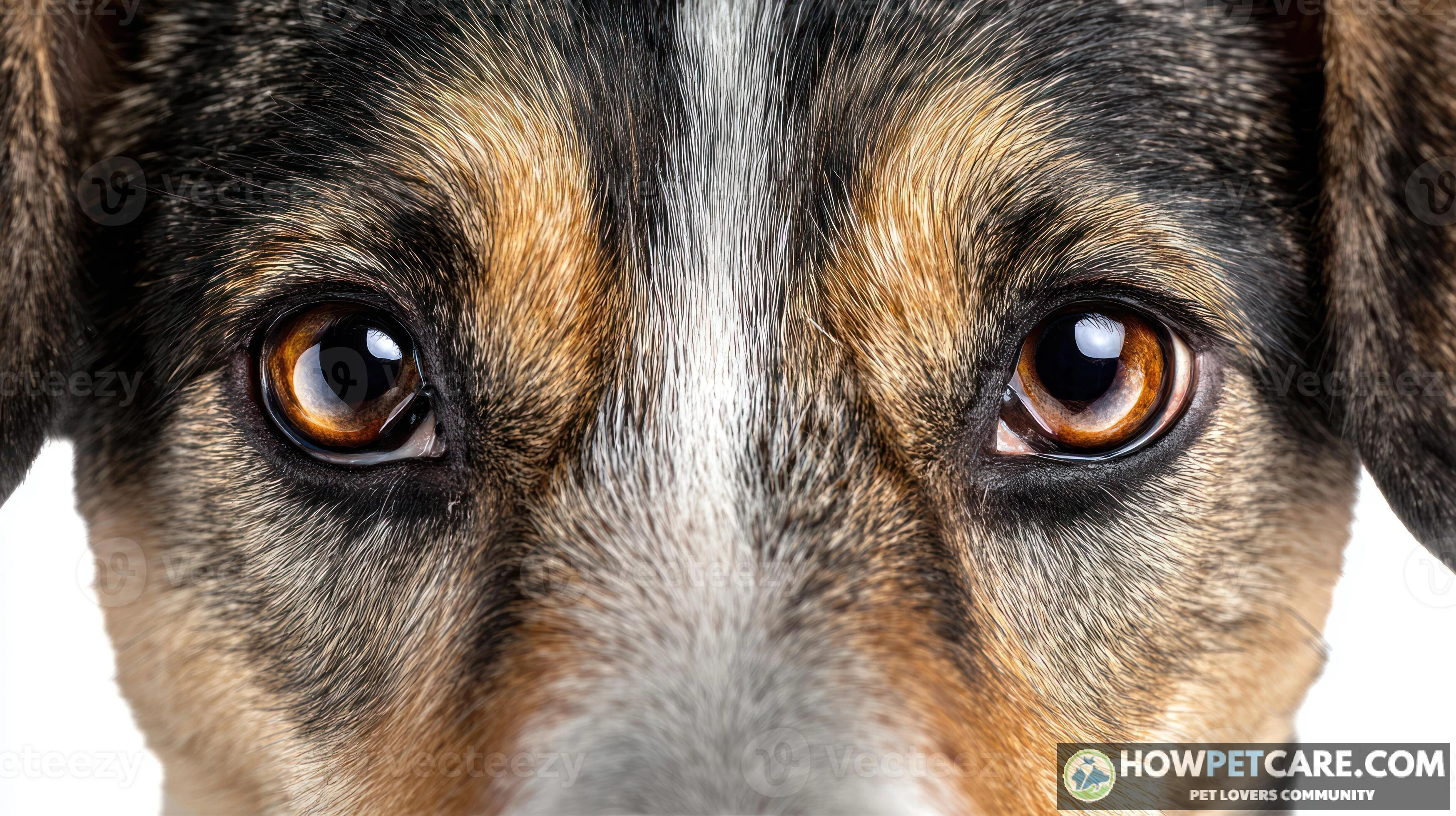

Dogs see blue and yellow but cannot tell red from green, have roughly 20/75 visual acuity versus human 20/20, a wider field of view, and stronger low-light vision from extra rods and a tapetum lucidum. Blue and yellow toys stand out best, while red and green can blend together.
Your dog sees blue and yellow but can’t tell red from green, resolves detail at roughly 20/75 compared with human 20/20, takes in a wider field of view, and navigates dim rooms better than you do thanks to extra rods and a reflective layer behind the retina. This guide turns those benchmarks into plain comparisons, breed-aware context, screen guidance, lifespan expectations, warning-sign triage, and an at-home check you can run today.
Dog Vision at a Glance: Side-by-Side Comparison
The table gives quantified benchmarks before the anatomy and behavior behind them.
| Measure | Dog | Human | Plain-English meaning |
|---|---|---|---|
| Color channels | 2 (blue-yellow) | 3 (red-green-blue) | Dogs do not see red-green differences; blue and yellow stand out best |
| Visual acuity | about 20/75 | about 20/20 | At 20 feet, a dog sees what a person with typical vision sees at 75 feet |
| Field of view | about 240-270 degrees | about 180 degrees | Dogs notice more side-to-side movement, but with less overlap in the center |
| Low-light sensitivity | stronger | weaker | More rods and a tapetum lucidum help dogs navigate dim rooms |
| Motion sensitivity | higher at low light | lower | Dogs may spot a moving toy in dusk before a person does |
| Flicker perception | higher threshold | lower threshold | Some older screens can look like a strobe to a dog |

Color: what dogs see vs humans
Dogs are dichromatic, meaning two cone types sensitive to blue and red-green wavelengths. Humans are trichromatic, with three cone types. In practice, a dog’s world reads in shades of blue, yellow, and gray. Red and green look similar to each other, so a bright red ball on green grass may blend into the background while a blue toy pops against yellow or green surroundings. For a deeper look at what colors dogs see best, compare your toy choices against that practical color guide.

Sharpness: acuity ranges in plain terms
Typical dog visual acuity is roughly 20/75 versus human 20/20. An object a person sees clearly at 75 feet may need to be 20 feet away for a dog to see with similar clarity. Dogs lack a fovea; instead they have an area centralis with the highest cone density, which helps explain why fine detail isn’t their strength even though they track movement well.
Field of view and binocular overlap by head shape
A dog’s field of view is often about 250 degrees compared with about 180 degrees for humans, but the exact number varies by skull shape. Binocular overlap — the region where both eyes see the same scene and depth perception works best — is roughly 60 to 70 degrees in dogs. Long-snouted sighthounds tend toward wider peripheral coverage, while short-snouted breeds may have more frontal overlap. These differences matter when you judge whether your dog truly saw something or only sensed movement at the edge of vision.

Night vision and the tapetum lucidum
Dogs can’t see in total darkness, but how well dogs see in the dark depends on rod-dominant retinas and a reflective tapetum lucidum that sends light back through the retina a second time. This improves low-light capture but scatters some light, which can reduce image sharpness. That glow you sometimes see in flash photos is the tapetum at work.

The Anatomy Behind Dog Eyesight
Retina, rods, and cones explained
The retina lines the back of the eye and turns light into signals the brain can read. Dogs have far more rods than cones, favoring motion detection and dim-light sensitivity over color detail. Average cone density at the area centralis in a Beagle was measured at 26,299 cells per square millimeter, versus 3,053 in the peripheral retina. Cone cells absorb light most strongly around 440 nanometers and 555 nanometers, matching the blue-yellow world dogs perceive.
Dichromacy and color perception
Because dogs have only two cone types, they’re effectively red-green color blind. Their world isn’t black and white; reds and greens occupy similar positions in their color space. If you’re choosing toys or training markers, blue and yellow are safer high-contrast choices than red or green.
Tapetum lucidum and night vision
The tapetum lucidum sits behind the retina and reflects unabsorbed light back through it, giving photoreceptors another chance to catch dim images. The trade-off is scatter, which softens focus. For owners, this means your dog may spot you moving across a dark yard before you notice them, even if fine facial details are harder to make out.
UV light sensitivity: what current research says
Some research suggests canine eyes may transmit ultraviolet light more readily than human eyes, but the evidence doesn’t yet support a confident claim that dogs see UV as a distinct color. Treat ultraviolet sensitivity as an open question rather than a proven superpower, and avoid product claims that promise UV-specific vision benefits.
How Dogs See Movement, TV, and Modern Screens
Flicker-fusion and refresh rates
Dogs have a higher flicker-fusion frequency than humans, measured up to 75 hertz. An older 60Hz television or fluorescent light can look like a series of flashing images to a dog rather than smooth motion. Newer screens reduce that problem.
60Hz versus 120Hz-plus screens
A 60Hz display may flicker or shimmer for many dogs. Displays at 120Hz usually look much smoother, and 240Hz or higher often appears very smooth. The practical benefit is stable motion, not more realistic color, because dogs still see mainly in blue and yellow regardless of the panel’s color gamut.
What dogs actually perceive on a screen
Dogs detect motion better than fine detail, so they may react to a moving animal or object on a screen while ignoring a still image. Sound and movement usually matter more than picture content. Screen distance and blue-yellow contrast also influence whether a dog pays attention. If your dog barks at the television, it’s likely responding to motion and audio, not analyzing the scene like a person would.
| Visual Parameter | Dog Vision | Human Vision | Functional Difference & Meaning |
|---|---|---|---|
| Color vision | Dichromatic (2 channels: blue, yellow) | Trichromatic (3 channels: red, green, blue) | Dogs cannot distinguish red and green hues; blue and yellow stand out most clearly. |
| Visual acuity | Approximately 20/75 | Approximately 20/20 | Dogs must be at 20 feet to see an object with the same detail that a human with typical vision sees at 75 feet. |
| Field of view | Approximately 240°–270° | Approximately 180° | Dogs have broader peripheral vision to detect side-to-side movement, but possess less binocular overlap in the center. |
| Low-light sensitivity | Higher (stronger) | Lower (weaker) | A higher density of rod cells and the presence of a tapetum lucidum allow dogs to see and navigate much better in dim environments. |
| Motion sensitivity | Higher (especially in low light) | Lower | Dogs are significantly better at spotting moving objects in low light or dusk before a human can. |
| Flicker perception | Higher threshold | Lower threshold | Fast-flickering light sources or older screens may appear like a flashing strobe light to a dog. |
Breed Differences: Sighthounds, Brachycephalic Breeds, and Head Shape
Eye placement by skull shape
Skull shape affects how ganglion cells distribute across the retina. Long-snouted dogs often have a horizontal visual streak, while short-snouted dogs tend to have a more circular central area. Refractive error also varies by breed: Rottweilers and Collies trend toward nearsightedness, while Australian Shepherds trend toward farsightedness.
Sighthound versus brachycephalic vision
| Head shape example | Approximate field of view | Binocular overlap | What it means for the dog |
|---|---|---|---|
| Sighthound / long narrow snout | about 270 degrees | about 30-40% | Very wide side awareness; depth judgment is more front-focused |
| Medium / average snout | about 240-250 degrees | about 50-60% | Balanced side awareness and binocular depth cues |
| Brachycephalic / short snout | about 200-220 degrees | about 60-70% | More frontal overlap; may have more central depth detail but less side range |
| Mixed breed | varies widely | varies widely | Judge by individual behavior and eye placement, not breed label alone |

Sighthounds such as Greyhounds and Whippets often excel at detecting motion across a broad arc, which fits their history as coursing hunters. Brachycephalic breeds such as Pugs and Bulldogs may have more forward-facing eyes and different ocular surface risks, including exposure and irritation because of shallow sockets. Breed averages are useful starting points, but individual dogs vary, and mixed-breed owners should watch behavior rather than assume a breed profile.
What breed tells you—and what it does not
Breed can suggest likely field-of-view and binocular patterns, but it can’t tell you an individual dog’s exact acuity or whether vision is declining. Age, injury, and disease matter more than breed for most vision changes owners will actually observe.
Vision Across a Dog’s Lifespan: Puppies to Seniors
Puppy vision development timeline
Puppies are born with their eyes sealed shut. Eyelids usually open around 10 to 14 days of age, and vision continues to mature over the first several weeks. Puppies initially respond mostly to light and movement, not shapes or colors. By about 8 weeks, most puppies are navigating visually with growing confidence, though their visual system keeps developing for several months. For more on puppy eye development and behavior, focus on changes that seem sudden or painful.
Adult vision maturity
Young adult dogs generally reach mature visual acuity by several months of age. This is the baseline against which owners should compare later changes. A healthy adult dog’s vision should be stable unless injury or illness intervenes.
Senior dog vision changes and common conditions
Senior dogs often develop nuclear sclerosis, a normal bluish haze in the lens that usually doesn’t seriously impair vision. Cataracts are also common and can cause real vision loss. Reduced night vision and mild nearsightedness may appear with age. Normal aging tends to be gradual; sudden disorientation, bumping, or eye pain isn’t normal and warrants prompt veterinary care.

Signs Your Dog May Be Losing Vision
Everyday behavior changes
Watch for bumping into furniture, walls, or doorways in familiar rooms, hesitation in dim light or new spaces, reluctance to use stairs, and startling when approached from the side or behind. A dog that stops catching toys or tracking moving objects may be losing visual confidence.
Physical eye changes to watch
Cloudiness, redness, excessive tearing, discharge, squinting, or pupils that look unequal or don’t react to light are reasons to contact a veterinarian. A bluish haze from nuclear sclerosis is often benign in seniors, but only a veterinary exam can tell the difference.
Urgent versus monitor-at-home warning signs
| Check or symptom | Normal response | Possible concern | Action |
|---|---|---|---|
| Bumping into furniture | Rare, only in new rooms | Repeated in familiar spaces | Monitor; call vet if repeated or sudden |
| Dim-light hesitation | Mild slowing | Refusal, freezing, or collisions | Monitor; schedule vet visit if persistent |
| Eye appearance | Clear, bright, symmetric | Cloudiness, redness, tearing, unequal pupils | Call veterinarian soon |
| Startling from side or behind | Occasional | Frequent or worsening | Monitor; add approach cues and call vet if sudden |
| Toy tracking | Follows and catches | Misses, stops, or relies only on smell | Retest; call vet if repeat failures |
| Sudden vision loss | Not applicable | Immediate disorientation, panic, or eye pain | Seek urgent veterinary care |
Sudden blindness, obvious eye pain, or a rapidly cloudy eye is urgent. Gradual hesitation in one familiar room is a monitor-at-home situation that still deserves a veterinary visit if it persists.
At-Home Dog Vision Check: Step-by-Step Owner Guide
This checklist helps you notice possible vision changes. It isn’t a diagnostic exam, and a normal result doesn’t rule out disease.
Preparing the space
Choose a familiar room with low distractions and consistent lighting. Remove loose rugs or breakable items. Let your dog walk around for a few minutes so the space feels routine.
Motion and tracking tests
From about 3 feet away, drop a white cotton ball in front of your dog. A normal response is head or eye tracking, possibly followed by sniffing after it lands. No tracking at all, or searching only by scent, is a possible concern. Toss a high-contrast toy or treat 4 to 6 feet away. Your dog should visually follow and move toward it. Repeated misses suggest a problem worth rechecking.
Obstacle navigation in light and dim conditions
Place two or three low, soft obstacles in a clear path. In bright light, your dog should navigate without bumping. Repeat in dim light. Slight slowing is normal; major hesitation, bumping, or refusal to enter is a concern.

When to call a veterinarian
Contact a veterinarian if your dog fails two or more checks, if any change is sudden, or if you notice redness, cloudiness, discharge, squinting, unequal pupils, or signs of pain. Record what you saw and when it started so the veterinary team has useful information.
[Detailed step procedure below]
-
Set up the room
Use a familiar, low-distraction space with consistent lighting. Pass: dog walks normally and settles. Fail: repeated collisions, freezing, or refusing to enter.
-
Drop a cotton ball
From about 3 feet, drop a white cotton ball in front of the dog. Pass: head or eyes track it; may sniff after landing. Fail: no tracking, only scent search.
-
Bright-light obstacle course
Place 2-3 low, soft obstacles in a clear path. Pass: navigates without bumping. Fail: bumps, hesitates, or circles repeatedly.
-
Dim-light obstacle course
Repeat the same course in low light. Pass: only slight slowing. Fail: major hesitation, bumping, or refusal.
-
Toss-and-track test
Toss a high-contrast toy or treat 4-6 feet away. Pass: visually follows and moves toward it. Fail: relies on smell or misses repeatedly.
Decision rule: If one test fails once, retest the next day. If two or more fail, or any change is sudden, contact a veterinarian. Never treat a passed check as proof that your dog’s eyes are healthy; many conditions need professional equipment to detect.
Schedule a veterinary eye exam if your dog shows repeated vision-loss signs, sudden changes, or physical eye abnormalities. Bring your at-home check notes to the appointment so the veterinarian can focus on the patterns you observed.

FAQ
What colors can dogs actually see?
Dogs see blue and yellow clearly, but they cannot distinguish red from green. Their world appears in shades of blue, yellow, and gray rather than the full rainbow humans see.
How sharp is a dog’s vision compared with human 20/20 vision?
Typical dog visual acuity is roughly 20/75, meaning what a human sees clearly at 75 feet a dog may need to be 20 feet away to see with similar clarity. Exact sharpness varies by breed and individual dog.
Can dogs see in the dark or at night?
Dogs cannot see in total darkness, but they see better than humans in dim light because their retinas are rod-dominant and they have a tapetum lucidum that reflects light.
Do dogs see better than humans in any way?
Yes. Dogs generally have better motion detection, superior low-light sensitivity, and a wider field of view, while humans have sharper detail vision and fuller color perception.
Which dog vision questions need a veterinarian instead of an at-home check?
Sudden blindness, red or cloudy eyes, squinting, discharge, or obvious pain warrant prompt veterinary care; at-home checks are for monitoring, not diagnosis.