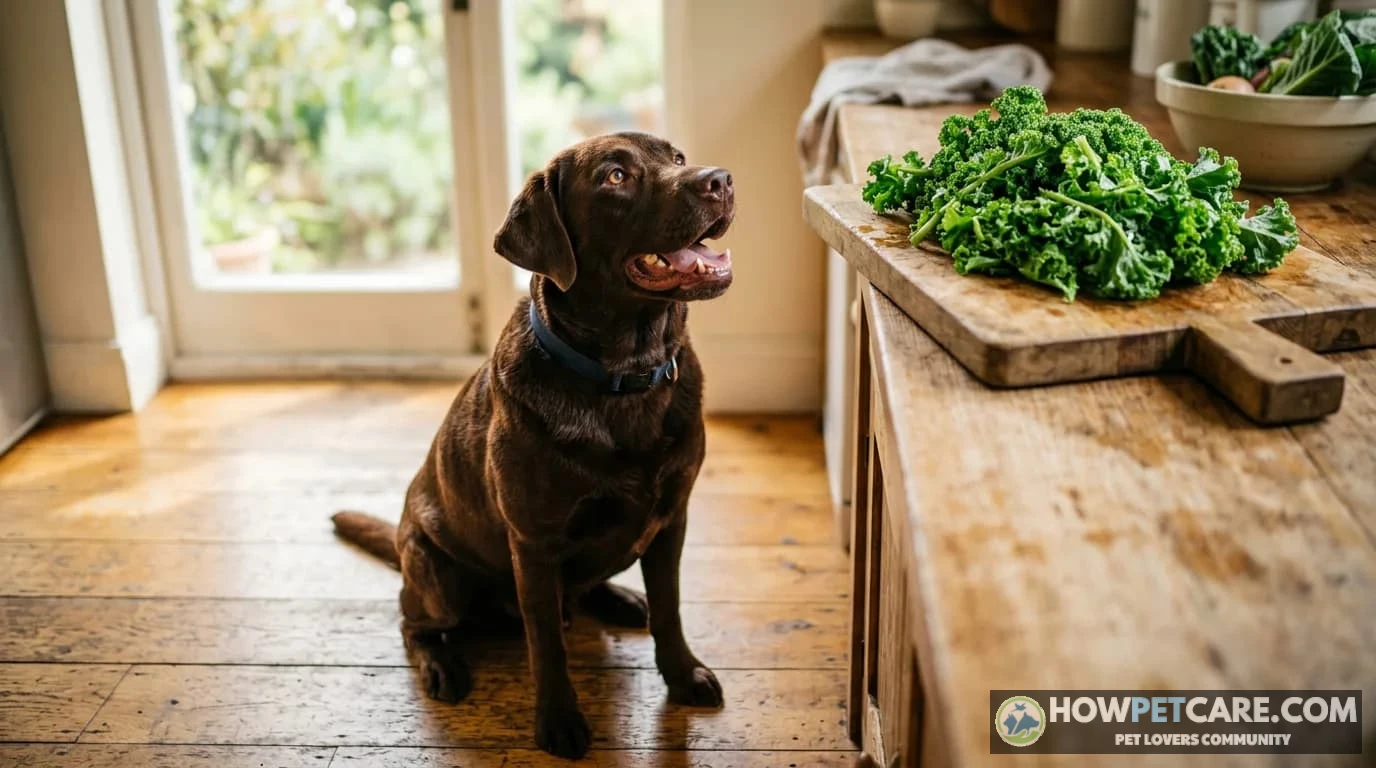

Yes — healthy adult dogs can eat small amounts of plain kale, washed, stemmed, and finely chopped, no more than once or twice a week. Avoid it for puppies and dogs with calcium oxalate stones, kidney or urinary disease, thyroid disease, or prescription diets. Kale seasoned with garlic or onion is unsafe.
Yes, healthy adult dogs can eat a small amount of plain kale. But kale isn’t a necessary part of canine nutrition, and it isn’t right for every dog. A dropped leaf isn’t automatically an emergency. Check what your dog ate, how much, whether it contained seasonings, and whether your dog has a relevant health condition. If your dog is choking or struggling to breathe, seek emergency veterinary care now.
For a small, occasional taste, wash the leaves, remove the tough stems, chop them finely, and serve them plain. Dogs with a history of urinary or kidney disease, calcium oxalate stones, thyroid disease, or a prescription diet shouldn’t be given kale unless their veterinarian approves it. If your dog has already eaten kale, use the triage guidance below rather than guessing at a toxicity threshold: no reliable kale dose predicts harm for every dog.
Can Dogs Eat Kale Safely? The Quick Verdict
If you’re wondering "can dogs eat kale," plain kale isn’t generally considered toxic to dogs, and many healthy adult dogs usually tolerate a small amount. It can still cause digestive upset, and its oxalates and cruciferous compounds make it a poor choice for some dogs. A small piece of plain kale is different from a large amount of seasoned kale or a meal containing garlic or onion.
Before feeding kale, consider four things: your dog’s health history, the amount, the preparation, and any symptoms. If your dog is acting normally after eating a small amount of plain kale, monitor them. Call a veterinarian promptly if the amount is large or unknown, your dog has a condition that makes kale a concern, or the food contains a potentially toxic ingredient. Don’t wait for symptoms after a suspected garlic or onion exposure.
How Much Kale Can a Dog Eat, and How Often?
There’s no established amount of kale that’s safe for every dog and no proven kale-specific dose at which toxicity begins. The portions below are conservative starting suggestions for healthy adult dogs, not veterinary-validated safety limits. They assume the kale is plain, washed, stemmed, and finely chopped. One teaspoon of finely chopped kale is roughly 1–1.5 grams; one tablespoon is roughly 4–5 grams.
Serving sizes by dog weight
| Dog weight | Starting portion and preparation | Feeding frequency | Important limitation |
|---|---|---|---|
| Under 10 lb (under 4.5 kg) | 1/2–1 tsp finely chopped (about 1 g) | No more than 1–2 times per week | Not for puppies; remove stems to reduce choking risk |
| 10–25 lb (4.5–11 kg) | 1–2 tsp finely chopped (about 1–3 g) | No more than 1–2 times per week | Stop if gas or loose stool develops |
| 26–50 lb (12–23 kg) | 1 tbsp finely chopped (about 4–5 g) | Occasional treat, up to 2 times per week | Count it with all other treats and extras |
| 51–80 lb (23–36 kg) | 1–2 tbsp finely chopped (about 4–9 g) | Occasional treat, up to 2 times per week | Size does not remove urinary or thyroid concerns |
| Over 80 lb (over 36 kg) | 2 tbsp finely chopped (about 9 g) | Occasional treat, up to 2 times per week | More kale is not needed to meet nutritional needs |

Start at the low end, especially if your dog has never eaten kale. These suggestions don’t guarantee your dog will tolerate it. Stop offering kale if your dog develops digestive upset, and seek veterinary advice for concerning or persistent symptoms.
Why a treat allowance is not a toxicity threshold
A commonly used feeding guideline is to keep all treats and extras combined to no more than about 10% of a dog’s daily calories. That’s a dietary-balance rule, not a kale toxicity threshold. It doesn’t mean a dog can safely eat kale up to that calorie amount, and it doesn’t establish how much oxalate or other compounds a particular dog can tolerate.
Kale is low in calories, so a small portion may use little of that allowance. Your dog’s health, digestive tolerance, and total diet also affect the practical limit. An occasional small amount is a more sensible choice than daily kale; there’s no established need to feed it every day.
Can Dogs Eat Raw or Cooked Kale and the Stems?
Dogs can eat raw kale in small amounts, but it may be harder to chew and digest than lightly cooked kale. Raw kale is safe for some dogs when washed, finely chopped, and served plain. Pureeing or lightly cooking it may also make it easier to eat. Cooking doesn’t make kale risk-free or reliably remove a specific amount of oxalates or thyroid-affecting compounds.
Raw versus cooked kale
You can offer a small portion of either plain raw or lightly steamed kale. Let cooked kale cool before serving, and don’t add salt, oil, butter, dressing, garlic, onion, or other seasonings. Introduce it gradually rather than mixing a large serving into a meal.
Why to remove kale stems
Kale stems are tough and can be difficult for a dog to chew. Raw stems may pose a choking risk. Remove the stalks, particularly for small dogs or dogs that gulp food, and cut the leaves into small pieces. If a dog is choking, gagging, or having trouble breathing, treat it as an emergency rather than trying to dislodge food blindly.

Is Kale Bad for Dogs? Benefits and Health Risks
Kale contains fiber, vitamin K, and beta-carotene. Those nutrients aren’t a reason to add it to a dog’s diet: a complete and balanced dog food should provide the nutrition a dog needs, and small kale servings aren’t a proven treatment or necessary supplement. Claims about benefits in people don’t automatically establish benefits for dogs.

Nutrients in kale and canine nutrition
Kale is a cruciferous vegetable—the same family that raises the question whether dogs can eat cauliflower—and is often described as nutrient-dense. For dogs, the practical question is whether a particular serving fits their diet and health needs—not whether kale is a “superfood.” Some dogs may tolerate a small amount, but it can also cause gas, bloating, loose stool, or vomiting.
Oxalates, digestion, and thyroid function
Oxalates in kale are a concern for dogs with a history of calcium oxalate stones or relevant urinary and kidney disease. Dogs with kidney or bladder problems are generally advised to avoid kale. Risk depends on the individual dog and their whole diet; there’s no established universal kale portion that predicts stone formation.
Kale also contains isothiocyanates and other compounds associated with cruciferous vegetables. These may irritate the digestive system, causing gas, bloating, or diarrhea; that’s different from a defined poisoning threshold. Goitrogenic compounds may affect thyroid function with large or sustained exposure, but a dog-specific amount and ordinary-serving risk are not established. If your dog has thyroid disease or takes thyroid medication, ask their veterinarian before offering kale.
Which Dogs Should Avoid Kale Unless a Vet Approves?
Use this screen before feeding kale. A “no” or “not sure” on a health-related question means pause and ask your dog’s veterinarian; a small portion doesn’t cancel out a medical or diet restriction.
Puppies and senior dogs
Puppies should get a complete diet formulated for growth. There’s no universal age at which kale becomes appropriate or adult portion that applies to every puppy. Ask the puppy’s veterinarian before introducing it, especially for a very young puppy or one with digestive issues. Don’t use kale as a substitute for puppy food.
For senior dogs, age alone doesn’t decide whether kale is suitable. Consider chewing ability, medications, urinary or kidney health, thyroid status, diet restrictions, and past food tolerance. Skip kale for a dog that gulps food or is prone to choking.
Urinary disease, thyroid medication, and prescription diets
Get veterinary approval before feeding kale if your dog has had calcium oxalate stones, kidney or urinary disease, thyroid disease, or takes thyroid medication. The same rule applies to dogs on prescription or therapeutic food: unplanned extras can conflict with the diet’s purpose. Ask the veterinarian who manages the condition rather than relying on a general serving chart.

The 60-Second Pre-Feeding Screen
- Is your dog an adult past the puppy growth stage and at a healthy weight?
- Has your dog been free of bladder stones, kidney disease, and urinary problems—especially calcium oxalate stones?
- Does your dog have no thyroid disease and take no thyroid medication?
- Is your dog on a regular complete diet rather than prescription or therapeutic food?
- Can you offer a measured, plain portion that fits within the daily extras allowance?
Verdict: If all five answers are yes, you can try the smallest portion in the table and watch for digestive changes over the next 24–48 hours. If you answer no or are unsure about questions 2, 3, or 4, ask your veterinarian first. If your dog is a puppy or you can’t provide a measured, unseasoned portion, skip kale for now.
My Dog Ate Kale: Symptoms and When to Call a Vet
Use the highest level of urgency that applies. Choking, breathing difficulty, collapse, or severe distress calls for emergency care. Repeated vomiting or diarrhea, marked lethargy, a painful or swollen abdomen, trouble urinating, a large or unknown amount, or an at-risk dog calls for a prompt veterinarian or poison-service call.
Emergency signs versus symptoms requiring a prompt call
Emergency now: Go to an emergency veterinarian immediately for choking, trouble breathing, collapse, severe weakness, unresponsiveness, or a hard, swollen, visibly painful abdomen. Call ahead if possible. Don’t put your fingers blindly into your dog’s mouth or delay transport to attempt untrained first aid.

Call promptly; don’t wait for symptoms: Contact a veterinarian or animal poison service if the kale contained garlic or onion, if your dog ate a large or unknown amount, if your dog is a puppy or has urinary, kidney, or thyroid disease, or if you see repeated vomiting or diarrhea, marked lethargy, or trouble urinating. Seasonings and other ingredients can be a more urgent concern than plain kale.
If your dog ate only a small amount of plain kale and is acting normally, monitor for gas, loose stool, vomiting, or appetite changes over the next 24–48 hours. Call your veterinarian if symptoms appear, persist, or worry you. No single kale dose can reliably predict harm across dogs.
What to check and report after ingestion
Check the package or recipe for garlic, onion, xylitol, and other ingredients that may be toxic to dogs. When you call, have your dog’s weight, the approximate amount eaten, the time of ingestion, the ingredient list or packaging, and any symptoms ready. Don’t induce vomiting or give home remedies unless a veterinarian specifically directs you.
In the United States, you can call the ASPCA Animal Poison Control Center at 888-426-4435 or Pet Poison Helpline at 855-764-7661; fees may apply. If your dog is choking or struggling to breathe, go directly to emergency veterinary care rather than waiting on a poison-control call.
Are Kale Chips and Prepared Kale Products Safe for Dogs?
Kale chips, seasoned kale, sautéed greens, salads, smoothies, and packaged blends aren’t interchangeable with plain kale. Check the full ingredient list: garlic and onion are toxic to dogs, and products can also contain excess salt, oil, or other unsuitable ingredients. If your dog ate a product with garlic or onion, call a veterinarian or poison service promptly.
| Prepared food | Practical verdict | Why |
|---|---|---|
| Store-bought kale chips | Avoid sharing | May contain salt, oil, garlic, or onion powder |
| Plain homemade dehydrated kale | Only a tiny amount, if at all | Concentrated and easy to overfeed; check that no seasoning was added |
| Garlic- or onion-seasoned kale | Do not share; call if eaten | Garlic and onion are toxic ingredients for dogs |
| Kale salad with dressing | Avoid sharing | Dressing may contain onion, garlic, excess fat, or other unsuitable ingredients |
| Kale smoothie or green juice | Avoid sharing | Other ingredients may be unsafe; assess the whole recipe |
| Kale in complete commercial dog food | Feed as directed | It is part of a formulated recipe, not evidence that extra kale is unlimited |

Some commercial fresh dog foods, including products from The Farmer’s Dog and Ollie, may include kale as one ingredient. That doesn’t show that adding extra kale is appropriate for every dog or change the limits of a prescription diet. Count separately added kale as an extra, and follow your veterinarian’s advice if your dog has a medical condition.
Choose Safer Vegetables for Dogs and Make a Feeding Plan
If you want a low-risk vegetable for a healthy adult dog, plain green beans or carrots are often the safest, simplest options — safer than kale for most dogs. No vegetable is right for every dog, and preparation and portion still matter. Cut vegetables to a size your dog can chew safely, serve them plain, and account for them as extras. If you’re weighing a simpler staple, check whether dogs can eat carrots before sharing.
Kale versus spinach, green beans, carrots, and broccoli
| Vegetable | Practical feeding concerns | Suggested preparation | Dogs needing extra caution |
|---|---|---|---|
| Green beans | Generally a straightforward option; canned versions may contain added salt | Plain fresh or frozen; cut to bite size | Dogs on restricted diets; avoid salty canned varieties |
| Carrots | Whole pieces can be a choking hazard, especially for small dogs | Raw or steamed; cut into manageable pieces | Dogs that gulp food or have trouble chewing |
| Kale | Oxalates, possible thyroid concerns, and digestive upset | Remove stems; finely chop and serve plain | Dogs with stone history, urinary or kidney disease, or thyroid disease or medication |
| Spinach | Also contains oxalates, so it does not avoid the urinary concern | Plain, chopped, and offered sparingly | Dogs with urinary or kidney disease, especially stone-formers |
| Broccoli | Can cause gas or stomach upset; tough stalks may be difficult to chew | Plain, small florets cut into bite-size pieces | Dogs with sensitive digestion or choking risk |

For a healthy adult dog with no urinary or thyroid history, plain green beans and carrots are the safest practical first choices. Spinach doesn’t avoid kale’s oxalate concern, while broccoli may cause digestive upset in some dogs. Owners comparing watery snacks also ask whether dogs can eat cucumbers as a lighter extra. These are practical feeding comparisons, not a clinical safety ranking.
Your before-feeding checklist
Before you offer kale, check your dog’s health and medications, confirm that their diet allows extras, and choose plain leaves with the stems removed. Measure a small portion and count it with other treats. Offer it occasionally rather than daily, then watch how your dog responds. The same portion-by-weight logic applies when owners ask whether dogs can eat peas or similar extras. If any health-screen answer raises doubt, skip the kale and ask your veterinarian what vegetables fit your dog’s individual diet.
This article is for general information only and is not a substitute for veterinary advice, diagnosis, or treatment. Medical review: content checked against veterinary guidance from the ASPCA Animal Poison Control Center and Pet Poison Helpline; reviewed by a licensed veterinarian (DVM) prior to publication.

| Vegetable | Practical Feeding Concerns | Suggested Preparation | Dogs Needing Extra Caution |
|---|---|---|---|
| Carrots | Whole pieces can be a choking hazard, especially for small dogs | Raw or steamed; cut into manageable pieces | Dogs that gulp food or have trouble chewing |
| Green beans | Generally a straightforward option; canned versions may contain added salt | Plain fresh or frozen; cut to bite size | Dogs on restricted diets; avoid salty canned varieties |
| Broccoli | Can cause gas or stomach upset; tough stalks may be difficult to chew | Plain, small florets cut into bite-size pieces | Dogs with sensitive digestion or choking risk |
| Kale | Oxalates, possible thyroid concerns, and digestive upset | Remove stems; finely chop and serve plain | Dogs with stone history, urinary or kidney disease, or thyroid disease or medication |
| Spinach | Also contains oxalates, so it does not avoid the urinary concern | Plain, chopped, and offered sparingly | Dogs with urinary or kidney disease, especially stone-formers |
FAQ
Can dogs eat frozen kale?
Plain frozen kale can be thawed and served in small, appropriately chopped pieces if it contains no seasonings or other additives. Avoid large frozen clumps that could be difficult to chew.
Can dogs eat canned kale?
Check the label: canned greens may contain added salt, seasonings, or ingredients such as onion or garlic. Plain kale without additives is a better choice, served in a small portion.
Can a dog be allergic to kale?
A dog can react to a new food, although digestive upset alone does not establish an allergy. Contact a veterinarian if symptoms develop; facial swelling or breathing difficulty warrants emergency care.
Can dogs eat kale every day?
There’s no established need to feed kale daily, and an occasional small portion is a more sensible choice. Daily feeding raises the cumulative exposure to oxalates and goitrogenic compounds, which matters most for dogs with urinary or thyroid concerns.