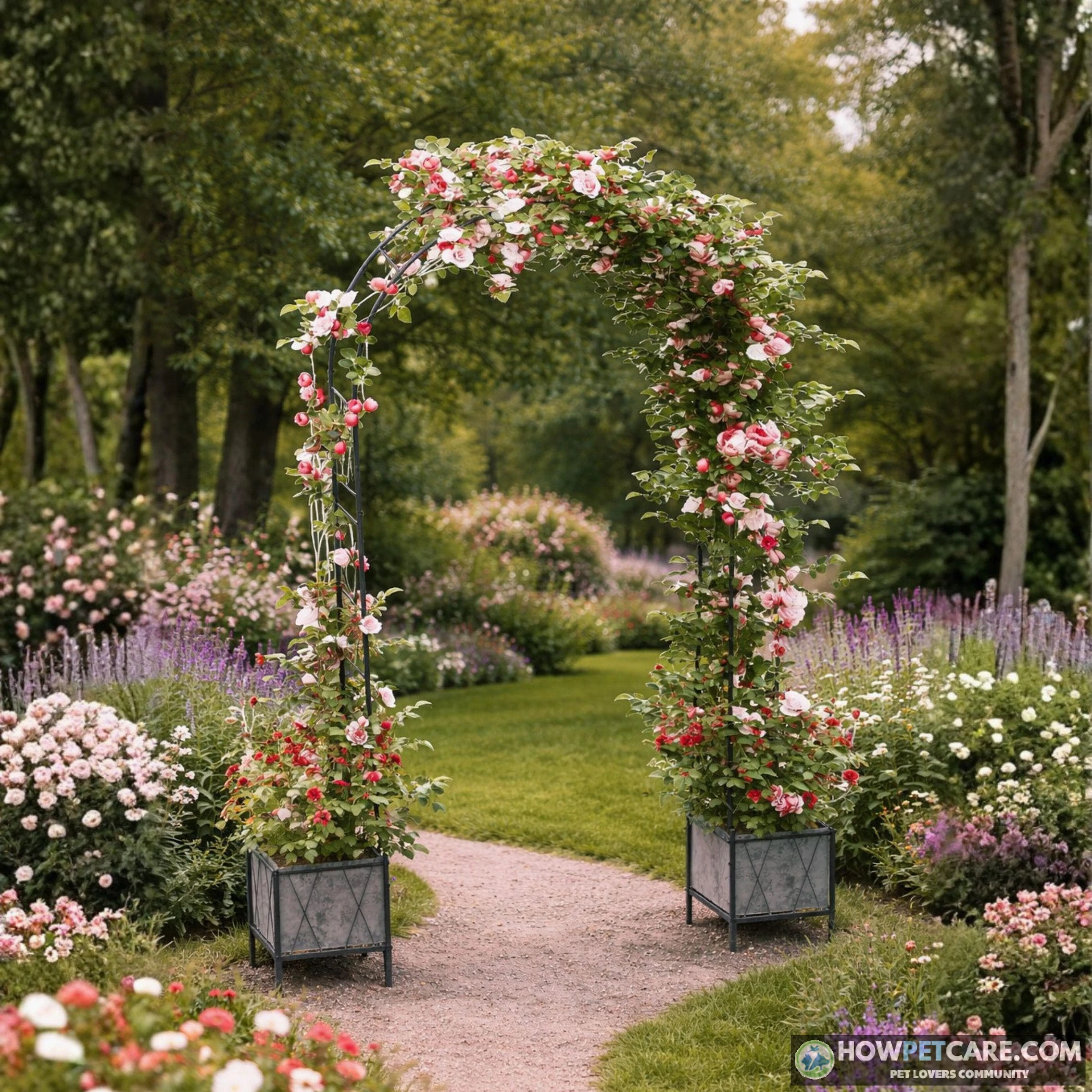

The best climbing roses for most gardens, by use case:
- Best overall: New Dawn — repeat blooms, 5/5 fragrance, very high disease resistance, zones 5–9.
- Most fragrant: Abraham Darby and Golden Celebration — top scent ratings, ideal for zone 6.
- Best for partial shade: Lady Banks and Eden — bloom reliably with 4–5 hours of sun.
- Best for large structures: Pierre de Ronsard — a vigorous rambler covering 15–20 ft.
- Best for beginners: Eden and Lady Banks — strong black-spot resistance and forgiving habits.
Whether you are dressing a brick wall, a wooden fence, or a garden arbor, the right climbing rose can turn a plain surface into a seasonal showcase of colour and fragrance. This guide delivers a step-by-step buying blueprint, a side-by-side cultivar comparison, and proven techniques for planting, anchoring, and training canes so you get the most blooms with the least guesswork.
Best Climbing Roses by Fragrance, Bloom, and Disease Resistance
Choosing a climbing rose begins with matching three core traits—fragrance, bloom frequency, and disease resistance—to the conditions of your garden. The table below condenses the most reliable data for US growers, letting you shortlist the few varieties that truly fit your needs.
| Cultivar | Rose Type | Mature Height & Spread | USDA Hardiness Zones | Bloom Frequency | Fragrance Strength | Shade Tolerance | Disease Resistance | Best Support |
|---|---|---|---|---|---|---|---|---|
| Eden | Climber | 8-10 ft tall, 6-8 ft spread | 5-9 | Repeat (flushes) | 4 / 5 | Partial shade OK (4-5 hrs) | High (black-spot resistant) | Pillar or small trellis |
| New Dawn | Climber | 10-12 ft tall, 8-10 ft spread | 5-9 | Repeat | 5 / 5 | Full sun best; tolerates 4 hrs | Very high | Arbor or pergola |
| Don Juan | Climber | 12-14 ft tall, 10-12 ft spread | 7-10 | Repeat | 4 / 5 | Full sun | Moderate (some black-spot) | Large fence or reinforced arbor |
| Lady Banks | Climber | 6-8 ft tall, 5-7 ft spread | 4-8 | Repeat | 3 / 5 | Partial shade OK | High | Small pillar or narrow trellis |
| Pierre de Ronsard | Rambler (climbing) | 15-20 ft tall, 12-15 ft spread | 5-9 | Once-year heavy flush | 4 / 5 | Full sun | Moderate | Reinforced pergola or wide-span trellis |
| Abraham Darby | David Austin climber | 9-10 ft tall, 7-8 ft spread | 6-9 | Repeat | 5 / 5 | Full sun | High | Trellis or garden arch |
| Iceberg Climber | Hybrid-tea climber | 8-9 ft tall, 6-7 ft spread | 5-9 | Repeat | 2 / 5 | Full sun | High | Fence, wall, or simple wire system |
| Golden Celebration | David Austin climber | 9-10 ft tall, 8-9 ft spread | 6-9 | Repeat | 5 / 5 | Full sun | High | Arbor or pergola |

Best Overall Climbing Roses for Most Gardens – New Dawn offers a full-sun, repeat-bloom habit, top-tier fragrance, and strong disease resistance, making it the go-to choice for USDA zones 5-9.
Most Fragrant Climbing Roses for Zone 6 – Abraham Darby and Golden Celebration both score five out of five on scent and thrive in the cooler winters of zone 6.
Best Disease-Resistant Climbing Roses for Beginners – Eden and Lady Banks tolerate partial shade and resist black spot, a frequent problem in humid mid-Atlantic gardens.
Best Repeat-Blooming Roses for Summer-Long Color – Don Juan and Iceberg Climber keep flushing from late spring through early fall when positioned for good airflow.
Best Climbing Roses for Partial Shade – Lady Banks and Eden will still produce repeat blooms with only four to five hours of morning sun, though overall bloom size may be modest.
True “continuous” flowering means a series of flushes, not a nonstop carpet of buds. Even the hardiest repeat bloomers pause during the hottest midsummer weeks.
Buying Criteria for Climbing Roses for Sale
When you browse a nursery catalog, compare each listing against these checkpoints:
- Mature size – Does the cultivar fit a pillar, trellis, or pergola?
- Hardiness zone – Verify the USDA range covers your location.
- Rootstock format – Own-root for cold zones, grafted for rapid early growth.
- Patented vs. open-source – Patented varieties often carry a guarantee of true-to-type performance.
- Disease-rating – Look for black-spot or powdery-mildew resistance notes.
- Fragrance rating – Many suppliers use a 1-5 scale; aim for 4-5 if scent matters.
By scoring each plant on these six items, you can rank candidates before ever stepping onto a bench. If cats patrol the beds, cross-check companion plantings against a list of plants safe for cats so the border stays beautiful and low-risk.

Match the Rose to Your Sun, Hardiness Zone, and Structure
Full Sun Versus Partial Shade
Climbing roses generate most of their energy in strong, direct light. Six to eight hours of unfiltered sun is ideal for vigorous repeat bloomers such as New Dawn and Don Juan. However, morning sun followed by afternoon shade can reduce fungal pressure and still yield respectable flowers on shade-tolerant cultivars like Lady Banks.
In humid regions (e.g., the Southeast), excess shade traps moisture on leaves, encouraging black spot and powdery mildew. Selecting a partial-shade tolerant rose and ensuring at least two feet of clearance between foliage and a wall helps air circulate and dries leaf surfaces faster.

Best Climbing Roses for Trellises and Arbors
- Compact pillar climbers (6-10 ft) – Eden, Lady Banks – suitable for narrow garden posts or ornamental pillars.
- Mid-size trellis roses (10-14 ft) – New Dawn, Abraham Darby – thrive on rectangular trellises with 12-18 in wire spacing.
- Vigorous arbors (15-20 ft) – Pierre de Ronsard (rambler), Don Juan – require a sturdy, reinforced arbor or pergola that can bear up to 150 lb of wet cane weight.

Choosing by Hardiness Zone and Microclimate
USDA zones indicate winter low tolerance, not summer heat. A rose rated for zone 5 will survive a –20 °F winter, but if you live in a zone 8 location with scorching July afternoons, ensure the cultivar tolerates high temperatures (most modern climbers do). Pair zone data with local climate metrics:
- Average summer max – > 90 °F can stress delicate buds; provide afternoon shade.
- Annual precipitation – > 40 in may increase disease pressure; select high-resistance varieties.
- Wind exposure – strong winds can damage long canes; a sturdy support mitigates breakage.
Sizing a Rose for a Wall, Fence, Pillar, or Pergola
Measure the vertical clearance and horizontal width of your structure. For a 6-ft brick wall, a climber that tops out at 9-ft (e.g., Eden) ensures the top can be tied off without over-reaching. For a 12-ft pergola, pick a vigorous rambler like Pierre de Ronsard that will fill the space but still leave room for airflow.
Do not plant a 20-ft rambler on a thin cedar fence; the combined load of wet canes and wind can snap the rails.
Climbing Roses vs. Rambler Roses: Growth and Flowering Differences
How Climbers and Ramblers Differ
| Characteristic | Climbing Roses | Rambler Roses |
|---|---|---|
| Cane thickness | Thicker, semi-woody, less flexible | Long, slender, highly flexible |
| Bloom cycle | Repeat-bloom (multiple flushes) | Typically a single, massive flush in early summer |
| Flower size | Larger, often hybrid-tea form | Smaller to medium, abundant clusters |
| Hip production | Often produce hips after bloom | Produce abundant hips, useful for wildlife |
| Ideal support | Pillars, arches, sturdy trellises (can handle weight) | Wide-span pergolas, fences, trees (need flexibility) |

Climbers retain a framework of permanent canes that are pruned back each winter, while ramblers rely on new, vigorous shoots each season that are cut back after flowering.
When a Rambler Is the Better Choice
If you have a large, open structure—such as a wide pergola, a sturdy fence, or a mature tree—and you desire a spectacular summer carpet of roses, a rambler like Pierre de Ronsard delivers a cascade of blooms that can cover 15-20 ft in height. Their flexible canes can be woven through the lattice without heavy hardware.
Why the Classification Changes Pruning Timing
Because ramblers flower on last-year wood, you prune them after the bloom to encourage fresh shoots for next year. Climbers, by contrast, set buds on the current season’s laterals, so you prune in late winter before new growth begins. Treating both groups with the same schedule leads to missed blooms on ramblers and excessive wood loss on climbers.
Own-Root vs. Grafted Climbing Roses: What to Buy for Your Zone
When Own-Root Roses Make Sense
- Cold zones (4-5) where the graft union is vulnerable to freeze-thaw damage. An own-root plant has no union to split, allowing the whole crown to survive winter die-back.
- Budget-conscious gardeners – own-root stock is often less expensive per plant.
- Long-term gardens – the plant retains true cultivar characteristics indefinitely, without the risk of rootstock suckers overtaking the bloom quality.
When Grafted Bare-Root Roses Make Sense
- Zones 6-9 where the winter is mild; the graft union stays well above the frost line.
- Desire for early vigor – grafted roses on vigorous rootstocks like Dr. Huey or Rosa canina establish quickly and may produce a modest first-year flush.
- Container availability – many nurseries only stock grafted climbers in 5-gal bags, simplifying transport and planting.
Cold-Climate and Rootstock Considerations
In zones 4-5, keep the graft union at least 6 in below the soil surface to protect it from wind-driven ice. In warmer zones, place the union 2-3 in above soil to avoid rot. Select rootstocks matched to your soil type: Dr. Huey for heavy clay, Rosa canina for sandy, well-drained sites.

How to Inspect Climbing Roses for Sale
- Check foliage – look for glossy, vibrant leaves free of black spots.
- Examine canes – the bark should be firm, not soft or oozing.
- Root health – bare-root plants should have white, moisture-filled roots without mushy sections.
- Label clarity – cultivar name, rootstock (if grafted), and USDA zone must be printed.
- Size rating – a 5-gal container should have a well-developed root ball; a bare-root bundle should be compact but not root-starved.

Start → What is your USDA hardiness zone?
   |

   ├─ Zone 4-5 (winter lows ≤ –20 °F) → Prefer **Own-Root** (no graft-union frost damage)
   │   |

   │   ├─ Do you need rapid early-season vigor? → If YES, consider **own-root on vigorous rootstock** (e.g., multiflora) but verify union depth ≥ 6 in below soil.
   │   └─ Budget tight? → Own-root usually cheaper per plant.
   |

   └─ Zone 6-9 (winter lows > –20 °F) → Both formats viable.
        |

        ├─ Do you want **early strong growth in the first season**? → Choose **Grafted** onto a compatible rootstock (e.g., Dr. Huey for heavy clay, or Rosa canina for sandy soils).
        │   |

        │   └─ Is the rootstock known for **disease resistance** in your area? → Select grafted accordingly.
        |

        └─ Are you planting in a container or limited space? → **Grafted container** plants are typically available and less shock-prone.
Key notes
- Keep the graft union at least 2-3 in above soil in warm zones; burying it can cause rotting.
- For own-root, expect a 2-week establishment lag before vigorous bloom.
- Always inspect the crown for a clean, green × green bud union before purchase.
How to Plant Bare-Root and Container Climbing Roses
Bare-Root Preparation and Planting
- Timing – Plant bare-root roses when the soil is workable and the plant is still dormant, typically 2-3 weeks before the last expected spring frost in your area. In the Midwest, that often means late March to early April.
- Unpack and soak – Remove the plant from its packaging, shake off loose soil, and soak the roots in lukewarm water for 30-45 minutes. Do not submerge longer than an hour; excess water limits oxygen and can cause root rot.
- Trim damaged roots – Using clean pruning shears, cut away any blackened or mushy tips, leaving healthy white or light-tan tissue.
- Dig the hole – Make a hole twice as wide as the root spread and as deep as the root ball, but no deeper than the crown. The crown (where canes meet roots) must sit just above ground level.
- Backfill – Mix native soil with ½ cup per plant of well-rotted compost and a thin layer of bone meal for phosphorus. Fill the hole in layers, gently firming each to eliminate air pockets.
- Water in – Saturate the planting area with a deep soak (≈ 10 gal for a 5-gal plant) until water drains from the bottom of the hole.
- Mulch – Apply a 2-3 in layer of shredded bark or pine needles, keeping mulch 2 in away from the crown to prevent crown rot.

Container Rose Planting
- Pre-water the pot for 15 minutes to settle the medium.
- Inspect the root ball – untangle circling roots and prune any that are excessively long or dead.
- Plant depth – Place the plant so the graft union (if present) follows the same guidance as bare-root: 2-3 in above soil in warm zones, 6 in below in cold zones.
- Backfill – Use the original potting mix, lightly amended with compost. Press gently around the roots.
- Water thoroughly – Fill the pot until water exits the drainage holes. Allow excess water to drain.
- Staking – Position the plant 12-18 in from the support to give cane-growth space. This avoids immediate bark abrasion on the wall or fence.

Spring Versus Autumn Timing
- Spring planting – optimal for zones 5-9 where winter freezes are mild; roots establish as temperatures rise.
- Autumn planting – feasible in zones 3-5 if the ground does not freeze until after the plant has set a shallow root network. Provide a protective mulch blanket of 4-5 in.
- Mixed spring borders – If tulips or other bulbs share the rose bed, confirm whether tulips are toxic to cats before planting where pets dig.
Initial Watering, Mulching, and Cane Protection
After planting, water deeply once a week for the first six weeks, then taper to bi-weekly based on rainfall. Avoid overhead watering; use a soaker hose to keep foliage dry and reduce disease risk.
Build a Climbing Rose Trellis or Wall-Wire Support
Support Loads: Compact Climbers vs. Vigorous Ramblers
| Rose Size or Vigor | Suitable Structure | Recommended Support Layout | Typical Wire or Rail Spacing | Wall Clearance | Anchor Considerations | Inspection Priority |
|---|---|---|---|---|---|---|
| Compact (6-10 ft) | Pillar, narrow trellis | Two horizontal wires, 12-in apart | 14-16 ga stainless steel | 4-6 in from surface | Light-duty eye bolts or masonry anchors rated ≥ 30 lb | Check tie slippage quarterly |
| Medium (10-14 ft) | Standard trellis, arbor | Three wires, 12-18 in spacing, central vertical rail | 14-16 ga stainless | 4-6 in | Heavy-duty eye bolts, toggle bolts for brick, or lag screws for wood | Tighten for wind-load shifts |
| Vigorous (15-20 ft) | Reinforced pergola, wide-span fence | Four-five wires, staggered diagonals, optional cable bracing | 12-14 ga galvanized or stainless | 4-6 in, never < 2 in to avoid moisture trap | Structural bolts, steel brackets, engineer-approved load rating | Annual structural safety check |
Wall Wires, Anchors, and Airflow Standoffs
Climbing roses do not cling on their own; they need a freestanding wire system anchored to sound material. Use stainless-steel 14-16 ga wire for most medium-vigorous cultivars; heavier ramblers benefit from 12-ga galvanized to resist sag under rain load.
Standoff distance – Keep the wire 4-6 in away from the wall surface. This provides airflow, reduces mildew, and gives you room to tie canes without damaging the masonry.
Anchor selection – For brick, drill a ½-in hole, insert a plastic or lead-filled masonry sleeve, then secure a 1-in heavy-duty eye bolt rated for at least 30 lb. For wood framing, a 2-in lag screw with a washer works well.

Trellises, Fences, Arbors, and Pergolas
- Freestanding trellis – Build from cedar or pressure-treated lumber; space vertical posts 6-ft apart. Attach horizontal rails at 2-ft intervals.
- Arbor – Use a 4-ft-diameter, 8-ft-high wooden arch, reinforced with metal brackets at the base.
- Pergola – Design beams to span 10-12 ft, using steel brackets that can bear 150 lb per foot of loaded cane weight.
Annual inspections are essential: look for rust, loose bolts, or rope abrasion on bark. Tighten or replace hardware before the first hard freeze.
Climbing roses cannot grip brick, stone, or siding. Tying them directly to mortar will damage the surface and give the plant nothing to hold onto. Always use a wire or rail system with a 4-6 in clearance.
How to Train Climbing Roses Horizontally for More Blooms
Bending the main canes away from the vertical axis triggers apical dominance loss, which forces the plant to develop lateral shoots that bear the majority of flowers. The angle range of 45-90 degrees provides the optimal balance between cane health and lateral bud activation.
-
Select structural canes (Year 1-2)
In early spring, identify 3-5 strong, disease-free canes that will become the permanent framework. Cut back any weak shoots to 12-18 in above ground.
-
Install the first horizontal line
Mount a stainless-steel wire 4–6 in from the wall or fence, securing it with a masonry anchor or heavy-duty eye bolt that can support ≥ 30 lb per foot.
-
Bend canes to 45-90°
Gently coax each structural cane outward, keeping the bend between 45° (shallow fan) and 90° (full horizontal). Use a padded hand-roller or flexible bamboo pole to avoid bark splitting.
-
Tie with soft ties
Loop a flexi-tie or natural jute twine around the cane and the wire in a figure-eight, leaving a 2-4 in standoff from the support. Ties should be snug but loose enough to slide as the cane thickens.
-
Space tie points
Place ties every 12-18 in along the cane, especially at directional changes. This distributes weight and prevents sagging.
-
Encourage laterals
Once the main cane is horizontal, pinch off the tip’s new growth to stimulate side shoots. Those laterals grow upward and become future flowering arms.
-
Quarterly check-ins
In early summer, early fall, and late winter, inspect each tie for bark abrasion or slippage. Replace any that have tightened or begun to cut into the bark.
-
Document progress
Keep a simple log (date, cane ID, angle, tie type) to track which training angles give the best lateral bloom density for your specific cultivar.
How to Train Climbing Roses on a Fence
- Run three parallel wires across the fence, spaced 12-18 in vertically.
- Attach canes to the middle wire first, bending them to a 45° angle toward the outer wire.
- Fan out additional canes on the top and bottom wires, creating a tiered “wave” that maximizes air flow.
- Secure laterals as they emerge, using figure-eight ties that allow movement.

Fan, Espalier, and Arbor Training Patterns
- Fan pattern – Ideal for a single pillar; spread main canes in a 180° fan from the base.
- Espalier – Train a single thin cane horizontally across a low wall, then add vertical side shoots for a classic “Belgian fence” look.
- Spiral arbor – Wrap a flexible cane around a central pole, keeping the spiral 30-45° from vertical to avoid girdling.
Seasonal Pruning, Deadheading, and Disease Control
Pruning Calendar for Repeat-Blooming Climbers
| Season | Tasks for Repeat-Blooming Climbers | Canes to Retain | Canes to Remove |
|---|---|---|---|
| Late Winter (Feb-Mar) | Remove dead, diseased, or crossing wood. Retain 3-5 strong framework canes (30-45 in above ground). Shorten selected laterals to 4-6 buds. Clean tools with 70 % isopropyl alcohol. | 3-5 strong structural canes | Weak, crowded, or diseased canes |
| Early Spring (Apr-May) | Light pinching of new growth to encourage side shoots. Adjust ties as canes thicken. | Existing framework + new laterals | None (only dead material) |
| Mid-Summer (Jun-Jul) | Deadhead spent buds to prolong flushes. Remove any fungal-infected foliage. Check tie integrity. | Healthy laterals | Infected or wilted leaves |
| Early Autumn (Sep-Oct) | Trim overly long laterals to ≤ 1/3 of total height for airflow. Apply balanced mulch 2-3 in thick. | Framework + refreshed laterals | Overly long, shaded canes |
| Winter Dormancy (Nov-Dec) | Final structural inspection. Tighten loose wires, replace worn ties. Record number of retained vs. removed canes for next year. | All surviving framework | None |

Pruning Calendar for Once-Blooming Ramblers
| Season | Tasks for Once-Blooming Ramblers | Canes to Retain | Canes to Remove |
|---|---|---|---|
| After First Flush (July-Aug) | Cut back spent flowering canes to 12-18 in above ground. Preserve most older wood for next year’s bloom. | Older woody stems | Spent flowering shoots |
| Late Winter (Feb-Mar) | Light sanitation pruning – remove dead or diseased wood. Do not prune heavily before the next season’s bloom because buds form on last year’s wood. | Healthy old wood | None (except dead) |
| Early Spring (Apr-May) | Shape remaining canes for airflow; thin out crowded sections. | Existing framework | Over-crowded branches |
| Summer (Jun) | Deadhead faded buds if a secondary flush is desired, though most ramblers produce a single major display. | — | — |
| Autumn (Sep-Oct) | Apply mulch, protect base from frost. | — | — |
Deadheading and Framework Renewal
Deadheading removes faded buds, encouraging the plant to allocate energy to new flower buds rather than seed development. For repeat-blooming climbers, deadhead every 2-3 weeks during the flush. In ramblers, deadhead only if a secondary flush is observed. For households with pets, keep cut stems and thorny prunings out of reach and review whether roses are toxic to cats before bringing blooms indoors.
Managing Black Spot and Powdery Mildew Without Bud Scorch
- Cultural prevention – Space plants 6-10 ft apart, prune for airflow, water at the soil line in the morning.
- Sanitation – Remove fallen leaves weekly; compost them away from the garden.
- Organic spray – Apply a copper-based fungicide or potassium bicarbonate at the first sign of infection, covering both leaf surfaces. Spray early in the morning to avoid heat-induced bud scorch.
- Chemical rotation – In high-pressure areas, alternate a sterol-inhibitor with a DMIs (demethylation-inhibitor) to reduce resistance buildup.
- Resistant cultivars – Even “high-resistance” roses like New Dawn can suffer in humid regions; ensure adequate airflow and avoid overhead watering.

A homemade spray of 1 tbsp baking soda, 1 tsp liquid dish soap, and 1 qt water can suppress powdery mildew when applied weekly. Re-apply after heavy rain.
Your Climbing Rose Buying and Setup Checklist
Before You Buy
- ☐ Confirm USDA hardiness zone and note the lowest winter temperature.
- ☐ Record daily sun exposure (hours of direct sun, morning vs. afternoon).
- ☐ Assess airflow around the intended structure (avoid dense, low-lying foliage).
- ☐ Determine soil drainage (well-draining loam is ideal; amend heavy clay with sand and compost).
- ☐ Identify disease pressure in your area (black spot, powdery mildew, rust).
- ☐ Measure the support structure (height, width, load capacity).
Before You Plant
- ☐ Choose a cultivar that matches height, fragrance, and disease rating per the decision matrix.
- ☐ Decide on own-root vs. grafted based on zone and desired early vigor.
- ☐ Install the trellis, wires, or arbor at least two weeks before planting to allow concrete or mortar cure.
- ☐ If cut stems will go indoors, choose companions from a vet-backed guide to cat safe flowers.
- ☐ Prepare the planting hole (2 × width, depth equal to root ball) and backfill mix.
- ☐ Position the plant 12-18 in from the support to allow tie-in space.
- ☐ Water deeply after planting; add a 2-3 in mulch ring, leaving a gap around the crown.
First-Season Training Priorities
- ☐ Identify 3-5 main canes in early spring; cut weak shoots back to 12-18 in.
- ☐ Install the first horizontal wire 4-6 in from the wall or fence.
- ☐ Bend each main cane to a 45-90° angle and secure with soft ties every 12-18 in.
- ☐ Pinch tip growth on horizontal canes to stimulate lateral shoots.
- ☐ Perform the late-winter pruning checklist for repeat bloomers (remove dead wood, retain framework).
- ☐ Monitor for disease; apply preventive sprays if humidity exceeds 70 % for three consecutive days.
By following this systematic plan—from cultivar selection through structural installation and seasonal care—you’ll enjoy a thriving vertical tapestry of roses that blooms year after year, stays healthy, and enhances the architectural charm of your home.
| Cultivar | Rose Type | Mature Height & Spread | USDA Hardiness Zones | Bloom Frequency | Fragrance Strength | Shade Tolerance | Disease Resistance | Best Support |
|---|---|---|---|---|---|---|---|---|
| Eden | Climber | 8-10 ft tall, 6-8 ft spread | 5-9 | Repeat | 4 / 5 | Partial shade OK | High | Pillar or trellis |
| New Dawn | Climber | 10-12 ft tall, 8-10 ft spread | 5-9 | Repeat | 5 / 5 | Partial shade OK | Very high | Arbor or pergola |
| Don Juan | Climber | 12-14 ft tall, 10-12 ft spread | 7-10 | Repeat | 4 / 5 | Full sun | Moderate | Fence or arbor |
| Lady Banks | Climber | 6-8 ft tall, 5-7 ft spread | 4-8 | Repeat | 3 / 5 | Partial shade OK | High | Pillar or trellis |
| Pierre de Ronsard | Rambler | 15-20 ft tall, 12-15 ft spread | 5-9 | Once-year heavy flush | 4 / 5 | Full sun | Moderate | Pergola or trellis |
| Abraham Darby | David Austin climber | 9-10 ft tall, 7-8 ft spread | 6-9 | Repeat | 5 / 5 | Full sun | High | Trellis or arch |
| Iceberg | Hybrid-tea climber | 8-9 ft tall, 6-7 ft spread | 5-9 | Repeat | 2 / 5 | Full sun | High | Fence, wall, or wire system |
| Golden Celebration | David Austin climber | 9-10 ft tall, 8-9 ft spread | 6-9 | Repeat | 5 / 5 | Full sun | High | Arbor or pergola |

FAQ
Do climbing roses come back every year?
Yes. Climbing roses are woody perennials and can return for many years when the cultivar is hardy in the local climate. In cold regions, exposed canes may die back even when protected roots survive.
How long does a climbing rose take to cover a trellis?
Many cultivars need two to three growing seasons to form a useful framework, although vigor, climate, plant size, and care affect the timeline. Full coverage can take longer, especially for own-root plants establishing from a small size.
How far apart should climbing roses be planted?
Spacing depends on mature spread and airflow needs, but many climbers require roughly 6 to 10 feet between plants. Follow the cultivar’s mature width rather than using a universal spacing rule.
Can a climbing rose damage a house?
The rose does not bore into a wall, but heavy canes, trapped moisture, thorns, and poorly installed anchors can damage finishes or aggravate existing defects. Mount supports to sound structural material and leave clearance for airflow and inspection.
Will a climbing rose flower in its first year?
It may produce some flowers, but the first season should prioritize root growth and development of structural canes. A fuller display generally follows once those main canes are trained laterally and produce flowering shoots.