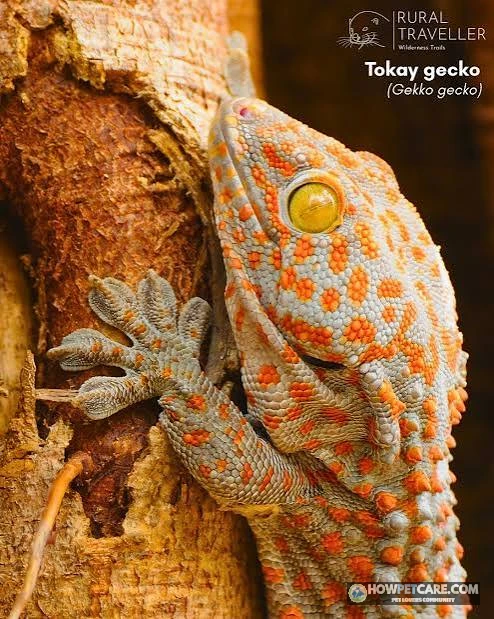

The Tokay gecko (Gekko gecko) is a large, arboreal lizard reaching 8 to 16 inches that requires an intermediate level of care. Thriving in a vertical vivarium with 60% to 80% humidity and basking temperatures of 88°F to 90°F, this vocal insectivore is best kept as a display animal due to its defensive temperament and powerful bite.
The Tokay gecko (Gekko gecko) ranks as the second-largest living gecko species in the world, combining striking slate-blue skin and vibrant orange spotting with an uncompromising, lightning-fast defensive drive. For intermediate reptile hobbyists, maintaining a tokay gecko pet requires shifting expectations away from hand-tame lizards like bearded dragons or leopard geckos. This arboreal insectivore demands specialized vertical microclimates, structured calcium supplementation, and a rigorous, hands-off handling protocol designed to manage an extraordinarily powerful defensive bite.
Tokay geckos are not recommended for novice reptile keepers. Their defensive aggression, biting capability, and strict humidity requirements make them an observation-only or display vivarium species for handlers with intermediate experience.
Tokay Gecko Essentials: Adult Size, Lifespan, and Distinguishing Physical Traits
Physical Dimensions
Male Tokay geckos reach an adult total length of 13 to 16 inches (35 to 40 cm), while females remain slightly more compact at 8 to 12 inches (20 to 30 cm). While standard body weights are rarely documented in baseline zoological records due to wide natural variations, mature specimens possess heavy, muscular bodies and broad, heart-shaped heads housing substantial jaw musculature. The tail is thick, banded, and semi-prehensile, functioning as both a fat-storage reservoir and an escape mechanism through caudal autotomy. If dropped during a perceived predator attack, tail regeneration may become evident within approximately 3 weeks, though the replacement cartilage lacks the detailed banding and tuberculated texture of the original.
Longevity
A captive Tokay gecko lifespan averages roughly 10 years under standard terrarium conditions. However, in well-managed setups free from chronic dehydration and endoparasite loads, individuals may reach 15 years, with documented lifespans extending up to 20 years. Sustained longevity depends heavily on high humidity cyclicity, gut-loaded prey, and minimizing handling-induced stress.
Key Identification Features
Beyond their bright orange-red spotting and powdery blue base coloration, Gekko gecko features specialized physical adaptations for an arboreal, nocturnal lifestyle:
- Subdigital Lamellae: Microscopic setae on expanded toe pads generate van der Waals forces, creating an adhesive grip reported as capable of supporting up to 450 pounds (204 kg) across their collective surface area.
- Parietal Eye: A primitive, translucent photoreceptive "third eye" on the crown of the head detects subtle shifts in light, regulating circadian rhythms and seasonal hormone cycles.
- Lateral Skin Folds: Loose dermal flaps running along the lower flanks flatten against tree trunks, reducing shadows and helping conceal the gecko against tree bark.
- Nocturnal Vocalization: Males defend territory and attract mates with a loud, two-tone bark phonetically rendered as "to-kay!" or "gek-ko!"

Exact Microclimate Requirements: Temperature, Humidity, and Vertical Enclosure Specs
Terrarium Size & Structure
Because Tokay geckos are strictly arboreal, vertical height takes absolute priority over floor footprint. A single adult requires an arboreal terrarium measuring at least 18" L × 18" W × 36" H (45 × 45 × 90 cm). While a baseline pair can technically survive in a 25-gallon tall volume, a 36-inch vertical clearance is necessary to establish functional thermoregulation and secure retreat zones. Build the interior with vertically mounted cork bark rounds, hollow bamboo poles, and heavy branches. Tokays spend daytime hours wedged tightly inside hollow vertical trunks, emerging only after dark.

Temperature Gradient
Establish a daytime ambient temperature of 78 to 85°F (25.5 to 29.4°C) throughout the middle and lower zones. At the top of the enclosure, position an overhead radiant heat panel or a ceramic heat emitter to generate a focused basking spot temperature of 88 to 90°F (31 to 32°C). At night, turn off all daytime basking elements to permit an ambient thermal drop down to 70 to 75°F (21 to 24°C). Avoid colored nighttime incandescent bulbs; nocturnal geckos perceive visible light spectrums, which disrupts their natural hunting rhythms.
Top (≈36ʺ) – Basking Perch
  • Temp: 88‑90°F (31‑32°C)
  • Relative Humidity: 60‑70%
  • Fixtures: Low-intensity UVB (e.g., Zoo Med ReptiSun 5.0) and ceramic heat emitter

Mid (≈24ʺ) – Ambient Hide
  • Temp: 78‑85°F (25.5‑29.4°C)
  • Relative Humidity: 70‑80%
  • Structure: Vertical cork slabs, dense foliage, secure sleeping hollows

Bottom (≈12ʺ) – Moisture Zone
  • Temp: 70‑75°F (21‑24°C)
  • Relative Humidity: 80‑90% (night peak)
  • Structure: Bioactive soil blend, damp leaf litter, drainage layer
Humidity Management
Maintain baseline daytime relative humidity levels between 60% and 80%, allowing a cyclical spike to 85%–90% at night. In captive environments, Tokay geckos often prefer to lap hanging water droplets sprayed across leaves, cork bark, and enclosure walls, although clean drinking water should remain available. Mist the vivarium thoroughly each evening using an automated misting system or a manual pressure sprayer. Use a deep, bioactive moisture-retentive substrate—such as coconut fiber blended with cypress mulch and sphagnum moss topped with live oak leaf litter—over an expanded clay drainage layer.

| Parameter | Daytime Range | Nighttime Range | Notes |
|---|---|---|---|
| Ambient Temperature | 78–85°F (25.5–29.4°C) | 70–75°F (21–24°C) | Measure via digital probes at mid-level |
| Basking Spot | 88–90°F (31–32°C) | Off (Ambient drop) | Ceramic heat emitter or radiant panel |
| Relative Humidity | 60–80% | 85–90% | Evening misting sustains overnight spike |
| Photoperiod | 12 Hours On | 12 Hours Off | Standard seasonal cycle |
Feeding Protocol: Insectivore Diet, Gut-Loading, and Calcium/D3 Supplementation
Insect Selection
Tokay geckos are aggressive, opportunistic predators. Their captive diet must consist of appropriately sized live feeder insects, primarily banded crickets, dubia roaches (Blaptica dubia), and hornworms. Supplement occasionally with black-kneed mealworms or superworms. Never feed prey larger than the width between the gecko’s eyes to prevent choking or regurgitation. While wild Tokays occasionally ingest small vertebrates, avoid feeding pinky mice in captivity; mammalian fats place unnecessary stress on the gecko’s liver.
Gut-Loading & Dusting
Feeder insects purchased from commercial distributors may be nutritionally inadequate without preparation. Before offering insects to your gecko, gut-load them for 2 to 3 days using a high-calcium, nutrient-rich diet of dark leafy greens (collard, mustard, turnip), squash, carrots, and commercial grain-based gut-loading diets.
Dust feeder insects systematically to balance the natural inverted calcium-to-phosphorus ratio of captive insects. Because this nocturnal gecko has limited natural UVB exposure, dietary cholecalciferol and appropriate low-output UVB can support calcium metabolism, but excess D3 should be avoided. Provide a balanced rotation of pure calcium carbonate and calcium powder with D3:
| Day | Insect(s) Fed | Gut-Load (48–72h) | Dusting Supplement |
|---|---|---|---|
| Monday | 8–10 Crickets | Greens, carrots, grain mash | Calcium with D3 |
| Wednesday | 6–8 Dubia roaches | Collard greens, squash | Pure Calcium (No D3) |
| Friday | 5–6 Hornworms or Crickets | High-calcium gut-load diet | Reptile Multivitamin |
| Weekend | Fasting / Rest | — | None |

Feeding Frequency
Offer food to juvenile Tokay geckos daily. Mature adults require feeding only 2 to 3 times per week, during the early evening hours just after the enclosure lights cycle off. Avoid leaving uneaten crickets loose in the terrarium overnight, as roaming insects may chew on the gecko’s soft tissues while it rests.
When Bites Happen: Bite Severity, Venom Myth, and Trauma-Informed Release Protocol
Bite Physiology
A common misconception is that the Tokay gecko is venomous. The Tokay gecko possesses no venom glands; its bite delivers no toxins. However, its mechanical bite force is exceptionally high for a lizard of its size and has been reported as exceeding 200 psi. Its massive pterygoid and jaw-adductor muscles anchor rows of fine, needle-sharp pleurodont teeth. When defensive, a Tokay may clamp down, twist its body, and maintain its grip rather than nip and retreat. This pressure can produce deep lacerations, crushed soft tissue, and persistent bleeding.
Never attempt to yank, pull, or pry a locked Tokay gecko off your flesh using force. Pulling tears human skin and frequently fractures the gecko’s delicate quadrate bone or lower jaw.
Safe Release Techniques
When an adult Tokay locks onto a finger or hand, keepers must execute a calm, step-by-step de-escalation protocol to release the mechanical lock without inflicting skeletal trauma on the lizard.

-
Step 1: Lower the Gecko to a Flat Surface
Immediately stop moving and lower your hand inside the enclosure or onto a flat table, allowing all four of the gecko’s feet to make firm contact with the substrate. Tokay geckos clamp down harder when suspended mid-air; feeling a solid surface beneath their feet may prompt them to disengage and prepare to run.
-
Step 2: Apply Lukewarm Water Stimulation
If the lizard refuses to release within 30 seconds, direct a gentle trickle of lukewarm tap water across the outside of the gecko’s snout for 5 to 10 seconds, taking care not to force water into its nostrils or mouth. Keep supporting its body and allow it to release voluntarily.
-
Step 3: Utilize Mild Chemical Stimulation
Do not apply 5% apple cider vinegar, food-grade grain alcohol, or other chemicals to the gecko’s lips, nostrils, or mouth; these substances can irritate sensitive tissue or be aspirated. If supported positioning and water fail, keep the lizard stable, avoid prying its jaws, and have another person contact an emergency veterinarian for guidance.
-
Step 4: Guide the Head Away
As soon as the jaws open, slide your hand backward and away in one smooth, deliberate motion. Place a piece of cork bark or a plastic capture container directly between your hand and the lizard to prevent a secondary lunge.
Post-Bite Care
Wash the wound thoroughly with soap and warm running water for a minimum of 5 minutes. The oral cavity of Gekko gecko may harbor opportunistic bacteria, including Pseudomonas and Salmonella. Treat the puncture wounds with a topical antiseptic, cover with a sterile bandage, and seek medical attention for a deep wound or if localized swelling, heat, throbbing, or red streaking occurs.
Captive-Bred vs Wild-Caught: Identification, Health Implications, and Parasite Management
Identification Checklist
The majority of commercially available Tokay geckos have historically been wild-caught (WC) imports shipped from Southeast Asia. For long-term success, intermediate keepers should prioritize captive-bred (CB) specimens produced by domestic breeders. Wild-caught animals commonly carry greater physiological stress and parasite risk, while captive-bred animals generally acclimate more readily. Appearance alone cannot prove origin, so obtain breeder records or import documentation rather than relying only on the traits below.
| Attribute | Captive-Bred (CB) | Wild-Caught (WC) |
|---|---|---|
| Body Condition | Often plump, rounded tail base, clear skin, intact snout | May be emaciated, with visible ribs or rostral rub injuries from shipping crates |
| Tail & Digits | Often an original tail with clean bands and intact toe pads | May have a regenerated or dropped tail or missing toe claws from shedding issues |
| Parasite Burden | Usually lower when responsibly bred and screened | Greater risk of lungworms, flagellates, and nematodes |
| Acclimation | More likely to accept tongs and cup feeding | May refuse food for weeks and suffer transport dehydration |
| Temperament | Defensive initially, but may habituate to calm presence | Often highly defensive, with persistent lunging and territorial stress |

Quarantine & Health Screening
Every newly acquired Tokay gecko requires an isolated quarantine enclosure for at least 60 days. House the animal on plain paper towels with minimalist, easily sanitized PVC perches and plastic hides. Collect fresh fecal samples within the first 72 hours, at day 14, and at day 30 for veterinary fecal flotation and direct smear analysis. Wild-caught imports have a higher likelihood of requiring treatment with veterinary-prescribed anthelmintics (such as fenbendazole) or antiprotozoals (such as metronidazole), but medication should follow examination and diagnostic testing rather than presumptive dosing.

Impact on Temperament
While captive-bred geckos still retain their natural defensive instincts, they are generally more adaptable. Through hands-off habituation and target-feeding using 12-inch rubber-tipped feeding tongs, captive-bred individuals may learn that human hands outside the enclosure do not represent a predatory threat. Wild-caught adults are less likely to abandon their fight-or-flight defensive response and may remain prone to biting throughout their lives.
Legal Landscape: CITES Appendix II, U.S. State Regulations, and Permit Requirements
International Trade Rules
Historically, millions of wild Tokay geckos were harvested from Southeast Asian forests annually to supply traditional medicine markets and unsubstantiated folk cures. In late 2019, the species officially received international trade protection under CITES Appendix II. Under this listing, international commercial importation, export, and re-export of Tokay geckos require CITES documentation demonstrating that specimens were legally obtained and that authorized trade does not threaten wild populations.
When acquiring a Tokay gecko, request written proof of captive breeding or legitimate import documentation from the seller. International trade without valid CITES compliance can lead to regulatory penalties under wildlife trade laws.
U.S. State Specifics
Because Tokay geckos can adapt to subtropical and tropical ecosystems, regional authorities may impose biosecurity and invasive species regulations to prevent escapes, establishment, and ecological harm:
- Florida: The Florida Fish and Wildlife Conservation Commission (FWC) monitors non-native Tokay geckos. While breeding and possession rules are subject to evolving non-native species lists, keepers must verify current containment and permitting rules before purchasing, as naturalized breeding populations exist in southern counties.
- Hawaii: Hawaii strictly regulates the importation and possession of Gekko gecko under state biosecurity laws. Unauthorized introduction may carry felony penalties, steep fines, and mandatory animal seizure; prospective keepers must verify current rules directly with state authorities.
- California and Texas: Possession requirements can change with state and local wildlife rules. Keepers should confirm current regulations and maintain specimens in secure, escape-proof indoor enclosures.

Health Watchlist: Metabolic Bone Disease, Mouth Rot, and Dysecdysis – Early Detection & Prevention
MBD Checklist
Metabolic Bone Disease (MBD) results from insufficient calcium absorption, a severe calcium-to-phosphorus imbalance, or a lack of vitamin D3 synthesis. Because Tokays are nocturnal, keepers frequently make the critical mistake of omitting D3 or UVB lighting entirely. Look for these early clinical indicators:
- A flexible, "rubbery" lower jaw that bends when the gecko bites.
- Inability to climb glass walls or vertical branches due to muscular tremors.
- Kinks, bumps, or strange s-curves along the spine and tail base.
- Lethargy and an inability to snap the mouth fully shut.
Provide consistent dietary calcium dusting and install a low-output 5% to 6% UVB fluorescent fixture over the mesh top to help prevent MBD.
Mouth Rot Indicators
Infectious stomatitis (mouth rot) typically arises secondary to roach bites, rostral abrasions from rubbing against screen lids, or chronically suboptimal temperatures. Check the oral cavity for:
- Excess thick, stringy saliva or bubbling around the lips.
- Yellowish, cheese-like plaque or necrotic tissue along the gumline.
- Asymmetrical jaw swelling or teeth exposed while the mouth is closed.
Mouth rot requires immediate veterinary evaluation and may require debridement and topical or systemic antibiotic therapy; untreated stomatitis can erode the jawbone.
Dysecdysis Management
Dysecdysis (incomplete shedding) occurs more readily when ambient humidity drops below 60%. Retained shed on the toes is particularly hazardous: as dried skin contracts, it can cut off capillary circulation, causing the gecko’s toe tips and subdigital lamellae to necrose and fall off.
To help resolve retained shed without handling the gecko directly, place the lizard in a ventilated plastic container lined with warm, water-soaked paper towels for 15 to 20 minutes. The resulting 100% humidity chamber can soften the stuck skin, allowing the gecko to pull it off naturally as it moves against the paper towels. Seek reptile-veterinary help if constricting shed remains.

Cost & Setup Blueprint: Building a Tall Arboreal Bioactive Terrarium and Ongoing Expenses
Establishing an adult Tokay gecko terrarium requires a higher initial financial commitment than standard terrestrial lizard setups due to the vertical space and automated environmental controls required.
| Item | Cost Range (USD) | Notes |
|---|---|---|
| 18"×18"×36" Glass Arboreal Terrarium | $175 – $250 | Front-opening doors mandatory for low-stress servicing |
| Ceramic Heat Emitter & Thermostat | $60 – $90 | Digital pulse-proportional thermostat is critical |
| Low-Output UVB Fixture (T5 5.0) | $60 – $80 | Replaced every 12 months |
| Automated Misting System | $70 – $130 | Essential for maintaining cyclical relative humidity |
| Bioactive Substrate, Cork Bark & Plants | $75 – $110 | Virgin cork tubes, drainage layer, springtails, isopods |
| Captive-Bred Gecko Acquisition | $80 – $175 | Sourced directly from specialized captive breeders |
| Total Initial Investment | $520 – $835 | Estimated initial setup cost |

Ongoing maintenance expenses include live feeder insects ($25 to $40 monthly), vitamin and calcium supplements ($15 annually), and an estimated veterinary budget of $100 to $150 per year for routine fecal screenings. While DIY builds using sealed vertical plywood or converted aquarium frames can reduce upfront enclosure costs, reliable misting systems and securely mounted cork bark structures help maintain consistent microclimates.

Decision Matrix: Are You Ready for a Tokay Gecko? Action Checklist
Evaluate your readiness to keep a Tokay gecko using this objective assessment matrix. Score each statement from 0 (Does not apply) to 2 (Fully prepared and verified):
- Enclosure Preparedness (0–2): A fully cycled, vertical terrarium (minimum 36 inches high) is running with stable microclimates (78–85°F ambient, 60–80% humidity) verified by digital probes.
- Bite Management Confidence (0–2): You are completely comfortable working with a fast, defensive lizard and understand the safe de-escalation protocol without pulling away or dropping the animal.
- Handling Philosophy (0–2): You accept that the Tokay gecko is fundamentally an observation and vivarium display animal, not a pet to be held or carried around outside its cage.
- Feeding Logistics (0–2): You have immediate, continuous access to live feeder colonies (roaches, crickets) and are prepared to maintain a strict 48-hour gut-loading schedule.
- Legal & Veterinary Sourcing (0–2): You have identified a certified exotics veterinarian experienced with arboreal geckos and confirmed all local state biosecurity regulations.
Interpreting Your Score:
- 8 to 10 Points: You are prepared to house a captive-bred Tokay gecko safely and successfully.
- 5 to 7 Points: Address critical hardware, enclosure size, or feeding limitations before acquiring an animal.
- Under 5 Points: Reconsider your choice. A hardier, less defensive terrestrial species like a leopard gecko (Eublepharis macularius) or a more readily handled arboreal species like a crested gecko (Correlophus ciliatus) may be better suited to your current goals.
FAQ
How aggressive are Tokay geckos compared to other popular pet lizards?
Tokays are markedly more defensive than leopard geckos or bearded dragons; they will usually bite or hiss when approached, whereas most beginner-friendly species display passive or mildly shy behavior.
Are Tokay geckos nocturnal and does that affect feeding times?
Yes, Tokays are primarily nocturnal; feeding should therefore be scheduled for the early evening hours when the lights are dimmed to mimic their natural activity period.
Can a Tokay gecko be housed with other reptile species safely?
Because of their territorial and aggressive nature, Tokays should be kept solitary; co-habitation with other reptiles often leads to stress, injury, or fatal bites.
What is the best way to introduce a new Tokay gecko to an existing enclosure?
Quarantine the newcomer for at least 30 days in a separate, fully equipped tank, perform parasite screening, and only after clearing health checks consider a brief visual introduction without physical contact.