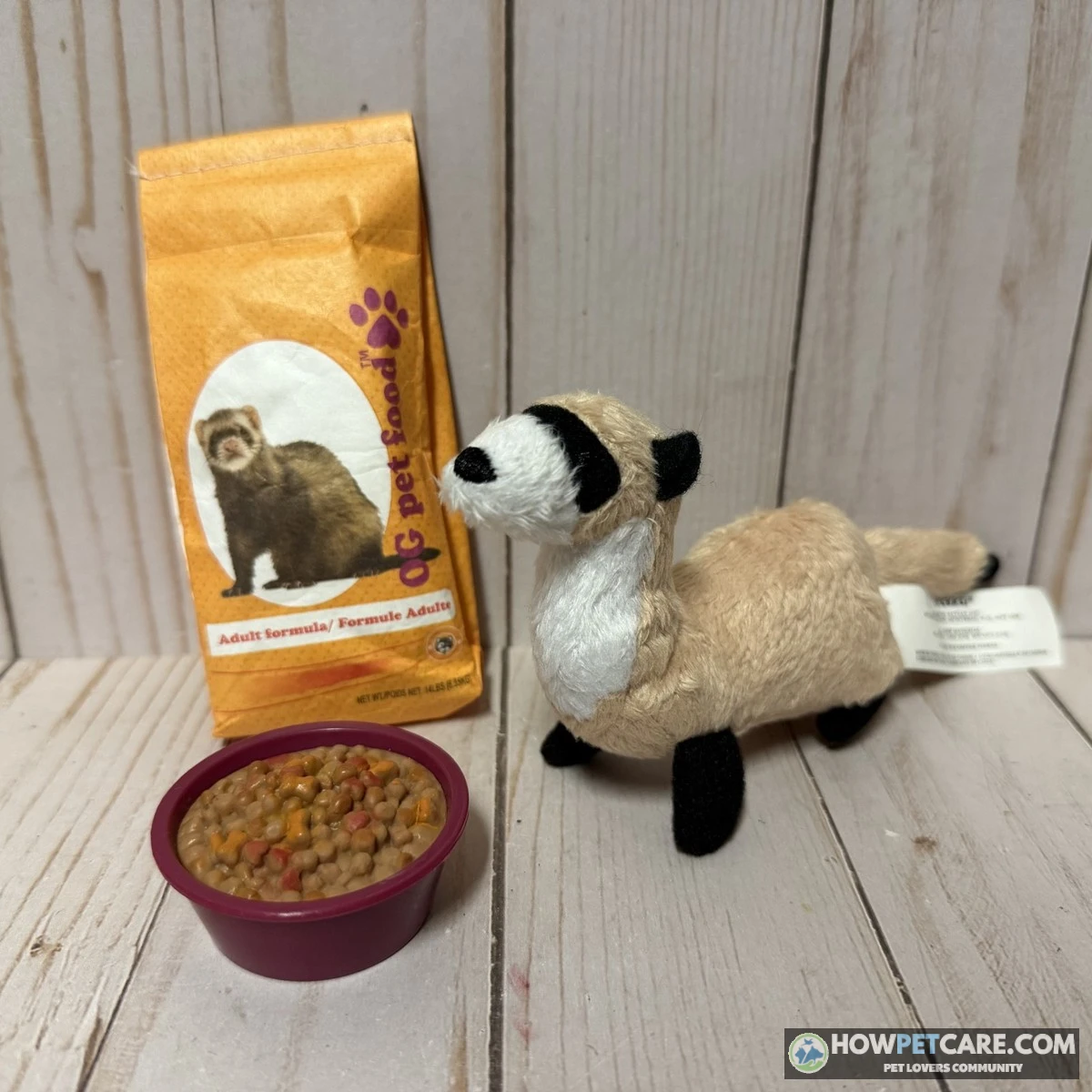

Ferrets should eat a complete, meat-based diet formulated for ferrets, such as complete ferret kibble or a properly balanced raw diet. Keep fresh water available at all times, offer measured meals or monitored portions, and give only small meat-based treats occasionally. Plain meat, fruit, vegetables, and dog food are not suitable staples.
What Ferrets Should Eat Every Day
Pet ferrets should eat a complete, meat-based diet formulated for ferrets. Because they are obligate carnivores, their everyday nutrition should come primarily from highly digestible animal protein and fat rather than grains, fruit, vegetables, or sugary foods. A complete ferret kibble is the most practical staple for many households. A commercially prepared raw diet labeled complete and balanced can also work, but plain raw meat alone does not make a complete ferret diet.
A ferret’s short digestive system moves animal-based food through quickly. That makes protein quality, fat, calorie density, and digestibility more important than a high percentage printed on the front of the bag. Ferrets generally do best with fresh water always available and their main food offered in several small meals or monitored free-choice portions.
The Everyday Diet at a Glance
A sensible daily ferret diet includes complete commercial ferret food as the staple, or a properly formulated complete raw diet, along with fresh water available at all times. Offer small, meat-based treats only occasionally, and avoid routine fruit, vegetables, sugary foods, dairy, or dog food. Monitor weight, body condition, appetite, stool, and drinking regularly.
Plain cooked poultry, a small amount of egg, mealworms, or a single-ingredient freeze-dried meat product can work as occasional treats, but they should not displace a complete food. Raw meat offered as a snack is not the same as a balanced raw diet; muscle meat by itself does not supply the correct balance of calcium, phosphorus, organs, vitamins, and trace nutrients.
What Do Ferrets Eat in the Wild?
Wild relatives eat whole prey rather than a bowl of muscle meat. Whole prey supplies muscle, organs, bones, fat, and other tissues together. That model explains why a ferret diet must be built around animal ingredients and why an improvised diet of chicken breast or hamburger is inadequate as a long-term staple.
The practical lesson is simple: imitate the nutritional completeness of prey, not merely its meat content. Commercial food achieves that through formulation; a raw diet must achieve it through a verified complete formula or professional recipe.

How to Read a Ferret Food Label
A package’s marketing language is not enough. Compare the nutritional-adequacy statement, guaranteed analysis, calorie information, feeding directions, and ingredient list together. No single line proves that a food is ideal.
Guaranteed-Analysis Targets
Many owner guides look for roughly 30–40% crude protein, 18–30% crude fat, and about 2–4% crude fiber or less on an as-fed label as a starting screening range. Traditional ferret nutrition guidance commonly cites 32–38% protein and 15–20% fat. These are screening ranges, not universal prescriptions: moisture level, calorie density, life-stage formulation, and the individual ferret all matter.
Check whether percentages are listed as-fed or dry-matter. As-fed numbers include the food’s moisture, so you cannot fairly compare percentages alone when one food is much wetter than another. A wet-food protein percentage may look lower while supplying a similar amount of protein once moisture is removed.
Look for:
- A nutritional-adequacy statement identifying ferrets and an appropriate life stage, such as growth, adult maintenance, or all life stages.
- Clearly stated calories in kcal/kg, kcal/cup, or kcal/gram.
- Protein and fat levels appropriate for a carnivorous, high-energy animal.
- Low fiber rather than a plant-heavy formula.
- Feeding directions that can be adjusted for body weight and condition.
- A statement that the product is complete and balanced, not a treat, topper, or supplemental food.

Carbohydrate is often not listed directly. You can make a rough estimate by subtracting protein, fat, fiber, moisture, and ash from 100%, but this estimate has limits: ash may be omitted, rounding affects the result, and labels may use different reporting conventions. Use it as a comparison tool, not as a laboratory result.
Ingredient-List Warning Signs
Ingredients are listed by pre-processing weight, so the first ingredient is not a guarantee of digestibility or overall quality. Still, the pattern is useful. Prefer clearly named animal proteins and fats near the beginning, such as chicken, turkey, lamb, or fish. Be cautious when plant proteins, peas, legumes, potatoes, tapioca, sweet potatoes, corn, wheat, soy, fruit, or vegetables dominate the early part of the list.
“Grain-free” does not mean carbohydrate-free. A grain-free formula may replace grains with peas, potatoes, legumes, or other starches. Likewise, a food can list meat first and still contain a substantial amount of plant material later in the formula.
Avoid treating unusual colors, multiple shapes, dried fruit, seeds, or nuts as evidence of quality. Uniform-looking ferret food without seeds, nuts, dried fruit, artificial colors, or varied pieces is a practical preference noted in traditional feeding guidance. The decisive question remains whether the complete nutrient profile fits the animal.

What a Label Cannot Tell You
A label cannot fully reveal digestibility, how an individual ferret responds, whether a picky ferret will eat the food consistently, or whether a medical condition changes the appropriate diet. It also cannot make a supplemental product complete. If your ferret has kidney disease, insulinoma, persistent gastrointestinal signs, dental trouble, or unexplained weight change, use an exotic-animal veterinarian rather than adjusting nutrients from a label alone.
Read the Bag in 60 Seconds
- ☐ The adequacy statement names ferrets and an appropriate life stage.
- ☐ A clearly named animal protein appears prominently.
- ☐ Protein is roughly 30–40% and fat roughly 18–30% as-fed, while recognizing individual and formulation differences.
- ☐ Fiber is low, ideally around 2–4% or less as-fed.
- ☐ Starchy plant ingredients are not prominent.
- ☐ Sugar, fruit, vegetables, corn, wheat, and soy are not prominent.
- ☐ Calories and feeding directions are provided.
- ☐ The food is complete and balanced.
A high protein number does not automatically mean high-quality ferret nutrition. Check the protein source, fat, fiber, calorie density, adequacy statement, and ingredient pattern together.
Can Ferrets Eat Cat Food or Kitten Food?
A ferret can eat some cat or kitten foods in an emergency, but neither package should be approved automatically. Many adult cat foods are not designed around a ferret’s needs and may provide too much fiber or carbohydrate or too little suitable animal fat. A high-quality kitten food is usually a more plausible short-term fallback because kitten formulas tend to be denser in calories, protein, and fat than adult cat food.
Use kitten food as a bridge during a brief supply interruption, not as a universal long-term answer. Seek veterinary guidance if it will be used for more than a short period or if the ferret is a kit, senior, pregnant, nursing, ill, or recovering from a medical problem.
When Kitten Food May Be a Temporary Option
Choose the closest label match you can find: complete food, high animal-protein content, low fiber, useful fat and calorie density, and no prominent sugar or starch-heavy ingredients. Introduce it gradually when possible. Do not assume that “premium,” “natural,” or “grain-free” means appropriate for ferrets.
| Factor | Complete ferret food | High-quality kitten food |
|---|---|---|
| Nutrient profile | Formulated for an obligate carnivore and the ferret’s intended life stage | Often protein-, fat-, and calorie-dense, but formulated for cats |
| Ingredient pattern | Animal proteins and fats should dominate; plant starches should stay low | May contain peas, potatoes, legumes, grains, or other starches |
| Completeness | Best default when labeled complete and balanced for ferrets | Temporary fallback; not automatically suitable long term |
| Best use case | Everyday staple for most healthy pet ferrets | Short-term bridge during a supply interruption |
| Main caution | Not every ferret food has the same formulation | Grain-free does not mean low-carbohydrate |

How to Compare Cat Food and Ferret Food
Put both packages side by side. Compare protein, fat, fiber, calories, moisture, adequacy wording, and the first several ingredients. A kitten food with better animal ingredients and lower fiber may be a better temporary option than an adult cat food, but it still does not become ferret food merely because it is calorie-dense.
Dog food is generally a poor substitute because many formulas are less concentrated in the animal protein and fat a ferret needs. If no appropriate food is available and your ferret is refusing food, contact an exotic-animal veterinarian rather than relying on a prolonged substitute.
How Often and How Much Should Ferrets Eat and Drink?
Ferrets normally eat multiple small meals. You can provide measured portions two to four times daily, or offer an appropriate dry food with monitored access if your ferret maintains a healthy body condition. Free-choice feeding is not truly “set it and forget it”: measure what goes into the bowl, check what remains, and track weight.
Meal Frequency for Kits, Adults, and Seniors
Kits need reliable access to food during growth and may require more frequent opportunities to eat. Do not deliberately restrict a growing kit without veterinary direction. Healthy adults can usually use a measured meal schedule or monitored access to dry food. Seniors need closer observation of weight, dental comfort, hydration, and appetite; age alone does not justify an automatic calorie reduction.
Never fast a ferret to force acceptance of a new food. Young, ill, or medically vulnerable ferrets may deteriorate quickly when intake falls.
Starting Calories and Portions by Body Weight
There is no single correct gram portion for every ferret. Sex, neuter status, activity, season, body condition, food energy density, and metabolism change the answer. Use the package’s calorie information and treat any calculation as a starting point.
For an illustration, assume an adult ferret needs an initial estimate of 60 kcal per pound per day and the food provides 4.0 kcal per gram:
- A 1.5-pound ferret: 1.5 × 60 = 90 kcal per day, or about 22.5 grams.
- A 2-pound ferret: 2 × 60 = 120 kcal per day, or about 30 grams.
- A 2.5-pound ferret: 2.5 × 60 = 150 kcal per day, or about 37.5 grams.
- A 3-pound ferret: 3 × 60 = 180 kcal per day, or about 45 grams.

These are examples, not veterinary prescriptions. If a cup holds about 120 grams, 30 grams is approximately one-quarter cup. Recalculate using your own food’s kcal/cup or kcal/gram rather than copying this volume.
A practical formula is: daily food grams equals estimated daily calories divided by kcal per gram. If the bag provides only kcal/kg, divide that number by 1,000 to obtain kcal per gram. Weighing kibble with a kitchen scale is more reliable than estimating by eye.
Daily Water Monitoring
Keep fresh water available continuously. A useful monitoring benchmark for a healthy ferret is roughly 50–100 milliliters per kilogram of body weight per day, including water obtained from food, but this is not a guaranteed minimum requirement. Wet or raw food can reduce visible bowl drinking, while heat, activity, illness, and diet composition can change intake.
For a 2-pound ferret, that broad reference equals approximately 45–90 milliliters per day, with some water coming from food. Treat it as a trend-monitoring aid, not a target that should be forced. Offer a heavy bowl that is difficult to tip; retain a bottle if your ferret reliably uses one, and check that the nozzle works. Measure refills consistently for several days so you know what is normal for that individual.

Markedly increased drinking, very little urine, dry or tacky gums, weakness, unusual sleepiness, vomiting, or refusal to eat warrants veterinary advice. Do not try to correct suspected dehydration with home treatment alone.
Adjusting Food by Weight and Body Condition
Weigh your ferret weekly on the same scale and, when possible, at a similar time. Look for a stable trend, a smooth body outline, and a body condition that your veterinarian considers healthy. A small seasonal change may occur, but rapid or substantial loss or gain deserves attention.
If weight rises while body condition becomes excessive, reduce the measured daily amount modestly and reassess after one to two weeks. If weight falls, appetite changes, or the ferret feels thin, do not simply add treats; contact a veterinarian. Dental pain, gastrointestinal disease, endocrine disease, and other problems can first appear as feeding or weight changes.
Safe Treats, Unsuitable Foods, and Immediate Hazards
Treats should be tiny, meat-based, and a small share of daily calories. Appropriate choices can include plain cooked poultry, a suitable freeze-dried meat treat, or an occasional small amount of egg. Avoid seasoning, sauces, onion, garlic, and added sugar.
Appropriate Meat-Based Treats
Use treats to reward behavior, not to replace meals. Introduce one new item at a time and watch stool and appetite. A single-ingredient freeze-dried meat product is a treat unless its label explicitly says it is complete and balanced. Mealworms may be offered occasionally if tolerated, but they are not a complete staple.

Toxic Foods Versus Poor Nutritional Choices
Fruit and vegetables are not recommended as routine ferret foods. They are not necessarily toxic in the same way as certain poisonings, but their sugar, fiber, and carbohydrate content make them a poor nutritional fit. Dairy may cause digestive upset, and sugary foods add calories without appropriate nutrition.
| Food or item | Category | Serving guidance | Primary risk | Action after exposure |
|---|---|---|---|---|
| Complete ferret food | Everyday staple | Main diet according to label and body condition | Imbalance if not complete | Monitor normally |
| Plain cooked poultry, egg, freeze-dried meat | Occasional treat | Tiny pieces only | Extra calories or imbalance if overfed | Stop excess treats and monitor |
| Raw meat | Treat only, not a complete diet | Small, infrequent portions from a safe source | Pathogens and nutrient imbalance | Monitor; discuss regular raw feeding with a veterinarian |
| Fruits and vegetables | Unsuitable | Do not feed routinely | Sugar, fiber, and carbohydrate load | Stop and monitor stool and appetite |
| Dairy and sugary foods | Unsuitable or high-risk | Avoid | Gastrointestinal upset and poor nutrition | Contact a veterinarian if signs develop |
| Chocolate, caffeine, alcohol, or xylitol products | Toxic or high-risk | None | Poisoning and potentially severe illness | Contact an exotic-animal veterinarian or animal poison service immediately |
| Onions, garlic, grapes, raisins | Toxic or high-risk | None | Toxicity | Seek prompt veterinary advice |
| Cooked bones, fibrous produce, oversized hard treats | Choking or obstruction risk | None | Choking, perforation, or intestinal blockage | Seek urgent advice, especially with vomiting, pain, or lethargy |

Choking and Intestinal-Obstruction Risks
Do not offer cooked bones, hard oversized pieces, rubbery toys, fibrous produce, or any item your ferret can swallow whole. If your ferret is gagging, repeatedly vomiting, pawing at the mouth, showing abdominal pain, becoming lethargic, or unable to keep food or water down, treat it as urgent. Do not wait for symptoms after a known toxic exposure.
Chocolate and xylitol products require poison guidance. Fruit, vegetables, and dairy may instead be nutritionally unsuitable or irritating. Both categories deserve avoidance, but the response after exposure depends on the item and amount.
How to Transition a Picky Ferret to New Food
Food-imprinted ferrets may reject an unfamiliar shape, smell, or texture. Begin before the old food runs out, and never use hunger to force acceptance.
A Step-by-Step Transition Schedule
- Record baseline weight, usual intake, stool, hydration, energy, and the old food.
- During week 1, mix 75% old food with 25% new food.
- During week 2, move to 50% old and 50% new if intake and stool remain normal.
- During week 3, move to 25% old and 75% new.
- During week 4, offer 100% new food if the ferret is eating well and stools are normal.
- For a reluctant ferret, hold each ratio for another one to two weeks before advancing.
- Mix thoroughly so the ferret cannot selectively remove every new piece.
- If needed, match the old food’s shape and texture before changing other features.

Some transitions take four to eight weeks. A ferret that eats less but continues eating may need a slower schedule. If intake falls, return to the last ratio that worked and contact your veterinarian if the problem continues.
The Daily Appetite, Stool, and Weight Tracker
Record food offered, food remaining, treats, stool consistency, vomiting, activity, water intake, and weight. This turns a vague concern into information a veterinarian can use. Keep the food’s package or photograph its label, including calories and ingredients.
When to Pause or Call a Veterinarian
Pause the transition and return to the prior ratio for reduced but ongoing intake or persistent loose stool. Seek prompt veterinary care for refusal to eat, repeated vomiting, marked lethargy, dehydration, black or bloody stool, rapid weight loss, severe diarrhea, abdominal pain, or difficulty swallowing. A ferret that stops eating should not be watched at home for an extended period.
Complete Kibble Versus a Balanced Raw Diet
Both methods can work when nutritionally complete and safely managed. Kibble is convenient and easy to measure. Commercial raw can provide a moisture-rich option and may suit some households, but it requires cold storage, sanitation, thawing, and careful waste control.
Nutrition and Completeness
A balanced raw diet must contain the correct proportions of muscle meat, organs, bone or a properly formulated mineral source, fat, vitamins, and trace nutrients. Plain chicken, ground beef, eggs, or a pile of supplements is not a verified diet. Calcium, phosphorus, taurine, vitamins, and trace minerals can be deficient or excessive when a recipe is improvised.
Choose a commercial raw product explicitly labeled complete and balanced for the relevant life stage, or use a recipe formulated for ferrets by a board-certified veterinary nutritionist. Do not copy an unverified online recipe.

Monthly Food and Household Costs
Prices vary by region and change frequently, so the following is an illustrative U.S. budget model for 2026 rather than a price quote. Assume one healthy 2-pound adult, 120 kcal per day, 3,600 kcal per 30-day month, and no medical diet.
| Cost or practical factor | Complete kibble | Commercially prepared balanced raw | How to calculate or evaluate |
|---|---|---|---|
| Food energy needed | 3,600 kcal/month | 3,600 kcal/month | Daily calories × 30 |
| Example food cost | About $15–$35/month | About $45–$100/month | Use current package price and kcal/package |
| Packaging and waste | Usually low | Often higher from thawed leftovers and damaged portions | Add discarded food and unusable portions |
| Storage | Pantry container | Freezer space, sealed containers, refrigerator thawing | Include containers and freezer capacity |
| Cleaning supplies | Low to moderate | Moderate to high | Include disinfectant, gloves, and washable tools |
| Time | Scoop, measure, wash bowl | Portion, thaw, sanitize, discard promptly | Count preparation and cleanup time |
| Shipping or delivery | Sometimes unnecessary | May be significant for frozen food | Add delivery fees and minimum orders |

To calculate a real budget, divide the monthly calorie requirement by the food’s kcal per package, round up to whole packages, multiply by the current price, and add waste and practical supplies. A multi-ferret household may lower the cost per serving but increase storage and sanitation demands.
Storage, Sanitation, and Time
Kibble needs a clean, sealed container and should be protected from heat and moisture. Raw food needs reliable refrigeration or freezing, separate preparation surfaces, prompt cleanup, and strict attention to serving windows. It may be a poor fit for a household with limited freezer space or people at increased risk from foodborne pathogens, including young children or immunocompromised individuals.
Neither diet is automatically best. The best choice is the complete diet your ferret eats consistently and your household can store, measure, and handle safely.
Build Your Ferret’s Feeding Plan
Use this five-minute food check before choosing or changing a staple:
- Confirm that the food is complete and balanced for ferrets and the appropriate life stage.
- Record protein, fat, fiber, moisture, ash if listed, and calories.
- Inspect the first several ingredients for named animal sources and prominent starches.
- Calculate a starting daily amount from body weight and the food’s calorie density.
- Decide whether measured meals or monitored access fits your ferret and household.
- Provide fresh water continuously and reserve only a small calorie share for treats.
For a 2-pound adult using the illustrative 120-kcal daily starting point, a 4-kcal-per-gram food begins at about 30 grams daily. Split that amount into two to four meals or monitor it as a measured daily allowance. Adjust only after observing weekly weight and body condition.
Keep a simple weekly record:
- Body weight and hands-on body condition.
- Food offered, remaining, and rejected.
- Stool consistency and vomiting.
- Water intake or refill changes.
- Energy, activity, and ease of eating.
- Any new treats, food, medication, or environmental change.
Reassess portions after two to four weeks and after a change in season, activity, health, or food. Contact an exotic-animal veterinarian for unexplained weight loss, persistent digestive changes, abnormal thirst, difficulty eating, rapid weight change, or a ferret that stops eating. Bring the food label and your intake log to the appointment.
A defensible ferret feeding plan is not built from one magic percentage or a single brand name. It is built from a complete animal-based staple, measured portions, constant access to water, restrained treats, safe transitions, and regular observation of the individual ferret.

| Food or Item | Category | Serving Guidance | Primary Risk | Action After Exposure |
|---|---|---|---|---|
| Complete ferret food | Everyday staple | Main diet according to label and body condition | Imbalance if not complete | Monitor normally |
| Plain cooked poultry, egg, freeze-dried meat | Occasional treat | Tiny pieces only | Extra calories or imbalance if overfed | Stop excess treats and monitor |
| Raw meat | Treat only | Small, infrequent portions from a safe source | Pathogens and nutrient imbalance | Monitor; discuss regular raw feeding with a veterinarian |
| Fruits and vegetables | Unsuitable | Do not feed routinely | Sugar, fiber, and carbohydrate load | Stop and monitor stool and appetite |
| Dairy and sugary foods | Unsuitable | Avoid | Gastrointestinal upset and poor nutrition | Contact a veterinarian if signs develop |
| Chocolate, caffeine, alcohol, or xylitol products | High-risk hazard | None | Poisoning and potentially severe illness | Contact an exotic-animal veterinarian or animal poison service immediately |
| Onions, garlic, grapes, raisins | High-risk hazard | None | Toxicity | Seek prompt veterinary advice |
| Cooked bones, fibrous produce, oversized hard treats | High-risk hazard | None | Choking, perforation, or intestinal blockage | Seek urgent advice, especially with vomiting, pain, or lethargy |
FAQ
Do ferrets need vitamin or taurine supplements?
A healthy ferret eating a complete and balanced diet usually does not need routine supplements. Adding vitamins, minerals, calcium, or taurine without veterinary guidance can unbalance the diet or cause harmful excesses.
Is freeze-dried raw food suitable for ferrets?
It can be suitable only if the product is labeled as a complete diet with an appropriate nutrient profile; single-ingredient freeze-dried meat is a treat, not a staple. Rehydrate it as directed and follow safe handling instructions.
Why does my ferret eat more or change weight in winter?
Ferrets can show seasonal changes in appetite, coat, activity, and body weight. Track the trend and body condition, but consult an exotic-animal veterinarian if the change is rapid, substantial, or accompanied by lethargy, vomiting, diarrhea, or altered thirst.
Should food be withheld before a veterinary appointment?
Do not fast a ferret unless the veterinary team gives specific instructions for that appointment or procedure. Ferrets have fast metabolisms, and fasting can be risky, especially for young, ill, or insulinoma-prone animals.