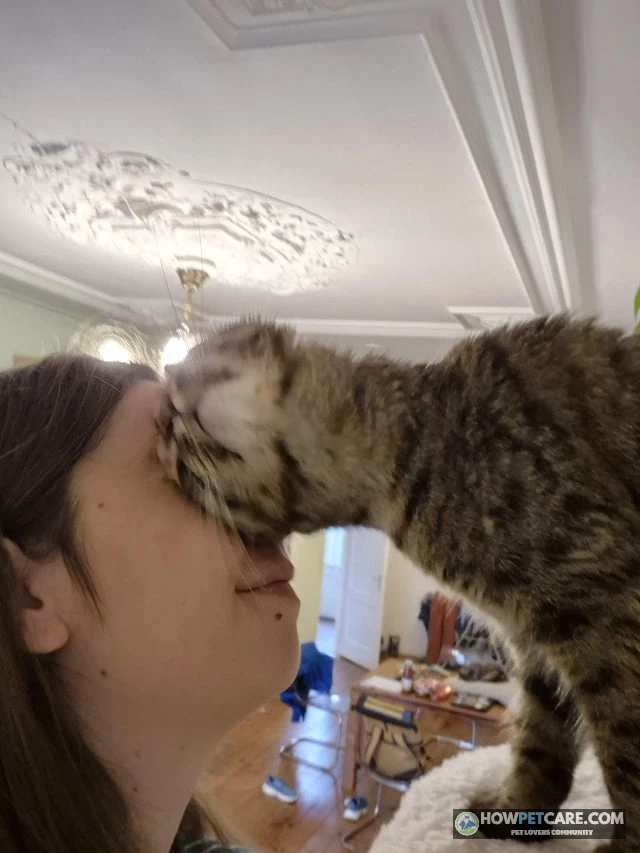

A cat headbutt — called bunting — usually combines several friendly messages:
- A greeting or social check-in, often when you come home or wake up
- Scent marking: facial pheromones label you as safe and familiar
- Bonding: the cat treats you as part of its social group
- A request for attention, petting, or food
- Rarely, a warning sign: persistent head pressing against walls or objects needs a vet
If you’re wondering "why does my cat headbutt me," the answer is most likely bunting: normal feline communication that can combine a greeting, social bonding, scent marking, and a request for attention. When your cat bumps its forehead or cheek against your hand, leg, or face, it isn’t making a dominance move or claiming you like a piece of furniture.
Cats have scent glands around their cheeks, chin, and forehead. Rubbing those areas on you transfers facial pheromones, chemical signals that other cats detect through scent. Researchers describe these pheromones as helping cats mark people, other animals, and objects as safe and familiar, though humans can’t read the chemistry like a written message. A headbutt usually means your cat sees you as part of its social group. Your cat may be saying hello after you come home, inviting you to stroke its cheeks, or asking you to notice it. Morning and sleep-time headbutts often relate to routine shifts toward feeding or interaction.
Why your cat headbutts you: a quick guide to bunting

Bunting is a social behavior. When a cat approaches you and makes brief head contact, it is usually combining several messages. The most common are a friendly greeting, a scent-marking gesture that mixes the cat’s odor with yours, an invitation to interact, and a low-pressure bid for attention. By depositing scent from glands in the face, cats also create a shared group smell that signals safety to them.
Facial pheromones aren’t a human-readable code with one fixed meaning. They’re chemical cues that influence how a cat perceives an environment. Saying a cat headbutts because it loves you is reasonable shorthand, but the behavior can also mean "I recognize you," "this is our shared space," or "pay attention to me now." It’s not proof of dominance, and cats vary widely in how affectionate they are. A cat that never headbutts may still be deeply bonded.
Read the force and context: gentle nudge, hard bump, or demand
Not all headbutts feel the same. A soft nudge during a relaxed greeting often invites contact. A firmer bump can reflect an individual cat’s style, excitement, urgency, or a learned way to get your attention. Force alone doesn’t diagnose mood; a hard bumper may simply be enthusiastic. Look to the surrounding body language to help interpret it.
Check posture, ears, tail, facial tension, vocalizing, and whether the cat can disengage. A cat bumping your hand may be requesting contact or steering your fingers toward its cheek. One bumping your phone or laptop may be targeting an accessible object, interrupting an attention barrier, or rubbing a familiar scent surface. Morning headbutts often serve as greetings or routine-based food requests. If your cat bumps you while you sleep and then meows or leads you to the kitchen, it’s likely connecting the bump to breakfast.
What a hard headbutt can—and cannot—tell you
A hard bump or repeated slamming is most often a demand for attention or food: a move the cat has learned works. It can also signal rising excitement that is about to tip into play. It doesn’t automatically mean aggression, anger, or dominance. Watch for meowing, pacing, staring at you, or a tail that starts to swish.
| What it feels like | Most likely meaning | Check these cues | Best response |
|---|---|---|---|
| Soft nudge, light cheek touch | Greeting or a polite invitation to interact | Relaxed body, upright tail, slow blinking, ears forward | Offer two or three cheek or chin strokes, then pause |
| Firm press held a beat longer | Scent marking or an insistent "notice me" | Purring, rubbing along your side, settling nearby | Pet briefly, then let the cat decide whether to continue |
| Hard bump or repeated slamming | Demand for attention or food; a learned "this works" move—or rising excitement | Meowing, pacing, staring at you, tail starting to swish | Give attention on your terms once calm; don’t reward frantic bumping instantly |
| Bump immediately followed by a nip | Request tipping into play or overstimulation | Tail flicking, ears rotating, skin rippling, body tensing | Stop contact calmly, withdraw your hand, give space |

Force varies between cats and contexts, so treat each interpretation as a possibility, not a certainty.
Why cats headbutt hands, faces, phones, and sleeping owners
Cats often target hands because hands are where petting happens. A headbutt to your palm may be an invitation or a way to redirect your hand toward the cheek. Faces are socially significant and carry strong scent, making them natural targets for a bonded cat. Phones and laptops are accessible objects that smell like you and sit between you and the cat. That can make them appealing scent targets or attention barriers.
Headbutting while you sleep usually follows the household routine. Your cat may be greeting you as wakefulness approaches, requesting breakfast, or seeking interaction as the day begins.
When a headbutt turns into a bite: spot overstimulation early

A headbutt followed by a bite can be a request that has shifted into play, frustration, or petting-induced aggression. The sequence doesn’t automatically mean the cat is spiteful. Often, the cat enjoys the contact at first, then reaches a threshold where continued petting feels irritating or overstimulating.
Watch for these pre-bite signals: a stiffening body, tail tip flicking or lashing, ears rotating sideways or flattening, skin rippling along the back, pupils widening, and the head turning toward your hand. Any one of these means the interaction is approaching its limit.
-
Scan for the warning cues while you pet
Pause at the first sign of the cues just listed—tail flicking, ears flattening, skin rippling, or the head turning toward your hand.
-
Freeze mid-stroke
Stop moving your hand where it is. Sudden withdrawal can trigger a chase-and-grab reflex, so keep the hand still for a second before slowly pulling away.
-
Break contact neutrally
Stand up or shift position if needed. No scolding, tapping, or pushing—the bite was communication, not spite, and punishment teaches the cat to skip warnings next time.
-
Give the cat space
Let the cat walk off, shake, or groom for a minute or two. That reset behavior means arousal is coming down.
-
Re-engage only if the cat reinitiates
If it rubs you again, try one or two strokes on the cheeks or chin, then pause and watch. Repeat in short rounds rather than one long session.
-
Note your cat’s personal stroke limit
If the bite consistently comes after roughly 30–60 seconds of petting, end sessions at 20–30 seconds next time, before the warning stage begins.
Punishment does not teach a cat to stop biting; it teaches the cat to skip the warning signals and bite sooner. End the interaction calmly instead.
Bunting versus head pressing: the signs that change the answer
Bunting and head pressing can look similar without context. Bunting is an intentional, usually brief social interaction: the cat approaches, rubs or bumps, then moves on or responds to people and surroundings. Head pressing is persistent, unusual pressure of the head against a wall, floor, or object, often while the cat stares blankly or sits motionless. It isn’t a harder version of a greeting, and it isn’t affection.
Suspected head pressing warrants prompt veterinary assessment, especially if you also notice circling, balance problems, seizures, vision changes, weakness, or altered responsiveness. Don’t diagnose from one behavior alone; describe what you observe and let a veterinarian evaluate it.
| Observable behavior | Typical context | What to do |
|---|---|---|
| Cat approaches and bumps your hand, face, or leg with cheek or forehead | Voluntary social contact — greeting, attention request, scent marking | Normal bunting. Offer a few cheek strokes or simply let the cat move on |
| Contact lasts a second or two, then the cat rubs along you or walks away | Part of a relaxed greeting sequence | Normal. The cat chooses to end it — that is the signature of social bunting |
| Cat presses its head against a wall, floor, or corner and holds it there | Not directed at you; cat may stare blankly or sit motionless | Call your vet the same day. Sustained head pressing against objects is not a harder version of a headbutt |
| Cat responds when you speak or move — looks at you, follows your hand | Alert, interactive, aware of surroundings | Reassuring sign. Responsive cats are communicating, not showing a neurological symptom |
| Cat seems disoriented, circles, wobbles, has a seizure, or does not react to you | Pressing behavior plus altered responsiveness, balance, or vision | Treat as urgent. Seek veterinary assessment promptly, or emergency care if signs are severe |
| New, constant, repetitive rubbing that the cat can’t seem to stop | May pair with scratching, ear shaking, or facial discomfort | Book a vet check within a few days. Video the behavior and note when it started |

Persistent head pressing against walls or objects is not a behavior problem you can manage at home. It can indicate a neurological issue, and a veterinarian should assess it promptly.
Headbutting people, other pets, and newcomers
Cats may bunt familiar people, strangers, other cats, or dogs. The target and surrounding body language matter. A cat approaching a stranger with a relaxed posture may be investigating or offering a greeting, but owners should let the cat choose whether to approach and avoid forcing contact. During new-pet introductions, bunting doesn’t guarantee that animals are comfortable or ready for direct contact. Keep introductions gradual and watch for avoidance, tension, or conflict.

A cat that rarely or never headbutts may still be bonded and comfortable. Some cats show social connection by sitting nearby, slow blinking, vocalizing, or grooming you instead.
Track changes in bunting and know when to call your vet
A change from your cat’s usual pattern matters more than any universal frequency. Note when the change began, what triggers it, and whether appetite, energy, mobility, grooming, or sociability also shifted.
A sudden increase may reflect a routine change or attention-seeking, but persistent, compulsive rubbing or new behavior paired with discomfort deserves veterinary advice. A sudden stop isn’t proof of illness by itself, but a change alongside withdrawal, pain signs, or other health changes warrants a checkup. For a concerning episode, record a short video and share the timeline and accompanying signs with the veterinarian.
My cat’s headbutting log
- Usual pattern: roughly times per day, mostly at (times/situations), usually aimed at ___ (hands/face/objects/other pets)
- Change first noticed on: ___ (date)
- What changed: more frequent / less frequent / stopped entirely / harder or more insistent / new target or context
- Possible triggers (routine change, new pet, schedule shift): ___
- Other changes in the same period: appetite / energy / grooming / litter box / sociability / mobility
- Does the cat seem uncomfortable (scratching, ear shaking, flinching when touched)? ___
- Video captured: yes / no
- Questions I want answered: ___

Your cat’s baseline matters more than a fixed number. More bumping alone is usually related to routine or attention; a sudden stop, compulsive nonstop rubbing, or any change paired with health warning signs is worth a checkup.
Respond safely: a quick checklist for your cat’s next headbutt
Use this sequence the next time your cat bumps you.
- ☐ 1. Check the context. Who initiated it? Did the cat approach you? What time is it, and what was the cat doing just before the bump?
- ☐ 2. Scan the body. Ears forward or slightly to the side, tail up or gently curved, loose posture, relaxed face = friendly signal. Tense body, swishing tail, dilated pupils = slow down.
- ☐ 3. Respond minimally. Offer a still hand for a sniff, or two or three gentle strokes on the cheeks or chin. Don’t go forehead-to-forehead or pick the cat up.
- ☐ 4. Pause and let the cat vote. Stop and watch: does it push back in for more, settle, or walk away? Reinitiating means continue briefly; walking away means done.
- ☐ 5. Watch for stop signals and red flags. Tail flicking, ear rotation, or skin rippling means end it now. Head pressed persistently against a wall or object—not at you—means call the vet.

Forehead-to-forehead reciprocation is usually unnecessary. Avoid it if either person or cat is unwell, the cat seems uncomfortable, or the interaction feels forced. A hand offered for sniffing is a safer alternative.
Seek veterinary help promptly for suspected head pressing or headbutting paired with neurological signs. Consult a vet for a persistent, unexplained behavior change. When in doubt, describe what you saw and let a professional decide whether an exam is needed.
1What primary purpose do facial pheromones serve when a cat bunts against a person or object?
Depositing facial pheromones transfers chemical signals that signal safety and social familiarity to the cat.
2What does a hard bump or repeated headbutting by a cat typically indicate?
Cats often repeat forceful bumps because they have learned that the behavior successfully attracts attention or food.
3Which set of body language cues indicates that a cat is becoming overstimulated during an interaction?
Flicking tails, rotating ears, and skin rippling are key indicators that physical contact is approaching an irritating threshold.
4If a cat shows signs of overstimulation while being petted, what is the recommended immediate response?
Pausing your movement avoids triggering a reactive grab while allowing the cat's arousal levels to settle.
5How does medical head pressing differ from normal social bunting?
Unlike interactive bunting, head pressing involves continuous, non-social pressure against inanimate surfaces and requires prompt medical care.
6Why do cats frequently target personal electronics like phones or laptops with headbutts?
Laptops and phones are accessible objects that smell like the owner and create a physical barrier to attention.
7Is a cat that never displays bunting behavior lacking a bond with its owner?
Cats vary in how affection is expressed; proximity, slow blinking, vocalizations, and grooming also signify strong bonds.
8What is considered the safest initial response when a cat approaches you to headbutt?
Extending a stationary hand allows the cat to guide the contact and choose whether to proceed.
9Which behavior scenario warrants immediate, same-day veterinary evaluation?
Continuous pressure against inanimate objects paired with disorientation is a medical warning sign requiring prompt evaluation.
10Why is physical or verbal punishment strongly discouraged if a cat bites following a headbutt?
Punishing a communication bite causes the cat to suppress subtle warning cues like ear rotation or tail flicking, increasing surprise bites later.
| Behavior Description | Likely Meaning | Body Language Cues | Recommended Action | Medical Red Flag (Inferred) |
|---|---|---|---|---|
| Soft nudge, light cheek touch | Greeting or a polite invitation to interact | Relaxed body, upright tail, slow blinking, ears forward | Offer two or three cheek or chin strokes, then pause | No (Normal social behavior) |
| Firm press held a beat longer | Scent marking or an insistent "notice me" | Purring, rubbing along your side, settling nearby | Pet briefly, then let the cat decide whether to continue | No (Normal social behavior) |
| Hard bump or repeated slamming | Demand for attention or food; a learned "this works" move—or rising excitement | Meowing, pacing, staring at you, tail starting to swish | Give attention on your terms once calm; don't reward frantic bumping instantly | No (Behavioral/attention-seeking behavior) |
| Bump immediately followed by a nip | Request tipping into play or overstimulation | Tail flicking, ears rotating, skin rippling, body tensing | Stop contact calmly, withdraw your hand, give space | No (Overstimulation/play behavior) |
| Cat presses its head against a wall, floor, or corner and holds it there | Sustained head pressing against objects; potentially a serious neurological or medical issue; not directed at you | Stare blankly or sit motionless | Call your vet the same day. Sustained head pressing against objects is not a harder version of a headbutt | Yes (Urgent medical red flag; potential neurological issue) |
| Cat responds when you speak or move — looks at you, follows your hand | Alert, interactive, aware of surroundings | Looks at you, follows your hand | Reassuring sign. Responsive cats are communicating, not showing a neurological symptom | No (Normal responsive behavior) |
| Cat seems disoriented, circles, wobbles, has a seizure, or does not react to you | Pressing behavior plus altered responsiveness, balance, or vision | Disoriented, circles, wobbles, has a seizure, or does not react to you | Treat as urgent. Seek veterinary assessment promptly, or emergency care if signs are severe | Yes (Urgent medical emergency) |
| New, constant, repetitive rubbing that the cat can't seem to stop | May pair with scratching, ear shaking, or facial discomfort; compulsive rubbing possibly linked to facial discomfort, ear issues, or skin irritation | Scratching, ear shaking, or facial discomfort | Book a vet check within a few days. Video the behavior and note when it started | Yes (Requires routine to prompt veterinary check) |
| Cat approaches and bumps your hand, face, or leg with cheek or forehead | Voluntary social contact — greeting, attention request, scent marking | Relaxed body language | Normal bunting. Offer a few cheek strokes or simply let the cat move on | No (Normal behavior) |
| Contact lasts a second or two, then the cat rubs along you or walks away | Part of a relaxed greeting sequence | Relaxed posture, cat chooses to end it | Normal. The cat chooses to end it — that is the signature of social bunting | No (Normal behavior) |
FAQ
Is it normal if my cat never headbutts me?
Yes. Cats differ in how they show social comfort; your cat may prefer sitting nearby, slow blinking, vocalizing, or other forms of contact.
Is cat headbutting a sign of affection?
It can be part of affectionate social bonding, but it can also be a greeting, scent-marking behavior, or a request for attention. Read the cat’s body language and what happens next.
Is it safe to headbutt my cat back?
It is safer to let your cat initiate contact and offer a hand to sniff or gentle cheek strokes instead. Do not press your face against a cat that seems uncomfortable, and avoid close contact if either of you is ill.
What is cat headbutting called?
The social rubbing or bumping of a cat’s head against a person or object is commonly called bunting. It differs from head pressing, which is persistent pressure against a surface and can signal a medical problem.