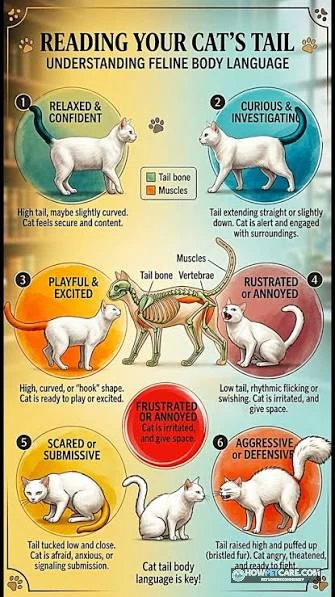

A cat’s tail offers useful clues, but only as part of whole-body body language. Upright relaxed tails often signal confidence, while tucked, puffed, or rapidly whipping tails can signal fear, uncertainty, or frustration. Check ears, eyes, posture, and context, then give space when cues conflict.
A cat’s tail offers a useful glimpse into feline body language, but it can’t tell you everything on its own. An upright, relaxed tail often signals confidence or a friendly greeting. A low, tucked, puffed, or rapidly whipping tail may point to fear, uncertainty, or rising frustration. Before approaching, playing, or backing off, check the tail alongside the cat’s ears, eyes, posture, vocalizations, and surroundings. Sudden or uneven movement, guarding, or signs of pain may point to a health problem. Contact a veterinarian rather than treating those changes as behavior alone.
Cat Tail Meanings at a Glance: Positions, Moods, and Safe Responses

Start by noticing the tail, then scan the rest of the body. A relaxed upright tail, forward ears, and loose posture often signal social interest. A tucked or puffed tail paired with flattened ears and wide pupils is a cue to give the cat room. Since each cat has a personal baseline, compare what you see with how your cat usually holds and moves its tail.
Quick-reference chart: tail position, likely mood, supporting cues, safest response
| Tail position or movement | Likely emotional state | Supporting body-language cues | Safest owner response |
|---|---|---|---|
| Upright, relaxed, slight curve | Friendly greeting or confidence | Loose body, forward ears, soft eyes, slow blinks | Approach sideways, let cat initiate contact |
| Low or tucked | Fear, uncertainty, or discomfort | Crouched posture, flattened ears, wide pupils, retreat | Stop approach, give space, remove pressure |
| Puffed or bottle-brush | High arousal, fear, or defensive aggression | Arched back, sideways stance, hissing or growling | Back away, do not touch, reduce triggers |
| Question-mark curve | Playful curiosity or social interest | Relaxed body, forward ears, loose tail base | Offer toy or gentle hand, watch for tension |
| Slow swish while focused | Hunting interest or mild irritation | Fixed gaze, still body, ears forward or slightly rotated | Pause handling, redirect with toy if needed |
| Rapid whip or thrash | Rising frustration or overstimulation | Stiff body, flattened ears, dilated pupils, tail base tension | Stop interaction immediately, let cat reset |
| Tip flick while resting | Alertness, low-level irritation, or restrained excitement | Eyes open, ears scanning, body mostly still | Observe first; avoid petting unless cat leans in |
| Wrapped around body while resting | Comfort, warmth, or self-protection | Soft posture, slow breathing, relaxed face | Leave cat alone unless it seeks interaction |

How to use the chart without treating one cue as a diagnosis
Treat the chart as a starting point, not a verdict. The same tail movement can mean different things in different situations: a slow swish during a laser-pointer game isn’t the same as one during petting. Look for clusters of cues, and choose the more cautious response when they don’t line up. An upright tail often goes with a happy, confident cat, but large pupils and a stiff body call for caution rather than a friendly approach.
Why Cats Wag, Swish, or Flick Their Tails
A cat’s tail helps with balance and communication. It contains roughly 19 to 23 vertebrae and makes up about 10% of the total bone count, allowing controlled movements that can signal what the cat is attending to; see how cats control their tails for the anatomy behind it. Speed, range, and intensity matter as much as position. Slow movement may reflect focus or mixed feelings; fast movement often signals rising arousal.
Slow swish versus rapid whip
A slow, side-to-side swish often means the cat is tracking something or feeling mildly conflicted. You might see it during hunting-style play, as the cat watches a toy or prey-like movement, or during petting as enjoyment shifts toward irritation. A rapid whip or thrash is a stronger warning: frustration or overstimulation is building, and the cat may bite, swat, or leave. Slow movement is a reason to watch; rapid movement means pause the interaction.

What a flicking tail tip means while lying down
A small flick of the tail tip while resting can signal alertness, mild irritation, or restrained excitement. The cat may be following a sound, reacting to a touch, or holding back a hunting response. If its body remains loose and its ears only swivel, the signal is likely mild. Faster flicks, flattened ears, or a stiffening body suggest irritation is escalating. A resting cat isn’t always fully relaxed; small movements can be an early warning.

Twitching, Swishing, Whipping, and Quivering: How to Tell Them Apart
People new to cat body language may use the same word for very different tail movements. Twitching is small and localized; swishing is broader and slower; whipping is fast and forceful; quivering is a rapid vertical shake of an upright tail. These movements can overlap in meaning, so check the cat’s pupils, ears, and body tension before responding.
Movement comparison table
| Movement | What it looks like | Likely meaning | What to do next |
|---|---|---|---|
| Twitching | Small, localized tail or tip movement | Focused attention, conflict, or restrained excitement | Observe; avoid adding stimulation |
| Slow swishing | Broad, slower side-to-side motion | Tracking, hunting interest, or mild irritation | Pause handling; redirect to a toy if needed |
| Rapid whipping | Fast, forceful, repeated side-to-side motion | Rising frustration, overstimulation, or defensive arousal | Stop interaction; give space |
| Upright quivering | Vertical shake of an upright tail | Excited greeting, or in some contexts marking-related arousal or stress | Read ears, posture, and situation; do not assume one meaning |

Common beginner mistakes when reading tail motion
The main mistake is treating tail movement by itself as a diagnosis. A flicking tip may mean alertness or annoyance. A wagging tail doesn’t automatically mean friendliness; rapid side-to-side movement in cats often signals agitation rather than happiness. It’s also easy to focus on the tail and miss flattened ears, wide pupils, or a stiff body. An upright tail doesn’t guarantee that a cat is comfortable if its posture is rigid and its pupils are large.
Playful or Escalating? A Decision Framework for Tail Movement
Instead of asking whether the tail is moving, look at whether the whole cat seems loose and engaged or tense and defensive. Playful arousal often comes with forward interest, relaxed ears, and a wiggly body. Flattened ears, dilated pupils, stiffness, retreat, or a rapidly whipping tail suggest escalation.
Green, yellow, and red response cues
Green cues mean you can continue carefully: ears forward or relaxed, pupils normal or only mildly dilated, claws sheathed, soft or chirping vocalizations, and a loose body leaning toward you. Yellow cues are a reason to pause and reassess: the tail speeds up, ears rotate, pupils widen, the body grows tense, or the cat shifts between interest and withdrawal. Red cues mean stop: flattened ears, dilated or fixed pupils, hissing or growling, a stiff or crouched posture, rapid whipping, a puffed tail, or any attempt to move away.

When to stop petting or playing
Stop if the tail speeds up as the body tenses, even when the cat still seems interested. Pause if a slow swish turns into a rapid whip, the tip flicks repeatedly and sharply, or the ears flatten. Direct play toward a toy, not your hands. Keep sessions short, then let the cat fully reset before trying again. Wait until its ears, pupils, posture, and tail soften.
Use this quick checkpoint before continuing petting or play. Answer each item Yes or No.
- Ears: Are they forward or relaxed? Yes = playful lean; No = flattened, rotated, or pinned.
- Pupils: Are they normal or only mildly dilated? Yes = playful lean; No = large, fixed, or rapidly changing.
- Claws: Are they sheathed? Yes = playful lean; No = extended or gripping.
- Vocalization: Is the cat silent, chirping, or trilling? Yes = playful lean; No = hissing, growling, or sharp yowling.
- Body posture: Is the body loose, wiggly, or leaning toward you? Yes = playful lean; No = stiff, crouched, frozen, or pulling away.
Decision rule:
- 5 Yes: Continue with hands off the tail and short sessions.
- 3-4 Yes with rising speed: Pause for 10 seconds; redirect to a toy if interest returns.
- 2 or fewer Yes, or any sudden switch to No: Stop interaction; give space and let the cat reset.
- If tail speed increases while body stiffens, treat it as escalating even if other cues are mixed.
Whole-Body Cat Communication: Tail Plus Ears, Eyes, Posture, and Voice
Tail cues make more sense when you read them with the rest of the cat’s body language. Ears can help distinguish curiosity from fear or aggression. Pupils add emotional context, posture shows whether the cat is approaching or preparing to flee, and vocalizations may signal contentment, distress, or a warning. The situation matters, too: feeding, grooming, vet visits, and introductions can all change how to read the same tail position.
Tail plus ears: the fastest mood check
Forward or relaxed ears often go with curiosity, confidence, or social interest. Flattened, rotated, or pinned ears may signal fear, irritation, or defensive arousal. If the tail is upright but the ears are back, don’t assume the cat is friendly. A low tail with forward ears and a loose body may indicate caution rather than fear. Checking these two cues together helps prevent common misreads.
Reading signals during petting, play, and introductions
During petting, a slow swish can mean the cat is still enjoying contact or starting to feel overstimulated. Pay attention to speed: a shift from slow to rapid movement is a common reason to stop. In play, tail movement may reflect hunting focus rather than anger, especially when the cat is crouched, staring, and ready to pounce. During introductions, a puffed tail, sideways stance, or arched back signals high arousal. Slow down and keep the exposure controlled rather than forcing contact.

Tail Meanings While Sitting, Lying Down, and Resting
A cat’s posture changes how its tail cues look. A tail wrapped around the body often signals comfort, warmth, or self-protection, particularly when the cat’s breathing is slow and its face is soft. A tail tucked under the body may point to fear, cold, or pain, especially if the cat is hunched or hiding. Changes in tail position during sleep or deep relaxation are usually normal. Still, read the whole body rather than relying on the tail alone.

Worked example: low, flicking tail while lying down
Observation: A cat lies on its side with its tail low and the tip flicking. Its ears swivel toward a hallway sound, its pupils are slightly dilated, and its body is otherwise loose.
Step-by-step reading:
- Tail cue: A low tail with a flicking tip suggests alertness or mild irritation, not full relaxation.
- Ears: Swiveling ears show the cat is tracking a sound and may be mildly on guard.
- Eyes: Slightly dilated pupils support the reading that the cat is paying close attention.
- Posture: A loose body suggests the cat isn’t yet defensive or preparing to flee.
- Context: An unfamiliar or repeated sound may quickly raise the cat’s arousal.
Response decision:
- Don’t start petting or pick up the cat.
- Pause and watch for 15-30 seconds.
- If the ears relax, pupils narrow, and tail stills, the cat may be settling; approach only if it turns toward you.
- If flicking speeds up, ears flatten, or the body stiffens, give the cat space and reduce noise or movement.
- If this happens daily around the same trigger, note the pattern and adjust the environment instead of pushing interaction.
Tailless, Bobtailed, Injured, and Long-Haired Cats: How Owners Can Compensate
Some cats don’t offer a clear tail signal. Tailless and bobtailed cats communicate through their ears, eyes, posture, and vocalizations. Learn each cat’s baseline, and don’t assume that a missing tail means a missing mood signal. Manx cats are a well-known example of tailless or short-tailed cats resulting from a genetic mutation, but cats vary, and breed descriptions aren’t guarantees. An injured cat may guard its tail, move it less, or react to touch. Long hair can obscure the tail’s shape; watch its base, the cat’s overall silhouette, and the direction of movement instead.

Compensating cues when the tail is hard to read
If the tail is absent, altered, injured, or hidden, scan the whole cat: ear direction, pupil size, body tension, weight distribution, vocalizations, and whether it approaches or retreats. A cat with no clear tail signal may still show fear by crouching, flattening its ears, and widening its pupils. Forward ears, soft eyes, and relaxed posture may suggest friendliness. Quiet observation is safer than forcing an interaction to test the cat’s response.
When a missing or altered tail changes the whole-body picture
A tail injury may lead a cat to guard its rear, avoid jumping, or react defensively to touch near the base. In a multi-cat household, signals may be harder to read when one cat has little or no tail. Watch ear flicks, body angles, and distance, not tail height alone. Kittens may have less refined tail control than adults, so age can affect how clearly they communicate with their tails.
Tail-Health Red Flags: When Tail Behavior May Mean Pain or Illness
Tail behavior can reflect pain, nerve problems, or injury, but it can’t diagnose a condition by itself. Seek veterinary advice for persistent unusual movement, loss of control, sudden asymmetry, guarding, flinching, or aggression when the tail is touched. Suspected spinal or nerve injury after trauma needs urgent care. Mild changes with no other symptoms may be routine concerns, especially if the cat is eating, moving, and using the litter box normally.
Urgent versus routine veterinary concerns
Urgent now: sudden loss of tail movement or control; a limp or dragging tail; obvious asymmetry; suspected spinal or nerve injury after a fall, bite, or trauma; severe signs of pain such as crying out, biting when touched, hiding, or refusing to move; or a tail that’s rapidly changing color, cold, or swollen. Prompt but not always emergency: unusual movement that lasts more than a day, repeated flinching or guarding, a new tail posture along with appetite, litter box, or mobility changes, or mild asymmetry with no trauma and no improvement over 24 hours. Routine monitoring: occasional tip flicking with no other behavior change, a resting tail position that differs from another cat’s baseline, or difficulty reading a long-haired or bobtailed cat’s tail shape when no other symptoms are present.
Red-flag checklist for owners
- ☐ Sudden loss of tail movement or control
- ☐ Tail hanging limp, dragging, or obviously asymmetric
- ☐ Suspected spinal or nerve injury after a fall, bite, or trauma
- ☐ Severe pain signs: crying out, biting when touched, hiding, or refusing to move
- ☐ Tail rapidly changing color, cold, or swollen
- ☐ Persistent abnormal tail movement lasting more than a day
- ☐ Repeated flinching, guarding, or aggression when the tail is touched
- ☐ New tail posture combined with appetite, litter box, or mobility changes
- ☐ Mild asymmetry with no trauma but no improvement over 24 hours
- ☐ Occasional tip flicking with no other behavior change
- ☐ Resting tail position that differs from another cat’s baseline
- ☐ Long-hair or bobtail-related difficulty reading tail shape without other symptoms

Don’t test or manipulate a painful or injured tail. Bring a short video and notes on timing, triggers, and other symptoms to the veterinary visit.
Check any item that applies. This timing guidance is conservative; call your veterinarian if you’re unsure.
Urgent now (same day or emergency care):
- ☐ Sudden loss of tail movement or control
- ☐ Tail hanging limp, dragging, or obviously asymmetric
- ☐ Suspected spinal or nerve injury after a fall, bite, or trauma
- ☐ Severe pain signs: crying out, biting when touched, hiding, or refusing to move
- ☐ Tail rapidly changing color, cold, or swollen
Prompt but not always emergency (contact within 24 hours):
- ☐ Persistent abnormal tail movement lasting more than a day
- ☐ Repeated flinching, guarding, or aggression when the tail is touched
- ☐ New tail posture combined with appetite, litter box, or mobility changes
- ☐ Mild asymmetry with no trauma but no improvement over 24 hours
Routine monitoring (mention at next appointment):
- ☐ Occasional tip flicking with no other behavior change
- ☐ Resting tail position that differs from another cat’s baseline
- ☐ Long-hair or bobtail-related difficulty reading tail shape without other symptoms
Important: Behavior alone can’t diagnose tail conditions. Bring a short video and notes on timing, triggers, and other symptoms to the veterinary visit.
Next Steps: A Safe Response Checklist for Cat Owners
Make tail reading part of how you approach your cat. Check the tail and whole body before moving closer, choose a response that fits the likely emotional state, and pause when signals escalate. Keep track of recurring patterns and triggers. If fear or aggression keeps returning, or you suspect pain, seek professional help.
Owner-response cheat sheet by tail signal
Choose a response for the signal you see. If the cues conflict, take the more cautious option.
- Upright, relaxed tail with soft body: Approach slowly from the side; offer a hand or toy; keep sessions short.
- Question-mark tail with forward interest: Redirect to interactive play; avoid grabbing; let the cat choose contact.
- Low, tucked, or wrapped tail: Pause; reduce eye contact; give an escape route; do not follow or corner.
- Slow swish during focused staring: Stop petting; move the toy or target away; let the cat blink and reset.
- Rapid whip, puffed tail, or stiff body: Back off entirely; remove hands, toys, and pressure; wait for full relaxation.
- Tip flick while resting: Observe before acting; if the cat leans in, use one or two gentle strokes; if tension rises, stop.
- Tail asymmetry, guarding, or sudden loss of normal movement: Do not test or manipulate; contact a veterinarian.
Reset rule: After any escalation, wait until the ears, pupils, posture, and tail all soften before re-engaging.

| Tail Position or Movement | Likely Emotional State | Supporting Body Cues | Recommended Owner Response | Risk Level (Inferred) |
|---|---|---|---|---|
| Upright, relaxed, slight curve | Friendly greeting or confidence | Loose body, forward ears, soft eyes, slow blinks | Approach sideways, let cat initiate contact | Low |
| Question-mark curve | Playful curiosity or social interest | Relaxed body, forward ears, loose tail base | Offer toy or gentle hand, watch for tension | Low |
| Upright quivering | Excited greeting, or in some contexts marking-related arousal or stress | Vertical shake of an upright tail | Read ears, posture, and situation; do not assume one meaning | Low |
| Wrapped around body while resting | Comfort, warmth, or self-protection | Soft posture, slow breathing, relaxed face | Leave cat alone unless it seeks interaction | Low |
| Slow swish while focused | Hunting interest, tracking, or mild irritation | Fixed gaze, still body, ears forward or slightly rotated, broad slower side-to-side tail motion | Pause handling, redirect with toy if needed | Low to Moderate |
| Tip flick while resting | Alertness, low-level irritation, or restrained excitement | Eyes open, ears scanning, body mostly still | Observe first; avoid petting unless cat leans in | Low to Moderate |
| Twitching | Focused attention, conflict, or restrained excitement | Small, localized tail or tip movement | Observe; avoid adding stimulation | Low to Moderate |
| Low or tucked | Fear, uncertainty, or discomfort | Crouched posture, flattened ears, wide pupils, retreat | Stop approach, give space, remove pressure | Moderate |
| Rapid whip or thrash | Rising frustration, overstimulation, or defensive arousal | Stiff body, flattened ears, dilated pupils, tail base tension, fast forceful repeated side-to-side motion | Stop interaction immediately, give space, let cat reset | High |
| Puffed or bottle-brush | High arousal, fear, or defensive aggression | Arched back, sideways stance, hissing or growling | Back away, do not touch, reduce triggers | High |
FAQ
What does it mean when a cat holds its tail up like a question mark?
A question-mark tail usually signals friendly curiosity or social interest. Check that the ears are relaxed and the body is loose before approaching.
Why does my cat wag its tail when I pet him?
Tail wagging during petting can mean contentment, overstimulation, or mild irritation. If the movement speeds up or the body stiffens, pause and let the cat reset.
What does a cat tail quivering upright mean?
Upright quivering can be an excited greeting, especially when paired with a relaxed body. In some contexts it may also relate to marking or stress, so consider the full situation.
Why do female cats lift their bum when you pet them?
This posture can be a normal response to touch or social interaction and is not always sexual. Read it alongside tail position, ear position, and whether the cat seems relaxed or overstimulated.
Is tail-chasing normal play or a sign of a medical problem?
Occasional tail-chasing can be playful, but frequent, intense, or self-injurious chasing may signal boredom, stress, or a medical issue. Seek veterinary or behavioral guidance if it persists.