
Yes—research suggests cats can distinguish their name from other sounds, but they often choose not to respond. A 2019 study found household cats reacted differently to their own names than to similar words. Look for subtle signs like an ear turn or brief glance; a missed response alone does not mean your cat failed to recognize its name.
Yes—cats often know their names, but they frequently choose not to respond. A cat may turn an ear or glance at you and still stay put. If your cat gives no visible response, that alone does not prove it failed to recognize the name: sleep, distraction, stress, or an unclear association can all affect what you see.
Do cats know their names, or just the sound and tone?
The best-supported answer is that cats can distinguish the familiar sound of their name from other sounds. They learn through associative learning: a sound becomes meaningful because of what tends to happen after it. A name followed by a treat or friendly attention may become worth noticing; a name that often precedes something unpleasant may not.
This does not show that a cat understands its name in the same way a person understands a personal identity. It shows that the cat can learn a sound pattern and respond differently to it. The separate question of whether cats can understand English words goes beyond recognizing one familiar sound. Tone of voice and context also provide clues, which is why it helps to use a neutral, consistent voice when checking whether your cat recognizes its name.

How to tell whether your cat recognizes its name
A cat’s response may be easy to miss. Look for small changes, not just a full-body approach:
- An ear turns toward you or flicks when you speak.
- The cat pauses grooming, play, or another activity.
- Its head turns, or it briefly looks in your direction.
- Its tail tip moves, it vocalizes, or it approaches.
These signs can suggest attention, but none prove recognition on its own. A tail movement, for example, can have several meanings depending on the cat and context. The most useful clue is a repeatable difference in response to the name compared with other sounds.
Try observing your cat when it is awake and relaxed. In a neutral voice, say the name once without showing food or starting a familiar routine. On separate occasions, use a few unfamiliar words in a similar tone and at a similar volume. Notice whether your cat more often orients to its name. Keep the test low-pressure; do not call repeatedly or startle the cat to force a reaction. A lack of visible response during a home test is inconclusive.
Cats may ignore a call because they are resting, focused elsewhere, stressed, or not motivated to move. They may also have learned that the name does not reliably predict anything worthwhile. A cat that hears and recognizes a name may still choose—or simply happen—to stay where it is. We cannot infer intent from a missed response alone.
What the name recognition study actually found
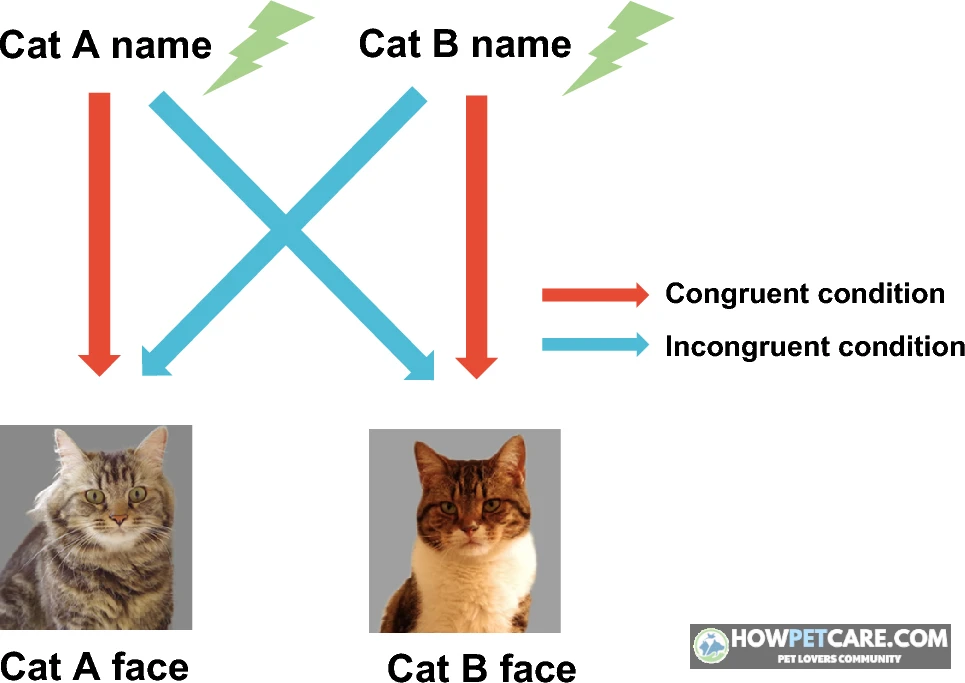
Atsuko Saito and colleagues reported a name-recognition study in Scientific Reports in 2019. The work involved 78 cats across four linked experiments, including household cats and cats living in a cat café; not every cat took part in every condition.
How researchers measured recognition
The researchers used a habituation-dishabituation approach. Cats heard a series of words or cat names, followed by the subject’s own name. As cats heard similar sounds repeatedly, their observable responses tended to decline. Researchers then looked for renewed responses—such as ear or head movements—when the cat’s name was played. A change in response suggests the cat noticed a difference in the sound.
In the household-cat conditions, cats as a group responded differently to their own names than to similar-sounding words and to the names of cats they lived with. The cat-café findings were less clear. The results support the idea that household cats can distinguish their names from familiar alternatives, but they do not show that every cat individually passed a test or that every cat will respond at home.
What the findings do and do not prove
The study supports sound discrimination: cats can learn that their name differs from other familiar sounds. It does not prove that cats think of a name as a human-style identity label, deliberately ignore their owners, or will come when called. Those are different claims from recognizing a sound.
Study card: Saito et al. (2019), Scientific Reports
- Sample: 78 cats across four linked experiments, including household and cat-café cats. Not all cats completed every experiment.
- Method: Researchers played sequences of similar-sounding words or other cats’ names, then the subject’s name, and compared observable orientation responses.
- Finding: Household cats showed a group-level difference in response to their own names; cat-café results were less clear.
- Limit: A group pattern does not establish how every individual cat responds or what a cat understands about the concept of a name.

Separate research by Saito and Shinozuka, published in Animal Cognition in 2013, used recorded voices and found that cats responded differently to their owner’s voice than to unfamiliar voices. That supports the idea that cats can distinguish familiar voices. A related question is whether cats remember people at all, but that memory claim is separate from naming. It is not evidence that they understand their owner’s name, and recorded-voice results should not be confused with a live test of name recognition.
Cats vs. dogs: recognition is not the same as response
Dogs often give a more obvious response when called, but visible obedience is not a fair measure of which species can recognize a sound. Cats may signal attention with an ear turn; a dog may orient, make eye contact, or approach. Individuals, training histories, and motivations vary widely.
| Factor | Cats | Dogs | Important caveat |
|---|---|---|---|
| Domestication history | A different domestication path, often associated with living near human settlements | A long history of close relationships and work with people | Historical patterns do not determine what an individual animal can learn. |
| Human-directed selection | Many cats were not bred to perform tasks on cue | Many dogs were selected for roles involving cooperation with people | This is context, not a ranking of intelligence or name recognition. |
| Common visible response | Ear turn, head turn, brief look, or pause | Orientation, eye contact, or approach | Subtle attention can be easy to overlook in cats. |
| What a name response can mean | The sound may predict something relevant | The sound may cue attention or a learned action | A response depends on training, context, and motivation in both species. |
| Evidence discussed here | Saito et al. (2019) tested cats’ responses to their names and other sounds | No directly comparable head-to-head test is established by that cat study | Do not use these findings to claim one species is better at recognizing names. |

Cats’ name recognition is not the same as willingness to approach. Dogs’ more conspicuous responses can reflect their history and training as well as what they have learned—not proof that cats are less capable.
A 14-day plan to teach a cat its name
Use positive reinforcement: say the name once in a pleasant, consistent tone, then reward an orienting response. In operant conditioning, a behavior becomes more likely when it is followed by a rewarding outcome. A small food reward is one option; choose something your cat values and can safely have. A clicker can mark the moment your cat turns toward you, but it is optional.
Keep sessions short and stop while your cat is still interested. The schedule below is a practical framework, not a scientifically guaranteed timeline.
| Days | Practice | Suggested session length | Milestone before progressing |
|---|---|---|---|
| 1–3 | In a quiet room, say the name once at a comfortable distance. Reward an ear turn, head turn, or glance promptly. | 1–2 minutes, once or twice daily | Your cat begins to orient to the sound. |
| 4–7 | Repeat in another calm room. Gradually look for a clearer head turn or glance before rewarding. | 1–2 minutes, once or twice daily | Your cat orients in more than one quiet setting. |
| 8–11 | Add a small amount of distance or a mild distraction, such as a quiet toy nearby. | 2–3 minutes, once daily | Your cat can orient with a modest distraction. |
| 12–14 | Vary rooms and distances. Reward orientation; occasionally reward a step toward you. | 2–3 minutes, once daily | Your cat begins to approach as well as orient. |

Days 1–7: Build the association
Begin when your cat is awake and calm, not when it is deeply asleep or already focused on a meal. Say the name once. As soon as your cat shows a small orienting response, offer the reward. Aim for a few successful repetitions rather than a long drill. If your cat does not respond, pause and try another time or make the situation easier.
Days 8–14: Add distance and distractions
When your cat is responding in a quiet setting, practice in another room and gradually increase the challenge. Add only one change at a time: a little more distance, a different room, or a mild distraction. If the response gets less reliable, return to an easier step.
The key milestone is orientation, not coming when called. Approaching is a separate behavior to reinforce. Say the name once rather than repeating it, and avoid using it mainly before medicine, scolding, or other unpleasant events. The suggested session length and schedule are starting points; the evidence does not promise a specific timetable for every cat.
How to train names in a multi-cat household
Saito and colleagues’ household-cat results suggest that cats can, as a group, distinguish their own names from the names of cats they live with. That does not guarantee every cat will distinguish every name, especially when names sound alike or the cats often hear several names followed by the same activity.
Start with individual practice. Work with one cat in a quiet room while the others are elsewhere, and reward only the cat whose name you said. Once that cat responds reliably in a calm setting, practice with a housemate at a manageable distance. Keep rewards close so the intended cat gets them promptly; if another cat repeatedly collects the reward, separate them again and make the session easier.
Distinct-sounding names may make the cues easier to tell apart. If a cat seems unsure, avoid repeating both names in rapid succession. Return to separate sessions, reward the intended response, and gradually reintroduce the other cat. Watch for stress or competition around food, and end the session if either cat becomes uncomfortable.

Renaming an adopted or adult cat
Adult cats can learn a new sound-and-reward association. They do not necessarily need to erase an old name first. Choose a consistent new name, let a newly adopted cat settle into its surroundings, and then use the same short, reward-based routine described above.
If you know the old name and the cat clearly responds to it, you can briefly pair it with the new name, then reward an orientation. After a few sessions, use the new name alone. If the old name does not seem meaningful to the cat, there is no need to include it; simply build the new association.
There is no reliable universal timeline for a rename. A cat may start responding within days, or it may take weeks or longer, depending on its experience, stress, surroundings, and practice. The 14-day schedule is a starting framework, not a promise. There is not enough evidence here to claim that a particular breed or age learns names faster.
Not responding to a name: your next steps
If your cat sometimes turns an ear or looks toward you but does not come over, observe the context and practice rewarding orientation. For readers wondering whether cats hold grudges, inconsistent response by itself does not mean your cat cannot hear you or is choosing to defy you.
A change in response deserves more attention when it is sudden or occurs alongside other unusual behavior. Contact a veterinarian promptly if a previously responsive cat suddenly stops reacting to familiar sounds, or if you notice ear discomfort, discharge, odor, swelling, head tilt, stumbling, or balance changes. Gradual reduction in response—particularly in an older cat—is also a reason to arrange a veterinary assessment. Hearing decline or an ear problem is one possible explanation among others; a home test cannot diagnose or rule out a medical issue.
While arranging care, avoid startling your cat and use visible cues where practical. Do not rely on a single sound test to decide whether hearing is normal.
- Observe and train: Your cat sometimes orients to its name but does not approach, with no other change in behavior.
- Arrange a vet visit: You notice a gradual decline in response to familiar sounds or other changes that concern you.
- Contact a vet promptly: The change is sudden, or it comes with ear symptoms, balance problems, or other severe signs.
If the concern is simply that your cat hears its name but does not come, start with short, rewarding practice and judge progress by small orientation signals—not by whether your cat always stops what it is doing.
| Study / Authors | Publication Year | Journal Name | Sample Description | Methodology | Key Findings | Limitations |
|---|---|---|---|---|---|---|
| Saito et al. | 2019 | Scientific Reports | 78 cats across four linked experiments, including household and cat-café cats | Habituation-dishabituation approach: played sequences of similar-sounding words or other cats' names, followed by the subject's name, and compared observable orientation responses (ear/head movements) | Household cats showed a group-level difference in response to their own names compared to similar-sounding words and names of cohabiting cats; cat-café results were less clear. Supports sound discrimination by cats. | Not all cats completed every experiment. A group pattern does not establish how every individual cat responds or what a cat understands about the concept of a name; does not prove cats view names as human-style identity labels or will come when called. |
| Saito and Shinozuka | 2013 | Animal Cognition | Not in source | Used recorded voices (owner's voice vs. unfamiliar voices) to test and observe cats' orienting responses | Cats responded differently to their owner's voice than to unfamiliar voices, supporting that cats can distinguish familiar voices. | Does not prove cats understand their owner's name; recorded-voice results should not be confused with a live test of name recognition. |

FAQ
Do cats recognize nicknames and shortened versions of their names?
A cat may learn several frequently used sounds if each is consistently associated with attention, food or another meaningful outcome. A new nickname is not automatically recognizable, so reward a response to help establish it.
Do cats recognize their owner’s voice on a recording?
Research using recorded voices has found that cats can distinguish their owner’s voice from unfamiliar voices through subtle orienting responses. That does not mean every cat will respond visibly, or that voice recognition proves a cat knows its owner’s name.
Can kittens learn their names faster than adult cats?
Both kittens and adult cats can learn associations with a name, but there is not enough evidence here to promise a consistent age-based difference in learning speed. Health, stress, practice and motivation can all affect an individual cat’s progress.
Does a cat’s breed determine whether it recognizes its name?
Breed alone cannot reliably predict whether an individual cat will recognize or respond to its name. Avoid assuming a breed-specific learning speed without good comparative evidence.