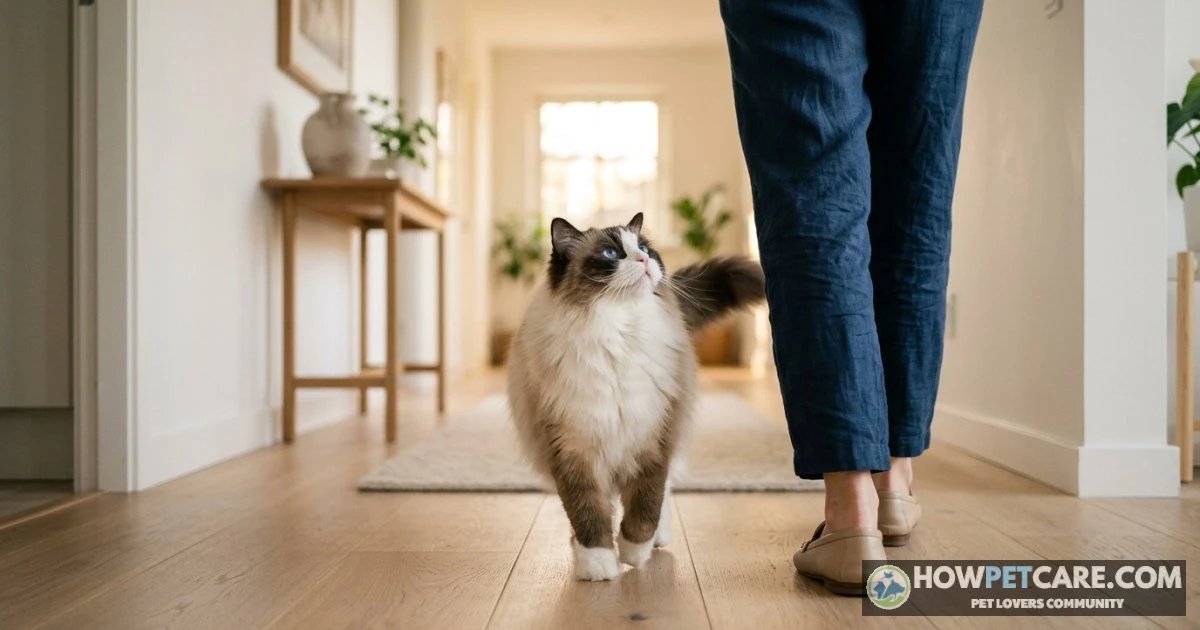

Cats usually follow their owners because of social bonding, curiosity, or a learned link between you and things they want, like food, play, or attention. It’s typically normal behavior. It’s only a concern when the following is new, intense, or paired with distress or changes in appetite, sleep, or litter-box habits.
If you’re wondering why does my cat follow me everywhere, the answer is usually simple: you’re familiar, interesting, or connected to something they want, such as food, play, attention, or access to a room. Following can be normal social bonding, a learned routine, or curiosity. On its own, it doesn’t mean your cat is anxious or ill. Context matters. A relaxed cat who settles nearby is different from one who panics when you leave or suddenly starts shadowing you while their appetite, sleep, or litter-box habits change.
Why your cat follows you
Common reasons cats shadow their people
Your cat may follow you for interaction, petting, or play, or because they’ve learned that seeing you near the kitchen predicts food. They may also be curious about where you’re going, interested in a closed room, or reassured by being near a familiar person. Boredom, a predictable household routine, and attention-seeking behavior can play a part too.
Some cats rub against your legs as they walk. That can involve scent marking from facial glands and may be part of familiar territorial behavior. Social signals vary: one cat rubs, another licks the people they trust, and many simply stay close. It doesn’t mean every cat who follows a person is marking them.

What the behavior alone can and cannot tell you
A cat who follows you around the house may enjoy your company without wanting to be held. Following can be social, but it isn’t a reliable measure of how much your cat loves you, and it doesn’t establish a diagnosis. Watch your cat’s body language and what happens when you stop moving. A loose posture and a nap nearby suggest something different from tense pacing and persistent distress.
Many cats normally follow their people. What matters is whether the behavior is relaxed and consistent with your cat’s usual routine, or new, intense, and paired with other changes.
Use this checklist to distinguish bonding from anxiety or illness
A three-way check: social bonding, separation distress, or possible health change
Separation anxiety is more than a desire to stay near you. It’s more concerning when being left alone repeatedly triggers distress, such as prolonged vocalizing, pacing, destructive behavior, or house-soiling. A veterinarian can help assess the pattern. Following alone isn’t enough to label it separation anxiety.
| Pattern | What you may notice | Other clues to check | What to do |
|---|---|---|---|
| Social bonding or learned routine | Calmly trails you, settles when you sit, follows around meals | Usual appetite, litter-box habits, sleep, and play; relaxed posture | Keep routines predictable and reward settling on a bed or perch |
| Possible separation distress | Follows and becomes distressed when you leave; vocalizes, paces, scratches doors, or cannot settle | Behaviors recur during absences or around departure cues | Track the pattern; ask a veterinarian for guidance, especially if distress is severe |
| Possible health or age-related change | Following is new, intense, or paired with unusual vocalizing, hiding, restlessness, or night waking | Changes in eating, drinking, weight, litter-box use, grooming, mobility, or sleep | Contact a veterinarian, particularly if the change was sudden or your cat is senior |
A simple home check can help you organize what you observe, though it can’t diagnose anxiety or illness. Note whether your cat becomes distressed behind a closed door and whether they can settle somewhere else. Look for following that’s new or much worse than before, and changes in eating, drinking, weight, urination, stool, grooming, sleep, or jumping. Also check whether your cat looks tense, with flattened ears, a crouched body, or a thrashing tail, or appears relaxed.
If the pattern is calm and the rest of your cat’s routine is unchanged, monitoring them and adjusting the environment may be reasonable. If following is intense, sudden, or paired with distress or physical changes, get professional advice rather than relying on a score or checklist.

Red flags that warrant a veterinary appointment
Book a veterinary appointment if clinginess comes with a noticeable change in appetite or thirst, weight loss or gain, vomiting or diarrhea, altered urination or defecation, difficulty jumping or walking, changes in grooming, persistent night waking, confusion, or unusual hiding. These signs can have several causes. They don’t prove your cat is sick, but they deserve attention. A sudden behavior change in a senior cat is also worth discussing with a veterinarian.
Audit what changed when the following starts all of a sudden
If your cat has suddenly started following you everywhere, look back at the weeks before it began. A schedule change, visitors, a move, new furniture, a new pet, or a different feeding routine can make a cat’s surroundings feel less predictable. Conflict between cats or reduced access to a favored resting place may also play a role. Stress, routine changes, and separation-related distress can contribute to persistent following.

Kittens, newly adopted cats, and senior cats
A newly adopted cat may look to you as a safe reference point while learning the home. Offer a quiet starting area, predictable meals, and chances to explore at the cat’s pace. A kitten may follow as it learns social routines; provide structured play, safe resting spots, and opportunities to explore independently. If a kitten was separated from its mother before eight weeks, mention that early separation to a veterinarian or qualified behavior professional if attachment-related concerns arise.
Senior cats may follow more as their needs or routines change. Don’t dismiss new clinginess in an older cat as “just aging,” especially if you also notice night waking, confusion, changes in mobility, or altered eating and drinking.
Household, health, and routine changes to check
Consider whether someone has moved in or out, work hours have changed, or feeding happens at a different time. Your cat may also have less access to windows, climbing routes, or quiet resting spots. In a multi-cat home, watch for staring, chasing, blocked doorways or litter boxes, and food stealing. A cat who shadows you may be seeking a calmer route through the home, but that’s a possibility to investigate, not a diagnosis.
Include health changes in your audit. Pain, illness, sensory changes, or reduced mobility can affect behavior. If the clinginess began abruptly or comes with other symptoms, arrange a veterinary check before treating it as a training problem.
Spaying or neutering may reduce some hormone-driven behaviors, but it isn’t a dependable way to change a cat’s social attachment. Discuss timing and behavior questions with your veterinarian.
Read the situation: bathroom trips, meowing, nighttime, and one-person following
| Situation | Possible explanation | First step | Seek help if |
|---|---|---|---|
| Follows at night | Routine, attention, food expectation, or a change affecting sleep | Keep bedtime consistent and try a play-and-feeding routine before bed | Night behavior is new or comes with confusion, thirst, or litter-box changes |
| Follows one person | Social preference or a learned association with that person’s meals and play | Let other household members offer meals and play without forcing contact | The cat panics when that person leaves or guards them aggressively |
| Follows while staring or meowing | A request, hunger cue, frustration, or social contact | Note the timing and what happens next | Vocalizing is new, persistent, or paired with physical changes |
| Newly adopted cat shadows you | The person may feel like a safe anchor | Keep the routine steady and expand access gradually | The cat cannot eat, rest, or use the litter box without you after settling in |
| Senior cat becomes clingier | Comfort-seeking or a change in health, senses, or routine | Make essential resources easy to reach and note changes | The change is sudden or comes with confusion or mobility problems |
| One cat is always underfoot in a multi-cat home | Possible tension or unequal access to resources | Check for blocking and provide separate routes and resources | Chasing, injuries, house-soiling, or weight changes occur |
Why cats follow people into the bathroom
Bathrooms offer a change of scene, and a closed door can make a familiar room newly intriguing. Your cat may also be following an established routine or seeking attention. Curiosity and interest in rooms that are usually closed can lead cats to follow people inside.
Myth check: The idea that cats reliably follow people into the bathroom to guard them is a popular claim, not an established explanation. Curiosity, routine, attention, and access to a familiar person are more cautious possibilities; the behavior alone can’t tell you which applies.

Following at night, staring, or meowing
A cat who follows and meows may be asking for food, play, attention, or access, or communicating socially. If it happens at a predictable time, check whether it lines up with a meal, your bedtime, or a change in your routine. Avoid assigning a single meaning to a stare. Consider your cat’s posture, ears, and tail, as well as what happens next.
For nighttime following, keep household responses consistent. If you sometimes get up to feed or play after meowing and sometimes don’t, your cat may keep trying. A new nighttime pattern merits a conversation with your veterinarian, especially in a senior cat or alongside changes in thirst, urination, orientation, or sleep.
Why one person becomes the favorite
A cat may follow the person who feeds them, plays with them, handles them gently, or spends the most predictable time at home. Close contact can deepen that preference too: some cats choose the person whose chest they sleep on. That preference doesn’t mean the cat dislikes everyone else. Invite other household members to build a relationship through calm play and meals. Let the cat approach rather than insisting on contact.

How much do breed and personality affect clinginess?
Breed tendencies versus the individual cat
Some breeds are commonly described as people-oriented, but a breed label can’t predict how an individual cat will behave. There isn’t enough comparative evidence to rank these breeds by clinginess. Socialization, personality, environment, and learned routines all matter.
| Breed | Commonly described social tendency | What not to assume |
|---|---|---|
| Siamese | Often described as vocal and socially engaged | Every Siamese will be clingy or talkative |
| Ragdoll | Often described as people-oriented and relaxed | A Ragdoll will want constant handling or follow everyone |
| Maine Coon | Often described as sociable and involved in household activity | A large, friendly cat necessarily wants close contact |
| Abyssinian | Often described as active and curious | Curiosity or activity means separation anxiety |
These descriptions are general reputations, not a reliable comparison test. Individual temperament and experience outweigh breed stereotypes. Following doesn’t prove “imprinting” either: a cat can form a strong bond without that label explaining the behavior.

Build independence with a step-by-step plan that preserves your bond
First, rule out health concerns if the behavior is sudden or accompanied by physical or routine changes. Then choose one predictable trigger to address, rather than trying to stop every instance of following at once.
A gradual independence routine
-
Days 1–3: observe and log
For three days, note when following starts, what you were doing, what your cat received afterward, and whether they can settle elsewhere. If you’ve noticed health changes, contact your veterinarian before starting behavior work.
-
Days 4–10: create a resting station
Place a comfortable bed or perch a few feet from busy walking paths, ideally with a view of the room. Reward your cat for settling there before you start walking. Avoid luring them with a treat once they’re already underfoot.
-
Week 2: make play and food predictable
Offer two short, scheduled play sessions each day, followed by a meal or food puzzle. A predictable play-then-food routine can help meet your cat’s activity needs and make food expectations less dependent on following your movements.
-
Week 3: practice brief separations
Invite your cat to the station, step out of sight for a few seconds, and return while they’re calm. Gradually extend the time. If distress escalates, make the next practice easier and seek professional guidance if the pattern is severe.
-
Week 4: reinforce calm independence
Reward quiet settling and independent exploration. Keep the routine consistent and use the station before predictable busy periods, such as a work call. A gradual plan may take several weeks; let your cat’s comfort set the pace.
Avoid scolding, pushing, or frightening your cat. Punishment can increase stress without teaching them a safer place to settle. Keep giving attention and play, but try to offer them on a predictable schedule rather than only after persistent demand meowing.
Prevent underfoot following safely
If your cat interrupts you while you work from home, set up a resting spot near the walking route or desk area, but not in it. Before a call or crossing a busy room, redirect your cat there and reward settling. Keep paths clear, and use a safe gate or separate room when needed around young children, stairs, older adults, or anyone with limited mobility. Never rely on a treat or training cue as the only protection against a tripping hazard.
If your cat isn’t improving, becomes distressed, or starts showing new symptoms, pause the plan and consult a veterinarian. The goal isn’t to stop your cat from seeking you out. It’s to help them feel comfortable settling safely when you’re nearby or briefly out of sight.

| Situation | Possible Explanation | First Step | When to Seek Help |
|---|---|---|---|
| Follows at night | Routine, attention, food expectation, or a change affecting sleep | Keep bedtime consistent and try a play-and-feeding routine before bed | Night behavior is new or comes with confusion, thirst, or litter-box changes |
| Follows one person | Social preference or a learned association with that person's meals and play | Let other household members offer meals and play without forcing contact | The cat panics when that person leaves or guards them aggressively |
| Follows while staring or meowing | A request, hunger cue, frustration, or social contact | Note the timing and what happens next | Vocalizing is new, persistent, or paired with physical changes |
| Newly adopted cat shadows you | The person may feel like a safe anchor | Keep the routine steady and expand access gradually | The cat cannot eat, rest, or use the litter box without you after settling in |
| Senior cat becomes clingier | Comfort-seeking or a change in health, senses, or routine | Make essential resources easy to reach and note changes; contact a veterinarian, particularly if the change was sudden | The change is sudden or comes with confusion or mobility problems |
| One cat is always underfoot in a multi-cat home | Possible tension or unequal access to resources | Check for blocking and provide separate routes and resources | Chasing, injuries, house-soiling, or weight changes occur |
| Follows due to social bonding or routine | Social bonding or learned routine | Keep routines predictable and reward settling on a bed or perch | Not in source |
| Follows due to separation distress | Possible separation distress | Track the pattern; ask a veterinarian for guidance, especially if distress is severe | Not in source |

FAQ
Why does my cat follow me everywhere but not cuddle?
Following can show that your cat wants company or likes keeping track of you, while cuddling may feel too close or uncomfortable. Cats differ in how they prefer to show social bonding.
Does a clingy cat always have separation anxiety?
No. A cat can enjoy staying near you without becoming distressed when alone. Separation anxiety is more concerning when absence triggers a repeated pattern of distress, such as persistent vocalizing, elimination, or destructive behavior.
Will getting my cat spayed or neutered make it less clingy?
Spaying or neutering can reduce some hormone-driven behaviors, but it is not a dependable way to change social attachment. Ask your veterinarian about behavior changes and the right timing for the procedure.
Why does my cat follow me around the house and meow?
Your cat may be asking for food, play, access, or attention, or simply communicating socially. Track when the meowing happens and check for sudden changes in appetite, thirst, litter-box use, or energy.