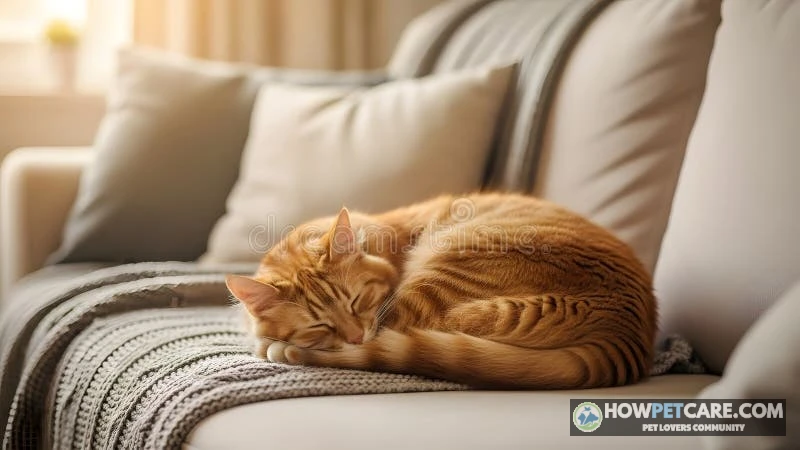

Cats sleep between 12 and 16 hours a day due to their evolutionary heritage as ambush predators. In the wild, hunting requires short, explosive bursts of adrenaline and energy. Extended resting periods conserve metabolic fuel, support cellular and muscle repair, and align with their natural crepuscular rhythm, which peaks around dawn and dusk.
Domestic cats typically sleep between 12 and 16 hours per day. For someone used to an eight-hour night’s sleep, watching a cat spend roughly two-thirds of its life curled up on the sofa can be concerning. Long sleep hours, though, are a normal part of feline physiology. They reflect thousands of years of evolution, energy conservation, and specialized predatory instincts.
Still, total sleep time is only part of the picture. To decide whether your cat’s sleep habits are healthy, look at its usual routine, individual baseline, and behavior while awake. A cat that rests for 15 hours but wakes ready to eat, groom, and play is having a normal feline day. By contrast, a cat within that same 12-to-16-hour window that suddenly stops greeting you, avoids jumping, or turns away from meals may be showing discomfort, stress, or illness. Understanding why cats sleep so much helps you tell harmless snoozing from a possible physical problem.
Why Do Cats Sleep So Much? The Biological Drive for Energy Conservation
A domestic cat may live comfortably indoors and never need to hunt, but its genetic blueprint remains virtually identical to that of its wild ancestors. In nature, feline predators rely on short, explosive bursts of speed and power to ambush prey, not long-distance endurance. Stalking, pouncing, sprinting, and wrestling demand a major surge of adrenaline and metabolic fuel. Long stretches of sleep between hunts let cats conserve energy, rebuild tissue, and maintain lean muscle mass without burning unnecessary calories.
Predator Instincts and Energy Conservation
Felines have a naturally high metabolic rate that uses energy quickly during intense physical exertion. In the wild, hunting success is never certain; a predator may make several stalks before catching a single meal. Extended rest acts as an energy buffer. Sleeping through quiet midday hours helps cats avoid cellular exhaustion and preserve sufficient glycogen reserves for sudden physical action.
That programming remains in an indoor house cat whose "prey" is kibble in a bowl or a feather toy on a wand. Sleep supports muscle repair, digestion, stress regulation, and mental well-being. During a nap, your cat’s body is still carrying out restorative work.

The Crepuscular Clock: Why Your Cat Is Awake at Dawn and Dusk
While many people wonder whether cats are nocturnal, that description is not quite accurate. Cats are actually crepuscular, meaning their circadian rhythm is set for peak activity around twilight, especially dawn and dusk.
In natural ecosystems, twilight offers clear advantages. Rodents, birds, and small mammals emerge during these transitions between day and night, while low light gives a stalking hunter cover. Humans are diurnal, active in daylight and resting at night, so our schedules often conflict with feline biology. When you leave for work in the morning or settle in during the afternoon, your cat may be entering one of its deepest rest periods. What looks like "sleeping all day" is often ordinary downtime between morning and evening bursts of energy.

How Many Hours Do Cats Sleep a Day? Life-Stage Breakdown and Baselines
Although 12 to 16 hours is a standard adult range, sleep needs vary across life stages, breed temperaments, and health profiles. Kittens need extensive rest to support rapid development, while older cats adjust their routines as stamina declines.
| Life Stage | Typical Daily Sleep Range | Primary Biological Driver | When to Consult a Veterinarian |
|---|---|---|---|
| Kitten (0–12 months) | ~18–20 hours | Rapid physical growth, central nervous system development, tissue synthesis | Awake periods are dull, limp, or slow; failure to nurse or eat; no spontaneous bursts of play between naps. |
| Adult (1–10 years) | ~12–16 hours | Ancestral predatory cycle (energy conservation between hunting sprints), crepuscular rhythm | Sudden jump of 2+ hours above their individual norm; withdrawal from household routine; sluggish response to meal prep. |
| Senior (11+ years) | ~16–18+ hours | Natural metabolic slowing, cognitive aging, energy management | Total sleep remains the same or rises while waking mobility drops (hesitation jumping, stiff gait); difficulty finding comfortable postures; waking vocalization. |
Important: These ranges are broad population averages, not mandatory quotas. A cat whose sleep suddenly shifts from 13 to 16 hours deserves veterinary attention, even though 16 hours falls within the "normal" adult range. A change from your cat’s baseline matters more than the raw total.
Breed tendencies can also create natural variation. Calm, placid breeds such as the Persian or Ragdoll frequently log up to 20 hours of daily rest, while active, highly vocal breeds like the Siamese often sleep closer to 12 to 14 hours per day.

Kittens, Adults, and Seniors: Expected Sleep Ranges
During kittenhood, growth hormone is released primarily during sleep. A kitten that races across the floor one minute and collapses into deep sleep the next is showing normal juvenile behavior. As kittens become healthy adults, total sleep settles around the 12-to-16-hour mark, broken up by interactive play, self-grooming, and social engagement.
In senior cats, typically defined as age 11 and older, the body’s metabolic pace slows. Joint stiffness, reduced sensory acuity, and normal biological aging can lead them to sleep anywhere from 16 to 18 hours or more. Even so, extreme inactivity in an older cat should never be dismissed as harmless. More rest in senior felines can reflect managed discomfort rather than ordinary sleepiness.

Building an Individual Baseline When You Work Away From Home
Few owners can watch their cats for 24 continuous hours. If you work outside the home, calculating an exact hour count is impractical. Rather than tallying every minute of sleep, build a behavioral baseline around a few regular household moments:
- The Morning Departure Window: Does your cat wake readily for breakfast? Are they moving smoothly between the feeding area, scratching post, and litter box?
- The Evening Arrival Window: Do they greet you at the door or raise their head from bed with clear, bright eyes? Are they interested in human interaction or evening feeding?
- The Pre-Bedtime Surge: Does your cat start spontaneous play, explore the room, or show brief crepuscular zoomies between 7 PM and 10 PM?
When these waking checkpoints stay consistent, your cat’s overall rest pattern is likely stable. Because feline sleep schedules differ from human routines, owners often wonder whether cats sleep at night or simply nap between bursts of household activity.
Cat Sleep Patterns: Light Naps vs. Deep and REM Sleep
A cat’s sleep architecture is not one solid block of unconsciousness. Like humans, felines move through distinct neurological stages, though the balance of those stages is built for survival. Much of what appears to be deep sleep is actually a light, semi-alert state often called a "catnap".
[LIGHT NON-REM SLEEP: "CATNAP"]
Physical cues: Ears swivel toward ambient noise; eyelids may twitch or sit half-open; muscle tone maintained.
Physiology: Low sensory threshold. Brain processes environmental cues for immediate fight-or-flight arousal.
       │
       ▼ (gradual descent over several minutes)
[DEEPER NON-REM SLEEP]
Physical cues: Body fully slack; rhythmic, slow respiration; ears stationary; slow arousal threshold.
Physiology: Somatic recovery, tissue maintenance, immune regulation.
       │
       ▼ (brief transitions)
[REM SLEEP: DREAM / PARADOXICAL STAGE]
Physical cues: Whiskers tremble, paws flex, subtle vocalizations, rapid eye movement behind lids.
Physiology: Low systemic muscle tone (atonia) prevents enactment of predatory reflexes; heightened neural activity.
Note: Cats do not adhere to human 90-minute sleep cycles. They slip fluidly between light alert rest and restorative phases based on ambient safety, household activity, and instinctual alertness.
During light slow-wave sleep, muscle tone remains active and sensory processing continues. If a floorboard creaks or a treat cupboard opens, a cat’s ears may swivel at once, and it can spring up within a split second. This lets wild felines rest while remaining alert to larger predators.
Only after several minutes of undisturbed safety does a cat move into deeper non-REM sleep and then rapid eye movement (REM) sleep. During REM, systemic muscle tone drops sharply in a state called motor atonia, which keeps the animal from acting out motor impulses. Paw twitching, whisker quivering, and muffled chirps lead many owners to wonder whether cats dream during sleep, though veterinary science cannot confirm specific dream content. Those visible twitches simply show that the nervous system is passing through normal paradoxical sleep.

Cats do not require a single unbroken block of rest. Instead, they distribute their sleep across dozens of short resting sessions throughout the day and night, dropping in and out of light sleep according to household noise and environmental security.
Ordinary Rest vs. Lethargy: Distinguishing Boredom, Stress, Pain, and Illness
For cat owners, the key skill is judging waking behavior rather than total sleep volume. Clinical lethargy does not mean a cat simply sleeps a lot. It means that, while awake, its energy, mental focus, responsiveness, and physical ability are noticeably reduced.
| Observable Domain | Normal Rest | Understimulation / Boredom | Chronic Pain (e.g., Osteoarthritis) | True Clinical Lethargy |
|---|---|---|---|---|
| Waking Responsiveness | Heads lift quickly; eyes track movement; ears orient to normal food sounds. | Slow, deliberate head lift; tracks sounds but immediately lays back down. | Responsive to sound, but visibly hesitates or repositions cautiously before rising. | Dull, delayed, or absent response; eyes remain glazed or half-closed; fails to arouse for food. |
| Voluntary Movement | Spontaneous trotting, stretching, scratching post use, post-nap zoomies. | Wanders briefly, meows at doors or blank spaces, returns to bed out of disinterest. | Avoids jumping onto counters/couches; uses intermediate steps or stays strictly floor-level. | Weakness, wobbliness, collapse, or complete refusal to leave bedding. |
| Appetite & Water | Eager at feeding times; finishes usual daily ration reliably. | Eats normally, but may graze out of boredom or beg for treats as stimulation. | Eats normal volume, but may abandon bowls if standing on hard floors is uncomfortable. | Hyporexia or anorexia (skipping meals); marked drop or spike in water bowl visits. |
| Litter-Box Habits | Normal posture; clean entry/exit; consistent stool and urine frequency. | Unchanged frequency; normal posture and cleanliness. | Urinating or defecating right beside the box due to high rim pain; matting on hindquarters. | Straining with little/no urine, soiling bedding, or completely absent elimination. |
| Grooming & Fur Care | Thorough, relaxed self-cleaning; smooth, glossy, well-kept fur. | Normal grooming, though may occasionally over-groom patches out of boredom. | Matted or greasy fur along spine; neglects hindquarters due to joint stiffness. | Complete cessation of self-grooming, unkempt coat, or urine-soiled fur. |
| Breathing & Posture | Quiet, effortless chest movement while resting; relaxed body posture. | Normal, easy breathing; comfortable resting positions. | Guarded posture; hesitates to curl tightly; normal resting respiration. | Labored breathing, abdominal effort, open-mouth panting, or hunched distress. |
| Recommended Action | Baseline is stable. Continue normal routine and annual checkups. | Implement no-cost environmental enrichment (see below); reassess over 3–5 days. | Schedule non-urgent veterinary exam to evaluate orthopedic comfort and joint health. | Immediate veterinary evaluation. Do not wait to see if sleep improves. |
Note: These behavioral categories frequently overlap. A cat experiencing orthopedic pain may also appear bored because play hurts. Never use behavioral observation to rule out medical pathology.
Waking Behavior: The Key Indicator Most Owners Overlook
A cat can sleep 16 hours a day and be in peak physical condition. Another can sleep 13 hours a day while masking a developing illness. The difference is how they engage while awake. After a healthy cat finishes a nap, it stretches smoothly, takes an immediate interest in family activity, grooms thoroughly, and follows visual movement with bright, clear eyes.
A sick or clinically lethargic cat may wake with glazed eyes, delayed reflexes, and an unusual reluctance to interact. It may sit tightly hunched with its nose pointed toward the floor, show third-eyelid protrusion, or ignore food preparation that once triggered instant excitement. If your cat’s responsiveness while awake has declined, the total number of hours slept matters far less than getting medical attention.
Boredom and Chronic Stress vs. True Physical Fatigue
Indoor cats live safely, but safety can also become monotonous. When a cat lacks mental stimulation, outlets for predatory play, and vertical climbing structures, sleep can become a default way to pass the time. A bored cat sleeps because the environment offers little to do. Post-play rest is brief and restorative, characterized by relaxed muscles, easy breathing, and quick recovery after physical exertion, whereas true lethargy persists regardless of recent activity.
Chronic psychological stress, caused by inter-cat conflict, household renovations, or loud disruptions, can also make a cat withdraw into feigned sleep. Remaining still with closed eyes in a high or hidden location may be an attempt to reduce sensory input and avoid confrontation. To distinguish boredom from physical fatigue, introduce mild environmental changes. A bored cat may eventually engage with a new feather toy or puzzle feeder, while a severely exhausted or ill cat may lack the stamina to join in.

Aging vs. Hidden Pain: Why Older Cats Rest More
Osteoarthritis is exceptionally common in senior felines, affecting upwards of 90% of cats over the age of 12. Cats are small prey animals as well as predators, and instinct encourages them to hide orthopedic pain. They rarely vocalize, limp, or whimper when their joints hurt.
Instead, arthritic cats may simply stop jumping. They spend more time on low bedding, hesitate before stepping down from low furniture, and develop greasy or matted back coats because bending to groom their spine is uncomfortable. When an owner notices an older cat "slowing down and sleeping more," unmanaged joint pain may be the cause rather than inevitable aging. A prompt veterinary exam can identify mobility problems and support targeted pain management.


When to Worry: A Prioritized Checklist of Veterinary Red Flags
Sleeping a lot is not an emergency by itself. Sleepiness paired with certain physical signs, however, calls for prompt veterinary care. Do not wait to see whether prolonged sleep passes if any of the following warning signs are present.
Emergency and Same-Day Warning Signs
Some clinical signs point to an acute medical crisis. If your cat’s unusual sleepiness comes with any symptom below, contact an emergency veterinary hospital immediately:
- Labored or Open-Mouth Breathing: Any heavy abdominal effort to breathe, panting, or gasping while resting.
- Collapse or Extreme Unresponsiveness: Inability to stand, drunken/wobbly gait, head pressing into walls, or total failure to arouse when touched.
- Gum Discoloration: Gums that appear pale, stark white, bluish, or muddy grey rather than a healthy bubblegum pink.
- Straining in the Litter Box: A cat—particularly a male—making frequent, painful trips to the litter box with little to no urine produced. This is a life-threatening urethral obstruction.
- Suspected Toxin Ingestion: Known contact with lilies (even pollen or vase water), human medications like acetaminophen or ibuprofen, essential oils, or rodent bait.
For sudden changes without immediate respiratory or urinary distress, contact your veterinarian for a same-day appointment if your cat has refused food for 24 hours (or 12 hours for a kitten), is vomiting repeatedly, or shows signs of high fever or subnormal body temperature.
A cat that stops eating and sleeps continuously is at rapid risk of developing hepatic lipidosis (fatty liver disease), a potentially fatal metabolic complication. Never allow an adult cat to go more than 24 hours without food.
Subtle Changes That Justify a Scheduled Clinic Visit
Not every medical problem is an emergency. Many systemic diseases—including chronic kidney disease, diabetes mellitus, hyperthyroidism, and feline infectious diseases—develop gradually and can cause a slow rise in resting time over several weeks.
Book a routine physical examination if you notice:

- A steady, gradual expansion of daily sleep hours over a two-to-four-week period.
- A marked increase in water intake accompanied by heavier, more frequent litter-box urine clumps.
- Progressive weight loss despite a seemingly stable or increased appetite.
- Deterioration of grooming habits, resulting in mats, dandruff, or unkempt fur along the lower back.
- Reluctance to jump up to customary perches, accompanied by hesitation or tentative stepping.
Do Weather, Seasons, and Diet Change How Much Cats Sleep?
Many pet owners notice their cats sleeping more on rainy afternoons, hot summer days, or cold winter evenings. Environmental conditions can influence feline behavior, but it is important to separate supported physiology from speculation.
Ambient Temperature, Light, and Weather
Temperature regulation affects feline rest patterns. In hot summer weather, cats may sleep more to reduce internal metabolic heat production. By stretching out on cool tile floors, they reduce physical output and limit thermal stress. During colder winter months, cats often sleep curled into tight balls to conserve core body heat.
Natural-light shifts matter, too. Seasonal daylight changes can influence feline melatonin levels and activity windows, leading to modest increases in sleep during darker winter periods. Owners often report that rainy or stormy days make their cats sleepy. Changes in barometric pressure, dimmer light, and steady rain sounds may create a quiet setting that encourages rest, but robust scientific evidence directly linking rain to increased feline sleep is limited. Extra sleep during dreary weather is normal only if the cat stays alert, responsive, and willing to eat.

Evaluating the Diet and High-Protein Claims
A persistent internet myth claims that a high-protein, meat-rich diet makes cats lethargic because digestion is demanding. No credible physiological evidence supports the idea that a balanced, high-protein feline diet causes excessive sleepiness. Cats are obligate carnivores, with digestive systems adapted to process animal protein and fat efficiently.
Diet-related problems that do affect alertness include unbalanced nutrition, sudden caloric deficits, or underlying food intolerances. A sudden food switch can cause gastrointestinal upset or meal refusal, followed by energy crashes. Do not change your cat’s diet simply because it appears to sleep a lot. If you think food may be contributing to low energy, ask a veterinarian to review nutritional balance and rule out metabolic conditions.
Cats living in chaotic, noisy households with young children or active dogs may struggle to get restorative REM sleep during the day. Ensure your cat has access to elevated, quiet retreats where they can rest without constant disruption.
Practical Next Steps: Safe Indoor Enrichment and an Observation Plan
If your cat sleeps near the higher end of the normal range, has no red-flag symptoms, and remains bright and interactive while awake, low-stress enrichment may help show whether boredom is adding to its nap time. An eager response to a toy does not prove a cat is healthy, however, and enrichment does not treat disease.
Targeted Enrichment for Understimulated Indoor Cats
A more engaging indoor environment gives cats choices to use their minds and bodies during the day. Do not delay veterinary care to attempt environmental enrichment if your cat shows warning signs of lethargy, pain, or illness. Furthermore, a temporary behavioral improvement does not rule out underlying medical issues.
-
Introduce Vertical Territory
Install wall-mounted cat shelves, clear space atop secure bookcases, or position a tall cat tree near a living room window to encourage voluntary climbing and visual scanning.
-
Establish Crepuscular Play Routines
Schedule two focused 10-minute interactive play sessions daily—one at dawn and one at dusk. Use wand toys, feather teasers, or laser pointers (ending on a physical toy) to mimic natural predatory chase sequences.
-
Incorporate Foraging and Puzzle Feeders
Replace simple bowls with interactive puzzle feeders or scatter kibble across clean multi-level surfaces to turn eating into a stimulating problem-solving activity.
-
Create Sensory Window Perches
Set up a secure resting spot overlooking a garden bird feeder or rustling trees to provide non-strenuous cognitive stimulation during quiet afternoon hours.
If your cat eagerly engages with these changes and spends more daytime hours watching its surroundings, understimulation was likely contributing to the sleep routine. If it ignores enrichment entirely, avoids movement, or seems irritable when approached, stop the trial and seek veterinary advice.

The 3-Day Baseline Log to Bring to Your Vet
Before a veterinary visit for unusual sleepiness or low energy, a statement such as "he seems more tired lately" offers limited diagnostic value. Recording objective behaviors over a three-day period gives your veterinary team useful, concrete information.
DATE: ______________ | CAT NAME: ______________

1. APPROXIMATE RESTING WINDOWS
   - Morning (6 AM - 12 PM): [ ] Sleeping deeply | [ ] Light napping | [ ] Active/Exploring

   - Afternoon (12 PM - 6 PM): [ ] Sleeping deeply | [ ] Light napping | [ ] Active/Exploring

   - Evening/Night (6 PM - 6 AM): [ ] Active | [ ] Resting near family | [ ] Sleeping isolated

   - Unobserved hours (e.g., owner at work): ______ hrs

2. WAKING RESPONSIVENESS & POSTURE
   - Can-opener / Food prep sound reaction: [ ] Instant trot  [ ] Slow rise  [ ] No response
   - Posture when awake: [ ] Upright & relaxed  [ ] Tense/Hunched  [ ] Stiff/Limping
   - Grooming status: [ ] Normal  [ ] Neglecting rear/back  [ ] Over-licking single spot

3. INTAKE & OUTPUT
   - Food consumed: [ ] Full normal portion  [ ] Half portion  [ ] Refused entirely
   - Water visits: [ ] Normal  [ ] Noticeably increased  [ ] Unseen
   - Litter box: Urine clumps (#): ___ | Stool passed: [ ] Yes / [ ] No | Straining: [ ] Yes / [ ] No

4. NOTABLE HOUSEHOLD SHIFTS (Visitors, weather spikes, new furniture, loud noises):
   _________________________________________________________________
Reference Cases: Why Change Matters More Than Total Hours
To see how veterinarians interpret this information, consider two contrasting scenarios:
- Case A (High baseline, stable): Milo (Adult, 4 yrs). Milo sleeps an estimated 15 hours daily. He trots immediately to the kitchen when breakfast is prepared, grooms thoroughly, and initiates evening play with a wand toy for 10 minutes.
- Assessment: Healthy individual baseline. Milo’s 15 hours of rest reflect personal temperament and indoor comfort rather than clinical concern.
- Case B (Moderate baseline, compromised): Luna (Adult, 4 yrs). Luna sleeps 13 hours daily—sitting squarely within the textbook 12-to-16-hour average. However, her previous baseline was 10 hours. She no longer meets her owner at the front door, hesitates before hopping onto the sofa, and left half her wet food untouched this morning.
- Assessment: Veterinary evaluation needed promptly. Even though Luna’s total hours appear normal on paper, her behavioral delta indicates discomfort, systemic illness, or pain.
By watching what your cat does while awake, respecting its biological need to conserve energy, and staying alert to shifts in appetite, posture, and mobility, you can help ensure that its long sleep hours remain safe, restful, and healthy.

| Observable Domain | Normal Rest | Understimulation / Boredom | Chronic Pain | True Clinical Lethargy | Recommended Action |
|---|---|---|---|---|---|
| Waking Responsiveness | Heads lift quickly; eyes track movement; ears orient to normal food sounds. | Slow, deliberate head lift; tracks sounds but immediately lays back down. | Responsive to sound, but visibly hesitates or repositions cautiously before rising. | Dull, delayed, or absent response; eyes remain glazed or half-closed; fails to arouse for food. | Baseline is stable. Continue normal routine and annual checkups. |
| Voluntary Movement | Spontaneous trotting, stretching, scratching post use, post-nap zoomies. | Wanders briefly, meows at doors or blank spaces, returns to bed out of disinterest. | Avoids jumping onto counters/couches; uses intermediate steps or stays strictly floor-level. | Weakness, wobbliness, collapse, or complete refusal to leave bedding. | Implement no-cost environmental enrichment (see below); reassess over 3–5 days. |
| Appetite & Water | Eager at feeding times; finishes usual daily ration reliably. | Eats normally, but may graze out of boredom or beg for treats as stimulation. | Eats normal volume, but may abandon bowls if standing on hard floors is uncomfortable. | Hyporexia or anorexia (skipping meals); marked drop or spike in water bowl visits. | Schedule non-urgent veterinary exam to evaluate orthopedic comfort and joint health. |
| Litter-Box Habits | Normal posture; clean entry/exit; consistent stool and urine frequency. | Unchanged frequency; normal posture and cleanliness. | Urinating or defecating right beside the box due to high rim pain; matting on hindquarters. | Straining with little/no urine, soiling bedding, or completely absent elimination. | Immediate veterinary evaluation. Do not wait to see if sleep improves. |
| Grooming & Fur Care | Thorough, relaxed self-cleaning; smooth, glossy, well-kept fur. | Normal grooming, though may occasionally over-groom patches out of boredom. | Matted or greasy fur along spine; neglects hindquarters due to joint stiffness. | Complete cessation of self-grooming, unkempt coat, or urine-soiled fur. | Not in source |
| Breathing & Posture | Quiet, effortless chest movement while resting; relaxed body posture. | Normal, easy breathing; comfortable resting positions. | Guarded posture; hesitates to curl tightly; normal resting respiration. | Labored breathing, abdominal effort, open-mouth panting, or hunched distress. | Not in source |
FAQ
Is it normal for a domestic cat to sleep all day every day?
Yes, spending 12 to 16 hours resting each day is biologically normal for domestic cats. However, during their waking hours—especially around dawn and dusk—they should be alert, responsive, interested in food, and able to move comfortably.
Can a cat that still plays or eats eagerly actually be sick?
Yes. Cats are instinctual masters at masking illness and pain, meaning they may still briefly engage with food or high-value toys even when experiencing underlying conditions. A noticeable increase in total resting time or reduced overall stamina warrants monitoring even if appetite appears intact.
Do indoor cats sleep more than outdoor cats?
Indoor cats often log more resting hours because their environment requires no active foraging, territory defense, or predator evasion. While safe, indoor environments can sometimes lack stimulation, leading cats to nap out of simple boredom rather than genuine physical necessity.
Why does my cat sleep all day and stay awake running around at night?
Cats possess a crepuscular circadian rhythm, making them naturally primed for activity during twilight hours at dusk and dawn. Late-night running often happens when an indoor cat receives insufficient physical and mental stimulation during daytime waking hours.