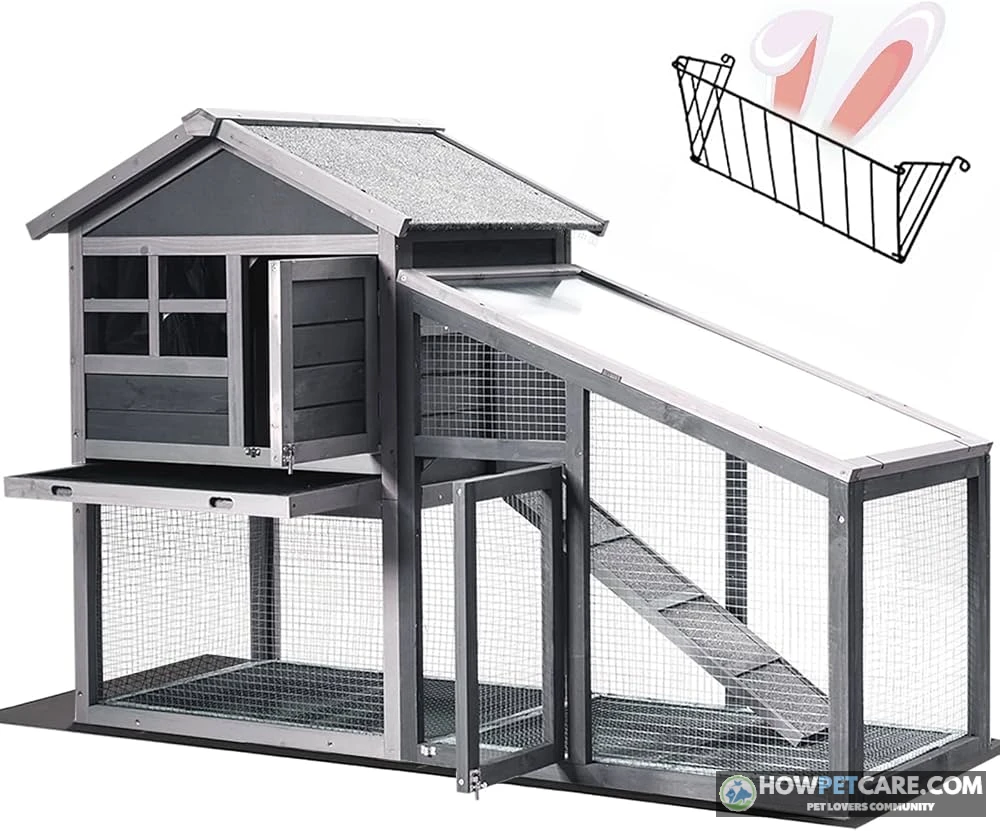

Minimum rabbit cage dimensions by rabbit size:
| Rabbit type | Minimum floor space | Minimum height |
|---|---|---|
| Small (up to 4 lb) | 4 sq ft | 24 inches |
| Medium (4–8 lb) | 6 sq ft | 30 inches |
| Large (8–12 lb) | 8–12 sq ft | 36–42 inches |
| Bonded pair, small breeds | 8 sq ft | 24 inches |
| Bonded pair, medium breeds | 12 sq ft | 30 inches |
The cage must also let the rabbit stand fully upright without its ears touching the top, and accessories don’t count toward floor space.
Choosing the right rabbit cage starts with the rabbit, not the product. Before comparing wire cages, hutches, or playpens, consider your rabbit’s breed and size, as well as how many rabbits will share the enclosure. A cage labeled “large” may still be too small for a Flemish Giant or a bonded pair. Meanwhile, an oversized wire cage with a bare wire floor can injure a small Holland Lop’s feet. This guide covers breed-specific dimensions, flooring safety, indoor-versus-outdoor criteria, cleaning routines, material comparisons, assembly, and apartment layouts so you can choose and configure a safe, practical enclosure.
How to Choose the Right Rabbit Cage Size for Your Rabbit
Base cage size on the rabbit’s full adult length, not its size as a baby. A common shelter standard recommends a minimum of 24 inches wide by 42 inches long by 24 inches high, intended to pair with a runaround space rather than 24/7 confinement. The cage should be at least twice as long as a fully stretched rabbit, typically 30–36 inches long and 24–36 inches wide. It must also be tall enough for the rabbit to stand fully on its hind legs without its ears touching the top.
Length matters more than width because rabbits need room to hop. Aim for at least 30 inches of length so a rabbit can make three consecutive hops. Litter boxes, hay racks, hideouts, and other accessories don’t count toward usable floor space. Add their footprint to the minimum cage size rather than subtracting them from the rabbit’s living area.

Breed-specific cage dimension table
| Breed or rabbit count | Minimum floor space | Recommended cage height | Notes |
|---|---|---|---|
| Small (up to 4 lb, e.g. Holland Lop, Netherland Dwarf) | 4 square feet | 24 inches | Length matters more than width; aim for at least 30 inches long so the rabbit can hop 3 times. |
| Medium (4–8 lb, e.g. Rex, Mini Lop) | 6 square feet | 30 inches | Add a litter box and hay rack inside the footprint; do not count accessories as floor space. |
| Large (8–12 lb, e.g. Flemish Giant, French Lop) | 8–12 square feet | 36–42 inches | Door must be wide enough for the rabbit to enter and exit without crouching. |
| Bonded pair, small breeds | 8 square feet minimum | 24 inches | Two separate litter boxes and two hiding spots reduce territorial fighting. |
| Bonded pair, medium breeds | 12 square feet minimum | 30 inches | Single-level cages under 10 square feet often cause stress in pairs. |
| Two non-bonded rabbits | 2 separate cages | 24–30 inches | Never house un-bonded rabbits in one enclosure; they can injure each other. |
Sizing for bonded pairs in small apartments
Bonded rabbits need considerably more space than a single rabbit, along with separate resources that help reduce conflict. Provide two litter boxes, two hiding spots, and enough room for both rabbits to lie fully stretched out at the same time without touching. In a small apartment, modular C&C grids or an exercise pen extension may fit more naturally than one massive cage that dominates the room.
For example, two bonded Holland Lops weighing about 4 pounds each can fit in a 6-foot by 2-foot alcove. That gives them 12 square feet, exceeding the 8-square-foot minimum for two small bonded rabbits. A 4-foot by 2-foot C&C cage against the back wall provides 8 square feet, while a 2-foot by 2-foot exercise pen extension adds 4 square feet. Keep a 24-inch human walkway in front so you can reach litter boxes and food bowls without stepping inside.
Indoor rabbit cage footprint vs. outdoor hutch footprint
Indoor cages and outdoor hutches follow the same breed-based minimums, but outdoor housing also needs weatherproofing, predator protection, and access in every season. An outdoor hutch should never be smaller than the indoor minimum for the breed. It also benefits from an attached secure run, allowing the rabbit to exercise without being carried indoors each day.
Wire Floors, Solid Bases, and Safe Flooring Combinations
Full wire floors aren’t safe as a rabbit’s main standing surface. Wire fails to support the feet properly and can cause sore hocks, particularly in larger or heavier breeds. It’s suitable for cage sides and tops, where it provides ventilation, but not as the full-time living surface.
Wire rabbit cage floor safety rules
If you buy a wire rabbit cage with a removable plastic tray, the wire floor may sit above the tray so droppings fall through. The rabbit still needs a solid resting surface. Cover some or all of the wire with non-slip flooring, fleece, cardboard, or a solid platform, giving the rabbit somewhere to rest its feet. Avoid wire mesh with gaps large enough for a foot or head to slip through.
Best bedding and litter box setup for tray-based cages
Solid plastic bases wipe clean easily, although chew-prone corners can crack. Wood absorbs urine and stains, so it needs sealing and more frequent replacement. Non-slip rubber mats protect the feet but must be removed and cleaned regularly. Put the litter box in the corner where the rabbit naturally eliminates, using paper-based or aspen bedding instead of clumping cat litter or cedar shavings.
One practical combination is a plastic tray base with a solid platform or fleece resting liner, plus a litter box filled with safe litter and topped with hay. This arrangement keeps urine away from the rabbit’s feet and makes daily cleanup quicker.

Indoor Rabbit Cage vs Outdoor Hutch: Climate, Weatherproofing, and Placement
Indoor housing is generally safer for most US rabbit owners. It offers stable temperatures, easier socialization, and more convenient cleaning. Outdoor hutches can work in mild climates, but they demand careful weatherproofing and daily monitoring.
Indoor rabbit cage with playpen layout ideas
Set the cage in a quiet corner away from direct sunlight, radiators, and loud appliances. Basements may be too damp for rabbits, so look for a well-ventilated room with stable humidity. An indoor rabbit cage with a playpen allows the rabbit to remain securely enclosed while you’re away, then exercise in a larger area when you’re home. Place the playpen against a wall, preserve a clear human walkway, and cover all electrical cords.

Outdoor hutch placement and seasonal care
Outdoor rabbits face heat risk above 80°F and freezing risk below 20°F. A suitable hutch needs a waterproof roof, a raised floor that blocks ground moisture, cross-ventilation without drafts, and wind-blocked sides. For predator protection, use sturdy wire, secure locks, and a solid floor or apron that prevents animals from digging in from below.
In hot weather, move the hutch into shade, supply frozen water bottles, and check the rabbit several times daily. During winter, add extra bedding and keep water bottles from freezing. Make seasonal changes gradually; don’t move an indoor rabbit outside without warning during extreme heat or cold.

Cleaning and Maintenance: Rabbit Cage with Tray, Deep Clean, and Weekly Routine
A rabbit cage with a tray makes waste removal easier because droppings either fall through the wire or remain on the tray surface. Consider the time you can realistically spend cleaning when choosing a design. A large cage filled with corners and complex fittings takes longer to maintain than a simple tray-based enclosure.
Rabbit cage with tray cleaning schedule
Daily spot cleaning takes about 5–10 minutes. Scoop the litter box and add fresh litter, then empty and refill the water bottle or bowl and wipe its nozzle. Sweep or spot-clean poop pellets outside the litter box, and replace any soiled bedding in sleeping areas.
Weekly deep cleaning takes about 20–30 minutes. Pull out the tray and dump the waste, then wash it with mild dish soap and warm water before rinsing thoroughly. Wipe cage bars and ramps with a vinegar-and-water mix (1 part white vinegar to 1 part water), wash fabric hideouts and fleece liners, and inspect the enclosure for chewed plastic or bent wires.
Monthly deep cleaning takes 45–60 minutes. Move the rabbit into a safe exercise pen or temporary enclosure and disassemble all removable parts. Scrub every surface with a rabbit-safe cleaner, avoiding bleach, phenols, and ammonia. Let everything air-dry completely, then inspect floor corners and door latches for rust or wear.

Safe cleaners and odor management
Mild dish soap and white vinegar solutions work well for routine cleaning. Avoid bleach, phenols, and ammonia because they can leave harmful residues or strong fumes. Good ventilation limits odor and helps surfaces dry during and after cleaning. Don’t leave cleaner residue on bars, trays, or platforms the rabbit might chew or lick.
Cage Materials, Cost, Durability, and Assembly Side by Side
Each material suits different budgets, chewing habits, and cleaning preferences. Wire cages resist chewing, though they require solid flooring to protect the feet. Wood can look attractive but absorbs urine and is easy to chew. Plastic bases weigh less, but their corners may crack. C&C grids paired with coroplast bases provide a flexible and affordable DIY option.
Cage material comparison: cost, durability, cleaning, assembly
| Material type | Cost range | Durability | Cleaning effort | Assembly tools needed |
|---|---|---|---|---|
| Wire | $60–$150 | High against chewing; bars can bend if a large rabbit leans on them | Low—wipe bars and pull out tray | Screwdriver or Allen key; 20–40 minutes |
| Wood | $120–$300 | Medium—absorbs urine and is easily chewed | High—urine stains soak in; needs sealing | Screwdriver, drill; 45–90 minutes |
| Plastic / solid base | $80–$180 | Medium—chew-prone corners crack over time | Medium—tray slides out, but corners collect debris | Usually snap-together; no tools or basic screwdriver; 15–30 minutes |
| C&C grids and coroplast | $50–$120 | High—grids resist chewing; coroplast base is waterproof | Low—wipe coroplast, replace soiled sections | Scissors or box cutter; zip ties; 30–60 minutes |

Assembly time and tool list by cage type
Wire cages typically need a screwdriver or Allen key and take 20–40 minutes to assemble. Plastic habitats often snap together, requiring either no tools or a basic screwdriver, and take 15–30 minutes. Wooden hutches call for a screwdriver and drill and take 45–90 minutes. C&C grids need scissors or a box cutter, along with zip ties, and take 30–60 minutes.
Before assembly, clear a floor area larger than the cage footprint and lay out every part. Make sure the door latches move smoothly and that all edges are smooth or guarded. Test the tray slide and check each ramp for stability before introducing the rabbit.
Chew prevention for plastic wood and coated wire
Rabbits that like to chew may damage plastic corners, wood edges, and even coated wire. Shield vulnerable spots with clear acrylic corner guards, or offer untreated pine boards that are safe to chew. A pet-safe bitter deterrent spray can help protect baseboards, furniture legs, and cage ramps; reapply it weekly or after cleaning. Keep at least two approved chew toys in the cage, such as untreated apple sticks, seagrass mats, or cardboard tubes.
- Cover exposed electrical cords with rigid plastic tubing or spiral wrap; never rely on spray deterrent alone for cords.
- Protect cage corners and wood edges with clear acrylic corner guards or untreated pine boards the rabbit is allowed to chew.
- Apply a pet-safe bitter deterrent spray to baseboards, furniture legs, and cage ramps; reapply weekly or after cleaning.
- Provide at least two approved chew toys inside the cage, such as untreated apple sticks, seagrass mats, or cardboard tubes.
- Block off under-furniture zones with a solid baby gate or C&C grid panel secured with zip ties.
- Check rubber seals, carpet edges, and linoleum seams daily; rabbits often start chewing where material is already loose.
- Never use chicken wire with sharp cut edges as a barrier; fold the edges inward or cover them with duct tape.
Exercise Pens, Free-Roam Time, and Enrichment Beyond the Cage
A cage by itself isn’t enough. Rabbits need daily exercise outside the enclosure or access to a large attached exercise pen. Supervise free-roam time in a rabbit-proofed area to keep the rabbit from chewing cords, furniture, or other unsafe items.
Exercise pen versus cage: when each is appropriate
The cage acts as a home base for sleeping, eating, and litter habits. An exercise pen adds temporary or permanent room for movement. Keep the rabbit in its cage when you can’t supervise, then provide an exercise pen or free-roam time for daily activity. Attaching a playpen to the cage combines both uses in a single layout.
Indoor rabbit cage with playpen combinations
Connect the cage and playpen with a flat bridge or ramp. Keep the cage against the wall as the sleeping and feeding area, while the pen extends into the room for exercise. When the pen isn’t needed, fold it against the wall to recover floor space.

Apartment multi-rabbit layout with footprint math
Scenario: Two bonded Holland Lops (about 4 lb each) in a 700-square-foot apartment with a 6-foot by 2-foot alcove available.
- Alcove floor space: 6 feet x 2 feet = 12 square feet.
- Minimum for two small bonded rabbits: 8 square feet.
- Recommended working area after accessories: 10 square feet keeps room for two litter boxes, a hay rack, and a hideout.
- Layout: Place a 4-foot by 2-foot C&C cage against the back wall (8 square feet). Add a 2-foot by 2-foot exercise pen extension on the open side (4 square feet), connected by a 12-inch wide ramp or flat bridge.
- Total rabbit territory: 12 square feet.
- Human walkway: Leave 24 inches in front of the cage so you can reach the litter boxes and food bowls without stepping inside.
- Free-roam add-on: A 4-foot by 4-foot exercise pen in the living room for 3–4 hours of supervised daily exercise, folded against the wall when not in use.
Enrichment items that fit inside or outside the cage
Set a hay feeder at one end of the cage so the rabbit can eat while standing or sitting. Mount the water bottle outside the bars, with the sipper tube extending inside at a comfortable height. Include a hideout or cardboard box for privacy, a seagrass mat for chewing, and a lightweight toy the rabbit can nudge. Rotate toys weekly to maintain interest.

Multi-level and C&C setup comparison on cost and cleaning effort
Multi-level cages provide vertical space, but their ramps need non-slip surfaces. They can also make cleaning harder because waste falls between the levels. C&C setups are usually single-level, cost less than commercial multi-level cages, and are easier to wipe down. For most beginners, a large single-level C&C enclosure or wire cage with a tray will be easier to maintain than a multi-level design.
Rabbit Cage Buyer’s Decision Checklist and Next Steps
Follow this workflow as you move from measuring the available space to placing an order.
- Measure your available indoor floor space and note doorways, walkways, and furniture placement.
- Identify your rabbit’s breed and adult weight, then match it to the breed-specific size table.
- Decide indoor or outdoor housing based on your climate, predator risk, and ability to supervise daily.
- Choose a material based on budget, chewing tendency, and cleaning capacity.
- Select a cage with a removable tray if you want simple waste removal.
- Plan the flooring combination: solid resting area, litter box, and bedding.
- Order an exercise pen or plan free-roam space in addition to the cage.
- Assemble the cage, test latches and tray slides, then introduce the rabbit gradually.
Purchase checklist by living situation
In an apartment, prioritize a cage under 8 square feet that fits against a wall, along with a foldable exercise pen for free-roam time. A house with a dedicated room can accommodate a larger wire cage or C&C setup with an attached pen. For outdoor housing, plan for a weatherproof hutch with a raised floor and predator locks, as well as indoor backup space during extreme weather.
Budget tiers
Cheap rabbit cages under 50 often include basic C&C grid kits or small wire habitats, although they may lack trays or solid flooring. Mid-range wire cages cost $60–$150. Large rabbit cage options for giant breeds or bonded pairs start around $150 and can reach $300 for wooden hutches or premium wire models with stands.
Where to buy
Online retailers carry the broadest range of indoor rabbit cage models, wire rabbit cage options, and large rabbit cage listings with delivery. Local searches for “rabbit cage for sale near me” may lead to pet stores and secondhand listings. Before buying a used cage, inspect it closely for chewed corners, rust, and broken latches.
Indoor versus outdoor final decision tree
Choose indoor housing for stable temperature control, straightforward cleaning, and daily socialization. Consider outdoor housing only if you have mild weather, shaded placement, a secure predator-proof hutch, and enough time for daily visits. If summer temperatures regularly exceed 80°F or winter drops below 20°F, indoor housing is the safer default.
Final safety inspection before introducing a rabbit to a new cage
Make sure the door opens outward and latches securely. Check that the wire spacing is narrow enough to keep feet and heads from becoming trapped. The rabbit should be able to stand fully on its hind legs without its ears touching the top. Confirm that the tray slides smoothly and all ramps have non-slip surfaces. Set up the litter box, hay feeder, and water bottle before bringing the rabbit inside.


| Category or Breed Size | Minimum Floor Space | Recommended Height | Material or Type | Cost Range | Durability & Safety Notes | Cleaning Effort |
|---|---|---|---|---|---|---|
| Small (up to 4 lb, e.g., Holland Lop, Netherland Dwarf) | 4 sq ft | 24 in | Not in source | Not in source | Length matters more than width; aim for at least 30 in long so the rabbit can hop 3 times. | Not in source |
| Medium (4–8 lb, e.g., Rex, Mini Lop) | 6 sq ft | 30 in | Not in source | Not in source | Add a litter box and hay rack inside the footprint; do not count accessories as floor space. | Not in source |
| Large (8–12 lb, e.g., Flemish Giant, French Lop) | 8–12 sq ft | 36–42 in | Not in source | Not in source | Door must be wide enough for the rabbit to enter and exit without crouching. | Not in source |
| Bonded pair, small breeds | 8 sq ft minimum | 24 in | Not in source | Not in source | Two separate litter boxes and two hiding spots reduce territorial fighting. | Not in source |
| Bonded pair, medium breeds | 12 sq ft minimum | 30 in | Not in source | Not in source | Single-level cages under 10 sq ft often cause stress in pairs. | Not in source |
| Two non-bonded rabbits | 2 separate cages | 24–30 in | Not in source | Not in source | Never house un-bonded rabbits in one enclosure; they can injure each other. | Not in source |
| Not in source | Not in source | Not in source | Wire | 60–150 | High against chewing; bars can bend if a large rabbit leans on them. | Low—wipe bars and pull out tray. |
| Not in source | Not in source | Not in source | Wood | 120–300 | Medium—absorbs urine and is easily chewed. | High—urine stains soak in; needs sealing. |
| Not in source | Not in source | Not in source | Plastic / solid base | 80–180 | Medium—chew-prone corners crack over time. | Medium—tray slides out, but corners collect debris. |
| Not in source | Not in source | Not in source | C&C grids and coroplast | 50–120 | High—grids resist chewing; coroplast base is waterproof. | Low—wipe coroplast, replace soiled sections. |
FAQ
What size rabbit cage do I need for a Holland Lop?
A Holland Lop typically needs a minimum of 24 by 36 inches of floor space, with height allowing the rabbit to stand fully on its hind legs without ears touching the top. For bonded pairs, increase floor area significantly and provide separate litter boxes and hiding spots.
Can I build my own rabbit cage?
Yes, C&C grids and wooden frames are common DIY options, but avoid full wire floors and use non-toxic, chew-safe materials. Ensure all wire spacing is small enough to prevent feet or heads from getting caught.
Do rabbits need an exercise pen or free-roam time?
A cage alone is not enough; rabbits need daily exercise outside the enclosure or a large attached exercise pen. Free-roam time should be supervised in a rabbit-proofed area to prevent chewing on cords and furniture.