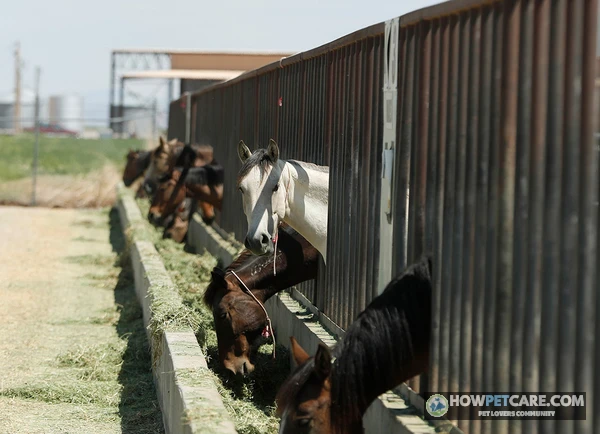

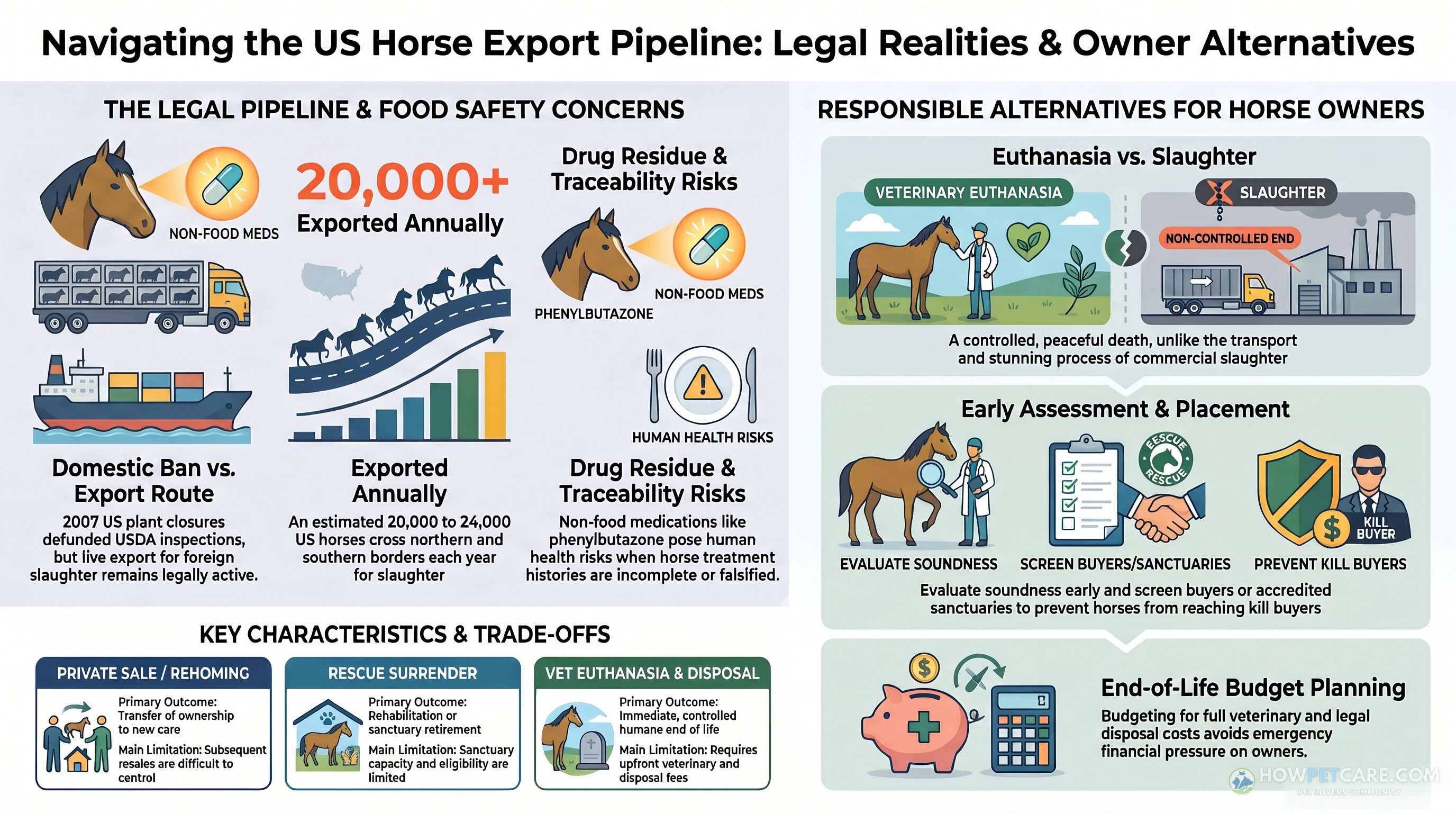
Inside a slaughterhouse, a horse is unloaded, inspected, held in lairage, restrained in a stun box, rendered insensible with a penetrating captive bolt, then shackled, hoisted and bled out. US plants closed in 2007, but live horses are still exported to Canada and Mexico for slaughter.
American horses can still enter the horse meat industry, even though the last federally inspected US horse slaughterhouses closed in 2007. Live horses may be exported to Canada and Mexico for slaughter under those countries’ rules. Inside a plant, the process generally moves from unloading and ante-mortem inspection through holding, restraint, stunning, and bleeding.
The distinction between a domestic closure and an export ban matters. Federal inspection funding, state laws, transport rules, and proposed legislation each address different parts of the trade. This explainer follows the horse slaughter pipeline, looks at what is known about welfare and food safety, and weighs the practical choices facing owners who can no longer keep a horse.
Is horse slaughter legal in the US? The short answer on the 2007 closures and the export route
Domestic ban vs. export: why both are true at once
The last federally inspected US horse slaughter plants closed in 2007. Calling that a blanket federal ban is misleading. State-law enforcement and court decisions contributed to the closures, while congressional restrictions on funding USDA inspections created a separate barrier to domestic production. Without required inspection, a plant cannot produce horse meat for sale under federal inspection.
The inspection-funding restriction has not been continuous. Its wording depends on federal appropriations, so the law for any given year must be checked rather than assumed. State laws can also restrict slaughter or the sale of horse meat. Eating horse meat is not subject to a general federal prohibition, though state rules can affect its sale.
Export is a separate issue. Closing domestic plants did not itself prohibit shipping live horses across the border for slaughter.

The pipeline at a glance
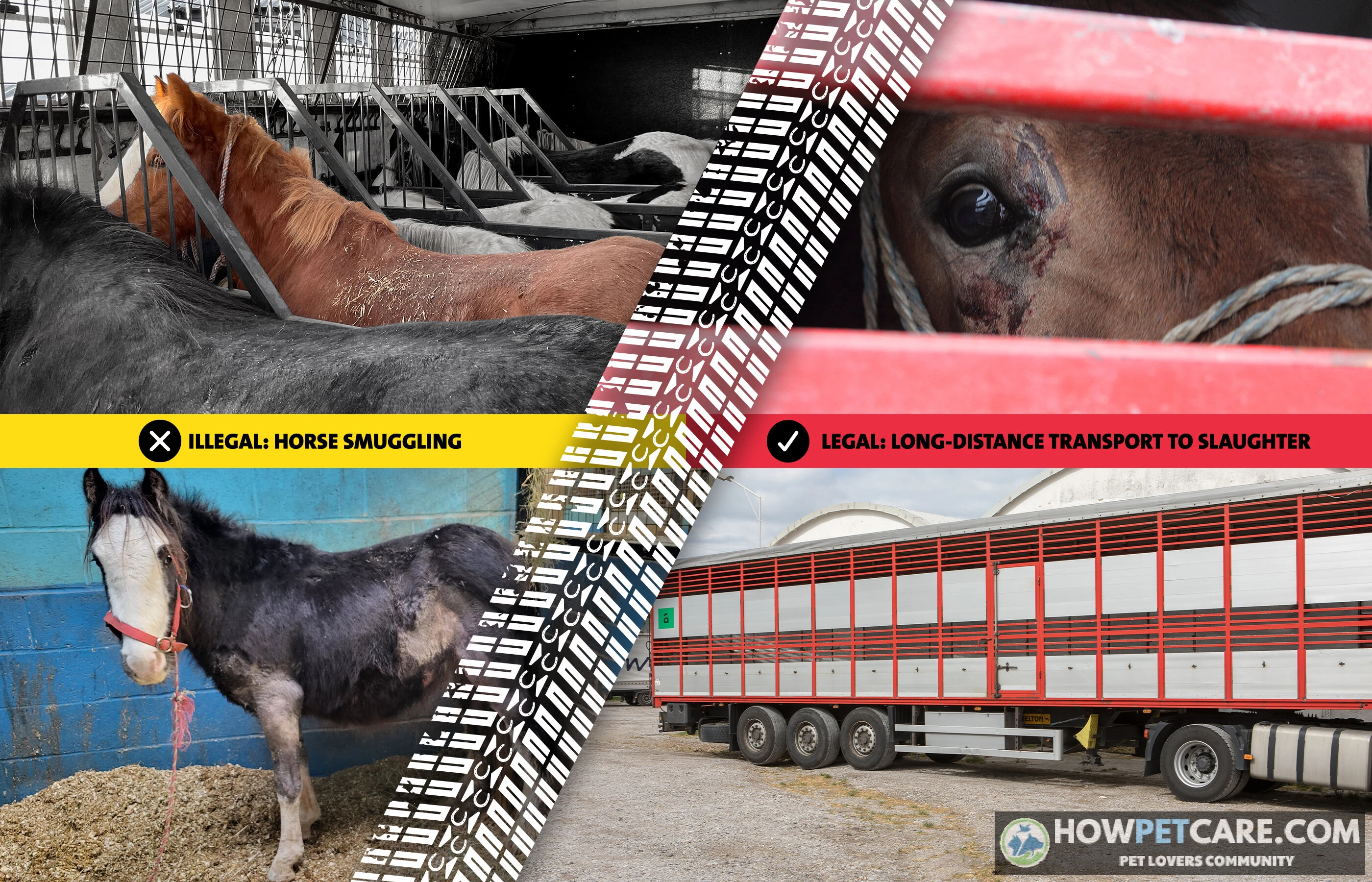
A horse may be sold privately or at a livestock auction, bought by a dealer who supplies the slaughter market, held while a shipment is put together, and transported to Canada or Mexico. At the destination, eligible horses can enter a slaughter plant, and the resulting meat may be sold domestically or exported. Not every horse at an auction follows this route, and dealers may resell horses for other purposes.
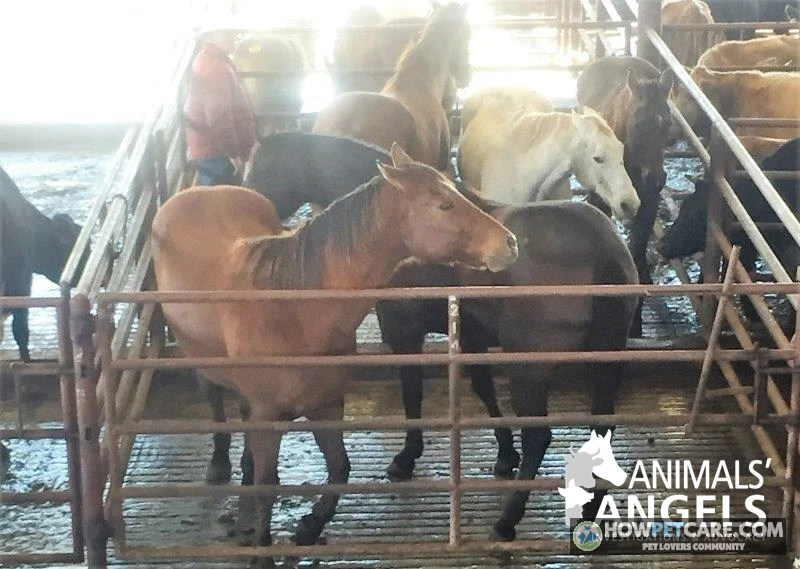
Whether a US plant can obtain inspection is not the same question as whether a live horse can be exported for slaughter. A domestic inspection restriction does not, by itself, close the export route.
Why horses end up at slaughterhouses: who sells, who buys, and how many go each year
From auction pen to kill buyer
Horses enter the market for many reasons. An owner may face illness, a move, rising feed costs, or financial hardship. A horse may be injured, hard to handle, no longer suited to competition, or expensive to maintain in retirement. Breeding and shifting demand can add to the number needing new homes. A horse described as unwanted is not necessarily old, sick, or dangerous; the term describes a placement problem, not a diagnosis.
At an auction, private buyers, trainers, rescue representatives, and dealers may bid on the same animals. A kill buyer is a buyer who acquires horses for resale into the slaughter market. The term describes a commercial role, not a guarantee that every horse purchased will be slaughtered. Some dealers also resell horses to individual owners.
Price may be quoted per horse or by weight. For a seller, the appeal can be speed and payment rather than an immediate expense. The trade-off is losing control over where the horse goes next. A horse sold privately can also be resold later, so its first destination does not necessarily determine its final one.
From feedlot to border crossing
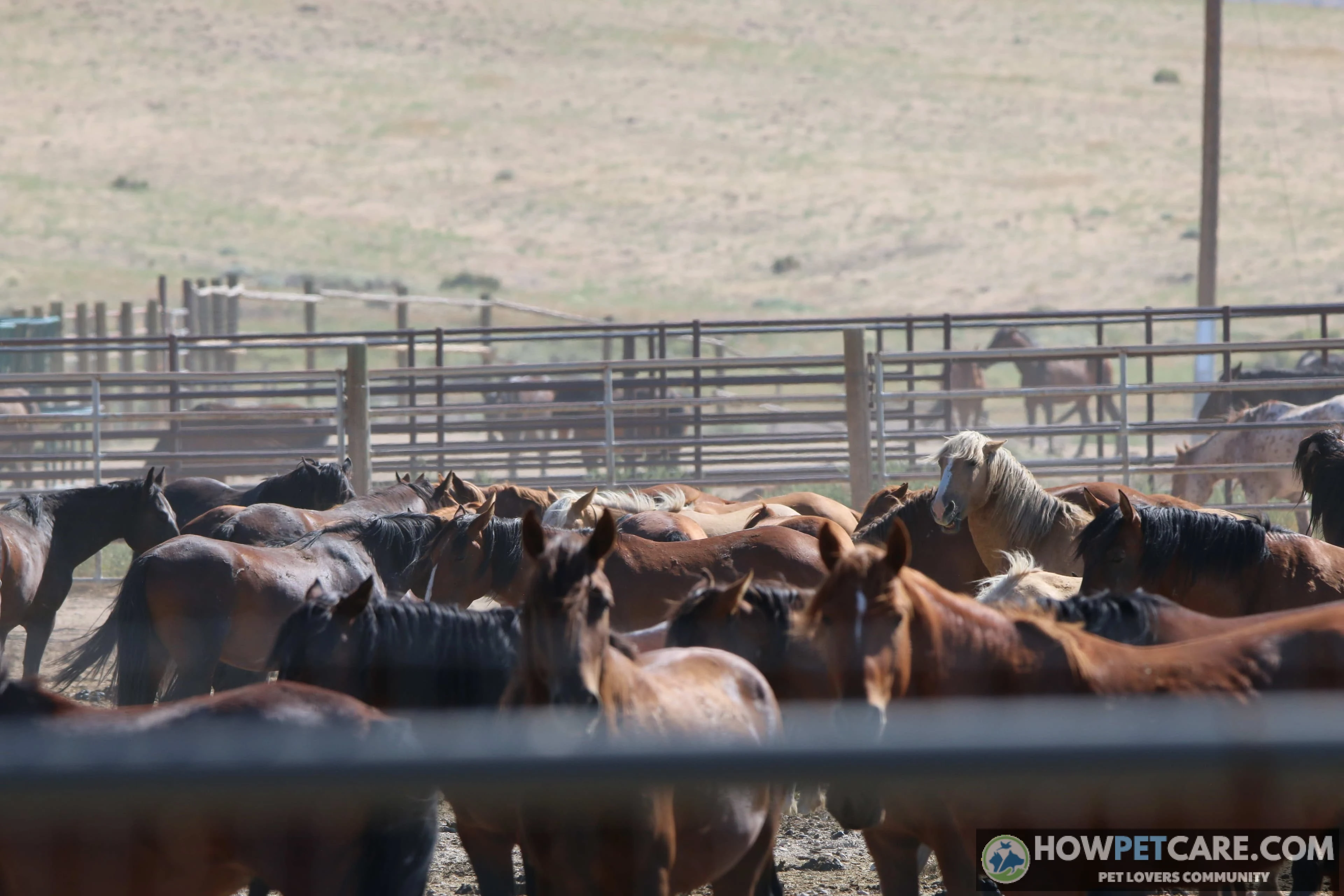
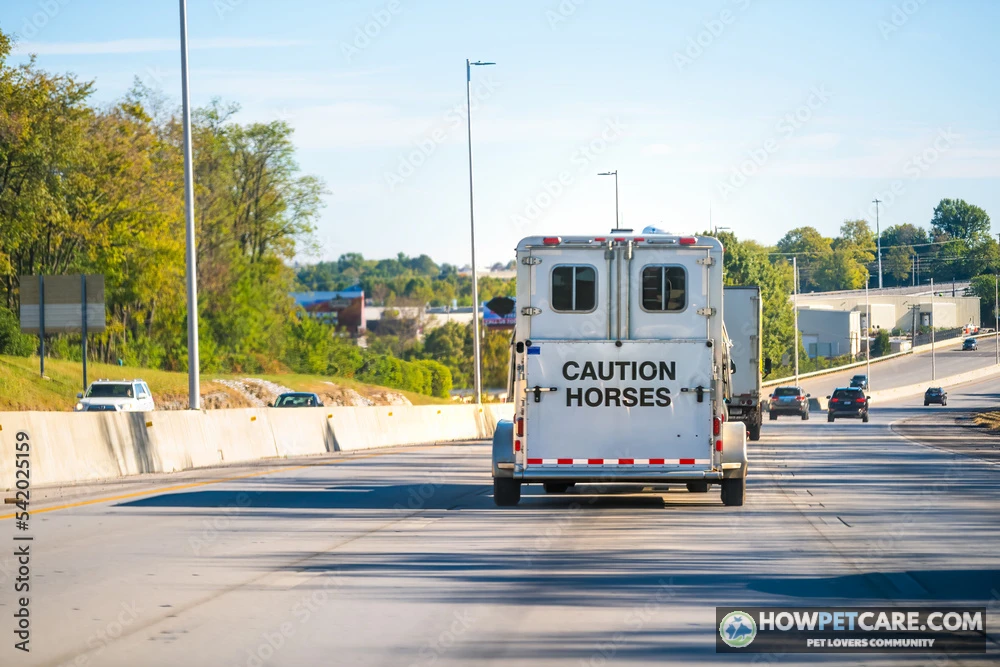
A dealer may collect horses at a holding facility before shipping them. They then travel under rules that depend on the journey’s stage and purpose. USDA’s commercial transport regulations cover horses shipped to slaughter, including documentation, fitness for travel, trailer design, and opportunities for food, water, and rest. Border and destination-country requirements also apply. Compliance on paper is not the same as proof that every animal has a safe journey.
Transport is part of the welfare question, not just a prelude to it. Mixing unfamiliar horses, loading, heat, delays, and the animal’s condition can affect the trip. Conditions after a border crossing fall under the destination country’s rules and enforcement.
Year-by-year export numbers since 2007
Available estimates put the number of US horses crossing into Canada and Mexico for slaughter at roughly 20,000 to 24,000 annually, but the year, destination split, and underlying dataset are not identified. That figure therefore cannot establish a current annual total.
| Year or period | Slaughtered in US plants | Exported to Canada | Exported to Mexico | Total exported for slaughter | Source and limitation |
|---|---|---|---|---|---|
| 2007 | Last federally inspected plants closed during the year; an annual count is not established here | Not established here | Not established here | Not established here | Research summary; not a destination-by-destination dataset. |
| After 2007 | No federally inspected US horse slaughter plant operated after the closures | Exports continued; annual counts not established here | Exports continued; annual counts not established here | Exact annual totals not established here | Research summary. |
This table does not establish a year-by-year trend. A reliable comparison requires the USDA source series, its definitions, and the latest completed reporting year. In particular, a live-horse export count should not automatically be treated as a count of horses actually slaughtered: the recorded purpose, border data, and destination-plant data can differ.
Horse meat is consumed in some markets in Europe, Asia, and Mexico, but the destination of meat from US-origin horses cannot be determined reliably from a live-export count alone. That would require current trade data tracing both the meat and the horses’ origin.
The SAFE Act: what it would do and where it stands after the February 2025 reintroduction
What the bill says
The proposed Save America’s Forgotten Equines, or SAFE, Act aims to address the slaughter of equines for human consumption and the movement of animals into that trade. Its significance lies in the export question: a restriction on transport for slaughter could reach a route that an inspection-funding restriction alone does not.
A bill is not law simply because it has been introduced. Its precise effect depends on the text Congress considers, including definitions, exceptions, and enforcement provisions.
Where it is now
The proposal was reintroduced in February 2025. Based on the congressional record, the bill was referred to committee and has not advanced to a floor vote; it has not been enacted. Sponsors, bill numbers, and cosponsor counts should be checked against the current Congress.gov bill record, which changes as the session proceeds.
Earlier versions were introduced repeatedly without becoming law. That history is why reintroduction alone should not be treated as a prediction of passage.
Other routes: appropriations language and the Farm Bill
Congress can address domestic inspection through appropriations language; a broader statutory prohibition would be a different route. A Farm Bill amendment is another possible legislative vehicle, but the existence or status of any particular amendment must be checked rather than inferred. State restrictions may affect conduct within a state, subject to their wording and any applicable federal law.
The federal Humane Methods of Slaughter Act expressly includes horses in its definition of livestock. That should not be confused with a finding that the Act directly governs a Canadian or Mexican plant; foreign facilities operate under their own jurisdictions’ rules. Supporters and opponents of federal legislation also disagree about the likely consequences of removing the slaughter market, including the availability and cost of other outcomes for horses.
What happens to a horse inside the slaughterhouse, step by step
The following describes the general sequence for horses in slaughterhouses that use a penetrating captive bolt and bleeding. It is not a claim that every equine slaughterhouse uses identical equipment or follows every rule in practice. Public information about individual facilities and their performance varies.
Unloading and ante-mortem inspection
Receiving. Horses are unloaded from vehicles and moved into receiving pens. Handlers and inspectors look for animals that are injured, unable to stand, or otherwise unfit. An ante-mortem inspection is an examination before slaughter; its exact timing and requirements depend on the jurisdiction.
Holding, or lairage. Horses wait in pens before slaughter. Water, space, handling, and separation of incompatible animals matter because unfamiliar surroundings, noise, and mixing can increase stress or injury risk. The time a horse spends in lairage varies.
Lairage and the stun box
Moving forward. Handlers guide horses from the holding pens toward the stunning area. Slippery floors, sharp turns, crowding, and unfamiliar equipment can make movement more difficult. Horses’ reactions to confinement and sudden movement make calm, species-appropriate handling important.
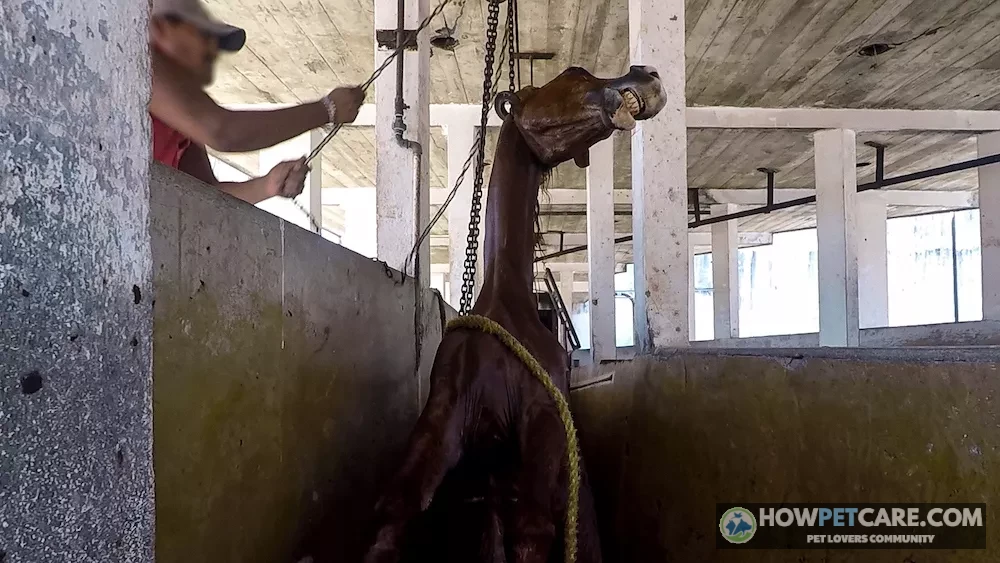
Restraint. A horse enters a stun box or other restraint system meant to limit movement enough for accurate stunning. Head movement makes placement more difficult. Equipment and restraint must fit the animal; forcing the head or body into an unsuitable position can increase distress and interfere with accuracy.

A stun box restrains the horse so the captive bolt can be placed accurately (Source: horsesandpeople)
Captive bolt placement and why horses are hard to stun
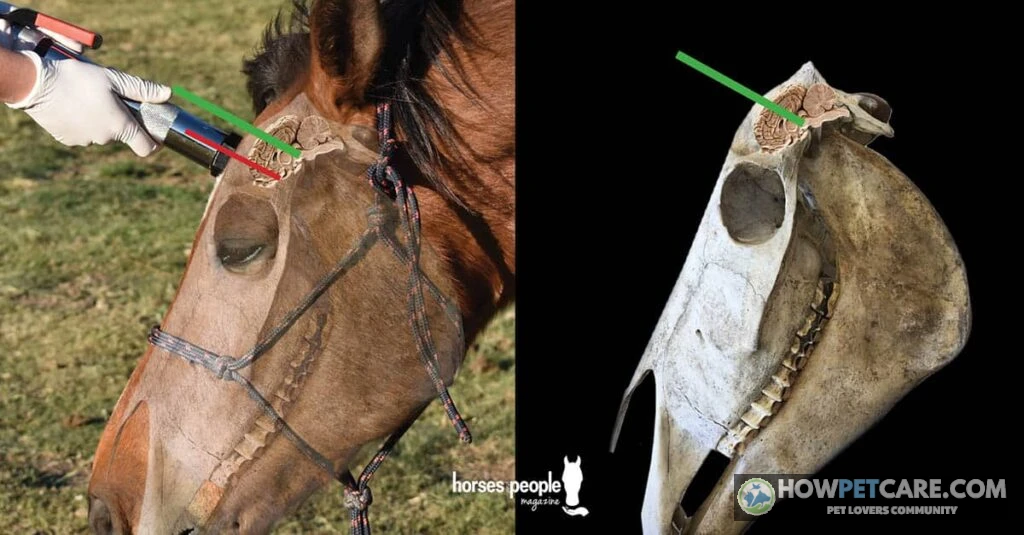
Positioning the device. A penetrating captive bolt drives a metal bolt through the skull and into the brain. The aim is to render the horse immediately insensible. Placement must account for the horse’s skull anatomy and the device’s operating instructions; an incorrectly positioned bolt may not produce an effective stun. This is a task for trained personnel following current veterinary and equipment guidance, not something to improvise from a diagram.
Checking the stun. A successful stun should produce immediate loss of sensibility. Personnel must assess signs together: rhythmic breathing, an attempt to rise, vocalization, or a response to stimulation can indicate a problem. Involuntary kicking can occur without proving consciousness, so movement alone should not be interpreted in isolation. If a stun is ineffective, prompt corrective action is necessary.
Stun-to-stick interval and bleed-out
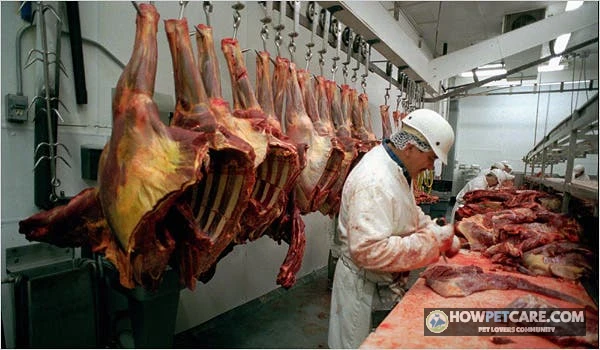
Shackling and hoisting. The horse is typically attached by a hind leg and raised for bleeding. The time between stunning and the cut is called the stun-to-stick interval. It should be kept as short as the applicable rules and method require; delay matters because an animal that was not effectively or irreversibly stunned may recover sensibility.
Bleeding and confirmation. Major blood vessels are cut so that the animal bleeds out. Staff must continue checking for signs of sensibility and confirm death before dressing the carcass. A penetrating bolt stuns the animal; it may also cause fatal brain injury, but the procedure must not rely on the assumption that the bolt alone caused death.

After stunning, the horse is hoisted and bled on the processing line (Source: nytimes)
What the studies say about stunning failure
A frequently repeated figure puts captive-bolt stunning failure in horses between 22% and 28%. The range is commonly attributed to EU Food and Veterinary Office audits of equine slaughter plants, which documented instances of ineffective stunning, but the primary study, its sample, and its definition of failure are not clearly identified. It should not be presented as an industry-wide rate—or even a verified rate for a particular plant—without that information.
The same limitation applies to footage or investigations showing apparent conscious slaughter: such material can be important evidence about the recorded facility and incident, but it does not establish how often the problem occurs across all plants. The underlying investigation is not identified clearly enough to assess its scope here.
Is horse meat from US horses safe? Phenylbutazone, clenbuterol, and EID fraud
Banned drugs in horses and their residues
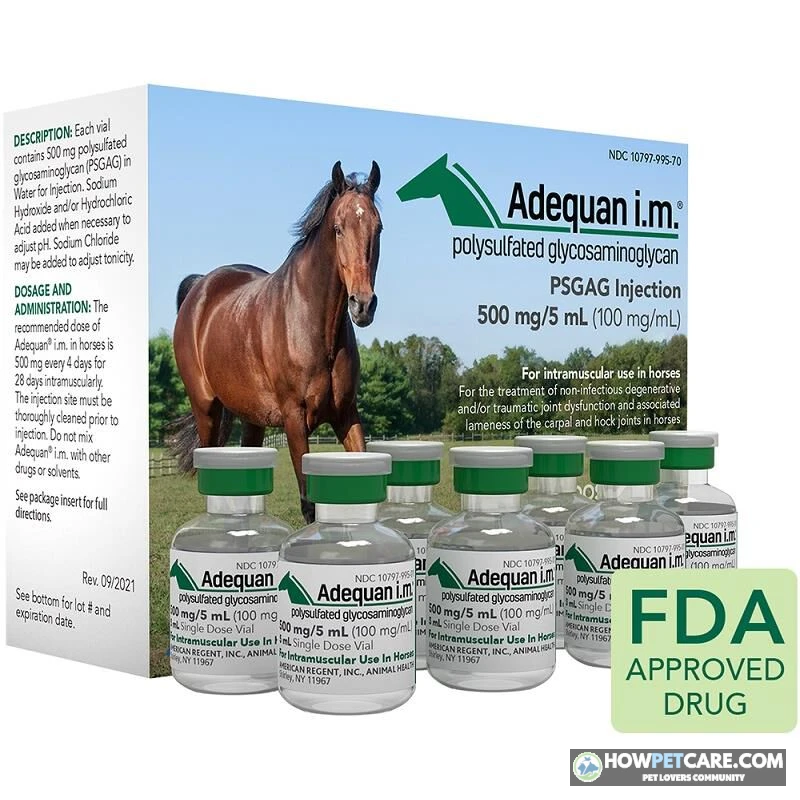
A food-safety concern arises because many US horses spend their lives as riding, working, or companion animals rather than being managed from birth under a food-animal medication record. Their histories can include drugs whose use makes food-chain eligibility difficult to establish.
Phenylbutazone, commonly called bute, is an anti-inflammatory used in horses. Its potential human-health concern includes rare, serious blood disorders associated with exposure. Clenbuterol is another relevant drug: it has veterinary uses but is subject to food-animal restrictions because residues can pose risks. The applicable prohibition, permitted use, and residue standard depend on the jurisdiction and species.
The presence of a drug in a horse’s treatment history is not the same as a measured harmful residue in a particular piece of meat. Equally, a negative residue test does not reconstruct a complete lifetime treatment history. Published reviews also note a lack of long-term clinical surveillance of people consuming horse meat for effects of phenylbutazone and its metabolite oxyphenbutazone.
Paperwork and fraud: how drug histories go missing
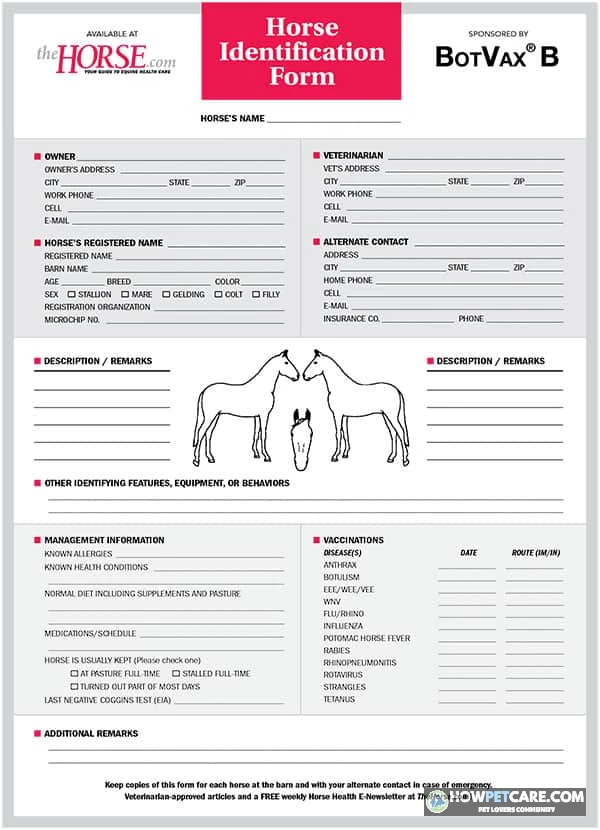
Identification documents and treatment declarations are intended to connect an animal to its medication history and food-chain eligibility. In Canada, the key record is the Equine Information Document, or EID, on which the person presenting a horse declares its treatment history; the EU relies on horse passports for a similar purpose. That control is only as reliable as the identification, the information available to the person signing it, and the checks performed. A declaration made after a horse has changed hands repeatedly may be difficult to substantiate.
False paperwork—including a falsified EID—is distinct from an incomplete record. Available material does not identify an individual enforcement case or audit finding, so it cannot establish how often either occurred. Nor does it support a claim that all American horses lack records or that all declarations are false.
What CFIA and EU audits found
Regulators use documentation, inspection, and residue testing as different layers of control. The Canadian Food Inspection Agency, or CFIA, oversees federal meat inspection in Canada; European authorities impose import conditions and audit relevant systems. Testing can detect selected substances in sampled animals, but its value depends on which drugs are tested, when samples are taken, and what proportion of animals is checked.
No verifiable CFIA testing percentage, named audit finding, or confirmed current status of EU imports of horse meat from Mexico is established here. Those details need primary-source verification before they can support a numerical comparison or a claim about a present suspension. A food-safety judgment should not be reduced to “all meat is unsafe” or “testing makes incomplete histories irrelevant.”
A treatment record answers what an animal received, if the record is complete. A residue test answers whether selected substances were detected in a particular sample. Neither control automatically replaces the other.
Horse slaughter laws and welfare standards compared: US, Canada, Mexico, the UK, and the EU
The comparison below separates the existence of rules from evidence of enforcement. Requirements can vary by facility, destination market, and local jurisdiction.
| Jurisdiction | Slaughter for food legal? | Oversight body | Stunning requirement | Transport and traceability rules | Drug-residue and medication-record rules | Notes and source |
|---|---|---|---|---|---|---|
| United States | No federally inspected horse slaughter plant has operated since the 2007 closures; live export has continued | USDA oversees relevant federal inspection and slaughter-bound commercial transport | Federal humane-slaughter law includes horses; applicability must be considered alongside inspection and state law | Federal commercial transport rules apply to covered slaughter shipments; destination rules also apply | Food-animal and residue rules are separate from the absence of operating inspected plants | A domestic closure is not an export ban. |
| Canada | Legal at appropriately inspected facilities | CFIA for federally inspected plants | Federal humane-slaughter requirements apply; the permitted method and facility procedures must be checked | Federal transport rules and identification requirements apply; export-market conditions can add requirements | Documentation and residue controls depend in part on the market | Current plant-level performance and testing rates are not established here. |
| Mexico | Horse slaughter for food is legal under applicable controls | Federal and local oversight varies by facility | Requirements and enforcement should be checked for the facility and market | Transport and identification requirements vary with the route and market | Export-market eligibility depends on applicable certification and residue rules | Current plant-specific compliance and EU import status are not established here. |
| United Kingdom | Legal at authorized facilities | Food Standards Agency and other competent authorities | Welfare law generally requires stunning, subject to applicable legal exceptions | Equine identification and movement requirements apply | Identification and food-chain status affect eligibility | Rules differ among UK nations; check the relevant authority. |
| European Union | Legal at authorized facilities | Member-state authorities; European Commission oversight and audits | Stunning is generally required, with specified legal exceptions | Equine identification and traceability requirements apply | Medication history and prohibited substances affect food-chain eligibility | Implementation and enforcement involve individual member states. |
Cultural attitudes toward eating horse meat do not determine its legal status. Conversely, a legal requirement on paper does not establish that it is met in every shipment or plant.
If export ended: surplus horses, euthanasia costs, and the arguments on each side
Arguments for ending export
Those who favor an export ban point to transport stress, the difficulty of accurate stunning, the possibility of ineffective enforcement, and uncertainty about medication histories. Some also object to treating horses as food animals. These concerns do not require assuming that every shipment is abusive or that every sample of meat contains a harmful residue.
A ban directed at transport for slaughter would address more of the pipeline than a restriction on funding domestic inspection alone. Its welfare effect would depend in part on what happens to horses that otherwise would have entered that pipeline.
Arguments for keeping the slaughter market
Those who favor retaining the market argue that it gives owners a buyer for horses with limited value elsewhere. A sale can bring in money immediately; veterinary euthanasia and carcass disposal generally require payment. Where rescue places, renderers, or legal disposal options are scarce, removing a buyer does not automatically make those services available.
The concern about neglect or abandonment is a serious question, not proof that a ban would cause either outcome. Owners’ decisions respond to many factors, including local prices, feed costs, enforcement of neglect laws, and access to assistance.
What we know and do not know about surplus horses
The US Government Accountability Office examined indicators of horse welfare after domestic slaughter plant closures in its 2011 report. That is useful historical context, but conditions after domestic closures do not by themselves predict the effect of a future export ban: horses could still cross the border during the period examined.
The annual export estimate in circulation—roughly 20,000 to 24,000 horses—is undated; it is neither a verified current count nor an estimate of how many would need rescue if exports ended. Some might be retained, sold for another purpose, retired, or euthanized; how many would follow each path is not established here. A horse counted in the trade is not automatically a horse a rescue would have to house.
Costs could fall on owners, rescues, local governments, and disposal providers. Regional capacity matters: a service available in one county may be unavailable or unlawful in another. Better planning, responsible breeding, gelding where appropriate, and earlier rehoming can reduce pressure, but none removes the need to budget for horses that cannot be placed.
Alternatives to sending a horse to slaughter, with costs, and a checklist for owners
Rehoming and rescue options
Start with an honest assessment of the horse’s soundness, temperament, and care needs. A suitable home for a riding horse may not be suitable for a horse needing retirement or veterinary management. Disclose known health and behavior issues rather than presenting a quick sale as a guaranteed permanent placement.
| Option | Typical cost to owner | Time and effort | Potential outcome | Main limitation |
|---|---|---|---|---|
| Private sale or rehoming | Advertising, care while waiting and possible transport; obtain local quotes | Screening and written disclosure take time | A new owner takes responsibility | A later resale can be difficult to control |
| Trainer, breed group or appropriate riding program | Training, evaluation or transport may be charged | Requires an assessment and a suitable match | Retraining or placement in a relevant program | Programs cannot accept every horse or every medical condition |
| Rescue or sanctuary surrender | Fees and transport vary; ask before applying | Application, records and waiting may be required | Placement, rehabilitation or retirement if accepted | Capacity and eligibility vary |
| Retirement boarding | Ongoing board, veterinary, farrier and other care costs | Requires a continuing budget and oversight | Long-term care without transferring ownership | Cost continues for the rest of the horse’s life |
| Veterinary euthanasia and disposal | Veterinary visit, medication and disposal; request an itemized local quote | Requires a veterinary discussion and disposal plan | A controlled end-of-life option | Upfront cost and local disposal restrictions |
No reliable national price range is established here for euthanasia, disposal, or the amount a kill buyer would pay. The meaningful comparison is therefore local: ask an auction about commissions and likely charges, a veterinarian for an end-of-life quote, and disposal providers what they accept. Compare the net proceeds of a sale with the complete euthanasia and disposal bill, not just the injection fee.
For a rescue, ask about capacity, surrender terms, adoption screening, follow-up, and what happens if the horse cannot be placed. Accreditation by a recognized organization such as the Global Federation of Animal Sanctuaries can be one useful screening factor, but it does not guarantee an opening or a particular outcome. Hay assistance, owner-support, and gelding programs may be available locally; confirm their current eligibility and funding before relying on them.
Euthanasia and disposal: what they cost and how they work
Veterinary euthanasia can be a responsible choice when a horse is suffering, cannot be safely handled, or cannot be provided an appropriate quality of life. A veterinarian can discuss the animal’s condition, sedation, and the method used. The aim is a controlled death with minimal avoidable distress; it is not the same process as commercial slaughter.
Plan disposal before the appointment. Depending on location and service availability, options may include permitted burial, rendering, composting, or cremation. Local rules, ground conditions, and the euthanasia drugs used can affect which options are available. In particular, remains containing euthanasia drugs can poison scavengers and may not be accepted by every disposal service.
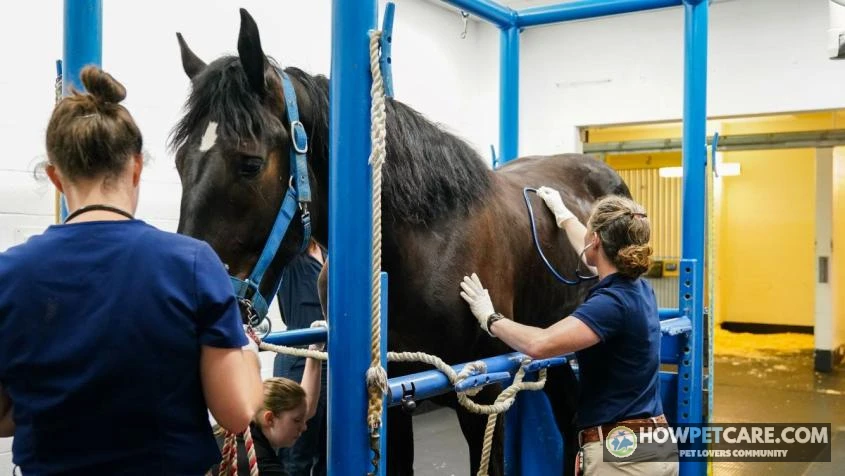
When requesting a quote, ask about the farm call, sedation, euthanasia, pickup, disposal, and any emergency or distance fees. Confirm that the disposal provider can accept the remains after the planned procedure.
A decision checklist for owners
Assess the horse with a veterinarian. Record pain, soundness, behavior, treatment needs, and a realistic prognosis.
Set a budget and timeline. Include continuing care while seeking a home and obtain an itemized euthanasia-and-disposal quote as a baseline.
Contact potential placements early. Ask suitable trainers, breed groups, programs and rescues about eligibility, costs, and waiting lists.
Screen prospective owners. Discuss intended use, experience, facilities, and the horse’s limitations. Put disclosures and sale terms in writing.
Understand contract limits. A right of first refusal or no-slaughter clause may help document intentions, but enforcement can be difficult after a horse changes hands. It is not a lifetime guarantee.
Keep identification and medication records. Pass accurate records to the next owner and retain copies. They support continuity of care and may matter to any future food-chain eligibility decision.
FAQ
What is a kill buyer?
A kill buyer purchases horses, usually at livestock auctions, to resell them for slaughter. Some also resell horses to riders or rescues, so the term describes a buying purpose and not a licensed occupation.
Is it legal to eat horse meat in the United States?
No federal law bans eating horse meat, but there are no USDA-inspected horse slaughter plants to supply it. Some states prohibit selling it for human consumption, so check your state’s law.
Which countries eat horse meat from US horses?
Meat from US-origin horses slaughtered in Canada and Mexico is sold to a mix of foreign markets, including some in Europe and Asia, and Mexico’s domestic market. Export destinations change by year, so consult current USDA and CFIA trade data.
Is horse slaughter the same as euthanasia?
No. Euthanasia is a veterinarian-administered injection that causes death with minimal stress, while slaughter involves transport, handling, and a stunning and bleeding process at a plant. Euthanasia typically costs the owner money, while a horse sold for slaughter brings a small payment.
Are there transport rules for horses going to slaughter?
Yes. A USDA rule for commercial transport of horses to slaughter bans double-decker trailers and requires periodic rest, feed, and water. How well the rule is enforced and whether it is sufficient are disputed.