
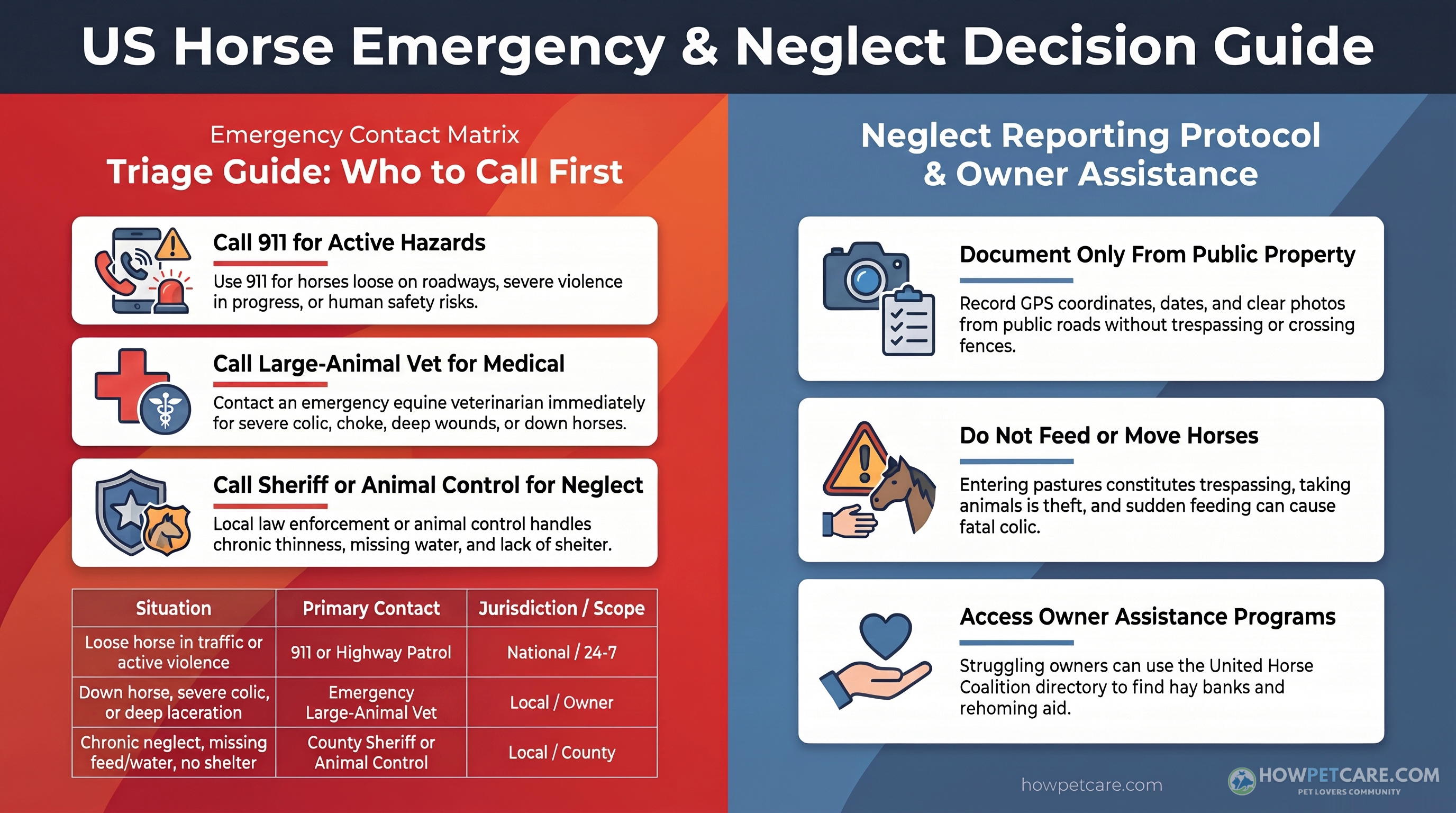
There is no single national horse helpline in the US. Match your situation to the right first call:
| Situation | First call |
|---|---|
| Person in danger, horse loose on a road, cruelty in progress | 911 |
| Horse down, severe colic, injured, or choking | Emergency large-animal veterinarian |
| Suspected neglect or abuse | Local animal control or county sheriff non-emergency line |
| Wild horse or burro on federal land | BLM: 866-468-7826 (866-4MUSTANGS) |
| Suspected poisoning | Vet first, then ASPCA Poison Control (888) 426-4435 |
If a horse is in trouble right now, here’s the plain truth: there is no single US-wide horse helpline number you can dial. In the United States, horse emergencies and welfare concerns run through a patchwork of local, state, and national contacts. For immediate danger, call 911. For a medical emergency such as colic or a horse that’s down, call a large-animal veterinarian or an emergency equine vet. For suspected neglect or abuse, call your local animal control, county sheriff, or a humane officer. Nationwide, the Bureau of Land Management (BLM) wild horse and burro program is the closest thing to a dedicated hotline, at 866-468-7826 (866-4MUSTANGS).
Many search results for "horse helpline" lead to British charities like the British Horse Society, World Horse Welfare, and the National Equine Welfare Council. Their phone numbers, laws, and reporting flows do not apply in the United States. US readers should ignore those numbers and use the domestic directory below.
Three situations, three calls. Keep this short list handy and read on for the details:
- Horse down, injured, or showing severe colic: call the owner if known; otherwise a local emergency large-animal vet. Call 911 if a person is in danger.
- Horse loose on a road or highway: call 911 or the highway patrol right away.
- Suspected neglect or abuse: call local animal control or the county sheriff non-emergency line.
The rest of this guide gives you the full directory, a scenario-by-scenario decision guide, a checklist to have ready before you call, and honest answers about what happens afterward.
An equine helpline sounds like it should be one number, but the US doesn’t work that way. Enforcement of horse cruelty and neglect is handled at the state and county level under state law, and medical emergencies belong to veterinarians, not phone lines. The practical routing order is: 911 for life-or-safety situations, a large-animal veterinarian for anything medical, and animal control or the sheriff for welfare concerns. National organizations like the ASPCA and the United Horse Coalition (UHC) mostly provide resources, referrals, and advocacy rather than 24/7 dispatch, so treat them as guides to the right local agency, not as the first call for an active emergency.
National US horse helpline and hotline directory
This table consolidates the contacts that actually handle horse issues in the US. Phone numbers change, so verify any number on the organization’s official site before a real emergency, and confirm against the source page. Treat every entry here as needing a quick check on the official page.
| Contact or Agency | Phone or Where to Find It | Hours | Jurisdiction | Best For | Cost to Caller |
|---|---|---|---|---|---|
| 911 | Dial 911 | 24/7 | United States | Person in danger, horse loose on a road or highway, cruelty or violence in progress | Free |
| Local animal control or humane officers | Official city or county website | Varies; many business hours with emergency dispatch | Usually city limits or county service area | Neglect concerns: no feed, no water, no shelter, chronic thinness, unsafe conditions | Usually free |
| County sheriff non-emergency line | County sheriff official site or county directory | Dispatch often 24/7; livestock deputies vary | Unincorporated and rural areas in many states | Loose livestock, welfare checks, neglect where animal control does not cover horses | Free |
| State veterinarian or state department of agriculture | Official state .gov agriculture or animal health page | Mostly business hours | Statewide | Herd-level welfare concerns, animal disease questions, referrals to the right enforcement channel | Free |
| ASPCA Animal Poison Control Center | (888) 426-4435; verify on aspca.org | 24/7 | US | Suspected poisoning, toxic plants, contaminated feed or medication exposure | Consultation fee may apply |
| Pet Poison Helpline | (855) 764-7661; verify on petpoisonhelpline.com | 24/7 | North America | Poison exposure guidance for animals, including horses when accepted | Consultation fee may apply |
| United Horse Coalition | unitedhorsecoalition.org resource directory | Website | US | Owner help: hay, feed, veterinary assistance, rehoming and safety-net resources | Free to browse; program rules vary |
| BLM Wild Horse and Burro Program | 866-468-7826 (866-4MUSTANGS) | Mostly business hours | Federal land | Wild horses or burros on federal land; do not route to local animal control first | Free |
One clarification on those national groups: the ASPCA and the United Horse Coalition are resource, advocacy, and referral organizations, not 24/7 horse dispatch lines. The BLM program takes calls specifically about wild horses and burros on federal land. For everything else, the working call is your local animal control, sheriff, or state agriculture office. Days End Farm Horse Rescue (DEFHR), reachable at 301-854-5037, is one example of an equine rescue that offers help and guidance rather than acting as a national hotline.

Which Number to Call for Your Situation: Collapsed, Loose, Thin, or Owner in Crisis
The fastest way to act is to match your situation to the right first call. This decision guide covers the scenarios readers face most. When in doubt, start with the highest-urgency line available for that situation.
| Situation | First Call | Backup Call | What to Say or Have Ready | Urgency Level |
|---|---|---|---|---|
| Horse down and cannot rise, severe colic, major bleeding, wound near a joint, choke, or heat stress | Owner if known; otherwise a local emergency large-animal veterinarian | 911 or sheriff if any person is in danger | Exact location, whether the horse is trapped, visible injuries, how long it has been down | Emergency now |
| Loose horse on a road, highway, rail crossing, or public area | 911 or highway patrol for active traffic danger | Sheriff non-emergency line once the scene is safe | Road name, nearest mile marker or cross-street, direction of travel, whether cars are braking or swerving | Emergency now |
| Chronically thin horse, empty water troughs in heat, no hay or feed visible, no shelter in harsh weather | Local animal control or sheriff for livestock areas | State veterinarian or county extension if you cannot find the right agency | Address or GPS pin, dates seen, photos from public property, number of horses, water/feed/shelter observed | Report promptly, usually business hours |
| Deliberate cruelty, beating, shooting, or abuse happening now | 911 or law enforcement | Animal control after immediate danger is handled | What is happening, whether weapons are present, whether people are at risk, location | Emergency now |
| Suspected poisoning, toxic feed, moldy hay, pesticide, or plant exposure | Large-animal veterinarian first | ASPCA Animal Poison Control or Pet Poison Helpline if advised | What the horse may have eaten, amount if known, time of exposure, symptoms | Call a vet now |
| Wild horse or burro on BLM, Forest Service, tribal, park, or other managed land | Managing land agency field office | 911 if the animal is creating an immediate road hazard | Land name, road or trail, GPS or mile marker, whether the animal is injured or near traffic | Urgent if roadway; otherwise agency hours |
| Owner says they cannot afford hay, farrier, euthanasia, or veterinary care | United Horse Coalition directory, local rescue, hay bank, extension office, or vet | Animal control proactive welfare conversation if surrender or compliance is a concern | What is needed, county, number of horses, timeline, whether the issue is temporary or ongoing | Help channel, not a report |
| Unsure whether it is neglect or a sick or elderly horse under care | Document from public property, then call animal control or sheriff non-emergency | Ask county extension or a large-animal vet which agency covers the address | Facts only: what you saw, when, how often, and whether conditions changed | Report promptly, not accusatory |
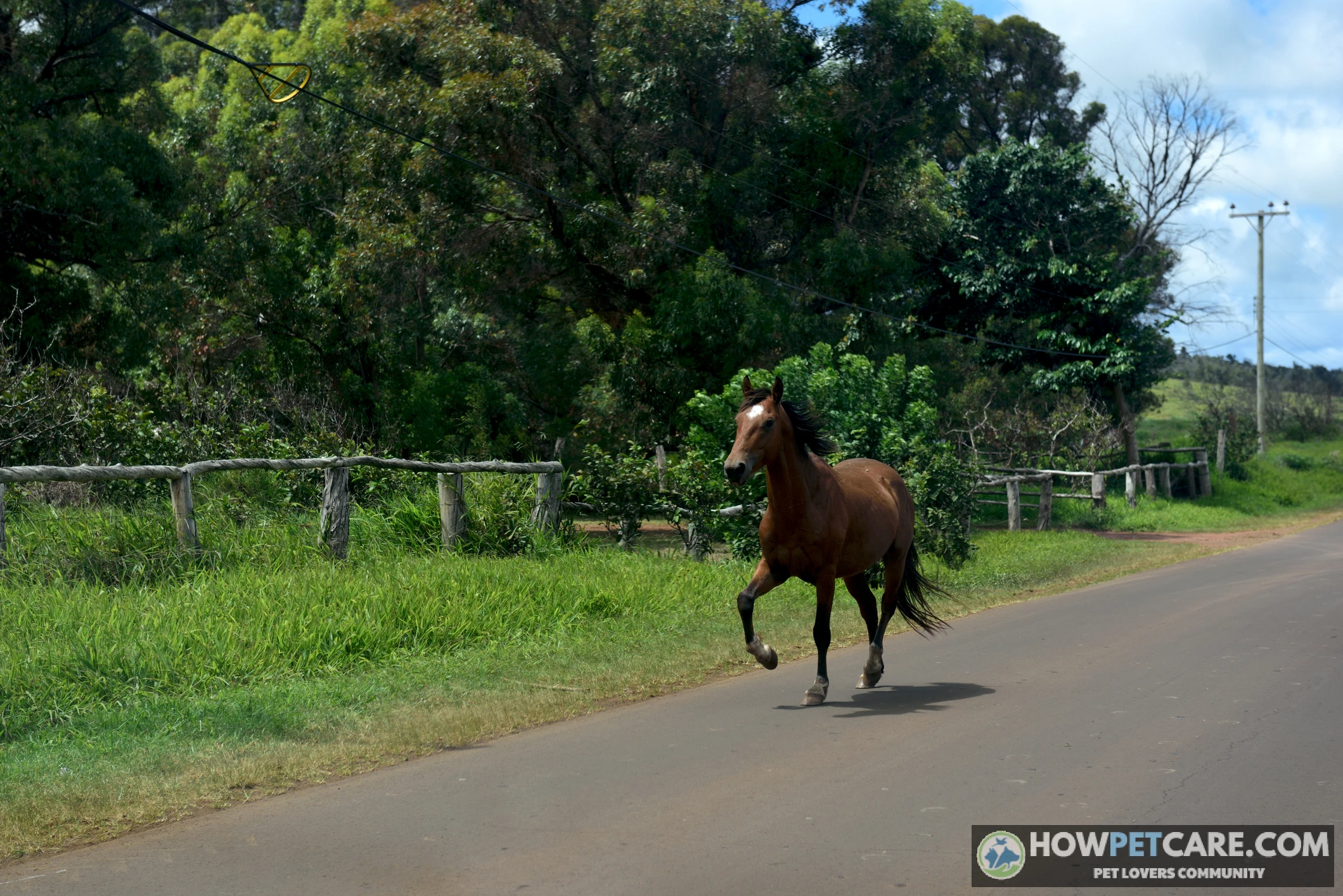
A few rules of thumb make the table easier to use. If a person is in danger at any point, 911 overrides everything else. If the horse is on a roadway, treat it as a public safety hazard and call 911 or highway patrol before anything else, because a loose animal in traffic endangers drivers, not just the horse. If the concern is chronic thinness or missing water and feed, that is an animal control or sheriff matter, usually handled during business hours. If the horse owner is struggling to afford care, that is a help channel, not a report, and it belongs in the owner-in-crisis section below.
If you can’t tell which category it is
When you are unsure whether something is an emergency, a neglect concern, or a sick animal under veterinary care, document what you observe from public property and call animal control or the sheriff non-emergency line. Ask them plainly: "Who handles livestock cruelty reports at this address?" That single question routes you to the right agency even when you do not know your county’s structure. It is always acceptable to ask rather than guess.
Horse Welfare Emergency vs. Non-Urgent Concern: What Counts and What Doesn’t
Knowing what counts as a horse welfare emergency helps you act quickly and helps the call-taker triage your report. Emergency equine care situations are time-sensitive, while non-urgent concerns still matter but do not require an immediate response.
Signs a horse needs emergency help now
Call for an emergency horse veterinarian right away if you see any of these:
- A horse that is down and cannot rise, or is cast and unable to get up.
- Colic signs: repeated rolling, pawing, kicking at the belly, sweating, or a horse that will not eat and looks uncomfortable.
- Laminitis signs: reluctance to move, a rocking-back stance that shifts weight off the front feet, or a horse standing stretched out.
- Severe bleeding, a wound near a joint, or a deep laceration.
- Choke (saliva, food, or discharge at the nose and mouth, repeated swallowing), or signs of heat stress.
- No access to water in extreme heat or cold.
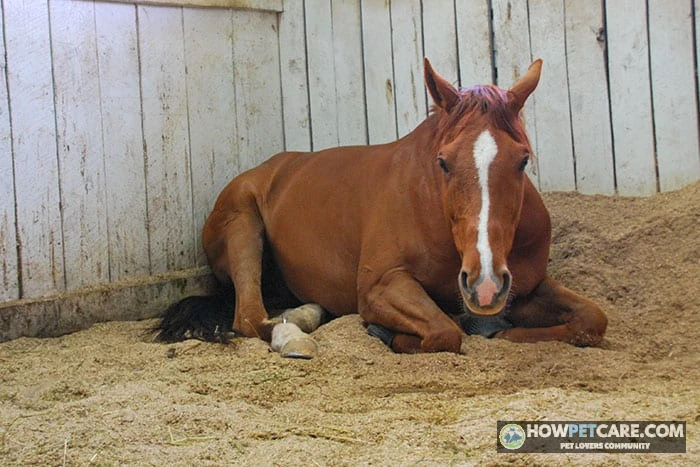
If the horse is trapped or badly injured, a large-animal veterinarian or emergency equine veterinarian should be your first medical call, and 911 if anyone is in danger. Do not attempt to move a badly injured animal yourself.
How to tell a neglected horse from an elderly or under-care horse
Not every thin horse is a neglected horse, and reporting based on appearance alone can be unfair and unhelpful. A useful reference is the Henneke Body Condition Score, a 1-to-9 scale used to assess equine body condition. Elderly horses, horses recovering from illness, and horses with dental problems or certain medical conditions can look thin while receiving appropriate care.
The stronger signals of neglect are conditions, not just body shape: no visible feed or hay, no water, no shelter in harsh weather, unsafe fencing, or signs that a horse has not received needed veterinary or farrier care over time. Describe what you observe and avoid diagnosing or accusing. Only authorities can determine whether conduct violates a state anti-cruelty statute. Keep the tone toward owners calm and neutral, because many cases involve a lack of resources or knowledge rather than intent.
When you report, state what you can see: "no water trough visible and no hay over the last two weeks." Avoid labels like "starving" unless a veterinarian or officer has confirmed them. Observations are more actionable and more credible than accusations.
State-by-State: How to Find Who Takes Horse Neglect Reports in Your State
This is the question US searchers ask most and get the worst answer to: everyone says "call animal control" and stops. The truth is that authority is split by state and county. Horse cruelty and neglect law is state law, and enforcement may sit with animal control, the sheriff, humane officers, or the state department of agriculture or state veterinarian. In many rural counties, the sheriff’s office handles livestock calls because there is no dedicated animal control for horses.
| State | Typical Lead Reporting Agency | State Veterinarian or Agriculture Office | Official Reporting Page or Phone | Notes on Anonymity or Jurisdiction |
|---|---|---|---|---|
| Texas | County sheriff or local animal control | Texas Animal Health Commission, state veterinarian office | Official county sheriff or city animal services page; TAHC via texas agriculture site | Varies by county; large rural areas often rely on sheriff livestock deputies |
| California | Local animal control or humane officer | California Department of Food and Agriculture, Animal Health and Food Safety Services | City or county animal services page; CDFA official site | Many counties have humane officers empowered to investigate |
| Florida | County sheriff or animal services | Florida Department of Agriculture and Consumer Services, Division of Animal Industry | County animal services page; FDACS official site | Livestock investigations often handled by sheriff’s agricultural unit |
| Kentucky | County sheriff or animal control | Kentucky Department of Agriculture, state veterinarian | County sheriff or animal shelter page; KDA official site | Equine-dense state; county rules vary widely |
| Any US state | Local animal control, county sheriff, or state agriculture office | State department of agriculture or state veterinarian page | Search ‘[county] animal control’ or ‘[county] sheriff’; confirm on official .gov page | Seizure authority and reporter protections vary by state |
Why ‘animal control’ is not always the right answer for horses
Some city animal control agencies handle only dogs and cats, or have no jurisdiction over livestock outside city limits. That is why the sheriff is often the correct call for horses in rural areas. In some states, livestock or brand inspectors or specially empowered humane officers exist, but only name those where your state’s official sources confirm it. The safest default is to call the county non-emergency line and ask who handles livestock cruelty reports at a given address.
Lookup method for any county
When your state is not detailed in the table above, use this four-step method:
-
Find the local authority
Search "[county] animal control" or "[county] sheriff" and open the official government or county page, not a third-party listing.
-
Check the state level
Find the state department of agriculture and state veterinarian page, which usually lists reporting contacts and authority.
-
Ask a local expert
Call the county extension office or a large animal veterinarian and ask which agency covers livestock welfare at your address.
-
Use the non-emergency line
Call the county non-emergency number and ask, "Who handles livestock cruelty reports at this address?"
Also note jurisdiction differences: a case inside city limits, in unincorporated county land, on tribal land, or on federal land can each route to a different authority.
Before You Call: A Mobile-Friendly Documentation Checklist
A clear report is far more actionable than a vague one. Use this checklist from your phone before you call. Confirm only what you can see from public property or with permission, and never trespass to gather information. This is your neglect reporting preparation, and it works equally well for an emergency welfare check.
- ☐ Exact location: street address, GPS pin, road names, nearest cross-street, county if known, and landmarks for unmarked driveways.
- ☐ Access note: where an officer can legally view the horse from public land, a driveway approach, or with owner permission. Do not enter fenced pasture.
- ☐ Animals present: number of horses, colors, markings, approximate size, and whether mules, donkeys, cattle, or other livestock are also present.
- ☐ Condition: body condition using the Henneke 1-9 scale if you know it, visible ribs or spine, wounds, lameness, blanket or fly-mask issues, manure buildup, fencing hazards.
- ☐ Basics observed: water present or absent, feed or hay visible, shelter or shade, mud or ice conditions, and extreme weather during your observation.
- ☐ Timeline: first date noticed, how many times seen, approximate times, and whether the situation is improving, stable, or worse.
- ☐ Photos or video: take wide shots for location plus closer views of water, feed, shelter, fencing, and body condition. Keep timestamps on. Do not trespass, climb fences, open gates, or fly a drone where prohibited.
- ☐ People and contact: owner name or property occupant if known, whether you have spoken to them, witnesses, and whether anyone is feeding or checking on the horse.
- ☐ Your contact preference: name and callback number, or anonymous tip. If anonymous, ask how the agency can still reach you if they need the exact location.
- ☐ Safety: note dogs, gates, traffic, firearms concerns, or weather hazards an officer should know before arrival.

What to say in the first 30 seconds
Use a short script so you stay calm and give the call-taker what they need: "I would like to report a possible horse welfare concern at [address or GPS pin]. I have seen [number] horses there since [date]. My main concerns are [no water or feed or shelter or injury or body condition]. I have [photos or video] taken from [public road or permitted location]. Can you tell me which agency handles livestock reports at this address and whether I can get a case number?"
What Happens After You Report Horse Neglect: Investigation Steps, Timelines, and Costs
Knowing what happens after a report reduces anxiety and sets realistic expectations. This part of the reporting process is often left unexplained, so here is the general process, along with honest limits.
Step-by-step: what the investigation looks like
- Intake: the call-taker records location, urgency, number of animals, safety risks, and your callback preference. Ask: "Can I get a case or incident number?"
- Triage: emergency danger to people or animals is prioritized over non-urgent welfare concerns. Ask: "Is this being routed to animal control, a sheriff deputy, humane officers, or the state veterinarian?"
- Welfare check: an officer may drive by, visit the site, contact the owner, or request entry consent. They generally cannot diagnose on the spot.
- Assessment: if warranted, the agency may involve a veterinarian, body-condition scoring, water and feed checks, shelter review, and records for prior complaints.
- Outcome paths: common outcomes include education, a corrective plan with recheck dates, a citation or charge where state law allows, a surrender arrangement, or seizure only when an authorized officer or court process supports it. No action is also a possible outcome.
- Follow-up: before ending the call, ask, "Can I check back using the case number? Will you be able to tell me the outcome, or is the investigation confidential?"
How long it takes and whether you will hear back
Timelines vary widely by staffing, urgency, and county capacity, so no honest article can promise a fixed response time. Urgent cases are prioritized, and non-urgent welfare concerns may take longer. Many agencies cannot share case details during an open investigation, so ask for a case number and whether you can check back. Manage expectations: outcomes can include education, a corrective plan, or no action, and that can feel slow even when the process is working.
Regarding legal authority, seizure typically requires law enforcement or a court order or statutory authority under state law, and private charities generally act through, or alongside, authorized officers rather than seizing animals themselves. The ASPCA and United Horse Coalition, for example, provide resources and referrals, not independent seizure power. This varies by state, so treat it as general guidance, not legal advice.
Who pays for the vet, transport, and rescue
Calling 911, an animal control reporting line, or a sheriff non-emergency line is generally free. Veterinary exams, transport, boarding, and rescue costs vary by agency and state. In many cases the owner is billed, and agencies or rescues may cover costs when owners cannot. Poison control lines such as the ASPCA Animal Poison Control Center and Pet Poison Helpline typically charge a consultation fee, so ask about cost when you call.
As the reporter, you are not usually responsible for response costs, but do not authorize veterinary treatment for a horse you do not own without an agency’s direction. Do not promise boarding or pay for care unless an agency asks you to. Leave the financial and medical decisions to the owner and the responding authority.
Your job is to report accurate observations and then step back. The agency decides urgency, authority, and outcome. Trying to manage the case yourself can complicate or delay it.
Anonymous Reports, Retaliation, and What Not to Do When Reporting
Many people hesitate to report because they worry about their identity or about the owner retaliating. Here is how to protect yourself and keep the case clean.
Can I stay anonymous?
Many agencies accept anonymous tips, but confidentiality rules vary by state and agency. In some places, public records laws may expose a reporter’s identity, so ask before you give your name. There is a trade-off: anonymous reports can be harder to follow up on and can limit the agency’s ability to ask questions. A practical middle path is to give your name and request confidentiality, which keeps you reachable for follow-up while asking the agency to protect your information.
If the owner retaliates
Threats, harassment, or property damage are crimes. If an owner retaliates against you, report it to law enforcement immediately and keep records of dates, messages, and witnesses. Legal protections for good-faith reporters vary by state, so confirm your options with the responding agency or local counsel rather than assuming a blanket protection exists. Stay calm and non-confrontational in any contact with an owner, and if you feel unsafe, step back and let authorities handle it.
Common mistakes that hurt a case
- Do not trespass or enter the property to gather evidence. Photos from public property are enough.
- Do not cut fences, open gates, or take the horse. Taking an animal can be treated as theft.
- Do not feed an unfamiliar horse. Sudden feed changes can cause colic or other harm in a thin horse.
- Do not post accusations on social media. It can interfere with an investigation and expose you to defamation claims.
- Do not confront the owner in an accusatory way. Describe conditions to the agency and let them act.
It is tempting to help a horse in poor condition directly, but entering the property can be trespassing, moving the horse can be treated as theft, and sudden feed changes can make a thin horse sick. Report the concern and let animal control or the sheriff direct any care.
If You’re the Horse Owner Who Can’t Afford Care: Hay Banks, Rehoming, and Low-Cost Vet Help
If you own a horse and are struggling to afford feed or veterinary care, asking for help early is far better than waiting until the situation becomes a welfare emergency. Many programs exist for owners in hardship, and using them is a responsible step, not a failure.
Hay banks and feed assistance
Local hay banks and feed assistance programs, often run by rescues, 4-H clubs, or county extension offices, can help with short-term feed needs. The United Horse Coalition maintains a resource directory that lists safety-net programs, rehoming options, and veterinary assistance. These programs have eligibility rules and limited capacity, so call ahead to confirm what is available and whether you qualify.
Rehoming, surrender, and rescue options
If keeping the horse is no longer feasible, contact accredited or well-reviewed rescues, breed rescues, local humane societies, and veterinary school clinics. Expect capacity limits and waitlists, since many rescues are full. Days End Farm Horse Rescue and similar organizations offer rehoming and surrender support. If an owner is worried about losing the horse, a proactive, voluntary welfare conversation with animal control can sometimes reveal local hay banks, rescues, or surrender pathways before a formal report is ever filed.
Low-cost veterinary care
State veterinary schools and large-animal clinics often offer reduced-fee programs or teaching-hospital rates. Ask your regular large-animal veterinarian about payment options and low-cost clinics. For a horse with a poor quality-of-life prognosis, speak to a veterinarian about humane euthanasia as a legitimate option, along with estimated costs and disposal or rendering rules in your area, rather than letting the horse decline.
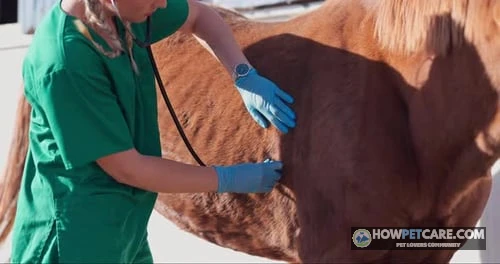
-
Make one owner-help call
Hi, I own [number] horses in [county/state]. I am having a temporary problem with [hay cost, veterinary bill, fencing, transport, or loss of income]. I want to fix this before the horses are at risk. Do you offer hay or feed assistance, low-cost veterinary referrals, gelding or euthanasia assistance, foster, surrender, or a waitlist? If you cannot help, who covers [county]?
-
Have your details ready
County, number and ages of horses, approximate monthly hay or feed need, farrier due date, veterinary issue and prognosis if any, whether the hardship is temporary or permanent, transport ability, and whether any horse is injured or urgent.
Do not assume availability or funding. Call ahead to confirm eligibility and capacity, and do not wait until the animals are visibly suffering to ask for help.
Your Next Steps: A Quick Action Plan for Today, Including a 2 A.M. Weekend Emergency
Turn what you have learned into action today. Work through this sequence, and save the key contacts before you ever need them.
- Make sure you and anyone with you are safe first, especially near traffic or an injured animal.
- Decide the scenario: immediate emergency, public hazard, or a welfare concern to report.
- Make the first call from the directory or decision table above.
- Document what you see with the pre-call checklist and note any case number.
- Follow up using the agency’s process and ask whether you will receive outcome information.
The 2 a.m. weekend plan
At night or on a weekend, coverage differs by situation. For a medical emergency, call a local emergency large-animal veterinarian or an after-hours veterinary line; many areas and veterinary school hospitals staff emergency equine care around the clock. For a roadway or violent situation, call 911. For a non-urgent neglect concern, file during business hours and keep your notes and photos so the report is ready to submit. Confirm that there are 24/7 options in your region ahead of time rather than assuming.
Save these contacts before you need them
Program these numbers into your phone now, so a barn emergency plan is already in place:
- Your regular large-animal veterinarian and their after-hours instructions.
- A backup emergency equine veterinarian or veterinary school hospital.
- Your county animal control and county sheriff non-emergency line.
- Your state veterinarian or state department of agriculture office.
- The United Horse Coalition directory and a local hay bank or equine rescue.
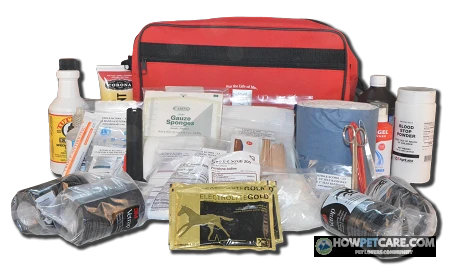
For horse owners, build a full barn emergency plan with vet contacts, evacuation steps, and a stocked first-aid kit, and post it where anyone can find it quickly. Bookmark this page so the directory and scenario tables are one tap away when you need them most.
1A motorist spots a horse running loose along a busy highway. What is the appropriate primary emergency contact according to US dispatch protocols?
A loose animal on an active roadway creates an immediate public safety hazard for drivers and requires urgent law enforcement dispatch.
2If a horse owner notices their horse is showing signs of severe colic or is down and unable to rise, who should be called first?
Acute medical conditions like severe colic require immediate professional veterinary evaluation and clinical treatment.
3Which of the following conditions or symptoms indicate an immediate equine medical emergency requiring a large-animal veterinarian right away? (Select all that apply.)
A rocking-back stance indicates severe foot pain and laminitis, which requires rapid medical intervention to manage structural damage.
4Why is the county sheriff's office often the lead agency for horse neglect reports in rural or unincorporated areas, rather than city animal control?
Municipal animal control frequently has territorial limits or species restrictions that leave rural livestock enforcement under the county sheriff's purview.
5When documenting potential horse neglect from outside a property, which action violates reporting guidelines and could legally jeopardize the investigation?
Crossing private fence lines without owner permission constitutes trespassing, which can invalidate evidence and lead to criminal charges.
6What is the official role of national organizations such as the ASPCA and the United Horse Coalition regarding active horse welfare emergencies in the US?
National equine groups function as advocacy and assistance networks, leaving emergency dispatch to local law enforcement and veterinary clinics.
7A horse owner is experiencing temporary financial hardship and can no longer afford hay or veterinary care. According to the source material, which responsible steps should the owner take before the situation becomes a welfare emergency? (Select all that apply.)
Local hay banks and extension services offer short-term feed assistance to bridge hardship and prevent acute nutritional deficits.
8If an observer is unsure whether a horse's thin appearance is due to active neglect or an ongoing age/medical condition under care, what is the best non-accusatory question to ask when calling the local non-emergency line?
Asking this administrative question ensures the report reaches the proper jurisdictional agency without making unverified legal or medical assertions.
9Which of the following contacts typically charge a consultation fee for their emergency guidance services? (Select all that apply.)
The ASPCA Animal Poison Control Center charges a consultation fee to cover expert veterinary toxicologist guidance.
FAQ
Is it legal for me to feed or move a horse I think is neglected?
You generally shouldn’t do either without the owner’s permission or an agency’s direction. Entering the property can be trespassing, moving the horse can be treated as theft, and sudden feed changes can make a thin horse sick. Report the concern to animal control or the sheriff and let them direct any care.
Do the ASPCA or the United Horse Coalition have legal power to seize a neglected horse?
Generally no. Seizure authority usually belongs to law enforcement, animal control, or officers authorized under state law, often with a court order. Charities may assist, advise, or take in animals through those authorities, but the rules vary by state.
What should I do if I think a horse has been poisoned?
Call a veterinarian right away and ask about an animal poison control service. Have the horse’s weight, the suspected substance, and the time of exposure ready. Poison control lines may charge a consultation fee, so ask when you call.
Who should I call about a wild horse or burro that appears injured or in distress?
If the animal is on federal land, contact the Bureau of Land Management or the agency that manages that land, not local animal control. If it is on or near a road and a public hazard, call 911 or the local law enforcement non-emergency line.
Are there 24/7 options for a horse emergency at night or on a weekend?
Many areas have emergency large animal veterinarians or veterinary school hospitals with after-hours lines, and you can call 911 for roadway or safety emergencies. Coverage varies a lot by region, so save your regular vet’s after-hours instructions and a backup clinic number ahead of time.