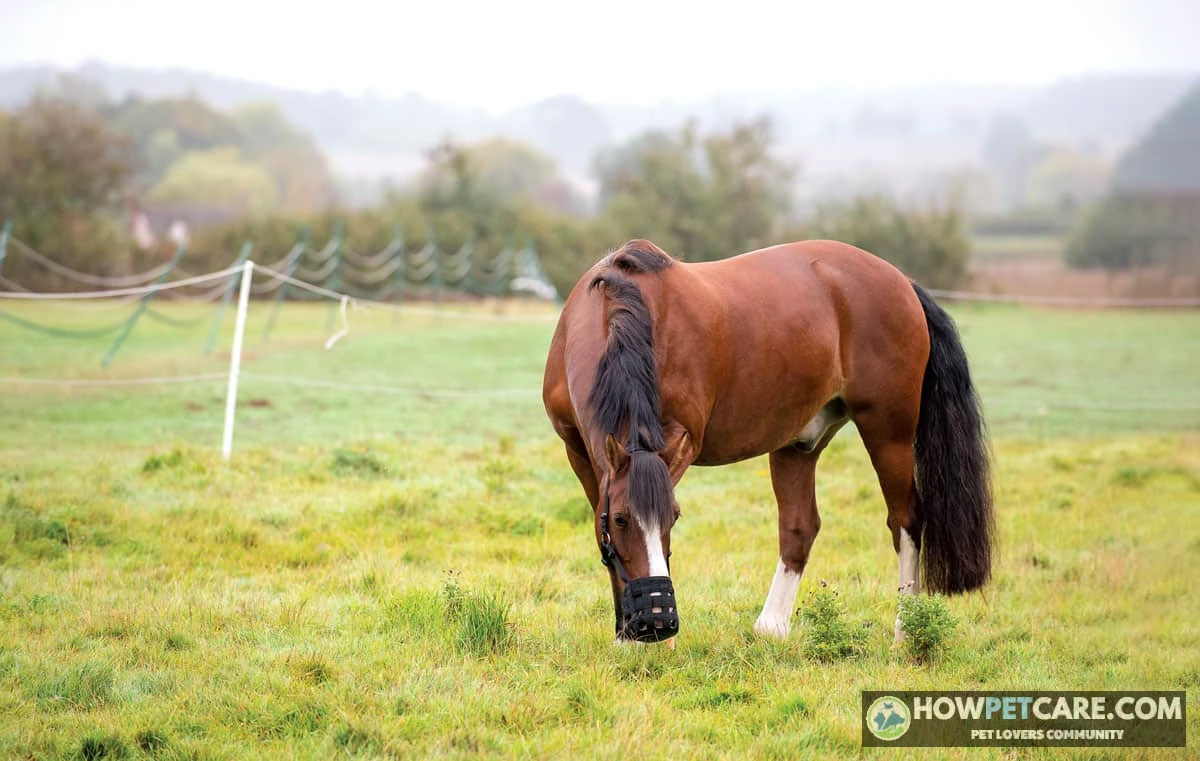

Choose a horse muzzle by the job first:
- For pasture control, buy a grazing muzzle that lets the horse drink and take small bites.
- Prioritize a manufacturer breakaway release, nostril clearance, and replaceable parts.
- Measure the exact model’s chart—mini, pony, horse, and draft labels are only starting points.
- Price the full setup: basket, compatible halter, liners, shipping, and spares.
- For laminitis or insulin resistance, set turnout time and forage with your veterinarian.
Best Grazing Muzzles Compared: Quick Picks by Horse Type, Budget, and Durability
For an overweight, insulin-resistant, or laminitis-prone horse that needs controlled pasture access, look for a grazing muzzle that fits the horse and suits a veterinarian-approved turnout plan. The best option isn’t necessarily the one with the smallest opening or the toughest-looking basket. Choose a design your horse can wear safely, drink through, and tolerate. If you’re managing cribbing or biting rather than grass intake, go to the muzzle-types section before you buy.
Quick picks by problem to solve
- Laminitis-prone or insulin-resistant horse: Compare purpose-built grazing designs from Best Friend, GreenGuard, or ThinLine with your veterinarian. No muzzle can guarantee a safe intake for an individual horse.
- Budget-conscious easy keeper: Compare Tough1 and Shires models, then check whether the price includes a halter and whether replacement parts are available.
- Escape artist: Compare an integrated muzzle-halter with a separate basket attached to a compatible breakaway halter. Prioritize fit and a safety release over extra straps.
- Airflow priority: Consider an open basket or flexible design, such as GreenGuard or ThinLine, and check how the specific product sits around the nostrils.
- Miniature horse or pony: Start with actual measurements. One retailer lists sizes from Mini through Draft across its selection, but individual models aren’t available in every size.
- Hard use: Compare the cost of the complete assembly and any separately sold parts. Material alone doesn’t show which muzzle will last longest for your horse.
Cross-brand comparison table
This shortlist compares construction and purchasing considerations, not results from hands-on testing. Available evidence identifies these brands in retailer selections but doesn’t verify current model-specific prices, hole dimensions, size ranges, or replacement-part inventories. For 2026 shopping, ask the seller for the current US price and product specifications rather than relying on an unsupported estimate.
| Brand / product line | Type and attachment | Approximate 2026 price range | Sizes offered | Grazing opening | Material, durability, and airflow considerations | Breakaway, padding, and parts | Best starting point for |
|---|---|---|---|---|---|---|---|
| Best Friend grazing muzzle | Basket-style options; check whether the selected version includes a halter | Not verified; compare current listings | Check model chart | Dimensions not verified | Rigid basket construction; wear and airflow depend on the selected version and fit | Verify release, padding, and replacement parts on the specific listing | Buyers comparing integrated and separate setups |
| GreenGuard / GG Equine grazing muzzle | Open basket; confirm compatible halter and attachment | Not verified; compare basket and halter costs | Check model chart | Grid dimensions not verified | Open grid design offers visible openings; inspect basket material and attachments for wear | Check compatible breakaway halter, padding, and separately sold parts | Buyers prioritizing an open design |
| ThinLine grazing muzzle | Flexible design; verify halter and attachment requirements | Not verified; compare complete setup costs | Check model chart | Dimensions not verified | Flexible material differs from a rigid basket; individual chewing habits matter | Check release, liners, and parts for the chosen model | Buyers comparing flexible designs |
| Tough1 grazing muzzle | Check the selected basket and halter configuration | Not verified; compare current listings | Check model chart | Dimensions not verified | Assess basket material, base, stitching, and openings on the selected model | Verify breakaway construction, padding, and parts | Buyers comparing entry-level options |
| Shires grazing muzzle | Check the selected basket and halter configuration | Not verified; compare current listings | Check model chart | Dimensions not verified | Inspect basket material, construction, and ventilation; durability isn’t independently compared here | Verify release, padding, and replacement parts | Buyers wanting another size and fit option |
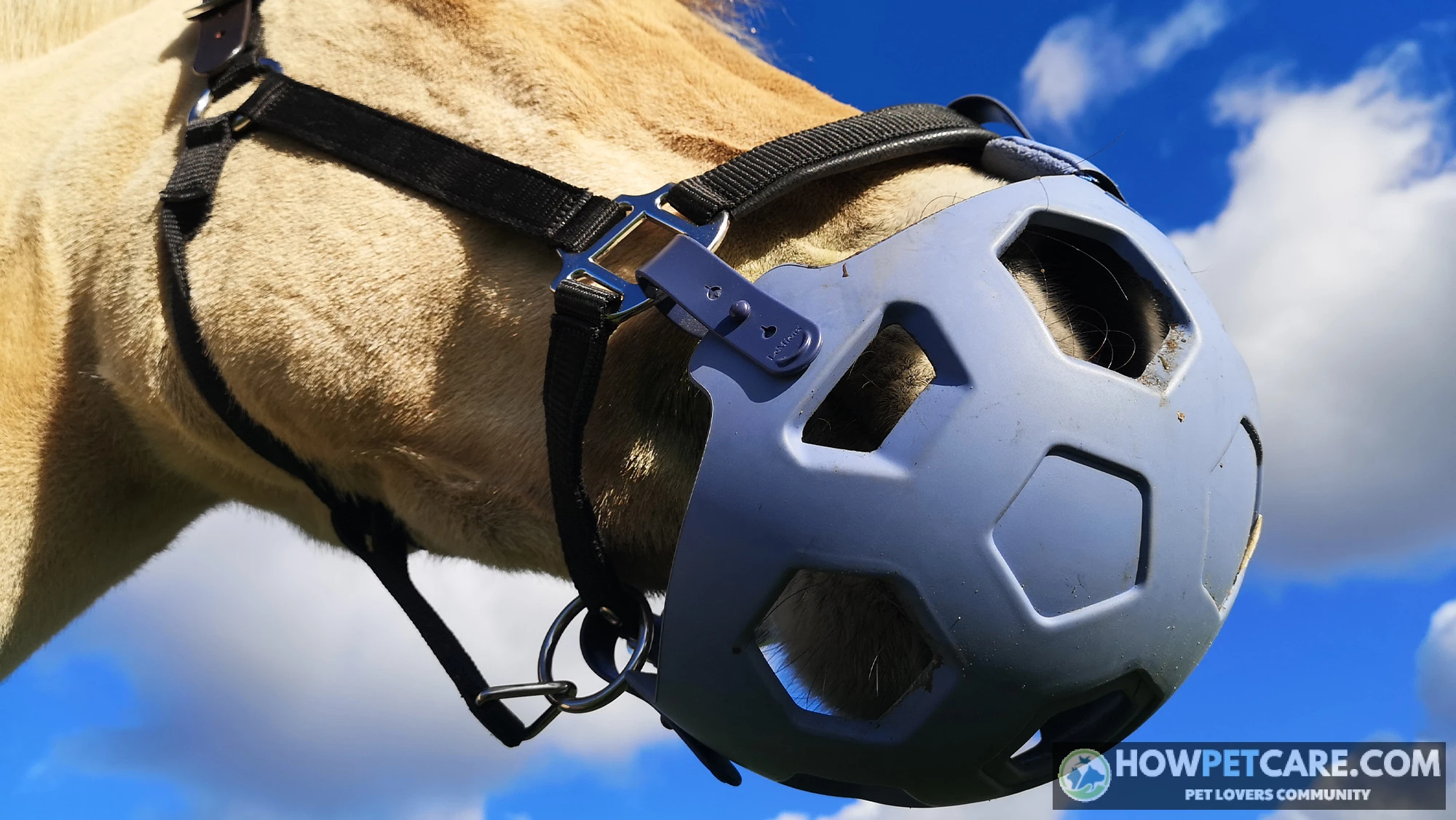
Treat the table as a shortlist, not a live product catalog. Retailers carry several styles across these brands, including breakaway-halter designs and standalone muzzles, so confirm the exact model before ordering. A smaller opening may restrict access to grass, but opening shape, pasture conditions, and the horse’s behavior also affect intake. Don’t choose or alter an opening size for a horse with laminitis without veterinary guidance.
Grazing, Anti-Cribbing, or Restraint: Which Type of Horse Muzzle Solves Your Problem?
A grazing muzzle limits the amount of grass a horse can take with each bite. Don’t assume a muzzle made for another purpose will do the same job. Grazing designs typically use a restricted opening or grid rather than a fully closed bottom.
| Muzzle type | Problem it addresses | What it does not do | Typical setting and wear | Avoid or reconsider when |
|---|---|---|---|---|
| Grazing muzzle | Restricts access to pasture grass | Does not guarantee a specific intake or treat laminitis | Turnout, for a period agreed with your veterinarian | The horse cannot drink or graze comfortably, has sores, or is distressed |
| Anti-cribbing device or cribbing muzzle | Attempts to discourage cribbing behavior | Does not reliably address the reason for the behavior or replace pasture control | According to the product instructions and a veterinary or behavior plan | It causes distress or injury, or the behavior has not been assessed |
| Biting, restraint, or training muzzle | May help manage mouthing or biting during a specific handling task | Is not a substitute for a grazing muzzle or a behavior assessment | Brief, attended handling according to product instructions | Unsupervised turnout, or any situation outside the product’s intended use |
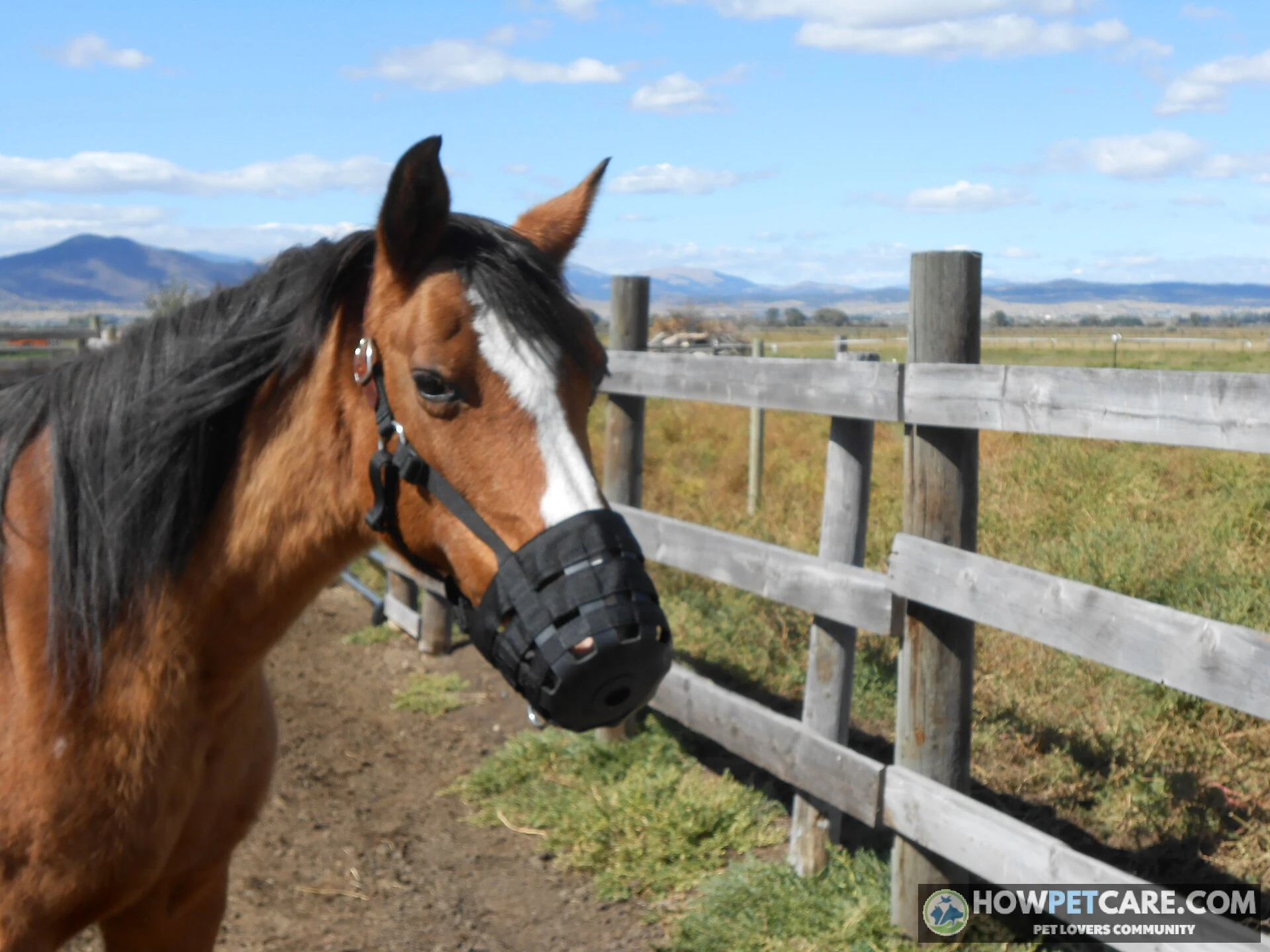
Basket, webbing, and rubber grazing muzzles
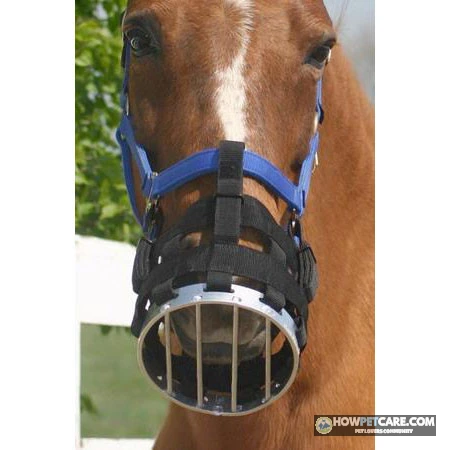
A basket muzzle creates a structured space around the mouth. With an open design, you can inspect the horse’s mouth and the basket more easily; the base limits access to grass. Webbing or mesh models use straps or panels around the face, while a rubber muzzle may have a rubber base or basket. Compare the product itself rather than assuming one material is always cooler or more durable.
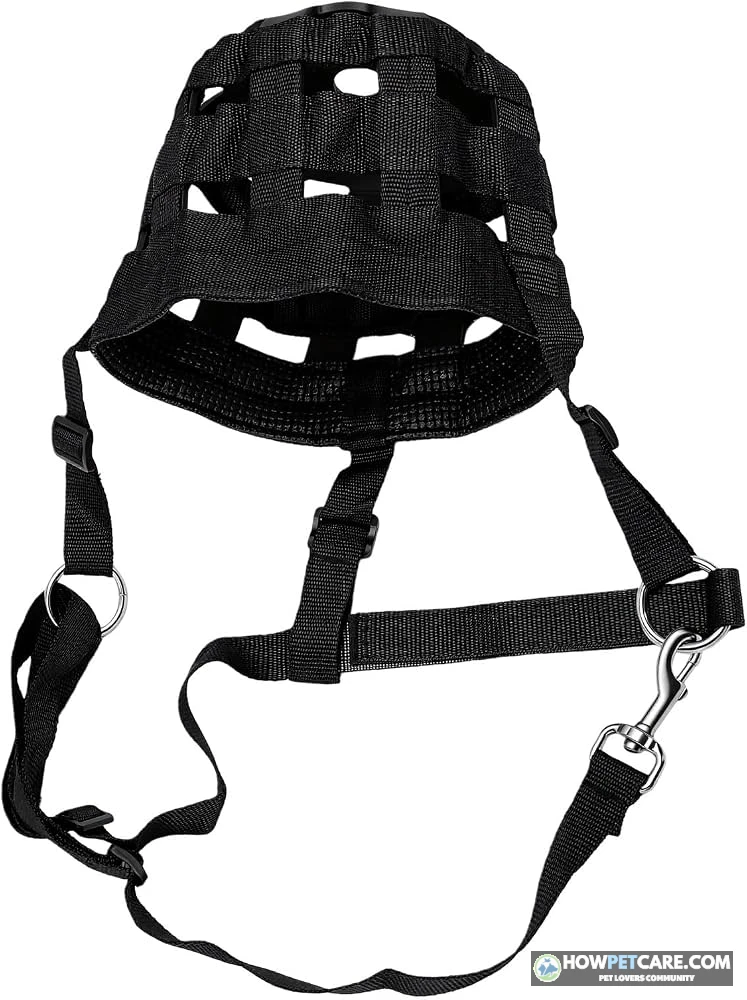
Some horse muzzle halters combine the basket and headgear in one unit. Others attach to a separate halter. A separate halter gives you a choice of compatible headgear, but the whole assembly still needs to fit and keep its intended breakaway function.
Anti-cribbing, biting, and training muzzles
A grazing basket isn’t a reliable solution for cribbing or wood chewing. Discuss persistent cribbing, chewing, or biting with your veterinarian and, when appropriate, a qualified behavior professional. A device alone may not resolve the cause. Don’t leave a restraint or biting muzzle on for turnout unless its manufacturer and your veterinarian explicitly support that use.
How a Grazing Muzzle Controls Intake (and Whether Your Horse Can Still Drink)
What a muzzle changes about each bite
A grazing muzzle puts a barrier between the horse’s mouth and most of the pasture. The horse reaches grass through the opening, restricting access while still allowing it to graze. The change in intake depends on the horse, design, fit, and pasture. There’s no single reduction percentage that applies to every combination.
A grazing muzzle can support a broader weight-management plan for an overweight horse, but it can’t ensure weight loss on its own. Total forage and feed, access to grass without a muzzle, activity, and the individual horse all matter. Ask your veterinarian about body-condition monitoring and any metabolic concerns.
Eating and drinking while muzzled
Grazing designs are intended to allow drinking as well as restricted grazing. Still, not every horse can use every bucket or trough with every basket. During an early supervised session, offer the horse its usual water source and watch it drink. Check that the basket fits the container without trapping the horse’s head or tipping the container.
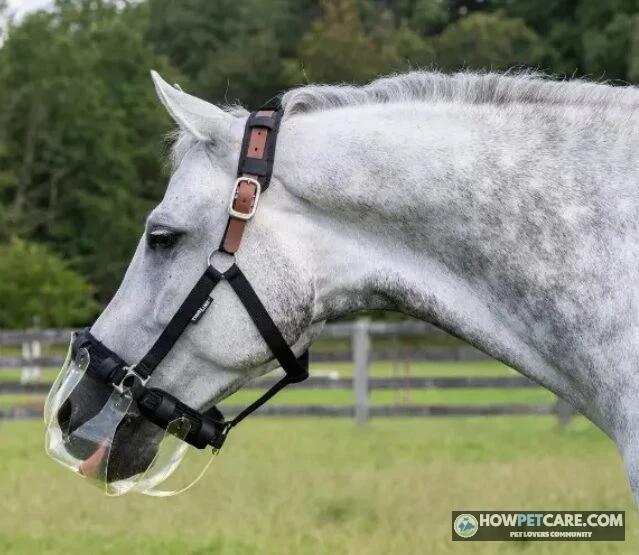
Watch the horse take grass through the opening, too. If it can’t eat or drink comfortably, remove the muzzle and reassess rather than assuming the horse will eventually learn. A horse with suspected or active laminitis needs veterinary assessment; a muzzle isn’t a stand-alone treatment.
Safety and Durability Checks Before You Buy: Breakaway Straps, Liners, and Replacement Parts
Safety features checklist
Use this scorecard to compare options, not as a substitute for a fit trial. The first two items and nostril clearance are essential. A high score can’t make an unsafe fit acceptable.
- ☐ Breakaway: The complete halter-and-muzzle setup has a manufacturer-designed release, such as a replaceable leather section or safety tab.
- ☐ No bypass: No added strap or reinforced crownpiece would keep the assembly attached if the intended breakaway section released.
- ☐ Snag awareness: Hardware sits securely, and the turnout area has no obvious loose wire, protrusions, or other hazards.
- ☐ Nostril clearance: The design can sit clear of the nostrils when the horse lowers its head.
- ☐ Contact protection: You can check and pad the nose, chin, and crown contact points as needed without making the fit tight.
- ☐ Adjustment: Cheek and throat areas can be adjusted as the manufacturer directs.
- ☐ Airflow: Openings and materials suit the conditions; a breathable-looking basket doesn’t make extreme heat safe.
- ☐ Attachment compatibility: A separate basket fits the specific breakaway halter you plan to use.
- ☐ Replacement parts: Check whether the seller offers the relevant basket, straps, liner, or insert separately.
- ☐ Exchange policy: Confirm whether an incorrectly sized or tried-on muzzle can be exchanged.
- ☐ Size availability: For a miniature horse or pony, verify that the specific model comes in a suitable size.
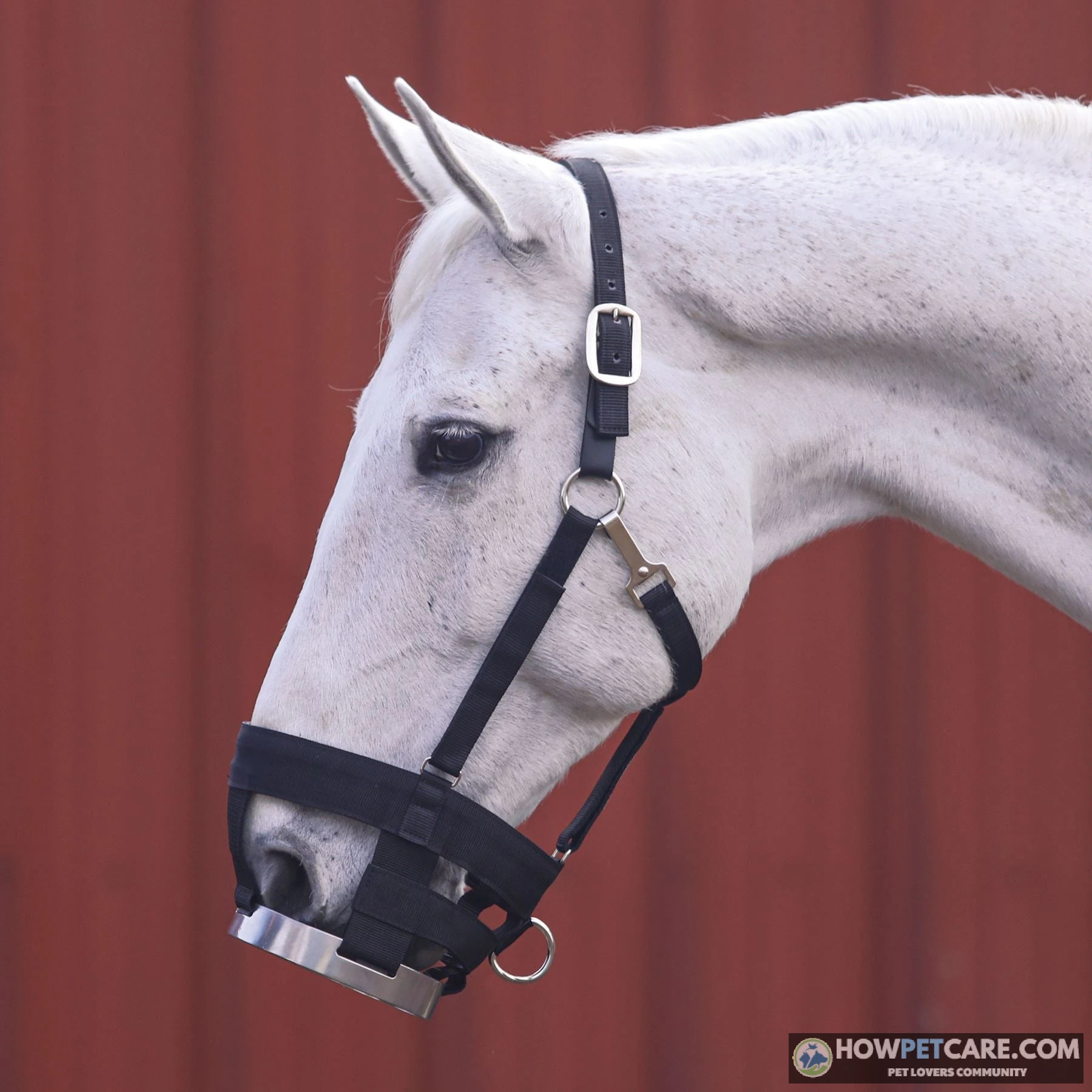
Ask the manufacturer how its release works and whether all components are compatible. Don’t deliberately load-test a breakaway on the horse or reinforce it with non-breakaway webbing to prevent escape. A release reduces snag risk but can’t eliminate it.
Replacement parts and true cost of ownership
Compare the basket price plus any required halter, safety tabs, padding, shipping, and likely replacement parts. A replaceable insert is useful only if it fits the model and remains available. Fleece, neoprene, or leather liners may ease rubbing at a contact point, but added bulk can make a previously correct fit too tight.
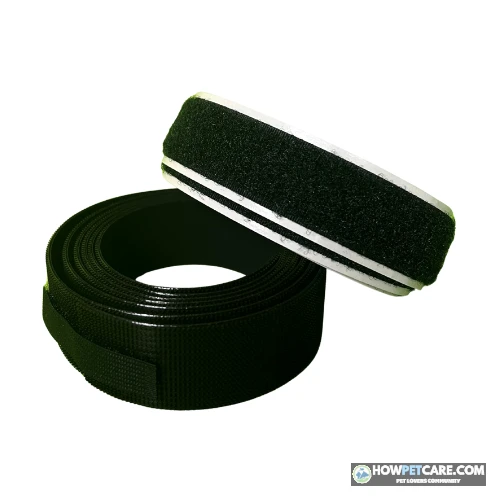
There’s no dependable universal lifespan. Chewing, rubbing on fences, turnout conditions, and the product itself all affect wear. Inspect the assembly before use and replace damaged components according to the manufacturer’s guidance; a higher price doesn’t mean the basket will last longer.
How to Measure and Fit a Grazing Muzzle, From Miniature to Draft
Step-by-step measuring protocol
Use a soft tape, a calm horse, and the specific manufacturer’s chart. Retail guidance commonly asks buyers to consider muzzle width and depth, but brands may measure at different points. Record measurements in inches and, if the chart requires them, centimeters.
- Find the manufacturer’s measuring points. Check where it measures circumference, width, depth, and any head or crown dimensions. Don’t substitute another brand’s method.
- Measure the nose or muzzle circumference. Place the tape where the chart specifies, snug but not tight. Keep it clear of the nostrils and record the result.
- Measure the required depth and headgear dimensions. Depending on the product, this may include the distance from the stated upper edge of the basket to the bottom of the muzzle, as well as crown or halter measurements. If you’re buying a compatible separate basket, note the size of a halter that already fits.
- Match measurements to the model’s chart. Use the size class as a starting point only. If measurements fall between sizes, ask the manufacturer which one governs and confirm the exchange policy before ordering.
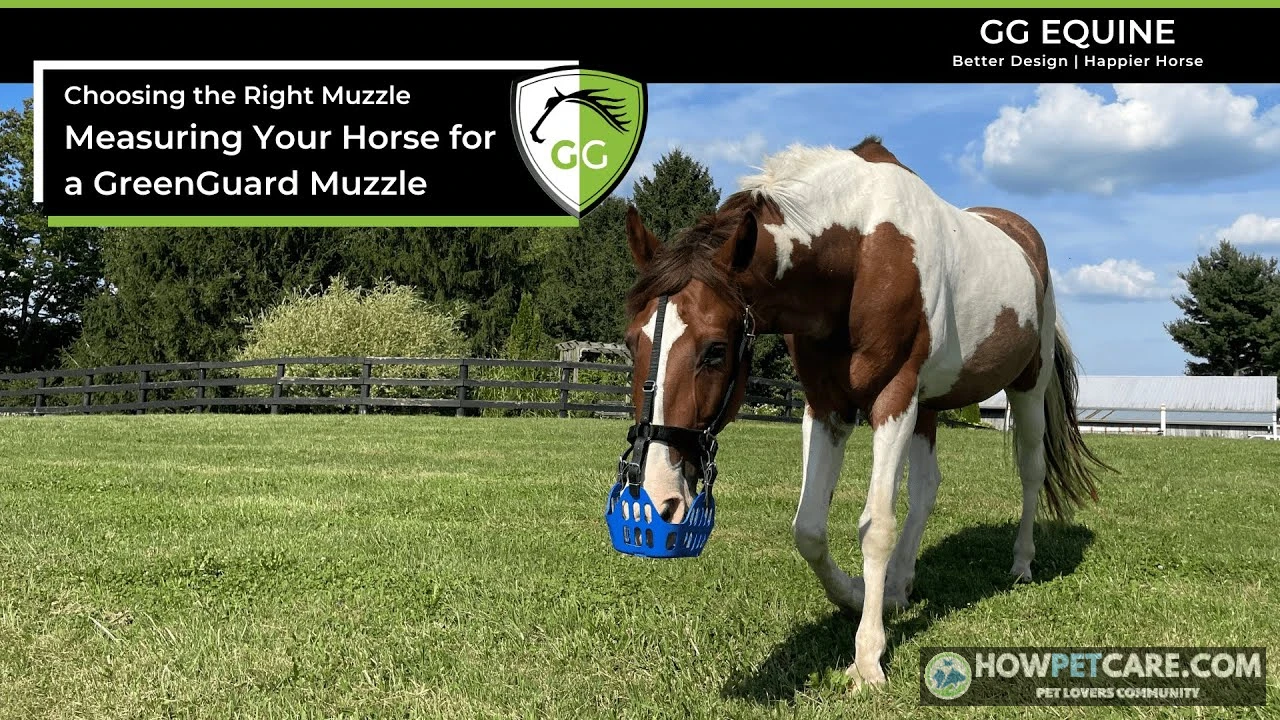
Size class guide: Mini, pony, horse, draft
| Size class | Starting example | Measurements to take | Fit concern | Chart check |
|---|---|---|---|---|
| Miniature | Miniature horse | Brand-specified circumference, depth, and headgear measurements | An adult basket may ride high or interfere with nostrils | Confirm a true Mini size in the exact model |
| Pony | Small pony | The same model-specific measurements | Short or wide heads may not match the label | Compare both width and depth |
| Cob / small horse | Cob or smaller adult horse | The same model-specific measurements | A narrow face and deep muzzle may fall into different sizes | Ask which measurement controls |
| Horse | Average-sized riding horse | The same model-specific measurements | A familiar halter size may not predict basket fit | Check the muzzle chart separately |
| Large horse / Warmblood | Large-headed riding horse | The same model-specific measurements | Cheek and crown adjustment may be insufficient | Check headgear adjustment as well as basket dimensions |
| Draft / oversize | Draft horse | The same model-specific measurements | A large circumference may still need more basket depth | Confirm the exact model offers sufficient dimensions |
Breed and height don’t guarantee a particular head shape. A grazing muzzle for a miniature horse needs the same functional checks as a full-size model, especially around the nostrils and the basket’s top edge.
Fit check before turnout
With the horse calm, check these points in a safe, supervised area:
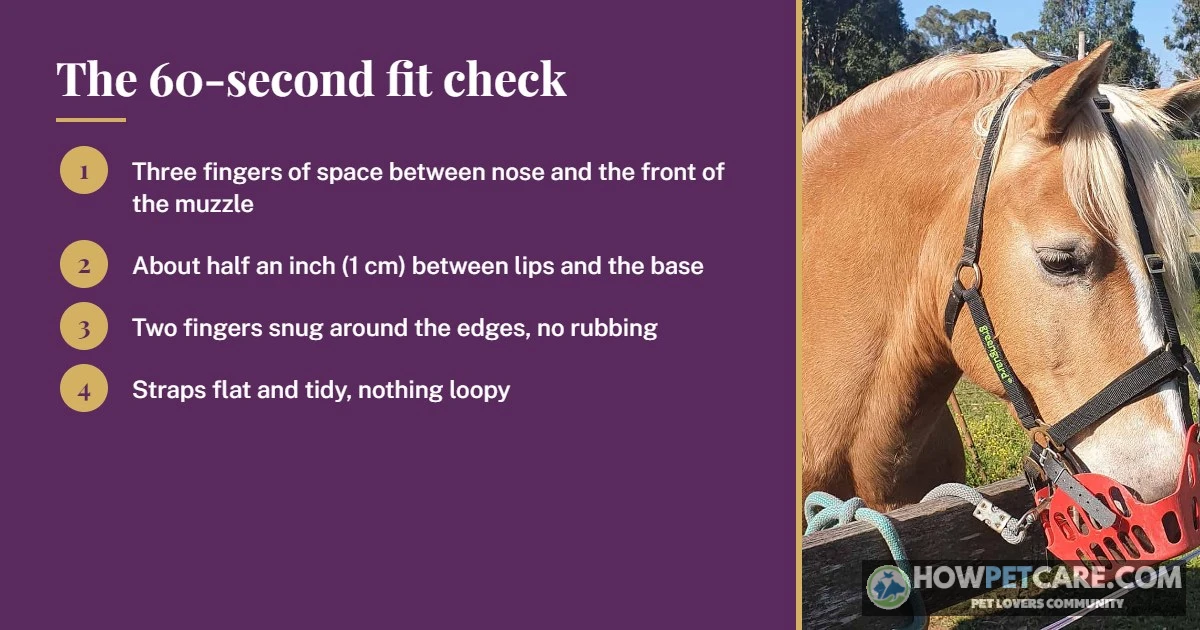
- The horse can open its mouth and work a small bite through the opening.
- The basket doesn’t press on the nostrils, bridge, chin, or jaw when the horse lowers its head.
- Straps allow the clearance specified by the manufacturer. Use a finger check where recommended rather than applying the same clearance to every strap.
- The basket stays aligned as the horse moves its head without being excessively tight.
- The horse can lower its head, graze, and reach water normally.
A basket that rotates or comes off easily may be too loose or the wrong shape. Pressure marks, hair loss, and raw spots can point to a tight or poorly shaped fit. Adjust it according to the instructions and check again. If the problem persists, exchange the size or style instead of tightening the straps.
Introducing a Muzzle for the First Time: A Week-One Acclimation Plan and Herd Effects
First-week acclimation steps
Use this as a flexible progression, not a deadline. Some horses need more time at each stage; others may not adapt safely. Agree on the turnout routine with your veterinarian, especially for a horse with laminitis or insulin resistance.
- Introduce the equipment. In a safe space, let the horse investigate the muzzle. Briefly touch it to the face and reward calm behavior with a vet-approved treat.
- Try a short fitting session. Put the muzzle on for a few supervised minutes, check its position, and take it off before the horse becomes upset. Repeat as needed.
- Practice grazing and drinking. In a small, safe pen or paddock, watch the horse use the opening and drink from its usual water source. Remove the muzzle and inspect the skin afterward.
- Add familiar turnout. Extend the session gradually, as long as eating, drinking, fit, and behavior remain acceptable. Check the horse during the session and again when you remove the muzzle.
- Observe the normal herd setting. Bring in the usual companions and turnout area once the horse is comfortable. Keep the first herd session short enough to observe interactions.
Don’t put on a new muzzle and leave the horse to figure it out alone. If it can’t settle, return to an easier stage. If distress continues, stop and consult your veterinarian or a qualified trainer.
Signs of distress to watch for
Persistent head tossing, frantic pawing, repeated face-rubbing, sweating, refusal to drink, or standing withdrawn instead of grazing are reasons to end the session and investigate. Remove the muzzle if a sore develops. A quiet, motionless horse isn’t necessarily comfortable; check whether it can and will eat and reach water.
Herd hierarchy and bullying
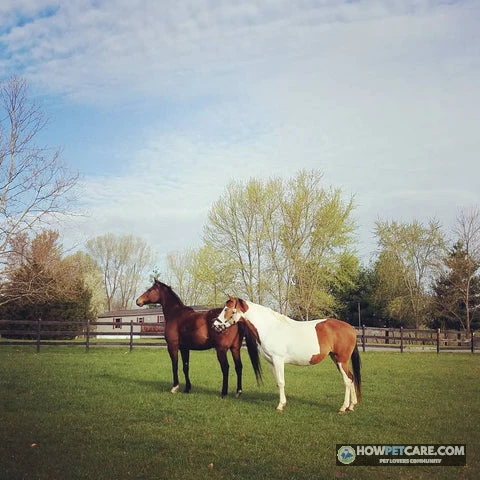
Watch to see whether companions keep the muzzled horse away from water, shelter, or grazing. A basket can also change how horses interact at close range. If the horse is repeatedly chased or isolated, change the turnout arrangement or safely separate compatible companions. Don’t compromise access to water or social contact just to keep the muzzle on. If the pattern continues, ask your veterinarian or a behavior professional for help.
How Long Can a Horse Wear a Grazing Muzzle? Wear-Time Limits and When Muzzling Is the Wrong Choice
Daily wear time and what vets advise
The evidence provided here doesn’t establish a universal safe maximum. As a working ceiling rather than a target, many veterinary and welfare guides suggest limiting muzzled grazing to part of the day — commonly no more than roughly ten hours at a stretch — with daily unmuzzled access to forage and water. Start with a few supervised minutes during acclimation, then agree on the daily turnout duration and maximum with your veterinarian before extending wear. The right schedule depends on intake, access to forage and water, skin condition, weather, and the horse’s medical needs. A normal turnout window isn’t automatically safe for a full day.
Remove the muzzle for hay or feed meals unless your veterinarian and the product instructions support another arrangement. Don’t leave a newly fitted muzzle on overnight or when nobody can check the horse. Discuss any overnight plan with your veterinarian, including how water access, skin, and forage intake will be monitored.
Before each session, check that the skin is intact, the horse drank normally during its previous session, the release works and isn’t obstructed, and the turnout area has no obvious snag hazards. During wear, make sure the horse can graze, reach water and shelter, and remain comfortable with its herd. Remove the muzzle if any of these checks fail.

Remove the muzzle and contact your veterinarian promptly if you notice new lameness, reluctance to move, or other signs that make you suspect laminitis. Do not rely on a muzzle to treat a flare.
When not to use a muzzle
Stop and consult your veterinarian if the horse can’t drink or eat comfortably, has broken skin or recurring rubs, has mouth or dental pain, or shows sustained distress. Reconsider muzzling, too, if heat, humidity, fencing, debris, or herd behavior makes the particular setup unsafe. A history of choke or difficulty eating calls for a veterinary discussion before use.
Remove the grazing muzzle before riding or tacking up. It’s turnout equipment, not a bridle or riding aid.
Alternatives: strip grazing, slow feeders, and dry lots
A dry lot or sacrifice paddock with managed forage can make pasture restriction more predictable while allowing turnout, provided the horse still has suitable forage, water, shelter, and social contact. Strip grazing and shorter turnout windows can limit access, but neither guarantees safe intake for a horse at metabolic risk. A slow feeder may regulate access to suitable hay; check that its design and placement suit the individual horse.
Stall confinement with managed hay may be necessary in some situations, but it limits movement and social contact. Discuss the welfare trade-offs and medical plan with your veterinarian rather than relying on stall rest as a weight-loss shortcut.
Winter, tall grass, and dry pasture
A change in season doesn’t make pasture safe by itself. In winter, assess the available forage and the horse’s needs with your veterinarian. A muzzle may be inappropriate if it further restricts an already limited forage supply. Dormant-looking grass alone doesn’t prove that a metabolic-risk horse can graze without restrictions.
Tall grass may interact differently with a particular opening, and a horse may learn to pull or gather grass through its basket. On short or sparse, dry pasture, check whether the horse can get enough forage and whether it’s rubbing the basket against the ground. Reassess the entire turnout plan when pasture conditions change.
Supplementing when grass intake is restricted
Limiting grass shouldn’t leave the horse with too little forage overall. Ask your veterinarian or an equine nutritionist to assess the complete ration, including suitable hay and whether a ration balancer or vitamin-and-mineral supplement is needed. Don’t add supplements or sharply cut forage just because you bought a muzzle. Monitor body condition and review the plan as pasture and workload change.
Troubleshooting a Muzzle: Rubs, Escapes, Torn Baskets, and Worn Inserts
Rubs and sore spots: resize, reline, or stop
Check the bridge of the nose, chin, jaw, cheeks, and poll after early sessions and regularly afterward. Remove the muzzle if you find a rub; don’t cover broken skin with a liner and continue turnout. If the skin is broken, the horse is painful, or rubbing returns, consult your veterinarian.
| Symptom | Possible cause | First action | Stop or change course when |
|---|---|---|---|
| Nose or bridge rub | Pressure, movement, or an unsuitable contact point | Remove the muzzle; let skin recover and reassess fit and padding | Skin is broken or rubbing returns despite a correct fit |
| Chin or jaw rub | Basket depth or shape does not suit the horse | Check clearance in the grazing position; try a different size or design | Pressure remains or the horse cannot graze comfortably |
| Muzzle slips or rotates | Loose adjustment, incompatible halter, or unsuitable shape | Refit according to the manufacturer’s instructions | The horse repeatedly removes it; do not defeat the breakaway system |
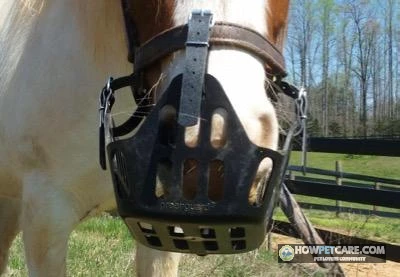
| Torn basket, webbing, or snapped strap | Chewing, rubbing, snagging, or component wear | Remove from service; replace the damaged compatible part if available | Edges are sharp, other components are degraded, or damage recurs |
| Worn or enlarged opening | Abrasion or chewing has changed the base or insert | Compare it with the original specification or a new compatible part | The opening, edges, or attachment no longer match the intended design |
Horses that remove or break the muzzle
If your horse is an escape artist, check fit, head shape, and attachment compatibility before buying another product. A different basket or integrated muzzle-halter may work better, but no extra strap should override a safety release. Persistent escape attempts may signal discomfort or distress, not simply a clever horse.
Check the grazing opening and all straps regularly. Replace a part if the manufacturer offers the correct replacement and the rest of the assembly is sound. Replace the whole muzzle if its structure is compromised or compatible parts aren’t available. There’s no reliable fixed replacement interval for every horse.
Your Buying Checklist: Choose the Right Muzzle and Start Safely
- Confirm the job. Choose a grazing design for pasture-intake control, not as a general fix for cribbing or biting.
- Agree on the plan. If the horse has laminitis, founder, insulin resistance, or a history of feeding difficulty, consult your veterinarian about turnout, forage, and an individual wear limit before ordering.
- Measure for the exact model. Compare circumference, depth, and headgear dimensions with that brand’s chart. Check the exchange policy if measurements span sizes.
- Price the complete setup. Include the basket, compatible breakaway halter, padding, replacement parts, and shipping—not just the advertised basket price.
- Fit, introduce, and observe. Start with short supervised sessions, confirm the horse can graze and drink, inspect its skin, and watch its place in the herd.
- Reassess rather than force it. Track body condition with your veterinarian and review the routine as pasture changes. Stop for sores, drinking problems, persistent distress, or unsafe damage. Contact your veterinarian promptly if you suspect laminitis.
Use your measurements and veterinarian’s recommendations to narrow the comparison table. Before checkout, confirm the selected model’s current price, size chart, opening, and safety features with the seller.
1What is the primary function of a grazing muzzle compared to an anti-cribbing or restraint muzzle?
Grazing muzzles are designed with restricted bottom openings to allow controlled eating and drinking while limiting intake during pasture turnout.
2What is the general veterinary guidance regarding daily wear-time limits for a grazing muzzle?
Veterinary and welfare recommendations generally favor partial-day muzzled turnout combined with daily unmuzzled access to forage and water.
3When attaching a separate grazing basket to a halter, which safety feature is critical?
A functioning breakaway release allows the horse to free itself if the muzzle or halter snags on an obstacle in the pasture.
4What is the appropriate response if a horse develops a rub that breaks the skin under its grazing muzzle?
Continuing to wear a muzzle over broken skin leads to severe sores and infection, requiring skin recovery and fit reassessment.
5Why is it essential to measure a horse's head using a manufacturer's specific chart rather than relying on general size labels like 'Pony' or 'Horse'?
Head shapes vary widely and manufacturers measure muzzle depth and circumference at different reference points.
6What should be checked regarding water access during early supervised muzzling sessions?
Bulky muzzle baskets can collide with container rims or fit tightly inside buckets, preventing the horse from reaching water.
7How does a grazing muzzle contribute to an overall weight-management plan for an overweight horse?
Muzzles reduce pasture intake per bite, but total weight management relies on comprehensive dietary and exercise control.
8What should an owner evaluate regarding herd dynamics when turnout begins with a muzzled horse?
A muzzle changes close-range interactions and may place a horse at a disadvantage, leading to harassment or water restriction by herd mates.
9What step is required before implementing a grazing muzzle on a horse prone to laminitis or insulin resistance?
Metabolic risks require professional oversight to set safe turnout schedules and monitor intake alongside muzzle use.
10What is the rule regarding grazing muzzles when preparing to ride or tack up a horse?
Muzzles are designed strictly for pasture turnout and should never be worn beneath riding bridles or tack.
| Brand / product line | Type and attachment | Approximate 2026 price range | Sizes offered | Grazing opening | Material, durability, and airflow considerations | Breakaway, padding, and parts | Best starting point for |
|---|---|---|---|---|---|---|---|
| Best Friend grazing muzzle | Basket-style options; check whether the selected version includes a halter | Not verified; compare current listings | Check model chart | Dimensions not verified | Rigid basket construction; wear and airflow depend on the selected version and fit | Verify release, padding, and replacement parts on the specific listing | Buyers comparing integrated and separate setups |
| GreenGuard / GG Equine grazing muzzle | Open basket; confirm compatible halter and attachment | Not verified; compare basket and halter costs | Check model chart | Grid dimensions not verified | Open grid design offers visible openings; inspect basket material and attachments for wear | Check compatible breakaway halter, padding, and separately sold parts | Buyers prioritizing an open design |
| ThinLine grazing muzzle | Flexible design; verify halter and attachment requirements | Not verified; compare complete setup costs | Check model chart | Dimensions not verified | Flexible material differs from a rigid basket; individual chewing habits matter | Check release, liners, and parts for the chosen model | Buyers comparing flexible designs |
| Tough1 grazing muzzle | Check the selected basket and halter configuration | Not verified; compare current listings | Check model chart | Dimensions not verified | Assess basket material, base, stitching, and openings on the selected model | Verify breakaway construction, padding, and parts | Buyers comparing entry-level options |
| Shires grazing muzzle | Check the selected basket and halter configuration | Not verified; compare current listings | Check model chart | Dimensions not verified | Inspect basket material, construction, and ventilation; durability isn't independently compared here | Verify release, padding, and replacement parts | Buyers wanting another size and fit option |
FAQ
Can I ride my horse while it is wearing a grazing muzzle?
Generally no. Grazing muzzles are designed for turnout and not for riding or tack use, and wearing one under a bridle can be unsafe. Remove it before tacking up, and check the manufacturer’s instructions.
Will a grazing muzzle alone make my horse lose weight?
Not necessarily. A muzzle can reduce grass intake, but weight loss also depends on total diet, exercise, and the individual horse. Ask your vet to set a plan and monitor body condition.
Can a miniature horse or pony wear a grazing muzzle?
Yes, if you buy a size made for the animal. Minis and ponies need careful measuring because adult-horse muzzles can sit too high or press on the nostrils. Check that the brand offers a true mini or pony size.
Is a horse muzzle halter the same as a grazing muzzle?
Not always. Some grazing muzzles come with their own halter, while others clip onto the horse’s existing halter. The difference affects fit consistency, breakaway safety, and how easily a horse can remove the muzzle.
Should a grazing muzzle be left on overnight?
Usually not unless a vet specifically advises it. Most guidance favors wearing a muzzle only during supervised turnout and removing it for rest, hay, and times when the horse cannot be monitored.