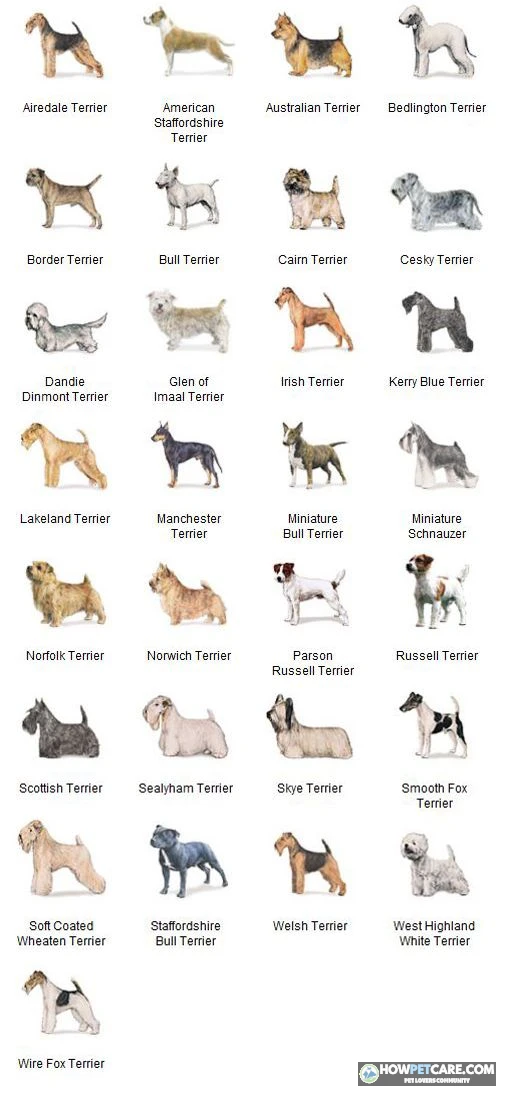

Terrier types are dogs originally bred to hunt and dispatch vermin, ranging from tiny Yorkshire Terriers to the 50–70-pound Airedale. The main groups include small working, long-legged, short-legged Scottish, bull-type and toy-type terriers. Breed counts differ by registry: the AKC lists 32, the Royal Kennel Club 33, and the UKC 45.
Terrier types range from small, high-drive working dogs to large Airedales, silky-coated toy companions and bull-type breeds. Terriers were originally developed to hunt and kill rodents and other vermin, so many combine alertness, persistence and a strong interest in moving animals. Size matters less than your tolerance for exercise, barking, grooming and prey drive.
There is no single universal count of terrier breeds. As of the research compiled for this guide, the American Kennel Club (AKC) lists 32 in its Terrier Group, the Royal Kennel Club lists 33, and the United Kennel Club (UKC) lists 45. A figure of 27 appears in a separate British Kennel Club count. Each count follows different recognition rules and group classifications. The comparison chart below covers commonly discussed breeds, and the lifestyle guide helps narrow the list to a realistic match.
Terrier Types at a Glance: What Counts as a Terrier and the Main Groups
Quick definition: what is a terrier dog breed?
A terrier is a dog traditionally bred to pursue, locate and dispatch vermin, sometimes underground. The name is associated with the Latin terra, meaning earth. Terrier breeds differ greatly in size and coat, but many keep an independent streak and a prey drive. Individual temperament varies, and socialization, training, health and environment all matter.
A useful beginner’s overview groups terriers by build and historical role:
- Small working terriers: Jack Russell or Russell Terriers and Rat Terriers are compact, active dogs bred for vermin control and other work.
- Long-legged and large terriers: The Airedale is the largest terrier breed and is often called the "King of Terriers."
- Short-legged and Scottish-type terriers: Scottish Terriers, West Highland White Terriers and Cairn Terriers have compact builds, and their coats and head shapes help tell them apart.
- Bull-type and toy-type terriers: Bull Terriers belong to the AKC Terrier Group, while Yorkshire Terriers are terrier-descended dogs placed in the AKC Toy Group.

Familiar US breeds include the Yorkshire Terrier, Boston Terrier, Bull Terrier, Scottish Terrier, West Highland White Terrier, Airedale Terrier and Rat Terrier. The Boston Terrier has terrier ancestry but belongs to the AKC Non-Sporting Group, not its Terrier Group.
Largest and smallest terrier breeds
The Airedale is the largest breed in the AKC Terrier Group, with a typical height around 23 inches and a weight range of 50 to 70 pounds. The Yorkshire Terrier is one of the smallest dogs commonly described as a terrier, though the AKC places it in the Toy Group. Breed standards and individual dogs vary. And "terrier" in a breed name doesn’t necessarily mean a kennel club currently classifies the dog in its Terrier Group.

How Many Terrier Breeds Are There? Why AKC, UKC and Royal Kennel Club Counts Differ (27 vs 32 vs 33 vs 45)
No single count is correct for every purpose. A count means something only when it names the registry, the group being counted and the date of the registry list. The figures in the table reflect the research supplied for this guide. Check each organization’s current breed and group lists before using a number for registration or showing.
Registry-by-registry reconciliation
| Registry | Approx. terrier breed count | What is included | What is classified elsewhere | Why the count differs |
|---|---|---|---|---|
| American Kennel Club (AKC), United States | 32 | Its designated Terrier Group, including breeds such as the Airedale, Bull Terrier, Scottish Terrier, West Highland White Terrier and Rat Terrier | Yorkshire Terrier is Toy; Boston Terrier is Non-Sporting | AKC group placement excludes some breeds with terrier ancestry or names |
| Royal Kennel Club, United Kingdom | 33 | Breeds placed in its Terrier Group | Some small breeds are assigned to other groups | The Royal Kennel Club uses its own recognition and group rules |
| British Kennel Club count cited in research | 27 | A separate count reported for the terrier category | Depends on the source’s recognition list and date | The figure may reflect a different list or point in time; it should not be treated as interchangeable with the Royal Kennel Club figure |
| United Kennel Club (UKC), United States | 45 | A broader Terrier Group that includes additional working and bull-type breeds | Other registries may place some of these dogs in different groups or not recognize them | UKC’s group boundaries and breed recognition differ |
The figures 27, 32, 33 and 45 therefore answer different registry-specific questions rather than contradicting one another. Both the 27 and 33 figures are attributed to British organizations in the available research. Because the evidence doesn’t establish the exact list or date behind the 27 figure, treat it as a reported count, not a definitive current Royal Kennel Club total. Older pages may also reproduce historical counts without noting when their lists were checked.

Why Yorkshire Terriers and bull-type breeds are classified differently
The AKC places Yorkshire Terriers in the Toy Group, even though the breed developed from working terriers and keeps many terrier-like traits. Group systems classify breeds by registry rules. They aren’t a complete account of a dog’s ancestry or behavior.
Bull-type dogs show the same split between history and classification. The Bull Terrier is in the AKC Terrier Group, while the Boston Terrier, despite its name and bull-and-terrier ancestry, is in the Non-Sporting Group. Some bull-type breeds are included in UKC’s broader terrier grouping but are absent from, or grouped differently by, other registries. Don’t assume every dog called a terrier belongs to every registry’s Terrier Group.

Newly recognized terrier breeds and the count
Recognition changes can alter a group total. The AKC recognized the Biewer Terrier in 2021, and its group classification is Toy, not Terrier. Rat Terriers and American Hairless Terriers are examples of breeds the AKC recognizes within its Terrier Group. Russell-type names add confusion: Russell Terrier and Parson Russell Terrier are distinct entries in some registry lists, while other organizations use different naming or recognition rules. "New" is registry-relative, so verify a breed’s current status with the organization relevant to you rather than relying on an undated list. The same caution applies to less-common dogs such as a rare Sealyham terrier puppy, where current recognition, health screening and breeder practices matter.
Terrier Breed Comparison Chart: Size, Weight, Lifespan, Coat, Shedding, Energy and Trainability
The ranges below are practical orientation, not guarantees. Size and lifespan figures can vary by sex, line and source. Verify a breed standard and discuss health expectations with a veterinarian or responsible breed organization. AKC group labels refer to AKC classification.
| Breed | AKC group | Height or size | Weight range | Typical lifespan | Coat type | Shedding | Energy | Trainability | Best for |
|---|---|---|---|---|---|---|---|---|---|
| Yorkshire Terrier | Toy | About 7–8 in | Up to about 7 lb | About 11–15 years | Long, silky | Low | Medium | Medium | Small homes and owners prepared for frequent coat care |
| Jack Russell / Russell Terrier | Terrier | About 10–15 in, depending on variety | About 9–17 lb | Jack Russell: 13–18 years | Smooth, broken or rough | Moderate | Very high | Medium; can be independent | Active owners who enjoy training and activity |
| Rat Terrier | Terrier | About 10–18 in, depending on variety | About 10–25 lb | Often around 12–18 years | Short, smooth | Low to moderate | High | Often responsive with consistent training | Active households seeking a trainable working terrier |
| Boston Terrier | Non-Sporting | About 15–17 in | About 12–25 lb | About 11–13 years | Short, smooth | Low to moderate | Medium | Often responsive | People seeking a compact companion; consider heat and breathing needs |
| West Highland White Terrier | Terrier | About 10–11 in | About 15–20 lb | About 12–16 years | Harsh outer coat, soft undercoat | Low | Medium to high | Medium | Owners ready for coat care and an alert companion |
| Scottish Terrier | Terrier | About 10 in | About 18–22 lb | Around 12 years | Hard, wiry double coat | Low | Medium | Medium; can be independent | Owners who like a compact, self-possessed dog |
| Cairn Terrier | Terrier | About 9–10 in | About 13–14 lb | About 12–15 years | Harsh, weather-resistant | Low | Medium to high | Medium | Active small-dog homes |
| Bull Terrier | Terrier | About 21–22 in | About 50–70 lb | About 12–13 years | Short, smooth | Moderate | High | Medium | Experienced, active owners able to manage a strong dog |
| Airedale Terrier | Terrier | About 23 in | About 50–70 lb | About 11–14 years | Wiry double coat | Low to moderate | High | Medium to high | Active households prepared for training and grooming |
| Soft Coated Wheaten Terrier | Terrier | About 17–19 in | About 30–40 lb | About 12–14 years | Soft, wavy | Low | Medium to high | Medium | Owners prepared for regular coat maintenance |
"Low shedding" describes the amount of loose hair around the home. It doesn’t mean allergen-free, and low-shedding coats often need more brushing or professional grooming. In this chart, the Jack Russell is among the highest-energy options, the Airedale is the largest, and the Yorkshire is among the smallest. Those are broad comparisons, not a promise about any individual dog.

Terrier Breed Profiles: Popular Types of Terriers Numbered by Fit
These profiles focus on differences that can help narrow a shortlist. Breed tendencies aren’t guarantees. An individual dog’s temperament reflects genetics, health, early experiences, socialization and training.
Small and toy terriers
Yorkshire Terrier. A very small, long-coated, terrier-descended companion placed in the AKC Toy Group. Its boldness can outsize its body, and its coat needs regular brushing or professional upkeep. Rough handling can injure small dogs, so consider whether children can reliably interact gently. Small breeds may be predisposed to dental problems or luxating patella; ask a veterinarian about appropriate screening and preventive care.
Jack Russell or Russell Terrier. A compact, athletic working terrier with smooth or rough coat varieties. Quickness, energy and prey interest make it a better fit for people who want to provide regular activity, training and secure management than for someone seeking a quiet lap dog. Keep it leashed or behind secure fencing around wildlife and small pets. Discuss breed-specific health screening with a veterinarian or responsible breed organization.
Rat Terrier. A short-coated American working terrier recognized in the AKC Terrier Group. Rat Terriers often respond well to reward-based training, but their vermin-hunting heritage can still matter around rodents and other small animals. They tend to suit owners who want an engaged dog and can provide exercise and enrichment. Ask about family health history and recommended veterinary screening.
Cairn Terrier. A small, rough-coated Scottish terrier with a sturdy, practical build. Compared with a Yorkshire Terrier, it has a harsh coat rather than long silky hair and generally has more of a digging-and-exploring working-dog profile. It can suit an active household that accepts grooming and prey-drive management. Ask a veterinarian about health screening for the individual dog.

Medium working and Scottish-type terriers
West Highland White Terrier. The Westie is a compact, white, short-legged terrier with small pointed ears and a weather-resistant double coat. It differs from the taller, smooth-coated Bull Terrier and from the leggier Jack Russell. Westies need regular coat care and can be alert barkers. Skin allergies are a recognized concern to discuss with a veterinarian, not an inevitable outcome.
Scottish Terrier. The Scottie’s relatively long head, pronounced brows and beard give it a distinct silhouette. Its hard coat needs ongoing grooming, and its independent nature calls for patient, consistent training. It may suit someone comfortable with a dog that doesn’t always respond instantly better than an owner expecting automatic off-leash reliability. Ask about breed-relevant health screening and veterinary care.
Boston Terrier. Despite the name, the AKC classifies the Boston Terrier in the Non-Sporting Group. It’s a compact, short-coated companion with terrier ancestry, not a member of the AKC Terrier Group. Its smooth coat is simpler to maintain than a wire coat, but its short muzzle can affect breathing and heat tolerance. Discuss respiratory and eye health with a veterinarian, and take particular care in hot weather.
Soft Coated Wheaten Terrier. This medium-sized terrier has a soft, wavy coat that tends to leave less loose hair around the home than many short-coated breeds. That coat mats without regular brushing and trimming. Wheatens are active and benefit from training and daily engagement. "Low shedding" doesn’t make them allergy-proof. Ask about health testing and veterinary screening before choosing an individual dog.

Large and bull-type terriers
Airedale Terrier. The largest terrier breed, the Airedale stands around 23 inches and can weigh 50–70 pounds. Its wiry coat needs regular care, and its size and energy make training, exercise and space planning important. It can be a rewarding fit for an active owner willing to invest in those needs, but it isn’t a low-effort small-space dog by default. Discuss joint health and other breed-relevant screening with a veterinarian.
Bull Terrier. Recognizable by its long, egg-shaped head and muscular body, the Bull Terrier is larger and more powerful than the small terriers in this guide. Its coat is short, but the dog still needs structured exercise, early training and careful socialization. The breed may suit an experienced, active household more readily than a home seeking a particularly easy first dog. Ask about breed-specific health screening, including concerns relevant to the dog’s line.

Which Terrier Is Right for Me? Best Breeds for Apartments, First-Time Owners, Families and Multi-Pet Homes
Use these filters to identify likely fits, not guarantees. A terrier’s individual behavior, training history, age and health matter as much as a breed label.
Best terriers for apartments and first-time owners
Apartments: A Yorkshire Terrier or Boston Terrier may be practical where space is limited, while a Rat Terrier may suit an active owner who can provide daily outings and enrichment. Small size alone doesn’t guarantee apartment compatibility; barking, alone-time tolerance and exercise needs matter. A high-drive Jack Russell may be challenging in a small home unless the owner can provide substantial daily activity, training and noise management.
First-time owners: Consider a Rat Terrier or Boston Terrier if you want a smaller dog and are ready to train and socialize consistently. A Wheaten may suit a beginner who can handle a medium-sized active dog and its grooming needs. Approach Jack Russell, Scottish and Bull Terriers carefully if you have little dog experience, since independence, intensity or strength can make beginner mistakes harder to manage. Meet adult dogs as well as puppies where possible.

Terriers with kids, cats and other pets
With young children, prioritize sturdy build, tolerance for handling and an adult’s ability to supervise. A Boston or Wheaten may be worth considering; a Bull Terrier may suit a dog-savvy family prepared for a larger, strong dog. Very small dogs such as Yorkshire Terriers can be injured by accidental drops or squeezing. No dog should be expected to tolerate rough handling, and children should never be left unsupervised with a dog.
Cats and small pets call for a separate risk assessment. Many terriers were bred to pursue vermin, so prey drive can make a home with rabbits, rodents or birds especially difficult. A dog raised alongside a cat may still chase it, and no breed label guarantees safety. Use secure separation and supervision, and never leave a terrier alone with a small animal. Ask a rescue or breeder about the individual dog’s history, but remember that past calm behavior can’t eliminate risk.

Small terrier breeds that don’t shed much
Yorkshire, West Highland White, Scottish, Airedale and Wheaten coats may leave less loose hair than many breeds, but they’re not maintenance-free. Silky coats need brushing to prevent tangles. Harsh and wire-haired coats may need hand-stripping or clipping, and Wheatens need frequent combing to prevent mats. No dog is truly hypoallergenic, and individual allergy reactions differ. If allergies are a concern, spend time with the actual breed (and, ideally, the individual dog) before making a commitment.
A practical five-filter shortlist:
- Space and noise: Can you meet the dog’s activity needs and manage barking where you live?
- Experience: Are you comfortable training an independent, energetic dog?
- Children: Can the household supervise and prevent rough handling?
- Other pets: Can you safely separate a dog from animals it might chase?
- Allergies and grooming: Can you tolerate the coat and pay for its care, even if shedding is low?
Keep only breeds that pass all five filters, then compare costs and meet individual dogs before deciding.
How to Tell Similar Terriers Apart: White Terriers, Scottish Varieties and Small vs Large Types
When breeds look alike, compare shape and proportions before color. Ear carriage, leg length, muzzle and head shape are often more useful than coat markings.
White terriers
A West Highland White Terrier is small, short-legged and solid white, with a blunt muzzle and pointed ears. A white Bull Terrier is much taller and muscular, with a distinctive convex, egg-shaped head. A Jack Russell is generally leggier and more lightly built, and its coat can be white with tan or black markings. A white coat alone doesn’t identify the breed.

Scottish-type terriers
The Scottish Terrier has a longer head, heavy brows and a beard. The Cairn looks smaller and scruffier, with a more foxlike outline. Norwich and Norfolk Terriers are close relatives, and their ears are the easiest way to separate them: Norwich ears stand upright, while Norfolk ears fold forward. These are helpful visual cues, not substitutes for pedigree or registry identification.

Bull-type vs terrier group
The Bull Terrier’s egg-shaped head separates it from the Staffordshire Bull Terrier, which has a broad but more conventionally shaped skull and a shorter, stockier outline. Registry grouping can differ from ancestry: some organizations place bull-type dogs in a terrier category, while others group them differently. An AKC group name is a classification, not a guarantee that two dogs share temperament or care needs.
Other useful comparisons include the Airedale and Welsh Terrier. Both can have black-and-tan wiry coats, but the Airedale is substantially larger. Russell Terrier and Parson Russell Terrier can be told apart by build; the Parson is the longer-legged type, while the Russell is more compact. Always confirm a dog’s breed rather than relying on appearance alone.
What a Terrier Really Costs: Puppy Price, Insurance, Vet Care and First-Year Budget
Terrier ownership costs depend on location, the dog’s age and health, adoption versus purchase, coat care and the coverage selected. The following estimates are planning ranges, not quotes, and prices can vary widely by region and breeder. Get local veterinary, insurance and grooming estimates before committing. The available evidence does not establish a single independently verified 2026 national price schedule, so treat these as broad budgeting examples rather than precise current-market averages.
Typical planning ranges for a small terrier puppy include a breeder price of roughly $1,200–$3,000, initial veterinary care and supplies of several hundred dollars, and recurring costs for food, preventatives, insurance, grooming and training. A large adult terrier adopted through a rescue may have a lower adoption fee but higher food and insurance costs. Adoption fees and what they include vary by organization.
| Cost category | Small terrier (Yorkshire or Jack Russell) | Medium terrier (Scottish or Bull) | Large terrier (Airedale) | Notes and variability |
|---|---|---|---|---|
| Puppy purchase or adoption | About $150–$500 adoption; breeder prices may be about $1,200–$3,000 | About $150–$500 adoption; breeder prices often vary widely | About $150–$500 adoption; breeder prices often vary widely | Location, breeder, age and included veterinary care affect price |
| Initial veterinary care | About $300–$700 | About $300–$700 | About $300–$800 | Vaccinations, exam, microchip and spay/neuter timing affect totals |
| Routine vet care and preventatives | About $200–$500 per year | About $250–$600 per year | About $300–$700 per year | Local fees and the dog’s health change costs |
| Pet insurance | About $300–$700 per year | About $400–$900 per year | About $500–$1,000 per year | Premiums depend on age, location, coverage and health history |
| Food | About $200–$500 per year | About $350–$800 per year | About $500–$1,000 per year | Food needs vary with size, age and health |
| Grooming | About $400–$900 per year for frequent coat care | About $300–$1,000 per year | About $400–$1,200 per year | Coat type and hand-stripping versus clipping drive variation |
| Training and supplies | About $300–$700 initially | About $350–$800 initially | About $400–$900 initially | Classes, equipment and replacement needs vary |
A broad first-year planning total might run roughly $3,000–$7,000 for a small terrier and $3,500–$8,000 or more for a larger dog, depending on acquisition, grooming, insurance and veterinary care. Ongoing monthly costs can be roughly $100–$300 for a small terrier and $150–$400 or more for a large one. These totals are intentionally broad and leave out emergency treatment or major illness. Ask local providers for estimates rather than treating a range as a promise.

First-year vs monthly cost example
Consider two illustrative choices: a Yorkshire puppy bought from a breeder and an adult Airedale adopted from a rescue. The puppy may cost more to acquire and need initial puppy veterinary care. The adopted adult may have some procedures already completed, but will generally eat more and may cost more to insure and groom. As a broad example, plan for roughly $3,000–$7,000 in the first year for the small puppy and $3,000–$8,000 or more for the adopted large dog, with ongoing monthly costs around $100–$300 and $150–$400 or more, respectively. These are illustrative ranges, not a precise quote or a sourced national average.
The main budgeting lesson: include recurring costs, not just the puppy price. Ask what the adoption fee or purchase price covers, request local estimates for veterinary care and grooming, and consider an emergency fund. Insurance terms and eligibility vary, so compare policies independently and understand exclusions before enrolling.
Health-risk costs to plan for
Breed predispositions are risks, not predictions. Small breeds such as Yorkshire Terriers may be predisposed to luxating patella, and small dogs can also need ongoing dental care. West Highland White Terriers may be prone to skin allergies. Larger dogs can develop joint problems. Osteoarthritis is common among older dogs generally, but the available research doesn’t justify treating one breed as certain to develop it. Ask a veterinarian which screening and preventive care suit the individual dog, and budget for routine checkups as well as unexpected treatment.
Terrier Coat and Grooming Guide: Hand-Stripping vs Clipping by Coat Type
A low-shedding coat can still be demanding. Grooming depends on hair texture and how the coat grows, not simply on whether hair falls around the house.
- Wire or harsh coats: Scottish, West Highland White, Cairn and Airedale coats may need hand-stripping or clipping, plus regular brushing.
- Smooth coats: Jack Russell and Rat Terriers need less coat shaping, but still benefit from brushing, nail trims, ear checks and routine bathing when dirty.
- Silky coats: Yorkshire Terriers need frequent combing to prevent tangles and may need professional trimming if kept short.
- Soft or wavy coats: Wheatens need regular brushing and combing to prevent mats, as well as periodic trimming.
Hand-stripping explained
Hand-stripping removes mature hairs from a harsh, wiry coat by pulling them out by the root, usually with fingers or a stripping tool. A groomer works through the coat in sections, and the work takes skill and time. For show-style coats, stripping can help maintain the characteristic texture and color. Pet owners may need professional stripping every several weeks to a few months, depending on coat growth and the finish they want.

Price varies by region, coat condition and groomer. A hand-stripped groom may cost substantially more than a basic clip because it takes longer. Ask local groomers for a quote and confirm that they offer the technique. If the dog is distressed or the skin looks irritated, stop and ask an experienced groomer or veterinarian for guidance.
Clipping: pros, cons and when it makes sense
Clipping cuts the coat shorter with electric clippers. It’s often quicker and more convenient for a pet dog, but repeated clipping can soften a harsh wire coat and may alter its texture or color. That trade-off may be acceptable if ease of maintenance matters more than preserving a traditional coat finish. Discuss options with a groomer familiar with the breed.
At home, establish a calm routine: brush or comb as often as the coat requires, check ears and paws, trim nails regularly and brush teeth. For long or mat-prone coats, don’t wait until tangles are tight before seeking help. Grooming is also a chance to notice skin changes, lumps or sensitivity and raise them with a veterinarian.
Exercise, Digging and Barking: Living With Terrier Temperament
Terriers vary, but many need daily physical activity and chances to sniff, search and solve problems. A useful starting point is about an hour of exercise a day, adjusted for the dog’s age, health, size and individual energy. Some dogs need more. Puppies, seniors and dogs with health limitations need plans tailored with a veterinarian. A walk alone may not satisfy a dog whose working instincts call for exploration and mental enrichment.
How much exercise a terrier needs
Build a routine from walks, play, training and safe sniffing rather than relying on one exhausting session. Short training games, food-search activities and appropriate dog sports can provide mental work. Increase activity gradually and watch for signs of fatigue or discomfort. A high-drive Jack Russell may need more structured engagement than a lower-energy individual Boston Terrier, but individual variation matters more than a simple breed ranking.

How to manage digging and barking
Digging and barking can reflect instinct, excitement, alerting or unmet needs. Punishment may suppress a signal without addressing its cause. Try a consistent, reward-based plan:
-
Meet basic needs
Provide regular walks, sniffing opportunities, play, rest and short training sessions. Rule out pain or distress if behavior changes suddenly.
-
Give digging a legal outlet
Set up a designated digging area, hide toys or treats there, and praise the dog for using it. Supervise the area and block garden spots that are unsafe or off-limits.
-
Redirect and reward quiet
Interrupt early with a cue the dog knows, redirect to a toy or search game, and reward calm behavior. Avoid shouting, which can add excitement or sound like participation.
-
Protect against chasing
Use a leash or long line in unsecured areas and maintain secure fencing. Train recall with rewards, but do not rely on recall alone around wildlife or small pets.
-
Practice short absences
Build alone time gradually, pairing brief departures with calm routines. If the dog panics or cannot settle, consult a veterinarian or qualified behavior professional.
If barking, digging or separation distress persists, or if the dog risks injuring another animal, seek help from a qualified reward-based trainer or veterinary behavior professional. Terriers can learn. Management and consistent practice are part of responsible ownership.
Your Terrier Decision Checklist: Next Steps Before You Choose a Breed
Use a short, evidence-based process rather than choosing by appearance alone:
- Choose the registry question. Decide whether you need an AKC, Royal Kennel Club or UKC breed list, and confirm the current group and recognition status directly with that organization. Counts differ because registries recognize and classify breeds differently.
- Shortlist two or three breeds. Use the comparison table to compare size, energy, coat, shedding and trainability. Include breeds outside the AKC Terrier Group if their ancestry or traits interest you, but keep the classification distinction clear.
- Test the lifestyle fit. Check your living space, noise tolerance, work schedule, children, other pets, experience and ability to manage prey drive. Meet adult dogs when possible; a puppy’s behavior is not a reliable preview of its adult temperament.
- Build a realistic budget. Add acquisition or adoption, routine veterinary care, insurance, food, training and grooming. Get local quotes and leave room for emergencies.
- Meet responsible sources and individual dogs. Ask breeders or rescues about health screening, the dog’s temperament, socialization, grooming needs and any known history around children or other animals. A responsible source should welcome questions and provide clear records. Avoid sellers who pressure you to pay quickly or won’t discuss health and living conditions.
Before committing, ask yourself whether you can manage the dog’s exercise, grooming and likely behavior for its whole life. If showing or registration matters to you, verify registry recognition again, since lists can change. The best terrier for your home isn’t the one with the most appealing label. It’s the individual dog whose needs your household can consistently meet.

| Breed | AKC Group | Height or Size | Weight Range | Typical Lifespan | Coat Type | Shedding Level | Energy Level | Trainability | Best Fit / Recommended For |
|---|---|---|---|---|---|---|---|---|---|
| Jack Russell / Russell Terrier | Terrier | 10–15 in | 9–17 lb | 13–18 years | Smooth, broken, or rough | Moderate | Very high | Medium | Active owners who enjoy training and activity |
| Rat Terrier | Terrier | 10–18 in | 10–25 lb | 12–18 years | Short, smooth | Low to moderate | High | High | Active households seeking a trainable working terrier |
| West Highland White Terrier | Terrier | 10–11 in | 15–20 lb | 12–16 years | Harsh outer coat, soft undercoat | Low | Medium to high | Medium | Owners ready for coat care and an alert companion |
| Scottish Terrier | Terrier | 10 in | 18–22 lb | 12 years | Hard, wiry double coat | Low | Medium | Medium | Owners who like a compact, self-possessed dog |
| Cairn Terrier | Terrier | 9–10 in | 13–14 lb | 12–15 years | Harsh, weather-resistant | Low | Medium to high | Medium | Active small-dog homes |
| Bull Terrier | Terrier | 21–22 in | 50–70 lb | 12–13 years | Short, smooth | Moderate | High | Medium | Experienced, active owners able to manage a strong dog |
| Airedale Terrier | Terrier | 23 in | 50–70 lb | 11–14 years | Wiry double coat | Low to moderate | High | Medium to high | Active households prepared for training and grooming |
| Soft Coated Wheaten Terrier | Terrier | 17–19 in | 30–40 lb | 12–14 years | Soft, wavy | Low | Medium to high | Medium | Owners prepared for regular coat maintenance |
| Yorkshire Terrier | Toy | 7–8 in | Up to 7 lb | 11–15 years | Long, silky | Low | Medium | Medium | Small homes and owners prepared for frequent coat care |
| Boston Terrier | Non-Sporting | 15–17 in | 12–25 lb | 11–13 years | Short, smooth | Low to moderate | Medium | High | People seeking a compact companion; consider heat and breathing needs |
FAQ
Are Yorkshire Terriers real terriers?
Yes, they were developed from working terriers to catch rats, but the AKC places them in the toy group because of their size. Their temperament is still typically terrier-like: bold, alert and tenacious.
Do terriers do well in apartments?
Some can, particularly smaller or calmer breeds with sufficient daily exercise and mental stimulation. Barking and high energy can be challenges, so noise tolerance and training matter more than size alone.
Are terriers good with children?
It depends on the breed and individual dog. Sturdier, more tolerant terriers often do better with kids, while very small or high-strung breeds may struggle with rough handling, so supervision and early socialization are essential.
Which terrier breeds shed the least?
Wire-coated and curly-coated terriers, such as the Airedale, Scottish Terrier and Wheaten-type coats, tend to shed little but need regular grooming. No breed is truly hypoallergenic, so allergy-prone owners should spend time with a breed before committing.
Is the Boston Terrier a true terrier?
Despite its name, the Boston Terrier is classified by the AKC in the non-sporting group. Its ancestry includes bull-and-terrier crosses, which is why the name stuck while its classification differs.