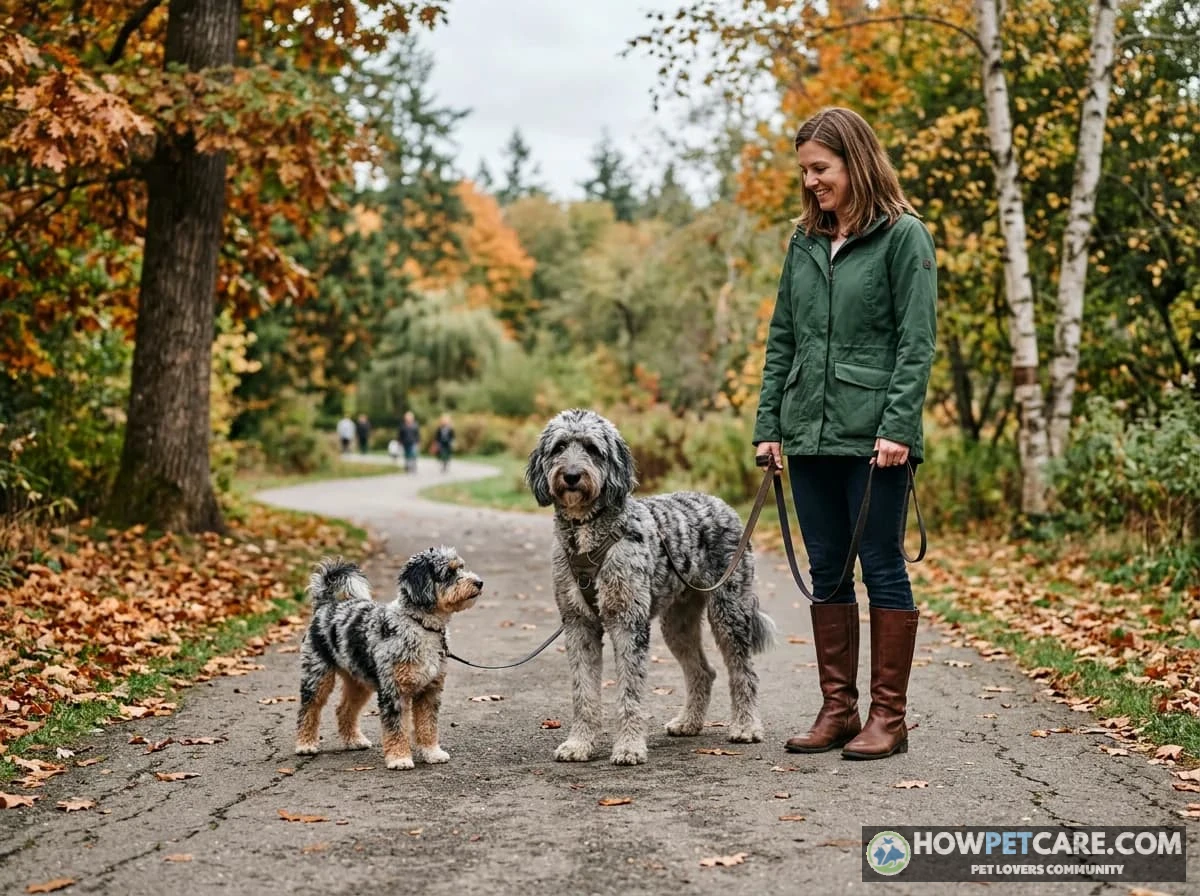

A mini Aussiedoodle is an Australian Shepherd–Poodle cross that generally stands 12 to 18 inches tall and weighs 15 to 35 pounds as an adult. Expect an active, intelligent companion with variable shedding and regular grooming needs. Compare parent health clearances and budget for training, veterinary care, and grooming before buying.
A full-grown mini Aussiedoodle generally stands 12 to 18 inches tall at the shoulder and weighs between 15 and 35 pounds. A cross between a Miniature Australian Shepherd (or standard Australian Shepherd) and a Miniature Poodle, this hybrid pairs high working intelligence with a compact frame and a low-shedding coat when genetics align. Even so, adult size, temperament, and coat demands swing widely across generational lines, breeding practices, and early training.
Anyone shopping for mini aussiedoodle puppies has to sort through misleading sales labels, verify multi-panel health screenings, and budget realistically for ongoing care. This guide walks through the clinical, genetic, and financial realities so you can decide if this active companion fits your home.
Mini Aussiedoodle Full Grown: Size, Weight, and Growth Timeline

Full grown, the miniature aussiedoodle falls into the small-to-medium range. Adult height typically ranges from 12 to 18 inches at the withers, though some smaller lines measure closer to 10 to 14 inches. Healthy adult weights usually settle between 15 and 35 pounds, with larger individuals reaching up to 40 pounds depending on whether a Miniature or standard Australian Shepherd appears in the parental pedigree. Because the mini aussiedoodle is a crossbreed rather than a closed, purebred lineage recognized by the American Kennel Club (AKC), physical proportions reflect a blend of both ancestral breeds.
It helps to distinguish between the purebred Miniature American Shepherd—recognized by the AKC since 2015 with a seasonally shedding double coat—and the mini Australian Shepherd Poodle mix, which introduces Poodle curl genetics to alter shedding patterns.
Legitimate Size Standards vs. Deceptive ‘Teacup’ and ‘Micro’ Labels
Commercial puppy brokers and backyard breeders frequently advertise a "toy aussiedoodle," "micro mini," or "teacup aussiedoodle" at inflated price points of $3,000 to $6,000. These labels do not represent recognized, predictable size classes established by reputable canine registries. In reality, these descriptors are marketing inventions created to sell undersized dogs.
Breeding mini Aussiedoodles down below the standard 15-pound threshold often relies on selecting runts, introducing dwarfing mutations, or crossing with smaller toy breeds. These practices dramatically heighten risks of portosystemic liver shunts, persistent open fontanelles (soft spots in the skull), chronic hypoglycemia, and severe dental crowding.
When purchasing a miniature aussiedoodle, prioritize structural soundness and orthopedically sound parentage over extreme, miniaturized proportions.
Month-by-Month Weight Milestones and Growth Plate Development
A puppy’s growth follows a steady physiological path, though structural maturity takes time:
- 8 to 12 Weeks: Rapid initial skeletal development; average weight sits between 4 and 8 pounds.
- 16 Weeks (4 Months): The puppy reaches roughly 50% of its expected adult weight.
- 6 Months: Skeletal frame reaches approximately 75% of full adult height, with weight averaging 12 to 24 pounds.
- 9 to 11 Months: Long bones achieve full length, and vertical height stabilizes between 12 and 18 inches.
- 12 to 16 Months: Skeletal growth plates fully close, allowing chest broadening and lean muscle development to complete.

The growth plates in a mini Aussiedoodle typically close between 10 and 14 months of age. Avoid high-impact concussive exercise—such as repetitive agility jumps, long-distance running on asphalt, or intense frisbee leaps—until a licensed veterinarian confirms radiographic growth plate closure.
F1 vs. F1b Mini Aussiedoodles: Generational Genetics and Shedding
Understanding generational terminology is essential when selecting mini aussiedoodle puppies for allergy-sensitive households. Generational labels indicate the theoretical genetic split between the Miniature Australian Shepherd and the Miniature Poodle, determining the presence of coat furnishings and curl tightness.
Generational Breakdown: F1, F1b, F2, and Multigen Differences
An F1 mini aussiedoodle is a direct first-generation cross: 50% Miniature Australian Shepherd and 50% Miniature Poodle. This pairing offers the highest degree of hybrid vigor, which provides minor resilience against inbreeding depression. However, coat phenotypes in F1 litters are highly variable. Puppies can exhibit loose waves, straight hair, or soft curls, and shedding levels range from minimal to moderate.
An f1b mini aussiedoodle is a backcross: an F1 Aussiedoodle bred to a purebred Miniature Poodle (yielding roughly 75% Poodle and 25% Miniature Australian Shepherd). This backcross consistently produces tighter fleece or wool coats with predictable low-shedding attributes.
An F2 cross pairs two F1 Aussiedoodles. F2 litters produce significant genetic variation. A puppy can inherit an "improper coat" lacking facial furnishings, resulting in a shedding double coat identical to that of an Australian Shepherd. Multigenerational (Multigen) pairings involve breeding beyond second-generation crosses, often selected across successive generations to fix non-shedding furnishing genes.
| Generation | Parent Cross | Genetic Percentage | Typical Coat Texture | Shedding Predictability | Allergy Compatibility |
|---|---|---|---|---|---|
| F1 | Mini Aussie x Mini Poodle | 50% Aussie / 50% Poodle | Wavy fleece to loose curls | Moderate; variable | Low to Moderate |
| F1b | F1 Aussiedoodle x Mini Poodle | 25% Aussie / 75% Poodle | Tight fleece to spiral wool | High; minimal shedding | High |
| F2 | F1 Aussiedoodle x F1 Aussiedoodle | 50% Aussie / 50% Poodle | Flat, wavy, or curly (high variance) | Unpredictable; risk of high shedding | Variable |
| Multigen | F1b/Multigen x F1b/Multigen | Typically >65% Poodle | Uniform fleece or wool | High; consistently low shedding | High |

The Furnishings Gene (RSPO2) and Shedding Predictability
The canine coat involves specific gene loci. The presence of "furnishings"—longer facial hair forming a mustache, beard, and prominent eyebrows—is governed by dominant mutations in the RSPO2 gene.
- Furnished Dogs (F/F or F/f): Possess facial furnishings and continuously growing coat hair that traps shedding fibers, significantly reducing airborne dander.
- Unfurnished Dogs (f/f): Lack furnishings, producing smooth muzzles, a seasonally blown undercoat, and shedding patterns similar to an Australian Shepherd.

Canine allergies are not caused by hair alone, making the term "hypoallergenic" misleading. Reactions stem primarily from Can f 1 and Can f 2 proteins found in saliva, sebum, and dander. While an F1b mini Aussiedoodle with two copies of the furnishing gene drops substantially less dander-laden hair across household surfaces, sensitive individuals may still react to salivary proteins.

Mini Aussiedoodle Temperament: Herding Drives and Daily Realities

The mini aussiedoodle temperament reflects its working heritage. This hybrid combines the sharp intelligence, biddability, and prey drive of the Poodle with the motion sensitivity, environmental alertness, and loyalty of the Australian Shepherd. The result is an affectionate dog that thrives on active engagement rather than quiet lap time.
Without appropriate outlets, that high energy can turn into behavioral friction. Mini Aussiedoodles routinely shadow their handlers from room to room. That level of devotion means building early, structured independence is essential.
Herding Instinct Management: Redirecting Nipping and Alert Barking
Because of their Australian Shepherd background, mini Aussiedoodle puppies frequently show predatory-motor patterns like stalking, ankle-nipping, and circling running children or quick-moving pets. Punishing these natural drives usually backfires and spikes canine arousal; handlers need to redirect them instead.
- Establish a Rapid Redirection Protocol: When the puppy goes after heels or pant legs, freeze immediately to cut off the motion that triggers the chase. Offer an appropriate target right away, such as a high-value tug toy or braided fleece rope.
- Engage Working Drives with Impulse Drills: Channel herding focus into organized games. Work with a flirt pole using clear "wait," "chase," and "drop it" cues to teach self-control around sudden movement.
- Decondition Perimeter Alert Barking: Aussiedoodles instinctively patrol boundaries. When your dog barks at outside noises, acknowledge the sound with a calm marker, then direct them to an alternate behavior, like heading to a "place" mat for a food reward.

Crate Training and Preventing Separation Anxiety in High-Attachment Dogs
Strong attachment makes mini Aussiedoodles prone to distress vocalizations and destructive habits when left alone. Crate training provides safety and a calm retreat when taught patiently.
- Feed All Meals Inside the Enclosure: Build positive associations by placing food bowls and long-lasting enrichment items (such as frozen peanut butter KONGs) inside the open crate.
- Practice Micro-Absences: Step out of the room for 30 seconds while the dog remains calm, then return quietly. Gradually lengthen these stretches to 5, 15, and 45 minutes over two to three weeks.
- Enforce Daytime Settling Windows: Working breeds rarely sleep when they should. Plan 2-hour crate naps after 60 minutes of exercise and mental work to keep overtired puppies from getting mouthy and frantic.

Mini Aussiedoodle Lifestyle Compatibility Index

Calculate your compatibility score before contacting breeders. Score each category from 1 to 4 based on your actual daily capacity:

1. Daily Exercise & Mental Engagement Available
   - Under 30 minutes casual walking = 1 pt
   - 30–60 minutes walking/light fetch = 2 pts
   - 60–90 minutes mixed cardio, structured training, and scent work = 3 pts
   - 90+ minutes intense hiking, agility, or working-drive sports = 4 pts

2. Daily Isolation Window (Continuous Unattended Hours)
   - 8+ hours alone daily without a midday visit = 1 pt
   - 6–8 hours alone daily with scheduled dog-walker check-in = 2 pts
   - 3–5 hours alone daily = 3 pts
   - Work-from-home or continuous household presence = 4 pts

3. Tolerance for Grooming & Coat Maintenance
   - Zero tolerance; preference for wash-and-wear short coats = 1 pt
   - Willing to pay professional groomer every 10–12 weeks; weekly brushing = 2 pts
   - Line brushing 3x/week; 4–6 week recurring professional grooming schedule ($90–$140/visit) = 3 pts
   - Dedicated daily line brushing down to the dermis plus full home scissoring/clipping = 4 pts

4. Reactivity & Vocalization Threshold (Living Environment)
   - Shared-wall apartment with zero noise tolerance; sensitive neighbors = 1 pt
   - Dense condo/townhome with patio; moderate noise tolerance = 2 pts
   - Suburban detached home with fenced yard = 3 pts
   - Rural acreage or low-density neighborhood = 4 pts

Interpreting Your Score:
- 4–7 Points (High Risk): Unfavorable match. Under-stimulated dogs frequently develop barrier barking, neurotic pacing, and destructive separation anxiety.
- 8–11 Points (Conditional Match): Feasible only with external support (daily professional midday walker, pre-budgeted monthly professional grooming, and dedicated weekend mental enrichment).
- 12–16 Points (Optimal Match): Ideal home environment capable of meeting this hybrid's cognitive workload, exercise volume, and coat maintenance demands.
Lifespan and Hereditary Health Risks: Mandatory Testing Protocols
The expected mini aussiedoodle lifespan ranges between 12 and 15 years. Reaching that milestone takes more than luck; parent stock must be screened for hereditary disorders common to both Australian Shepherds and Poodles.
The MDR1 Mutation and Medication Sensitivities
The Multidrug Resistance 1 (MDR1) gene mutation occurs frequently in herding breeds. Dogs carrying one (M/N) or two (M/M) mutant alleles produce an abnormal P-glycoprotein pump in the blood-brain barrier.
When exposed to common medications—including high-dose ivermectin antiparasitics, loperamide (Imodium), acepromazine, and select chemotherapy drugs—the compounds pass directly into the central nervous system. That exposure can cause severe neurotoxicity, respiratory failure, seizures, or death. Responsible breeders run DNA panels on all breeding stock to ensure no puppy inherits a double mutation.
The Genetics of the Merle Coat Pattern: Avoiding Lethal Double-Merle Crosses
The merle pattern creates dappled patches of dilute pigment across the coat, often paired with bright blue or split-colored eyes. Though striking, the semi-dominant merle gene (M) carries severe health risks if bred carelessly.

Never purchase a puppy from a breeder who mates two merle-patterned parents (merle-to-merle breeding). Statistically, 25% of offspring from such pairings become homozygous ‘double merles’ (M/M), resulting in congenital bilateral deafness, microphthalmia (abnormally underdeveloped eyes), structural colobomas, and irreversible blindness.
Verifying OFA and CERF Clearances: How to Read Public Registries
Never rely on a breeder’s claim that parent dogs are "vet checked." A standard physical exam cannot detect hidden hip dysplasia, early retinal degeneration, or genetic carrier status. Reputable breeders verify their stock through established public registries:
- Orthopedic Foundation for Animals (OFA) Hips and Patellas: Hips must be radiographed after 24 months of age and certified as "Fair," "Good," or "Excellent." Patellar luxation (kneecap displacement common in miniature Poodles) must be certified "Normal."
- OFA Companion Animal Eye Registry (CAER): Annual ophthalmic examinations performed by a board-certified veterinary ophthalmologist certifying parents free from inherited cataracts, progressive rod-cone degeneration (prcd-PRA), and collie eye anomaly (CEA).

Ask prospective breeders for the official registered names or registration numbers of the sire and dam, then verify these clearances directly in the public OFA database.
| # | Pervasive Myth | Biological & Commercial Reality |
|---|---|---|
| 1 | "Mini Aussiedoodles are 100% hypoallergenic." | False. Dog allergies are triggered primarily by Can f 1 and Can f 2 proteins found in saliva, sebum, and dander, not the hair itself. Low-shedding coats simply shed less hair-bound dander into the home. |
| 2 | "An F1 cross sheds less than an F1b cross." | False. An F1 (50% Mini Aussie / 50% Mini Poodle) inherits one shedding gene from the Aussie, often creating an open, shedding fleece. An F1b (75% Poodle backcross) has a higher probability of carrying two copies of the RSPO2 furnishing gene, sharply reducing shedding. |
| 3 | "Every Mini Aussiedoodle stays under 20 pounds." | False. Standard miniature genetics range between 15 and 35 pounds. Australian Shepherd breed throwbacks routinely produce 30+ lb dogs even when bred to miniature poodles. Adult size cannot be guaranteed before 8–10 months. |
| 4 | "’Toy’, ‘Teacup’, or ‘Micro’ varieties are recognized sizes." | False. These are unregulated marketing terms invented by commercial brokers. Breeding Mini Aussiedoodles below 12 pounds often involves runting practices or dwarfing mutations, risking portosystemic liver shunts and severe hypoglycemia. |
| 5 | "Doodles inherit only the best traits of both parent breeds." | False. Genetic inheritance is stochastic. A puppy can inherit the high motion sensitivity, nipping, and watchdog barking of the Australian Shepherd alongside the high prey-drive and separation sensitivity of the Poodle. |
| 6 | "They only need brushing once a week." | False. Weekly surface brushing causes severe matting near the skin line. Without routine "line brushing" using a long-pin slicker followed by a metal greyhound comb, mixed fleece/wool coats mat into solid pelts that require shaving. |
| 7 | "A cheaper puppy ($800–$1,200) is just as safe if vet-checked." | False. A standard "vet check" is merely a visual physical exam. It does not screen for hereditary hip dysplasia, progressive retinal atrophy, or MDR1 drug toxicity. Conducting thorough health testing on parents costs thousands, which is reflected in transparent pricing ($2,000–$3,500). |
| 8 | "They are low-maintenance family pets for sedentary owners." | False. Both ancestral breeds are working lineages. A Mini Aussiedoodle requires a minimum of 60 minutes of active exercise daily alongside cognitive engagement (puzzles, scent work, obedience) to prevent destructive chewing. |
| 9 | "Merle-to-merle breeding produces prettier, higher-value puppies." | False. Breeding two merle dogs creates a 25% statistical risk of "double-merle" homozygous puppies, which frequently suffer from congenital deafness and microphthalmia. |
| 10 | "Hybrid vigor makes them immune to genetic health disorders." | False. First-generation crosses can inherit health vulnerabilities shared by both parent breeds, notably progressive retinal atrophy, cataracts, and patellar luxation. Hybrid vigor does not provide immunity to dominant or co-expressed mutations. |
Daily Nutrition Guidelines: Caloric Needs Across Life Stages
Mini Aussiedoodles burn calories quickly thanks to their high working drives and energetic metabolisms. Balancing their macronutrient intake helps maintain lean muscle while avoiding unnecessary stress on growing joints.
Calibrated Daily Calorie Requirements by Weight and Activity Level
To calculate daily caloric targets, first determine the dog’s Resting Energy Requirement (RER), calculated as 70 * (body weight in kg)^0.75. Next, apply a Maintenance Energy Requirement (MER) multiplier:
- Rapid Growth Puppy (< 4 months):
3.0 * RER - Developing Adolescent Puppy (4 to 12 months):
2.0 * RER - Intact / High-Activity Adult:
1.8 * RER - Neutered / Moderate-Activity Adult:
1.6 * RER
Select a diet meeting Association of American Feed Control Officials (AAFCO) profiles for the dog’s specific life stage. Working puppies require a minimum 28% protein and 18% crude fat ratio to fuel neurological and tissue development. Always consult your veterinarian to adjust portions based on your dog’s specific body condition score (BCS).
| Life Stage | Weight Range (lbs) | Daily Caloric Target (kcal) | Recommended Daily Protein/Fat Split | Daily Feeding Frequency |
|---|---|---|---|---|
| Puppy (2–6 Months) | 5 – 15 | 350 – 650 kcal | 28% Protein / 18% Fat | 3 to 4 meals/day |
| Adolescent (6–12 Months) | 15 – 25 | 600 – 850 kcal | 26% Protein / 16% Fat | 2 meals/day |
| Active Adult (1–7 Years) | 20 – 35 | 700 – 1,050 kcal | 24% Protein / 14% Fat | 2 meals/day |
| Senior (8+ Years) | 18 – 30 | 500 – 750 kcal | 26% Protein / 10% Fat | 2 meals/day |

Preventing Obesity-Linked Joint Stress and Patellar Luxation
Keep treats under 10% of your mini Aussiedoodle’s total daily caloric intake. Excess weight puts immediate stress on joints, worsening patellar luxation (slipping kneecaps) and accelerating hip arthritis.
Mini Aussiedoodles can also inherit sensitive stomachs from their Poodle side. If your dog struggles with intermittent loose stools or skin itching (pruritus), consider transitioning to a single-source novel protein (such as lamb, venison, or salmon) with prebiotic beet pulp or chicory root to support healthy digestion.
Grooming and Coat Care Requirements: Line Brushing and Salon Upkeep
The mini Aussiedoodle coat combines the straight shedding undercoat of the Australian Shepherd with the continuously growing hair of the Poodle. Loose undercoat fibers shed straight into surrounding fleece or wool curls. Left alone, these trapped hairs quickly turn into dense mats against the skin.
The Daily At-Home Regimen: Line Brushing and Dematting Tools
Brushing only the top of the coat with a standard bristle brush gives the illusion of a groomed dog while dense mats form underneath. Protecting the coat requires systematic line brushing down to the skin three to four times per week.

-
Section the Coat
Part the dog’s hair down to the bare skin using your non-dominant hand, exposing a clean horizontal line of dermis across the flank or leg.
-
Work with a Long-Pin Slicker
Using a high-quality, long-pin slicker brush, brush downward through the parted hair from root to tip using short, gentle strokes.
-
Move Sequentially Upward
Move the parted line up by one inch and brush out the next layer of hair, working methodically across the entire torso, neck, legs, and tail.
-
Verify with a Metal Greyhound Comb
Run a wide-tooth metal greyhound comb flat against the skin through the brushed section. If the tines catch on underlying tangles, separate the knot gently with your fingers before smoothing it out with the comb.
Between 7 and 14 months of age, your mini Aussiedoodle will shed its soft puppy coat as the denser adult fleece or wool emerges. Matting accelerates dramatically during this transitional window. Daily line brushing is required during this phase to avoid needing to shave the coat down completely.
Professional Grooming Schedules and Lifetime Salon Budgeting
Plan on professional grooming visits every 4-to-6-week cycle. A standard appointment includes a hygienic sanitary shave, ear canal cleaning, nail clipping, thorough de-shedding, bathing, and hand-scissoring into a breed trim (such as a teddy bear cut or utility shave).
Expect to invest $85 to $125 plus gratuity per salon visit, amounting to roughly $900 to $1,400 in professional coat care expenses annually. Neglecting this maintenance can lead to pelt matting, which cuts off skin circulation, traps moisture, and causes painful fungal and bacterial hot spots.

The True Cost of Ownership: Puppy Price and First-Year Financial Breakdown
Purchasing and raising a mini Aussiedoodle requires a real financial commitment. The initial purchase price is only the beginning; ongoing costs include veterinary wellness visits, premium food, and frequent professional grooming.
Purchase Price vs. Quality Indicators: What Drives the Cost Variance?
Ethical, preservation-minded breeders typically price mini Aussiedoodle puppies between $2,000 and $4,500. That figure accounts for multi-generational DNA testing, certified OFA hip and eye examinations, prenatal veterinary care, and early socialization protocols like Puppy Culture or Early Neurological Stimulation.
Puppies listed below $1,200 often come from commercial puppy mills or backyard breeders. These operations save money by skipping health clearances, housing dogs in poor conditions, and ignoring early behavioral enrichment. The initial savings rarely hold up once medical and behavioral bills arrive.
First-Year Expense Ledger: Upfront Setups, Routine Care, and Recurring Costs
During the first year, puppy owners face upfront capital outlays along with recurring living expenses.
| Expense Category | Initial Upfront Cost ($) | Monthly / Recurring Cost ($) | First-Year Estimated Total ($) |
|---|---|---|---|
| Puppy Acquisition (OFA-Tested Breeder) | $2,000 – $4,500 | $0 | $2,000 – $4,500 |
| Core Vaccines & Initial Veterinary Workups (DHPP series, Rabies, Bordetella, Leptospirosis, Microchip) | $350 – $550 | $0 | $350 – $550 |
| Spay / Neuter Procedure & Pre-Op Bloodwork | $300 – $650 | $0 | $300 – $650 |
| Durable Equipment Setup (Crate, playpen, biothane leads, harness, stainless bowls, car harness) | $250 – $400 | $0 | $250 – $400 |
| Grooming Tools (Long-pin slicker brush, metal greyhound comb, dematting rake, blunt shears) | $75 – $120 | $0 | $75 – $120 |
| Professional Grooming (Starting at month 4; 4–6 week intervals at $85–$125 + tip) | $0 | $85 – $125 / mo | $680 – $1,000 |
| Nutritional Sustenance (AAFCO-compliant high-protein puppy/adult kibble) | $40 – $60 | $45 – $70 / mo | $540 – $840 |
| Parasite Prevention (Heartworm, flea, and tick chewables; weight-adjusted) | $0 | $25 – $40 / mo | $300 – $480 |
| Pet Health Insurance (Accident & illness coverage, $500 deductible, 80% reimbursement) | $0 | $38 – $65 / mo | $456 – $780 |
| Training & Behavioral Foundation (Puppy socialization + Level 1 manners classes) | $180 – $350 | $0 | $180 – $350 |
| Consumable Enrichment (Puzzle feeders, KONGs, natural chews, waste bags) | $60 – $100 | $20 – $35 / mo | $300 – $520 |
| Annual Contingency Reserve (Unforeseen emergency diagnostics or deductible) | $500 | $0 | $500 |
| TOTALS | $3,755 – $7,230 | $213 – $335 / mo | $5,931 – $10,690 |

After the initial year, annual maintenance costs generally settle between $1,800 and $3,000. These ongoing expenses cover food, regular professional grooming, preventative parasite medications, and routine veterinary wellness checkups.
Vetting a Reputable Breeder: Verification Checklist and Red-Flag Defense
Protecting yourself from commercial puppy mills comes down to independent verification. Conscientious breeders prioritize physical soundness and behavioral stability over litter volume, and they welcome detailed questions about their breeding stock.
Step-by-Step Parent Health Verification Audit
Never finalize a purchase contract or submit a non-refundable deposit without completing this four-step verification audit:
- Obtain Official Registered Identifiers: Request the registered kennel names, microchip IDs, and registration numbers for both the sire and the dam.
- Audit Independent Database Clearances: Search the Orthopedic Foundation for Animals (ofa.org) database using the parents’ registered names. Confirm that hip radiographs (Good or Excellent) and annual CAER eye exams were certified by independent veterinary specialists rather than the breeder’s private vet.
- Review Comprehensive Genetic Screening Panels: Verify that DNA testing confirms both parents are clear of the MDR1 drug sensitivity mutation, progressive rod-cone degeneration (prcd-PRA), and degenerative myelopathy (SOD1). If one parent is a carrier, ensure the mate is genetically clear to prevent affected puppies.
- Inspect the Physical Facility or Living Conditions: Visit the kennel in person or request an interactive live video call to observe the mother and puppies in their primary living area. Confirm the dogs are raised indoors in clean, enriched environments with appropriate early sensory socialization.

Breeder Clinical Audit: Health Testing & Pedigree Verification Script

Copy and paste this inquiry directly when vetting prospective breeders. Do not accept general assurances such as "our vet checked the parents."

---

Subject: Health Testing Documentation Inquiry

Dear Breeder,

I am evaluating litters for an upcoming Mini Aussiedoodle adoption and am prioritizing documented orthopedic and genetic clearances to ensure long-term physical soundness.

Could you please provide the registered kennel names, microchip numbers, or direct Orthopedic Foundation for Animals (OFA) / PennHIP reference numbers for both the sire and the dam of this planned litter?

Specifically, I am verifying the following prior to placing a deposit:

1. Orthopedic Clearances: OFA or PennHIP evaluations for both parents (Hip Dysplasia scores of Fair, Good, or Excellent; OFA Normal status for Patellar Luxation).
2. Ophthalmic Clearances: OFA Companion Animal Eye Registry (CAER) eye exams cleared within the last 12 months.
3. DNA Mutation Panels: Proof of parentage clearance (Clear or Carrier status, ensuring no At-Risk pairings) for:
   - Multidrug Resistance Mutation (MDR1 gene)
   - Progressive Rod-Cone Degeneration (prcd-PRA)
   - Collie Eye Anomaly (CEA)
   - Degenerative Myelopathy (SOD1)
   - Hereditary Cataracts (HSF4)
4. Coat Genetics: Confirmation that neither parent carries double-merle (M/M) alleles, and the specific RSPO2 (furnishings) genotype if predicting non-shedding coat types in this cross.

Could you also clarify whether your purchase agreement includes a contractual lifetime rehoming guarantee if the owner becomes unable to care for the dog?

Thank you for your time and commitment to health transparency.

Best regards
Contract Safeguards: Health Guarantees and Lifetime Return Clauses
A clear puppy contract protects both the animal’s welfare and your investment. Look for a written guarantee covering at least two years against debilitating hereditary defects, including juvenile cataracts, early hip dysplasia, and congenital heart problems.
Ethical breeders insist on a mandatory lifetime surrender clause. If personal, medical, or financial hardship prevents you from caring for your dog at any point during its life, the breeder must agree to take the dog back rather than allow it to enter a municipal shelter system.
Watch for major warning signs: breeders who ship puppies via third-party haulers without meeting you, facilities selling multiple designer mixes, sellers who refuse to show health certificates, or ads promoting "micro," "teacup," or "rare double-merle" pups. Sticking to objective health data and realistic budgeting ensures you bring home a sound, stable mini Aussiedoodle ready for a long, healthy life.
| Generation | Parent Cross | Genetic Percentage | Typical Coat Texture | Shedding Predictability | Allergy Compatibility |
|---|---|---|---|---|---|
| F1 | Mini Aussie x Mini Poodle | 50% Aussie / 50% Poodle | Wavy fleece to loose curls | Moderate; variable | Low to Moderate |
| F1b | F1 Aussiedoodle x Mini Poodle | 25% Aussie / 75% Poodle | Tight fleece to spiral wool | High; minimal shedding | High |
| F2 | F1 Aussiedoodle x F1 Aussiedoodle | 50% Aussie / 50% Poodle | Flat, wavy, or curly (high variance) | Unpredictable; risk of high shedding | Variable |
| Multigen | F1b/Multigen x F1b/Multigen | Typically >65% Poodle | Uniform fleece or wool | High; consistently low shedding | High |
FAQ
What is the primary difference between a Mini Aussiedoodle and a Mini Goldendoodle?
Mini Aussiedoodles may inherit Australian Shepherd herding instincts, including motion sensitivity, alert barking, and nipping. Mini Goldendoodles have retriever ancestry; temperament and activity needs vary among individual dogs of either cross.
Can a Mini Aussiedoodle live comfortably in an apartment?
Yes, provided its exercise, mental stimulation, and training needs are met and alert barking is managed. Individual energy levels and tolerance for close-quarters living vary.
At what age is a Mini Aussiedoodle considered fully grown?
Mini Aussiedoodles often reach adult height between 9 and 11 months, though individual growth rates vary. They may continue developing muscle and broadening in the chest until around 14 to 16 months.
Are Mini Aussiedoodles easy to crate train?
Many learn readily with patient, positive crate training, but rushing can cause distress. Build comfortable associations with the crate and gradually increase the time spent inside without using it as punishment.