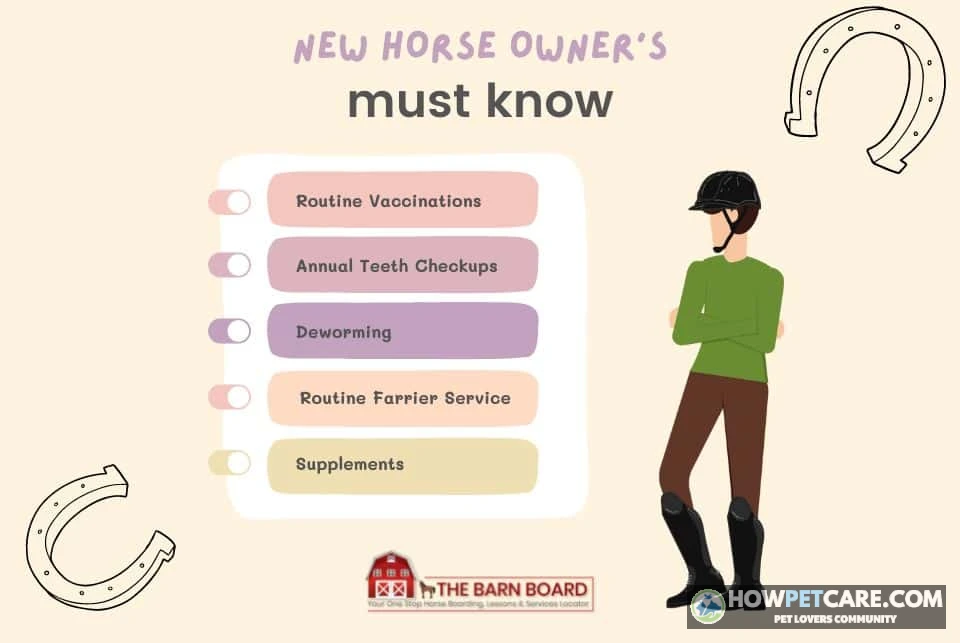

New horse owners need a safe shelter and turnout setup, clean water, weighed forage, safe handling and grooming supplies, daily health checks, routine farrier and veterinary care, and a written emergency plan. Confirm which responsibilities and supplies your boarding facility provides before your horse arrives.
Safe horse ownership starts before your horse arrives. Arrange suitable housing, a written feeding and care plan, essential handling equipment, a primary veterinarian, a farrier, emergency transportation, and a reserve for unexpected costs. Separate what every horse needs from supplies your boarding facility provides and gear that can wait until you know the horse’s size, routine, and workload.
This guide to horse care essentials for new owners gives you a practical system to use at the barn. It covers what to prepare, daily and weekly chores, forage calculations, equipment fit, professional care schedules, and the first steps to take if you suspect colic or another emergency.
Pre-Arrival Day-One Checklist: Must-Have Horse Supplies and Setup
Critical Supplies to Have on Site Before Delivery
From the first hour, your horse needs safe handling, shelter, forage, clean water, and someone watching for problems. Confirm the barn’s responsibilities in writing before delivery. Full board may include feed, buckets, bedding, turnout, stall cleaning, and blanketing; self-care or home ownership usually does not.
Mandatory day-one supplies
- A properly sized breakaway halter and sturdy cotton lead rope. A leather crownpiece or approved breakaway mechanism is important when a horse is left haltered without supervision; a regular nylon halter can pose a dangerous entrapment risk.
- A labeled feed tub, water bucket, and hay net or feeder if the facility doesn’t provide them.
- A curry comb, stiff brush, soft brush, mane and tail comb, and hoof pick. Daily grooming and hoof picking remove dirt and help you spot early injuries or skin problems.
- A digital rectal thermometer with a string or clip, lubricant, and a basic stethoscope to record the horse’s baseline vital signs.
- An equine first-aid kit, clean towels, flashlight, gloves, and a phone charger kept at the barn.
- Safe storage for feed, supplements, medications, blankets, and tack. Keep grain in a sealed, rodent-proof container.
- Identification information: the horse’s registered name, barn name, age, color, microchip number if applicable, current photographs, and insurance details.

Facility safety check
Walk through the stall and turnout pasture before unloading. Check that:
- Fences are secure, visible, and free of protruding wire, broken boards, nails, and sharp edges.
- Gates latch reliably and the horse cannot open them.
- The stall has safe walls, adequate ventilation, dry bedding, and no exposed hardware.
- The water trough or automatic waterer works, is clean, and cannot trap a hoof.
- Toxic plants, discarded equipment, baling twine, and loose plastic have been removed.
- The horse has a safe place to shelter from heat, rain, wind, and snow.
- A compatible turnout group or companion arrangement is ready. Horses are social animals; a home setup shouldn’t leave one horse isolated without a carefully planned companion.

Day-One Gear Priority Matrix
| Item | Classification | Why This Status? | What to Check Before Buying |
|---|---|---|---|
| Breakaway halter and cotton lead rope | Mandatory day-one | Needed for transport and safe handling | Correct size, sturdy lead, breakaway crown or safety fuse |
| Thermometer and stethoscope | Mandatory day-one | Establishes a health baseline | Fast-read thermometer with clip; usable stethoscope |
| Curry, stiff brush, hoof pick | Mandatory day-one | Supports daily inspection and hygiene | Suitable bristles and comfortable grip |
| Feed and water buckets | Facility-dependent | Often supplied with full board | Confirm inventory, mounting hardware, and labeling |
| Turnout blanket or sheet | Horse and climate-dependent | Depends on coat, clipping, age, weather, and shelter | Measure the actual horse; do not guess size |
| Fly sheet and fly mask | Seasonal or conditional | Useful in high-insect areas or for sensitive horses | Clear eye space and secure jaw fit |
| Saddle and custom bridle | Conditional; buy later | Fit depends on the individual horse and rider | Arrange a qualified saddle fitter after the horse settles |
| Specialized boots and training aids | Optional | Can cause injury or clutter when used incorrectly | Use only for a documented need and with professional guidance |
Setting Up Barn Contacts and Emergency Hauling Ahead of Time
Save contact details for the primary equine veterinarian, referral hospital, certified farrier, equine dentist or veterinarian providing dental care, trainer, and licensed emergency hauler. Keep them in your phone and on a printed barn sheet. Ask the boarding manager who can hold the horse for routine appointments, who pays holding fees, and who authorizes emergency treatment if you can’t be reached.
Don’t wait for an emergency to find out whether a trailer is available. Confirm the hospital address, gate access, trailer loading plan, and spending authorization in writing.
Write down the horse’s normal appetite, manure pattern, temperature, pulse, respiration, and behavior as soon as practical. A meaningful change from that individual baseline can be more useful than a generic number alone.
Daily and Weekly Horse Care Routine Checklist
Morning and Evening Chore Sequence
Follow the same sequence each day and record anything unusual. A consistent routine makes changes easier to spot.
Morning
- Observe the horse before entering: attitude, posture, breathing, appetite, manure, lameness, swelling, and signs of pain; understanding whether horses sleep standing up or require lying down for deep rest helps you evaluate their overnight posture.
- Confirm fresh, clean water is available. Horses need continuous access to clean water for digestion, temperature regulation, and normal body function.
- Feed the assigned forage and concentrate ration by weight, not by an unmeasured scoop.
- Muck the stall, remove wet bedding and manure, and check that the horse hasn’t pawed, cast itself, or damaged a wall.
- Pick all four hooves and look for packed mud, heat, odor, cracks, stones, loose shoes, or a sudden change in stance.
- Groom before turnout or work: curry the body, use a dandy brush, finish with a soft brush, and inspect the skin.
- Apply only the blanket, fly equipment, or boots specified by the care plan.
Evening

- Repeat the health observation and compare appetite and manure with the morning record.
- Refill and inspect water, including troughs and automatic waterers.
- Feed the evening forage and concentrate at the scheduled time.
- Remove manure and wet bedding again.
- Pick hooves, check legs for heat or swelling, and inspect any wounds or prescribed treatments.
- Confirm gates, stall doors, blankets, and turnout arrangements before leaving.
Everyday Grooming and Hoof Inspection Protocol
Start at the left shoulder and work methodically so you don’t miss an area. Move a rubber curry comb in small circles over fleshy body areas to loosen dirt and stimulate the skin. Avoid bony prominences, open wounds, and swollen areas. Follow with a stiff brush, then use a soft brush on the face and sensitive areas. Pick hooves from heel toward toe, keeping your body beside the horse rather than directly in front of or behind it.
Stop and call a professional if you find a hot, painful hoof; a strong digital pulse; sudden lameness; a deep puncture; an embedded object; or worsening swelling. Don’t pull an object out of the sole or limb unless a veterinarian directs you to do so.
Weekly Facility and Tack Storage Maintenance
Once each week, inspect fence lines, gate latches, stall hardware, feeders, and pasture footing. Scrub water buckets and troughs to remove algae and sediment, and check the flow in automatic waterers. Examine hay for mold, dust, heating, discoloration, or a musty smell. Discard questionable forage rather than mixing it into the ration.
Clean and dry grooming tools. Wipe tack after use and condition leather according to the manufacturer’s guidance. Check stitching, billets, girth straps, reins, snaps, and stirrup leathers for wear. Store equipment off the floor in a dry, ventilated tack storage area.

Equine Nutrition: Calculating Daily Forage, Concentrates, and Water
Worked Feeding Calculation for a 1,000-Pound Horse
For a mature 1,000-pound horse in maintenance to light work, a useful starting point is 2.0% of body weight in forage dry matter: 1,000 pounds x 0.02 = 20 pounds of dry matter daily. The general planning range is about 1.5% to 2.5% of body weight. The right amount depends on body condition, forage quality, age, dental status, metabolism, workload, weather, and veterinary findings.
Assume the grass hay is 90% dry matter. To find the as-fed amount, divide 20 pounds by 0.90, giving 22.2 pounds of hay daily. Weigh representative flakes; their size varies. If a flake weighs 4.5 pounds, 22.5 pounds equals about five flakes:

- Morning: 1.5 flakes, approximately 6.75 pounds.
- Midday: 1 flake, approximately 4.5 pounds, preferably in a safe slow-feed net if appropriate.
- Evening and overnight: 2.5 flakes, approximately 11.25 pounds.
This is an example, not a prescription. A thin horse may need more calories. An easy keeper or a horse with metabolic disease may need a different forage strategy, while poor teeth may call for soaked or processed forage. Obtain a forage analysis and ask a qualified equine nutritionist to balance the ration if body condition is outside the desired range, the horse has PPID or equine metabolic syndrome, or the forage is variable.
Balancing Forage, Concentrates, and Free-Choice Salt
Forage and roughage should form the foundation of most horse diets. If forage alone doesn’t supply the required vitamins, minerals, protein, or amino acids, a ration balancer may help. Not every horse needs concentrates. Follow the product label and professional advice rather than adding grain because the horse seems energetic or a scoop looks small.
Provide a plain white salt block and discuss loose salt with your veterinarian or nutrition professional, especially during hot weather, heavy sweating, or increased work. For planning, water intake commonly falls around 8 to 12 gallons per day, but it can rise substantially in heat, lactation, or strenuous exercise. Monitor your horse’s intake along with water cleanliness, weather, sweat loss, and manure consistency.
Change hay, concentrate, or supplements gradually over approximately 10 to 14 days when possible. Sudden feed changes can disrupt hindgut fermentation and increase digestive risk. Weigh feed, keep a written ration, and recheck body condition regularly.

| Workload Level | Daily Forage for a 1,000-Pound Horse | Concentrate or Balancer | Water Planning Range |
|---|---|---|---|
| Maintenance or easy keeper | Start near 1.5%–2.0% body weight, adjusted to condition | Forage may be sufficient; balancer only if needed | About 8–12 gallons daily, adjusted for conditions |
| Light work | Often near 2.0% body weight, with forage quality considered | Balancer or measured concentrate if calories or nutrients require it | More with heat and sweating |
| Moderate or heavy work | Often 2.0%–2.5% or a professional ration plan | Measured energy and electrolyte plan may be needed | Can exceed the baseline substantially |
| Senior, metabolic, or dental concern | Individualized forage form and amount | Veterinary or nutritionist-directed | Monitor intake and hydration closely |
Essential Equipment Fit and Safety Checks: Halters, Tack, and Blankets
Fit equipment on a calm, supervised horse, then recheck it after movement. Poor fit can cause rubs, pressure, restricted chewing, or escape hazards.
Two-Finger Rules for Halters and Bridles
Position the halter’s noseband about two fingers below the prominent cheekbone. Two stacked fingers should fit beneath it without binding or excessive slack. Allow roughly three to four adult fingers of clearance at the throatlatch. Check that the crownpiece doesn’t press into the ears and the halter doesn’t hang low enough to catch on a bucket or fence.
On a bridle, the browband should lie flat without pulling the crownpiece into the ears. The bit belongs in the interdental space and should create only one or two soft wrinkles at the mouth corners, depending on the horse and bit. Allow approximately two fingers of room beneath the cavesson over the nasal bone; never clamp it tightly. Check cheekpieces, reins, stitching, and buckles for damage.

Blanket Sizing and Winter Layering Guidelines
Measure from the center of the chest around the point of the shoulder to the point of the buttock. The chest closure should sit securely without pulling fabric into the neck or shoulder. Belly surcingles should cross flat and stay secure without binding. Leave enough slack in leg straps for movement, but not enough to catch a hoof.
Check under the blanket daily for heat, dampness, rubs, swelling, and weight loss. A healthy, unclipped horse with shelter and adequate forage may not need a blanket in a mild climate. A clipped, elderly, underweight, or soaked horse may need different protection. Winter forage can provide additional calories for heat production. Don’t choose blanket fill solely from a temperature chart; consider wind, rain, coat, shelter, body condition, and the horse’s response.

Red-Flag Signs of Poor Saddle Fit
A basic check can reveal obvious problems, but it can’t replace a qualified saddle fitter. With the girth tightened, look for two to three fingers of clearance between the withers and the pommel or swell. Sight down the gullet from behind to confirm that the saddle doesn’t rest on the spine. It should sit level, without tipping forward or backward, and stay stable at a walk.
Stop using the saddle and arrange a professional assessment if you notice white or dry pressure patches, repeated ear pinning during girthing, bucking that begins with saddling, soreness, bridging, rocking, slipping, or persistent lameness. Protective boots must fit snugly without restricting circulation, trapping heat, rubbing, or rotating into the fetlock.
-
Inspect before use
Check every strap, buckle, stitch, and fastener for cracks, dry rot, sharp edges, and stretched holes.
-
Fit while standing
Place the equipment correctly, apply only the necessary tension, and check clearance with your fingers.
-
Recheck after movement
Walk the horse, inspect for slipping or rubbing, and reassess after about 15 minutes of work.
-
Stop when warning signs appear
Remove equipment for pain, swelling, restricted breathing or chewing, lameness, or skin damage, then consult the appropriate professional.
Preventative Health Schedule: Farrier Care, Vaccinations, and Parasites
Hoof Maintenance and Farrier Cycles
Arrange regular farrier care, commonly every 4 to 8 weeks. Adjust the interval for hoof growth, season, conformation, terrain, and whether the horse is barefoot or shod. Daily picking doesn’t replace trimming or shoeing. Record appointment dates, hoof balance, cracks, lost shoes, and changes in movement.
Core Vaccination Timetable and Annual Dental Care
Ask your veterinarian to build a risk-based vaccination plan around the horse’s age, travel, exposure, geography, and barn population. Core planning commonly addresses tetanus, rabies, Eastern and Western equine encephalomyelitis, and West Nile virus; influenza, rhinopneumonitis, and strangles may be appropriate based on risk. No single calendar suits every horse.
Schedule a veterinary examination at least annually, and more often for senior horses, chronic conditions, new symptoms, or performance concerns. Dental examination and floating frequency depend on age, tooth condition, chewing ability, and examination findings. Many horses need annual or semiannual assessment. Watch for quidding, weight loss, dropped feed, foul odor, facial swelling, or resistance to the bit.

Strategic Fecal Egg Counts vs. Rotational Deworming
Ask your veterinarian about quantitative fecal egg counts and targeted parasite control instead of automatically rotating dewormers on a fixed calendar. The plan should account for local parasite risk, season, age, previous results, pasture management, and resistance concerns. Don’t choose products, doses, or intervals from a generalized internet schedule.

| Care Category | Recommended Frequency | Primary Professional | Key Notes and Indications |
|---|---|---|---|
| Veterinary wellness exam | At least annually; sooner when indicated | Equine veterinarian | Create an individual exam, vaccination, and monitoring plan |
| Core and risk-based vaccines | Per veterinarian and regional risk | Equine veterinarian | Core and exposure-based vaccines are not identical for every horse |
| Dental examination | Commonly annually or semiannually as indicated | Veterinarian or qualified dental provider | Age, chewing, weight, and tooth findings determine frequency |
| Farrier trim or shoeing | Often every 4–8 weeks | Certified or qualified farrier | Adjust for growth, conformation, terrain, and work |
| Fecal egg count and parasite plan | Veterinarian-directed | Veterinarian | Use results and risk rather than routine rotation alone |
Equine First Aid and Suspected Colic Emergency Protocol
First-Aid Kit Must-Haves and Normal Vital Signs
Keep a labeled equine first aid kit with a digital thermometer, lubricant, gloves, sterile gauze, clean towels, saline flush, chlorhexidine solution for veterinarian-approved cleaning, cohesive bandage wrap, elastic or pressure bandages, scissors, flashlight, and a notebook. Include your veterinarian’s written instructions and medication list. Don’t stock or administer prescription drugs without veterinary direction.
Useful resting reference ranges are approximately 99.0–101.5°F for temperature, 28–44 beats per minute for heart rate, and 8–16 breaths per minute for respiration. Gums should normally be pink and moist, with color returning in roughly two seconds after gentle pressure. A significant departure from your horse’s normal baseline is a reason to call, not a diagnosis.
Recognizing Early Signs of Colic and Distress
Possible colic signs include pawing, flank watching, lip curling, restlessness, repeated lying down or rolling, sweating, stretching as if to urinate, reduced appetite, reduced manure, abnormal gut sounds, or a raised pulse. Serious disease doesn’t always cause dramatic rolling. Don’t wait for symptoms to become severe.
Step-by-Step Triage: What to Do and What Never to Do
-
Call the veterinarian first
Report the signs immediately and provide the horse’s age, location, onset, recent feed or travel changes, manure history, and access instructions.
-
Observe and record safely
Take temperature, pulse, respiration, gum color and refill time, gut sounds in all four quadrants if safe, posture, pain behavior, and the time and character of the last manure.
-
Remove feed and hazards
Remove grain, hay, and treats while awaiting instructions. Keep the area safe and follow the veterinarian’s direction about water; remove buckets or obstacles if the horse is thrashing.
-
Manage movement without exhaustion
If the horse is violently rolling and at risk of injury, calm, brief walking may be appropriate while waiting for professional direction. Do not force continuous trotting, longeing, or exhausting exercise.
-
Prepare for referral
Open gates, locate the halter and records, confirm the emergency hauler, identify the referral hospital, and prepare transportation only as directed.
Never administer flunixin meglumine, phenylbutazone, sedatives, mineral oil, or other medication without speaking to the veterinarian. Don’t attempt home tubing, a rectal examination, forced water intake, or wound closure. Never give flunixin intramuscularly; the veterinarian must direct the route and dose. Deep or contaminated wounds, severe bleeding, eye injuries, suspected fractures, inability to stand, breathing difficulty, and abnormal vital signs require urgent professional assessment.
Realistic Cost Breakdown: Setup Budgets and Monthly Boarding Models
These are planning estimates in 2026 U.S. dollars, not quotes. Prices vary substantially with region, facility, horse size, labor, hay markets, medical history, and season. Get local quotes before committing.
One-time setup planning: A low-cost setup may be approximately $500–$1,500 if the barn supplies buckets, fencing, stall equipment, and some turnout gear. A typical setup may be $1,500–$4,000 once you add a grooming kit, first-aid supplies, used but safe handling equipment, blankets, and basic tack. Setup costs can exceed $4,000 if you buy a saddle, custom fitting, extensive home-farm equipment, trailer access, or specialized gear. Budget separately for the horse’s purchase and pre-purchase veterinary costs.
Monthly planning: Full board commonly costs more because it includes labor, stall care, feed, turnout, and facility services. Pasture board may reduce labor and bedding costs, but forage, herd dynamics, water, shelter, and weather still need close monitoring. Keeping a horse at home can appear cheaper while shifting expenses to fencing, shelter, manure management, hay storage, labor, utilities, and emergency infrastructure.
| Expense Category | Full Board (Stall) | Pasture Board | Self-Care or At-Home | Frequency |
|---|---|---|---|---|
| Board, shelter, and routine labor | About $500–$1,800+ | About $200–$900+ | Facility and labor vary widely | Monthly |
| Hay and concentrate supplements | Often partly included | May be partly included | Owner pays directly | Monthly |
| Farrier care | About $50–$250+ | About $50–$250+ | About $50–$250+ | Usually 4–8 weeks |
| Routine veterinary and dental reserve | About $50–$200+ averaged monthly | About $50–$200+ | About $50–$200+ | Annual or scheduled |
| Bedding | Often included or separately billed | Usually low | Owner pays directly | Monthly or seasonal |
| Blankets, fly control, and repairs | $25–$150+ averaged | $25–$150+ averaged | $50–$300+ averaged | Seasonal or as needed |
| Emergency reserve or insurance | Owner-selected | Owner-selected | Owner-selected | Monthly reserve |
Build your first-year budget around day-one supplies, routine board, farrier care, dental and vaccination visits, feed changes, seasonal equipment, and an emergency reserve. Set that reserve aside rather than relying on a credit card as your emergency plan. Ask your veterinarian about insurance, major medical coverage, or a surgical colic endorsement if appropriate for your situation.
How to Build Your Stable-Side Care Binder and Responsibility Matrix
Your Printable Emergency and Care Sheet
Print a copy for the stall area and the central barn binder. Fill in every blank before your horse arrives.
HORSE IDENTIFICATION
Registered name: __________________  Barn name: __________________
Breed: __________ Age: ____ Sex: ____ Color: ______ Microchip: __________
Normal temperature: ____ Normal pulse: ____ Normal respiration: ____

EMERGENCY CONTACTS
Owner: __________________ Phone: __________ Backup: __________________
Primary veterinarian: __________________ Phone: ______________________
Referral hospital: _____________________ Phone: ______________________
Licensed equine hauler: _______________ Phone: ______________________
Farrier: ______________________________ Phone: ______________________
Maximum emergency spending authorization: $___________________________

CARE PLAN
AM forage amount: __________  PM forage amount: __________
Concentrate or balancer: __________  Salt plan: ______________________
Turnout location and group: _________________________________________
Blanketing instructions: ____________________________________________
Medication instructions: ____________________________________________

RESPONSIBILITY MATRIX
Task                         Barn staff   Owner   Schedule or notes
AM feed and hay              [   ]        [   ]   ______________________
PM feed and hay              [   ]        [   ]   ______________________
Water refill and cleaning   [   ]        [   ]   ______________________
Stall mucking                [   ]        [   ]   ______________________
Turnout and bring-in         [   ]        [   ]   ______________________
Blanket and fly equipment   [   ]        [   ]   ______________________
Daily hoof check             [   ]        [   ]   ______________________
Farrier holding              [   ]        [   ]   ______________________
Routine veterinary holding   [   ]        [   ]   ______________________
Medication administration   [   ]        [   ]   ______________________
Assigning Responsibilities by Boarding Model
With full board, confirm exactly what “included” means. Establish who weighs feed, checks water, turns out, changes blankets, administers medication, cleans stalls, and calls you about a concern. For pasture board, verify who checks the herd, fencing, water, shelter, body condition, and weather exposure. If you choose self-care or at-home care, arrange a backup person for every morning, evening, holiday, illness, and emergency task.
Diagnosis and treatment decisions belong to the veterinarian; trimming and shoeing recommendations belong to the farrier. A qualified saddle fitter assesses saddle fit, and a nutrition professional can interpret forage analysis and balance difficult rations. Barn staff carry out only the tasks assigned in writing. As the owner, you remain responsible for accurate instructions, supplies, and authorization.
During the first 30 days, review body condition, manure, appetite, hoof balance, blanket response, and equipment fit with the care team. Weigh hay, record changes, and update the binder rather than relying on memory. A long shopping list isn’t a substitute for a written care plan and a comprehensive horse care guide. Keep that plan current so everyone can recognize a change in your horse’s normal routine and reach the right professional when needed.


| Care Category | Recommended Frequency | Primary Professional | Key Notes and Indications |
|---|---|---|---|
| Veterinary wellness exam | At least annually; sooner when indicated | Equine veterinarian | Create an individual exam, vaccination, and monitoring plan |
| Core and risk-based vaccines | Per veterinarian and regional risk | Equine veterinarian | Core and exposure-based vaccines are not identical for every horse |
| Dental examination | Commonly annually or semiannually as indicated | Veterinarian or qualified dental provider | Age, chewing, weight, and tooth findings determine frequency |
| Farrier trim or shoeing | Often every 4–8 weeks | Certified or qualified farrier | Adjust for growth, conformation, terrain, and work |
| Fecal egg count and parasite plan | Veterinarian-directed | Veterinarian | Use results and risk rather than routine rotation alone |
FAQ
How many hours a day does a new horse owner need to spend at the barn?
If your horse is kept on full board, plan to spend 1 to 2 hours per visit for grooming, exercise, and basic health checks 4 to 6 days a week. For self-care or keeping a horse at home, daily feeding, mucking, and watering require a minimum of 2 to 3 committed hours every single day, split between morning and evening.
Can I keep a horse alone on my property if I meet all basic care requirements?
Horses are herd animals with strong social needs; keeping a single horse in isolation can cause chronic stress, stereotypic behaviors, and anxiety. If you manage a horse at home, provide at least one companion animal, such as another horse, pony, donkey, or goat.
How do I know if my new horse is cold and needs a blanket?
Healthy, unclipped horses with full winter coats and adequate forage typically tolerate temperatures down to 18°F (-8°C) without a blanket. Check behind the horse’s withers: if the skin feels warm and dry, the horse is comfortable, but shivering, old age, low body weight, or being soaked through in cold rain may require appropriate blanketing.
What is the difference between pasture board and full board for beginners?
Full board commonly includes a stall, daily mucking, structured turnout, and facility-provided feeding and watering, making it a more forgiving option for first-time owners. Pasture board keeps the horse outdoors full-time with a run-in shelter and shared herd management, lowering monthly costs but requiring closer monitoring of herd dynamics, seasonal forage, and weather exposure.