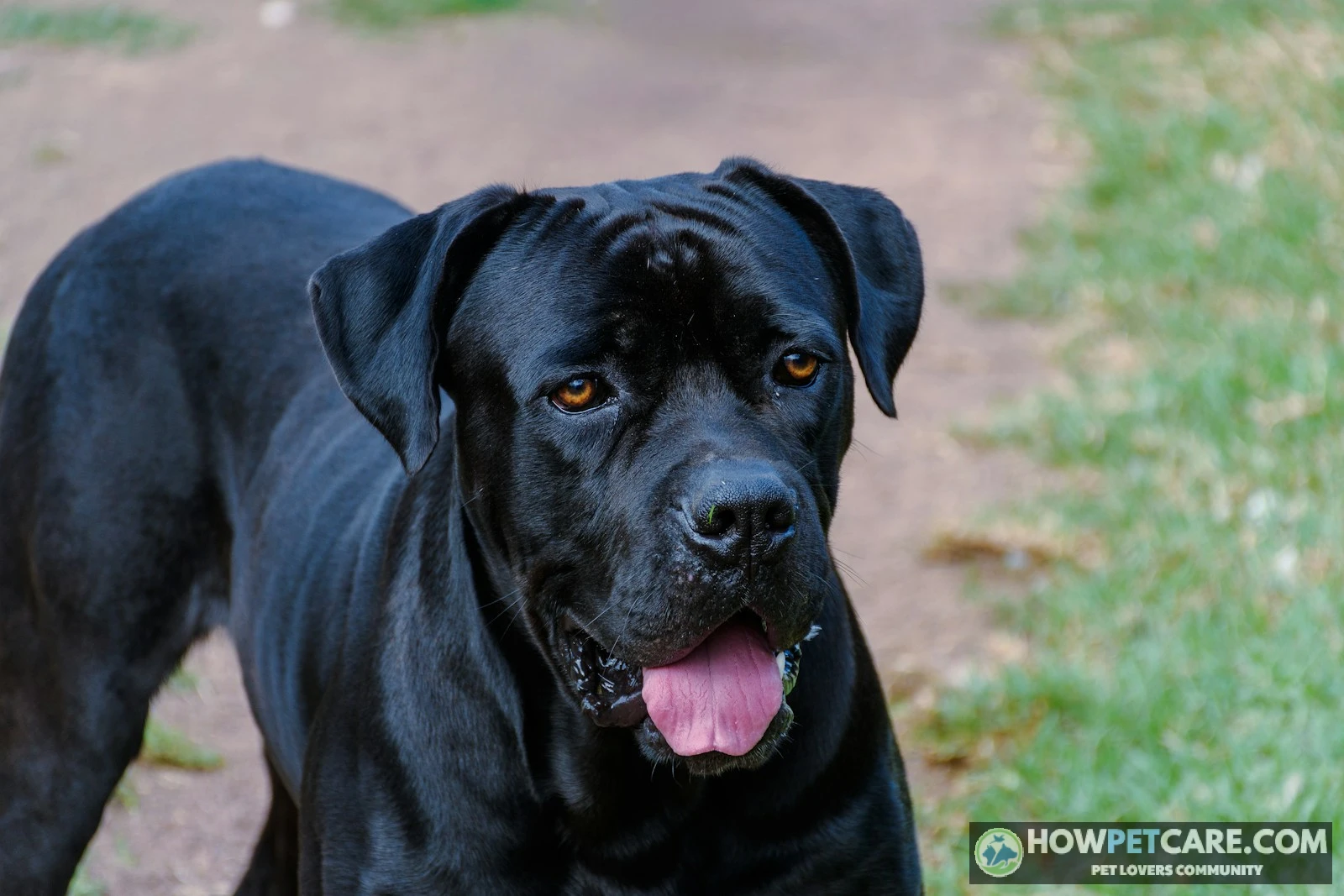

No recognized breed called a "black mastiff" exists. The AKC English Mastiff standard accepts only fawn, apricot, and brindle with a black mask. Dogs sold as black mastiffs are almost always black Cane Corsos, Neapolitan Mastiffs, dark brindles, or mastiff mixes.
There is no recognized dog breed called a "black mastiff," and the American Kennel Club (AKC) breed standard for the English Mastiff does not recognize a solid black coat. The English Mastiff standard accepts only fawn, apricot, and brindle. Each must have a dark mask, dark ears, and a dark muzzle rather than a solid dark body. When an online listing, shelter tag, or breeder website advertises a "black mastiff dog," the animal is almost certainly a black Cane Corso, a black Neapolitan Mastiff, a dark-brindle Bullmastiff or Presa Canario, or a mixed-breed litter.
For prospective owners, it’s worth understanding that label before putting down a deposit. Someone expecting an English Mastiff’s gentle, slow-paced couch-potato demeanor could end up with an athletic, high-drive Cane Corso or a heavily folded Neapolitan Mastiff that needs extensive specialized care. The dog’s actual breed affects everything from puppy socialization and adult size to genetic health testing and a fair purchase price. Knowing what’s behind the label can help you spot a mislabeled listing and determine whether a puppy is a legitimate purebred or an overpriced cross.
Black Mastiff Myths vs. Facts

Myth: A black English Mastiff is a rare, valuable variety.
Fact: The AKC standard does not include a black English Mastiff. The accepted colors are fawn, apricot, and brindle, always paired with a black mask. Dogs advertised as "black English Mastiffs" are almost always mixed-breed puppies, very dark brindles mistaken for black, or mislabeled Cane Corsos.
Myth: "Rare black" justifies a higher puppy price.
Fact: Solid black is an ordinary, standard coat color in both the Cane Corso and the Neapolitan Mastiff—the two breeds most legitimately sold under the "black mastiff" umbrella. An exotic color surcharge for a black coat is a marketing tactic, not a reflection of genetic rarity or quality.
Myth: Black-coated mastiffs overheat far more than lighter dogs.
Fact: Dark fur absorbs more solar radiation in direct sunlight, but clinical evidence that coat color alone meaningfully drives heatstroke risk in dogs is limited. Giant body mass, dense musculature, and brachycephalic-leaning facial structure are far more influential risk factors. Every mastiff needs careful heat management, regardless of coat shade.
Why the AKC Doesn’t Accept a Solid Black English Mastiff
The English Mastiff is one of the oldest giant dog breeds, prized for centuries as an estate guardian and heavy draught dog. The standard maintained by the AKC and the Mastiff Club of America strictly limits its coat colors.
What the standard says about mastiff colors
The AKC breed standard recognizes exactly three colors in the English Mastiff: fawn, apricot, and brindle. Fawn ranges from light silver-fawn to golden-fawn; apricot is a warm, reddish tone; and brindle consists of dark stripes over a fawn or apricot background. All three varieties must have a dark or black mask over the muzzle, surrounding the eyes, and extending to the ears and nose.
A black mask is a localized facial pattern, not a solid coat color. Melanin on the face does not genetically allow for a completely black body in a standard English Mastiff. Solid black, solid blue, chocolate, and blue brindle coats do occasionally appear in non-standard litters, but these are disqualifying faults in breed club evaluation and aren’t accepted varieties in official show rings.

Where ‘black’ English Mastiff puppies come from genetically
Canine coat color genetics help explain why a purebred English Mastiff isn’t solid black. Several interacting genetic loci govern coat color, most notably the Agouti locus (A) and the Dominant Black locus (K). The worldwide gene pool of the purebred English Mastiff is fixed for the fawn allele at the Agouti locus and carries the recessive non-black allele at the K locus. A solid black coat requires either the dominant black gene (Kᴮ) or recessive black alleles that are absent from the registered English Mastiff genetic lineage.
When a puppy is marketed as a "black English Mastiff puppy," one of three scenarios explains its appearance:
- Crossbreeding: A breeder has introduced an outside breed carrying the dominant black gene, such as a Cane Corso, Great Dane, Labrador Retriever, or Neapolitan Mastiff, and backcrossed the offspring to look mastiff-like while retaining black pigment.
- Dark reverse brindle: A brindle mastiff with heavy, dense black striping can look completely black at a glance or in poorly lit photographs. A close look in natural sunlight reveals underlying fawn or apricot hairs.
- Intentional mislabeling: A seller with a litter of black Cane Corsos or mixed molosser puppies uses "black mastiff dog" as a broad search term on classified marketplaces to attract people looking for giant breeds.

Breeders who advertise ‘rare black English Mastiffs’ and charge thousands of dollars over standard puppy prices are exploiting misconceptions about color. Solid black is outside the standard, so paying a luxury premium for an unapproved coat variety often means paying purebred prices for an undocumented mix.
Which Mastiff Breeds Legitimately Come in Black
Several recognized breeds have solid black as an accepted standard coat color if you’re looking for a purebred, black-coated molosser. Each has its own temperament, health profile, and training needs.
Black-coat availability and stats compared
The term "mastiff" describes a broad ancestral family of heavy-boned guardian dogs known collectively as molossers. The English Mastiff standard excludes solid black, while its Italian and Mediterranean cousins accept it.
| Breed | Black coat in breed standard? | Typical height | Typical weight | Typical lifespan | Temperament summary | Registry notes |
|---|---|---|---|---|---|---|
| English Mastiff | No — only fawn, apricot, and brindle, each with a black mask, ears, and nose | 27.5–30+ in | 120–230 lb | 6–10 yrs | Calm, dignified, gentle giant | AKC standard; any ‘solid black English Mastiff’ claim conflicts with it |
| Cane Corso | Yes — black is a standard color; the most common real ‘black mastiff’ | 23.5–27.5 in | ~90–110 lb | 9–12 yrs | Alert, loyal, protective; needs experienced handling | AKC and FCI |
| Neapolitan Mastiff | Yes — black is standard, alongside blue, mahogany, and tawny | 24–31 in | 110–150 lb | 7–9 yrs | Calm, devoted, stubborn, heavily wrinkled | AKC |
| Bullmastiff | No — fawn, red, and brindle only; a very dark brindle can photograph as black | 24–27 in | 100–130 lb | 7–9 yrs | Steady, courageous, family-oriented guardian | AKC; ‘black Bullmastiff’ listings warrant scrutiny |
| Boerboel | No solid black — shades of brown, red, and fawn, plus brindle, piebald, and Irish-marked patterns | 22–27 in | 150–200 lb | 9–11 yrs | Confident, territorial, bonded to family | AKC; check registry, as standards vary by country |
| Presa Canario | No solid black — brindle and fawn with a black mask under FCI/UKC standards | 22–26 in | 84–110 lb | 9–11 yrs | Dominant, protective; not for first-time owners | Not fully AKC-recognized (Foundation Stock Service); FCI/UKC standard applies |
How to read this table: If an online advertisement lists a purebred "black mastiff," the dog is statistically and genetically most likely to be a Cane Corso or a Neapolitan Mastiff. Those are the two most common molosser breeds recognized by major registries that accept solid black as an official standard coat.

Breeds often confused with black mastiffs
Besides the Cane Corso and Neapolitan Mastiff, several other heavy breeds come up in searches for a "black mastiff breed":
- Bullmastiff: Developed in England by crossing English Mastiffs with Old English Bulldogs, the Bullmastiff standard allows only fawn, red, and brindle. Some dark brindles look almost jet-black, but true solid black isn’t permitted. A listing for a "black Bullmastiff" refers either to a heavy brindle or a cross.
- Boerboel (South African Mastiff): The AKC breed standard accepts fawn, brown, red, and brindle patterns. Some international working registries have historically accepted black coats, but major purebred kennel clubs in the United States exclude solid black Boerboels from the breed standard.
- Tibetan Mastiff: The Tibetan Mastiff is not a true molosser in the Western sense, but this primitive livestock guardian often has a black coat, either black-and-tan or solid black with minor white markings. Tibetan Mastiffs are distinct for their double coats, mane-like ruffs, and aloof, independent guarding temperaments.
- Presa Canario (Dogo Canario): FCI and UKC standards accept fawn and brindle. Black Presas exist in working lines and non-sanctioned registries, but standard show guidelines disqualify them.

 You might be wonderingDogue mastiffDogue Mastiff Guide: French Mastiff Care, Cost & RealityRead the answer
How to Tell a Black Cane Corso From a Neapolitan Mastiff, Bullmastiff, or Mastiff Mix
Whether you’re looking at shelter adoption photos, classified listings, or a rescue dog in person, structural features can help distinguish black molosser types.
| Trait | Black Cane Corso | Black Neapolitan Mastiff | Bullmastiff (dark brindle or mislabeled) | Likely mastiff mix |
|---|---|---|---|---|
| Head & Muzzle | Broad, flat skull, pronounced stop, square and deep muzzle | Massive skull buried under heavy facial wrinkles and hanging folds | Broad skull, very short muzzle (1/3 of head length), deep stop | Moderate head width, longer or pointed muzzle, weak stop |
| Skin & Jowls | Tight facial skin, moderate pendulous lips, minimal neck dewlap | Extreme loose skin, heavy hanging flews, massive dual dewlap | Moderate loose facial skin, well-developed jowls, slight dewlap | Tight skin, no excessive jowls, smooth throat without dewlap |
| Body Build | Muscular, athletic, rectangular, visible waist tuck-up | Heavy-boned, thick, barrel-chested, rolling lumbering gait | Compact, powerful, squarely proportioned, muscular loin | Leaner bone structure, tuck-up like a hound, narrow chest |
| Ear Appearance | Often cropped into equilateral triangles, or medium drop ears | Frequently cropped short, or small triangular drop ears close to cheek | Natural medium V-shaped drop ears folding back flat | Long pendant ears (Lab mix) or rose/semi-pricked ears (Pit mix) |
| Coat Texture | Short, stiff, dense, with light undercoat in cold weather | Short, dense, fine, hard texture; smooth across loose folds | Short, dense, weather-resistant lying flat against the body | Medium-length hair, soft feathering, or thin single coat |

Trait-by-trait photo checklist
When looking at a photo of a supposed black mastiff, check these visual indicators:
- Inspect skin folds and dewlap: Folds draped over the forehead and cheeks, along with a massive hanging throat dewlap, indicate a Neapolitan Mastiff. Smooth facial skin with only moderately loose jowls is more consistent with a Cane Corso or a mix.
- Examine head-to-body proportions: An athletic, squared head proportional to a muscular body matches the Cane Corso. An oversized head with a short, pushed-in muzzle suggests Bullmastiff heritage. A narrower, elongated snout points to a mix.
- Assess bone thickness and gait: True molossers have substantial bone diameter in their forelegs and broad paws. An adult dog with thin legs or narrow shoulders, or one that moves with light agility rather than deliberate power, carries non-mastiff bloodlines.
- Check the coat and tail: Solid black coats in purebreds are smooth and dense. Feathering on the legs, a long tail brush, or an "otter tail" shape points to sporting or herding crossbreeds.
Phenotype (how a dog looks) does not guarantee genotype (what a dog is genetically). A Great Dane and Boxer cross, or a Labrador Retriever and American Pit Bull Terrier cross, can easily produce a 100-pound, muscular black dog with a square jaw. Pedigree documentation or DNA panels are the only definitive ways to verify ancestry.
Common black mastiff mixes (Lab, Pit Bull, Great Dane)
Many puppies labeled as black mastiffs in shelters and classified ads are intentional or accidental crossbreeds:
- Mastiff x Labrador Retriever ("Mastador"): These crosses often produce solid black offspring because the black coat gene is dominant in Labradors. They typically have narrower skulls, longer muzzles, drop ears, and water-resistant double coats, along with a more eager-to-please temperament.
- Mastiff x American Pit Bull Terrier / Bully Breed: These dogs inherit a wide chest and muscular jaw, but their overall height and adult weight usually stay under 80 to 90 pounds. They generally have tight facial skin, minimal drool, and a shorter, leaner frame than any purebred mastiff.
- Mastiff x Great Dane ("Daniff"): This giant hybrid often produces tall, solid-black dogs. Daniffs have longer legs, a narrower ribcage, and a deeper chest tuck-up than purebred mastiffs, often exceeding 30 inches at the withers.

Will a black mix puppy keep its coat and mastiff traits as an adult?
Puppy buyers often ask whether a dark 8-week-old puppy will retain its color and giant proportions. If the puppy inherits dominant black (Kᴮ) from a non-mastiff parent, its coat will remain black throughout its life, although sun exposure and age may introduce reddish undertones or graying around the muzzle.
Body size and head shape, however, are polygenic traits. A puppy from a first-generation cross (F1) between an English Mastiff and a medium breed can vary widely in adult weight, sometimes maturing at just 70 pounds rather than the expected 150 pounds. Secondary sexual characteristics, such as broad head circumference, bone density, and loose jowls, don’t fully express until a dog reaches full musculoskeletal maturity at roughly two years of age.
Temperament, Size, and Guarding Instincts of Black-Coated Mastiff Breeds
Color doesn’t determine temperament. Coat pigmentation genes don’t govern behavioral traits such as aggression, loyalty, or trainability. Temperament instead depends on breed lineage, selective breeding, and early puppy socialization.
How big do black mastiffs get?
If your "black mastiff" is a Cane Corso, adult males typically reach 25 to 27.5 inches at the withers and weigh between 90 and 110 pounds, with an agile, athletic silhouette. Adult females stand 23.5 to 26 inches and weigh 85 to 100 pounds.
The Neapolitan Mastiff is built more for mass than athletic agility. Males stand 26 to 31 inches and weigh 130 to 150 pounds, with some exceptionally heavy males reaching more. Females measure 24 to 29 inches and weigh 110 to 130 pounds. By contrast, a male English Mastiff in standard fawn, apricot, or brindle stands at a minimum of 30 inches and weighs between 160 and 230 pounds.
Are they good family dogs?
Whether a black mastiff fits into a family home depends heavily on the breed you bring through the door:
- Cane Corso: The Corso is an active, assertive guardian with strong territorial instincts. Corsos bond deeply with their immediate human pack and can be patient with children when raised alongside them. They also have a strong prey drive and need firm, consistent leadership. They’re not passive couch companions; regular exercise and mental engagement are essential.
- Neapolitan Mastiff: Neapolitans are calm, low-energy giants that prefer lounging near their owners. Naturally watchful, steady, and protective, they rely on their imposing presence rather than overt hyperactivity. Their stubborn streak makes basic obedience training essential, and their immense weight can accidentally knock over small children.
- English Mastiff: Known as a quintessential gentle giant, the English Mastiff has a calm, dignified, and patient disposition. These dogs generally accept visitors once introduced and can be exceptionally forgiving family dogs, provided their size is managed.

Regardless of breed, every giant guardian needs structured puppy socialization between 8 and 16 weeks of age. Exposure to a range of sights, sounds, surfaces, unfamiliar people, and neutral animals teaches a young mastiff to assess threats rather than react out of fear or unmanaged territorial instinct.
Do Black Coats Make Giant Mastiffs Overheat? Health, Lifespan, and Heat Management
All giant molosser breeds have elevated health vulnerabilities because of their massive frames and rapid juvenile growth curves. Understanding their physiology can help owners prevent life-threatening complications.
Black coat and heatstroke risk: what the evidence says
Owners commonly worry that a black coat makes a giant mastiff prone to fatal heatstroke. Dark pigmentation absorbs more thermal solar radiation than lighter coats, such as fawn or apricot. In direct, radiant sunlight on hot summer days, the surface temperature of a black dog’s fur rises faster than that of a light-coated dog.
Veterinary consensus, however, emphasizes that dogs dissipate internal heat primarily through respiratory panting and vascular convection, not dermal radiation. Anatomy is therefore a far more critical heatstroke risk factor than coat color. Mastiff breeds have shorter muzzles, with brachycephalic or mesocephalic head shapes, elongated soft palates, and narrower airways that hinder rapid cooling. Combined with massive muscle bulk and heavy body weight, compromised airway efficiency makes it hard for any mastiff to regulate its internal temperature in humid heat.
Practical heat-management steps for dark-coated mastiffs include:
- Move exercise to dawn and dusk to avoid peak solar radiation.
- Restrict outdoor activity once the ambient temperature exceeds 80°F (27°C) or during high relative humidity.
- Provide unrestricted access to shade, cool indoor air conditioning, and fresh water.
- Watch for early signs of heat distress: excessive panting, thick ropey saliva, brick-red gums, disorientation, or unsteadiness.

Common health problems and lifespan
Giant mastiff breeds have relatively short average lifespans, typically 6 to 10 years for English Mastiffs, 7 to 9 years for Neapolitan Mastiffs, and 9 to 12 years for the lighter Cane Corso.
Major veterinary concerns across the molosser group include:
- Hip and Elbow Dysplasia: Mastiffs take roughly two full years to reach complete skeletal and growth-plate maturity. Malformation of the coxofemoral (hip) or elbow joints leads to early arthritis and severe mobility pain. Breeders must verify joint health through screening registries before mating.
- Gastric Dilatation-Volvulus (GDV or Bloat): Deep-chested breeds are vulnerable to GDV, a medical emergency in which the stomach fills with gas and twists on its mesenteric axis, cutting off blood supply. Emergency surgical gastropexy (tacking the stomach to the abdominal wall) is often performed preventatively during spay or neuter procedures.
- Cardiac Disease: Dilated Cardiomyopathy (DCM) and subaortic stenosis are documented genetic risks that require regular veterinary cardiac auscultation and echocardiograms.
- Obesity: Excess adipose tissue places immense stress on juvenile growth plates and adult joints. Research suggests obesity can shorten a mastiff’s lifespan by 2 to 6 years.
Skin-fold grooming and daily care
Mastiffs need specific hygiene routines, particularly heavily wrinkled breeds like the Neapolitan Mastiff. Moisture, facial drool, and debris quickly accumulate inside facial folds, creating an ideal environment for yeast (Malassezia) and bacterial dermatitis.
Owners must inspect and wipe facial folds, deep jowls, and ear canals with antiseptic or chlorhexidine grooming wipes several times per week, then dry the crevices thoroughly. Diet formulation also matters for growing dogs: giant breed puppy food must maintain a tight calcium-to-phosphorus ratio of roughly 1.2:1 to prevent developmental orthopedic diseases such as osteochondritis dissecans (OCD) and hypertrophic osteodystrophy (HOD).

What a Black Mastiff Puppy Really Costs: Purchase Price and Lifetime Ownership
The cost of bringing home a giant dog extends far beyond the initial adoption fee or breeder invoice.
Purchase price ranges
In the current market, purebred puppies from reputable breeders who perform comprehensive health screenings typically fall into these price bands:
- Cane Corso (black is standard): $1,500 to $4,000
- Neapolitan Mastiff (black is standard): $2,500 to $5,000
- English Mastiff (standard fawn, apricot, brindle): $1,800 to $3,500
- Bullmastiff (standard colors): $1,500 to $3,500
A classified advertisement offering a "rare black mastiff puppy" for $300 to $800 almost universally signals an unregulated backyard breeding operation, an accidental mixed litter, or a commercial puppy mill where parent dogs receive zero genetic health clearances. Conversely, a seller asking $6,000 or more for an English Mastiff solely because of a "rare black coat" is attempting to profit from a disqualifying breed fault.
Monthly and annual cost of owning a giant breed
Giant breeds incur what veterinarians and handlers call a "big-dog tax." Pharmaceutical dosing, surgical anesthesia, and boarding requirements scale directly with body weight, so everyday care costs significantly more than it does for standard-sized dogs.
| Cost category | Monthly estimate | Annual estimate | Notes and assumptions |
|---|---|---|---|
| Food | $80–$150 | $960–$1,800 | High-quality giant-breed kibble; consuming 6–8+ cups daily |
| Routine vet + preventives | $50–$90 | $600–$1,100 | Heartworm, flea, and tick preventives cost 2–3x more due to weight-tier dosing |
| Pet health insurance | $70–$150 | $840–$1,800 | Comprehensive accident/illness policies carry higher premiums for giant molossers |
| Training and socialization | $30–$80 | $350–$1,000 | Group obedience classes or private trainer support; essential for public safety |
| Skin-fold and coat care | $10–$25 | $120–$300 | Hypoallergenic wipes, medicated wrinkle balms, and ear flushes |
| Equipment & boarding surcharges | $20–$50 | $240–$600 | Heavy-duty XXL wire crates, orthopedic beds, and kennel boarding premiums |
| Estimated total | $260–$545 | $3,100–$6,500 | Routine baseline expenses, excluding emergency surgical care |

Estimated lifetime cost
Across an average 8- to 10-year lifespan, caring for a healthy 130- to 180-pound dog totals between $25,000 and $65,000, including initial acquisition, routine wellness care, premium nutrition, and senior joint maintenance.
Emergency care needs a place in the budget, too. Treating gastric dilatation-volvulus (bloat) with emergency surgical detorsion and gastropexy routinely costs between $3,000 and $8,000, depending on your metropolitan area. Before taking on a dog of this size, enroll your puppy in a reputable pet insurance policy early or establish a dedicated liquid emergency fund.
Buying a ‘Black Mastiff’ Puppy Safely: Verification Checklist and Next Steps
Finding a healthy, stable dog means looking past broad search terms and identifying the breed that fits your lifestyle. Use this verification framework to assess a breeder or shelter listing before making a financial commitment.
Paperwork and health tests to request
A dedicated, ethical preservation breeder will offer verifiable documentation before asking for a non-refundable deposit:
- Recognized registry registration: Legitimate purebred puppies in the United States come with registration paperwork from recognized registries such as the American Kennel Club (AKC) or the United Kennel Club (UKC). Be wary of vague promises that "papers will be mailed later."
- Three-generation pedigree: This document details the registered names, colors, and titles of the sire, dam, grandsires, and granddams, proving whether the ancestry is pure.
- Orthopedic Foundation for Animals (OFA) or PennHIP clearances: Both parents must have passing hip and elbow evaluations registered in the public OFA database. Ask for the parents’ registered names or registration numbers and verify their scores yourself on the OFA website.
- Cardiac clearances: Request an official OFA clearance certificate issued by a board-certified veterinary cardiologist, confirming the parents are free of congenital heart defects.
Questions to ask the breeder
Direct questions can help distinguish an ethical preservation breeder from an opportunistic broker:
- "Which specific breed are these puppies registered as?" (If they claim "English Mastiff" yet the puppies are solid black, ask how that aligns with the AKC standard).
- "Can I meet the mother on-site, and where are the puppies raised?"
- "What specific health tests did both parents pass prior to breeding, and can I see the certificates?"
- "Do you offer a written contract that guarantees against hereditary joint defects and includes a lifetime return-to-breeder policy?"

Red flags in marketplace listings
Walk away from any breeder or marketplace advertisement displaying the following signs:
- Charging premium prices for ‘rare black’ coats in breeds where black is either disqualified or completely ordinary.
- Refusing to allow you to see the mother interacting with the litter in person or via live video call.
- Selling multiple unrelated giant breeds simultaneously (e.g., Cane Corsos, French Bulldogs, and English Mastiffs on the same property).
- Demanding irreversible payment methods (wire transfers, peer-to-peer payment apps, gift cards) prior to contract execution.
- Inability to provide public OFA hip and elbow registration numbers for both parents.
Decision guide: what to do next
If you want to share your home with a loyal, protective black giant breed, take a careful approach to your search:
-
Choose the specific breed first
Look beyond the generic term ‘black mastiff.’ Decide whether your living situation, physical capability, and handling experience better suit the athletic, high-drive Cane Corso, the massive, low-energy Neapolitan Mastiff, or a lighter rescue mix.
-
Contact national parent breed clubs
Visit the official AKC parent club websites, such as the Cane Corso Association of America (CCAA) or the United States Neapolitan Mastiff Club (USNMC). These organizations maintain vetted breeder referral directories of handlers who follow strict ethical breeding practices and mandatory health screenings.
-
Consider specialized giant-breed rescues
Many black molossers and mastiff mixes end up in breed-specific rescue networks because previous owners were unprepared for their size and strength. Rescues such as Cane Corso Rescue or Mastiff Rescue networks evaluate adult temperaments, perform medical checks, and match dogs with qualified homes.
 You might be wonderingChihuahua poodle mixChihuahua Poodle Mix: Is a Chipoo Right for You?Read the answer
FAQ
What is a black mastiff mixed with?
Usually a Cane Corso, Neapolitan Mastiff, or a cross between a mastiff-type dog and a Labrador, Great Dane, or Pit Bull-type dog. Without DNA testing or documented parents, the mix cannot be known.
Are black mastiffs rare?
Solid black is not a standard English Mastiff color, so a true black English Mastiff is not a recognized variety. Black Cane Corsos and Neapolitan Mastiffs are not rare, since black is a standard color in both.
What mastiff breeds come in black?
Cane Corsos and Neapolitan Mastiffs come in black under their breed standards. Other molosser breeds, such as the Boerboel and Presa Canario, can appear dark, but standards vary by registry.
Is a black mastiff a good family dog?
It depends on the actual breed and the individual dog. Well-socialized, trained mastiff breeds can be loyal and calm, but their size and guarding instincts demand experienced, committed owners.
How long do black mastiffs live?
Giant mastiff-type breeds typically live around 6 to 12 years, with the largest breeds at the shorter end. Lifespan depends on breed, genetics, weight management, and health care.