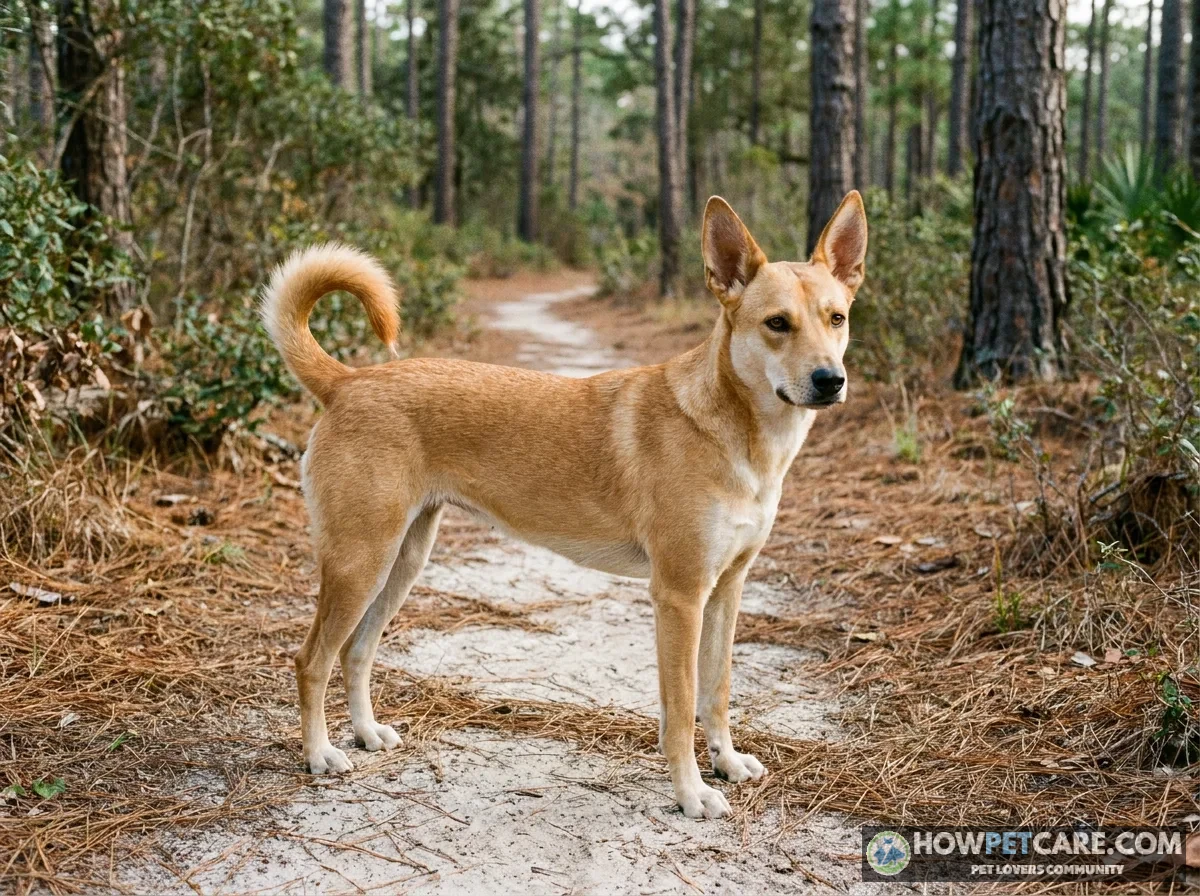

A Dixie Dingo is an informal nickname for the Carolina Dog, a domestic breed associated with free-ranging dogs of the American Southeast. It is not a separate breed or another name for the Australian dingo; the name refers to appearance, not verified ancestry.
A Dixie Dingo is a nickname for the Carolina Dog, a domestic breed associated with free-ranging dogs of the American Southeast. It isn’t a separate breed or another name for the Australian dingo. If you see the term on a shelter listing, ask what supports the identification. A tan coat and pointed ears alone can’t establish ancestry.
Carolina Dogs can make rewarding companions for people ready to work patiently with an alert, sometimes reserved dog. They won’t suit every household, and an individual dog’s history matters as much as its label.
A Dixie Dingo Is a Carolina Dog—not an Australian Dingo
What the name Dixie Dingo means
“Dixie” evokes the American South, while “dingo” refers to the dog’s resemblance to Australia’s wild canid. The nickname describes an appearance; it doesn’t establish direct descent from Australian dingoes. Carolina Dog is the breed name, and American Dingo is another informal nickname.
People sometimes use primitive breed for dogs associated with older free-ranging populations and relatively independent behavior. Pariah dog likewise describes a type of free-ranging dog. Neither term proves that an individual has an unchanged ancient pedigree.

Carolina Dog, American Dingo, and dingo-lookalike mixes
A dog advertised as a Dixie Dingo mix might have a documented Carolina Dog parent, a DNA result suggesting some Carolina Dog ancestry, or simply a look that led a shelter to use the label. Ask which applies. “American Dingo” may refer to a Carolina Dog, but the name doesn’t prove that a particular dog is registered or purebred.
How Dr. Brisbin’s Discovery Led to the Carolina Dog Name
The Brisbin story and free-ranging dogs
Dr. I. Lehr Brisbin brought wider scientific attention to free-ranging dogs observed around the Savannah River Site in the Southeast. His work helped establish the Carolina Dog name and a breed identity for dogs with similar characteristics. That history describes observation and later breed development; it doesn’t prove that every similar-looking dog in the region belongs to the breed.

What the Bering land bridge theory can—and cannot—tell us
One proposed origin suggests that ancestors of these dogs accompanied people from Asia into North America across the Bering land bridge. It’s plausible as a broad migration hypothesis, but it doesn’t establish an unmixed, unbroken line from ancient dogs to every modern Carolina Dog. Nor does it show that Carolina Dogs descend directly from Australian dingoes. Calling the breed a “living fossil,” the first American dog, or uniformly unhybridized goes beyond what this history can demonstrate.
Carolina Dog vs. Australian Dingo vs. Lookalike Mix
How to read the comparison
The key distinction is between a domestic breed, a wild canid population, and an informal description. Similar features can cause confusion, but appearance isn’t a pedigree.
| Dog or label | What the term means | Typical context | What appearance can tell you | What verifies ancestry |
|---|---|---|---|---|
| Carolina Dog, Dixie Dingo, or American Dingo | A domestic breed or breed type associated with the American Southeast | Companion dogs, breeders, rescues, and registries | An athletic build, erect ears, and a curved tail can be consistent with the breed | Credible pedigree and registration records; DNA may provide supporting evidence |
| Australian dingo | A wild canid population associated with Australia | Wildlife and conservation; ownership rules depend on jurisdiction | Its general resemblance helps explain the nickname but doesn’t identify a Carolina Dog’s ancestry | Reliable provenance and, where appropriate, genetic assessment; appearance alone is insufficient |
| Dingo-lookalike domestic mix | An informal description, not a standardized breed | Shelter listings and mixed-breed pets | A tan coat, upright ears, or curled tail may occur in many mixes | Known parentage and records, supplemented cautiously by a DNA test |

Why a fawn coat and fishhook tail are clues, not proof
A Carolina Dog may have a fawn coat and a raised tail that curves like a fishhook. Neither trait is unique to the breed. Pariah-type dogs and many mixed-breed dogs can look similar, including a shelter dog labeled a Carolina Dingo or a Dixie Dingo husky mix. Treat those names as a starting point for questions, not proof of identification.
Build, Coat, Temperament, and Trainability
Physical traits and identification
Carolina Dogs are generally medium-sized and athletic, with a wedge-shaped head and upright ears. One commonly cited profile gives a height range of 17–24 inches, weight of 30–55 pounds, and a lifespan of 12–15 years; individual dogs and published standards vary. Fawn or ginger coloring is common, but coat color alone can’t confirm a dog’s identity.

Some Carolina Dogs have been observed digging small, cone-shaped “snout pits.” Other dogs may dig similar holes, and a Carolina Dog needn’t show every reported behavior.
Temperament, socialization, and training
Descriptions often emphasize alertness, independence, attachment to familiar people, and reserve around strangers. Individual dogs vary. Experience, health, and socialization also shape behavior. “Pack behavior” doesn’t mean a dog will welcome every other dog or cope well when left alone.
Sources describe trainability differently: some emphasize a willingness to learn, while others focus on independence. Both descriptions may fit individual dogs. Use food rewards, play, short sessions, and consistent cues. Reward the behavior you want, and don’t force an uneasy dog into a situation. Practice recall on a long line in a safe area before expecting it around distractions.

Health, Lifespan, and What to Verify with a Veterinarian
Ivermectin sensitivity: what owners should know
Ivermectin sensitivity comes up in discussions of Carolina Dogs, but a breed label doesn’t establish that an individual dog is sensitive or carries an MDR1 gene variant. Tell your veterinarian about the dog’s known or suspected background, share a medication list, and ask whether MDR1 testing makes sense for that dog.
Don’t give livestock ivermectin or change a prescribed parasite preventive based on a breed label. Ask your veterinarian about the product, dose, and any testing relevant to your dog.
Health checks to discuss with your vet
Arrange an individual examination and discuss dental care, weight, vaccination, parasite prevention, and any concerns about mobility, eyes, or skin. Hip dysplasia and eye problems are reasonable topics to raise, but the information here doesn’t establish how common they are in Carolina Dogs. If you’re considering a puppy, ask the breeder which health evaluations the parents had and request the results rather than accepting a general assurance that they’re healthy.

Feed a complete, balanced diet suited to the dog’s life stage and body condition. Your veterinarian can help adjust portions and feeding plans. The dingo nickname doesn’t mean the dog needs a special “wild” diet.
Family Fit: Children, First-Time Owners, and Apartments
Questions to ask before bringing one home
- Family with children: Conditional. A dog known to be comfortable with children may do well with respectful handling and adult supervision. Never leave a dog and young child unattended together, whatever the breed.
- First-time owner: Conditional. A beginner willing to learn reward-based training and seek qualified help may do well. Someone expecting immediate obedience or an outgoing response to everyone may be better matched with another dog.
- Apartment: Conditional. Daily exercise, enrichment, secure exits, and comfort in shared spaces matter more than the address. Hallways, elevators, and frequent strangers may challenge a wary dog.
- Other pets: Conditional. Ask about the dog’s actual history. Introduce animals gradually and feed them separately at first. Take particular care around small pets if the dog chases.
- Long absences: Plan ahead. A dog that struggles alone may need gradual alone-time training, a sitter, or another arrangement. Ask the rescue or caregiver what the dog has already tolerated.
- Secure exercise: Essential. Use a secure fenced area or reliable leash setup, and manage doors carefully. An athletic dog that spots something to chase can be hard to recover.

A gradual socialization plan
Socialization helps a dog feel safe around ordinary experiences; it doesn’t mean making the dog greet everyone. If you have a puppy, ask your veterinarian how to balance early exposure with vaccination and local disease risks. With an adult, start at the dog’s known comfort level.
-
Start at a comfortable distance
Let the dog notice a calm person, dog, sound, or surface without forcing it closer. Offer a treat and let it move away.
-
Build positive associations
Pair brief, manageable encounters with rewards. Practice gentle handling in small increments, stopping if the dog becomes uncomfortable.
-
Increase difficulty gradually
Try new locations and experiences as the dog relaxes. If it freezes, retreats, or refuses food, add distance and make the next attempt easier.
-
Get help when needed
Choose a qualified reward-based trainer or consult your veterinarian if fear, aggression, or distress persists.
Finding a Carolina Dog: Scarcity, Costs, and Ancestry Checks
Breeder, rescue, and shelter routes
Carolina Dogs can be hard to find, and availability varies by location. The evidence here doesn’t provide a reliable shelter-wide count, so be cautious about claims that a particular listing is exceptionally rare. Contact breed organizations and registry referral resources, search reputable rescues and local shelters, and ask how each organization identifies its dogs. A shelter may use the label based on appearance rather than documented parentage.
If you approach a breeder, request a written price and details of what’s included. Ask about parentage records, health evaluations, early care, the contract, and what happens if you can’t keep the dog. Registration provides useful documentation, but it doesn’t guarantee health or suitable temperament. Be wary of sellers who tout a “rare wild dingo” instead of answering questions about the dog.
How much does a Dixie Dingo puppy cost? The available evidence doesn’t establish a reliable current breed-specific price range. Quotes vary, so compare what’s included rather than assuming one listing price is typical. The figures below are illustrative household-planning assumptions, not surveyed prices or breeder quotes.
| Cost category | One-time or recurring | What affects the cost | How to verify a local estimate |
|---|---|---|---|
| Adoption or puppy fee | One-time | Source, included care, and location | Request the written fee and list of included services |
| Initial veterinary care | Mostly first-year | Exam, vaccines, testing, and prior records | Ask a local clinic for an itemized estimate |
| Supplies and secure setup | Initial, with replacements | Harness, crate, bed, fencing, and equipment quality | Price the items your home actually needs |
| Food and parasite prevention | Recurring | Dog’s size, diet, products, and local risks | Check food prices and ask your vet about preventives |
| Training and enrichment | Recurring or periodic | Classes, private help, and the dog’s needs | Request rates from reward-based trainers |
| Emergency care or insurance | Recurring savings or premiums; care as needed | Coverage, deductible, location, and health history | Compare policy terms and ask clinics about payment expectations |
For a worked budget, suppose a shelter dog’s adoption fee is $200, initial supplies and vet costs total $500, routine food and care average $150 a month, and training costs $300. The illustrative first-year total is $2,800 before emergency savings or a major illness. For a breeder puppy, replace the $200 fee with the actual written puppy quote and revise puppy-specific vet and training expenses; those costs may differ. At the assumed $150 monthly routine rate, 12 years would total $21,600 in routine costs alone, before acquisition, emergencies, inflation, or changing needs. These examples show the arithmetic, not market prices or a prediction of lifetime costs.
A higher adoption fee may include vaccination, a microchip, or sterilization. Ask what has already been done before comparing it with another fee.
What a DNA test can and cannot confirm
Start with the shelter or seller: ask for intake history, parentage, medical records, and any registration documents. Photos can help describe a dog’s traits, but visual identification is uncertain. If you choose a commercial DNA test, check whether its breed panel includes Carolina Dog. Ask how the company validates that identification and reports low-percentage results.

Results depend on each company’s reference population and methods, so different tests may reach different conclusions. A result can support a suspicion, but it can’t independently certify a purebred Carolina Dog or replace a documented pedigree. Ask the company or your veterinarian to help interpret an unexpected result. Choose a dog for its needs and behavior, even if its ancestry remains uncertain.
Recognition and wild-population claims: check the evidence
The Carolina Dog entered the American Kennel Club’s Foundation Stock Service (FSS) in July 2017. FSS is a record-keeping and development pathway, not full AKC breed recognition. The United Kennel Club (UKC) recognizes the breed, but available sources disagree about whether that happened in 1995 or 1996. The available evidence doesn’t verify either registry’s live status in 2026. Check the AKC and UKC’s current breed listings and event rules before relying on a seller’s claim.
The evidence here establishes neither a dependable current count of free-ranging Carolina Dogs nor a quantified estimate of interbreeding with other domestic dogs. Some free-ranging dogs may interbreed. Don’t accept a precise remaining population or a blanket claim of “pure and unhybridized” survival without a credible, dated study.
Decide Whether to Pursue a Dixie Dingo
A Carolina Dog may suit you if you can provide secure exercise, patient training, gradual introductions, and a budget for routine and unexpected veterinary care. Another dog may be a better match if your household needs an immediately sociable companion, can’t manage safe exits, or has little time for training.
Before you commit, meet the dog if possible and ask the rescue or breeder about its behavior with children, visitors, other animals, and time alone. Review health and ancestry records, costs, and the return policy. If answers are incomplete, give a qualified trainer or veterinarian time to help assess the match instead of relying on the Dixie Dingo name.
| Dog or Label | What the Term Means | Typical Context | Physical Traits and Appearance | Ancestry Verification Method |
|---|---|---|---|---|
| Carolina Dog, Dixie Dingo, or American Dingo | A domestic breed or breed type associated with the American Southeast | Companion dogs, breeders, rescues, and registries | Athletic build, erect ears, and a curved tail | Credible pedigree and registration records; DNA may provide supporting evidence |
| Australian dingo | A wild canid population associated with Australia | Wildlife and conservation; ownership rules depend on jurisdiction | General dingo-like appearance (helps explain the nickname, but appearance alone is insufficient) | Reliable provenance and, where appropriate, genetic assessment |
| Dingo-lookalike domestic mix | An informal description, not a standardized breed | Shelter listings and mixed-breed pets | Tan coat, upright ears, or curled tail | Known parentage and records, supplemented cautiously by a DNA test |

FAQ
How rare are Carolina Dogs in shelters?
They may be uncommon in shelters, and dogs labeled Carolina Dogs are often identified by appearance rather than verified ancestry. Check local listings and breed-focused rescues, and ask what evidence supports the label.
How many Carolina Dogs still live in the wild?
There is no dependable, current population count established here for free-ranging Carolina Dogs, and claims of a precise number should be checked against a dated, credible study. Free-ranging dogs may also interbreed with domestic dogs, so “pure and unhybridized” should not be assumed.
Is a Carolina Dog a primitive breed?
Carolina Dogs are often described as primitive or pariah-type dogs because of their traits and history as free-ranging dogs. Those labels do not by themselves prove an unchanged ancient lineage.
What does a Dixie Dingo mix mean?
It usually describes a mixed-breed dog thought to resemble a Carolina Dog or dingo, not a standardized breed or confirmed ancestry. Ask for records and treat appearance-based labels as provisional.