
Watch for these common signs of cancer in cats — each can also have a non-cancer cause, so only a vet can confirm what’s going on:
- A new or changing lump anywhere on the body, including the belly or mammary area
- Unexplained weight loss, even when appetite seems normal
- Poor appetite, drooling, dropping food, or mouth bleeding
- Persistent vomiting, diarrhea, or litter-box changes
- Lethargy, hiding, or a personality change
- A sore that won’t heal on the ears, nose, or eyelids
- Breathing changes — open-mouth or labored breathing is an emergency
A new lump, unexplained weight loss, vomiting, drooling, or a change in breathing can be a sign of cancer in cats, but each can also have a non-cancer cause. Breathing difficulty, collapse, uncontrolled bleeding, or straining without producing urine needs emergency care. Call your veterinarian promptly about a new lump or unexplained weight loss. You may be able to briefly monitor an isolated mild change if your cat is otherwise comfortable.
Cats often hide illness, so it’s worth noticing even a small change in eating, activity, or routine. Only a veterinarian can determine what’s causing the signs and whether testing for cancer is needed.
Early Signs of Cancer in Cats: The Quick Checklist
The early warning signs of cancer in cats can be subtle and overlap with those of many other illnesses. Use these labels as a starting point; the triage guide below explains when a sign calls for faster action.
- New or changing lump — schedule soon. Note its location and size, including any lump along the belly or mammary area.
- Unexplained weight loss — schedule soon. Weight loss deserves a veterinary check, even if your cat’s appetite is normal or has increased.
- Reduced appetite or difficulty eating — schedule soon. If your cat has eaten nothing for 24 hours, seek veterinary care today; call sooner if your cat seems ill.
- Lethargy, hiding, or a personality change — schedule soon if persistent. Collapse, inability to stand, or rapid deterioration is an emergency.
- Vomiting or diarrhea — monitor one mild, isolated episode. Repeated vomiting, inability to keep water down, or vomiting with lethargy needs urgent care.
- A sore that does not heal — schedule soon. Watch for recurring scabs or ulcers on the ears, nose, and eyelids.
- Bad breath, drooling, dropping food, or mouth bleeding — schedule soon. Painful dental disease can cause these signs too.
- Breathing changes — assess immediately. Open-mouth or labored breathing is an emergency.
- Litter-box changes — schedule soon. Straining with little or no urine is an emergency, whether or not cancer is involved.
- Unexplained bleeding, discharge, swelling, or a growing abdomen — call your vet. Uncontrolled bleeding or a rapidly worsening condition needs emergency care.

These signs are warnings, not a way to diagnose a cat at home. Cancer is one possible explanation; infections, dental problems, organ disease, and other conditions can cause similar symptoms.
Emergency, Schedule Soon, or Monitor and Log? A Triage Guide for Worried Owners
When in doubt, call your veterinarian or an emergency clinic and describe what you see. The timing below is general guidance, not a substitute for an examination.
| Triage level | Symptoms or thresholds | What to do | Escalate if |
|---|---|---|---|
| Red: emergency or same-day care | Open-mouth or labored breathing; blue, white, or very pale gums; collapse; uncontrolled bleeding; straining without producing urine; severe pain; repeated vomiting with lethargy or inability to keep water down; rapid deterioration | Go to an emergency vet now for breathing distress, collapse, uncontrolled bleeding, or inability to urinate. Call ahead if possible. Seek care today for the other signs. | Do not wait for a monitoring period. |
| Amber: call within 24–72 hours | New or changing lump; unexplained weight loss; persistent drooling or a mouth mass; one-sided nasal discharge; a sore that does not heal; a persistent change in appetite, energy, stool, or urination | Call for the next appropriate appointment. Record changes and photograph visible findings. | Seek same-day or emergency care if a red flag develops or your cat rapidly worsens. |
| Green: monitor and log for up to 14 days | One isolated vomit in an otherwise well cat, or a brief mild behavior change after a known stressor that is already resolving | Record the episode and watch appetite, energy, and litter-box use. The maximum window is not a recommendation to wait two weeks for every symptom. | Call sooner if it recurs, persists, worsens, or another symptom appears. Appetite changes need a shorter window. |
See a vet today: red-flag symptoms
Open-mouth breathing, obvious effort to breathe, collapse, uncontrolled bleeding, and repeated straining with no urine are emergencies. Keep your cat calm during transport, and call the clinic on the way if someone else can make the call.
If your cat has eaten nothing for 24 hours, contact a veterinarian for same-day care. Don’t wait that long if your cat is weak, vomiting, painful, or otherwise unwell. A sleeping respiratory rate consistently above about 30 breaths per minute merits a call to your vet today, even if breathing looks comfortable. A rate over 40 at rest can indicate serious heart or lung disease. Any visible breathing effort or open-mouth breathing is an emergency, regardless of the number.
Book a visit this week: don’t wait for the annual exam
Call within 24–72 hours about a new or changing lump, unexplained weight loss, a mouth abnormality, or persistent discharge from one nostril. Also call about a sore that hasn’t healed over two to three weeks. These signs don’t confirm cancer, but an examination can help identify the next step.
A drop of roughly half a pound in a 10-pound cat is a 5% weight change. Report unexplained loss rather than waiting for it to reach a particular percentage. Tell the clinic about blood in vomit or stool; the amount and your cat’s condition may make the visit more urgent.
Monitor and log: what to track and when to escalate
It may be reasonable to watch a cat that vomits once and then eats and behaves normally. A mild stress-related change should improve, not continue or deepen. Call if vomiting recurs, appetite remains reduced, or energy doesn’t return to normal. A cat that stops eating entirely needs same-day care.
Don’t assume an unfamiliar soft bump is harmless because it feels small or movable. Arrange a check for a new lump. Once a veterinarian has assessed it, follow their advice about monitoring it at home.

A second symptom, worsening condition, or failure to improve is a reason to call sooner. Use the most urgent symptom to decide what to do; don’t wait for a monitoring window to end.
Cancer Signs by Body Location: Mouth, Stomach and Intestines, Lungs, Nose, and Skin
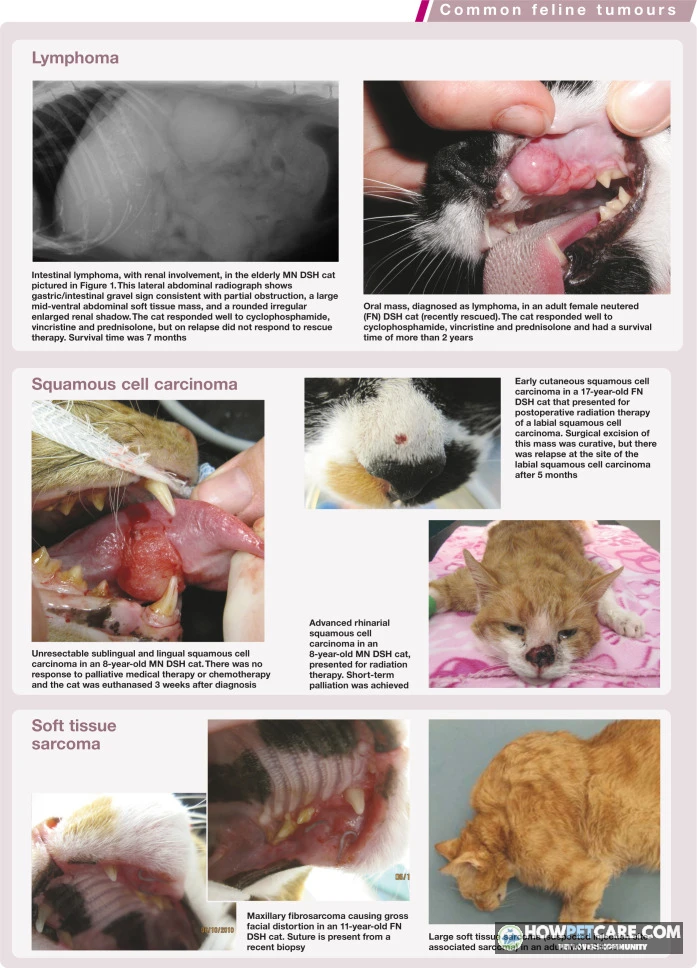
The location of a problem can help you describe it to your vet, but it can’t identify the disease. Lymphoma, squamous cell carcinoma, fibrosarcoma, and mammary tumors are among the cancers recognized in cats.
| Body location | What you may notice | Cancers a vet may consider | Non-cancer look-alikes | Urgency and next step |
|---|---|---|---|---|
| Mouth | Drooling, foul breath, dropping food, swelling, bleeding, or a visible mass | Squamous cell carcinoma | Dental disease, tooth resorption, inflammation, abscess | Call within 24–72 hours; call sooner if your cat cannot eat or is in severe pain. |
| Stomach and intestines | Recurring vomiting or diarrhea, weight loss, appetite change | Lymphoma, intestinal adenocarcinoma | Inflammatory bowel disease, parasites, food intolerance | Call promptly for recurring signs; repeated vomiting with lethargy or inability to keep water down needs urgent care. |
| Lungs and chest | Fast or labored breathing, reduced activity, sometimes coughing | Lung tumors, lymphoma in the chest | Asthma, heart disease, infection | Labored or open-mouth breathing is an emergency. Call today about a persistently elevated sleeping rate. |
| Nose and sinuses | Persistent discharge, sneezing blood, noisy breathing, facial asymmetry | Nasal lymphoma or carcinoma | Infection, foreign material, polyp | Arrange a prompt visit for persistent or one-sided discharge; breathing distress is an emergency. |
| Skin and under the skin | Lump, crust, ulcer, or nodule along the belly | Squamous cell carcinoma, mammary tumor, fibrosarcoma, mast cell tumor | Abscess, cyst, infection, injection-site reaction | Have a new or changing lump examined; call promptly about a growing or non-healing sore. |
| Eye, abdomen, or whole body | Eye changes, abdominal enlargement, weight loss, hiding, or low energy | Lymphoma or another tumor, depending on location | Eye disease, fluid buildup, organ disease, infection | Call promptly; sudden eye pain, breathing trouble, or rapid decline needs urgent assessment. |
Mouth and drooling
Oral squamous cell carcinoma can resemble dental disease: a cat may drool, have bad breath or bleeding, and struggle to eat. A cat that approaches food but drops it or turns away may be in pain. Don’t force the mouth open to look for a mass.

Vomiting, diarrhea, and weight loss (stomach and intestinal)
Gastrointestinal lymphoma is one form of feline lymphoma. Digestive signs alone can’t distinguish it from inflammatory disease or other causes. Tell your vet how often vomiting or diarrhea occurs and whether your cat’s weight or appetite has changed.
Breathing changes (lungs and chest)
Chest problems such as lung tumors in cats may affect breathing even when a cat doesn’t cough. Asthma and heart disease can also cause respiratory signs, and neither is safe to dismiss. Watch your cat at rest rather than relying on how they breathe immediately after play or a stressful trip.
Nose and sinus signs
Record whether discharge comes from one or both nostrils, whether it contains blood, and whether your cat is sneezing or has facial swelling. A nasal tumor is only one possible explanation; infection and other obstructions also need veterinary assessment.
Skin changes, lumps, and bumps
Look at the ears, nose, eyelids, and mammary area as well as the back and legs. A persistent crust or an enlarging lump deserves attention, even when your cat otherwise seems comfortable.

Most Common Cancers in Cats and the Signs Each One Causes
Cancer involves abnormal cell growth. Some tumors remain localized, while malignant tumors can invade nearby tissue or spread. Signs depend on where a tumor develops, and a cat can have the same signs for an unrelated reason.
Lymphoma
Lymphoma is a commonly diagnosed feline cancer that can affect the gastrointestinal tract and other locations. Signs of lymphoma in cats vary with the site: digestive disease may involve vomiting or weight loss, while disease in the chest may affect breathing. Feline leukemia virus, or FeLV, and feline immunodeficiency virus, or FIV, are associated with lymphoma risk.
Squamous cell carcinoma
This cancer can occur in the mouth or on skin, including sun-exposed areas. Oral signs may look like a dental problem, which is one reason a persistent mouth change needs an examination rather than a home diagnosis.
Mammary tumors
Mammary tumors may appear as nodules along the underside of the body. Spay status matters to mammary tumor risk, but a lump can’t be classified by appearance or touch. Show your veterinarian any new nodule along the mammary chains.
Fibrosarcoma and other soft-tissue tumors
Fibrosarcoma is a soft-tissue cancer that may appear as a lump. Other masses a vet may consider include mast cell tumors; bone tumors can cause pain or lameness. A lump or limp doesn’t establish which, if any, is present.
A veterinary oncology consultation can help explain a confirmed diagnosis and its outlook. Prognosis depends on the cancer’s type, location, and extent as well as the individual cat; it can’t be inferred from a symptom list.

What a Cancerous Lump, Mouth Lesion, or Non-Healing Sore Looks and Feels Like
A concerning lump may be firm, irregular, attached to underlying tissue, growing, ulcerated, or bleeding. A mouth lesion can look like swollen, red, gray, or raw tissue; a skin lesion may appear as a crust or a sore that repeatedly opens. No single appearance or texture proves cancer or rules it out. Cysts, abscesses, and other non-cancer problems can also cause lumps or sores.
How to check your cat for lumps at home
When your cat is relaxed, use flat fingers to feel gently from head to tail. Include under the jaw, the neck, the sides, both mammary chains, and behind the knees. Don’t squeeze a lump or repeatedly press a painful area.
Record the location, approximate width, whether the surface is smooth or broken, and whether it seems to move with the skin. Photograph it beside a ruler for scale. A new, growing, bleeding, or ulcerated lump should be checked; don’t wait for it to reach a certain size.

Tell your vet if a lump is at a previous injection site and when the injection was given. The timing and changes in size help the vet decide whether to sample it.
What a suspicious mouth lesion can look like
If your cat tolerates it, gently lift the lip and look for swelling, unusual tissue, bleeding, or a loose-looking adult tooth. Some lesions are under the tongue, where a tongue tumor can hide, or elsewhere you can’t safely see. Stop if your cat resists, and let the veterinary team perform a full oral exam.
A crust on the ear, nose, or eyelid warrants a call if it hasn’t healed after two to three weeks, or if it grows or repeatedly reopens. Photograph it without picking at the scab.
Cancer or Something Else? Benign Look-Alikes for Vomiting, Weight Loss, and Lethargy
A look-alike isn’t necessarily minor. Kidney disease, urinary obstruction, and other non-cancer conditions can also need prompt care. Duration, progression, and accompanying signs help your veterinarian choose tests; they don’t confirm cancer.
| Sign | Possible non-cancer explanations | When to call |
|---|---|---|
| Vomiting | Hairball, diet change, parasites, or digestive disease | Call if it recurs; seek urgent care for repeated vomiting with lethargy or inability to keep water down. |
| Weight loss | Hyperthyroidism, diabetes, kidney disease, dental pain, or parasites | Arrange a prompt check for unexplained or progressive loss, including loss despite eating. |
| Low energy or appetite | Stress, pain, infection, dental disease, or kidney disease | Call if the change persists or your cat seems unwell. No food for 24 hours needs same-day care. |
| Drooling or bad breath | Dental disease, tooth resorption, or mouth inflammation | Arrange a visit, especially with dropping food, swelling, or bleeding. |
| Diarrhea | Diet change, parasites, or intestinal inflammation | Call for recurrence, persistence, blood, or other signs; seek urgent care if your cat is weak or deteriorating. |
| Litter-box changes | Urinary disease, constipation, arthritis, or stress | Call about a new persistent change. Straining without urine is an emergency. |

Which Cats Are at Higher Risk: Age, Breed, UV, FeLV/FIV, and Smoke Exposure
Cancer can affect indoor cats as well as outdoor cats. Pay particular attention to unexplained changes in older cats; don’t write off weight loss or reduced activity as age alone. Unspayed female cats have greater mammary tumor risk than cats spayed early.
FeLV and FIV status is relevant to lymphoma risk. Ask your vet whether your cat’s status is known and whether testing is appropriate. Watch light-colored ears, noses, and eyelids for persistent sores, particularly with sun exposure.
Outdoor access may affect exposure to infections, injury, and sunlight; staying indoors doesn’t eliminate exposure to sunlight through windows. Secondhand smoke is another exposure worth discussing and reducing. Breed associations can vary by tumor type, so breed alone should never reassure you or determine a diagnosis.

For a higher-risk cat, ask your vet whether more frequent checks or wellness visits are appropriate. Don’t substitute home monitoring for a visit if a concerning sign is already present.
Can a Blood Test Detect Cancer in Cats? The Diagnostic Journey, Step by Step
Normal bloodwork does not rule out cancer in a cat. Blood tests can reveal abnormalities and help investigate other causes, but they don’t examine every tissue for a tumor. An abnormal result, on the other hand, doesn’t by itself establish cancer.
Why normal bloodwork doesn’t rule out cancer
A complete blood count, often called a CBC, looks at blood cells. A chemistry panel assesses markers associated with organ function and other body processes. Your vet may add a urinalysis, thyroid test, or FeLV/FIV test based on the history. These results help guide care, even when a lump or another finding still needs a sample.
First, second, and referral-level tests
The usual starting point is a history and physical examination. Your vet may check weight, mouth, lymph nodes, abdomen, skin, and mammary area, then recommend tests suited to the findings. Imaging and sampling don’t always happen in the same order: an accessible lump might be sampled early, while an internal concern may require imaging first.
A fine-needle aspirate uses a small needle to collect cells for examination. It can be useful, but a sample may not contain enough diagnostic cells. A biopsy collects tissue for a pathologist to examine and is often needed to identify a tumor; additional testing can sometimes be necessary. Oral squamous cell carcinoma, for example, is diagnosed with biopsy.

Realistic US cost ranges
Costs vary substantially by location, clinic, emergency or referral status, sedation, and laboratory fees. Reliable national price ranges weren’t supplied for this draft, so the table describes the expenses to ask about rather than presenting unverified figures. Request an itemized written estimate before non-emergency testing, including what happens if a sample is inconclusive.
| Test or step | What it can show | Limitations | US cost expectation |
|---|---|---|---|
| Exam | Weight, visible changes, pain, and areas needing investigation | Cannot identify every internal problem | Ask for the office-visit fee; emergency and specialty exams may cost more. |
| CBC, chemistry, urinalysis, and possible thyroid test | Blood-cell changes, organ markers, and clues to other illnesses | Normal results do not exclude cancer. | Ask which tests and laboratory fees are included. |
| X-rays or ultrasound | Changes in organs, masses, or fluid, depending on the study | Imaging may not identify tumor type or detect every lesion. | Ask separately about imaging, interpretation, and sedation. |
| Fine-needle aspirate and cell evaluation | Cells from an accessible lump or other site | Can be inconclusive; some sites require imaging guidance or sedation. | Ask whether collection and laboratory review are both included. |
| Biopsy and pathology | Tissue structure and, often, tumor identification | Requires tissue collection and sometimes anesthesia; further tests may be needed. | Ask about the procedure, anesthesia, pathology, and follow-up. |
| Oncology referral and staging | Specialist assessment and tests to assess disease extent | Recommendations depend on the diagnosis and the cat’s condition. | Request a consult fee and a separate estimate for proposed tests. |
Bring your symptom log, dated photos, weight history, food and medication list, and any known FeLV/FIV results. If cancer is confirmed, a veterinarian or veterinary oncologist can discuss the role of surgery, chemotherapy, radiation, or palliative care. Choosing comfort-focused care is a valid discussion, not a failure to act.
Your Monthly Cat Cancer Check and Symptom Log: What to Do Starting Today
Choose a regular day each month. This routine can help you notice changes, but it doesn’t replace wellness exams or an appointment for an existing concern.
-
Weigh your cat
Use a baby or pet scale if available. Alternatively, weigh yourself holding your cat, then subtract your own weight. Use the same method each time and record the result.
-
Feel gently for lumps
Run flat fingers from head to tail, including under the jaw, behind the knees, and along both mammary chains. Record new findings and measure known ones.
-
Look at the mouth and skin
If your cat is comfortable, lift the lip briefly. Check the ears, nose, and eyelids for persistent sores. Do not force the mouth open or pick at a lesion.
-
Count sleeping breaths
While your cat sleeps, count chest rises for 30 seconds and double the number. One rise and fall counts as one breath. Record the result when your cat is not purring or dreaming.
Simple symptom log template
| Date | Weight | Appetite and water | Vomit or diarrhea | Litter-box changes | Energy | Lump or sore: location and size | Sleeping breaths per minute | Notes or photo |
|---|---|---|---|---|---|---|---|---|
| Example | 10.2 lb | Normal | None | None | Normal | Left shoulder, measured and photographed | 24 | First noticed today; call vet |
| Your entry |

Escalation triggers to write on your fridge
- Go to an emergency vet: open-mouth or labored breathing, collapse, uncontrolled bleeding, or straining without urine.
- Seek care today: no food for 24 hours, repeated vomiting with lethargy or inability to keep water down, severe pain, or rapid decline. Call sooner for a cat that appears unwell.
- Call your vet today: a sleeping breathing rate consistently above about 30 breaths per minute, even without obvious effort. Visible breathing distress is an emergency at any rate.
- Call within 24–72 hours: a new or changing lump, unexplained weight loss, a persistent sore, a mouth change, or another persistent or progressive sign.
- Stop monitoring and call sooner: a mild sign recurs, worsens, or is joined by another symptom. Don’t wait two weeks for an appetite problem.
If your cat has already been diagnosed and you’re wondering when to euthanize a cat with cancer, ask your veterinarian for a quality-of-life assessment. Pain control, breathing, appetite, mobility, and the balance of good and difficult days can guide a compassionate, individual decision.
Reviewed for medical accuracy by a licensed veterinarian. This guide supports, but does not replace, a veterinary examination.
1Which of the following breathing patterns in a cat represents an immediate red-flag emergency requiring instant veterinary care?
Visible breathing effort or open-mouth breathing indicates acute respiratory distress and requires immediate emergency evaluation regardless of the breath count.
2An owner notices that a cat has had a single, isolated episode of vomiting but is otherwise eating, drinking, and acting normally. What is the appropriate triage approach?
An isolated mild episode in a comfortable cat fits the green monitoring level, provided the sign does not recur or worsen.
3Why is normal bloodwork (such as a complete blood count and chemistry panel) insufficient to completely rule out cancer in a cat?
Normal bloodwork indicates blood cell populations and organ function markers, but localized tumors often leave circulating blood parameters unchanged.
4What is a primary diagnostic limitation of a fine-needle aspirate (FNA) when evaluating a suspicious lump?
FNA harvests small cellular samples that can sometimes be inconclusive, necessitating a full biopsy to evaluate tissue architecture.
5Which combination of symptoms is commonly seen with oral squamous cell carcinoma, often mimicking severe dental disease?
Oral tumors cause local inflammation, pain, and structural disruption that produce signs very similar to painful dental conditions.
6What is the recommended approach when performing a monthly hands-on lump check on a cat at home?
A gentle search using flat fingers across key anatomical areas—including the underside and legs—helps detect small surface or subsurface changes.
7When monitoring a cat at rest, what sleeping respiratory rate consistently merits contacting a veterinarian today?
A resting breathing rate consistently over 30 breaths per minute warrants same-day veterinary contact, as it can indicate underlying cardiac or pulmonary disease.
8Which risk factor significantly increases the likelihood of a female cat developing mammary tumors?
Spay status plays a major role in feline mammary tumor risk, with unspayed female cats facing a higher risk than those spayed early.
9Why is a half-pound weight loss in a 10-pound cat considered clinically significant?
In a small animal, modest absolute weight loss translates to a substantial percentage change that should be reported regardless of appetite.
10Under which circumstance should a pet owner seek same-day veterinary care rather than waiting 24–72 hours for an appointment?
Complete anorexia for 24 hours or repeated vomiting combined with systemic weakness requires same-day medical attention.
| Body Location | Observable Symptoms | Suspected Cancers | Non-Cancer Look-Alikes | Urgency Level and Next Step |
|---|---|---|---|---|
| Mouth | Drooling, foul breath, dropping food, swelling, bleeding, or a visible mass | Squamous cell carcinoma | Dental disease, tooth resorption, inflammation, abscess | Call within 24–72 hours; call sooner if your cat cannot eat or is in severe pain. |
| Stomach and intestines | Recurring vomiting or diarrhea, weight loss, appetite change | Lymphoma, intestinal adenocarcinoma | Inflammatory bowel disease, parasites, food intolerance | Call promptly for recurring signs; repeated vomiting with lethargy or inability to keep water down needs urgent care. |
| Lungs and chest | Fast or labored breathing, reduced activity, sometimes coughing | Lung tumors, lymphoma in the chest | Asthma, heart disease, infection | Labored or open-mouth breathing is an emergency. Call today about a persistently elevated sleeping rate. |
| Nose and sinuses | Persistent discharge, sneezing blood, noisy breathing, facial asymmetry | Nasal lymphoma or carcinoma | Infection, foreign material, polyp | Arrange a prompt visit for persistent or one-sided discharge; breathing distress is an emergency. |
| Skin and under the skin | Lump, crust, ulcer, or nodule along the belly | Squamous cell carcinoma, mammary tumor, fibrosarcoma, mast cell tumor | Abscess, cyst, infection, injection-site reaction | Have a new or changing lump examined; call promptly about a growing or non-healing sore. |
| Eye, abdomen, or whole body | Eye changes, abdominal enlargement, weight loss, hiding, or low energy | Lymphoma or another tumor, depending on location | Eye disease, fluid buildup, organ disease, infection | Call promptly; sudden eye pain, breathing trouble, or rapid decline needs urgent assessment. |
FAQ
How long can a cat live with cancer?
It depends heavily on the cancer type, stage, location, and treatment. Some cats with lymphoma achieve remission for months or years with chemotherapy, while aggressive tumors can bring much shorter timelines. A veterinary oncologist can give a case-specific outlook.
Is rapid weight loss in cats always a sign of cancer?
No. Hyperthyroidism, diabetes, kidney disease, dental pain, and parasites are more common causes. Still, unexplained weight loss is never normal and warrants a vet visit.
When is it time to euthanize a cat with cancer?
There is no single cutoff. Vets often use quality-of-life scales that weigh appetite, pain control, mobility, breathing, and whether good days still outnumber bad ones. Discuss it with your vet as the disease progresses.
Can indoor cats get cancer?
Yes. Indoor cats can develop lymphoma, mammary tumors, and other cancers. Outdoor access and sun exposure raise the risk of some types, but indoor cats still benefit from regular checks.
What is the most common cancer in cats?
Lymphoma is the most frequently diagnosed cancer in cats. Squamous cell carcinoma, mammary tumors, and soft-tissue sarcomas are also common.